

Autonomous Vehicle Market Analysis & Forecast: 2026-2033
Autonomous Vehicle Market is estimated to be valued at USD 286.45 Bn in 2026 and is expected to reach USD 3,034.68 Bn in 2033, exhibiting a compound annual growth rate (CAGR) of 40.1% from 2026 to 2033.
Key Takeaways
- Based on Application, the Transportation segment is expected to lead the market with 76% share in 2026, fueled by logistics, ride-hailing, delivery services, and industrial automation.
- Based on Region, North America is set to lead the autonomous vehicle market with 29.3% share in 2026. While, Asia Pacific is anticipated to be the fastest growing region.
Market Overview
The autonomous vehicle market is undergoing significant developments due to increased collaboration between automotive and electronics companies. Increasing R&D expenditure on development of autonomous vehicles is also expected to drive growth of the global autonomous vehicle market in the coming future.
Current Events and Its Impacts on the Autonomous Vehicle Market
Current Event | Description and its Impacts |
AI Technology Advancements and Regulatory Frameworks |
|
Infrastructure and Energy Transition |
|
Role of Artificial Intelligence (AI) in Autonomous Vehicle Market
Artificial intelligence (AI), which is the backbone of self-driving technology, is an important component of the autonomous vehicle market in 2025. AI lets cars see everything around them, make choices, and drive safely without any help from people. The main technologies used are machine learning, computer vision, natural language processing, and generative AI. These systems let self-driving cars read sensor data, guess what is going to occur in traffic, and talk to passengers in a natural way.
In October 2025, General Motors and the University of Michigan worked together to create a single software platform that combined conversational AI with self-driving car systems. The goal of the partnership is to improve driverless mobility, allowing cars to communicate naturally with passengers, which could make transportation safer, more efficient, and more enjoyable in the future.
- Current Industry Events of 2026
- Market Size Estimation
- Regional Breakdown
- Competitive Landscape
- Customer Intelligence
- Segmental Analysis
- Pricing Analysis
- Key Market Drivers, Challenges & Future Trends
- Customized Insights Section
Segmental Insights
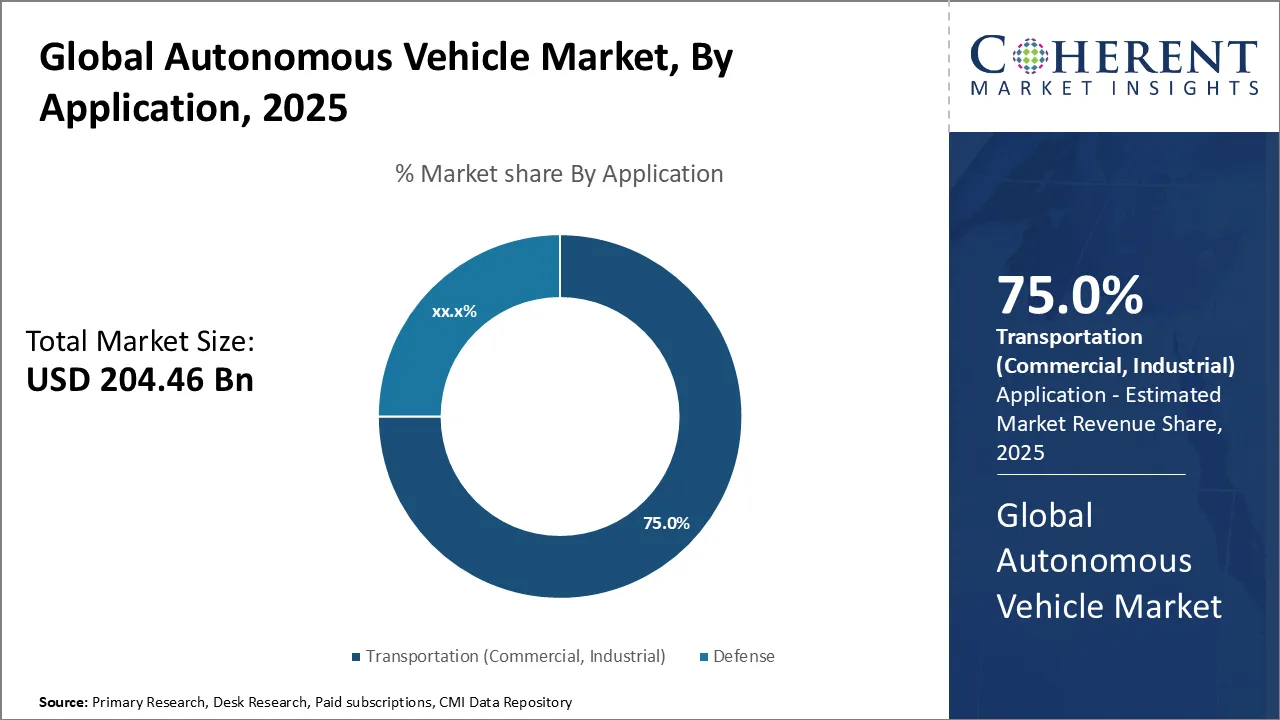
Global Autonomous Vehicle Market Insights, By Application: Transportation Dominance Is Fueled by Logistics, Ride-Hailing, Delivery Services, And Industrial Automation
Based on Application, the Transportation segment is expected to dominate the global market with 76% share in 2026. This is attributed to the increasing adoption of autonomous vehicles in transportation. The transportation segment is commonly driven by logistics, ride-hailing, delivery services, and industrial automation.
For instance, in December 2026, Kazakhstan planned using self-driving freight trucks by 2027 to improve transportation. Sensors will be put on roads for long-term use, which will make it easier to cross borders, lower costs, and keep the roads open 24 hours a day, seven days a week. Through the use of advanced transportation technology, this project hopes to triple delivery speeds and make the environment better.
Regional Insights
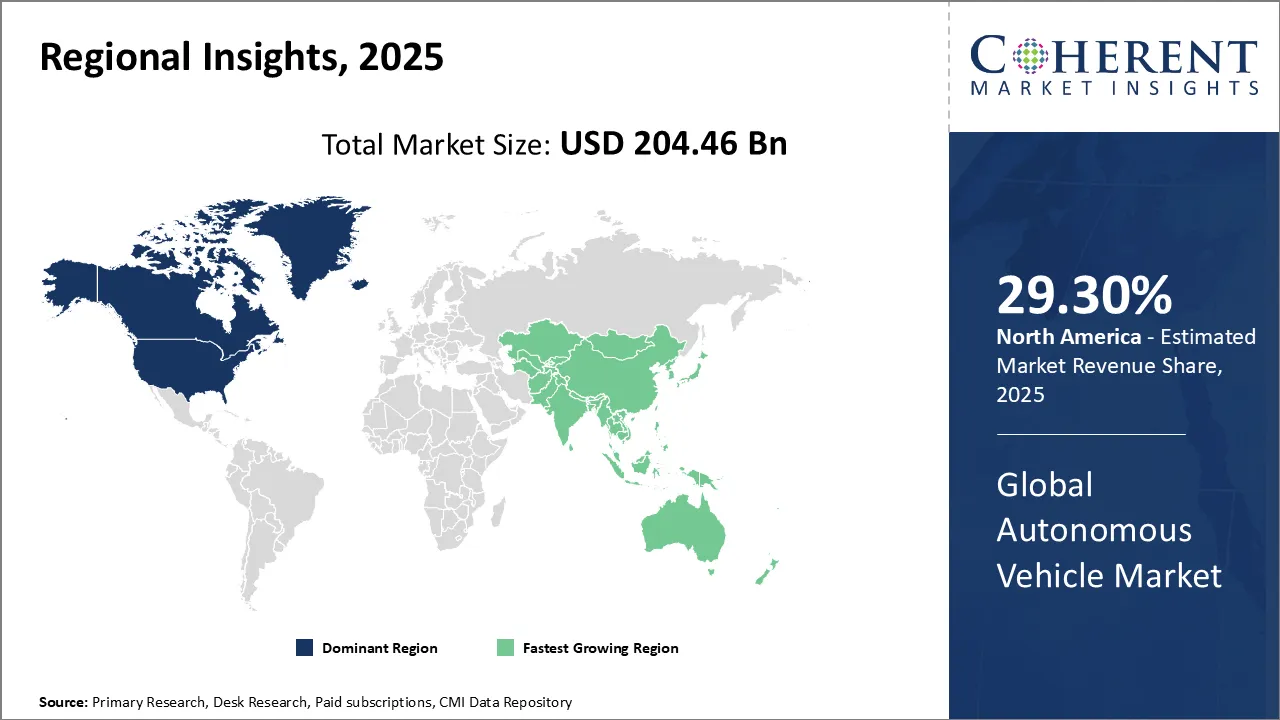
North America Autonomous Vehicle Market Analysis & Trends
North America is projected to show significant growth in the global autonomous vehicle market with 29.3% share in 2026. This growth can be attributed to increasing growth of mobility as a service sector. Moreover, the region is likely to show strong growth due to amendments in traffic regulations in the U.S. for incorporating autonomous cars on public roads. The adoption of these regulations is increasing all over the country, which will lead to complete autonomous transportation in the country. Such factors are thus expected to fuel growth of the market across the region.
For instance, in December 2026, Uber and AvRide started offering self-driving robot taxis in Dallas, Texas, covering nine square miles in the city center. People can book rides through the Uber app, and there are safety drivers on board right now. The service wants to grow and eventually offer rides without a driver, which should enhance transportation and mobility in cities. It has cameras and sensors.
Asia Pacific Autonomous Vehicle Market Analysis & Trends
Asia Pacific is also anticipated to exhibit substantial growth in the global autonomous vehicle market during the forecast period, owing to rise in demand for an efficient, convenient, and safe driving experience, stringent safety regulations, and increasing disposable incomes in developing countries across the region. Moreover, rise in partnerships adopted by market players providing self-driving/autonomous car technology in the region is also driving growth of the market in Asia Pacific.
For instance, by the end of March 2028, Nissan Motor and UK-based AI company Wayve will have a self-driving system ready for use. The partnership is mainly about using advanced AI and machine learning to help cars drive themselves through complicated city settings. This shows Japan's push for self-driving cars and new ways to get around in the future.
Autonomous Vehicle Market Outlook Country-Wise
The U.S. Autonomous Vehicle Market Trends
The U.S. market for autonomous vehicle market is anticipated to be highly competitive in 2026 because tech companies are making big investments, ride-hailing and logistics companies are using them extensively, regulations are helpful, and people are interested in safety and convenience. Urban mobility projects and industrial automation are also driving demand, making transportation the most popular application area in the country.
For instance, in November 2026, Waymo started running fully self-driving robotaxis in Miami in November 2026. They then added four more U.S. cities. These cars without a driver, which is a big step forward for getting around in cities. The rollout shows that more and more people are using self-driving ride-hailing services.
China Autonomous Vehicle Market Trends
In 2026, China's market for autonomous vehicle market is expected to be very competitive because the government is very supportive, there are more high-level self-driving zones, and AI-powered mobility solutions are being adopted quickly. China is the fastest-growing market in the world because of smart city projects, the growth of logistics, and companies like Huawei making their products available to everyone.
For instance, in December 2026, Huawei is bringing its self-driving technology to regular cars in China, not just high-end ones. The goal of this project is to make self-driving cars available to as many people as possible by using AI to improve safety and efficiency.
Market Report Scope
Autonomous Vehicle Market Report Coverage
| Report Coverage | Details | ||
|---|---|---|---|
| Base Year: | 2025 | Market Size in 2026: | USD 286.45 Bn |
| Historical Data for: | 2020 To 2024 | Forecast Period: | 2026 To 2033 |
| Forecast Period 2026 to 2033 CAGR: | 40.1% | 2033 Value Projection: | USD 3,034.68 Bn |
| Geographies covered: |
| ||
| Segments covered: |
| ||
| Companies covered: | Audi AG, BMW AG, Daimler AG (Mercedes Benz), Ford Motor Company, General Motors, Google LLC, Honda Motor Corporation, Nissan Motor Company, Tesla, Inc., Toyota Motor Corporation, Uber Technologies, Inc., and Volvo Car Corporation | ||
| Growth Drivers: |
| ||
| Restraints & Challenges: |
| ||
Global Autonomous Vehicle Market Drivers
- Increasing need for road safety to boost growth of the market: Increasing number of road accidents all over the world is creating a strong need for road safety. As per the Association for Safe International Road Travel (ASIRT), road accidents cause more than one million deaths every year. The primary cause of these accidents is human error occurring in an uncertainty of events; such as head-on collision caused due to driver’s misinterpretation. These accidents could also occur owing to part or machine failure such as breakage of axles or brake failure. Thus, the need for road safety is increasing all over the world, which in turn is expected to propel growth of the global autonomous vehicle market over the forecast period.
- Higher energy savings by autonomous vehicles to fuel the market growth: The efficiency of cars as compared to human drivers is increasing due to rise in development of autonomous cars integrated with artificial intelligence (AI). Autonomous vehicles are capable of providing enhanced real-time traffic updates, improved, telematics and connected cars, and can change routes accordingly on their own. Thus, these vehicles will be highly efficient as they world limit the waste of fuel at traffic jams. This factor is further expected to boost growth of the global autonomous vehicle market over the forecast period.
Global Autonomous Vehicle Market Opportunities
- Rise in technological developments by OEMs for autonomous vehicles is expected to offer growth opportunities in the global autonomous vehicle market over the forecast period. OEMs are increasingly focusing on technological developments aimed at providing enhanced features while cutting down on the cost. This in turn is driving the demand for autonomous cars. With advancements around driver assistance, security, convenience and comfort, power train, electrical suspension, instrumentation, safety, and braking of autonomous vehicles is driving their demand. As a result, the market is witnessing multiple opportunities.
- Novel business modules for insurance companies is also creating growth opportunities in the global autonomous vehicles market. With growing emergence of autonomous vehicles, innovation of automobile insurance is also growing all over the world. Conventional automobile insurance is secured by vehicle owners. For instance, car owners have to ensure their vehicles to prevent loss against accidents. According to research, human error cause more than 90% of car errors. Due to this, insurance companies offer aid in terms of monetary benefits. Thus, such new business models for insurance companies are creating multiple opportunities in the market.
Global Autonomous Vehicle Market Trends
- Adoption of various growth strategies by market players is a major trend: Major players in the global autonomous vehicle market are adopting collaborations and development of new solutions to boost their competitive edge in the market.
- Supportive regulations by governments are trending in the market: With increasing development of autonomous vehicle, governments of several countries are establishing regulations and laws related to the technology. These rules and regulations are for addressing liability, safety, security, and privacy associated with the new-wave automobiles. Governments are introducing regulations to administer road testing of autonomous vehicles. Such regulations are anticipated to support development of autonomous vehicles. This trend is likely to continue in the market, further driving growth of the market in the coming future.
Analyst Opinion (Expert Opinion)
As sensors, compute platforms, and full-stack autonomy software improve, the market for self-driving cars is moving closer to large-scale commercialization. Industry reports for 2024 show that the global market will be very active. This is due to pilot fleets are being deployed quickly, AI perception systems are getting better, and some areas are relaxing their rules. North America continues to remain the busiest place for testing and deployment, thanks to early regulatory frameworks and high-density urban trials. The autonomy compute segment is growing swiftly. This is as high-performance chips and AI accelerators are the most expensive part of higher-level autonomy, which shows how compute-intensive perception and planning workloads are.
Operational data from the top robotaxi companies shows that the number of completed autonomous trips will rise sharply between 2023 and 2024. This means that the service will be more reliable and cover a larger area. Partnerships between ride-hail platforms and autonomy developers show that the ecosystem is moving toward platform integration instead of full verticalization. A greater amount of capital is going into autonomy software, sensor innovation, and fleet management systems. These are all areas where there is a lot of potential for recurring revenue through OTA updates, data-driven improvements, and subscription-based service models.
Some of the main limitations are that market definitions can change, regulations can be confusing, and unit economics can be affected by the manner in which they are used. Even with these problems, the market is moving quickly toward profitable large-scale fleet operations as technology and operational readiness improve.
Speak to the analyst
Want personalized insights?
Take the findings above to one of our principal consultants, or have the report rebuilt around the segments, geographies and competitors you actually track.
Global Autonomous Vehicle Market: Key Developments
- In December 2025, Stellantis and Bolt worked together to move forward with the widespread use of driverless mobility in Europe. The goal of the partnership is to speed up the use of self-driving technology by working on self-driving ride-hailing and shared mobility solutions. This project illustrates how Europe is becoming more committed to self-driving cars and new ideas for how people will get around in cities in the future.
- In December 2025, Mercedes-Benz and Momenta launched a robotaxi service in Abu Dhabi, introducing autonomous ride-hailing to the UAE capital. The collaboration expands self-driving technology beyond China, marking a milestone in global adoption. This initiative highlights growing demand for autonomous mobility and innovation in future urban transportation systems.
Market Segmentation
- Global Autonomous Vehicle Market, By Application (Revenue, USD Bn, 2021 - 2033)
- Transportation
- Commercial
- Industrial
- Defense
- Global Autonomous Vehicle Market, By Region (Revenue, USD Bn, 2021 - 2033)
- North America
- U.S.
- Canada
- Latin America
- Brazil
- Argentina
- Mexico
- Rest of Latin America
- Europe
- Germany
- U.K.
- Spain
- France
- Italy
- Russia
- Rest of Europe
- Asia Pacific
- China
- India
- Japan
- Australia
- South Korea
- ASEAN
- Rest of Asia Pacific
- Middle East & Africa
- GCC Countries
- Israel
- Rest of Middle East & Africa
- North America
- Key Companies Insights (Revenue, USD Bn, 2021 - 2033)
- Audi AG
- BMW AG
- Daimler AG (Mercedes Benz)
- Ford Motor Company
- General Motors
- Google LLC
- Honda Motor Corporation
- Nissan Motor Company
- Tesla, Inc.
- Toyota Motor Corporation
- Uber Technologies, Inc.
- Volvo Car Corporation
- Volkswagen AG
Sources
Primary Research Interviews
- Automotive OEMs (passenger & commercial)
- Tier-1 Autonomy & ADAS Suppliers
- LiDAR / Radar / Camera Sensor Manufacturers
- Autonomous Driving Software & Perception Teams
- High-Definition Mapping & Localization Providers
- Fleet Operators & Mobility-as-a-Service (MaaS) Companies
- Telecommunications & V2X Solution Providers
- Testing & Validation Labs / Proving Grounds Operators
- Regulatory & Safety Compliance Experts
- Others
Databases
- Bloomberg Terminal
- Thomson Reuters Eikon
- IHS Markit (S&P Global Mobility)
- PitchBook
- CB Insights
- Frost & Sullivan
- IDTechEx
- Others
Magazines
- Automotive News
- Wired (transportation & mobility coverage)
- IEEE Spectrum
- AutoTech Insight
- Transport Topics
- Others
Journals
- IEEE Transactions on Intelligent Transportation Systems
- IEEE Transactions on Vehicular Technology
- Transportation Research Part C: Emerging Technologies
- Journal of Field Robotics
- International Journal of Automotive Technology
- Others
Newspapers
- Financial Times
- The Wall Street Journal
- Reuters
- Bloomberg News
- The New York Times (Automotive / Tech sections)
- Others
Associations
- SAE International (Society of Automotive Engineers)
- Intelligent Transportation Society of America (ITS America)
- European ITS Platform / ERTICO
- UNECE Working Party on Automated/Autonomous Driving (WP.29/WP.1)
- Consumers International / Euro NCAP (safety testing & protocols)
- Others
Public Domain Sources
- U.S. Department of Transportation (DOT) / NHTSA reports & datasets
- European Commission — Mobility and Transport Directorate publications
- Organisation for Economic Co-operation and Development (OECD) transport studies
- World Bank Open Data (transportation & urban mobility)
- National Transportation Safety Board (NTSB) investigation reports
- Others
Proprietary Elements
- CMI Data Analytics Tool
- Proprietary CMI Existing Repository of Information for the Last 8 Years
Definition: An autonomous vehicle (AV) is a motorized vehicle that can perform driving tasks without the need for human control. The driving tasks can include steering, acceleration, and braking. The AV can also detect, classify, and avoid static and moving obstacles in its environment. It can even communicate with other vehicles to determine the safest path.
Get access to 250+ pages report
Every segment, forecast, competitor profile and data table behind the analysis above — available for instant download.
- ESOMAR Member
- ISO 9001:2015 Certified
- D-U-N-S Registered
- GDPR & CCPA Compliant
Missing comfort of reading report in your local language? Find your preferred language:
Transform your Strategy with Exclusive Trending Reports
Frequently Asked Questions
The Autonomous Vehicle Market is estimated to be valued at USD 286.45 Bn in 2026, and is expected to reach USD 3,034.68 Bn by 2033.
The CAGR of the Autonomous Vehicle Market is projected to be 40.1% from 2026 to 2033.
Increasing need for road safety and higher energy savings by autonomous vehicles are fuelling the growth of market.
The Transportation segment is the leading segment in the market.
Concerns around cyber-security and vehicle safety and lack of infrastructure in emerging nations are the major factors restraining growth of the market.
Audi AG, BMW AG, Daimler AG (Mercedes Benz), Ford Motor Company, General Motors, Google LLC, Honda Motor Corporation, Nissan Motor Company, Tesla, Inc., Toyota Motor Corporation, Uber Technologies, Inc., and Volvo Car Corporation