

Transportation Management System Market Size and Forecast – 2026 to 2033
The Transportation Management System Market is anticipated to grow at a CAGR of 16.4% with USD 21.8 Bn in 2026 and is expected to reach USD 67.5 Bn in 2033. The Transportation Management System (TMS) Market is driven by the rapid expansion of e-commerce, growing demand for efficient logistics and real-time shipment visibility, and increasing supply chain digitalization. According to our research, the logistics industry size is estimated to surpass USD 26,646.0 Mn by 2033.
Key Takeaways
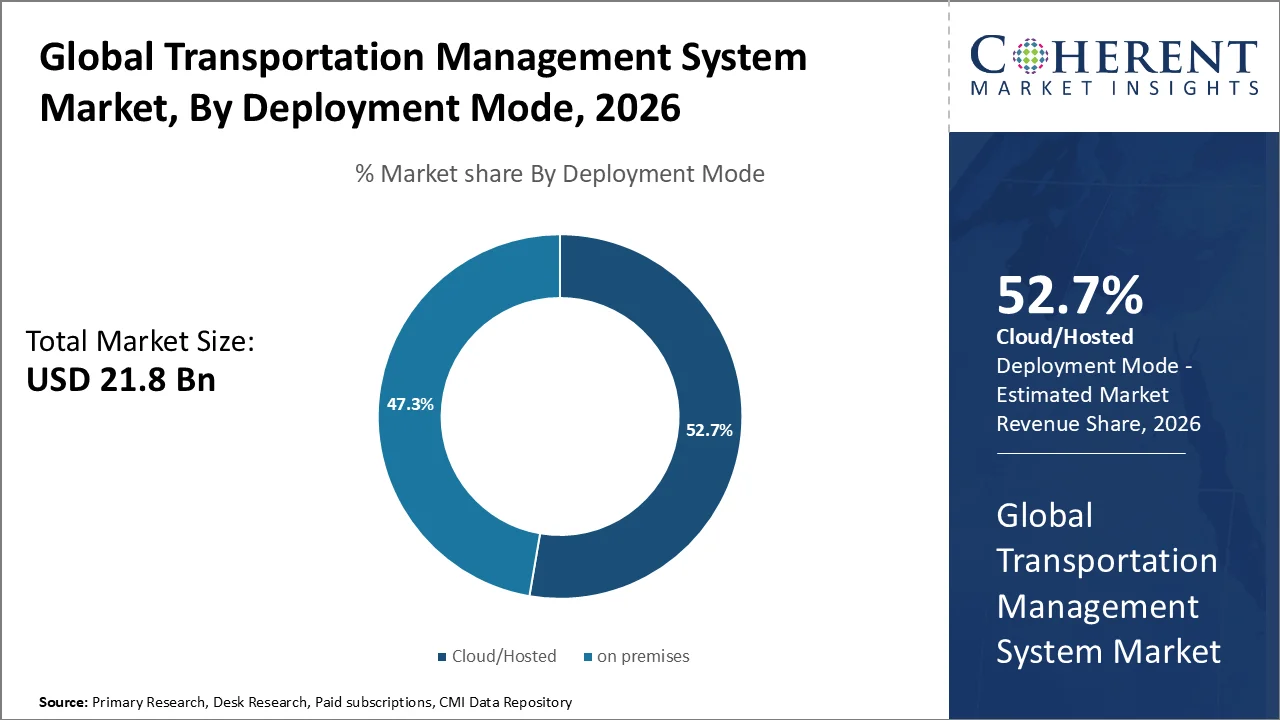
- Cloud/Hosted hold the largest market share of 52.7% in 2026 driven by lower upfront investment, reduced infrastructure requirements, and the scalability offered by cloud-based platforms.
- Automotive expected to hold largest market share of 42.2% in 2026 owing to the complex, multi-tier nature of automotive supply chains and the need for efficient transportation planning across suppliers, manufacturing facilities, distribution centers, and dealers. The scale of the industry further strengthens demand for transportation management solutions. According to the International Organization of Motor Vehicle Manufacturers (OICA), global vehicle production increased from 92.7 million units in 2024 to 96.4 million units in 2025, representing a 3.9% increase.
- Roadways acquired the prominent market share of 38.9% in 2026 owing to the growth of road freight transportation. Indian Railways transported 1.67 Bn tonnes of freight in FY 2025–26, up from 1.62 Bn tonnes in FY 2024–25.
- Fleet Management captures the largest market share of 53.6% in 2026 owing to the growing demand for real-time fleet visibility.
- North America is expected to acquire the dominant share of 41.4% in 2026 owing to its mature transportation and logistics infrastructure. The U.S. logistics and transportation system is a large, integrated network that moves goods through highways, Class I railroads, inland waterways, and air freight.
Current Events and Their Impact on the Transportation Management System Market
Current Event | Description and its Impact |
U.S. National Freight Strategic Plan 2026 |
|
U.S.-China Tariff and Trade Policy Changes |
|
Segmental Insights
- Current Industry Events of 2026
- Market Size Estimation
- Regional Breakdown
- Competitive Landscape
- Customer Intelligence
- Segmental Analysis
- Pricing Analysis
- Key Market Drivers, Challenges & Future Trends
- Customized Insights Section
Why is Cloud/Hosted Acquiring the Largest Market Share?
Cloud/Hosted hold the largest market share of 52.7% in 2026. Companies adopt Cloud/Hosted Transportation Management Systems to gain scalability, lower upfront costs, faster deployment, and greater operational flexibility. They use these platforms to improve real-time shipment visibility, automate transportation planning, and integrate ERP, IoT, telematics, and carrier systems. Cloud TMS also enables remote access, automatic updates, and easy expansion across locations and transportation modes. Rising e-commerce, supply-chain complexity, AI adoption, and cost-reduction efforts further drive companies to replace traditional on-premise systems with flexible cloud-based solutions. For instance, Trimble launched a cloud-native transportation management system for North American shippers, providing a bundled platform that supports expansion with additional freight management tools.
Automotive expected to hold largest market share
Automotive expected to hold largest market share of 42.2% in 2026 owing to its growing need for real-time visibility. The automotive Transportation Management System market is driven by companies seeking to simplify complex global supply chains, improve real-time shipment visibility, and optimize routes, freight costs, and delivery schedules. E-commerce and omnichannel distribution are increasing transportation volumes and intensifying delivery demands. Automotive companies are adopting cloud platforms, AI, IoT, telematics, and predictive analytics to strengthen fleet coordination and improve operational efficiency. Additionally, rising electric vehicle production, sustainability goals, regulatory requirements, and supply chain resilience are prompting companies to implement advanced TMS solutions. For instance, in June 2026, Super Dispatch launched SuperCard, a fuel card tailored for auto transport carriers. The card enables carriers to access or build credit, secure exclusive fuel discounts, manage expenses efficiently, and streamline administrative tasks.
Roadways acquired the prominent market share
Roadways acquired the prominent market share of 38.9% in 2026 owing to the AI and predictive analytics adoption. The roadways segment is growing as businesses increasingly move goods by road, expand e-commerce operations, and seek more efficient fleet management. Higher fuel and logistics costs push companies to optimize routes, loads, and delivery schedules. Transport operators increasingly use real-time vehicle tracking, automated dispatching, freight visibility, and digital documentation to streamline operations. Cloud-based platforms, IoT connectivity, and advanced analytics further help companies improve efficiency, minimize delays, enhance safety, and strengthen overall supply-chain visibility. For instance, in July 2026, the Greater Chennai Corporation unveiled an Intelligent Transport System (ITS), supported by JICA funding, to improve urban mobility across the Chennai Metropolitan Area.
Which Function dominates the market?
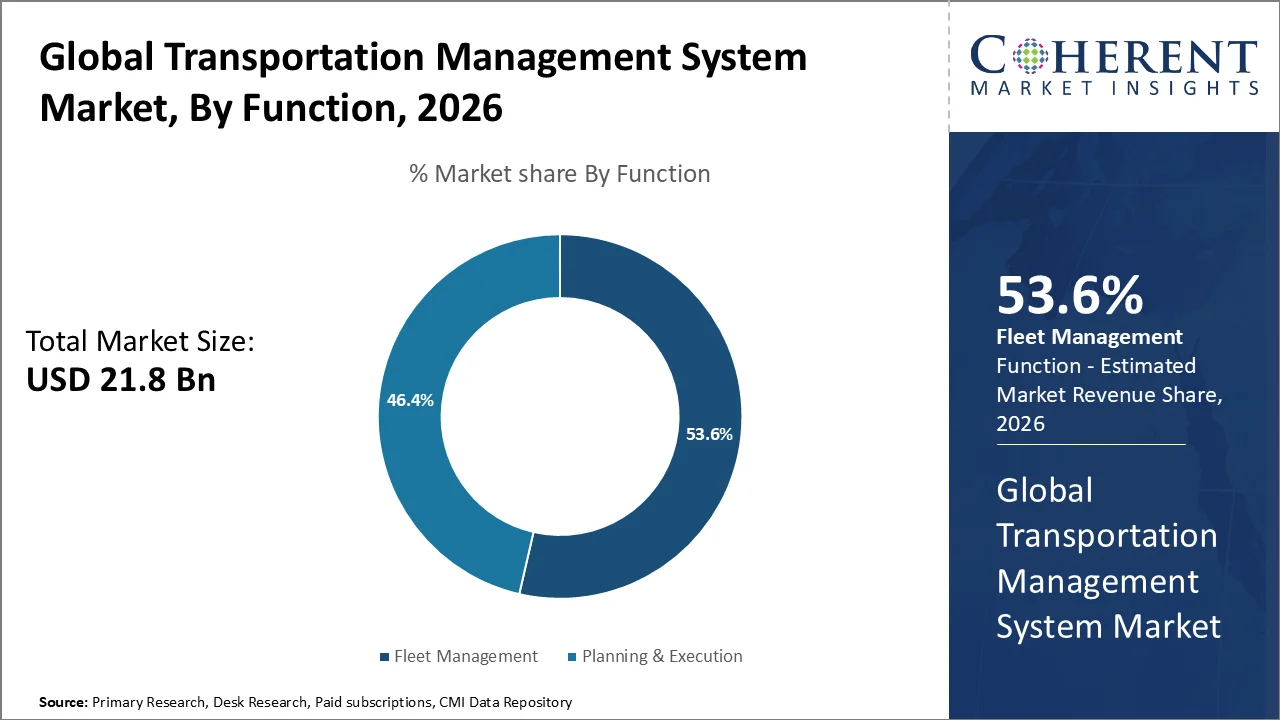
Fleet Management captures the largest market share of 53.6% in 2026. Fleet management growth in the Transportation Management System market stems from companies’ increasing focus on improving operational efficiency, lowering costs, and gaining real-time fleet visibility. The rapid expansion of e-commerce and last-mile delivery also boosts demand for dynamic routing and shipment visibility. In June 2024, HERE Technologies launched its Fleet Optimization software package to improve the efficiency, scalability, and performance of fleet management operations in the transportation and logistics industry. Regulatory requirements, driver safety, predictive maintenance, and sustainability goals further encourage organizations to adopt fleet management solutions.
Transportation Management System Market Trends
- Growing integration of artificial intelligence (AI) and machine learning (ML) enhances route optimization, demand forecasting, freight planning, and real-time decision-making. According to IBM, 81% of surveyed executives said generative AI's predictive capabilities can help detect problems earlier, while 80% said AI models with visualization and simulation could identify supply-chain bottlenecks in real time.
- Increasing focus on sustainability encourages companies to adopt transportation management solutions that optimize routes, reduce fuel consumption, minimize empty miles, and support lower-emission logistics operations. AI could reduce freight-logistics emissions by up to 15% through optimized operations, improved capacity utilization, and shifts toward lower-carbon transportation modes.
- Rising use of real-time tracking technologies, including GPS, IoT sensors, and telematics, improves shipment visibility, fleet monitoring, delivery accuracy, and operational control. TMS platforms increasingly incorporate real-time data and connected technologies to monitor shipments and support faster operational decisions. IBM identifies real-time shipment tracking and automated workflows as key capabilities of modern TMS solutions. In August 2026, Sharjah Roads and Transport Authority (SRTA) launched a project to install real-time bus arrival information screens, providing passengers with accurate updates on bus movements and arrival times to improve public transport convenience and user experience.
Regional Insights
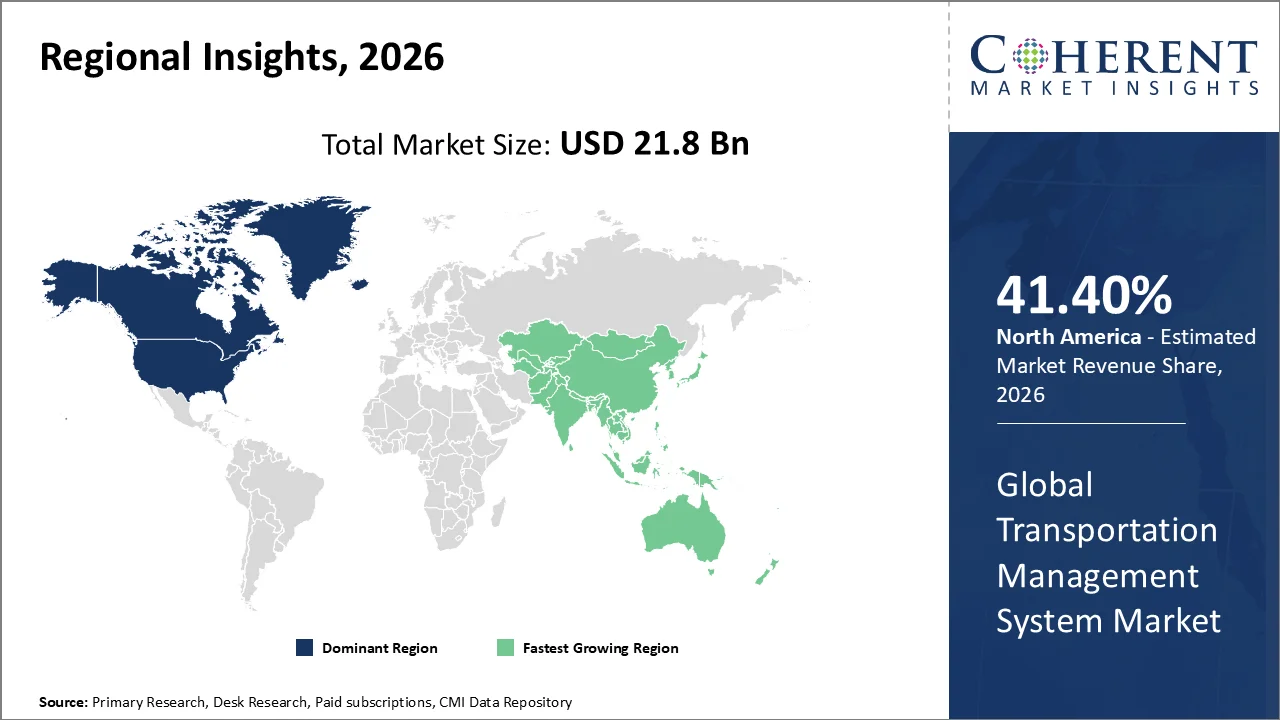
North America dominates owing to need to reduce transportation and logistics costs
North America is expected to acquire the dominant share of 41.40% in 2026. North America’s Transportation Management System market is expanding as e-commerce grows, freight volumes rise, and businesses demand faster, more reliable deliveries. Companies use TMS solutions to enhance supply chain visibility, optimize routes, lower transportation costs, and manage complex carrier networks. Companies are also adopting cloud-based platforms, real-time tracking, AI-powered analytics, and IoT technologies to strengthen transportation management. Increasing cross-border trade and multimodal transportation further drive the adoption of TMS solutions across the region. For instance, in July 2026, Trucking Hub launched its online Trucking Hub Store, offering trucking companies fleet hardware such as ELDs, GPS trackers, dashcams, tablets, and connectivity solutions.
Asia Pacific Transportation Management System Market Trends
Rapid e-commerce growth, supply chain digitalization, rising logistics costs, and demand for real-time shipment visibility drive the Asia Pacific Transportation Management System market. According to IBEF, India’s e-commerce market was valued at USD 125 billion in 2024 and is projected to reach USD 345 billion by 2030. Governments and businesses are investing in ports, rail corridors, smart transportation infrastructure, and digital customs, which accelerate market adoption. In August 2026, the government announced a Rs. 450 billion investment to upgrade railway infrastructure along the borders with China, Pakistan, and Bangladesh. The 18–24-month program will fund new tracks, platforms, and network strengthening across Punjab, West Bengal, Himachal Pradesh, and Rajasthan. Companies increasingly use cloud computing, mobile technologies, automation, and analytics to optimize route planning and freight operations. Expanding manufacturing activities and cross-border trade also encourage businesses to adopt integrated transportation management solutions that improve efficiency, streamline logistics processes, and enhance supply chain performance.
United States Transportation Management System Market Trends
The United States Transportation Management System market is expanding as e-commerce grows rapidly, supply chains become more complex, and businesses seek greater freight efficiency. Companies increasingly adopt TMS solutions to gain real-time shipment visibility, optimize routes, and reduce transportation costs. Businesses also leverage cloud platforms, artificial intelligence, IoT, telematics, and predictive analytics to enhance transportation management. Rising customer expectations for faster deliveries, stricter regulatory requirements, and the need to maximize fleet utilization further encourage U.S. companies across industries to implement advanced TMS solutions.
Japan Transportation Management System Market Trends
Japan’s Transportation Management System market is expanding as logistics demand increases, and businesses seek greater transportation efficiency. Stricter working-hour regulations, higher delivery volumes, rising costs, and sustainability objectives further motivate Japanese companies to digitize transportation processes and optimize overall supply chain performance.
Who are the Major Companies in Transportation Management System Industry
Some of the major key players in Transportation Management System are TMW Systems, Inc., SAP SE, Oracle Corporation, Metro Infrasys Private Limited, Mercurygate International, Inc., Manhattan Associates, JDA Software, Inc., Inet-Logistics GmbH, Efkon AG, Descartes, CTSI-Global, and Blujay Solutions.
Key News
- In June 2026, Trimble launched a cloud-native TMS for North American shippers, centralizing supply chain operations while integrating with ERP systems and supporting tools from freight procurement to financial settlement.
Market Report Scope
Transportation Management System Market Report Coverage
| Report Coverage | Details | ||
|---|---|---|---|
| Base Year: | 2025 | Market Size in 2026: | USD 21.8 Bn |
| Historical Data for: | 2020 To 2024 | Forecast Period: | 2026 To 2033 |
| Forecast Period 2026 to 2033 CAGR: | 16.4% | 2033 Value Projection: | USD 67.5 Bn |
| Geographies covered: |
| ||
| Segments covered: |
| ||
| Companies covered: | TMW Systems, Inc., SAP SE, Oracle Corporation, Metro Infrasys Private Limited, Mercurygate International, Inc., Manhattan Associates, JDA Software, Inc., Inet-Logistics GmbH, Efkon AG, Descartes, CTSI-Global, and Blujay Solutions. | ||
Analyst Opinion
- Logistics labor shortages are making TMS a necessity, not an optional technology. In Japan, truck drivers face a legally enforced annual overtime ceiling of 960 hours, while authorities estimate transportation capacity could fall short by roughly 14% without efficiency measures. In my view, this creates a direct business case for TMS platforms that optimize routes, consolidate loads, reduce empty miles, and coordinate delivery schedules. The market will increasingly reward solutions that help companies move more freight with the same workforce rather than simply digitizing existing processes.
- E-commerce is turning transportation complexity into a technology problem. Japan handled more than 5 billion parcels in fiscal 2024, while the country’s e-commerce market reached approximately ¥26.1 trillion. This volume makes manual transportation planning increasingly inefficient, particularly when businesses must manage tighter delivery windows and high-frequency shipments. TMS platforms that connect orders, carriers, routes, and real-time shipment information will therefore become operational control systems rather than back-office software.
- The strongest opportunity is shifting toward intelligent, integrated TMS rather than basic routing software. Japan’s government is actively promoting logistics DX, system integration, automation, and standardized logistics data, while its latest FY2026–FY2030 policy framework explicitly prioritizes logistics efficiency and digital transformation. In my assessment, vendors that combine TMS with AI-driven planning, warehouse connectivity, telematics, and carrier collaboration will gain the clearest competitive advantage because customers increasingly need one coordinated platform to solve labor, capacity, and delivery constraints.
Speak to the analyst
Want personalized insights?
Take the findings above to one of our principal consultants, or have the report rebuilt around the segments, geographies and competitors you actually track.
Market Segmentation
- By Deployment Mode (Revenue, USD Bn, 2021-2033)
- Cloud/Hosted
- on premises
- By Application (Revenue, USD Bn, 2021-2033)
- Aerospace & Defense
- Automotive
- Chemical
- Others
- By Mode of Transportation (Revenue, USD Bn, 2021-2033)
- Railways
- Roadways
- Airways
- Seaways
- By Function (Revenue, USD Bn, 2021-2033)
- Planning & Execution
- Fleet Management
- By Region (Revenue, USD Bn, 2021-2033)
- North America
- U.S.
- Canada
- Latin America
- Brazil
- Mexico
- Argentina
- Rest of Latin America
- Europe
- Germany
- U.K.
- France
- Italy
- Spain
- Russia
- Rest of Europe
- Asia Pacific
- China
- India
- Japan
- Australia
- South Korea
- ASEAN
- Rest of Asia Pacific
- Middle East
- GCC
- Israel
- Rest of Middle East
- Africa
- South Africa
- Central Africa
- North Africa
- North America
Sources
Primary Research interviews
- Transportation and logistics managers
- Supply chain directors and transportation planners
- Fleet and dispatch managers
- Freight procurement and carrier-management professionals
- Third-party logistics (3PL) and fourth-party logistics (4PL) professionals
- Shippers and manufacturers using Transportation Management Systems (TMS)
- Freight carriers and logistics service providers
- Technology and IT managers responsible for TMS implementation and integration
- System integrators and transportation technology specialists
- Industry experts involved in route optimization, freight visibility, fleet management, and transportation analytics
Databases
- U.S. Bureau of Transportation Statistics (BTS) transportation datasets and National Transportation Atlas Database (NTAD)
- Federal Transit Administration (FTA) National Transit Database (NTD)
- U.S. Department of Transportation transportation statistics and datasets
- Federal Highway Administration (FHWA) transportation operations and freight datasets
- U.S. Census Bureau trade, business, and economic datasets
- Eurostat transport statistics database
- OECD transport and logistics statistics
- World Bank transport and logistics indicators
- UN Comtrade international trade database
- National and regional government transportation databases
- Public freight, fleet, vehicle-registration, road-network, and trade datasets
Magazines
- Inbound Logistics
- Logistics Management
- Supply Chain Management Review
- DC Velocity
- FleetOwner
- Transport Topics
- FreightWaves
- The Journal of Commerce
- Supply Chain Digital
- Automotive Logistics
Journals
- Transportation Journal
- Journal of Transportation Management
- Journal of Transport Geography
- Journal of Supply Chain Management
- International Journal of Logistics Management
- International Journal of Physical Distribution & Logistics Management
Newspapers
- The Wall Street Journal
- Financial Times
- The Economic Times
- The Times of India
- The Hindu BusinessLine
- Business Standard
- Reuters
- Bloomberg
- The New York Times
- The Washington Post
Associations
- Council of Supply Chain Management Professionals (CSCMP)
- Association for Supply Chain Management (ASCM)
- Transportation Intermediaries Association (TIA)
- American Trucking Associations (ATA)
- National Private Truck Council (NPTC)
- International Warehouse Logistics Association (IWLA)
- Institute of Supply Management (ISM)
- International Road Federation (IRF)
- Chartered Institute of Logistics and Transport (CILT)
- Indian Roads Congress (IRC)
- Federation of Freight Forwarders’ Associations in India (FFFAI)
Public Domain sources
- U.S. Department of Transportation (USDOT)
- Bureau of Transportation Statistics (BTS)
- Federal Highway Administration (FHWA)
- Federal Transit Administration (FTA)
- National Highway Traffic Safety Administration (NHTSA)
- U.S. Census Bureau
- Eurostat
- OECD
- World Bank
- United Nations
- Government of India – Ministry of Road Transport & Highways (MoRTH)
- Government of India – Ministry of Railways
- Government of India – Ministry of Ports, Shipping and Waterways
- Government of India – Ministry of Commerce & Industry
- Government of India – Ministry of Statistics and Programme Implementation (MoSPI)
- State and regional transportation authorities
- Public transportation and freight infrastructure databases
- Government publications, regulatory filings, transport statistics, trade statistics, and transportation policy documents
Proprietary Elements
- CMI Data Analytics Tool
- Proprietary CMI Existing Repository of information for last 10 years
Get access to 250+ pages report
Every segment, forecast, competitor profile and data table behind the analysis above — available for instant download.
- ESOMAR Member
- ISO 9001:2015 Certified
- D-U-N-S Registered
- GDPR & CCPA Compliant
Missing comfort of reading report in your local language? Find your preferred language:
Transform your Strategy with Exclusive Trending Reports
Frequently Asked Questions
The Transportation Management System Market is anticipated to grow at a CAGR of 16.4% with USD 21.8 Bn in 2026 and is expected to reach USD 67.5 Bn in 2033.
A Transportation Management System is software that helps businesses plan, execute, monitor, and optimize the movement of goods.
The market is primarily driven by rising e-commerce activity, growing supply chain complexity, demand for real-time shipment visibility, and increasing adoption of cloud-based logistics technologies.
Major users include retail and e-commerce, manufacturing, automotive, food and beverage, healthcare and pharmaceuticals, wholesalers, distributors, and third-party logistics providers.
Cloud-based TMS solutions provide easier connectivity with carriers, customers, and other supply chain systems while reducing infrastructure requirements.
A TMS can compare carrier rates, optimize routes and loads, automate shipment planning, reduce manual administration, and improve fleet utilization.