

United States Data Center Market Size and Forecast – 2026 to 2033
The United States data center market is estimated to be valued at USD 48,029.6 Mn in 2026 and is expected to reach USD 1,26,212.4 Mn by 2033, exhibiting a compound annual growth rate (CAGR) of 14.8% from 2026 to 2033.
Key Takeaways
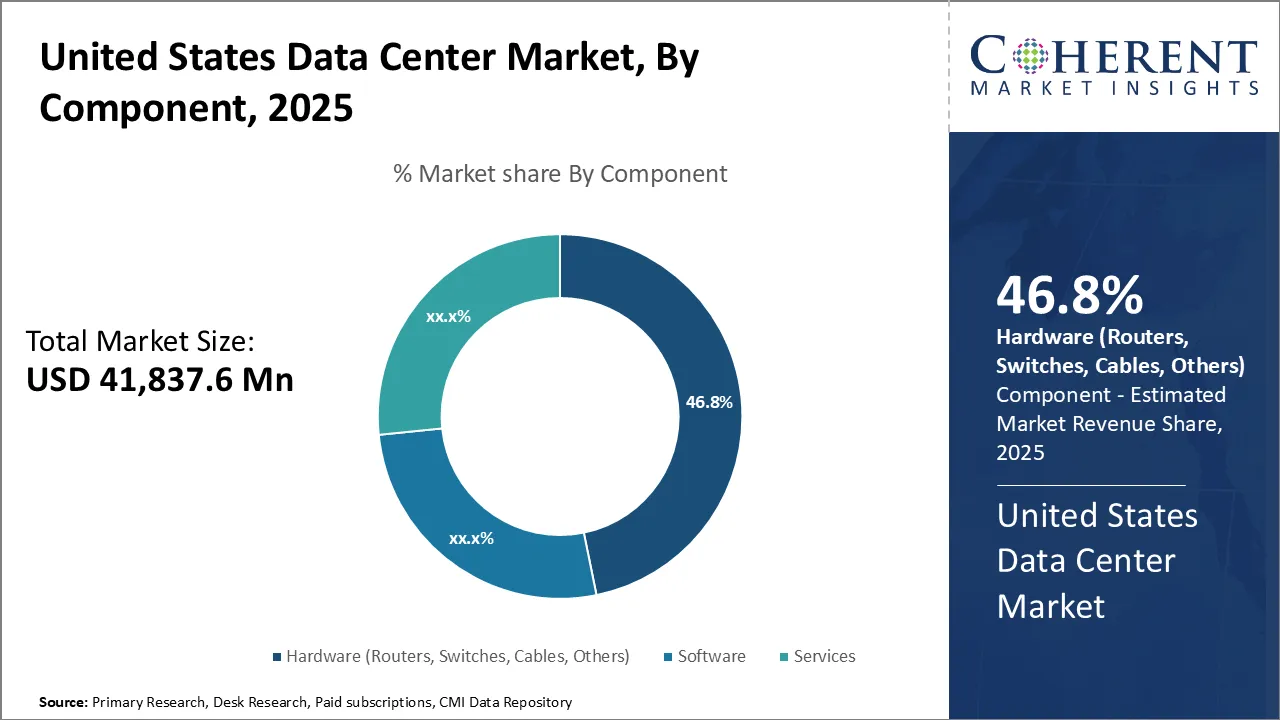
- By Component, Hardware holds the largest market share of 47.8% in 2026 owing to the explosion of AI and machine learning workloads.
- By Application, Network Infrastructure expected to hold the largest market share of 40.9% in 2026 owing to its cloud adoption & hybrid/multi‑cloud architectures.
- By End User, BFSI acquired the prominent market share of 32.9% in 2026 owing to its regulatory compliance & stringent security requirements.
Market Overview
The United States data center market is evolving rapidly as businesses increasingly demand cloud computing, AI workloads, and digital services. Hyperscale and enterprise data centers are expanding to provide high-performance computing, storage, and networking, while edge data centers are emerging to deliver low-latency support for 5G and IoT applications. Key sectors such as financial services, healthcare, and technology are driving investments, prioritizing security, compliance, and resilience. Companies are also adopting energy-efficient hardware, automation, and software-defined infrastructure to modernize and strengthen their operations
Current Events and Its Impact on the United States Data Center Market
Current Events | Description and its impact |
Geopolitical and Regulatory Developments |
|
Economic and Market Dynamics |
|
Environmental and Climate-Related Challenges |
|
Segmental Insights
- Current Industry Events of 2026
- Market Size Estimation
- Regional Breakdown
- Competitive Landscape
- Customer Intelligence
- Segmental Analysis
- Pricing Analysis
- Key Market Drivers, Challenges & Future Trends
- Customized Insights Section
United States Data Center Market Insights, By Component - Hardware contributes the highest share of the market owing to its hardware refresh cycles & new architectures
Hardware holds the largest market share of 47.8% in 2026. The United States data center market drives hardware demand as AI and machine learning workloads push companies to deploy powerful servers and specialized accelerators. Businesses expand storage, compute, and networking capacities to support cloud adoption and digital transformation. The rollout of edge computing and 5G compels organizations to build distributed, high-performance infrastructure. Frequent technology upgrades, the pursuit of energy-efficient solutions, and growing data volumes from finance, healthcare, and e-commerce sectors further motivate companies to invest in advanced data center hardware. For instance, in January 2025, Verizon has introduced a new AI-focused network service and plans to make its underused data center assets available for companies to deploy hardware
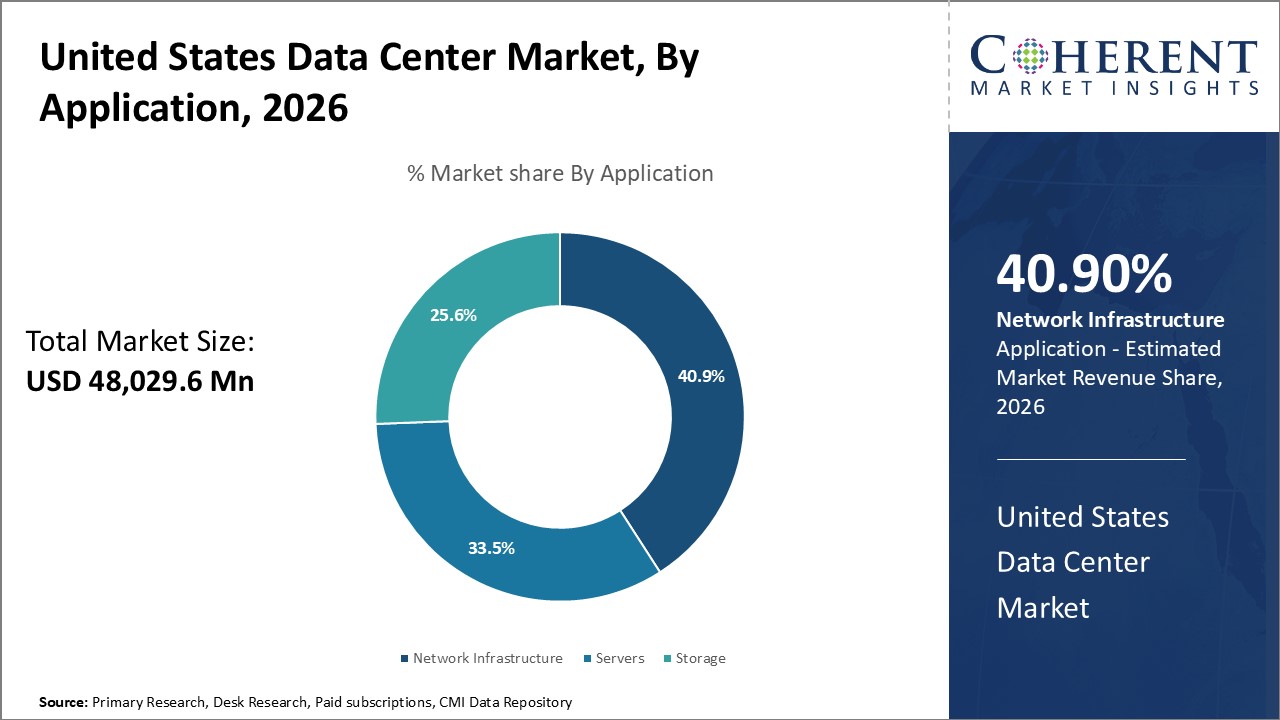
United States Data Center Market Insights, By Application - Network Infrastructure contribute the highest share of the market owing to its hybrid cloud & integration complexity
Network Infrastructure expected to hold the largest market share of 40.9% in 2026. Rising data traffic and growing digital services drive the United States data center market to expand network infrastructure, demanding faster and more reliable connectivity. Organizations strengthen interconnectivity across data centers to support cloud adoption and hybrid architectures. AI, big data, and high-performance computing generate heavy east-west traffic, prompting deployment of advanced switches and routers. The rollout of 5G and edge computing pushes companies to build low-latency networks, while investments in security, automation, and energy-efficient technologies enhance scalable, resilient, and high-speed network infrastructure. For instance, in August 2025, Broadcom has launched Jericho4, its latest network chip designed to meet the increasing demand for scalable AI infrastructure.
United States Data Center Market Insights, By End User - BFSI contribute the highest share of the market owing to its rising volume of critical & sensitive data
BFSI acquired the prominent market share of 33.9% in 2026. The BFSI sector in the United States fuels data center demand as financial institutions roll out digital banking, insurance platforms, and fintech services. Regulatory compliance and the need to safeguard sensitive customer data drive them to invest in secure, resilient infrastructure. High transaction volumes, real-time analytics, and AI-driven risk management push organizations to expand computing and storage capacities. By adopting hybrid and multi-cloud strategies, disaster recovery solutions, and advanced cybersecurity measures, BFSI companies strengthen data center capabilities to ensure continuous operations and competitive digital offerings. For instance, in February 2025, US investment firm Dominari Holdings, specializing in wealth management and asset management, has launched the HPC data center unit American Data Centers Inc. (ADC) with President Trump’s elder sons to expand beyond its current business.
Role of AI (Artificial Intelligence) in the United States Data Center Market
Artificial Intelligence transforms the United States data center market by increasing demand for high-performance computing, specialized servers, and accelerated storage solutions. Machine learning, deep learning, and real-time analytics generate massive data processing needs and require low-latency networks, prompting operators to expand and optimize data centers. Companies deploy AI-driven management tools to boost energy efficiency, automate operations, and anticipate maintenance requirements. Furthermore, AI improves traffic routing, resource allocation, and security monitoring, enabling data centers to operate more efficiently, resiliently, and at greater scale. For instance, in October 2025, Volt, a new AI data center company, has launched in the Netherlands and plans to expand across Europe, the US, and the Middle East, offering 14MW of capacity from Switch Datacenters’ AMS4 facility and pursuing five additional projects.
End-user Feedback and Unmet Needs in the United States Data Center Market
- Demand for Higher Energy Efficiency: End-users report rising operational costs due to energy-intensive infrastructure. They seek more energy-efficient servers, cooling systems, and power management solutions. There’s a growing need for sustainable designs that reduce carbon footprints while maintaining high performance. Providers must innovate to balance efficiency, reliability, and cost-effectiveness.
- Scalability and Flexibility Challenges: Many organizations find current data centers inflexible for rapid workload scaling. Businesses need modular and adaptable infrastructure to support hybrid, multi-cloud, and edge deployments. End-users highlight difficulties in quickly reallocating resources or integrating new technologies, emphasizing the need for highly configurable and future-ready environments.
- Security and Compliance Gaps: End-users express concerns about data security, privacy, and compliance with evolving regulations. They require advanced encryption, real-time threat monitoring, and stricter access controls. Many report that existing solutions fall short in preventing sophisticated cyberattacks, making secure and compliant infrastructure a top priority.
United States Data Center Market Trend
Expansion of Hyperscale Data Centers
Hyperscale data centers continue to dominate the U.S. market, driven by cloud providers and large enterprises. These facilities prioritize massive compute, storage, and networking capabilities to support AI, big data, and streaming services. Operators focus on high-density infrastructure, efficient cooling systems, and modular designs to maximize space and performance. The trend reflects the growing need for scalable, centralized facilities capable of handling surging digital workloads while optimizing operational efficiency and uptime.
United States Data Center Market Opportunity
Expansion of Edge and 5G Infrastructure
The rollout of 5G networks and IoT devices creates strong demand for edge data centers that bring computing closer to end-users. Companies can capitalize on opportunities to deploy smaller, distributed facilities to reduce latency, enhance real-time processing, and support emerging applications such as autonomous vehicles, AR/VR, and smart cities. This trend encourages investments in hybrid networks, low-latency connectivity, and energy-efficient edge solutions, providing a strategic advantage for operators seeking to serve local and regional markets.
Market Report Scope
United States Data Center Market Report Coverage
| Report Coverage | Details | ||
|---|---|---|---|
| Base Year: | 2025 | Market Size in 2026: | USD 48,029.6 Mn |
| Historical Data for: | 2020 To 2024 | Forecast Period: | 2026 To 2033 |
| Forecast Period 2026 to 2033 CAGR: | 14.8% | 2033 Value Projection: | USD 1,26,212.4 Mn |
| Segments covered: |
| ||
| Companies covered: | Amazon Web Services (AWS), Microsoft Azure, Google Cloud Platform, Equinix, Digital Realty, CyrusOne, CoreSite Realty Corporation, IBM, Facebook (Meta), and Alibaba Cloud | ||
| Growth Drivers: |
| ||
| Restraints & Challenges: |
| ||
United States Data Center Market News
- In July 2025, The National Renewable Energy Laboratory (NREL) released a map that shows the U.S. data center sector and how it is geographically connected to the critical infrastructure that supports it.
- In July 2025, Technology group Wartsila will deliver 282 MW of flexible engines for a new data center project in Ohio, USA. The onsite power plant will supply electricity directly to the data center using fifteen Wärtsilä 18V50SG natural gas–fueled engines
Analyst Opinion (Expert Opinion)
- The United States data center market has entered a structural inflection driven by artificial intelligence and hyperscale cloud competition. AI workloads are no longer incremental; they redefine infrastructure requirements, with hyperscalers like AWS, Microsoft, Google, Meta, and emerging players committing multibillion‑dollar pipelines to AI‑ready campuses that support hundreds of megawatts per site.
- Critically, the market is constrained more by power and siting realities than by demand itself. Major reports highlight that innovative cooling technologies and grid‑adjacent power strategies are now prerequisites to enable multi‑gigawatt facilities rather than differentiators. Hyperscale operators are already optimizing for liquid cooling to support GPU‑dense racks capable of 200 kW‑plus per rack—an order of magnitude beyond traditional cloud facilities—reinforcing that design and operational sophistication determine competitive positioning.
- The regional dynamics are also shifting significantly. Pennsylvania’s surge in gas‑powered centers and Amazon’s $20 billion investments into multiple campus builds illustrate that secondary markets with robust power and incentive profiles are emerging as counterweights to traditional hubs like Northern Virginia and Silicon Valley. This dispersal reflects real constraints—the lagging grid capacity and rising energy costs that now actively shape location strategy and accelerate investment into on‑site generation and innovative power procurement approaches.
- Against this backdrop, the market is bifurcating: participants who view data centers as commoditized real estate risk stranded assets, while those embracing data centers as engineering‑intensive, AI‑centric platforms will capture disproportionate value. This shift is already reflected in capital allocation decisions and investor sentiment, where AI infrastructure announcements simultaneously drive valuations and, in setbacks like the Oracle funding withdrawal, trigger sharp market repricing on concerns over sustainability of capital intensity.
Speak to the analyst
Want personalized insights?
Take the findings above to one of our principal consultants, or have the report rebuilt around the segments, geographies and competitors you actually track.
Market Segmentation
- Component Insights (Revenue, USD Mn, 2021 - 2033)
- Hardware
- Routers
- Switches
- Cables
- Others
- Software
- Services
- Application Insights (Revenue, USD Mn, 2021 - 2033)
- Network Infrastructure
- Servers
- Storage
- End User Insights (Revenue, USD Mn, 2021 - 2033)
- BFSI
- Healthcare
- IT & Telecom
- Retail & Consumer Goods
- Energy & Utilities
- Government & Public Sector
- Others
- Key Players Insights
- Amazon Web Services (AWS)
- Microsoft Azure
- Google Cloud Platform
- Equinix
- Digital Realty
- CyrusOne
- CoreSite Realty Corporation
- IBM
- Facebook (Meta)
- Alibaba Cloud
Sources
Primary Research interviews
- CIOs, CTOs, and IT Managers of leading enterprises operating data centers in the U.S.
- Facility managers and operations heads of major hyperscale and colocation data centers
- Cloud service providers’ technical and infrastructure teams
- Network engineers and data center architects
- Energy and sustainability managers involved in data center operations
Databases
- U.S. Energy Information Administration (EIA) databases
- Federal Communications Commission (FCC) data portals
- U.S. Census Bureau datasets on business and infrastructure
- National Renewable Energy Laboratory (NREL) energy consumption datasets
- OpenStreetMap and other geospatial data sources for data center locations
Magazines
- Data Center Frontier
- Data Center Knowledge
- InformationWeek
- Network World
- Wired
Journals
- IEEE Transactions on Cloud Computing
- Journal of Data Center Management
- ACM Journal on Emerging Technologies in Computing Systems
- Sustainable Computing: Informatics and Systems
- Journal of Network and Computer Applications
Newspapers
- The New York Times (Technology section)
- The Wall Street Journal (Tech/Infrastructure coverage)
- The Washington Post (Technology reporting)
- Tech sections of regional newspapers covering U.S. infrastructure projects
Associations
- Uptime Institute
- The Green Grid
- Telecommunications Industry Association (TIA)
- Internet Infrastructure Coalition
- American Society of Heating, Refrigerating and Air-Conditioning Engineers (ASHRAE)
Public Domain sources
- U.S. Department of Energy (DOE) reports
- Federal Energy Regulatory Commission (FERC) publications
- Environmental Protection Agency (EPA) energy efficiency reports
- U.S. government open data portals (data.gov)
- State-level energy and infrastructure reports
Proprietary Elements
- CMI Data Analytics Tool
- Proprietary CMI Existing Repository of information for last 8 years
Get access to 250+ pages report
Every segment, forecast, competitor profile and data table behind the analysis above — available for instant download.
- ESOMAR Member
- ISO 9001:2015 Certified
- D-U-N-S Registered
- GDPR & CCPA Compliant
Missing comfort of reading report in your local language? Find your preferred language:
Transform your Strategy with Exclusive Trending Reports
Frequently Asked Questions
The United States Data Center Market is estimated to be valued at USD 48,029.6 Mn in 2026, and is expected to reach USD 1,26,212.4 Mn by 2033.
The CAGR of the United States Data Center Market is projected to be 14.8% from 2026 to 2033.
Implementation of new technologies and growing demand for energy efficient infrastructure are the major factors driving the growth of the United States data center market.
Regulatory compliance and high initial investment are the major factors hampering the growth of the United States data center market.
In terms of component, hardware is estimated to dominate the market revenue share in 2026.
Amazon Web Services (AWS), Microsoft Azure, Google Cloud Platform, Equinix, Digital Realty, CyrusOne, CoreSite Realty Corporation, IBM, Facebook (Meta), and Alibaba Cloud are the major players.