

Imaging Technology For Precision Agriculture Market Size and Share Analysis - 2026 To 2033
Imaging technology for precision agriculture refers to the use of advanced imaging systems, including multispectral and hyperspectral technologies, cameras, sensors, and software solutions, to collect and analyze agricultural field data. These technologies capture information related to crop health, vegetation conditions, soil characteristics, and field variability to support precision farming activities. Imaging solutions are used in applications such as crop monitoring, disease detection, irrigation management, yield estimation, and resource optimization. The data generated through these systems helps farmers make informed decisions and improve agricultural productivity through data-driven farm management practices.
Key Statistics at a Glance
Metric | Value |
Market Size (2026) | USD 1,405.3 Mn |
Projected Market Size (2033) | USD 2,703.9 Mn |
CAGR (2026–2033) | 9.8% |
Leading Technology Segment (2026) | Multispectral Imaging (72.4% share) |
Leading Product Segment (2026) | Sensors (37.8% share) |
Leading Region (2026) | North America (38% share) |
Fastest-Growing Region | Asia Pacific (11.2% CAGR) |
Key Players | BaySpec, Quest Innovations, Tetracam, Pixelteq, MicaSense, Resonon, Ximea, Teledyne DALSA |
Global Imaging Technology For Precision Agriculture Market Size and Revenue Forecast 2026–2033
The global imaging technology for precision agriculture market is estimated to be valued at USD 1,405.3 Mn in 2026 and is expected to reach USD 2,703.9 Mn by 2033, growing at a CAGR of 9.8% during the forecast period. This projected growth is mostly due to increasing adoption of precision farming practices, rising demand for real-time crop monitoring and yield optimization, and growing use of drones as well as satellite imaging technologies.
Key Takeaways from the Imaging Technology For Precision Agriculture Market Report
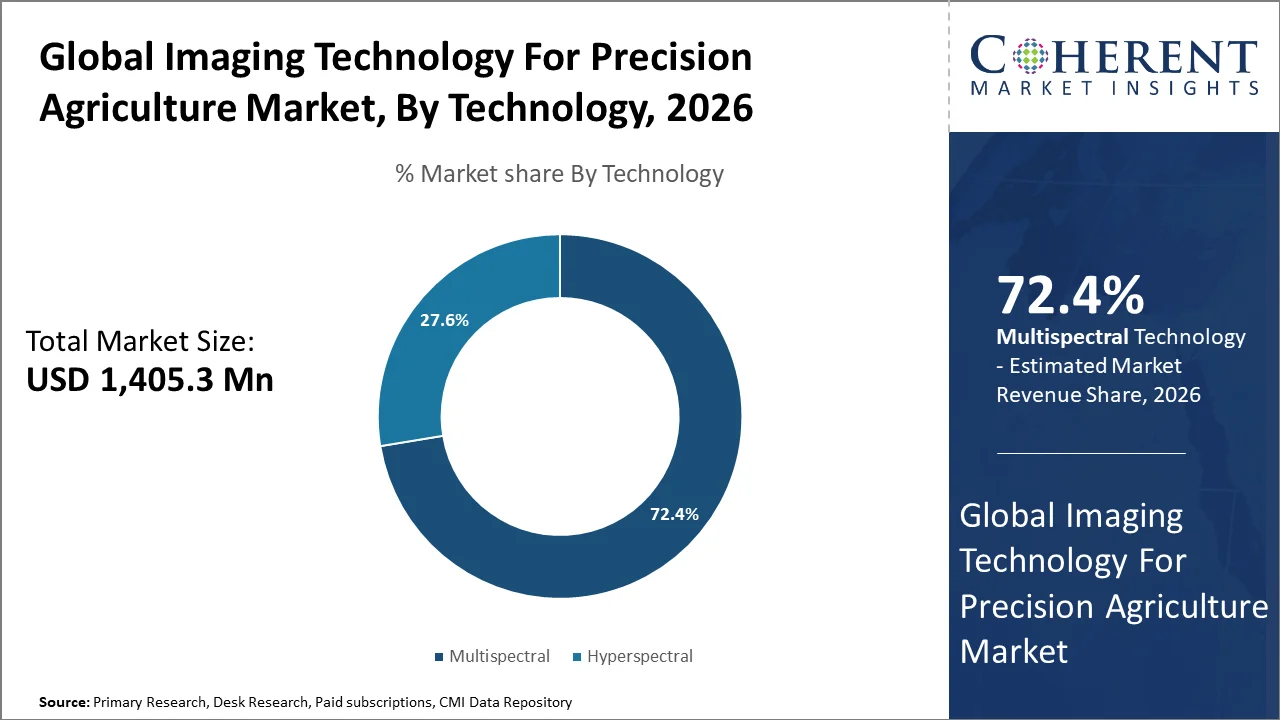
- Multispectral imaging segment is expected to lead the market with a share of 72.4% in 2026 due to widespread adoption in UAVs, satellites, and crop health monitoring. A 2025 supporting its growing use in precision agriculture.
- Sensors are slated to account for the largest market revenue share of 37.8% in 2026 due to extensive deployment in drones, satellites, and field monitoring systems. For example, the European Space Agency’s Sentinel-2 satellites use 13 spectral bands with a 5-day revisit time, enabling sensor-based crop health monitoring and precision agriculture applications.
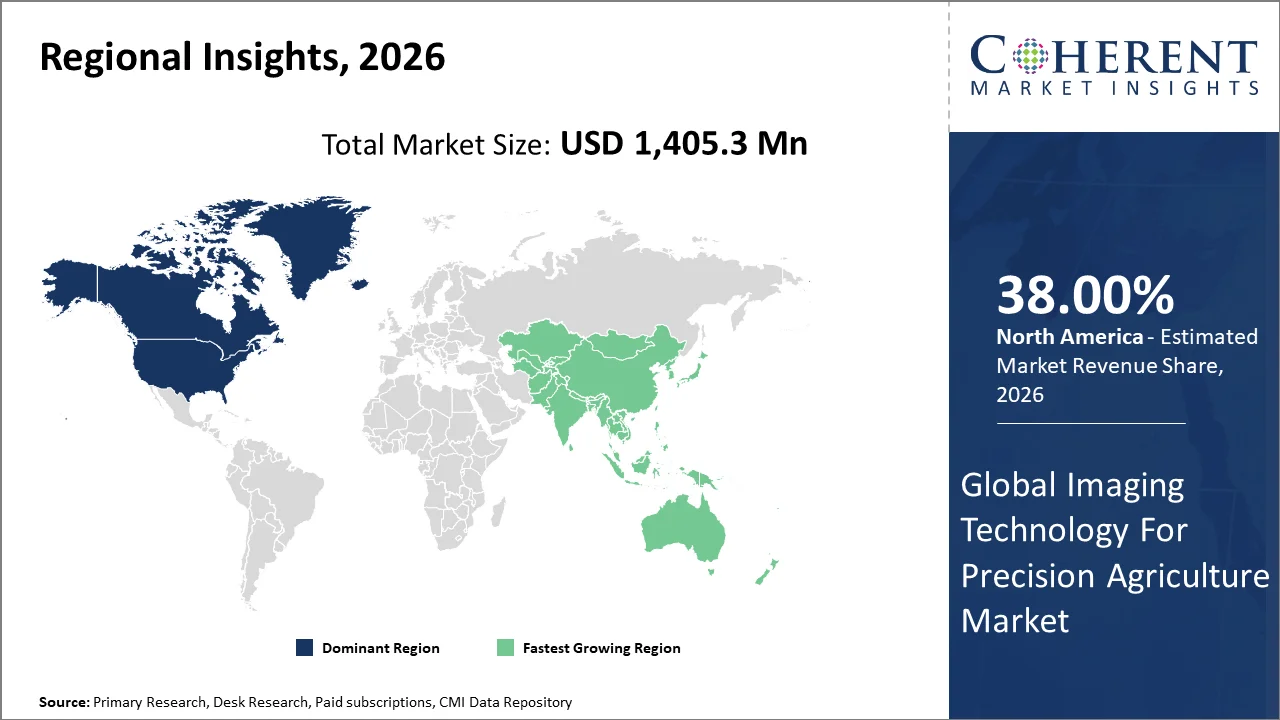
- North America is projected to dominate the global imaging technology for precision agriculture industry with a share of 38% in 2026 owing to high precision farming adoption, strong agri-tech investments, and extensive drone usage. According to the USDA Economic Research Service (2024), 70% of large-scale U.S. crop farms used guidance autosteering systems and 68% used yield monitors, yield maps, and soil maps in 2023, showing strong adoption of precision agriculture technologies.
- Asia Pacific, recording a CAGR of 11.2% , is poised to emerge as the fastest-growing market for imaging technology for precision agriculture during the forecast period, thanks to expanding smart farming investments in China, India, and Japan. For instance, in September 2024, India approved the Digital Agriculture Mission with an outlay of ₹2,817 crore to promote digital and precision farming technologies.
Imaging Technology For Precision Agriculture Market Overview
The global imaging technology for precision agriculture market is poised to record strong growth during the forecast period. This can be attributed to increasing adoption of precision farming practices, rising demand for higher crop productivity, and growing use of advanced imaging solutions such as multispectral and hyperspectral imaging for real-time crop monitoring.
Integration of artificial intelligence (AI), machine learning, drones, and satellite-based imaging technologies is enabling farmers to improve resource utilization, detect crop diseases early, and optimize irrigation and fertilizer application. These advancements are expected to foster growth of imaging technology for precision agriculture market during the forthcoming period.
Growing use of drones and aerial imaging is also supporting market expansion. UAVs equipped with high-resolution, multispectral, and hyperspectral cameras are gaining adoption because of their tendency to quickly capture detailed field data, monitor crop health, and detect pests, diseases, and nutrient deficiencies.
Similarly, greater emphasis on food security and sustainable agriculture is creating a conducive environment for the development of the imaging technology for precision agriculture market. As per the forecasts of the Food and Agriculture Organization (FAO), food requirements globally could rise by 50 percent by 2050. Rising food demand globally and the necessity of reducing the consumption of water, fertilizers, and pesticides are compelling farmers to use imaging technologies that boost efficiency without wasting resources.
Segmental Insights
- Current Industry Events of 2026
- Market Size Estimation
- Regional Breakdown
- Competitive Landscape
- Customer Intelligence
- Segmental Analysis
- Pricing Analysis
- Key Market Drivers, Challenges & Future Trends
- Customized Insights Section
Which Technology Leads the Imaging Technology For Precision Agriculture Market?
Multispectral Technology Holds Nearly Three-Fourths Market Share
Based on technology, multispectral segment is set to lead the market, capturing a share of 72.4% in 2026. This dominance is attributable to its ability to provide detailed information about crop health, vegetation conditions, and soil characteristics by capturing data across multiple spectral bands.
Multispectral imaging is widely adopted for applications such as crop monitoring, disease detection, irrigation management, and yield estimation due to its cost-effectiveness and compatibility with drones, satellites, and other remote sensing platforms. Increasing adoption of precision farming practices and the need for real-time agricultural insights are also fostering segment growth.
Which is the Most Sought-After Product in the Imaging Technology for Precision Agriculture Market?
Demand to Remain High for Sensors Through 2033
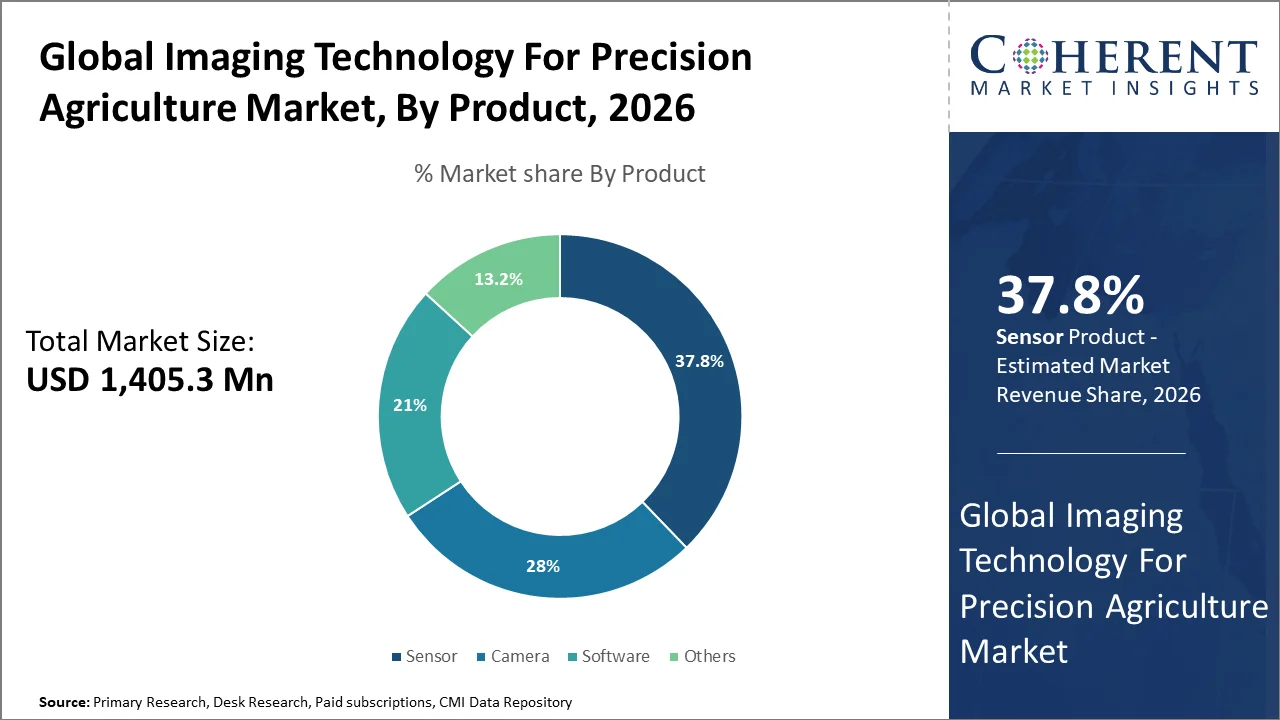
According to Coherent Market Insights’ latest imaging technology for precision agriculture market analysis, sensors are projected to account for the largest market revenue share of 37.8% in 2026. This is mostly due to their increasing adoption for real-time crop monitoring, soil analysis, and data-driven farm management. Under the Digital Agriculture Mission, India has generated over 7.63 crore Farmer IDs and surveyed more than 23.5 crore crop plots. The National Pest Surveillance System monitors 66 crops and over 432 pest species, providing real-time advisories to more than 10,000 extension workers. As of December 2025, the Kisan e-Mitra chatbot has responded to over 9.3 million farmer queries, handling more than 8,000 queries daily across 11 regional languages.
Sensors enable farmers to collect accurate information on crop health, moisture levels, nutrient conditions, and environmental factors, helping improve productivity and optimize resource utilization. In addition, advancements in IoT-enabled sensors, wireless connectivity, and smart farming solutions are also supporting their widespread use across precision agriculture applications.
Imaging Technology For Precision Agriculture Market Growth Drivers
Shift Towards Precision Farming Practices
Rising adoption of precision farming practices is driving the growth of the imaging technology for precision agriculture market. Increasing focus on improving crop yields, optimizing resource use, and promoting sustainable farming is accelerating the adoption of imaging technologies for crop monitoring, soil assessment, disease detection, and yield forecasting. These technologies enable data-driven decision-making by providing real-time insights into crop health, field conditions, and resource requirements.
For instance, a 2025 survey of U.S. farmers found that nearly one-quarter of respondents had adopted agricultural UAVs, with 18% using drones for remote sensing and imagery applications. This increasing use of drone-based imaging for crop monitoring, field mapping, and data-driven farm management is expected to support market expansion during the forecast period.
Imaging Technology For Precision Agriculture Market Opportunities
Advancements in Multispectral and Hyperspectral Imaging
Development of remote sensing technology is helping detect crop stress, soil, and vegetation with increased accuracy. The ability to detect these factors is allowing farmers to take informed decisions and enhance productivity through proper utilization of resources. Thus, there are immense growth prospects for the imaging technology for precision agriculture market.
Imaging Technology For Precision Agriculture Market Trends
Integration of AI and Machine Learning with Imaging Systems
Use of artificial intelligence and machine learning with imaging systems is transforming precision agriculture. AI-powered image analytics enable automated analysis of agricultural data, allowing farmers to make faster and more accurate decisions related to irrigation, fertilization, disease detection, and yield forecasting.
For instance, researchers at the University of California, Davis developed an AI-based Leaf Monitor tool in 2025 that uses spectral imaging and predictive modeling to provide real-time insights into crop nutrition and stress conditions, supporting more precise farm management. Increasing adoption of such technologies is expected to drive growth of the imaging technology for precision agriculture market during the forecast period.
Current Events and Their Impact on the Imaging Technology For Precision Agriculture Market
Current Event | Description and its Impact |
EU Funding for Digital and Precision Farming |
|
Growth of Satellite-Based Agricultural Monitoring |
|
Regional Insights
North America Dominates the Global Imaging Technology for Precision Agriculture Industry
North America is projected to hold the largest share of the global imaging technology for precision agriculture market with around 38% share in 2026. This dominance can be attributed to rising adoption of precision farming practices as well as increasing use of drones and satellite imagery and strong investments in agricultural technology. In July 2026, DJI Agriculture launched the DJI Agras T55 and DJI Agras T100 Dual Battery Spraying System, expanding its agricultural drone portfolio with next-generation spraying technologies developed through more than 13 years of R&D.
The region is witnessing greater demand for imaging solutions that help farmers monitor crop health, optimize inputs, and improve yields. According to USDA Agricultural Research Service, more than 80% of surveyed agricultural drone users considered drone-based measurements valuable, highlighting strong acceptance of imaging-based solutions in modern farming.
Asia Pacific Becoming a Hotbed for Precision Agriculture Imaging Technology Companies
Asia Pacific imaging technology for precision agriculture market is anticipated to grow at a CAGR of 11.2% during the forecast period. This is attributable to rising adoption of smart farming, government support for digital agriculture, and increasing need to improve productivity on limited farmland. Growing use of drones, remote sensing, and AI-based crop monitoring is helping farmers detect crop stress and manage resources efficiently.
For example, India is making efforts for increasing the use of agricultural drones through governmental programs. According to the Ministry of Agriculture & Farmers Welfare, 2,122 agricultural drones were approved for distribution to farmers and Custom Hiring Centres between 2023–24 and November 2025. This expansion is expected to increase demand for imaging-based solutions for crop monitoring, spraying, and field analysis across Asia Pacific during the forecast period.
Imaging Technology For Precision Agriculture Market Outlook – Country-wise
U.S. Imaging Technology For Precision Agriculture Market Trends
The United States is anticipated to remain a key market for precision agriculture imaging technologies during the assessment period. This can be attributed to high adoption of digital farming tools among large-scale farms, increasing use of drone-based imaging, and growing demand for yield monitoring and field mapping solutions. According to the USDA Economic Research Service, yield monitors, yield maps, and soil maps were used by 68% of large-scale crop-producing farms in 2023, supporting demand for advanced imaging technologies.
China Imaging Technology For Precision Agriculture Market Forecast
The imaging technology for precision agriculture market in China is poised to exhibit strong growth throughout the forecast period. This is mostly due to government initiatives promoting smart agriculture, increasing deployment of agricultural drones, and rising adoption of remote sensing technologies to improve crop monitoring. In June 2026, China unveiled its 15th Five-Year Plan (2026–2030) for agriculture and rural development, focusing on strengthening food security, advancing agricultural technology, improving rural livelihoods, and promoting sustainable agricultural growth. Similarly, declining hardware costs and improved accessibility of drones, cameras, and sensors are enabling wider adoption among small and medium-sized farms.
Who are the Major Companies in the Imaging Technology For Precision Agriculture Market?
Company | Headquarters | Key Products / Product Lines | Market Segment |
BaySpec, Inc. | San Jose, California, U.S. | Hyperspectral imagers, spectral sensors, remote sensing solutions | Hyperspectral imaging systems |
MicaSense (AgEagle Aerial Systems Inc.) | Wichita, Kansas, U.S. | RedEdge and Altum multispectral sensors | Drone-based multispectral imaging |
Resonon Inc. | Bozeman, Montana, U.S. | Hyperspectral cameras and remote sensing systems | Hyperspectral imaging solutions |
XIMEA GmbH | Münster, Germany | Scientific cameras and hyperspectral imaging cameras | Industrial and scientific imaging |
Teledyne DALSA Inc. | Waterloo, Ontario, Canada | Industrial cameras, imaging sensors, machine vision solutions | Imaging sensors and camera systems |
Tetracam Inc. | U.S. | Multispectral agricultural cameras | Multispectral imaging |
Pixelteq LLC | U.S. | Multispectral sensors and optical imaging solutions | Multispectral imaging |
Quest Innovations | U.S. | Hyperspectral imaging solutions | Hyperspectral imaging |
Key Strategies Adopted by Industry Players
Top precision agriculture imaging technology providers are adopting various organic and inorganic strategies to boost their revenue as well as gain a competitive edge over the industry. These include new product launches, mergers, partnerships, acquisitions, and distribution agreements.
- In May 2026, Teledyne DALSA launched the Kaleido SWIR hyperspectral camera for industrial inspection applications. It helps industries analyze materials and improve sorting and quality control processes.
- In September 2025, XIMEA announced its participation at INTERGEO 2025 in Frankfurt to showcase its imaging solutions. The company presented cameras for aerial mapping, surveying, and geospatial applications.
- In August 2025, OMRON Electronic Components launched a next-generation Weather Sensor for agriculture, meteorology, and smart city applications. It provides accurate environmental data to support better monitoring and decision-making.
Market Report Scope
Imaging Technology For Precision Agriculture Market Report Coverage
| Report Coverage | Details | ||
|---|---|---|---|
| Base Year: | 2025 | Market Size in 2026: | USD 1,405.3 Mn |
| Historical Data for: | 2020 To 2024 | Forecast Period: | 2026 To 2033 |
| Forecast Period 2026 to 2033 CAGR: | 9.8% | 2033 Value Projection: | USD 2,703.9 Mn |
| Geographies covered: |
| ||
| Segments covered: |
| ||
| Companies covered: | Bayspec, Quest Innovations, Tetracam, Pixelteq, Micasense, Resonon¸ Ximea, and Teledyne Dalsa | ||
| Growth Drivers: |
| ||
| Restraints & Challenges: |
| ||
Analyst Opinion (Expert Opinion)
- Precision farming is becoming more data-driven. Imaging technologies such as drones, satellites, and multispectral cameras help farmers monitor crop health, detect stress early, and optimize inputs. This shift toward data-based farming is expected to increase demand for imaging solutions.
- The utilization of agricultural drones has been increasing across the world. According to the Food and Agriculture Organization of the United Nations (FAO), modern technologies in digital agriculture like remote sensing and drones are helping in monitoring crops and other resources more efficiently. This will help in increasing the adoption of imaging technology in precision agriculture.
- Remote sensing is improving farm efficiency. Satellite-based imaging enables large-scale monitoring of vegetation, soil conditions, and water availability, helping farmers make timely decisions and reduce resource wastage. This is expected to fuel adoption of imaging platforms across commercial farms during the forthcoming period.
- AI-powered image analysis is breathing a new life into precision agriculture. Advanced analytics can automatically interpret field images to detect diseases and nutrient deficiencies along with crop variability. It is expected that the value of the imaging system will be increased due to the conversion of raw data into useful farm information.
Speak to the analyst
Want personalized insights?
Take the findings above to one of our principal consultants, or have the report rebuilt around the segments, geographies and competitors you actually track.
Market Segmentation
- By Technology Insights ( Revenue, USD Mn, 2020 - 2033)
- Multispectral
- Hyperspectral
- By Product Insights ( Revenue, USD Mn, 2020 - 2033)
- Camera
- Sensor
- Software
- Others
- By Region Insights ( Revenue, USD Mn, 2020 - 2033)
- North America
- U.S.
- Canada
- Latin America
- Brazil
- Argentina
- Mexico
- Rest of Latin America
- Europe
- Germany
- U.K.
- Spain
- France
- Italy
- Russia
- Rest of Europe
- Asia Pacific
- China
- India
- Japan
- Australia
- South Korea
- ASEAN
- Rest of Asia Pacific
- Middle East
- GCC
- Israel
- Rest of Middle East
- Africa
- North Africa
- Central Africa
- South Africa
- North America
Sources
Primary Research interviews
- Interviews with industry participants, including precision agriculture technology providers, imaging solution developers, agricultural equipment manufacturers, drone and satellite imaging companies, farm management solution providers, and agriculture technology experts
Databases
- United States Department of Agriculture (USDA) databases
- Food and Agriculture Organization (FAO) statistical databases
- World Bank agricultural databases
- National Aeronautics and Space Administration (NASA) Earth observation datasets
- European Space Agency (ESA) Earth observation data
- United Nations agricultural databases
- Government agricultural statistics portals
Magazines
- Precision Farming Dealer
- Agriculture Technology Magazine
- Farm Journal, Successful Farming
- AgFunderNews
- GPS World
- Other agriculture and technology-focused publications
Journals
- Remote Sensing
- Computers and Electronics in Agriculture
- Precision Agriculture Journal
- Sensors
- Agricultural Systems
- IEEE Journal of Selected Topics in Applied Earth Observations and Remote Sensing
- Other peer-reviewed scientific publications related to agricultural imaging and sensing technologies
Newspapers
- Reuters
- The Economic Times
- The Hindu BusinessLine
- Financial Times
- The Wall Street Journal
- Other global news publications covering agriculture technology, satellite imaging, drones, and digital farming developments.
Associations
- International Society of Precision Agriculture (ISPA)
- American Farm Bureau Federation
- Association of Unmanned Vehicle Systems International (AUVSI)
- Agricultural Industries Electronics Foundation (AEF)
- National Association of Agricultural Extension Agents (NAAEA)
- Other agriculture and technology industry associations
Public Domain sources
- Government agriculture departments
- USDA reports
- FAO publications
- NASA Earth observation resources
- ESA Copernicus Programme data
- Agricultural technology policy documents
- Environmental monitoring reports
- Open-access research publications
- Publicly available company filings and regulatory documents
Proprietary Elements
- CMI Data Analytics Tool
- Proprietary CMI Existing Repository of information for last 10 years
Get access to 250+ pages report
Every segment, forecast, competitor profile and data table behind the analysis above — available for instant download.
- ESOMAR Member
- ISO 9001:2015 Certified
- D-U-N-S Registered
- GDPR & CCPA Compliant
Missing comfort of reading report in your local language? Find your preferred language:
Transform your Strategy with Exclusive Trending Reports
Frequently Asked Questions
The global Imaging Technology for Precision Agriculture Market size is set to total USD 1,405.3 Mn in 2026.
The global Imaging Technology For Precision Agriculture Market value is expected to reach USD 2,703.9 Mn by 2033.
The global market is poised to exhibit a CAGR of 9.8% from 2026 to 2033.
Major growth drivers include rising adoption of precision farming practices, increasing use of drones and satellites, and growing demand for real-time crop monitoring solutions.
Key trends include integration of artificial intelligence, machine learning, drones, and satellite-based imaging with agricultural management systems.
Multispectral imaging segment is expected to lead the market with a share of 72.4% in 2026.
Sensors are projected to dominate the market with a share of 37.8% in 2026.