

Asia Pacific, Latin America and EMEA System Integration in Telecommunication Market Size and Share Analysis: (2026 - 2033)
The Asia Pacific, Latin America and EMEA System Integration in Telecommunication market is anticipated to grow at a CAGR of 7.2% with USD 24.2 Bn in 2026 and is expected to reach USD 38.0 Bn in 2033. The market is growing mainly because of big 5G network rollouts {Brazil (1.6% of all 5G connections) and Puerto Rico (41.1% of all 5G connections)}, more use of cloud and virtual systems, and higher demand for fast and secure optical backhaul in telecom networks.
Key Takeaways
- Network integration is expected to account the largest share of 40% in 2026, driven by the rapid deployment of 5G and fiber networks in APAC, Latin America, and EMEA. In 2025, telecom operators in these regions deployed over 308,000 5G sites in India, 4.6 million base stations in China, and upgraded fiber networks across the EU.
- Based on service model, managed services will dominate with 50% in 2026, managed Services cover end-to-end service management, including monitoring, maintenance, and optimization, which reduces the operational burden on companies. According to the FCC, U.S. telecom providers that adopt managed services reduce downtime and improve network reliability, with some operators reporting up to 25% reduction in operational disruptions.
- Based on deployment mode, cloud/hosted will dominate with 65% in 2026, Cloud/Hosted deployment allows faster implementation, lower upfront costs, and scalability, which are critical for modern enterprises adopting SLM solutions. EU reports indicate that operators using managed IT and network services achieve around 20–30% cost savings in network operations and maintenance.
- Based on end user, telecom operators will dominate with 55% in 2026, enterprises across industries such as manufacturing, healthcare, high technology, and automotive have a high demand for efficient service management to optimize operations and reduce downtime. Telecom operators report that unplanned network downtime costs can reach up to USD 300,000 per hour for manufacturing as well as high-tech industries, highlighting the critical need for efficient service management.
- Asia-Pacific is expected to acquire the dominant share of 45% in 2026, the segment is growing as India has 1.21 billion telecom subscribers and 979 million internet users, China has 1.108 billion internet users, and both countries are rolling out large 5G networks and fiber-optic infrastructure.
Deployment of 5G Network is transforming the Asia Pacific, Latin America and EMEA System Integration in Telecommunication Industry
The rollout of 5G networks is increasing the need for system integration services in Asia-Pacific, Latin America, and EMEA. Telecom companies are building networks that mix 4G, 5G, and private networks, so they need platforms that can manage everything together. By June 2025, India had 1.21 billion telecom subscribers and 979 million internet users. 5G made up 25% of wireless data use in FY25, after 308,466 5G sites were set up by July 2023.
Similarly, by the end of 2025, the number of 5G base stations in China reached 4.838 million, according to the Ministry of Industry and Information Technology. This translates to 34.4 5G base stations per 10,000 people, exceeding the national planning target by 8.4 units.
These network setups need tools to manage, monitor, as well as connect different parts of the network, like radio, core, transport, etc. Telecom companies need platforms that support network slicing, edge computing, and real-time analytics to make money from 5G while keeping services running smoothly during upgrades.
Digital Services Platform: A major breakthrough in Asia Pacific, Latin America and EMEA System Integration in Telecommunication
The fast growth of data-heavy digital services needs better integration of OSS and BSS in the telecom system integration market. The number of internet users in China hit 1.1 billion by December 2024, up 16 million from the previous year, according to an industrial report on the country's internet development. The report by the China Internet Network Information Center (CNNIC) reported that internet penetration in China reached 78.6 percent in 2024, 30 years after the country was fully integrated to the global internet.
Similarly, European Commission households achieved 99% internet access in the Netherlands/Luxembourg by 2025, with 74% e-commerce penetration as well as 52% eID usage.
Telecom companies connect these platforms with billing, customer care, as well as real-time charging systems to offer flexible pricing and service bundles. They also need to manage APIs, keep data in sync across cloud systems, as well as follow local data protection rules.
- Current Industry Events of 2026
- Market Size Estimation
- Regional Breakdown
- Competitive Landscape
- Customer Intelligence
- Segmental Analysis
- Pricing Analysis
- Key Market Drivers, Challenges & Future Trends
- Customized Insights Section
Current Events and Their Impact on the Asia Pacific, Latin America and EMEA System Integration in Telecommunication Market
Current Event | Description and its Impact |
5G Spectrum Auctions in APAC (2025) |
|
Brazil 5G Rollout Expansion (2026) |
|
Segmental Insights
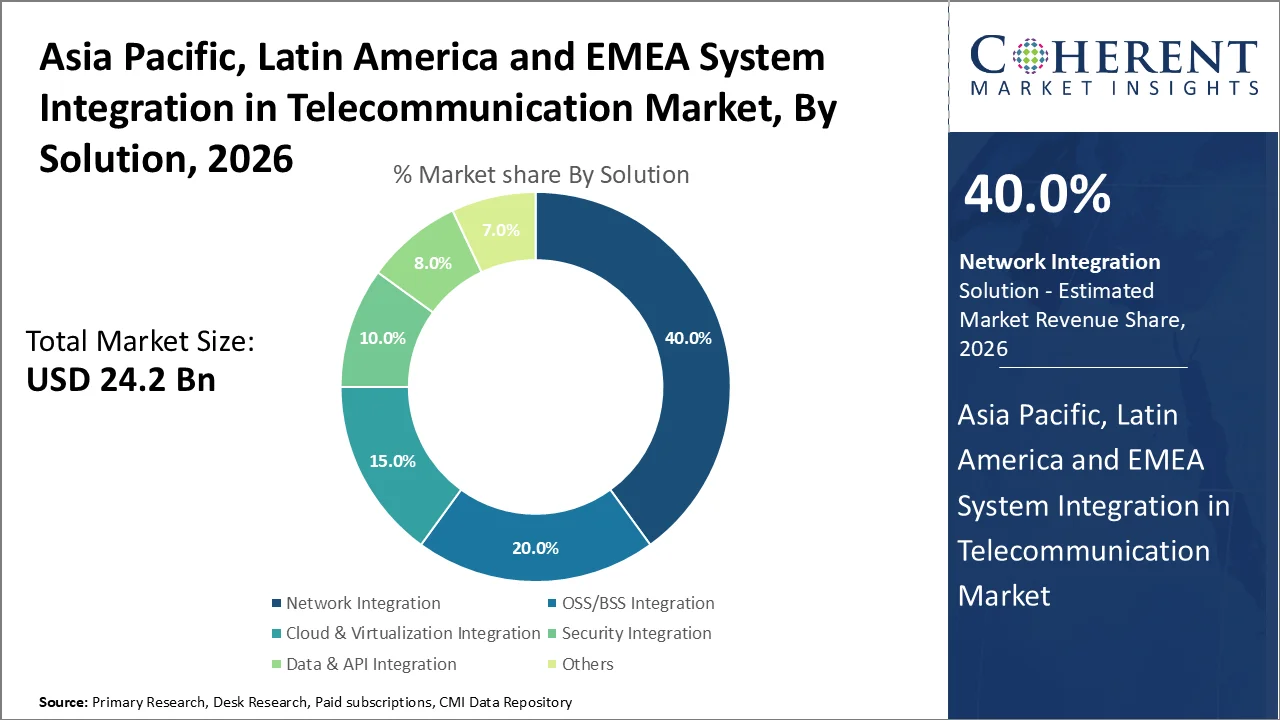
Why is Network Integration is Acquiring the Largest Market Share?
Based on Solution, Network Integration dominates the market, accounting for a significant 40% share in 2026, this is important as it is needed for 5G networks. Operators need a single system to manage radio networks, core networks, and transport layers, and to support network slicing and flexible service management. India’s 308,466 5G sites and China’s 4.6 million base stations create ongoing demand for systems that connect different vendors’ equipment, making sure network handovers are smooth and service quality stays high.
Operators rely on network integration to ensure smooth operation, quick fault resolution, and high performance across multi-vendor 5G networks, making it the backbone of modern telecom services.
Managed Services holds the Largest Market Share
Based on service model, managed services dominate the market, accounting for a significant 50% share in 2026, this shows that telecom operators prefer contracts where they pay or measure success based on actual results or performance, rather than just the services provided.
Service providers take full responsibility for running the networks, fixing problems, and improving performance for 1.21 billion users in India and China had 1.125 billion internet users by the end of 2025. Using standard systems helps them save costs when working in multiple countries.
Cloud/Hosted holds the Largest Market Share
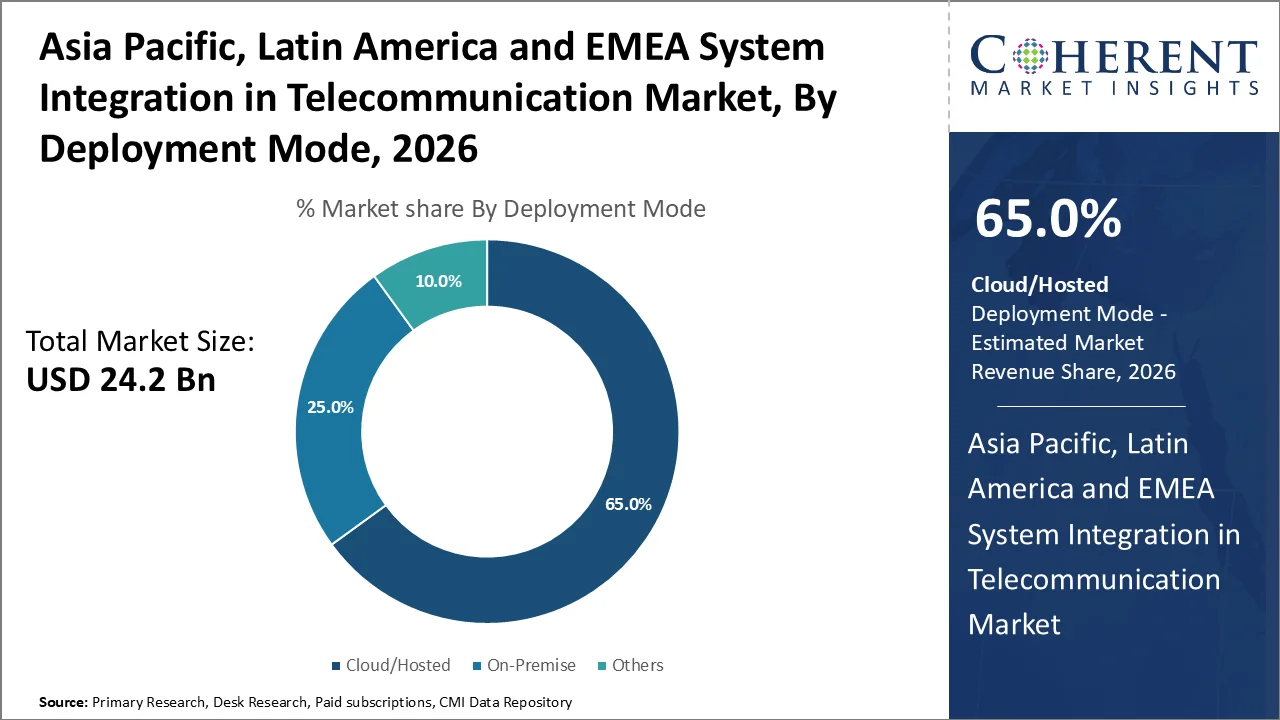
Based on deployment mode, cloud/hosted dominate the market, accounting for a significant 65% share in 2026, owing to the fundamental shift in telecommunications infrastructure management as well as the high demand for scalable, flexible solutions across these diverse geographical regions.
The dominance of cloud-based/hosted deployment models can be attributed to major factors that have reshaped the telecommunications landscape over the past decade. Conventional on-premise deployments require substantial upfront capital investments in hardware, software licenses, as well as dedicated infrastructure, which can be prohibitive for many telecom operators, particularly in advancing markets across these regions.
Telecom Operators holds the Largest Market Share
Based on end user, telecom operators dominate the market, accounting for a significant 55% share in 2026, they are the major customers for updating networks. Tier-1 operators handle networks with billions of subscribers and need systems that work across different IT environments. India’s telecom industry is growing fast. Revenue increased from USD 39.22 billion in FY24 to USD 43.42 billion in FY25, and by September 2025, 86.65% of the population had a phone connection.
Telecom operators are also investing heavily in 5G and fiber network expansions, which fuels demand for advanced system integration services. With growing data traffic along with the need for seamless connectivity, operators rely on integrated platforms to manage network slicing, edge computing, as well as real-time analytics, ensuring high service quality for millions of users.
Asia Pacific, Latin America and EMEA System Integration in Telecommunication Market Trends
- 5G Deployment & Network Modernization: The consistent deployment of 5G networks is propelling demand for system integration services, as telecom operators seek seamless integration of new infrastructure with legacy systems.
- Cloud & Edge Computing Adoption: More companies are using cloud networks and edge computing, so system integrators are building complete solutions that give fast connections and high data speeds.
- Focus on IoT & Smart Solutions: IoT is growing fast in cities, factories, and transport. This means telecom networks need custom setups that are safe, strong, and can grow easily.
- Automation & AI-driven Operations: Integrators are leveraging AI and automation for predictive maintenance, network optimization, as well as improved service delivery.
Regional Insights
Asia Pacific dominates owing to extensive 5G network rollouts
Asia Pacific account 45% market share in 2026, and is considered as the fastest growing region, driven by large 5G network rollouts, country-wide fiber optic installations, and faster mobile broadband network growth. With India's telecom subscriber base reaching 1.32 billion in February 2026 serve as a major engine of regional growth.
Programs by government authorities like India’s BharatNet and China’s gigabit fiber are improving internet in rural areas, adding more network coverage in cities, and building high-speed connections. This creates big opportunities for system integration companies.
Vast Infrastructural Advancements is Accelerating the Asia Pacific, Latin America and EMEA System Integration in Telecommunication Market Demand in China
The China subsegment contributes the highest share in the System Integration in Telecommunication Market, largely due to its vast infrastructural advancements and strategic national initiatives aimed at digital transformation.
China’s telecommunications landscape is characterized by an aggressive deployment of advanced network infrastructure, including extensive rollout of 5G technology supported by both government policy as well as major domestic telecom operators such as China Mobile, China Telecom, China Unicom, etc.
For example, in 2024, China successfully exceeded 2.5 million 5G base stations nationwide, encouraging an unprecedented capacity expansion that needs sophisticated systems integration to manage the complex network environment easily. The integration of emerging technologies such as AI-driven network management and IoT ecosystems further reinforces China’s leadership in the Asia Pacific telecommunication system integration sphere.
Who are the Major Companies in Asia Pacific, Latin America and EMEA System Integration in Telecommunication Industry
Some of the major key players in Ericsson, Redknee Inc., Huawei Technologies Co., Ltd., NetCracker Technology Corporation, Amdocs Inc., Sigma System Canada, Comptel Corp., and Openet Telecom.
Key News
- In October 2025, Bharti Airtel, a top telecom company in India, partnered with IBM to improve its Airtel Cloud. The partnership will combine Airtel Cloud’s reliable and secure network with IBM’s cloud technology and AI tools.
- In October 2025, Telstra and Ericsson agreed to work together to speed up the move toward autonomous networks, creating a plan for their joint efforts.
Market Report Scope
Asia Pacific, Latin America and EMEA System Integration in Telecommunication Market Report Coverage
| Report Coverage | Details | ||
|---|---|---|---|
| Base Year: | 2025 | Market Size in 2026: | USD 24.2 Bn |
| Historical Data for: | 2020 To 2024 | Forecast Period: | 2026 To 2033 |
| Forecast Period 2026 to 2033 CAGR: | 7.2% | 2033 Value Projection: | USD 38.0 Bn |
| Geographies covered: |
| ||
| Segments covered: |
| ||
| Companies covered: | Ericsson, Redknee Inc., Huawei Technologies Co., Ltd., NetCracker Technology Corporation, Amdocs Inc., Sigma System Canada, Comptel Corp., and Openet Telecom | ||
| Growth Drivers: |
| ||
| Restraints & Challenges: |
| ||
Analyst Opinion
- Asia Pacific, Latin America and EMEA System Integration in Telecommunication Market growth is driven by 5G and fiber network expansion. In 2025, Asia Pacific telecom operators deployed over 308,000 5G sites and 4.6 million fiber nodes, showing the critical role of system integration in managing multi-vendor networks efficiently.
- Cloud-native and virtualization adoption accelerates demand. Operators migrating over 60% of managed services to cloud-based platforms reported faster network rollout as well as lower operational costs, highlighting the push for modernization across APAC and EMEA.
- Network integration dominates the market. as operators need unified management across radio, core, and transport layers to support network slicing, edge computing, along with high-quality service delivery.
- Telecom operators lead the way. In 2025, Latin America connected 15 million homes to broadband, and EMEA had 94% of people online. This increased the need for OSS/BSS integration, real-time analytics, and automated network management.
Speak to the analyst
Want personalized insights?
Take the findings above to one of our principal consultants, or have the report rebuilt around the segments, geographies and competitors you actually track.
Asia Pacific, Latin America and EMEA System Integration in Telecommunication Market Segmentation
- By Solution
- Network Integration
- OSS/BSS Integration
- Cloud & Virtualization Integration
- Security Integration
- Data & API Integration
- Others
- By Service Model
- Managed Services
- Professional Services
- Support & Maintenance Services
- Others
- By Deployment Mode
- On-Premise
- Cloud/Hosted
- Others
- By End User
- Telecom Operators
- Enterprises
- Government & Public Sector
- Others
- Asia Pacific, Latin America and EMEA System Integration in Telecommunication Market, By Region
- Latin America
- Brazil
- Mexico
- Argentina
- Rest of Latin America
- Europe
- Germany
- U.K.
- France
- Italy
- Spain
- Russia
- Rest of Europe
- Asia Pacific
- China
- India
- Japan
- Australia
- South Korea
- ASEAN
- Rest of Asia Pacific
- Middle East and Africa
- GCC
- Israel
- Rest of Middle East
- South Africa
- Central Africa
- North Africa
- Latin America
Sources
Primary Research Interviews
- Telecommunication System Integration Service Providers
- Network Infrastructure Equipment Manufacturers
- Telecom Operators and Service Providers
- Technology Solution Architects and Consultants
- Others
Databases
- ITU (International Telecommunication Union) Database
- GSMA Intelligence Database
- TeleGeography Database
- Omdia Telecom Database
- Others
Magazines
- Telecom Asia Magazine
- Communications Today
- Total Telecom Magazine
- Mobile World Magazine
- Network World Magazine
- Others
Journals
- IEEE Communications Magazine
- Telecommunications Policy Journal
- International Journal of Communication Systems
- Others
Newspapers
- Financial Times
- The Wall Street Journal
- Reuters Technology News
- Bloomberg Technology
- Economic Times
- Others
Associations
- GSMA (Global System for Mobile Communications Association)
- ITU (International Telecommunication Union)
- TM Forum (TeleManagement Forum)
- ETSI (European Telecommunications Standards Institute)
- Others
Public Domain Sources
- Government Telecom Regulatory Authority Reports
- World Bank Telecommunications Data
- OECD Digital Economy Reports
- Regional Telecom Ministry Publications
- Others
Proprietary Elements
- CMI Data Analytics Tool
- Proprietary CMI Existing Repository of information for last 10 years
Get access to 250+ pages report
Every segment, forecast, competitor profile and data table behind the analysis above — available for instant download.
- ESOMAR Member
- ISO 9001:2015 Certified
- D-U-N-S Registered
- GDPR & CCPA Compliant
Missing comfort of reading report in your local language? Find your preferred language:
Transform your Strategy with Exclusive Trending Reports
Frequently Asked Questions
The Asia Pacific, Latin America and EMEA System Integration in Telecommunication market is expected to reach USD 38.0 Bn in 2033.
Major players operating in the Asia Pacific, Latin America and EMEA System Integration in Telecommunication market include Ericsson, Redknee Inc., Huawei Technologies Co., Ltd., NetCracker Technology Corporation, Amdocs Inc., Sigma System Canada, Comptel Corp., and Openet Telecom.
Challenges related to legacy OSS/BSS systems is expected to restrain growth of the Asia Pacific, Latin America, and EMEA system integration in telecommunication market growth over the forecast period.
Increasing need for convergent billing systems is expected to drive growth of the Asia Pacific, Latin America, and EMEA system integration in telecommunication market during the forecast period.
The Asia Pacific, Latin America and EMEA System Integration in Telecommunication market is anticipated to grow at a CAGR of 7.2% between 2026 and 2033.
Among regions, Asia Pacific is expected to account for a largest market share in the Asia Pacific, Latin America and EMEA System Integration in Telecommunication market over the forecast period.