

Global Distributed Denial of Service (DDoS) Protection Market Size and Forecast – 2026 To 2033
The global distributed denial of service (DDoS) protection market is expected to grow from USD 5,135.6 Mn in 2026 to USD 12,615.8 Mn by 2033, registering a compound annual growth rate (CAGR) of 13.7% from 2026 to 2033. A recent rise in DDoS attacks and advancements in attack techniques is a major driver for the global distributed denial of service (DDoS) protection market.
The ongoing Operation PowerOff (started in July 2017), a global law enforcement effort targeting and dismantling distributed denial of service (DDoS) for hire, is a major example. This operation targets booter and stresser websites which offer on-demand cyberattacks, often disguised as tools for legitimate testing. These services let users flood a target server or website with high volumes of fake traffic, making them inaccessible to real users.
(Source: Europol)
Key Takeaways of the Global Distributed Denial of Service (DDoS) Protection Market
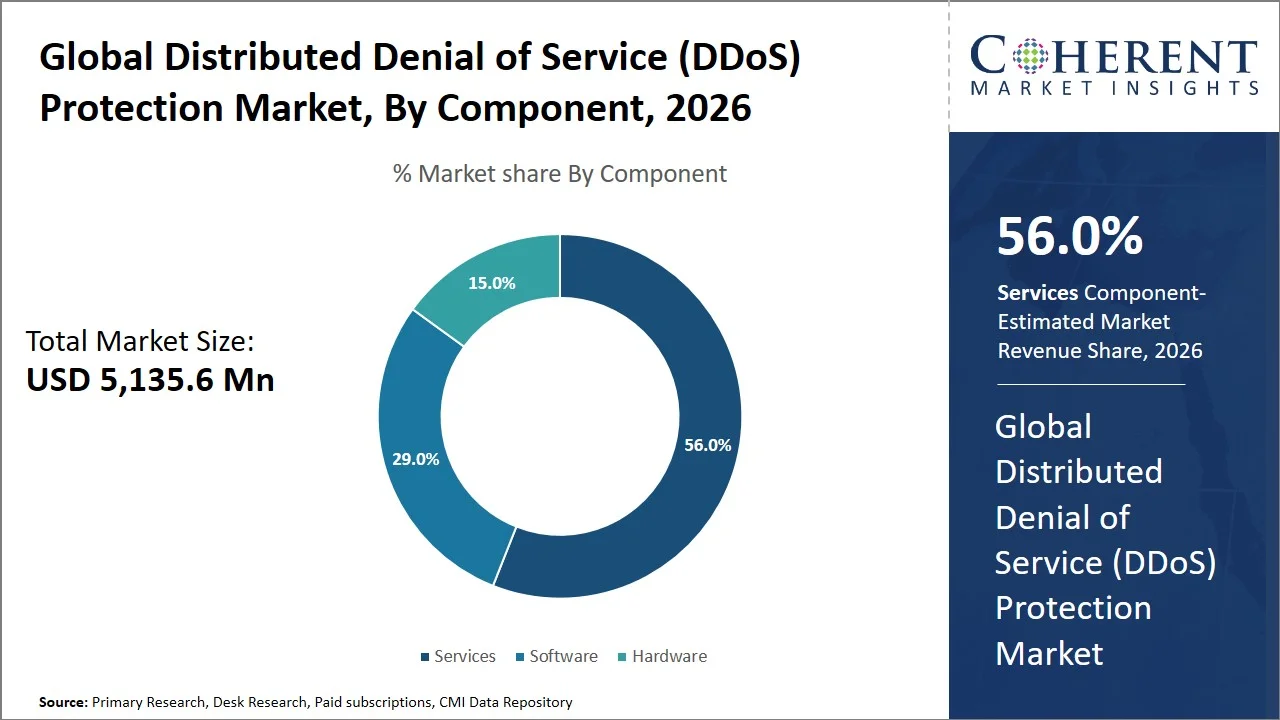
- The services segment is expected to account for 56% of the global distributed denial of service (DDoS) protection market share in 2026. A consistent rise in multi-vector, large scale DDoS attacks are major factor driving the segment growth. On September 3, 2025, Cloudflare declared that it had successfully blocked the largest DDoS attack that bombarded its target with 11.5 Tbps of traffic for a record 35 seconds. (Source: Security Week)
- The cloud-based segment is estimated to capture 51% of the market share in 2026. The rapid growth of IoT ecosystem is a primary driver for the adoption of cloud-based solutions. On April 20, 2026, ServiceNow announced that it had completed the acquisition of Armis. Armis, a leading cyber exposure management and security company, delivers a comprehensive AI-powered solution that sees, protects, and manages cyber risk across every connected asset, from OT, IoT, medical devices, physical AI to code and cloud, in real time. (Source: Service Now)
- The network layer protection segment is projected to hold 42% of the global distributed denial of service (DDoS) protection market share in 2026. The growing need of multi-layer protection for optimum operational security is pushing the demand for network layer protection. On February 05, 2026, Cloudflare published in a report that DDoS attacks surged by 121% in 2025, reaching an average of 5,376 attacks automatically mitigated every hour. The number of DDoS attacks spiked 236% between 2023 and 2025. (Source: Cloudflare)
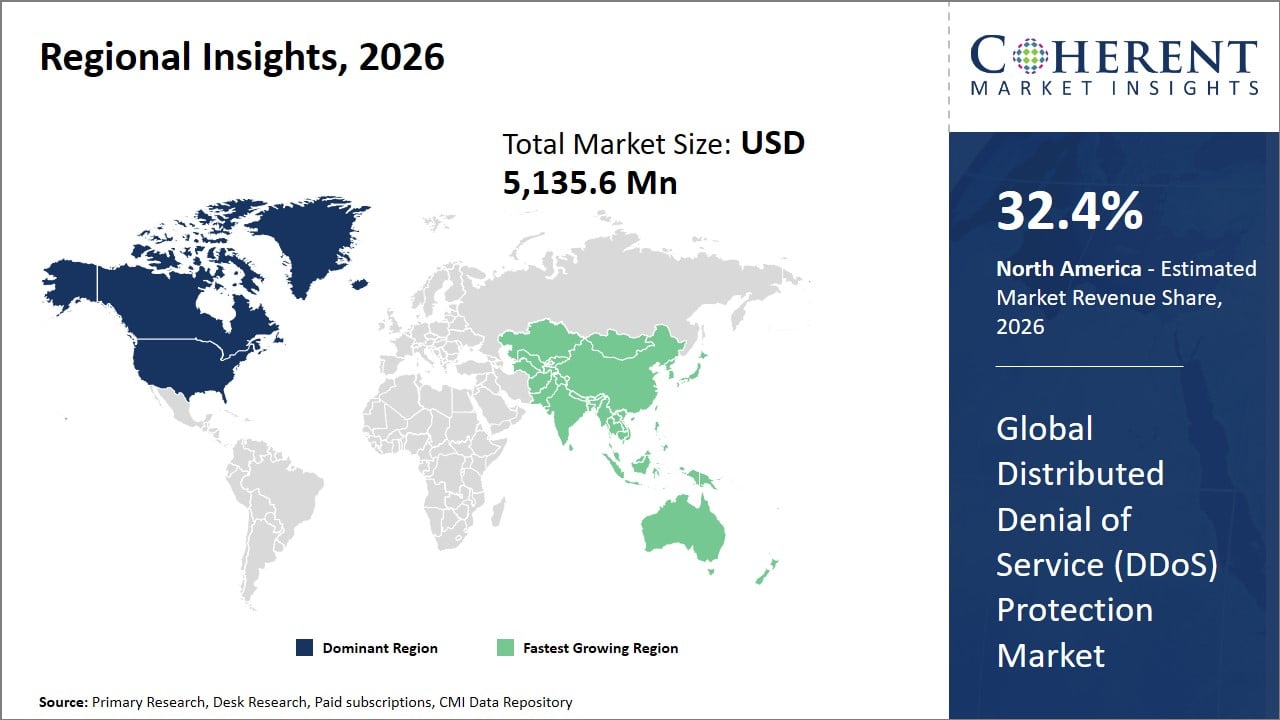
- North America is expected to dominate the distributed denial of service (DDoS) protection market in 2026 with a market share of 32.4%. Most organizations are rapidly migrating towards cloud computing. This digital transformation is a major factor driving the distributed denial of service (DDoS) protection market in North America. On Aprill 22, 2026, Google rolled out new artificial intelligence computing accelerators at its cloud computing event. Companies using Google's new agentic cloud platform include Home Depot, Unilever, PepsiCo, Fair Price Group and eBay. (Source: Investors Business Daily)
- Asia Pacific is expected to account for 27.6% share in 2026 and is projected to record the fastest growth over the forecast period. The introduction of several data protection laws in the region is expected to drive the adoption of DDoS protection services in Asia Pacific. On November 15, 2025, India put new privacy rules into force that will obligate Meta, Google, OpenAI, and other companies minimize the collection of personal data and give people more control over their information. The rules, akin to the broader goals of the European Union's landmark GDPR privacy law, come as countries are scrambling to safeguard personal data with the rising adoption of AI. (Source: Republic World)
- Cloud-Based DDoS Protection (DDoS-as-a-Service): Despite rising demand, traditional setups now give way to environments such as Microsoft Azure, Google Cloud, yet also Amazon Web Services. Instead of high-cost on-premise systems, firms opt for recurring access models. With these online tools comes adaptability alongside immediate identification of risks, this frequently shortens response delays.
- Protection for IoT & Critical Infrastructure: A surge in use of IoT devices, both industrial and residential, has created enormous attack surfaces. Primarily, sectors like BFSI, Government and Energy & Utilities are becoming vulnerable to DDoS attacks. The need to secure such high-value systems ensures continuous investments in advanced DDoS protection solutions and services.
Segmental Insights
Why Does Services Segment Dominate the Global Distributed Denial of Service (DDoS) Protection Market?
The Services segment is expected to account for 56% of the global distributed denial of service (DDoS) protection market share in 2026. Services are gaining popularity and widespread adoption owing to a constant increase in the frequency of DDoS attacks. Organizations with high volumes of data and resources need threat intelligence in real-time to mitigate the risk of such attacks. On March 19, 2026, the U.S. Justice Department participated in a court-authorized law enforcement operation to disrupt Command and Control (C2) infrastructure used by the Aisuru, KimWolf, JackSkid and Mossad Internet of Things (IoT) botnets. The operation was conducted simultaneously to law enforcement actions conducted in Canada and Germany, which targeted individuals who operated these botnets. The four botnets launched Distributed Denial of Service (DDoS) attacks targeting victims around the world. Some of these attacks measured approximately 30 Tbps.
(Source: United States Attorney’s Office)
- Current Industry Events of 2026
- Market Size Estimation
- Regional Breakdown
- Competitive Landscape
- Customer Intelligence
- Segmental Analysis
- Pricing Analysis
- Key Market Drivers, Challenges & Future Trends
- Customized Insights Section
Why is Cloud-Based the Most Preferred Deployment Mode?
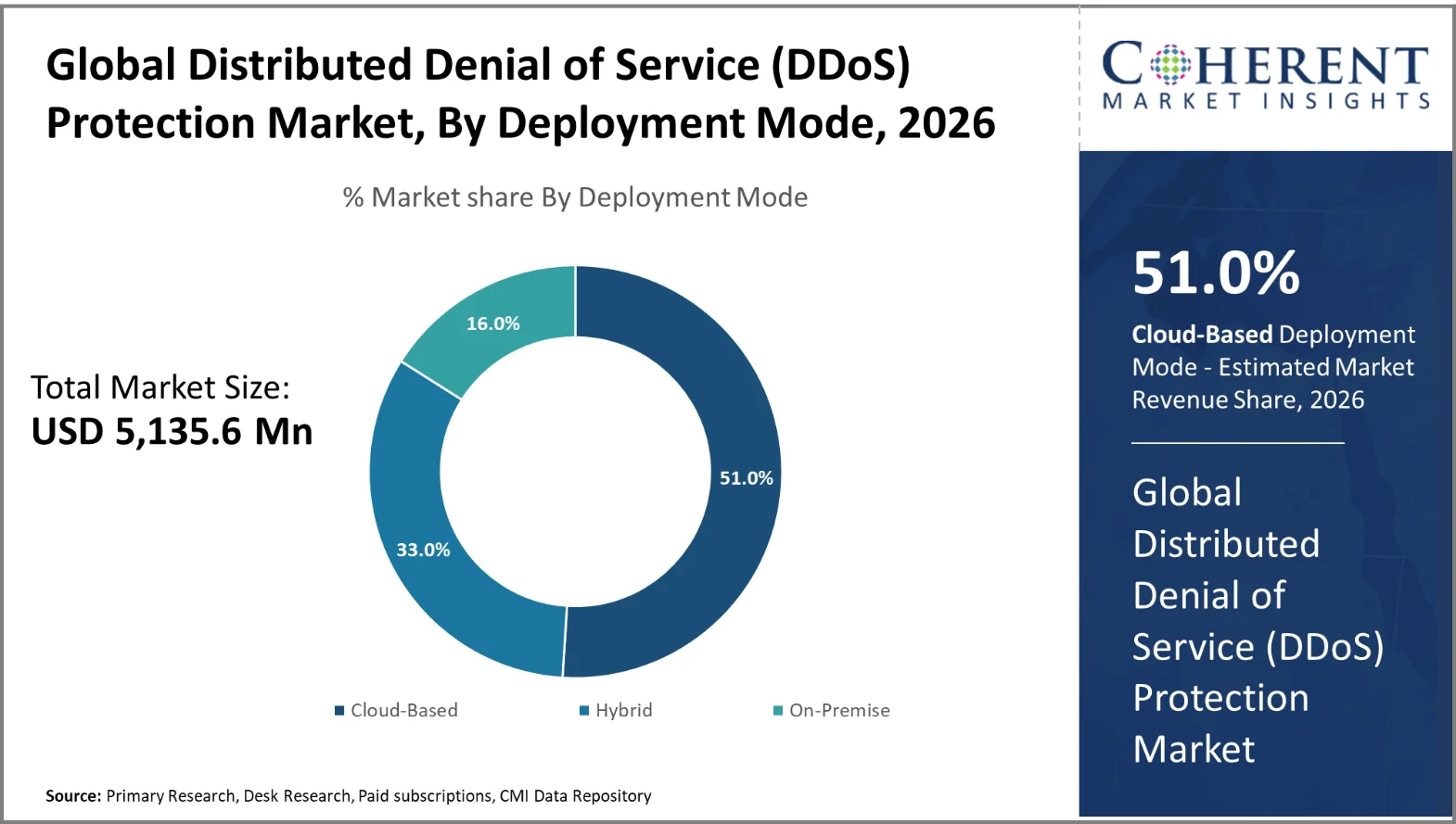
The cloud-based segment is expected to account for 51% of the global distributed denial of service (DDoS) protection market share in 2026. Cloud deployment offers easy to implement, subscription-based models that can be accessed on the go. The real time monitoring and detection provided by cloud-based services are a major factor for companies selecting them over on-premise models. Moreover, the expansion of IoT ecosystem is pushing the demand for cloud deployment. On February 26, 2026, IoT and physical security startup Sprintly raised USD 8 million in a Series A round funding. The funding was led by Accel.
(Source: The Hindu)
Network Layer Protection Segment Dominates the Global Distributed Denial of Service (DDoS) Protection Market
The network layer protection segment is expected to account for 42% of the global distributed denial of service (DDoS) protection market share in 2026. Sectors like BFSI and government are in constant need of multi-layered security systems to prevent the ongoing threat of DDoS attacks. The growing need of network layer protection is also linked to the vulnerabilities of AI systems. Most organizations are now investing heavily to secure their data amidst the international threat of these attacks. On March 3, 2026, a report by Trend Micro revealed a rise in AI-related vulnerabilities, with over 6,000 unique cases identified since 2018, culminating in a record-setting surge in 2025. The AI ecosystem now poses a significant cybersecurity risk. The study’s analysis of 330,239 Common Vulnerabilities and Exposures (CVEs) identified 6,086 unique vulnerabilities disclosed from 2018 to 2025 that directly affect AI systems.
(Source: Trend Micro)
Currents Events and their Impact
Current Events | Description and its Impact |
China - Cybersecurity Law Amendment |
|
Hong Kong - Critical Infrastructure Cybersecurity Law |
|
(Source: China Briefing, OCCICS)
Global Distributed Denial of Service (DDoS) Protection Market Dynamics
Market Drivers
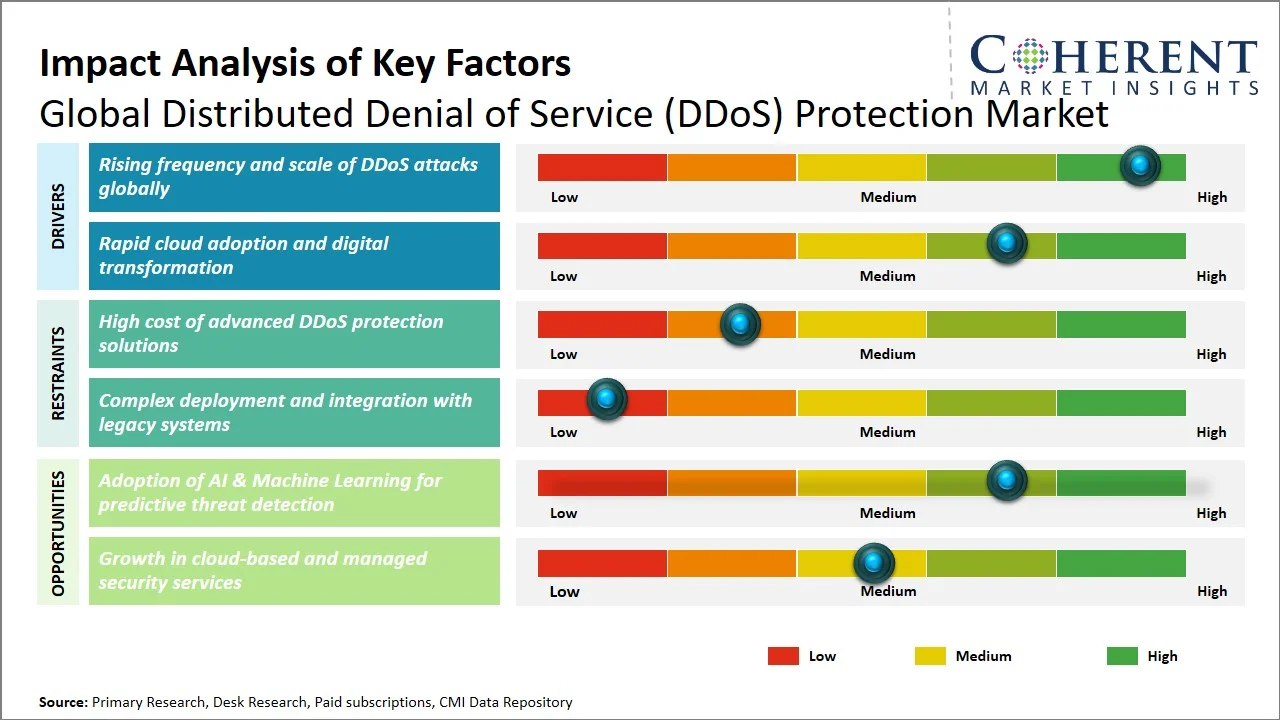
- Rising frequency and scale of DDoS attacks globally: Frequently, DDoS attacks happen across regions due to enhanced botnet capabilities. IoT flaws are now widespread and this expansion runs parallel to the simpler acquisition of digital intrusion tools via web platforms. Rather than basic traffic spikes, today’s disruptions combine network saturation, application overload, and protocol interference. Scale grows rapidly; sophistication climbs steadily through successive waves. Under such stress, routine digital functions endure recurring failures. As a result, many institutions dedicate substantial budgets toward resilient defense systems capable of scaling quickly. Reports show that Network-layer DDoS attacks surged 509% YoY while application-layer attacks rose by 74%. Every minute of DDoS downtime costs an average of USD 22,000 and 89% of DDoS attacks now last under 10 minutes, which signifies a hit and run mentality of attackers, driving the need more real time detection and mitigation even more. (Source: StationX)
- Rapid cloud adoption and digital transformation: Fast movement marks cloud uptake, still its influence on daily operations shows clearer with passing months. Online platforms now handle tasks once managed by older systems, driven by cost efficiency alongside broader access. Where operations occur shapes adoption patterns of adaptable frameworks, yet decisions rely heavily on accumulated insights. Expansion accelerates through industries if tools serve remote locations without intricate setup. When constant connection turns into standard expectation, underlying designs gain heightened relevance. Shifting function delivery reshapes priorities, even as scalability remains a quiet force behind progress. On July 18, 2025, Open AI expanded its multi-cloud as it collaborated with Google Cloud for its ChatGPT service and application programming interface. (Source: Trend Spider)
Emerging Trends
- Shift toward AI-driven, automated multi-layer defense systems: Advanced DDoS attacks are adaptive and multi-vector which has made organizations obligated to use AI/ML based protection system that detect anomalies in real-time and automatically respond to them.
- Convergence of DDoS protection into unified WAAP platforms: The growing use of integrated Web Application and API Protection (WAAP) platforms over standalone tools like WAF, CDN and DDoS protection provides centralized security for APIs, web applications, and cloud infrastructures. This simplifies operations while also providing solid resilience against complex multi-layered DDoS attacks.
Regional Insights
Why is North America a Strong Market for Distributed Denial of Service (DDoS) Protection?
North America is expected to account for a market share of 32.4% in 2026. The growing shift towards cloud computing and digital infrastructure is a major factor driving the growth of the North America distributed denial of service (DDoS) protection market. On January 3, 2025, Microsoft announced plans to invest approximately USD 80 billion to build out AI-enabled datacenters to train AI models and deploy AI and cloud-based applications around the world. More than half of this total investment will be in the U.S. In 2024, Microsoft announced that it intended to invest more than USD 35 billion in 14 countries within three years to build trusted and secure AI and cloud datacenter infrastructure. (Source: Microsoft)
Why Does Asia Pacific Distributed Denial of Service (DDoS) Protection Market Exhibit High Growth?
Asia Pacific is expected to account for a market share of 27.6% in 2026 and is expected to register the fastest growth rate over the forecast period. The introduction of several data protection laws and compliance guidelines are major factor driving the growth of the Asia Pacific distributed denial of service (DDoS) protection market. In November 2025, the Government of India notified the Digital Personal Data Protection (DPDP) Rules, 2025. This marks the full operational initiation of the Digital Personal Data Protection Act, 2023 (DPDP Act). Together, the Act and the Rules form a clear and citizen-centered framework for the responsible use of digital personal data. They place equal weight on individual rights and lawful data processing (Source: PIB). Moreover, In June 2025, the Singapore PDPC and CSA issued a joint advisory to clarify that NRIC numbers should not be misused for authentication1. Common examples of misuse include using NRIC numbers (whether in full or part) as default passwords, whether on their own or together with other easily obtainable personal data such as names and birth dates. (Source: PDPC)
Why is U.S. Emerging as a Major Hub in the Distributed Denial of Service (DDoS) Protection Market?
Focused on the U.S., expansion in DDoS protection stems from large-scale cloud systems, operated by AWS, Google Cloud, and Microsoft Azure - that support critical business and government functions. Even before deadlines arrive, movement forward persists though certain dangers still demand caution. As speed is not the only factor, changing threats gradually expose how protections are structured. Over watchful periods, improvements appear faintly, especially within organizations such as Akamai, Cloudflare, and Palo Alto. Despite delays elsewhere, clarity grows where control stays tight. As mandates affect essential services, changes enter foundational tech without delay. Under strain, advancement holds its course - never stopping, never slowing.
Is the China the Next Growth Engine for the Distributed Denial of Service (DDoS) Protection Market?
Across China, increasing number of people are using the internet, which increases interest in DDoS safeguards. As more devices connect, concern over security grows just as fast. Because laws like the Cybersecurity Law and PIPI require stricter controls, firms start using enhanced safeguards. Rather than simple barriers, some opt for solutions that identify risks amid heavy data movement. Because cloud tools improve, driven forward by firms like Alibaba Cloud and Tencent Cloud, operations shift faster. As banking setups break, gaming links fade, or essential functions stumble, reactions start to adapt. With incidents rising in frequency, readiness creeps forward - not by decision, but by demand. Under these conditions, protective technologies gain relevance across critical sectors. While digital progress continues, so does the need for robust network shielding methods.
Germany Distributed Denial of Service (DDoS) Protection Market Analysis and Trends
Growth within Germany’s DDoS protection sector gains momentum due to widespread digital operations alongside dense networks of finance and communications centered in cities including Frankfurt and Munich - common focal points for complex, layered cyber assaults. Instead of relying solely on traditional defenses, businesses along with firms like Akamai and Cloudflare now employ artificial intelligence and machine learning tools capable of examining data flows instantly while triggering countermeasures during massive disruptions. With increasing numbers of organizations moving services to cloud platforms, while linking industrial equipment through online networks under national digital transformation plans, vulnerability to attacks rises continuously, prompting both public institutions and private firms to adopt flexible, durable security responses. Government agencies find themselves adjusting alongside enterprises as threat landscapes evolve.
Progress in defending against DDoS attacks moves quicker in India than in many developing nations, due to more digital data moving daily. With UPI networks processing heavier loads, and large operators such as Flipkart and Amazon India expanding activities, pressure grows on security setups. Major cloud providers like AWS, Microsoft Azure, Google Cloud, are extending services deeper into local hubs like Hyderabad and Mumbai. Because of this shift, businesses lean toward integrated cloud-based protection instead of relying only on traditional hardware devices. Even though volume-heavy attacks persist, frequent disruptions at the app layer now often target fintech services.
Distributed Denial of Service (DDoS) Protection Market - Attack Volume, Intensity & Evolution Metrics
Metric | 2024 | 2025 |
Total DDoS attacks | ~14–20 Mn | 47.1 million attacks |
Quarterly attack surge | ~3–5 Mn/quarter | 20.5M attacks in Q1 alone |
Network-layer attacks share | ~60–70% | 78% of all attacks |
Multi-vector attack share | ~15–20% | 29% to 83% increase |
Hyper-volumetric attacks (Tbps scale) | 1–5 Tbps typical | Up to 31.4 Tbps record attack |
Attack frequency (per hour | ~2,000–3,000 | 5,376 attacks/hour (Cloudflare avg.) |
Application/API attacks growth | Emerging | 43% API DDoS growth |
How is Adoption of AI & Machine Learning for Predictive Threat Detection Creating New Growth Opportunities in the Global Distributed Denial of Service (DDoS) Protection Market?
Use of artificial intelligence in defending against DDoS attacks opens fresh paths for expansion, allowing services like Cloudflare and Akamai Technologies to move beyond simple reaction toward forecasting threats through spotting unusual traffic flow ahead of full escalation. Now emerging are systems shaped by vast records of network behavior, recognizing odd shifts by analyzing statistical variance rather than relying on preset thresholds. On April 23, 2026, Google unveiled a broad push toward agentic, AI-driven defense at Google Cloud Next 2026 to help SOC analysts as they scramble to keep up with the influx of CVEs Mythos threatens. Google unveiled new capabilities focused on automating detection, accelerating response, and securing the increasingly messy intersection of AI, cloud, and third-party ecosystems. (Source: CSO)
Market Players, Key Development, and Competitive Intelligence
Key Developments
- On February 26, 2025, NETSCOUT SYSTEMS, INC. has enhanced its Arbor Threat Mitigation System with new AI and machine learning capabilities to improve its resilience against distributed denial of service (DDoS) attacks. This update comes amidst a 55% increase in such attacks targeting IT infrastructure and services over the past four years.
- On June 6, 2024, Nokia unveiled an expanded set of Distributed Denial of Service (DDoS) mitigation capabilities of its Defender Mitigation System (7750 DMS-1) through advanced DDoS countermeasures. These countermeasures allow the DMS to meet the growing demands of communications service providers (CSPs) and large digital enterprises to fight the latest generations of DDoS attacks with improved efficiency and cost efficiency.
Competitive Landscape
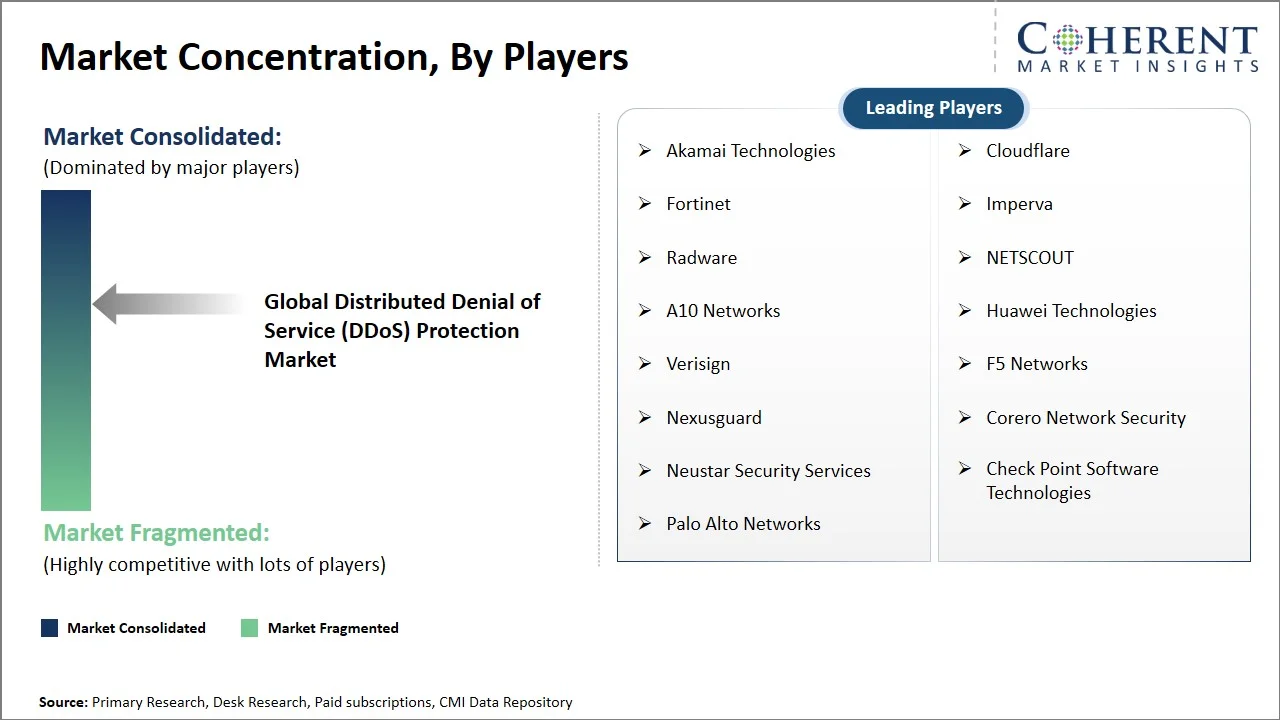
Worldwide competition grows stronger within DDoS defense as major names in digital safety and infrastructure extend operations. While companies like Cloudflare and Akamai Technologies hold firm ground, so does Amazon Web Services - each relying on vast cross-border systems paired with built-in protective measures. Despite differing approaches, geographic scale and unified safeguards remain central to their standing. Their edge emerges not just from size but from advanced functions, threat identification powered by artificial intelligence appears alongside layered defenses covering network traffic, app behavior, along with API access points. At the same time, niche cybersecurity vendors and telecom providers are focusing on managed security services and specialized enterprise solutions, intensifying competition through innovation and service differentiation.
Market Report Scope
Distributed Denial of Service (DDoS) Protection Market Report Coverage
| Report Coverage | Details | ||
|---|---|---|---|
| Base Year: | 2025 | Market Size in 2026: | USD 5,135.6 Mn |
| Historical Data for: | 2020 To 2024 | Forecast Period: | 2026 To 2033 |
| Forecast Period 2026 to 2033 CAGR: | 13.7% | 2033 Value Projection: | USD 12,615.8 Mn |
| Geographies covered: |
| ||
| Segments covered: |
| ||
| Companies covered: | Akamai Technologies, Cloudflare, Fortinet, Imperva, Radware, NETSCOUT, A10 Networks, Huawei Technologies, Verisign, F5 Networks, Nexusguard, Corero Network Security, Neustar Security Services, Check Point Software Technologies, and Palo Alto Networks | ||
| Growth Drivers: |
| ||
| Restraints & Challenges: |
| ||
Analyst Opinion (Expert Opinion)
- The distributed denial of service (DDoS) protection market is evolving into a mission-critical cybersecurity segment as analysts observe a sharp rise in multi-terabit, multi-vector attacks and AI-powered botnets, forcing enterprises to move from traditional filtering tools to AI-driven, cloud-native mitigation platforms. Recent industry data and incidents show that attack frequency and complexity are accelerating, making real-time automation, predictive analytics, and edge-based scrubbing essential for enterprise resilience. This change affects how vendors compete. Now built into cloud platforms are DDoS defenses, formed by working alongside leading security companies. Not separate utilities anymore, such shields arise within broader operating structures. With tighter links across layers, clear separations among components fade gradually. Once independent elements sink inward via persistent coordination.
- Emerging patterns in DDoS defense increasingly follow paths shaped by machine learning, particularly through tools able to anticipate attacks prior to activation. As cloud environments grow, alongside mixed networks combining on-site and off-site resources, change becomes a constant feature of operations. Despite appearances, progress here does not rely on speed alone but rather predictive accuracy refined over time. Owing to this, automated responses are seen more often in shielding operations. At present, attack volumes reach extremes never recorded earlier, several surpassing a trillion bits transmitted each second. Meanwhile, clusters of hijacked machines multiply at rising speed throughout different areas. Should circumstances remain unchanged, expansion may continue through the 2030s at notable annual percentages. Firms often turn instead to external oversight tools paired with rigid entry controls enforcing constant validation.
Speak to the analyst
Want personalized insights?
Take the findings above to one of our principal consultants, or have the report rebuilt around the segments, geographies and competitors you actually track.
Market Segmentation
- Component Insights (Revenue, USD Million, 2021 - 2033)
- Services
- Software
- Hardware
- Deployment Mode Insights (Revenue, USD Million, 2021 - 2033)
- Cloud-Based
- Hybrid
- On-Premise
- Application Insights (Revenue, USD Million, 2021 - 2033)
- Network Layer Protection
- Application Layer protection
- Database Protection
- Endpoint Security
- End User Insights (Revenue, USD Million, 2021 - 2033)
- BFSI
- IT & Telecom
- Government & Defense
- Healthcare
- Retail & E-commerce
- Media & Entertainment
- Others
- Regional Insights (Revenue, USD Million, 2021 - 2033)
- North America
- U.S.
- Canada
- Latin America
- Brazil
- Argentina
- Mexico
- Rest of Latin America
- Europe
- Germany
- U.K.
- Spain
- France
- Italy
- Russia
- Rest of Europe
- Asia Pacific
- China
- India
- Japan
- Australia
- South Korea
- ASEAN
- Rest of Asia Pacific
- Middle East
- GCC Countries
- Israel
- Rest of Middle East
- Africa
- South Africa
- North Africa
- Central Africa
- North America
- Key Players Insights
- Akamai Technologies
- Cloudflare
- Fortinet
- Imperva
- Radware
- NETSCOUT
- A10 Networks
- Huawei Technologies
- Verisign
- F5 Networks
- Nexusguard
- Corero Network Security
- Neustar Security Services
- Check Point Software Technologies
- Palo Alto Networks
Sources
Primary Research Interviews
- Chief Information Security Officers (CISOs) from Fortune 500 companies
- Network Security Engineers from leading telecommunications providers
- Product Managers from DDoS protection solution vendors
- IT Infrastructure Directors from cloud service providers
Magazines
- Dark Reading Magazine
- SC Magazine (Security Magazine)
- Information Security Magazine
- Cybersecurity & Infrastructure Security Magazine
Journals
- IEEE Security & Privacy Journal
- Journal of Network and Computer Applications
- Computers & Security Journal
Associations
- Cloud Security Alliance (CSA)
- Internet Security Alliance (ISA)
- Anti-Phishing Working Group (APWG)
- Forum of Incident Response and Security Teams (FIRST)
Public Domain Sources
- U.S. Department of Homeland Security Cybersecurity Reports
- NIST Cybersecurity Framework Documentation
- European Network and Information Security Agency (ENISA) Reports
- Akamai State of the Internet Security Reports
Proprietary Elements
- CMI Data Analytics Tool
- Proprietary CMI Existing Repository of information for last 10 years
Get access to 250+ pages report
Every segment, forecast, competitor profile and data table behind the analysis above — available for instant download.
- ESOMAR Member
- ISO 9001:2015 Certified
- D-U-N-S Registered
- GDPR & CCPA Compliant
Missing comfort of reading report in your local language? Find your preferred language:
Transform your Strategy with Exclusive Trending Reports
Frequently Asked Questions
The global distributed denial of service (DDoS) protection market is expected to stand at USD 5,135.6 Mn in 2026 and is expected to reach USD 12,615.8 Mn by 2033.
The CAGR of the global distributed denial of service (DDoS) protection market is projected to be 13.7% from 2026 to 2033.
Rising frequency and scale of DDoS attacks globally and rapid cloud adoption and digital transformation are the major factors driving the growth of the global distributed denial of service (DDoS) protection market.
High cost of advanced DDoS protection solutions and complex deployment and integration with legacy systems are the major factors hampering the growth of the global distributed denial of service (DDoS) protection market.
In terms of component, services segment is estimated to dominate the market revenue share in 2026.
AI helps detect abnormal traffic patterns and predict attacks before they fully escalate.
Many IoT devices have weak security and can be easily converted into botnets.