

Distributed Control Systems Market Analysis & Forecast
Distributed Control Systems Market is estimated to be valued at USD 44.74 Bn in 2026 and is expected to reach USD 68.62 Bn in 2033, exhibiting a compound annual growth rate (CAGR) of 6.3% from 2026 to 2033.
Key Takeaways
- On the basis of Component, Hardware segment is projected to account about 46% shares in the global market during the forecast period.
- Based on Region, North America is expected to hold around 35% shares in the global distributed control system market in 2026.
Market Overview
The global distributed control systems market is expected to witness significant growth during the forecast period owing to various factors. These include growing adoption of automation in industrial sectors, increasing demand for power, and rising investments in the power generation sector. Moreover, increased adoption of internet-based DCS is anticipated to accelerate the market growth.
Current Events and Its Impact on the Distributed Control Systems Market
Event | Description and Impact |
Global Digital Transformation and Industry 4.0 Acceleration |
|
Energy Sector Transition and Infrastructure Modernization |
|
Geopolitical Tensions and Supply Chain Disruptions |
|
Role of Technologies like AI on the Distributed Control Systems Market
Artificial Intelligence is quietly transforming Distributed Control Systems by adding a layer of smarts that makes factories feel more autonomous. By weaving machine learning, predictive analytics, and neural networks into traditional setups, todays DCS platforms can adjust on the fly, flag maintenance needs before they become costly, and steer processes for maximum efficiency. Major suppliers are racing to embed these tools because the value is clear. ABBs Ability platform, for instance, modifies control strategies in real time based on incoming data, while Honeywells Forge lets refineries forecast wear-and-tear and fine-tune operating conditions, trimming unscheduled outages.
Schneider Electrics EcoStruxure Foxboro DCS spots anomalies and tunes loops automatically, delivering 8-15 percent energy savings and halving process variability in some plants. Such gains ease budgets, cut emissions, and make work environments safer because problems are flagged long before they escalate. With Industry 4.0 in full swing, AI-driven DCS is shifting from optional upgrade to must-have backbone for scalable, intelligent manufacturing.
- Current Industry Events of 2026
- Market Size Estimation
- Regional Breakdown
- Competitive Landscape
- Customer Intelligence
- Segmental Analysis
- Pricing Analysis
- Key Market Drivers, Challenges & Future Trends
- Customized Insights Section
Pricing Analysis
The worldwide distributed control system market stood at around USD 18.5 billion in 2023 and follows a modular costing model built on hardware, software, engineering services, and ongoing support. As a result, total project budgets for medium to large plants can differ sharply, landing anywhere between USD 1.8 million and USD 15 million; exact figures hinge on vendor choice, system complexity, and installation size. Major cost drivers are: - Hardware (controllers, I/O modules): USD 25,000-75,000 each controller, USD 800-3,500 per I/O module - Software licenses (HMI, advanced control): USD 15,000-60,000 each license; high-end applications can top USD 300,000 - Engineering services: Custom design, setup, and start-up - Support contracts: Annual maintenance and upgrades, usually 15-20 percent of total cost Vendor snapshot: - Honeywell Experion PKS: USD 2.5 million-15 million (top-tier security and uptime) - Emerson DeltaV: USD 2 million-12 million (intuitive interface, long-term value) - ABB 800xA: USD 1.8 million-10 million (broad integration options) - Schneider Foxboro Evo: aimed at budget-sensitive clients seeking solid ROI Emerging pricing models include cloud-hosted DCS and subscription plans, which lower upfront spending while giving mid-size facilities room to scale as needed.
Segmental Insights
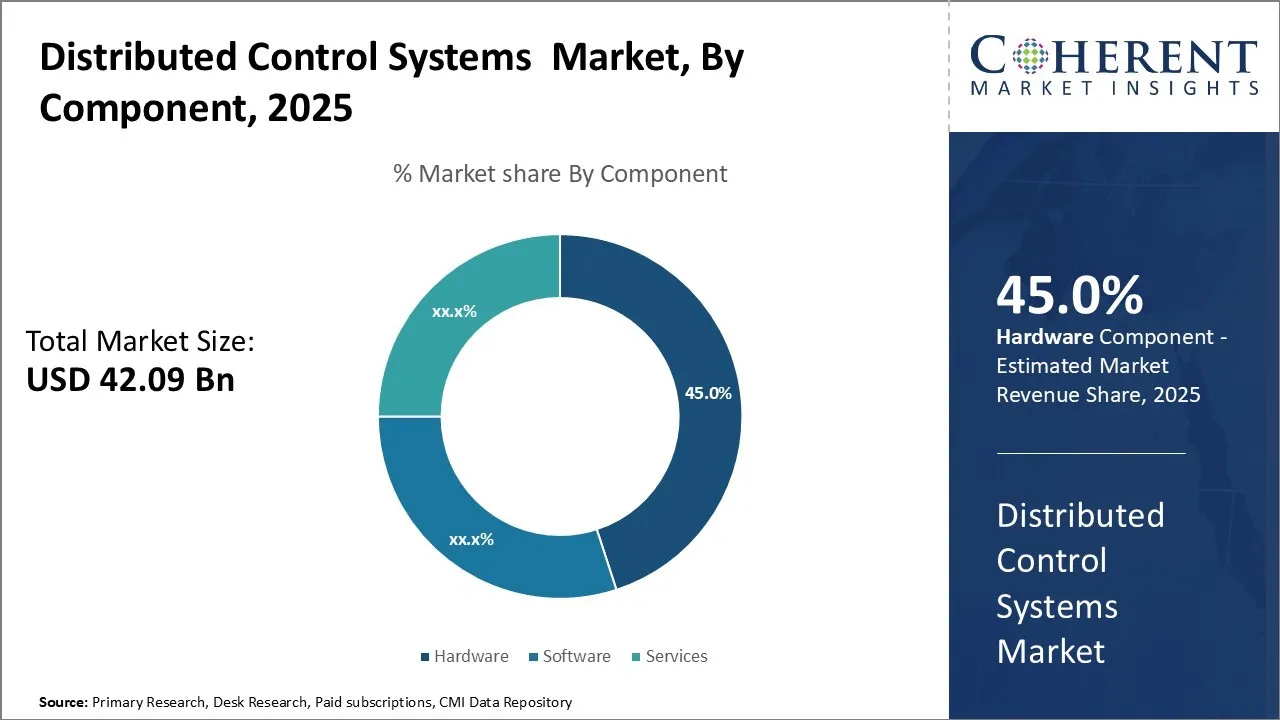
Distributed Control Systems Market Insights, By Component
In terms of component, the hardware segment is expected to lead the global distributed control systems (DCS) market with the share of 46.0% throughout the forecast period. Hardware has continued to lead the distributed control system market because these physical components are crucial for keeping operations running smoothly and reliably over large production sites. As facilities grow larger-especially in power-generation, chemical-manufacturing, and oil-refining industries-the demand for controllers, input-output cards, and field instruments remains consistently high and shows no signs of slowing. At the same time, the software side is set to grow quickly too, mainly because modern programs are cheaper, easier to adapt, and work well with many different devices. Stand-alone software packages allow plants to connect every system across the site while giving workers a single, clear screen to work from. That unifying view cuts costs and improves performance, which explains why more operators are choosing software-friendly designs in their DCS upgrades.
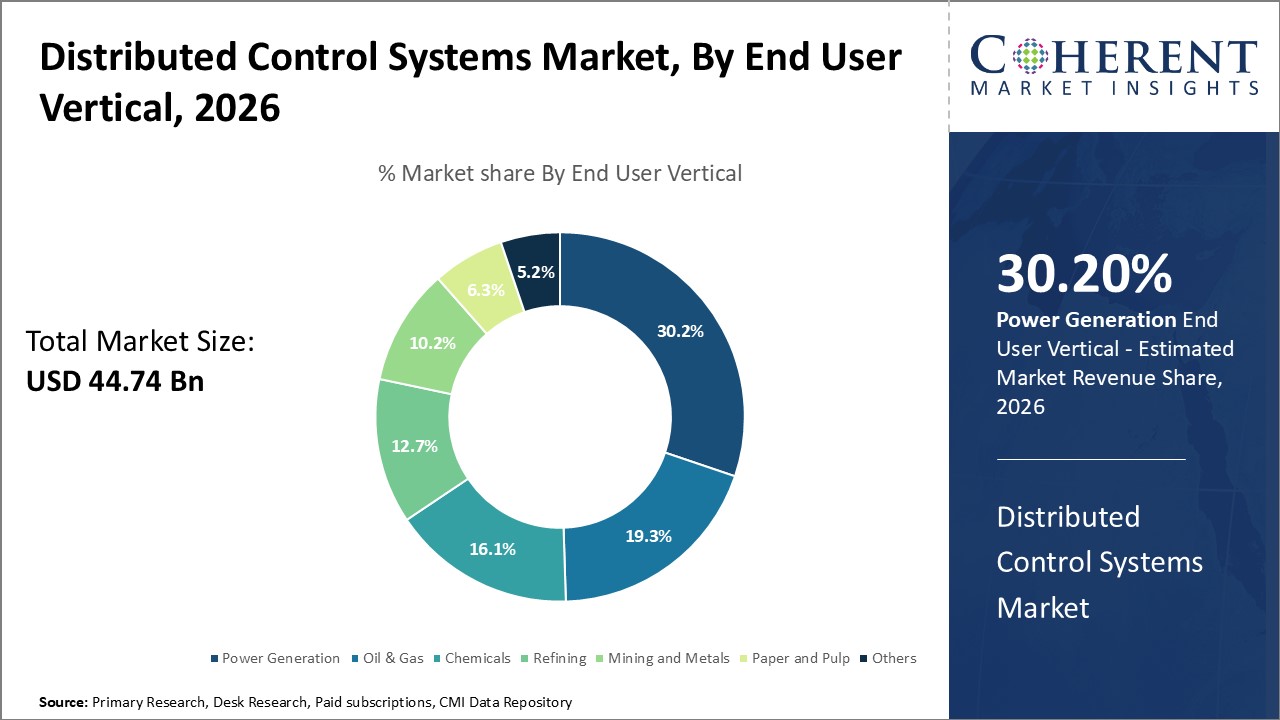
Distributed Control Systems Market Insights, By End User Vertical
Among end-user sectors, the power-generation segment is projected to lead the DCS market as global energy demand soars and the shift toward renewables picks up speed. Distributed control systems provide real-time management and optimization in plants, boosting both scalability and reliability. The oil-and-gas industry should also see robust growth, propelled by greater automation across upstream and downstream activities. In many emerging economies, rising energy use further intensifies the call for integrated control systems throughout the sector.
Global Distributed Control Systems Market: Regional Insights
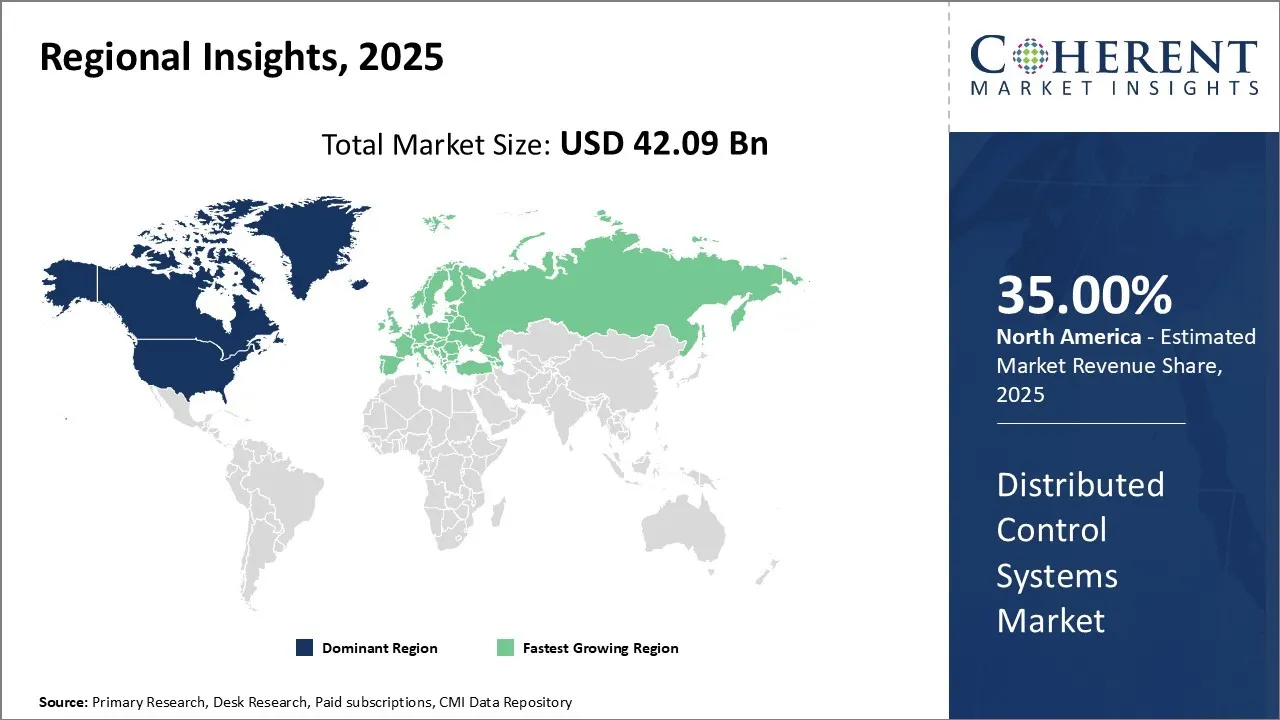
North America Distributed Control Systems Market Analysis and Trends
North America is projected to exhibit strong growth in the global distributed control systems (DCS) market over the forecast period, driven primarily by the rapid expansion of the shale gas industry. The region’s industrial automation efforts are closely tied to the rising need for robust process controls in high-risk environments such as oil and gas fields.
According to Coherent Market Insights, shale gas production surged from just 1% of total gas output in 2000 to 20% in 2010 and is expected to reach 45% by 2035.
This unprecedented growth in the energy sector is fueling demand for tightly integrated DCS technologies, which offer enhanced sustainability, real-time monitoring, and improved safety across critical operations. Furthermore, North American manufacturers are increasingly investing in advanced automation systems to boost productivity and meet stringent environmental regulations.
Asia Pacific Distributed Control Systems Market Analysis and Trends
Asia Pacific is anticipated to be the fastest-growing market for distributed control systems, supported by the region’s rapidly expanding industrial base. Factors such as abundant raw material reserves, pro-industry government policies, a vast labor pool, and growing domestic demand are accelerating manufacturing growth in countries like China, India, and Southeast Asia.
This surge in industrial activity is leading to increased adoption of automation technologies, including DCS solutions that optimize production, minimize downtime, and ensure quality control. As industries shift toward smart manufacturing, DCS deployment is becoming integral to achieving scalability and operational efficiency across sectors such as chemicals, power generation, and pharmaceuticals.
Dominating Countries in the Distributed Control Systems Market
United States Distributed Control Systems Market Analysis and Trends
The United States dominates the North American DCS market due to its robust shale gas exploration activities and advanced industrial infrastructure. Energy companies are increasingly adopting DCS to manage complex operations, ensure regulatory compliance, and enhance operational safety. Investments in automation and digital transformation—particularly in the oil & gas, power, and chemicals sectors—are driving sustained demand for DCS platforms.
China Distributed Control Systems Market Analysis and Trends
China is a key growth engine in the Asia Pacific DCS market, supported by its massive manufacturing ecosystem and government initiatives promoting industrial modernization. The country’s aggressive push toward intelligent factories and Industry 4.0 adoption is fostering widespread implementation of DCS across various verticals. Strategic investments in automation to meet global export standards are expected to further strengthen China’s role in the global DCS landscape.
Market Report Scope
Distributed Control Systems Market Report Coverage
| Report Coverage | Details | ||
|---|---|---|---|
| Base Year: | 2025 | Market Size in 2026: | USD 44.74 Bn |
| Historical Data for: | 2020 To 2024 | Forecast Period: | 2026 To 2033 |
| Forecast Period 2026 to 2033 CAGR: | 6.3% | 2033 Value Projection: | USD 68.62 Bn |
| Geographies covered: |
| ||
| Segments covered: |
| ||
| Companies covered: | ABB Group, Yokogawa Electric Company, Honeywell International Inc., Toshiba, Siemens AG, Azbil Corporation, Schneider Electric, Novatech LLC, Mitsubishi Electric, Omron Corporation, Rockwell Automation, METSO, and Emerson Electric Company | ||
| Growth Drivers: |
| ||
| Restraints & Challenges: |
| ||
Global Distributed Control Systems Market Drivers
- Rise in demand for energy across developing countries to boost the market growth
The demand for energy from emerging economies, especially from the BRICS countries is likely to fuel the expansion of oil and gas, power, and related sectors that are one of the major end user industries of distributed control systems. BRICS countries that are Brazil, Russia, India, China, and South Africa are culturally as well as economically diverse countries; however, all these countries have a common aim that the rapid growth and development of energy industry.
These nations are known to be among the top energy-consuming countries accounting currently for nearly 35% of the overall energy consumption. Thus, growing demand for energy in these countries is likely to fuel the need for DCSs, which is further anticipated to drive the market growth over the forecast future.
- Increasing adoption for smart applications to fuel the market pace
In recent years, manufacturing facilities and factories around the world are gradually adopting automation equipment to enable high level efficiency and performance. With the emergence of smart-field devices as well as analysis tools, the process automation sector is witnessing a paradigm shift in the sector.
The smart field devices are capable of automating some testing protocols. Thus, adoption of smart applications is growing across these industries, which in turn is creating demand for distributed control systems. These factor are further expected to drive growth of the global distributed control systems market during the forecast period.
Global Distributed Control Systems Market Opportunities
Rise in investment in processing and manufacturing industry is likely to bring multiple growth opportunities in the global distributed control systems market during the forecast period. The adoption of DCS systems is growing rapidly due to rise in investments from industrial sectors such as mining and metal, metallurgy, electronics, and food and beverage industry in emerging economies.
The distributed control systems have networking capabilities that can be used in process management and the inputs or outputs can be discrete or analog signal in the processing and manufacturing industries further enhancing the operational efficiency. This in turn will drive the demand for distributed control systems across these industries, which is expected to provide market players with several opportunities.
Use of IoT in oil and gas industry for real-time decision making is expected to provide market players with major business opportunities in the global distributed control systems market during the forecast period. Industries such as power, metal and mining, chemicals, and oil and gas are old industries and with technological development, the manufacturing processes among these industries are improved with advent of systems such as PLC, DCS, and SCADA.
The oil and gas industry can redefine its coverage through adoption of automation equipment. The adoption of distributed control systems is growing among manufacturers in oil and gas industry to accelerate the production and exploration processes. Thus, the global distributed control systems market is likely to witness major opportunities in the near future.
Global Distributed Control Systems Market Trends
- The services segment among components is gaining traction in the market
Key players in the market are increasingly emphasizing on expansion of capabilities for both project services and maintenance and operation services to continue their market expansion. The services segment of distributed control systems includes project management services, retrofits, non-contract maintenance, and upgrades.
With increasing number of providers of distributed antenna systems services, the service segment is gaining traction in the market. This in turn is likely to drive the demand for the segment in the market over the forecast future.
- Growing clean energy and renewable power generation demand is a recent trend in the market
The urbanization and industrialization are rapidly growing all over the world, along with it the demand for energy. The production of renewable power has now been enabled at large scale all over the world in order to cater the rising demand for energy, and increasingly depleting fossil fuel. Solar and wind plants in number are growing in several regions.
Thus, the use of distributed control system in solar field with local controller panels offers strong and highly reliable solutions. As a result, the demand for DCS systems is likely to increase in the near future.
Analyst Viewpoint: Distributed Control Systems Market
- The DCS market is gaining strong traction, fueled by industrial automation trends and the need for real-time, efficient process control in sectors such as oil & gas, chemicals, power generation, and pharmaceuticals.
- Adoption is accelerating as manufacturers seek improved operational efficiency, regulatory compliance, and enhanced plant safety through integrated control systems.
- Advanced technologies like AI, machine learning, and IIoT are transforming DCS platforms into intelligent, predictive, and self-optimizing systems.
- High upfront costs and complex deployment requirements continue to limit adoption among small and mid-sized enterprises.
- Cybersecurity concerns remain a critical barrier as DCS platforms become more interconnected and data-driven.
- Asia-Pacific is the fastest-growing region, supported by large-scale industrialization, infrastructure expansion, and increasing automation in countries such as China and India.
- North America holds a leading position due to its advanced industrial base and early adoption of smart automation technologies.
- The shift toward Industry 4.0, smart factories, and digital transformation presents significant growth opportunities for DCS providers.
- Demand for sustainable and energy-efficient operations is pushing industries toward more intelligent control solutions.
- Emerging trends such as cloud-based DCS models and edge computing are creating new pathways for scalable, flexible, and remote monitoring applications.
Global Distributed Control Systems Market: Key Developments
- In May 2025, Siemens launched its next-generation DCS platform with integrated AI-based diagnostics and real-time cybersecurity enhancements, targeting energy and chemical manufacturing facilities.
- In April 2025, Emerson introduced a cloud-enabled version of its DeltaV DCS system, allowing remote monitoring and optimization for oil & gas plants in remote or hazardous locations.
- In March 2025, ABB partnered with Microsoft to embed AI and edge computing into its DCS offering, enabling predictive control and analytics in smart factories.
- In February 2025, Yokogawa released a fortified version of its CENTUM VP DCS system with built-in zero-trust architecture to address increasing industrial cybersecurity threats.
- In January 2025, Honeywell expanded its Experion DCS portfolio by integrating with third-party IIoT platforms, facilitating seamless data exchange for advanced process automation.
Market Segmentation
- Global Distributed Control Systems Market, By Component (Revenue, USD Bn, 2021 - 2033)
- Hardware
- Software
- Services
- Global Distributed Control Systems Market, By End User Vertical (Revenue, USD Bn, 2021 - 2033)
- Power Generation
- Oil & Gas
- Chemicals
- Refining
- Mining and Metals
- Paper and Pulp
- Others
- Global Distributed Control Systems Market, By Region (Revenue, USD Bn, 2021 - 2033)
- North America
- U.S.
- Canada
- Latin America
- Brazil
- Argentina
- Mexico
- Rest of Latin America
- Europe
- Germany
- U.K.
- Spain
- France
- Italy
- Russia
- Rest of Europe
- Asia Pacific
- China
- India
- Japan
- Australia
- South Korea
- ASEAN
- Rest of Asia Pacific
- Middle East
- GCC Countries
- Israel
- Rest of Middle East
- Africa
- South Africa
- North Africa
- Central Africa
- North America
- Company Profiles
- ABB Group
- Honeywell International Inc.
- Siemens AG
- Schneider Electric
- Mitsubishi Electric
- Rockwell Automation
- Emerson Electric Company
- METSO
- Omron Corporation
- Novatech LLC
- Azbil Corporation
- Toshiba
- Yokogawa Electric Company
Sources
Primary Research Interviews
- Control System Engineers and Technical Specialists
- DCS Vendors and Solution Providers
- Plant Operations Managers and Process Engineers
- System Integrators and Automation Consultants
- Others
Databases
- IHS Markit Industrial Automation Database
- Frost & Sullivan Process Control Systems Database
- ARC Advisory Group Industrial Automation Database
- Global Industry Analysts Database
- Others
Magazines
- Control Engineering Magazine
- InTech Magazine (ISA)
- Automation World Magazine
- Process Engineering Magazine
- Others
Journals
- IEEE Transactions on Control Systems Technology
- Control Engineering Practice Journal
- Journal of Process Control
- Others
Newspapers
- Industrial Automation News
- Control & Instrumentation International
- Manufacturing Business Technology
- Plant Engineering News
- Others
Associations
- International Society of Automation (ISA)
- Control System Integrators Association (CSIA)
- PROFIBUS & PROFINET International (PI)
- Industrial Internet Consortium (IIC)
- Others
Public Domain Sources
- U.S. Department of Energy Industrial Reports
- International Energy Agency (IEA) Industrial Publications
- National Institute of Standards and Technology (NIST) Guidelines
- European Commission Industrial Automation Reports
- Others
Proprietary Elements
- CMI Data Analytics Tool
- Proprietary CMI Existing Repository of information for last 8 years
*Definition: A distributed control system (DCS) is a type of industrial automation that is used to manage all the components in a plant. This is a powerful tool that consists of a centralized control center and a network of automated local controllers that connect to it via high-speed communication networks. It is also very reliable and provides a safe operating environment for everyone in the plant.
Get access to 250+ pages report
Every segment, forecast, competitor profile and data table behind the analysis above — available for instant download.
- ESOMAR Member
- ISO 9001:2015 Certified
- D-U-N-S Registered
- GDPR & CCPA Compliant
Missing comfort of reading report in your local language? Find your preferred language:
Transform your Strategy with Exclusive Trending Reports
Frequently Asked Questions
The Distributed Control Systems Market size is estimated to be valued at USD 44.74 Bn in 2026, and is expected to reach USD 68.62 Bn by 2033.
The CAGR of the global Market is projected to be 6.3% from 2026 to 2033.
Rise in demand for energy across developing countries and increasing adoption for smart applications are fuelling the market.
The hardware segment is the leading component segment in the market.
Availability of alternative technologies in the process automation field and increasing concerns regarding security and rise in cost competition are the major factors restraining growth of the market.
ABB Group, Yokogawa Electric Company, Honeywell International Inc., Toshiba, Siemens AG, Azbil Corporation, Schneider Electric, Novatech LLC, Mitsubishi Electric, Omron Corporation, Rockwell Automation, METSO, and Emerson Electric Company.