

Entity Management Software Market Size and Forecast — 2026-2033
The Global Entity Management Software Market is expected to be valued at USD 9.73 Bn in 2026 and reach USD 22.50 Bn by 2033, exhibiting a compound annual growth rate (CAGR) of 15.0% from 2026 to 2033.
Key Takeaways of the Global Entity Management Software Market:
- The cloud-based segment is expected to lead the market holding a share of 63.7% in 2026.
- The financial services segment is projected to dominate with a share of 29.2% in 2026.
- North America is expected to lead the market with a share of 48.6% in 2026. Asia Pacific, holding a share of 28.7% in 2026, is projected to be the fastest growing region.
Market Overview:
The entity management software market is witnessing significant growth due to the rising demand for digitalization and centralized data storage across various industries. Owing to advantages like improved data governance and streamlined compliance workflows, more organizations are adopting entity management solutions. Additionally, increasing investments by software providers to integrate advanced technologies like AI and machine learning in their offerings are favoring the market growth. However, data security challenges and high initial costs associated with the implementation and maintenance of entity management platforms can hamper the adoption rate among smaller enterprises. Overall, the expanding Banking, Financial Services, and Insurance (BFSI) and healthcare industries which require robust entity data management are creating ample growth opportunities for entity management software vendors globally.
Deployment Type Insights
Deployment Type Insights - Cloud-based Segment Dominates Due to Flexibility and Scalability
The cloud-based segment is expected to account for the largest share of 63.7% in the global entity management software market in 2026. This is primarily due to the increased flexibility and scalability that cloud deployment offers over traditional on-premise solutions. With cloud-based software, customers can access their applications from any internet-connected device without having to install and maintain the infrastructure on their own servers. This allows for much greater mobility and ensures seamless collaboration between teams located in different geographic regions.
Additionally, cloud solutions are highly scalable. Customers only pay for the resources they use, allowing them to easily scale up or down as their needs change over time. There is no need to overprovision hardware or pay upfront license fees for maximum potential usage. Systems can flexibly accommodate fluctuations in user numbers, data volumes, and processing power requirements. This on-demand, pay-as-you-go model promises significant cost savings compared to on-premise alternatives with large upfront capital outlays and ongoing maintenance fees.
Automatic software updates are another advantage of cloud deployment. Vendors take care of implementing the latest features, fixes, and security patches behind the scenes without any disruption to live operations. Customers always have access to the most current version of the software. Data is also securely backed up in the cloud with redundancies to prevent loss. Overall, the operational efficiencies and increased agility delivered through cloud-based solutions are compelling factors driving their popularity over on-premise options.
End-use Industry Insights
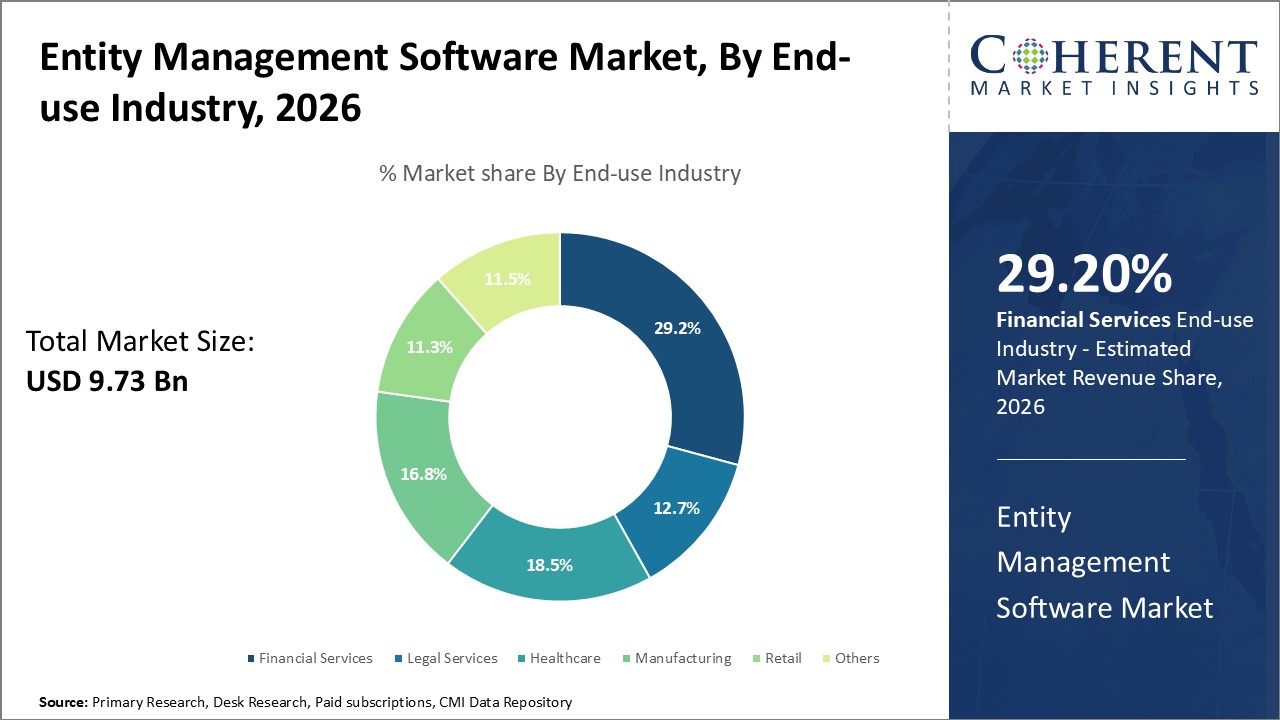
End-use Industry Insights - Financial Services Dominate Due to Robust Compliance Requirements
Within various end-use industries utilizing entity management software, the financial services segment is expected to account for the largest share of 29.2% in 2026. Complex regulations and the need for stringent compliance are major drivers behind this prominent position. Financial institutions deal with huge volumes of customer data and must adhere to strict privacy and security standards. Entity data management solutions efficiently track entities like customers, prospects, suppliers, and ensure all personally identifiable information remains confidential and protected.
Similarly, regulations like Know Your Customer (KYC), Anti-money Laundering (AML), and Counter Terrorist Financing (CTF) impose robust due diligence requirements on financial organizations. Entity software streamlines processes for onboarding new clients, monitoring existing relationships, and reporting any suspicious activity. It brings transparency to entity hierarchies, relationships, and ownership structures. This comprehensive entity data governance is critical for demonstrating regulatory compliance and mitigating financial and reputational risks.
Given the severe penalties for non-compliance in the financial industry, institutions prioritize technologies that support adherence to mandates from governing bodies. Entity management tools effectively address these priorities through centralized entity data management, standardized workflows, and auditable records of all entity-related activities. Their abilities to automate compliance processes and enable risk-based monitoring of high-risk entities has made them particularly attractive to the financially-regulated sector.
Regional Insights
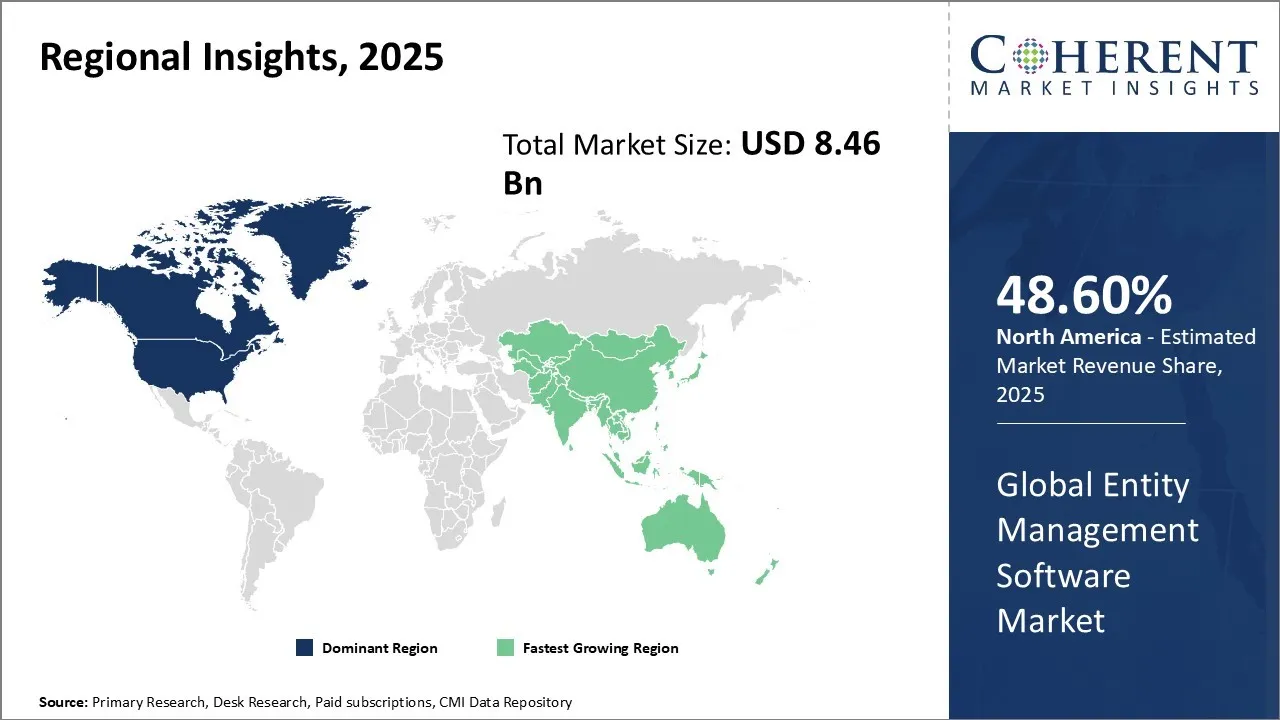
North America Entity Management Software Market Trends
North America, holding a share of 48.6% in 2026, is expected to dominate the global entity management software market, benefitting from early adoption of technologies and the presence of major players. Countries like the U.S. and Canada have seen widespread deployments across sectors owing to advanced digital infrastructure and industry presence. Notably, companies like IBM, Oracle, and SAP have dominated the market with their comprehensive product offerings catering to diverse business needs. Meanwhile, growing demand for intelligent solutions has led to the emergence of startups focusing on specific entity types or domains.
Asia Pacific Entity Management Software Market Trends
The Asia Pacific region, holding a share of 28.7% in 2026, is expected to exhibit the fastest growth in the global entity management software market. Rapid digital transformation initiatives by governments, such as India’s Digital India Programme, are driving adoption in the region. Countries like China and India have large customer bases in lucrative sectors such as BFSI, manufacturing, and IT & telecom.
Global Entity Management Software Market Outlook for Key Countries
China Entity Management Software Market Trends
China is poised for strong gains in the coming years. State-backed modernization programs, such as the Made in China 2026 Initiative, emphasize tech adoption across industries. Local giants like UCloud and Kingsoft are at the forefront, targeting Small and Medium-sized Businesses (SMBs) with affordable Software as a Service (SaaS)-based offerings. Joint ventures with global majors will see strengthen product portfolios and service capabilities.
India Entity Management Software Market Trends
India is set to experience robust growth in the entity management software market in the coming years. Government-led digitalization efforts, notably the Digital India initiative, are accelerating tech adoption across sectors. This program emphasizes e-governance, online regulatory compliance, and digital infrastructure for businesses. Domestic players, along with tech giants like Zoho and RazorpayX, are actively targeting Small and Medium-sized Enterprises (SMEs) with affordable, cloud-based entity and compliance management solutions.
U.S. Entity Management Software Market Trends
The U.S. global entity management software market leads in terms of spending and demand for advanced capabilities. Government mandates around data privacy and protection have accelerated deployments, along with reforms in healthcare and finance industries. IBM remains at the forefront with its integrated governance and master data management platforms. Startups bring new-age approaches around distributed ledger and AI-based solutions.
Germany Entity Management Software Market Trends
Germany is characterized by strong focus on quality and reliability. Manufacturers rely on entity solutions for supply chain traceability and compliance. SAP dominates with its localized offerings tailored for Industry 4.0 needs. Recently, Advaris has emerged as an innovator in the quality and compliance management domain through cloud-native implementations.
Market Players, Key Development, and Competitive Intelligence
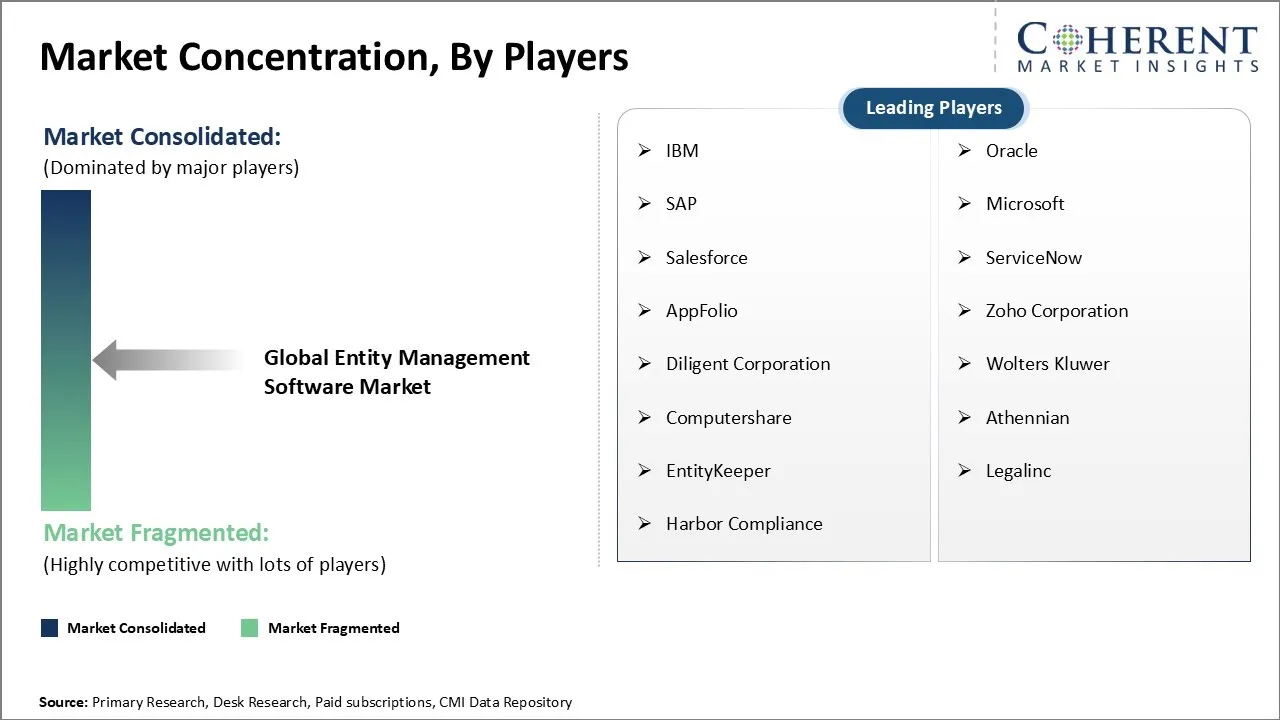
Key Developments:
- In March 2022, Athennian, a business entity management technology company, completed its Series B funding round, raising USD 33 million (CAD 42 million)
- In April 2021, Diligent Corporation, a modern governance company, completed its acquisition of Galvanize, a global leader in SaaS governance, risk, and compliance (GRC) software.
Top Strategies Followed by Global Entity Management Software Market Players
- Established Players: Leading companies focus on end-to-end compliance solutions, strategic acquisitions, and AI-enhanced governance platforms to maintain dominance and expand enterprise adoption.
- For example, Diligent Corporation launched an integrated Governance, Risk, and Compliance (GRC) platform that incorporates AI-based insights, real-time reporting, and compliance automation to support large enterprises. Additionally, Wolters Kluwer acquired eOriginal to strengthen its digital compliance offerings, combining entity management with secure digital transaction technologies.
- Mid-level Players: Mid-sized firms emphasize regional expansion, multi-entity support features, and integrations with legal and accounting software to broaden market reach and improve platform utility.
- For instance, Athennian expanded its presence in North America by adding enterprise-grade integrations with DocuSign and iManage, targeting law firms and corporate legal teams. Similarly, EntityKeeper enhanced its software to support global entity structuring and compliance tracking, appealing to mid-market corporations with growing international footprints.
- Small-scale Players: Smaller companies differentiate through niche targeting, simplified platforms for SMEs, and rapid onboarding experiences that emphasize affordability and ease of use.
- For example, Harbor Compliance introduced a compliance calendar tool specifically designed for small nonprofits and startups, helping them avoid missed deadlines. Meanwhile, Legalinc launched an automated business formation and registered agent service targeting small law firms and solo practitioners, offering low-cost, API-accessible solutions to streamline client onboarding and compliance.
Emerging Startups - Entity Management Software Industry Ecosystem
- Cloud-Native Architecture: Startups are designing platforms from the ground up with a cloud-first approach to ensure scalability, real-time collaboration, and seamless integrations.
- Athennian offers a fully cloud-based entity management platform that allows legal teams to collaborate across jurisdictions and departments. Its cloud-native design supports real-time document collaboration and automated workflows.
- EntityKeeper provides centralized access to corporate entity data, ensuring transparency and real-time updates via its secure cloud infrastructure, designed specifically for multi-entity organizations.
- Automation-First Solutions: Automation is central to reducing manual errors, streamlining entity lifecycle management, and improving compliance reporting.
- Diligent Entities uses automation to manage compliance obligations, track deadlines, and update corporate records, significantly reducing the manual effort for legal departments.
- Harbor Compliance integrates automated workflows into its software for business licensing and annual reporting, ensuring clients stay compliant without needing to track deadlines manually.
- SME-Focused Accessibility: Startups are building solutions tailored for small to mid-sized enterprises that require affordable yet robust tools to manage multiple legal entities.
- Kleos by Wolters Kluwer offers simplified legal practice and entity management tools for small firms in Europe, with easy onboarding and pay-as-you-go pricing.
- Goverlan Reach provides SMEs with cost-effective governance and compliance tools, allowing small teams to handle the same complexity typically reserved for enterprise-grade solutions.
- Current Industry Events of 2026
- Market Size Estimation
- Regional Breakdown
- Competitive Landscape
- Customer Intelligence
- Segmental Analysis
- Pricing Analysis
- Key Market Drivers, Challenges & Future Trends
- Customized Insights Section
Market Report Scope
Entity Management Software Market Report Coverage
| Report Coverage | Details | ||
|---|---|---|---|
| Base Year: | 2025 | Market Size in 2026: | USD 9.73 Bn |
| Historical Data for: | 2020 To 2024 | Forecast Period: | 2026 To 2033 |
| Forecast Period 2026 to 2033 CAGR: | 15.0% | 2033 Value Projection: | USD 22.50 Bn |
| Geographies covered: |
| ||
| Segments covered: |
| ||
| Companies covered: | IBM, Oracle, SAP, Microsoft, Salesforce, ServiceNow, AppFolio, Zoho Corporation, Diligent Corporation, Wolters Kluwer, Computershare, Athennian, EntityKeeper, Legalinc, and Harbor Compliance | ||
| Growth Drivers: |
| ||
| Restraints & Challenges: |
| ||
Market Dynamics
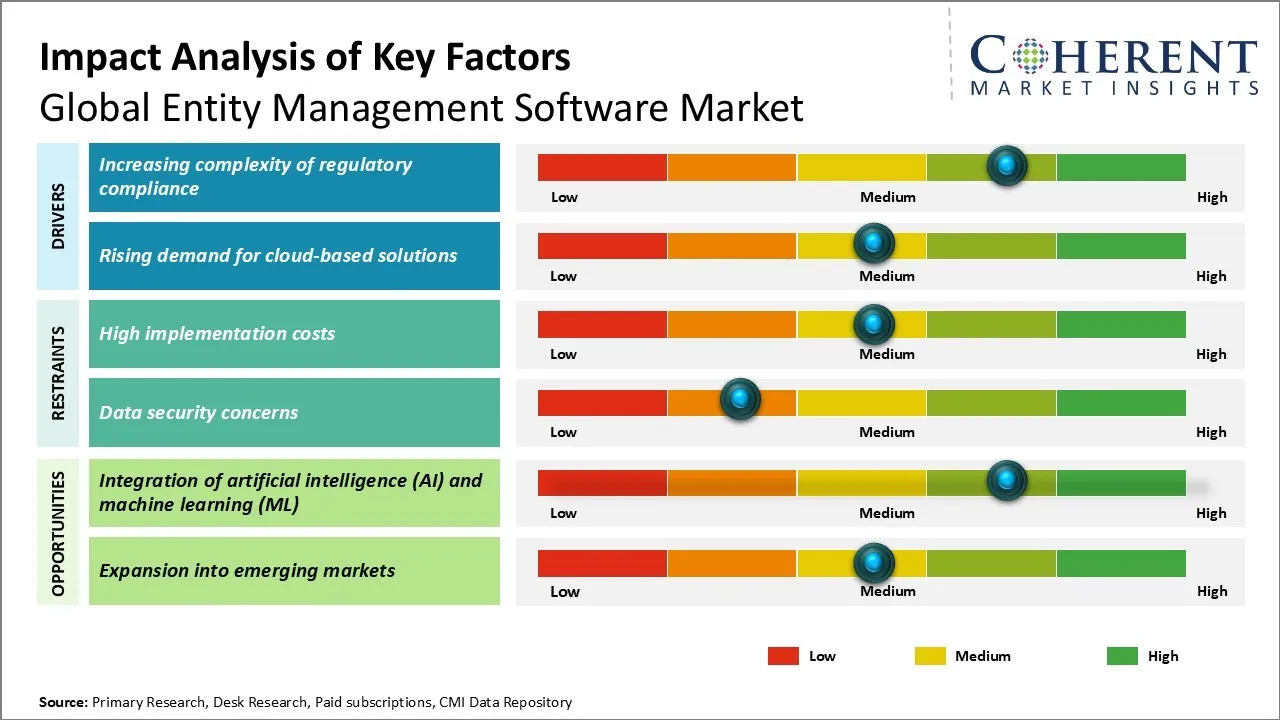
Global Entity Management Software Market Driver - Increasing complexity of regulatory compliance
With the constantly evolving regulatory landscape, businesses today are facing increasing complexity in ensuring adherence to various compliances. Be it privacy laws like GDPR, industry-specific regulations, or financial reporting standards - the regulatory environment that businesses operate in has become multifaceted in recent years. Maintaining compliance has become challenging with processes becoming more distributed and organizational boundaries blurring. This is leading many organizations to invest in entity management software that can help achieve regulatory compliance in an efficient, timely, and cost-effective manner. Such software enables companies to have enhanced visibility and control over their legal entity structures, ownership information, licenses, and permits in different geographies. They also provide capabilities for risk assessment and ongoing monitoring of changes to regulations. This helps automate previously manual processes and ensures businesses are aware of their obligations to avoid any non-compliance issues that could lead to heavy penalties.
Global Entity Management Software Market Challenge - High implementation costs
One of the key challenges faced by the global entity management software market is the high implementation costs associated with these solutions. Entity management software requires significant investments to purchase licenses, deploy the required infrastructure, integrate it with existing legacy systems, customize it as per business requirements, and train employees on how to use the new platform effectively. For many small and medium enterprises, the upfront capital expenditure and total cost of ownership of entity management software can be quite prohibitive. Even for large enterprises, the implementation process is often complex and lengthy, requiring specialized expertise and manpower. All these implementation costs contribute to longer payback periods for such software investments. Additionally, the need for recurring subscription and maintenance fees over the years further increases the overall expenditure. Unless the promised productivity gains and cost savings are realized quickly after deployment, high implementation costs can pose serious budgetary challenges for organizations.
Global Entity Management Software Market Opportunity - Integration of artificial intelligence (AI) and machine learning (ML) for entities
One of the major opportunities for the global entity management software market lies in further integrating artificial intelligence and machine learning capabilities within these solutions. As entities and their relationships grow increasingly complex across organizations, there is a need for software that can help automatically extract useful insights from vast amounts of entity data in a more intuitive manner. Vendors are focusing on developing AI-powered functionalities for entity resolution, relationship mapping, risk assessment, and other advanced analytics. Leveraging machine learning, entity management platforms can continuously learn from patterns in historical data and user behavior. This helps improve areas like data quality, compliance monitoring, fraud detection, and personalized recommendations over time without much human intervention. The integration of AI/ML allows entities to be managed more intelligently and keeps the software relevant in the evolving digital landscape. It also helps drive greater adoption among customers looking for more automated solutions.
Analyst Opinion (Expert Opinion)
- The entity management software market is expected to witness robust growth over the coming years, driven by the increasing complexity of corporate governance, cross-border operations, and growing regulatory demands. The demand for centralized platforms that streamline compliance, document management, and corporate recordkeeping is accelerating, especially among multi-entity organizations.
- A key challenge that could hinder market expansion is the concern over data security and confidentiality, especially for cloud-based platforms. Enterprises are cautious about hosting sensitive corporate data on third-party servers without strong assurances of compliance with data protection laws such as General Data Protection Regulation (GDPR) and California Consumer Privacy Act (CCPA).
- North America is projected to maintain its leadership position in the market, supported by the early adoption of legal tech solutions and the strong presence of major players like Diligent, Wolters Kluwer, and IBM. The Asia Pacific region, on the other hand, is poised to emerge as the fastest-growing market due to rapid digitalization, the expansion of multinational firms, and increased focus on governance in emerging economies.
Speak to the analyst
Want personalized insights?
Take the findings above to one of our principal consultants, or have the report rebuilt around the segments, geographies and competitors you actually track.
Market Segmentation
- Deployment Type Insights (Revenue, USD Bn, 2021 - 2033)
- Cloud-based
- Web-based
- End-use Industry Insights (Revenue, USD Bn, 2021 - 2033)
- Financial Services
- Legal Services
- Healthcare
- Manufacturing
- Retail
- Others
- Regional Insights (Revenue, USD Bn, 2021 - 2033)
- North America
- U.S.
- Canada
- Latin America
- Brazil
- Argentina
- Mexico
- Rest of Latin America
- Europe
- Germany
- U.K.
- Spain
- France
- Italy
- Russia
- Rest of Europe
- Asia Pacific
- China
- India
- Japan
- Australia
- South Korea
- ASEAN
- Rest of Asia Pacific
- Middle East
- GCC Countries
- Israel
- Rest of Middle East
- Africa
- South Africa
- North Africa
- Central Africa
- North America
- Key Players Insights
- IBM
- Oracle
- SAP
- Microsoft
- Salesforce
- ServiceNow
- AppFolio
- Zoho Corporation
- Diligent Corporation
- Wolters Kluwer
- Computershare
- Athennian
- EntityKeeper
- Legalinc
- Harbor Compliance
Get access to 250+ pages report
Every segment, forecast, competitor profile and data table behind the analysis above — available for instant download.
- ESOMAR Member
- ISO 9001:2015 Certified
- D-U-N-S Registered
- GDPR & CCPA Compliant
Missing comfort of reading report in your local language? Find your preferred language:
Transform your Strategy with Exclusive Trending Reports
Frequently Asked Questions
The global entity management software market is expected to be valued at USD 9.73 Bn in 2026 and reach USD 22.50 Bn by 2033.
The CAGR of the global entity management software market is projected to be 15.0% from 2026 to 2033.
Increasing complexity of regulatory compliance and rising demand for cloud-based solutions are the major factors driving the growth of the global entity management software market.
High implementation costs and data security concerns are the major factors hampering the growth of the global entity management software market.
In terms of deployment type, the cloud-based segment is estimated to dominate the market revenue share in 2026.
IBM, Oracle, SAP, Microsoft, Salesforce, ServiceNow, AppFolio, Zoho Corporation, Diligent Corporation, Wolters Kluwer, Computershare, Athennian, EntityKeeper, Legalinc, and Harbor Compliance are the major players.
North America is expected to lead the global entity management software market in 2026, holding a share of 48.6%.