

Electronic Access Control Systems Market Size and Forecast – 2026 to 2033
The global electronic access control systems market is estimated to be valued at USD 12.65 Bn in 2026 and is expected to reach USD 22.10 Bn by 2033, exhibiting a compound annual growth rate (CAGR) of 8.3% from 2026 to 2033.
Key Takeaways
- By Process Type, Authentication Systems hold the largest market share of 43.9% in 2026 owing to the rising security threats & compliance requirements.
- By Sales Channel, Direct Sales expected to hold largest market share of 48.3% in 2026 owing to its complexity of solutions and high-touch sales needs.
- By End User, Government acquired the prominent market share in 2026 owing to the critical infrastructure protection & national security.
- By Region, North America dominates the overall market with an estimated share of 39.1% in 2026 owing to the early technology adoption & mature infrastructure.
Market Overview
Increasing security concerns, technological innovation, and the need for efficient identity management are driving steady growth in the Electronic Access Control Systems market. Organizations across commercial, government, residential, and industrial sectors are adopting biometric and mobile-based authentication, integrating systems with IoT and cloud platforms, and upgrading existing infrastructure. Continuous investments in smart buildings and modern security frameworks are fueling demand for advanced access control solutions worldwide, enhancing safety measures and streamlining operational efficiency across diverse applications.
Current Events and its Impact on the Electronic Access Control Systems Market
Current Events | Description and its impact |
Geopolitical Tensions and Supply Chain Disruptions |
|
Technological Advancements and Integration Trends |
|
Economic Fluctuations and Market Spending Shifts |
|
Role of AI (Artificial Intelligence) in Electronic Access Control Systems
AI is reshaping electronic access control systems by making them smarter, faster, and more adaptive. Through advanced algorithms, AI enhances identity verification using biometrics such as facial, fingerprint, and behavioral recognition, improving both accuracy and resistance to spoofing. It enables real-time threat detection by analyzing patterns, identifying anomalies, and automating responses to potential security breaches. AI also optimizes system performance by learning traffic patterns, predicting access needs, and reducing false alarms.
In November 2025, Suprema introduced BioStar X, its most advanced unified security platform yet. Built to combine biometric access control and video surveillance in one scalable system, BioStar X aims to transform how organizations handle security across complex, multi-site environments.
- Current Industry Events of 2026
- Market Size Estimation
- Regional Breakdown
- Competitive Landscape
- Customer Intelligence
- Segmental Analysis
- Pricing Analysis
- Key Market Drivers, Challenges & Future Trends
- Customized Insights Section
Segmental Insights
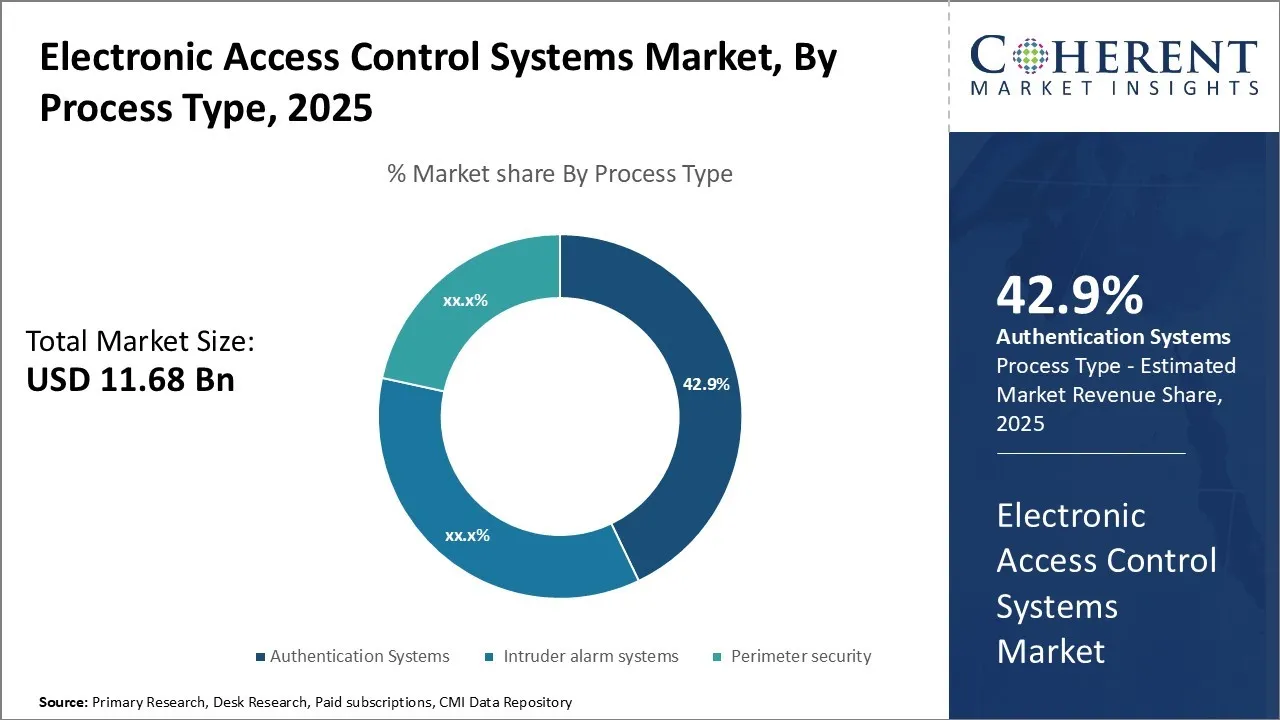
Electronic Access Control Systems Market Insights, By Process Type - Authentication Systems contribute the highest share of the market owing to its integration & system sophistication
Authentication Systems hold the largest market share of 43.9% in 2026. The need for stronger security, advanced identity verification, and seamless user access drives the growth of authentication systems in the Electronic Access Control Systems market. Organizations are increasingly adopting biometric, mobile, and multi-factor authentication solutions to protect physical and digital assets from evolving threats. By integrating these systems with cloud and IoT platforms, they improve real-time monitoring and data accuracy. Furthermore, the growing preference for contactless and efficient access methods is propelling the global adoption of innovative authentication technologies. For instance, in July 2025, Himachal Pradesh became the first Indian state to use Aadhaar-based face authentication (FaceAuth) to distribute rations to eligible beneficiaries under the Public Distribution System (PDS).
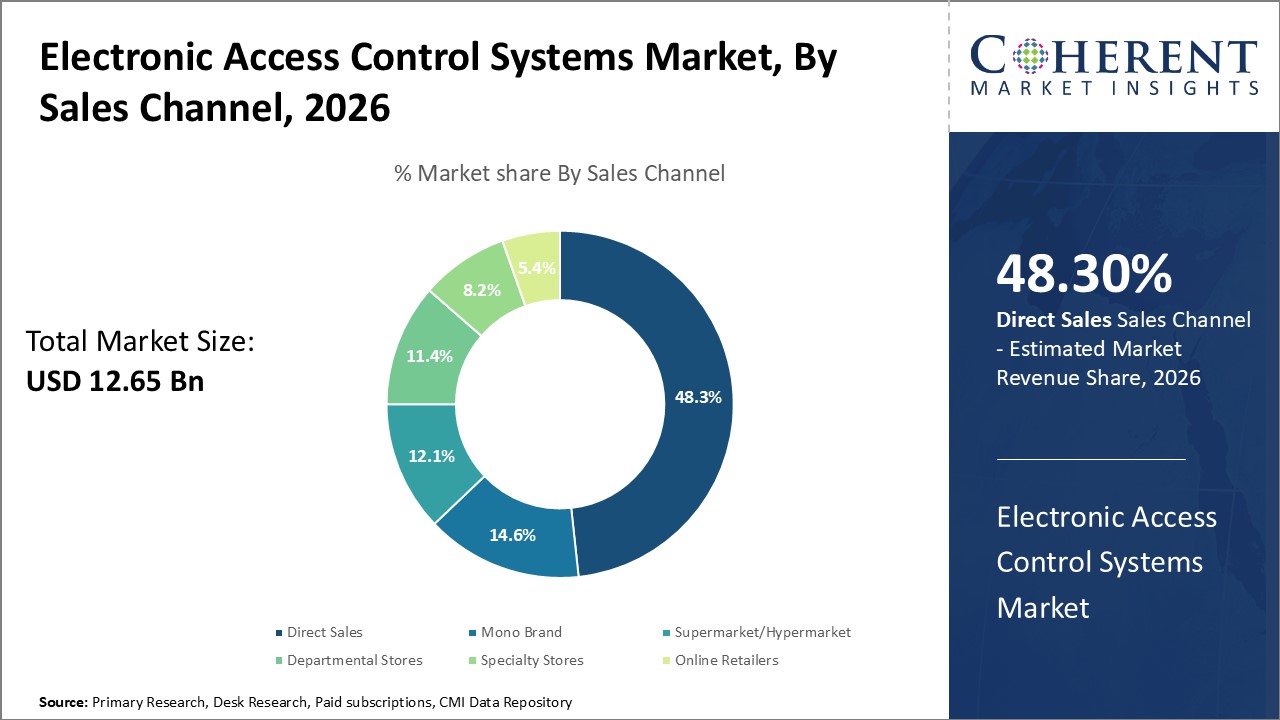
Electronic Access Control Systems Market Insights, By Sales Channel - Direct Sales contribute the highest share of the market owing to its large-scale deployments & strategic clients
Direct Sales expected to hold largest market share of 48.3% in 2026. Growing demand for customized security solutions and stronger customer relationships drives direct sales in the Electronic Access Control Systems market. Manufacturers engage directly with end users to maintain control over pricing, service quality, and system integration. Commercial, government, and industrial projects often require complex installations that demand tailored support and technical expertise. Moreover, vendors leverage digital platforms and remote consultation tools to build long-term partnerships, provide comprehensive solutions, and improve overall customer experience in the evolving security landscape.
Electronic Access Control Systems Market Insights, By End User - Government contributes the highest share of the market owing to its budget allocations & public procurement in security equipment
Public-sector organizations drive the Electronic Access Control Systems market share by prioritizing the security of sensitive facilities, critical infrastructure, and administrative buildings. Regulatory requirements and compliance standards compel agencies to implement advanced access control solutions. Governments also promote the integration of biometric, cloud-based, and mobile authentication systems through smart city initiatives, digital governance, and modern infrastructure projects. Furthermore, growing concerns about public safety, crime prevention, and identity management motivate governments to invest in scalable, efficient, and technologically advanced access control solutions across multiple sites. For instance, in March 2024, Identiv, a digital identity provider for IoT security, has launched ScrambleFactor, a three-factor authentication reader for physical access control. The LCD touchscreen device combines fingerprint biometrics, PIN, RFID, and contact credentials, and meets U.S. federal FICAM and PIV standards for government access control.
Regional Insights
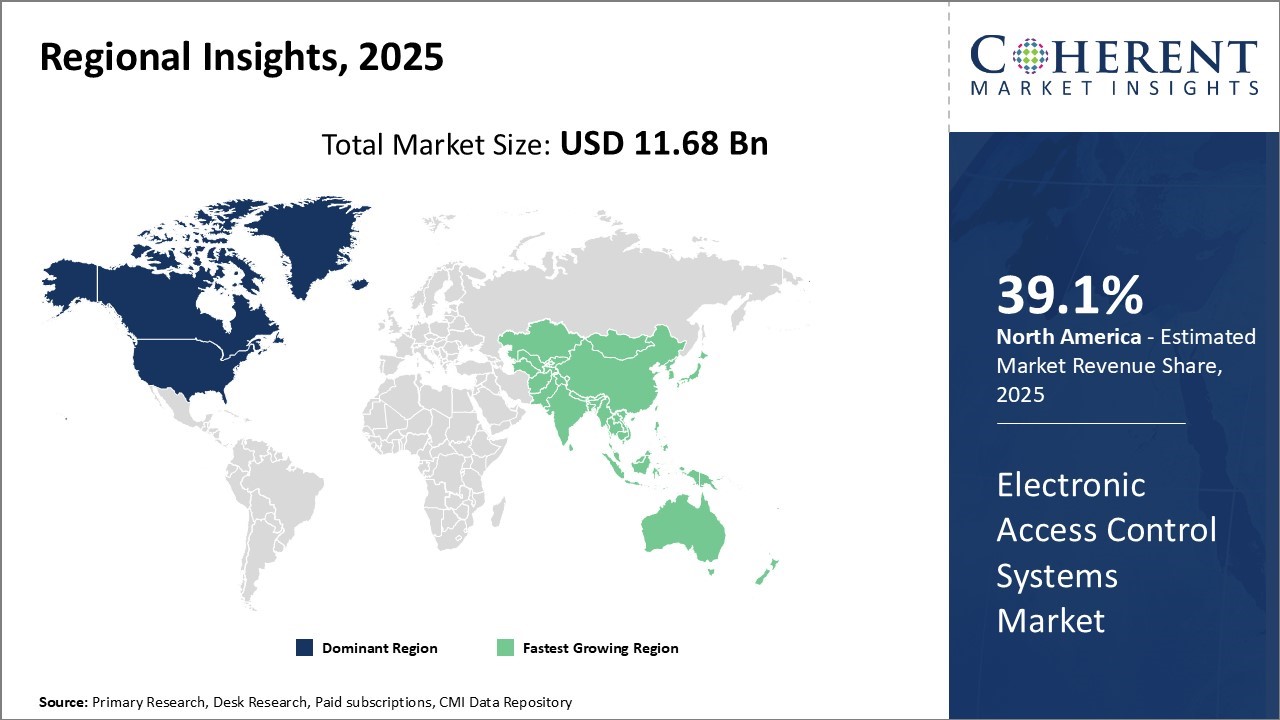
North America Electronic Access Control Systems Market Trends
North America dominates the overall market with an estimated share of 39.1% in 2026. In North America, organizations are driving the electronic access control systems market by adopting cloud-based solutions, mobile credentials, and biometric authentication across commercial, residential, and government facilities. Industry players are combining access control with video surveillance and intrusion detection to deliver unified security platforms. The rise of hybrid work models boosts the use of contactless and remote access features, while heightened security awareness and advanced technological infrastructure encourage faster adoption of modern access control solutions throughout the region. For instance, in November 2026, D-Link North America has introduced the DXS-3130 Series, a Layer-3 stackable managed switch for high-density access and aggregation. It offers 24 10GbE multi-gig ports and 4×25GbE SFP28 uplinks to support Wi-Fi clusters, surveillance, access control, kiosks, and building IoT, with PoE++ and non-PoE options.
Asia Pacific Electronic Access Control Systems Market Trends
In the Asia‑Pacific region, rapid urban expansion, large infrastructure projects, and smart‑city initiatives are driving the electronic access control systems market across countries like China, India, and Australia. Developers and facility owners are increasingly implementing cloud-based and IoT-enabled access solutions, integrating biometrics, mobile credentials, and contactless technologies into residential, commercial, and public-sector buildings. Heightened security awareness, modernization of aging infrastructure, and growing demand for seamless access management are motivating widespread adoption of advanced access control solutions throughout the region. For instance, in October 2026, Razorpay, in partnership with Yes Bank, has launched India’s first RBI-compliant biometric card authentication system. The new Access Control Server (ACS) uses biometric verification and AI-driven risk checks to authenticate transactions.
United States Electronic Access Control Systems Market Trends
In the United States, organizations are driving the electronic access control systems market by adopting mobile credentials, biometric authentication, and cloud-based management across enterprise, residential, and public infrastructures. Industry players are developing unified platforms that combine physical and cyber identity management, while federal funding and regulatory mandates encourage large-scale upgrades. The growth of remote work and smart building initiatives is also prompting investments in touchless, scalable access solutions, enabling centralized oversight and flexible deployment throughout various sectors. For instance, in October 2024, Johnson Controls, a global leader in smart and sustainable buildings, has launched the PENN® System 550, a modular electronic control solution for managing temperature, humidity, and pressure.
China Electronic Access Control Systems Market Trends
In China, organizations are rapidly advancing the electronic access control systems market by implementing AI-driven biometrics, mobile credentials, and IoT-based platforms across commercial, residential, and public sectors. National initiatives promoting smart-city infrastructure and urban modernization are driving the deployment of high-security access solutions. Local vendors are expanding domestic innovation, while growing demand for contactless access and cloud-based management is encouraging widespread adoption to address hygiene concerns and enable efficient remote monitoring.
End-user Feedback and Unmet Needs in the Electronic Access Control Systems Market
- Integration and Compatibility Challenges End users often report difficulties in integrating access control systems with existing security infrastructure, including CCTV, alarms, and building management systems. Legacy systems limit seamless interoperability, forcing organizations to seek unified platforms that support multiple technologies and enable centralized management, analytics, and remote monitoring without operational disruptions.
- User Experience and Accessibility Issues Users desire faster, more intuitive access methods. Traditional keycards and PIN-based systems can be cumbersome, and mobile or biometric alternatives sometimes face reliability or setup issues. Organizations are seeking solutions that balance convenience, speed, and security while reducing friction for employees, visitors, and contractors.
- Scalability and Flexibility Limitations Many current systems struggle to scale efficiently across multi-site enterprises or evolving facility layouts. End users require flexible solutions that allow easy addition of new access points, users, or buildings without costly hardware upgrades, ensuring long-term adaptability to organizational growth and changing security requirements.
Electronic Access Control Systems Market Trend
Cloud‑First Access Control
Organizations are increasingly deploying access control systems via cloud‑based platforms, allowing remote management, real‑time updates, and reduced on‑site hardware dependencies. This shift supports multi‑site operations and mobile workforce demands, while enabling faster deployment and simplified maintenance across geographically diverse facilities.
Biometric & Mobile Credential Adoption
The market is witnessing a strong surge in biometric authentication (facial, iris, fingerprint) and smartphone‑based credentials. These methods deliver higher security, ease of use, and eliminate many issues tied to physical cards or keys. Adoption is growing not only in high‑security environments but also commercial and residential settings.
Electronic Access Control Systems Market Opportunity
Cloud & Mobile Credential Adoption
As organizations shift from on‑premises hardware to cloud‑managed systems and mobile credentials, vendors can offer more flexible, scalable access control solutions. These options appeal to multi‑site enterprises, remote workplaces and modern residential complexes seeking simplified management and lower infrastructure costs.
Market Report Scope
Electronic Access Control Systems Market Report Coverage
| Report Coverage | Details | ||
|---|---|---|---|
| Base Year: | 2025 | Market Size in 2026: | USD 12.65 Bn |
| Historical Data for: | 2020 To 2024 | Forecast Period: | 2026 To 2033 |
| Forecast Period 2026 to 2033 CAGR: | 8.3% | 2033 Value Projection: | USD 22.10 Bn |
| Geographies covered: |
| ||
| Segments covered: |
| ||
| Companies covered: | Intelbras, Digicon, HID Global Corporation, part of ASSA ABLOY, Topdata, PPA – Motoppar Group, dormakaba Group, Control iD, ASSA ABLOY Group, MagiKey, Bosch Sicherheitssysteme GmbH, and Siemens | ||
| Growth Drivers: |
| ||
| Restraints & Challenges: |
| ||
Electronic Access Control Systems Market News
- In September 2025, France-based startup Continuum Identity has emerged from stealth to offer practical digital identity solutions. Its portfolio includes the CID platform for IAM, physical access control, visitor management, and digital KYC verification.
- In September 2024, Bull Products has launched SITEGATE, a workforce management and access control system for construction and development projects. The platform integrates with SITENET and SITEPROTECT systems to streamline site operations.
- In July 2024, Suprema, a security and access control provider, has launched CLUe, an open cloud integration platform that enables businesses to easily add biometric access control devices to their systems. Built on native cloud architecture, it connects directly through standard REST APIs.
Analyst Opinion (Expert Opinion)
- The electronic access control systems (EACS) space is entering a critical pivot point where technology differentiation, not broad market growth, becomes the decisive battleground. For years we’ve seen large‑scale installations of card‑based systems—but now the real value lies in biometrics, mobile credentials and cloud/AI‑enabled systems. Consider that over 50 % of enterprises reportedly integrate access control with smart building platforms. This means that vendors reliant solely on legacy hardware are being squeezed.
- Furthermore, emerging markets such as Asia‑Pacific are now outperforming developed markets, not just in volume but in pace—one estimate shows Asia‑Pacific at ~11 % CAGR versus global average around 9.7 %. But that leads to a structural challenge: local cost sensitivities and integration complexity. Approximately 35% of small‑businesses cite high upfront cost and legacy integration as key restraining factors. Thus, the winners will be those who can deliver modular, software‑defined access control at scale that aligns with enterprise IT stacks rather than “big box” hardware rolls.
- Some specific trends compel caution: The surge in mobile, cloud and IoT‑connected access control invites a risk landscape explosion. As one academic study warns, operational‑technology networks (some of which include access control endpoints) already show thousands of exposed devices globally. Vendors therefore must not only sell functionality but harden cybersecurity—those who ignore this will be exposed when a breach happens. Moreover, the fragmentation of the competitive landscape (top10 players holding 55 % share) means many smaller players must either specialize or get acquired. From a practical posture: enterprises should prioritise access control solutions that integrate video analytics, cloud‑credential management and anomaly detection rather than buying cheapest card‑swipe systems.
Speak to the analyst
Want personalized insights?
Take the findings above to one of our principal consultants, or have the report rebuilt around the segments, geographies and competitors you actually track.
Market Segmentation
- By Process Type Insights (Revenue, USD, 2019 - 2033)
- Authentication Systems
- Intruder alarm systems
- Perimeter security
- By Sales Channel Insights (Revenue, USD, 2019 - 2033)
- Direct Sales
- Mono Brand
- Supermarket/Hypermarket
- Departmental Stores
- Specialty Stores
- Online Retailers
- By End User Insights (Revenue, USD, 2019 - 2033)
- Government
- Commercial
- Industrial
- Residential
- By Regional Insights (Revenue, USD, 2019 - 2033)
- North America
- U.S.
- Canada
- Latin America
- Brazil
- Argentina
- Mexico
- Rest of Latin America
- Europe
- Germany
- U.K.
- Spain
- France
- Italy
- Russia
- Rest of Europe
- Asia Pacific
- China
- India
- Japan
- Australia
- South Korea
- ASEAN
- Rest of Asia Pacific
- Middle East
- GCC Countries
- Israel
- Rest of Middle East
- Africa
- South Africa
- North Africa
- Central Africa
- North America
- Key Players Insights
- Intelbras
- Digicon
- HID Global Corporation, part of ASSA ABLOY
- Topdata
- PPA – Motoppar Group
- dormakaba Group
- Control iD, ASSA ABLOY Group
- MagiKey
- Bosch Sicherheitssysteme GmbH
- Siemens
Sources
Primary Research interviews
- Security system integrators and installers
- Facility managers in commercial, industrial, and residential sectors
- Manufacturers of access control hardware and software
- IT and cybersecurity professionals responsible for physical security
- End-users in sectors like healthcare, education, government, and transportation
Databases
- IEEE Xplore Digital Library
- Scopus
- ScienceDirect
- Web of Science
- PubMed (for security and IoT-related studies)
Magazines
- Security Magazine
- SecurityInfoWatch
- Electronic Security Magazine
- Security Sales & Integration
- ASIS Security Management Magazine
Journals
- Journal of Security Administration
- Journal of Cyber Security Technology
- International Journal of Information Security
- Security Journal
- IEEE Transactions on Information Forensics and Security
Newspapers
- The Wall Street Journal (technology and security sections)
- The New York Times (technology and business sections)
- Financial Times (industry and tech coverage)
- The Guardian (security and technology coverage)
- Local/national newspapers reporting on security breaches or access control adoption trends
Associations
- ASIS International
- Security Industry Association (SIA)
- International Security Management Association (ISMA)
- Electronic Security Association (ESA)
- Building Owners and Managers Association (BOMA)
Public Domain sources
- Government reports on cybersecurity and physical security regulations
- National Institute of Standards and Technology (NIST) publications
- U.S. Department of Homeland Security publications
- Open-source technical papers on access control systems
- Patents and technical specifications available publicly
Proprietary Elements
- CMI Data Analytics Tool
- Proprietary CMI Existing Repository of information for last 8 years
Get access to 250+ pages report
Every segment, forecast, competitor profile and data table behind the analysis above — available for instant download.
- ESOMAR Member
- ISO 9001:2015 Certified
- D-U-N-S Registered
- GDPR & CCPA Compliant
Missing comfort of reading report in your local language? Find your preferred language:
Transform your Strategy with Exclusive Trending Reports
Frequently Asked Questions
The Electronic Access Control Systems Market is estimated to be valued at USD 12.65 Bn in 2026, and is expected to reach USD 22.10 Bn by 2033.
The CAGR of the Electronic Access Control Systems Market is projected to be 8.3% from 2026 to 2033.
Increasing demand for connectivity and entertainment features and Growth in sales of luxury vehicles are the major factor driving the growth of global electronic access control systems market.
High cost of innovative products and long replacement cycle of car electronics accessories are the major factor hampering the growth of global electronic access control systems market.
In terms of process type, authentication systems is estimated to dominate the market revenue share in 2026.
Intelbras, Digicon, HID Global Corporation, part of ASSA ABLOY, Topdata, PPA – Motoppar Group, dormakaba Group, Control iD, ASSA ABLOY Group, MagiKey, Bosch Sicherheitssysteme GmbH, and Siemens are the major players.
North America is expected to lead the global electronic access control systems market.