

Vacation Rental Market Size and Trends - 2026 to 2033
The vacation rental market is estimated to be valued at USD 84.02 Bn in 2026 and is expected to reach USD 125.50 Bn by 2033, growing at a compound annual growth rate (CAGR) of 5.9% from 2026 to 2033.
Key Takeaways
- Based on Booking Mode, the Online segment is expected to lead the market with 66.2% share in 2026, driven by mobile convenience and digital transparency.
- Based on Accommodation Type, the Home segment is expected to capture 39% share of the market in 2026, as its appeal as a home away from home.
- Based on Price Point, the Mid-Range segment is projected to account for 47.3% share of the market in 2026, due to its attractive balance of value and flexibility.
- Based Location Type, the Resort Areas segment is expected to dominate the market with the largest share in 2026, as it attracts the most travelers with scenic settings and bundled experiences.
- Based on Region, North America is set to lead the vacation rental market with 36.2% share in 2026. While, Asia Pacific is anticipated to be the fastest growing region.
Market Overview
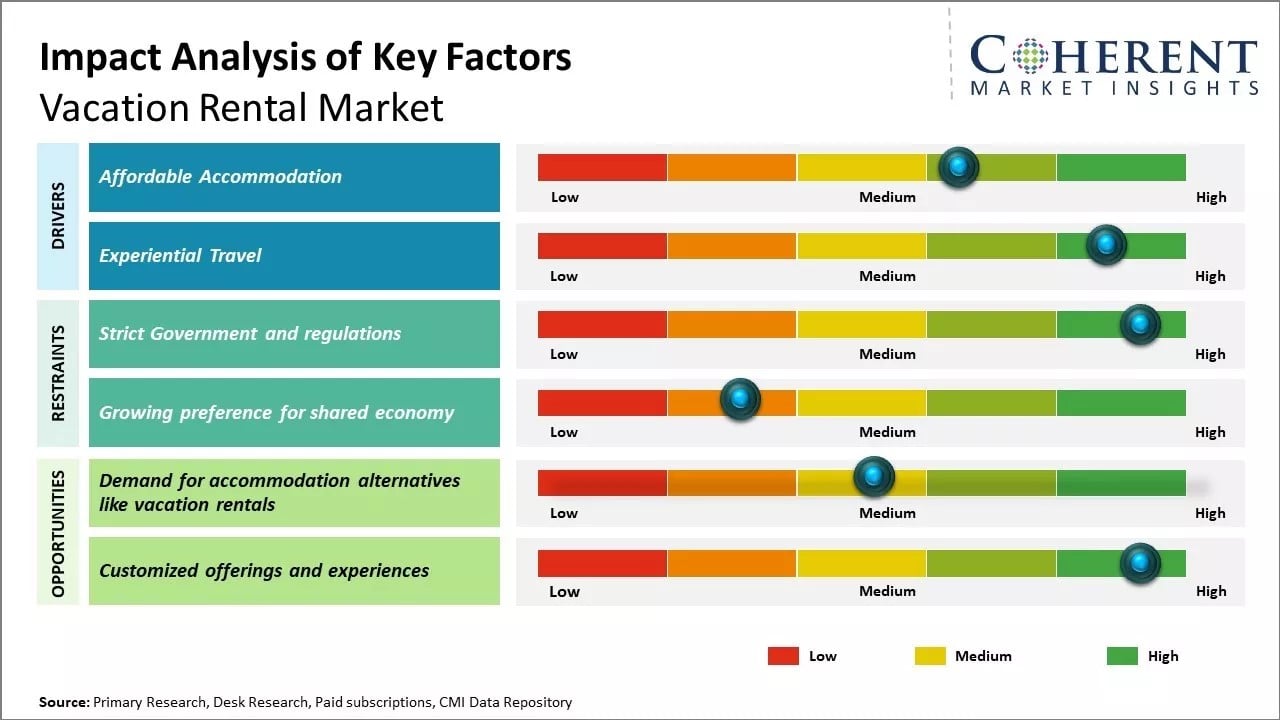
This industry is driven by the increased preference of travelers towards experiential travels and immersive vacation experiences. As people are willing to spend more on customized and personalized vacations, they are opting for full-home or private-room vacation rentals rather than traditional hotels. Properties managed by rental managers and independent hosts have increased exponentially to meet the rising demand. Furthermore, the continued popularity of practices like workcations and remote working is boosting reservations for mid-long term stays. Rapid advancements in technologies used for listing, booking, payments, and managing rentals have also improved service quality and driven efficiency in operations.
Current Events and Its Impact on the Vacation Rental Market
Current Event | Description and Its Impact |
Regulatory Environment Transformation |
|
Geopolitical Instability and Travel Uncertainty |
|
Vacation Rental Market Key Trends
Unique Stays on the Rise
- Statistical Insight: In 2024, 32% of Airbnb bookings were for “unique stays” such as treehouses, cave homes, yurts, and windmills.
- Why It Matters: Travelers are increasingly seeking memorable, Instagram-worthy experiences that go beyond standard accommodations.
- Impact: Platforms are expanding their inventory of unconventional properties, and hosts are investing in creative renovations to meet this demand.
Tech Integration in Guest Experience
- Statistical Insight: Over 68% of vacation rental hosts adopted at least one smart home device (e.g., smart locks, thermostats, or voice assistants) by mid-2025.
- AI Adoption: Nearly 40% of property managers now use AI-powered tools for dynamic pricing, guest messaging, and predictive maintenance.
- Impact: These technologies improve operational efficiency, enhance guest satisfaction, and increase booking conversion rates.
Professionalization of Property Management
- Statistical Insight: In 2025, over 55% of vacation rental properties are managed by professional companies, up from 42% in 2022.
- Why It Matters: Guests expect hotel-like consistency in cleanliness, service, and amenities.
- Impact: The rise of branded vacation rental collections (e.g., Stayterra) is helping standardize quality and build trust with travelers.
Business Travel Crossover
- Statistical Insight: Business travelers now account for 12–15% of vacation rental bookings, a segment growing at 2x the rate of leisure bookings.
- Platform Innovation: Livily’s 2025 launch of a business-class vacation rental platform integrated with global travel management systems is a key milestone.
- Impact: This trend is blurring the lines between work and leisure travel (“bleisure”), expanding the market into weekday and long-stay segments.
- Current Industry Events of 2026
- Market Size Estimation
- Regional Breakdown
- Competitive Landscape
- Customer Intelligence
- Segmental Analysis
- Pricing Analysis
- Key Market Drivers, Challenges & Future Trends
- Customized Insights Section
Segmental Insights
Vacation Rental Market Insights, By Booking Mode - Online Platforms Lead Is Driven by Mobile Convenience and Digital Transparency
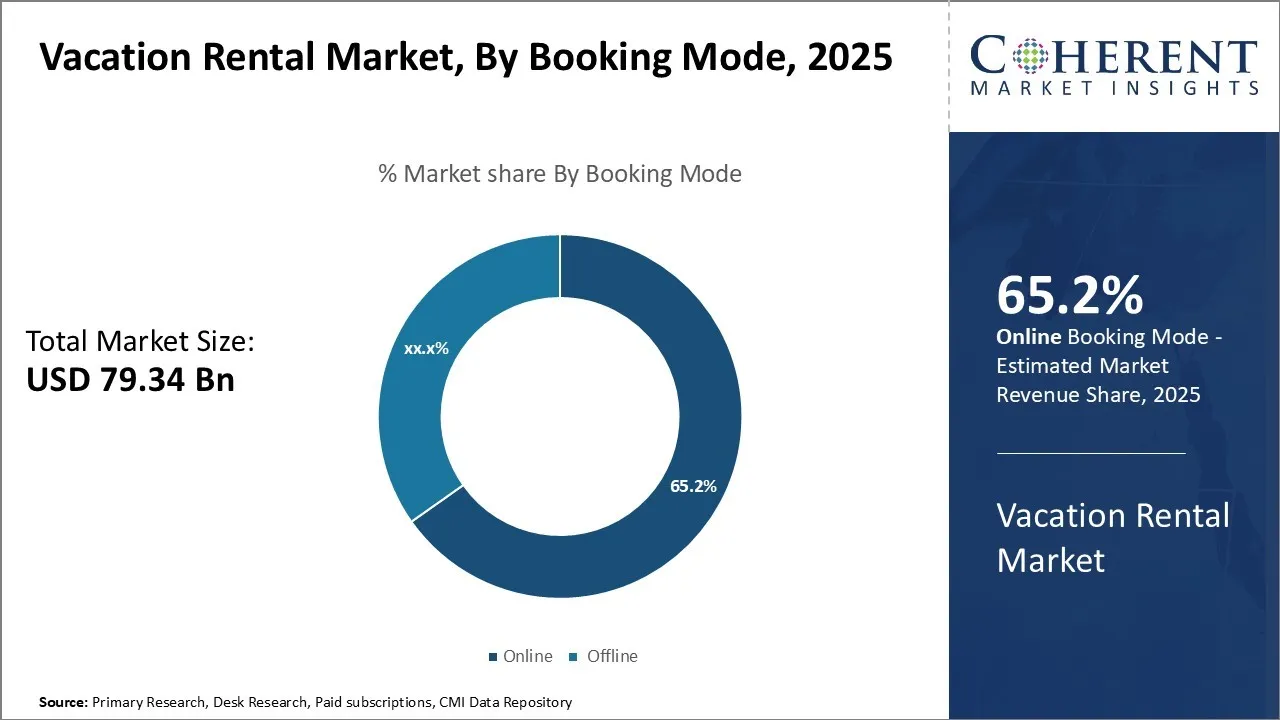
In terms of booking mode, online segment is expected to contributes the 66.2% share of the market in 2026. The proliferation of smartphones and the rise of intuitive travel apps have made it easier than ever for travelers to browse, compare, and reserve accommodations from anywhere in the world.
Airbnb, Vrbo, and Booking.com are examples of platforms that make it easy for users to find what they need, see real-time availability, see clear prices, and read reviews from other users. This digital convenience has reshaped consumer behavior, with most travelers now preferring to book online rather than through traditional offline channels. People of all ages, but especially tech-savvy millennials and Gen Z, keep using these platforms because they are reliable and adaptable.
For instance, in July 2025, an engineer from Hyderabad has created a travel app with no fees that aims to digitize India's homestay market. The platform wants to get 40% of the country's homestays online. It does this by giving hosts easy-to-use tools and cutting out middlemen. This moves fits with the trend of a growing number of people renting vacation homes online, and it makes it easier for both travelers and property owners to use.
Vacation Rental Market Insights, By Accommodation Type- Home Appeal Drives the Highest Accommodation Share
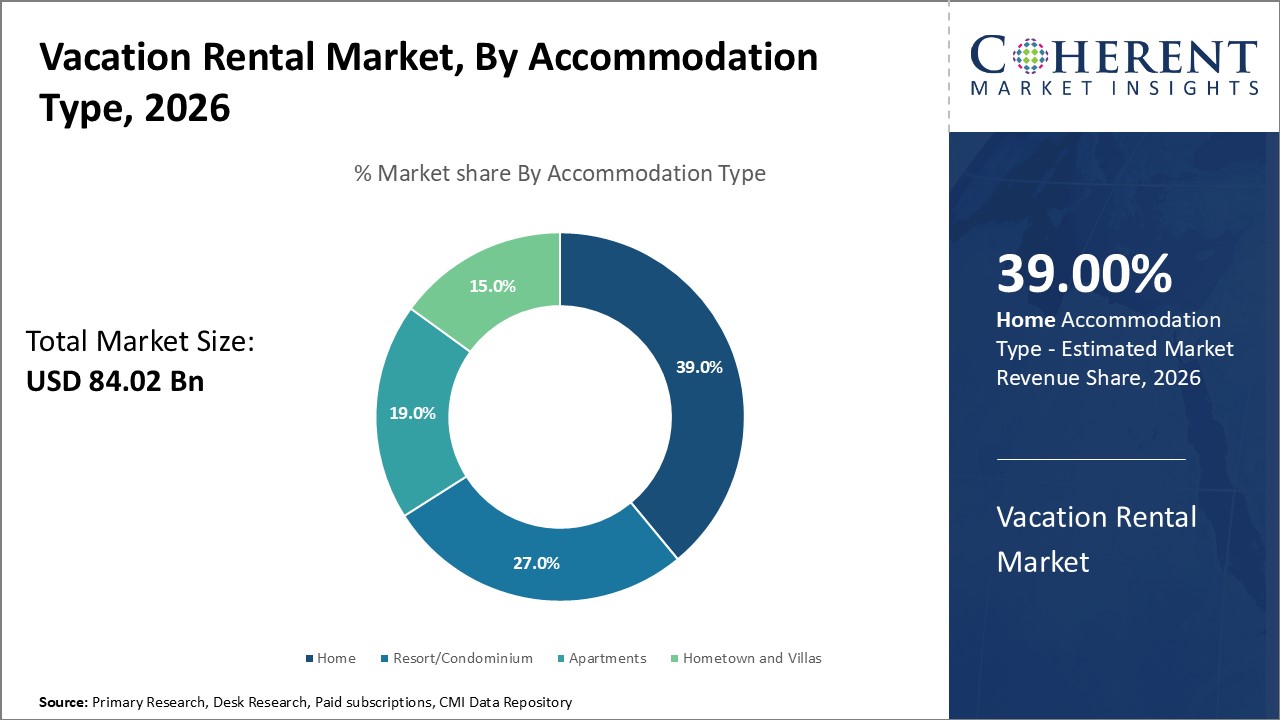
In terms of accommodation type, home segment is projected to contributes the 39% share of the market in 2026 as its appeal as a home away from home. Travelers have more room and amenities when they stay in a house than when they stay in a hotel or resort. It makes them feel at home as they have full kitchens, living areas, and often extra beds. This is a good option for families or large groups who want to stay somewhere comfortable and cook their own meals for a low price. The way the houses are set up also makes them great for longer vacations, when guests can really relax in a familiar, domestic setting.
Many property owners have enhanced their rental homes with welcoming furnishings and high-quality finishes to further replicate the warm, cozy feel of a personal residence.
For instance, in July 2025, OYO and DanCenter are working together to add 250 high-end vacation homes across India by FY26.
Vacation Rental Market Insights, By Price Point - Value and Flexibility Attract Mid-Range Customers
In terms of price point, mid-range segment is projected to contributes the highest share of the market owing 47.3% in 2026 due to its attractive balance of value and flexibility. The economic segment is very cost-focused but offers limited amenities. Luxury options cost a lot and might not be good for all budgets or trip purposes. Mid-range venues address these issues by providing decently-appointed accommodations at reasonable rates. Their prices are appealing to a wide range of travelers, from couples to families, who want to get the most out of their vacation budgets.
Mid-range properties also tend to have more payment plan options, flexible cancellation policies, and options for upgrading features to meet different needs. This adaptability keeps customers satisfied without breaking the bank, making the segment a sweet spot for many vacationers.
For instance, in September 2023, Hyatt started a new vacation rental site called "Homes & Hideaways by World of Hyatt." It features hand-picked private stays like villas, chalets, and townhouses in popular U.S. vacation spots. The program combines the high standards of hotels with the freedom of home rentals, which is appealing to mid-range and high-end travelers looking for unique, vetted places to stay with loyalty program benefits.
Vacation Rental Market Insights, By Location Type - Resort Areas Attract the Most Travelers with Scenic Settings and Bundled Experiences
In terms of location type, the resort area segment is expected to lead with the largest share of the market in 2026. These places have a great mix of natural beauty, fun things to do, and planned activities that are sure to appeal to a lot of different types of travelers. Resort areas are a great way to get away from the city and relax in beautiful settings, whether they are beachfront villas, mountain lodges, or lakeside cabins.
Adventure sports, wellness retreats, and cultural excursions are some of the bundled packages that make these places even more appealing. They are great for both short trips and long vacations. As more and more people travel for fun, resorts are still the best places for people who want to have fun and memorable experiences.
For instance, in November 2025, WelcomHeritage opened the Arka Resort & Spa in Rishikesh, which has 25 luxury chalets in the foothills of the Himalayas. The resort is perfect for nature-filled getaways that focus on health, sustainability, and beautiful views. This launch makes the vacation rental market in the resort area stronger, catering to travelers searching for high-end experiences in peaceful, spiritually significant locations.
Regional Insights
North America Vacation Rental Market Analysis & Trends
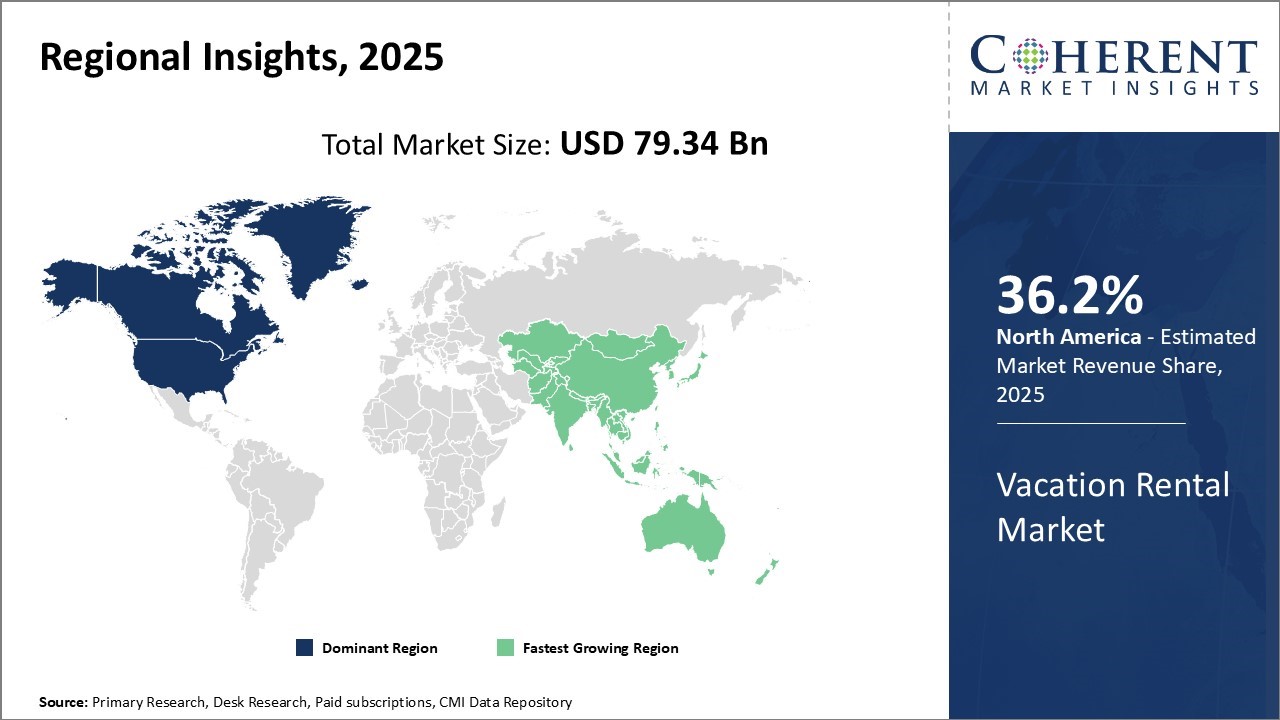
North America is expected to dominate the vacation rental market with 36.2% share in 2026, due to increasing numbers of individuals want flexible, home-like places to stay. Travelers of all kinds want personalized stays, places where they can work from home, and beautiful getaways. The region's strong digital infrastructure and preference for online booking platforms help growth even more. This makes vacation rentals a better choice than staying in a hotel.
For instance, in November 2026, by acquiring Vacasa's operations in some U.S. regions and launching a full digital overhaul, Casago solidified its place in the vacation rental market. The move enhances Casago’s property management capabilities and guest experience through improved technology, signaling a strategic push to expand its footprint and modernize services in the competitive short-term rental space.
Asia Pacific Vacation Rental Market Analysis & Trends
Asia Pacific is anticipated to be the fastest growing region, due to numerous individuals are traveling within and between countries, and more people are using technology. Travelers want cheap, flexible places to stay in places with a lot of culture, and platforms are expanding into new markets. The area's many different landscapes and activities make it a popular place for both leisure and experiential tourism.
For instance, in August 2026, Elivaas, a vacation rental platform based in India, raised $10 million to grow its business and improve its digital infrastructure. The funding will help it grow by managing more high-end vacation homes and making guests' stays better. Elivaas wants to strengthen its position in the changing short-term rental market by expanding both at home and abroad.
Vacation Rental Market Outlook Country-Wise
The U.S. Vacation Rental Market Trends
In 2026, the vacation rental market in the U.S. is booming as travelers want stays that are tailored to their needs and are flexible. People want private homes, remote work setups, and immersive local experiences, which drives demand. Digital platforms make it easy to book, and more and more travelers are choosing rentals over hotels since they offer more space, privacy, and unique places to stay.
For instance, in August 2026, Adventure released a new all-in-one booking platform that makes it easier for users to plan their trips by combining vacation rentals, hotels, and activities. The U.S.-based service wants to change the way travelers find and book accommodations and activities by focusing on making things easier and more personal. It offers a smooth alternative to the many different booking tools that are currently available in the tourism industry.
China Vacation Rental Market Trends
In 2026, China's vacation rental market is booming due to numerous individuals are traveling within the country, more people are using technology, and the middle class is growing. People who travel want to stay in cities, on the coast, and in the countryside for a short time at a low cost. Platforms benefit from tech-savvy customers and a desire for experiences that are culturally rich, leading to why vacation rentals are a popular choice over traditional hotels.
For instance, in October 2026, Hyatt Studios has entered the Chinese market through a 50-hotel franchise agreement with Homeinns Hotel Group. This is the company's first time in the country's extended-stay market. The new properties will have studio-style rooms with kitchenettes and workspaces. They will be great for business and leisure travelers who want a flexible, home-like stay in major and secondary Chinese cities.
Market Report Scope
Vacation Rental Market Report Coverage
| Report Coverage | Details | ||
|---|---|---|---|
| Base Year: | 2025 | Market Size in 2026: | USD 84.02 Bn |
| Historical Data for: | 2020 To 2024 | Forecast Period: | 2026 To 2033 |
| Forecast Period 2026 to 2033 CAGR: | 5.9% | 2033 Value Projection: | USD 125.50 Bn |
| Geographies covered: |
| ||
| Segments covered: |
| ||
| Companies covered: | 9flats, Booking.com, Hotelplan Management AG, MakeMyTrip Pvt. Ltd., OYO Hotels & Homes, Trivago, Agoda Company Pte. Ltd., Yatra Online Private Limited, Hotwire, Inc., HotelsCombined, Hotels.com, BookingBuddy.com, Inc., Priceline.com LLC, KAYAK, Google, Airbnb Inc., Booking Holdings Inc., Hotelplan Holding AG, MakeMyTrip Pvt. Ltd., Expedia Group Inc., NOVASOL AS, Oravel Stays Pvt. Ltd., Wyndham Destinations Inc., and TripAdvisor Inc. | ||
| Growth Drivers: |
| ||
| Restraints & Challenges: |
| ||
Vacation Rental Market Driver
Affordable Accommodation
The rise of the sharing economy and peer-to-peer rental platforms has provided travelers with an affordable accommodation alternative to hotels. Vacation rentals, such as entire homes, condominiums, cottages, beach houses, and chalets, listed on services such as Airbnb offer visitors increased living space and amenities at a lower price point compared to hotels. This disruptive distribution model allows homeowners to generate additional income from their unused or second properties by listing them online, while also benefiting guests seeking more value for money during their holidays. The ability to stay in an entire property rather than a single hotel room, often in desirable tourist destinations, makes vacation rentals compelling for budget-conscious travelers and families looking for spacious accommodations. Their growing popularity can be attributed to the cost savings they provide over traditional lodging such as hotels, resorts, motels, and bed & breakfasts in many popular tourist regions.
Experiential Travel
An emerging travel trend driving growth in the vacation rental sector is the rising demand for more authentic, local experiences among travelers as opposed to generic accommodation. Many visitors today are seeking meaning, cultural immersion, and authenticity during their trips rather than just sightseeing.
Travelers that stay in a vacation rental in a residential area instead of a hotel can feel more connected to the local community and culture, talk to locals, and really live like locals while they're there. They can cook their own meals like the locals do, go to places which are not as well known, and get a feel for the daily life of a place.
Vacation rentals provide a home base for travelers to embark on their own personalized exploration of places rather than just packaged tourist activities. Their growing appeal lies in satisfying the new generation of more experience-seeking travelers who want to escape from generic tours and interact with the destinations on a deeper level through living like residents.
Vacation Rental Market Opportunities
Demand for accommodation alternatives like vacation rentals
As tourism continues to grow globally, the vacation rental market forecast indicates a significant rise in demand for accommodation alternatives like vacation rentals. Millennials especially favor unique, whole-home rentals over traditional hotels. New property management tools are also making it easier for owners to operate multiple listings remotely.
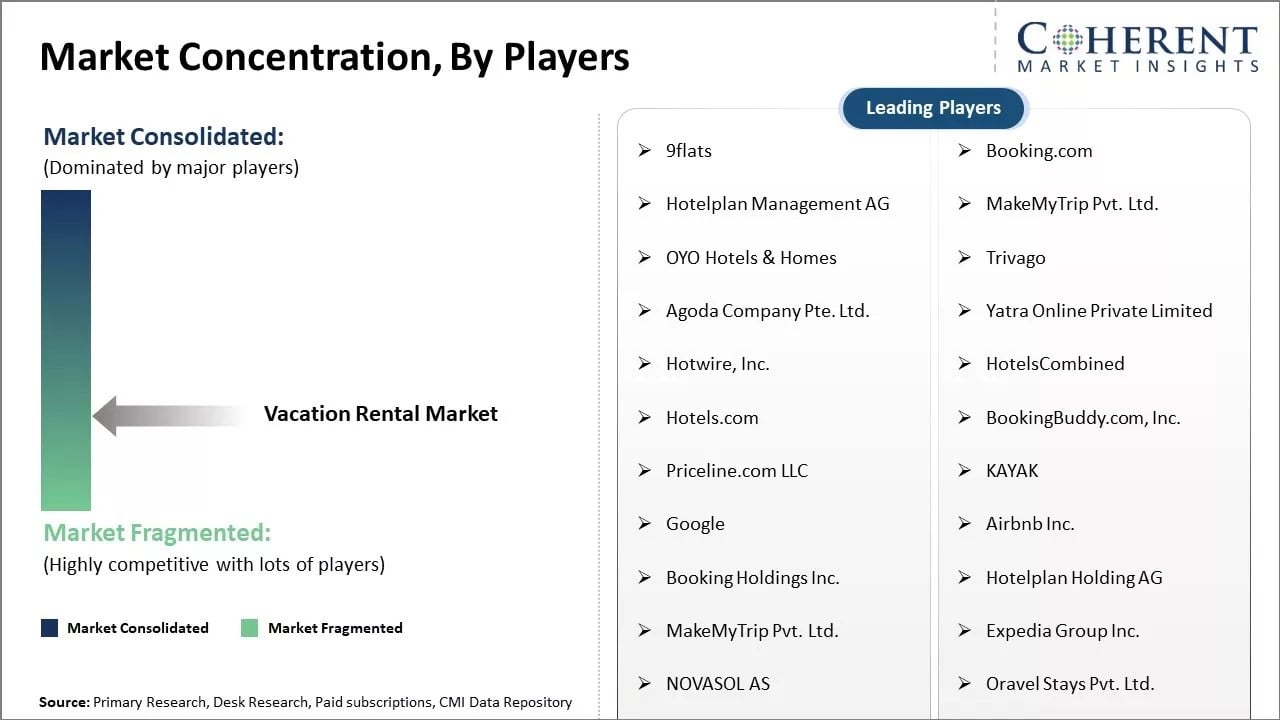
Market Concentration and Competitive Landscape
Analyst Opinion (Expert Opinion)
The vacation rental market is expanding quickly since travelers' tastes are changing and more people are working from home and being flexible.
Digital channels are becoming more popular, and by 2030, online bookings are expected to bring in 79% of revenue. However, offline bookings still make up a large part of reservations. Europe is the leader in the market, but Asia-Pacific has a lot of room to grow as more individuals are using digital technology and the middle class is growing.
There are risks from regulatory scrutiny, supply growth, and operational problems like managing turnover and optimizing prices. To get more people to stay longer, hosts, platforms, and institutional players need flexible strategies to optimize pricing and improve guest experiences.
Overall, the market has a lot of potential, but success depends on being able to adapt to changing consumer behavior, digital trends, and rules.
Speak to the analyst
Want personalized insights?
Take the findings above to one of our principal consultants, or have the report rebuilt around the segments, geographies and competitors you actually track.
Vacation Rental Industry News
- In November 2025, Livily launched the first vacation rental platform for business travelers that works with travel management systems all over the world. The service is made for business travelers and offers high-end short-term rentals with easy booking, compliance, and reporting. This new idea fills the gap between vacation-style hotels and business travel needs, marking a new era in business travel solutions.
- In June 2025, CBIZ started a national vacation rental insurance program with an A-rated carrier that gives short-term rental property owners coverage that fits their needs. The program protects against major risks like property damage and liability. Its goal is to help the growing vacation rental industry with specialized protection and easier insurance options across the United States.
- In April 2025, Stayterra launched a vacation rental management collection that offers high-end homes that are professionally managed and provide guests with a better experience. The platform's goal is to change the way people think about short-term rentals by focusing on high standards, carefully chosen properties, and better services. Stayterra is a leader in the high-end vacation rental market since it is dedicated to quality and hospitality.
- In May 2023, in celebration of the global accessibility awareness day, Airbnb, Inc. is a company that operates an online marketplace and hospitality service platform. announced that its staff had inspected and confirmed the accuracy of around 300,000 accessible features in homes worldwide. These features included entrances without steps, installed grab bars, or bath and shower chairs.
Market Segmentation
- Booking Mode Insights (Revenue, USD Bn, 2026 - 2033)
- Online
- Offline
- Accommodation Type Insights (Revenue, USD Bn, 2026 - 2033)
- Home
- Resort/Condominium
- Apartments
- Hometown
- Villas
- Price Point Insights (Revenue, USD Bn, 2026 - 2033)
- Economic
- Mid-Range
- Luxury
- Location Type Insights (Revenue, USD Bn, 2026 - 2033)
- Resort Area
- Rural Area
- Small Town
- Regional Insights (Revenue, USD Bn, 2026 - 2033)
- North America
- U.S.
- Canada
- Latin America
- Brazil
- Argentina
- Mexico
- Rest of Latin America
- Europe
- Germany
- U.K.
- France
- Italy
- Russia
- Rest of Europe
- Asia Pacific
- China
- India
- Japan
- Australia
- South Korea
- ASEAN
- Rest of Asia Pacific
- Middle East & Africa
- GCC Countries
- South Africa
- Rest of Middle East & Africa
- North America
- Key Players
- Booking.com
- Hotelplan Management AG
- MakeMyTrip Pvt. Ltd.
- OYO Hotels & Homes
- Trivago
- Agoda Company Pte. Ltd.
- Yatra Online Private Limited
- Hotwire, Inc.
- HotelsCombined
- Hotels.com
- BookingBuddy.com, Inc.
- Priceline.com LLC
- KAYAK
- Airbnb Inc.
- Booking Holdings Inc.
- Hotelplan Holding AG
- MakeMyTrip Pvt. Ltd.
- Expedia Group Inc.
- NOVASOL AS
- Oravel Stays Pvt. Ltd.
- Wyndham Destinations Inc.
- TripAdvisor Inc.
Sources
Primary Research Interviews
- Vacation Rental Platform Providers (e.g., Airbnb, Vrbo)
- Property Management Companies
- Hospitality and Tourism Consultants
- Real Estate Agents Specializing in Short-Term Rentals
- Travel and Leisure Service Providers
Databases
- Statista
- IBISWorld
- Euromonitor International
- Allied Market Research
- Others
Magazines
- Travel + Leisure
- Condé Nast Traveler
- Hospitality Technology
- Skift
- Others
Journals
- Journal of Travel Research
- International Journal of Hospitality Management
- Tourism Management
- Annals of Tourism Research
- Others
Newspapers
- The New York Times – Travel Section
- The Guardian – Travel Section
- Financial Times – Travel & Leisure
- Reuters – Hospitality News
- Others
Associations
- American Hotel & Lodging Association (AHLA)
- World Tourism Organization (UNWTO)
- European Holiday Home Association (EHHA)
- Short Term Accommodation Association (STAA)
- Others
Public Domain Sources
- U.S. Travel Association
- UN World Tourism Organization Data Portal
- National Statistical Offices (Tourism Data)
- World Bank – Tourism & Travel Data
- Others
Proprietary Elements
- CMI Data Analytics Tool
- Proprietary CMI Existing Repository of Vacation Rental Insights from the Last 8 Years
Definition: The vacation rental market provides an alternative accommodation option for travelers looking to rent fully-furnished homes, apartments or condominium units for short-term stays. This growing market offers properties that are often more spacious and equipped with amenities like kitchens, washer/dryers compared to traditional hotels. Vacation rental platforms and sites allow homeowners to list their properties and tourists to search for and book accommodations in different destinations worldwide.
Get access to 250+ pages report
Every segment, forecast, competitor profile and data table behind the analysis above — available for instant download.
- ESOMAR Member
- ISO 9001:2015 Certified
- D-U-N-S Registered
- GDPR & CCPA Compliant
Missing comfort of reading report in your local language? Find your preferred language:
Transform your Strategy with Exclusive Trending Reports
Frequently Asked Questions
The Vacation Rental Market is estimated to be valued at USD 84.02 Bn in 2026, and is expected to reach USD 125.50 Bn by 2033.
The CAGR of the Vacation Rental Market is projected to be 5.9% from 2026 to 2033.
Affordable accommodation and experiential travel are the major factors driving the growth of the vacation rental market.
Strict government and regulations and growing preference for shared economy are the major factors hampering the growth of the vacation rental market
In terms of booking mode, online is estimated to dominate the market revenue share in 2026.
9flats, Booking.com, Hotelplan Management AG, MakeMyTrip Pvt. Ltd., OYO Hotels & Homes, Trivago, Agoda Company Pte. Ltd., Yatra Online Private Limited, Hotwire, Inc., HotelsCombined, Hotels.com, BookingBuddy.com, Inc., Priceline.com LLC, KAYAK, Google, Airbnb Inc., Booking Holdings Inc., Hotelplan Holding AG, MakeMyTrip Pvt. Ltd., Expedia Group Inc., NOVASOL AS, Oravel Stays Pvt. Ltd., Wyndham Destinations Inc., and TripAdvisor Inc. are the major players.
North America is expected to lead the vacation rental market in 2026.