

Network Security Firewall Market Size and Share Analysis - 2026 To 2033
The network security firewall market is anticipated to grow at a CAGR of 22.0% with USD 9.77 Bn in 2026 and is expected to reach USD 39.28 Bn in 2033. High adoptions of Big Data, IoT, cloud computing, and others have changed the scenario of business needs, in order to have maximum potential in the market. Due to this, concerns regarding data breaches (2,090 cyber-attacks every week), account hijacking, unauthorized access, and others have also increased. Hence, network security is one of the major concerns for organizations, in order to minimize the issues related to data security.
Key Takeaways
- SMS firewall is expected to account the largest share of 55% in 2026, protects SMS traffic from spam, phishing (smishing), fraud, grey-route messaging, and A2P messaging abuse. UK mobile operators are finding and blocking more than 600 million suspected scam text messages every year.
- Professional services will dominate with 55.6% in 2026, telecom operators rely on experts to integrate firewalls with existing network infrastructure and optimize performance. Only 54% of countries have a dedicated agency responsible for critical infrastructure cybersecurity, and only 49% have cybersecurity frameworks for critical infrastructure.
- On-premises will dominate with 53.8% in 2026, as large telecom operators (Tier-1 carriers) prefer on-premises deployment for greater control over network security, data sovereignty, regulatory compliance, and integration with existing SS7, Diameter, and 5G infrastructure. This trend is reflected in industry surveys, where 86% of organizations are considering or planning to move workloads away from the public cloud, 27% are adopting hybrid cloud models, and 14% plan to move workloads fully on-premises.
- North America is expected to acquire the dominant share of 38.25% in 2026, early adoption of SMS firewall solutions, stringent telecom and privacy regulations, high A2P messaging volumes, advanced 5G infrastructure, and significant investments by telecom operators in messaging security. North America is expected to have 867 million 5G connections by 2030, more than twice the current number.
Segmental Insights
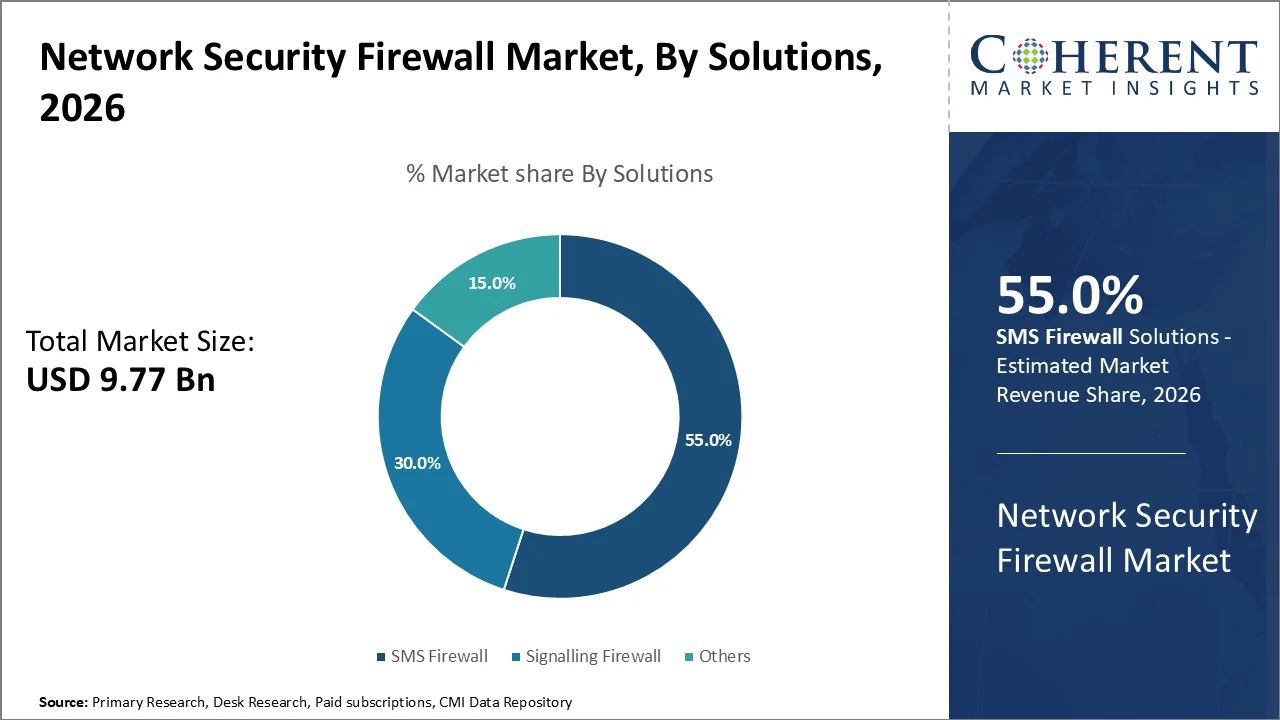
Why is SMS Firewall Segment Acquiring the Largest Market Share?
SMS firewall is projected to account for the largest share of solutions in 2026, representing approximately 55% of the total volume. Due to the exponentially rising volume of SMS-based cyber threats, fraudulent messaging activities, and the widespread exploitation of legacy telecommunication protocols that continue to expose mobile network operators and enterprises to significant financial and reputational damage. According to Zimperium's 2025 report, SMS is the most common type of mobile phishing attack, making up 69.3% of all mobile phishing (mishing) attacks. In consists of PDF-based attacks account for 28.4% and QR code attacks account for 2.4%.
The segment is propelled by its deeply rooted in the structural vulnerabilities that persist within global mobile messaging ecosystems, particularly as telecom operators worldwide continue to support Short Message Service infrastructure that was originally designed without robust security considerations.
For instance, AcePeak has introduced a new enterprise SMS Firewall to help mobile network operators (MNOs) protect their A2P messaging revenue and stop grey route fraud. The solution aid operators monitor SMS traffic, block unauthorized messages, and improve messaging security.
- Current Industry Events of 2026
- Market Size Estimation
- Regional Breakdown
- Competitive Landscape
- Customer Intelligence
- Segmental Analysis
- Pricing Analysis
- Key Market Drivers, Challenges & Future Trends
- Customized Insights Section
Professional Segment holds the Largest Market Share
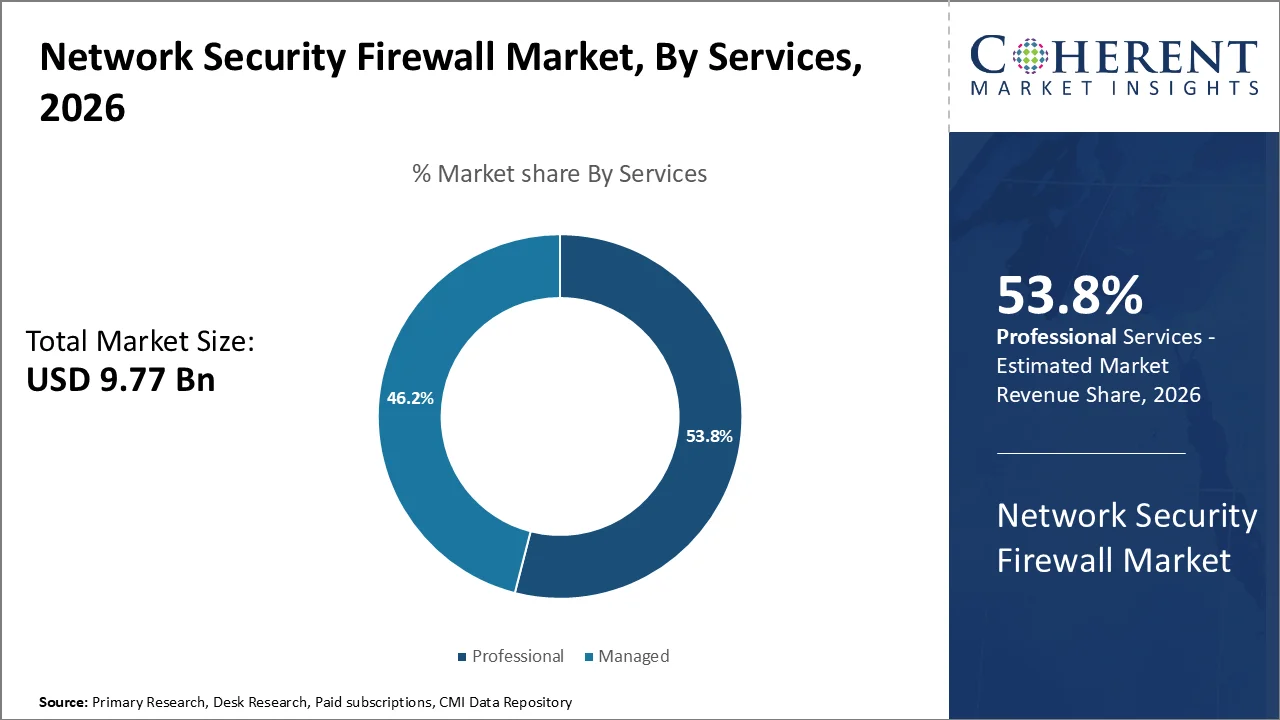
Based on services, professional dominates the market, accounting for a significant 55.6% share in 2026. Professional services contribute the highest share in the market owing to the deeply technical as well as complex nature of firewall deployment, integration, and long-term maintenance requirements across enterprises of all sizes.
Professional services encompass a broad spectrum of offerings, including consulting, system integration, training and education, and support and maintenance all of which demand highly specialized human expertise and domain knowledge.
Organizations deploying next-generation firewalls (NGFWs) or unified threat management (UTM) systems cannot simply install solutions out-of-the-box, they require expert-led configuration, policy customization, vulnerability assessment, as well as compliance alignment, which directly fuels the demand for professional service providers in this space.
For instance, in July 2026, Intel along with Fortinet are working together to develop a new Security Processor 6 (SP6) chip for Fortinet’s FortiGate firewalls. Intel will help with chip design, advanced packaging, and manufacturing, while Fortinet will use its cybersecurity expertise to build the next-generation security processor.
On-premises holds the Largest Market Share
Based on deployment, on-premises dominates the market, accounting for a significant 53.8% share in 2026. The deeply entrenched position in enterprise IT infrastructure, particularly among organizations operating in highly regulated as well as security-sensitive industries is one of the factors propelling the segmental growth. Global digital infrastructure spending is projected to reach USD 4.5 trillion by 2025, while the growth of IoT devices is expanding the volume of connected endpoints.
For instance, in March 2026, SentinelOne has released new AI security solutions for on-premises as well as self-hosted environments. These solutions make organizations to keep their security data inside their own systems instead of sending it to the cloud. This aid businesses maintain better control over their data, privacy, and security.
On-premises firewall deployment involves the physical installation of hardware-based or software-based firewall solutions within own data center or network environment of an an organization, giving IT teams direct and absolute control over their security policies, configurations, as well as data traffic management.
This level of control remains indispensable for industries such as banking, financial services, defense, healthcare, and critical national infrastructure, where data sovereignty, regulatory compliance, and low-latency requirements are non-negotiable priorities.
Market Drivers
Stateful Packet Inspection (SPI) is transforming the Network Security Firewall Industry
Stateful Packet Inspection (SPI) is a firewall technology that checks the source as well as destination of data packets and whether they belong to a valid and active network connection. It keeps a state table that stores details such as source and destination IP addresses, port numbers, TCP sequence numbers, connection status, etc. It verifies the TCP handshake (SYN, SYN-ACK, ACK), tracks UDP and ICMP traffic, as well as reassembles fragmented packets before inspection. This allows only legitimate traffic to pass while blocking suspicious or unauthorized packets.
For instance, VyOS offer strong firewall protection to aid secure modern networks. It uses features including Stateful Packet Inspection (SPI), Zone-Based Firewalling, etc., to control network traffic, block unwanted connections, etc. These features allow businesses to make security rules based on traffic type, connection status, as well as network areas.
SPI is broadly used in firewall products from Cisco ASA, Juniper Networks SRX Series, Fortinet FortiGate, as well as Check Point Security Gateways. For example, JPMorgan Chase deployed Cisco ASA appliances with SPI across more than 5,000 branch locations to monitor banking transactions. The system detected abnormal TCP behavior, such as SYN flood attacks, automatically blocked suspicious sessions, etc., without disturbing normal banking operations. This deployment reduced unauthorized intrusion attempts by about 67%, lowered false-positive alerts by 43%, as well as helped meet PCI-DSS compliance through session-level logging. However, SPI can reduce firewall performance by 15–20% compared with basic stateless packet filtering because it performs more detailed traffic inspection.
Current Events and Their Impact on the Network Security Firewall Market
Current Event | Description and its Impact |
Implementation of stricter cybersecurity regulations such as EU NIS2 Directive and critical infrastructure security requirements (2024–2026) |
|
Government cybersecurity modernization programs and zero-trust security adoption (2025–2026) |
|
Network Security Firewall Market Trends
- Conventional stateful firewalls are replaced by NGFWs that incorporate deep packet inspection (DPI), intrusion prevention systems (IPS), application awareness, SSL/TLS inspection, as well as AI-driven threat intelligence.
- The high adoption of public, private, as well as hybrid cloud environments is fueling the demand for cloud-native security solutions such as FWaaS. According to Red Hat’s cloud-native security report, 97% of organizations experienced at least one cloud security incident in the past year, while 74% slowed or delayed application deployments due to security concerns. These challenges are encouraging organizations to adopt scalable cloud security solutions that provide consistent protection across distributed environments.
- Adoption of AI/ML is becoming a major differentiator in firewall solutions. Advanced threat detection powered by behavioral analytics, anomaly detection, along with real-time threat intelligence feeds is enabling firewalls to identify zero-day vulnerabilities and advanced persistent threats (APTs) with greater accuracy as well as speed.
Regional Insights
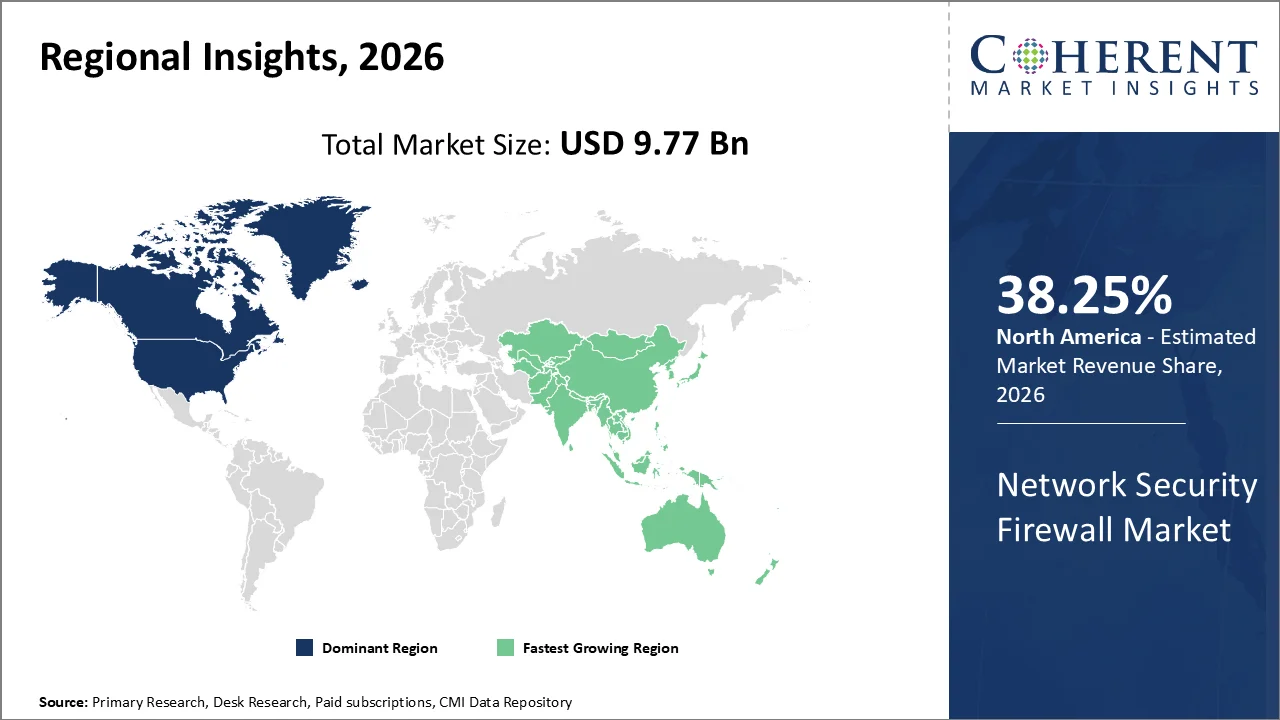
North America dominates owing to owing to its deeply entrenched digital infrastructure
North America account 38.25% market share in 2026, owing to its deeply entrenched digital infrastructure, stringent regulatory mandates, and the consistently high frequency of sophisticated cyberattacks targeting both private and public sector organizations.
The United States recorded around 93% of all reported incidents in the Americas, making it the country with the highest number of incidents in the region. Ransomware was the biggest type of attack, accounting for about 45% of all recorded incidents as well as causing major operational and financial damage.
The United States, in particular, operates under a complex web of compliance requirements including the Federal Information Security Modernization Act (FISMA), the Health Insurance Portability and Accountability Act (HIPAA), the Cybersecurity Maturity Model Certification (CMMC) framework, etc., introduced by the U.S. Department of Defense, all of which compel enterprises and government authorities to maintain robust firewall architectures as a baseline security requirement.
For instance, HPE has released new security solutions to aid organizations protect their networks as the use of AI as well as digital technologies grows. The company launched the Juniper Networking SRX400 Series Firewalls and improved its hybrid security platform to provide protection across cloud, data centers, edge environments, etc.
Asia Pacific Network Security Firewall Market Trends
The Asia Pacific region is poised to be the fastest-growing region through 2026-2033, expanding at a CAGR of approximately 6.8%. Driven by a convergence of expanding digital economies, rising cyber threat landscapes, as well as government-backed cybersecurity investment programs. Nations including China, Japan, India, South Korea, Australia, etc., are experiencing an unprecedented surge in enterprise digitalization, cloud adoption, as well as smart city initiatives, all of which demand strong network security infrastructure.
Indian organizations are increasing their funding on cybersecurity. Around 72% of Indian business as well as technology leaders are making cyber risk a top priority in their strategic plans.
Japan's Ministry of Economy, Trade and Industry (METI) has published multiple cybersecurity guidelines targeting critical infrastructure operators, pushing both public and private sector entities toward adopting advanced firewall technologies.
The Advance Cybersecurity Infrastructure is Accelerating the Network Security Firewall Market Demand in U.S.
The U.S. contributes the highest share in the network security firewall market in North America, owing to its deeply embedded cybersecurity infrastructure, high density of enterprise-level organizations, and an exceptionally aggressive federal mandate driving firewall adoption across both public and private sectors.
The United States federal government has been one of the most proactive forces in shaping firewall deployment standards, particularly through the Cybersecurity and Infrastructure Security Agency (CISA), which has issued binding operational directives requiring federal civilian agencies to implement specific network perimeter security technologies, including next-generation firewalls.
For example, CISA's Binding Operational Directive 23-01, which focused on improving asset visibility as well as vulnerability detection across federal networks, directly accelerated the procurement of advanced firewall systems capable of deep packet inspection across civilian federal infrastructure.
China Network Security Firewall Market Trends
China contributes the highest share in the network security firewall market in Asia Pacific, owing to its aggressive national cybersecurity policy framework and the sweeping digital infrastructure expansion mandated by government-led initiatives.
China's Cybersecurity Law, enforced by the Cyberspace Administration of China (CAC), mandates that all critical information infrastructure operators deploy multi-layered network protection systems, including next-generation firewalls, making enterprise as well as government adoption virtually non-negotiable across industries.
The country's ambitious "Digital China" strategy, which outlines the acceleration of cloud computing, industrial internet, as well as smart city deployments, has directly amplified the demand for robust perimeter and internal network security solutions.
According to the Ministry of Industry and Information Technology (MIIT) of China, the number of connected industrial devices exceeded 800 million units as of recent years, each representing a potential network entry point requiring firewall-level protection.
Who are the Major Companies in Network Security Firewall Industry
Some of the major key players in network security firewall market include, Symsoft, Anam Technologies, Cellusys, SAP SE, Tata Communications Limited, Adaptive Mobile, AMD Telecom S.A., Evolved Intelligence, Hewlett Packard Enterprise, Mobileum, Omobio Pvt. Ltd., and Openmind Networks
Key News
- In May 2026, Check Point has launched a new AI-powered network security platform to help businesses manage their security systems automatically. The platform uses AI agents to monitor networks, improve security policies, and reduce the need for manual security work.
- In July 2026, Sophos has launched Sophos Fusion, an AI-based cybersecurity platform that combines firewall, network security, endpoint protection, email security, cloud security, and identity protection in one system.
Market Report Scope
Network Security Firewall Market Report Coverage
| Report Coverage | Details | ||
|---|---|---|---|
| Base Year: | 2025 | Market Size in 2026: | USD 9.77 Bn |
| Historical Data for: | 2020 To 2024 | Forecast Period: | 2026 To 2033 |
| Forecast Period 2026 to 2033 CAGR: | 22.0% | 2033 Value Projection: | USD 39.28 Bn |
| Geographies covered: |
| ||
| Segments covered: |
| ||
| Companies covered: | Symsoft, Anam Technologies, Cellusys, SAP SE, Tata Communications Limited, Adaptive Mobile, AMD Telecom S.A., Evolved Intelligence, Hewlett Packard Enterprise, Mobileum, Omobio Pvt. Ltd., and Openmind Networks | ||
| Growth Drivers: |
| ||
| Restraints & Challenges: |
| ||
Analyst Opinion
- The network security firewall market is witnessing robust momentum driven by the exponential rise in sophisticated cyber threats and ransomware attacks targeting enterprises across industries. According to the State of Ransomware 2026 report, 56% of ransomware attacks successfully encrypted company data. Only 1 out of 3 small organizations were able to stop the attack before their data was encrypted. The average ransom payment was around USD 769,000, showing the serious financial impact of ransomware attacks.
- Organizations are highly opting for perimeter and network security investments as digital transformation accelerates as well as attack surfaces expand significantly. Global spending on information security is expected to reach USD 212 billion in 2026, fueling from USD 193 billion in 2025. This shows a 15.1% growth, showing that organizations are investing more in cybersecurity to protect against rising cyber threats, digital risks, as well as new security challenges.
- The high adoption of cloud computing, hybrid work environments, as well as IoT ecosystems has fundamentally redefined traditional network boundaries, compelling businesses to deploy next-generation firewall solutions that provide deeper packet inspection as well as application-level security controls.
- However, the market faces challenges, including the complexity of managing multi-vendor security environments along with the persistent shortage of skilled cybersecurity professionals who can effectively deploy and maintain advanced firewall infrastructures.
- The convergence of firewall capabilities with AI-powered threat intelligence as well as the emergence of SASE (Secure Access Service Edge) architecture are the major growth opportunities. The increasing regulatory compliance requirements across BFSI, healthcare, and government sectors are further accelerating firewall deployment mandates globally.
Speak to the analyst
Want personalized insights?
Take the findings above to one of our principal consultants, or have the report rebuilt around the segments, geographies and competitors you actually track.
Market Segmentation
- By Solutions (Revenue, USD Bn, 2021-2033)
- SMS Firewall
- Signaling Firewall
- Other
- By Services (Revenue, USD Bn, 2021-2033)
- Professional Services
- Managed Services
- By Deployment (Revenue, USD Bn, 2021-2033)
- On-premises
- Cloud-based
- NVF
- By Region (Revenue, USD Bn, 2021-2033)
- North America
- U.S.
- Canada
- Latin America
- Brazil
- Mexico
- Argentina
- Rest of Latin America
- Europe
- Germany
- U.K.
- France
- Italy
- Spain
- Russia
- Rest of Europe
- Asia Pacific
- China
- India
- Japan
- Australia
- South Korea
- ASEAN
- Rest of Asia Pacific
- Middle East
- GCC
- Israel
- Rest of Middle East
- Africa
- South Africa
- Central Africa
- North Africa
- North America
Sources
Primary Research Interviews
- Chief Information Security Officers (CISOs)
- Network Security Architects & Engineers
- Firewall Solution Vendors & Product Managers
- IT Infrastructure & Cybersecurity Consultants
- Others
Databases
- Gartner Research Database
- IDC (International Data Corporation) Database
- Others
Magazines
- SC Magazine (Cybersecurity)
- Network World Magazine
- InfoSecurity Magazine
- Dark Reading Magazine
- Others
Journals
- Journal of Network and Computer Applications (Elsevier)
- IEEE Transactions on Network and Service Management
- Journal of Cybersecurity (Oxford Academic)
- Others
Newspapers
- The Wall Street Journal (Technology & Cybersecurity Section)
- Financial Times (Technology Section)
- The Register (IT & Security News)
- CRN (Computer Reseller News)
- Others
Associations
- Information Systems Security Association (ISSA)
- Cloud Security Alliance (CSA)
- International Information System Security Certification Consortium (ISC²)
- Cybersecurity and Infrastructure Security Agency (CISA)
- Others
Public Domain Sources
- U.S. National Institute of Standards and Technology (NIST) – Cybersecurity Framework
- European Union Agency for Cybersecurity (ENISA) Reports
- U.S. Federal Trade Commission (FTC) – Cybersecurity Guidelines
- National Vulnerability Database (NVD)
- Others
Proprietary Elements
- CMI Data Analytics Tool
- Proprietary CMI Existing Repository of information for last 10 years
Get access to 250+ pages report
Every segment, forecast, competitor profile and data table behind the analysis above — available for instant download.
- ESOMAR Member
- ISO 9001:2015 Certified
- D-U-N-S Registered
- GDPR & CCPA Compliant
Missing comfort of reading report in your local language? Find your preferred language:
Transform your Strategy with Exclusive Trending Reports
Frequently Asked Questions
The network security firewall market is expected to reach USD 39.28 Bn in 2033.
Major players operating in the global network security firewall market include Symsoft, Anam Technologies, Cellusys, SAP SE, Tata Communications Limited, Adaptive Mobile, AMD Telecom S.A., Evolved Intelligence, Hewlett Packard Enterprise, Mobileum, Omobio Pvt. Ltd., and Openmind Networks.
Complexity of next-generation firewall configuration and management is one of the major factors that is expected to hamper growth of the market over the forecast period.
Rising frequency and sophistication of cyberattacks and data breaches are driving growth of the global network security firewall market.
The network security firewall market is anticipated to grow at a CAGR of 22.0% between 2026 and 2033.
Among regions, North America is expected to account for a largest market share in the global network security firewall market over the forecast period.
Firewalls are network security barriers that monitor and filter traffic based on predefined rules. The three primary types of firewalls, categorized by their structural delivery, are hardware firewalls, software firewalls, and cloud firewalls.