

Cloud Security Software Market Size and Forecast – 2026 to 2033
Global Cloud Security Software Market is estimated to be valued at USD 49.30 Bn in 2026 and is expected to reach USD 74.66 Bn by 2033, growing at a compound annual growth rate (CAGR) of 6.1% from 2026 to 2033.
Key Takeaways
- By Offering, Solution holds the largest market share of 60.8% in 2026 owing to the surge in cyber threats.
- By Service Model, IaaS expected to hold largest market share of 41.6% in 2026 owing to its cost efficiency and scalability.
- By Vertical, BFSI acquired the prominent market share of 39.8% in 2026 owing to the accelerated digital transformation.
- By Type, Data Security dominates the overall market share in 2026 owing to the surge in cybersecurity threats.
- By Region, North America dominates the overall market with an estimated share of 50.0% in 2026 owing to the robust investment in cloud infrastructure.
Market Overview
Organizations are rapidly adopting cloud technologies to boost agility and efficiency, driving rapid evolution in the Cloud Security Software Market. Increasing cyber threats and strict regulatory requirements push businesses to implement robust security solutions that protect sensitive data across various cloud environments. Advancements in AI and machine learning actively enhance threat detection and response. Moreover, the growing use of hybrid and multi-cloud deployments, combined with remote work trends, highlights the urgent need for comprehensive cloud security software.
Current Events and their Impact
Current Events | Description and its impact |
Geopolitical Tensions and Regulatory Shifts |
|
Economic Factors and Investment Trends |
|
Industry-Specific Cyber Incidents and Breaches |
|
Role of AI (Artificial Intelligence) in the Cloud Security Software Market
Artificial Intelligence makes the cloud security software market much better by letting threats be found and dealt with in real time. AI-powered systems go through a lot of data to find strange trends and weaknesses. This lets businesses take steps to protect themselves before an attack happens. These technologies make regular security duties easier, cut down on mistakes made by people, and make things run more smoothly. AI also helps with adaptive learning, which means that security systems may change as new threats arise. This makes cloud environments stronger and more resistant to cyberattacks that are getting more sophisticated.
For instance, in July 2025, Aqua Security Software Ltd., a cloud-native security company, launched the Secure AI Advisory Program, a strategic initiative that unites enterprise security leaders using AI to help shape how Secure AI is implemented in production environments.
- Current Industry Events of 2026
- Market Size Estimation
- Regional Breakdown
- Competitive Landscape
- Customer Intelligence
- Segmental Analysis
- Pricing Analysis
- Key Market Drivers, Challenges & Future Trends
- Customized Insights Section
Segmental Insights
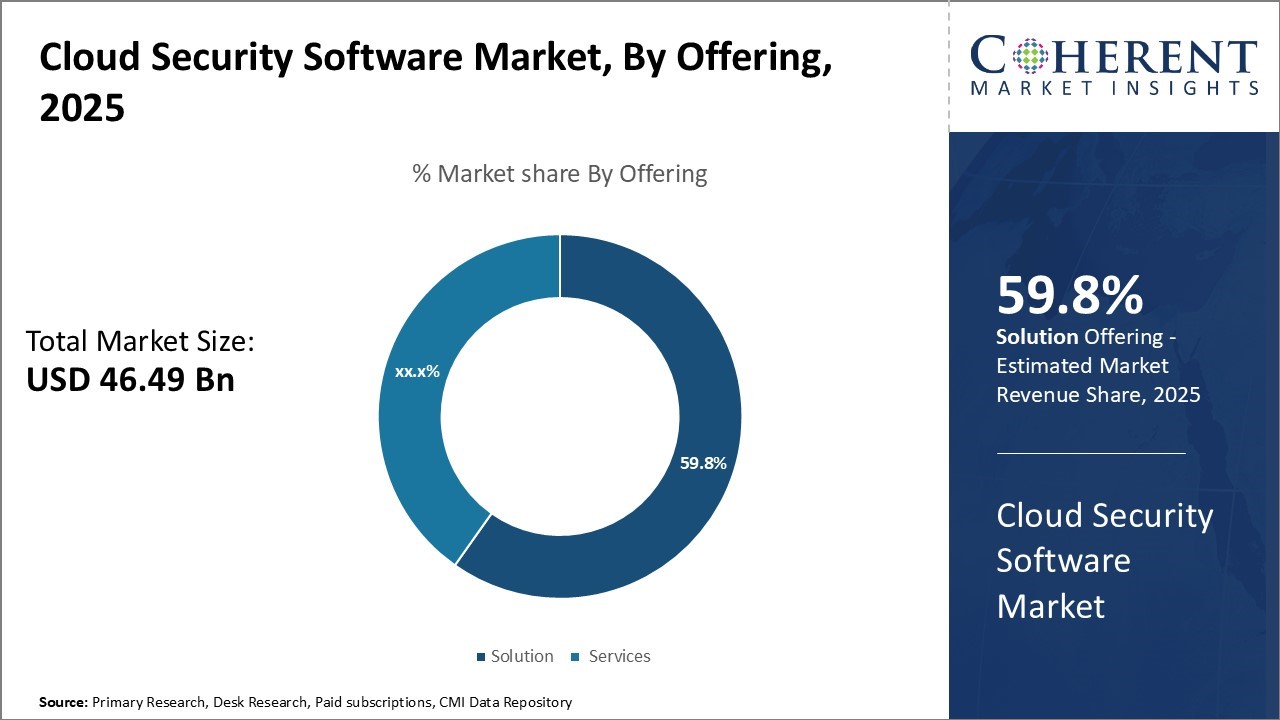
Cloud Security Software Market Insights, by Offering - Solution contributes the highest share of the market owing to its investment and strategic acquisitions
Solution holds the largest cloud security market share of 60.8% in 2026. As cyber threats get more complicated, businesses need to protect important data in dynamic cloud environments. This is driving up demand for cloud security solutions. Businesses have to improve their security because of rules and regulations. As more businesses use cloud technology and allow employees to work from home, the attack surface grows, making it even more important to have good security. Artificial intelligence and machine learning are getting better at finding threats, which is why businesses need to use advanced cloud security solutions to protect their operations.
For instance, in April 2025, Capital One Software introduced Databolt, a tokenization solution that helps businesses protect sensitive data at scale while maintaining performance and speed.
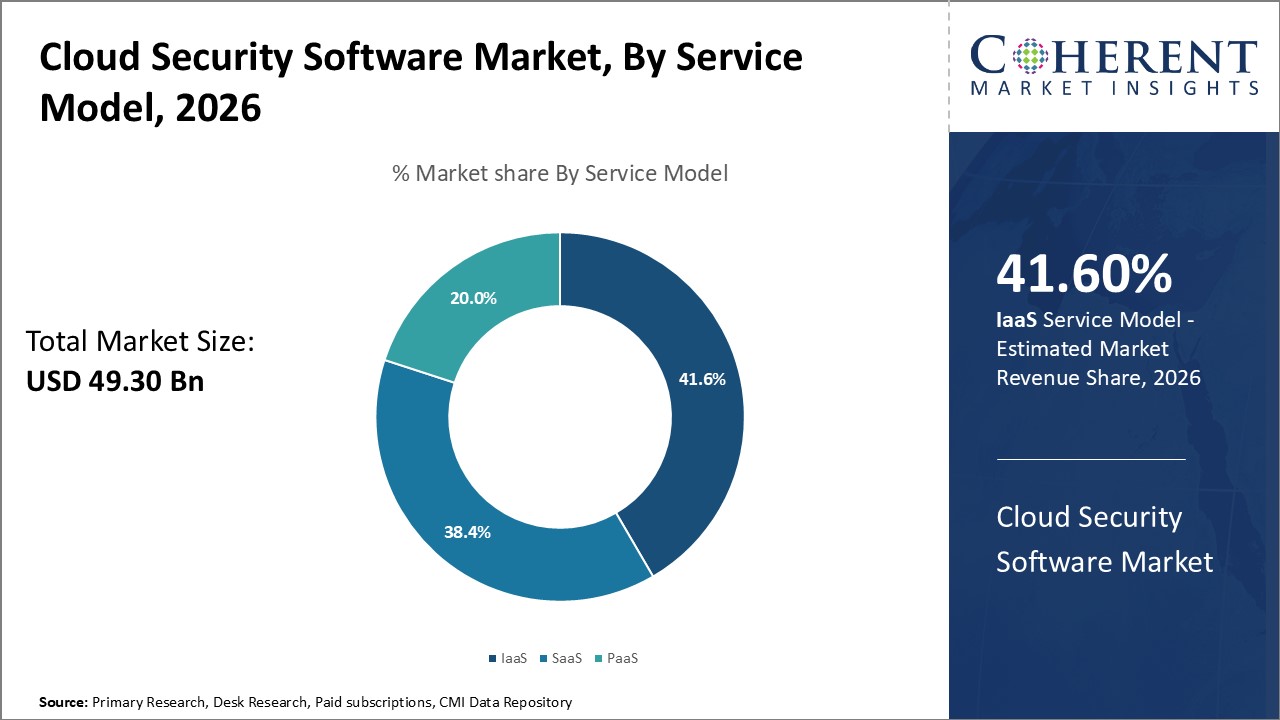
Cloud Security Software Market Insights, by Service Model - IaaS contributes the highest share of the market owing to its digital transformation initiatives
IaaS expected to hold largest market share of 41.6% in 2026. Organizations are pushing the expansion of IaaS in the cloud security software market because they want infrastructure that is flexible and can expand with them without having to pay a lot of money up front. As companies speed up their digital transformation, they actively use IaaS to better manage workloads and make their operations more flexible. As hybrid and multi-cloud systems get more complicated, there is a greater need for safe, integrated solutions. AI-powered tools in IaaS platforms also help find threats and manage resources better, making IaaS an important part of cloud security plans today.
For instance, in July 2025, Blue NAP Americas, a Curaçao-based data centre operator, partnered with Radian Arc and Emerging International to launch the first AI Infrastructure-as-a-Service (AI IaaS) platform in the Caribbean and Central America.
Cloud Security Software Market Insights, by Vertical - BFSI contributes the highest share of the market owing to its rising cybersecurity threats
BFSI acquired the prominent market share of 39.8% in 2026. As cyber dangers grow, the BFSI sector is asking for cloud security software to keep critical financial data safe. Banks and other financial organizations are quickly adopting cloud technologies to make things run more smoothly and improve the client experience. Because of strict rules, they have to put in place stringent security measures. As digital banking and distant services grow, so do the risks, which makes strong cloud security even more important. BFSI companies also utilize AI and automation in their security solutions to find and deal with threats, making sure they follow the rules and run smoothly.
For instance, in April 2025, NxtGen, a leading sovereign cloud services provider, unveiled India’s first Financial Services Cloud (FSC), a dedicated platform built to meet the strict compliance, security, and data sovereignty requirements of the country’s BFSI sector.
Cloud Security Software Market Insights, by Type - Data Security contributes the highest share of the market owing to its integration of AI and machine learning
More and more data breaches and assaults are making companies ask for better data protection in the cloud security software market. Companies make it a point to protect sensitive data that is kept on the cloud. Companies have to use stronger data protection methods because of rules and standards set by the government and the industry. As more businesses use several clouds and hybrid clouds, things get more complicated and they need better security solutions. They also use AI and machine learning to find threats faster and automate responses, which makes their cloud security stronger overall.
For instance, in April 2025, Google LLC has announced a range of new AI-driven features for enterprise security, including its new Google Unified Security service, along with advanced security agents and innovations.
Regional Insights
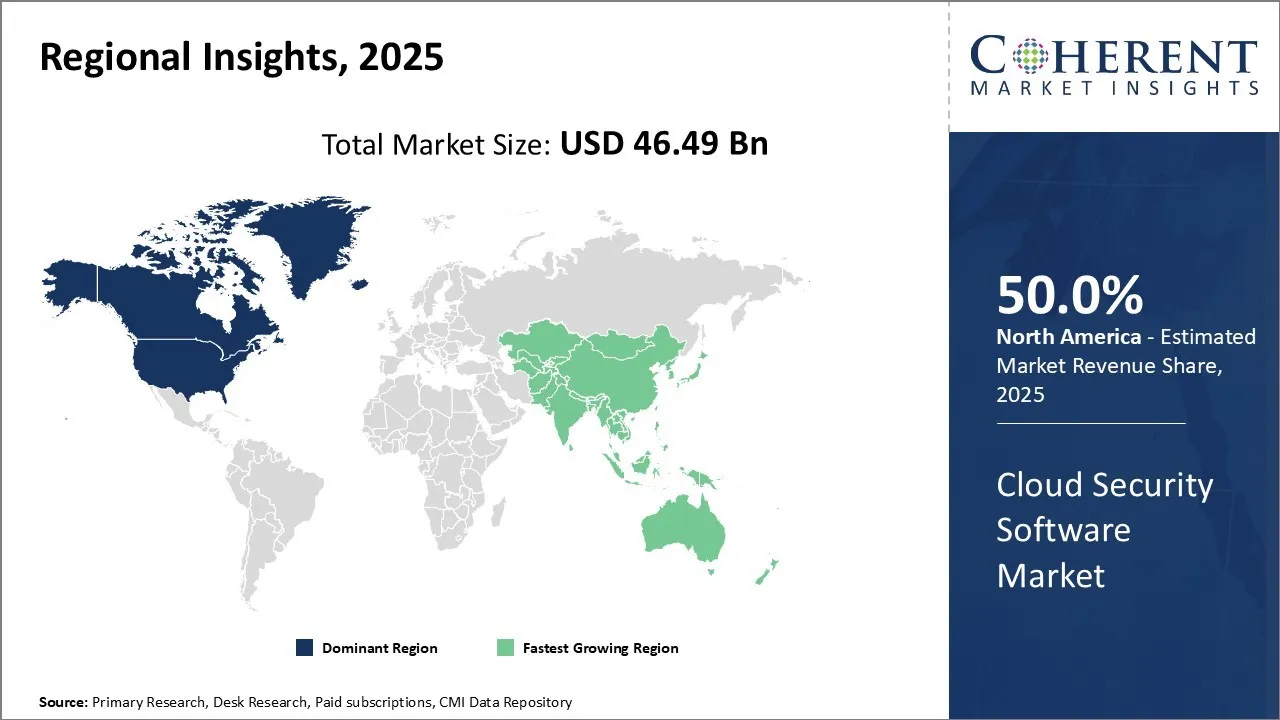
North America Cloud Security Software Market Trends
North America dominates the overall cloud security software market demand with an estimated share of 50.0% in 2026. In North America, organizations drive the cloud security software market by focusing on innovation and advanced security practices. They increasingly adopt zero-trust architectures and integrate AI-driven solutions to enhance their defenses. The widespread use of multi-cloud and hybrid cloud environments boosts demand for comprehensive security tools that protect seamlessly across platforms. Additionally, government regulations and industry standards compel businesses to prioritize data privacy and compliance, accelerating the adoption of sophisticated cloud security software across the region. For instance, in February 2026, Atos Group launched its Google Cloud Managed Security Services Provider (MSSP) portfolio, delivering a comprehensive suite of managed services. In collaboration with Google Cloud, Atos has also earned the Security Specialization under the Google Cloud Partner Advantage Program in both EMEA and North America.
Asia Pacific Cloud Security Software Market Trends
Businesses in the Asia Pacific region are rapidly expanding the cloud security software market by embracing digital transformation and adopting cloud technologies. Increasing cyber threats and data privacy concerns are prompting organizations to invest in advanced security solutions. Many companies actively integrate AI and automation to enhance threat detection and response. The growing use of hybrid and multi-cloud strategies drives demand for versatile security tools. Additionally, government initiatives promoting data protection and cybersecurity awareness actively support the market’s growth across the region. For instance, in May 2026, Check Point Software Technologies launched an automated threat intelligence platform in Singapore that integrates offensive and defensive cybersecurity strategies while ensuring local data residency.
United States Cloud Security Software Market Trends
Strong investments in cloud infrastructure and cutting-edge technologies are placing the United States at the forefront of the cloud security software market. Organizations actively implement zero-trust security models and use AI-enhanced threat detection to protect sensitive data. The growing adoption of hybrid and multi-cloud environments drives demand for integrated security solutions. Additionally, stringent regulatory requirements compel companies to improve compliance and data privacy measures. Together, these factors fuel robust growth and innovation in the U.S. cloud security software market. For instance, in April 2026, Verizon launched its first Government Cloud-Managed SD WAN product, built on its FedRAMP High Ready platform, featuring the platform’s first SaaS-managed SD WAN solution for U.S. federal agencies.
Japan Cloud Security Software Market Trends
Businesses in Japan are rapidly evolving the cloud security software market by accelerating their cloud adoption to boost digital capabilities. Companies actively strengthen security frameworks to protect sensitive information from increasing cyber threats. The rising use of hybrid cloud models drives demand for advanced, adaptable security solutions that provide seamless protection. Additionally, government policies focused on cybersecurity and data privacy encourage organizations to invest in robust cloud security technologies. Together, these factors drive steady growth and innovation in Japan’s cloud security market. For instance, in May 2026, Juniper Networks launched a new local Mist cloud instance in Japan to meet the increasing demand for secure, AI-driven networking services.
End-user Feedback and Unmet Needs
- Demand for Simplified Integration: End-users seek cloud security solutions that seamlessly integrate with existing IT infrastructure and multiple cloud platforms. Complexity in deployment and management often hinders adoption, driving the need for user-friendly, unified security frameworks that reduce operational overhead and improve visibility across diverse environments.
- Need for Real-Time Threat Detection: Users emphasize the importance of faster, more accurate threat detection and automated response capabilities. Delays in identifying security breaches can lead to significant damage, so there is growing demand for AI-driven tools that provide real-time monitoring and proactive defense mechanisms.
- Customization and Scalability Challenges: Many organizations require highly customizable cloud security solutions that can scale according to their specific needs. Current offerings sometimes lack flexibility, limiting the ability to tailor protection to unique business processes or rapidly expanding cloud infrastructures.
Cloud Security Software Market Trend
Rising Adoption of Zero Trust Architecture
The cloud security software market is increasingly embracing zero trust architecture, where no user or device is automatically trusted. This trend enhances security by continuously verifying identity and access privileges, reducing risks associated with insider threats and compromised credentials. Organizations implement zero trust models to ensure that every access request is scrutinized, making cloud environments more resilient against evolving cyberattacks.
Cloud Security Software Market Opportunity
Rising Demand for Cloud Security in IoT Deployments
The rapid proliferation of IoT devices creates new vulnerabilities that cloud security software can address. As industries integrate IoT with cloud platforms, securing connected devices and data becomes critical. This opens opportunities for vendors to develop specialized solutions focusing on IoT endpoint protection, secure data transmission, and real-time monitoring, helping organizations manage risks associated with an increasingly interconnected ecosystem.
Market Report Scope
Cloud Security Software Market Report Coverage
| Report Coverage | Details | ||
|---|---|---|---|
| Base Year: | 2025 | Market Size in 2026: | USD 49.30 Bn |
| Historical Data for: | 2020 To 2024 | Forecast Period: | 2026 To 2033 |
| Forecast Period 2026 to 2033 CAGR: | 6.1% | 2033 Value Projection: | USD 74.66 Bn |
| Geographies covered: |
| ||
| Segments covered: |
| ||
| Companies covered: | Amazon Web Services (AWS), Microsoft, Palo Alto Networks, Trend Micro, Broadcom, Check Point Software Technologies, Google, McAfee, IBM, Zscaler, Cisco Systems, Fortinet, Symantec Corporation | ||
| Growth Drivers: |
| ||
| Restraints & Challenges: |
| ||
Cloud Security Software Market News
- In April 2025, Google launched Google Unified Security, a new enterprise security platform that integrates the company’s visibility, threat detection, and incident response capabilities across networks, endpoints, cloud infrastructure, and apps.
- In October 2024, IBM Corp. introduced Guardium Data Security Center, a new platform designed to help organizations tackle increasing data security risks linked to hybrid cloud environments, artificial intelligence, and quantum computing.
- In February 2025, OpenText has announced OpenText™ Core Threat Detection and Response, an AI-powered cybersecurity solution for threat detection, available with Cloud Editions 25.2, expanding its portfolio to enhance enterprise threat hunting, detection, and response capabilities.
Analyst Opinion (Expert Opinion)
- The Cloud Security Software market is no longer a nascent segment but a critical battleground for cybersecurity innovation. From my observation, the pace at which cyber threats are evolving far outstrips traditional defense mechanisms, compelling organizations to rethink their security posture. AI-driven security solutions have proven indispensable—industry reports reveal that AI-enhanced threat detection reduces incident response times by over 30%, directly mitigating financial and reputational damage. For instance, companies like Darktrace and CrowdStrike, leveraging AI for real-time anomaly detection, are setting new industry standards in proactive defense.
- Moreover, the adoption of zero-trust models is shifting from theoretical frameworks to practical imperatives. According to Forrester, 90% of breaches involve compromised credentials, underscoring zero trust’s role in minimizing lateral movement within cloud environments. Enterprises investing in granular access controls and continuous verification, such as Google’s BeyondCorp initiative, demonstrate measurable reductions in breach incidents.
- However, the market still underestimates the complexity multi-cloud environments introduce. Security tools are struggling to keep pace with heterogeneous infrastructures, where inconsistent policy enforcement becomes a glaring vulnerability. Vendors who prioritize unified cloud security management, exemplified by Palo Alto Networks’ Prisma Cloud, will dominate by enabling centralized visibility and automated compliance across diverse platforms.
Speak to the analyst
Want personalized insights?
Take the findings above to one of our principal consultants, or have the report rebuilt around the segments, geographies and competitors you actually track.
Market Segmentation
- Offering Insights (Revenue, USD Bn, 2021 - 2033)
- Solution
- Services
- Service Model Insights (Revenue, USD Bn, 2021 - 2033)
- IaaS
- SaaS
- PaaS
- Vertical Insights (Revenue, USD Bn, 2021 - 2033)
- BFSI
- Healthcare
- Government
- IT and ITes
- Others
- Type Insights (Revenue, USD Bn, 2021 - 2033)
- Data Security
- Disaster Recovery and Business Continuity
- IAM
- Governance
- Visibility and Risk Assessment
- Regional Insights (Revenue, USD Bn, 2021 - 2033)
- North America
- U.S.
- Canada
- Latin America
- Brazil
- Argentina
- Mexico
- Rest of Latin America
- Europe
- Germany
- U.K.
- Spain
- France
- Italy
- Russia
- Rest of Europe
- Asia Pacific
- China
- India
- Japan
- Australia
- South Korea
- ASEAN
- Rest of Asia Pacific
- Middle East
- GCC Countries
- Israel
- Rest of Middle East
- Africa
- South Africa
- North Africa
- Central Africa
- Key Players Insights
- Amazon Web Services (AWS)
- Microsoft
- Palo Alto Networks
- Trend Micro
- Broadcom
- Check Point Software Technologies
- McAfee
- IBM
- Zscaler
- Cisco Systems
- Fortinet
- Symantec Corporation
Sources
Primary Research interviews
- CIOs and CISOs of leading enterprises
- Cloud security software vendors’ product managers
- IT security consultants and industry experts
- Cloud service providers’ security teams
Databases
- National Vulnerability Database (NVD)
- Common Vulnerabilities and Exposures (CVE) database
- IEEE Xplore Digital Library
- US Patent and Trademark Office (USPTO)
Magazines
- Cybersecurity Magazine
- Network Security Magazine
- Cloud Computing Journal
- Information Security Magazine
Journals
- Journal of Cybersecurity
- IEEE Transactions on Cloud Computing
- Computers & Security Journal
- International Journal of Information Security
Newspapers
- The Wall Street Journal – Technology Section
- The New York Times – Cybersecurity Reports
- Financial Times – Technology & Security
- The Washington Post – Cybersecurity Coverage
Associations
- Cloud Security Alliance (CSA)
- Information Systems Security Association (ISSA)
- International Information System Security Certification Consortium (ISC)²
- Internet Society (ISOC)
Public Domain sources
- US Department of Homeland Security (DHS) Cybersecurity Resources
- National Institute of Standards and Technology (NIST) Publications
- Open Web Application Security Project (OWASP) Guidelines
- Federal Trade Commission (FTC) Reports
Proprietary Elements
- CMI Data Analytics Tool, and Proprietary CMI Existing Repository of information for last 8 years
Get access to 250+ pages report
Every segment, forecast, competitor profile and data table behind the analysis above — available for instant download.
- ESOMAR Member
- ISO 9001:2015 Certified
- D-U-N-S Registered
- GDPR & CCPA Compliant
Missing comfort of reading report in your local language? Find your preferred language:
Transform your Strategy with Exclusive Trending Reports
Frequently Asked Questions
The Cloud Security Software Market is estimated to be valued at USD 49.30 Bn in 2026, and is expected to reach USD 74.66 Bn by 2033.
The CAGR of the Cloud Security Software Market is projected to be 6.1% from 2026 to 2033.
Increase in adoption of cloud-based applications and Growing need for centralized monitoring and logging of cloud infrastructure are the major factor driving the growth of Cloud Security Software Market.
Lack of technical expertise and Budget constraints are the major factor hampering the growth of Cloud Security Software Market.
In terms of offering, Solution is estimated to dominate the market revenue share in 2026.
Amazon Web Services (AWS), Microsoft, Palo Alto Networks, Trend Micro, Broadcom, Check Point Software Technologies, Google, McAfee, IBM, Zscaler, Cisco Systems, Fortinet, Symantec Corporation are the major players.
North America is expected to lead the Cloud Security Software Market in 2026.