

Mobile Application Testing Solution Market Size and Share Analysis - 2026 To 2033
The global mobile application testing solution market size is estimated at USD 11,451.1 Mn in 2026 and is projected to grow at a CAGR of 17.0% during the forecast period (2026–2033), reaching approximately USD 34,367.6 Mn by 2033. This strong growth is mostly due to rapid proliferation of smartphones and mobile applications and rising demand for seamless user experiences across multiple devices and operating systems. By late 2025, the United States had over 317 Mn smartphone users, with a 97% smartphone penetration rate.
Key Takeaways from the Mobile Application Testing Solution Market Report
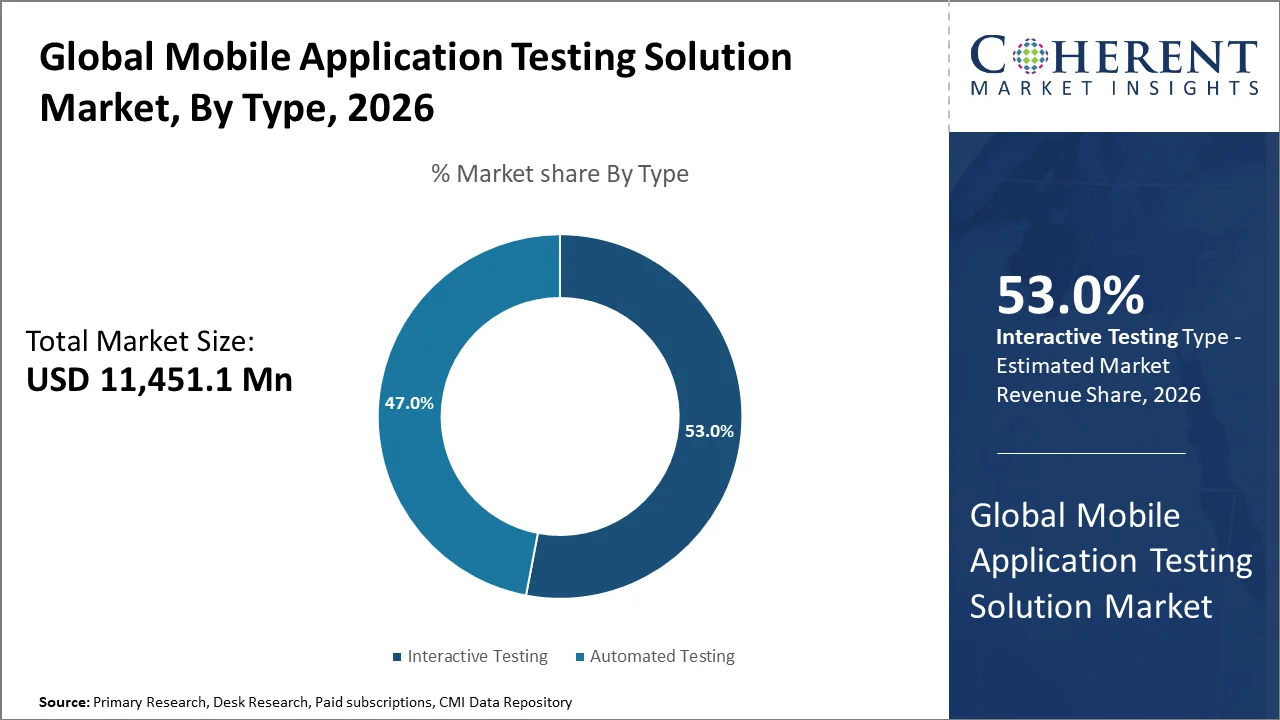
- Interactive testing is expected to lead the market with a share of 53% in 2026 due to its ability to detect usability issues as well as ensure a seamless user experience across multiple devices and platforms. For instance, a study conducted in 2024 indicated that less than 5% of the mobile applications that were released in 2023 made it commercially successful, where usability and user experience are noted to be key factors of app success.
- Android is anticipated to account for 60% of the global mobile application testing solution market share in 2026 because of its large global user base, wide device diversity, and frequent app releases requiring extensive testing. For instance, android powers more than 3.9 billion users worldwide.
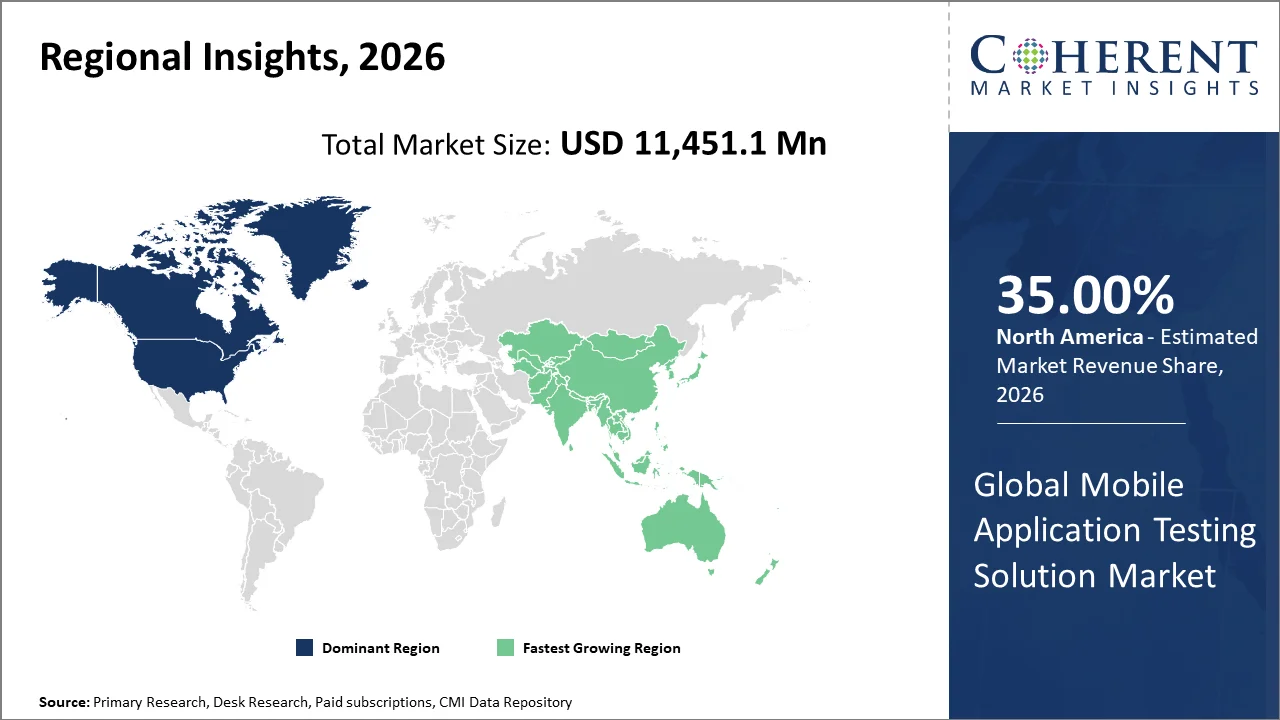
- North America is estimated to lead the global market for mobile application testing solutions with 35% of the share in 2026, owing to the strong presence of technology giants in this region, along with high development of mobile applications and adoption of advanced testing solutions. For instance, according to Apple Inc., there were more than 7.7 Mn applications updates recorded in the App Store in 2024.
- Asia Pacific region is expected to witness the highest CAGR of 22%, due to which it is anticipated to be the fertile ground for mobile application testing solutions providers, owing to high smartphone penetration rate and digital transformation in emerging economies. According to the projections of GSMA, Asia Pacific will have 2.1 billion unique mobile subscribers in 2030.
Mobile Application Testing Solution Market Overview
The global mobile application testing solution market is projected to register strong growth during the forecast period. This is due to rising penetration of smartphones, growing adoption of mobile applications across industries, and increasing need to deliver seamless user experiences. Mobile application testing solutions have the tendency to help organizations identify bugs, optimize application performance, and accelerate release cycles while maintaining high quality standards.
Organizations are increasingly integrating testing into continuous integration/continuous delivery (CI/CD) pipelines. This, in turn, is increasing the demand for automated testing solutions that support faster software releases and continuous quality assurance. Thus, rising adoption of Agile and DevOps is expected to boost mobile application testing solution market growth during the forecast period.
Growing concerns regarding application security, data privacy, and regulatory compliance are also motivating firms to look towards advanced mobile application testing tools. With banks, hospitals, retailers, e-commerce businesses, and entertainment companies continuing to rely on mobile applications, the outlook for the advanced mobile application testing services market looks promising.
Mobile applications have become a vital component of modern business operations, enabling organizations to improve customer engagement, streamline processes, and deliver digital services. Consequently, the adoption of mobile application testing solutions is increasing across the global IT industry.
Segmental Insights
Which Testing Type Dominates the Mobile Application Testing Solution Market?
Interactive Testing to Account for More than Half of Market Share in 2026
According to Coherent Market Insights’ latest mobile application testing solution market analysis, interactive testing is set to dominate the market, accounting for a share of 53% in 2026. This dominance is attributable to growing demand for seamless user experiences across diverse mobile devices, operating systems, and network conditions.
Interactive testing enables testers to manually evaluate application functionality, usability, responsiveness, and overall user experience in real-time, helping identify issues that automated tools may overlook. It is particularly valuable for testing complex user interfaces, gesture-based interactions, and newly introduced application features before deployment.
According to the results of the systematic mapping survey on 51 papers done in 2024, user-based usability testing is still the most common type of testing. Furthermore, due to the growth in the number of mobile applications in sectors like banking, medicine, e-commerce, and games, there is a growing need for interactive testing to guarantee proper performance and customer satisfaction.
- Current Industry Events of 2026
- Market Size Estimation
- Regional Breakdown
- Competitive Landscape
- Customer Intelligence
- Segmental Analysis
- Pricing Analysis
- Key Market Drivers, Challenges & Future Trends
- Customized Insights Section
Which Platform Accounts for the Largest Market Share?
Android to Hold Three-Fifths of Mobile Application Testing Solution Market Share in 2026
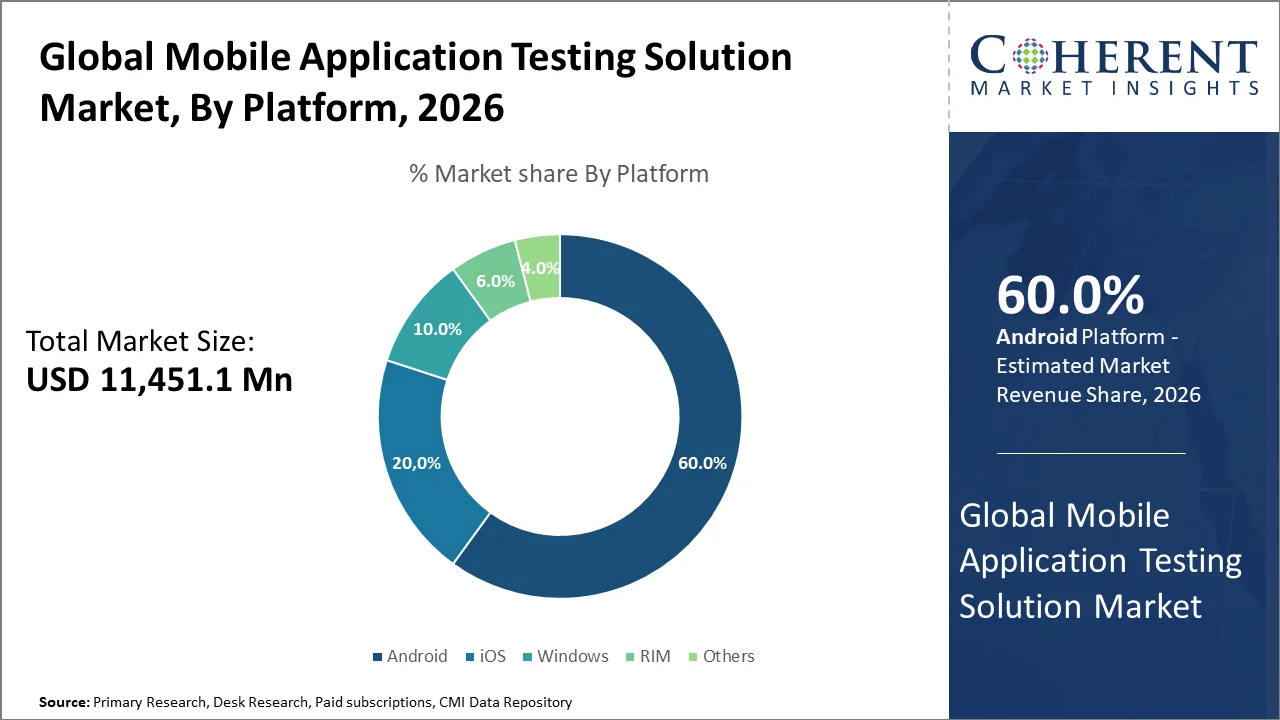
Based on platform, android is expected to account for the largest market share of 60% in 2026. This is mostly due to its dominant global smartphone user base, extensive device ecosystem, and widespread adoption across emerging economies. The platform's fragmentation, with numerous device manufacturers, screen sizes, and operating system versions, increases the need for comprehensive application testing to ensure compatibility, performance, and security.
Google's Android distribution data (Dec. 2025) shows active devices spread across multiple OS versions, including Android 15 (19.3%), Android 14 (17.2%), Android 13 (13.9%), Android 11 (13.7%), Android 12 (11.4%), Android 10 (7.8%), and Android 16 (7.5%). This fragmentation increases the need for comprehensive mobile application testing to ensure compatibility, performance, and seamless user experiences across diverse Android devices.
In addition, growing number of Android applications across industries like e-commerce, banking, healthcare, gaming, and entertainment is driving demand for automated and AI-powered mobile application testing solutions. Organizations are increasingly investing in Android testing tools to deliver seamless user experiences as well as reduce application crashes and speed up release cycles.
Mobile Application Testing Solution Market Growth Drivers
Rapid Growth in Mobile Application Development
Continuous expansion of mobile application development is driving growth of the mobile application testing solution market. The increasing number of Android, iOS, and cross-platform applications across industries like banking, healthcare, retail, education, and entertainment is fueling demand for comprehensive testing solutions to ensure application quality, performance, security, and user experience. Every mobile application requires rigorous testing before deployment and throughout its lifecycle, prompting organizations to invest in advanced mobile application testing solutions.
Mobile Application Testing Solution Market Opportunities
Expansion of Mobile Commerce and Digital Services
Rapid expansion of mobile commerce and digital services is expected to create lucrative growth opportunities for mobile application testing solution market during the forecast period. The increasing adoption of mobile banking, digital payments, e-commerce, telemedicine, and other online services is driving demand for secure, reliable, and high-performing mobile applications. As a result, organizations in the contemporary world are increasing investments in mobile application testing solutions to ensure application quality, security, compliance, and seamless user experiences.
Mobile Application Testing Solution Market Trends
Rising Adoption of Cloud-based Testing Platforms
Increasing popularity of cloud-based testing solutions is a key growth-shaping market trend. Cloud testing environments provide scalable access to thousands of real devices and browsers, enabling remote collaboration while lowering infrastructure costs.
Another emerging trend in the mobile application testing solution market is the rise of AI-powered and machine learning-based test automation. AI is improving automated test creation, defect prediction, self-healing scripts, and test optimization, significantly reducing testing time and overall costs.
A recent example of this trend is mabl’s launch of its AI-powered mobile application testing capabilities as part of its unified test automation platform in May 2024. Similarly, in August 2025, Applitools released major AI-powered upgrades to its testing platform, including natural language test creation (LLM-based), AI-driven visual validation, automated test data generation, and reduced manual QA scripting effort.
Current Events and Their Impact on the Mobile Application Testing Solution Market
Current Event | Description and its Impact |
Google Play's New App Quality Requirements |
|
EU Cyber Resilience Act |
|
Regional Insights
North America to Retain Its Dominance Over Mobile App Testing Solution Market
North America is expected to lead the global mobile application testing solution industry, capturing a share of 35% in 2026. This dominance can be attributed to strong enterprise digital transformation, high smartphone penetration, and rising adoption of cloud-based and AI-driven testing tools. The United States has a 91% smartphone penetration rate among adults and 98% overall mobile phone ownership, with more than 317 million smartphone users, making it one of the world’s most saturated mobile markets. The region’s leadership in sectors like banking, healthcare, retail, and IT services is increasing demand for continuous testing, performance validation, and security testing of complex mobile applications.
Rapid expansion of next-generation mobile connectivity, which increases application complexity and testing requirements, is playing a key role in boosting growth of North America mobile application testing solution market. For example, according to the GSMA Mobile Economy North America 2024 report, 5G connections in North America are projected to rise from about 220 million in 2023 to around 443 million by 2030. This, in turn, is set to fuel demand for high-performance mobile apps and automated testing solutions.
Asia Pacific to Emerge as the Fastest Growing Mobile App Testing Solution Market
Asia Pacific is anticipated to emerge as the most lucrative market for mobile app testing solution providers during the forecast period, registering a CAGR of 22%. This is mostly due to rapid digital transformation, expanding smartphone user base, and strong growth in mobile-first services such as e-commerce, fintech, and telemedicine. In addition, rising complexity of mobile applications is increasing the need for faster, automated, and AI-driven testing solutions to ensure performance and security at scale.
Growing mobile internet usage is providing a strong impetus for the growth of the Asia Pacific mobile application testing solution market. For example, according to the GSMA Mobile Economy Asia Pacific 2024 report, mobile internet subscribers in the region are expected to rise to over 2.1 billion by 2030. This is expected fuel demand for high-quality mobile applications and robust testing solutions.
Mobile Application Testing Solution Market Outlook – Country-wise
U.S. Mobile Application Testing Solution Market Trends
The United States is projected to remain a key market for mobile application testing solutions during the forecast period. This is attributable to increasing adoption of digitalization, high mobile app usage across banking, healthcare, retail, and media, and growing popularity of cloud-based and AI-enabled testing tools. Increasing complexity of mobile applications, along with growing demand for seamless user experience, is pushing organizations toward continuous testing and automation frameworks.
China Mobile Application Testing Solution Market Forecast
China is expected to witness strong growth, making it a hotbed for mobile application testing solution vendors. This is due to rapid urbanization, large-scale digital infrastructure expansion, and massive adoption of mobile-first services such as e-commerce, super apps, and digital payments. Increasing complexity of mobile ecosystems and strong government push for digital economy development are also expected to drive demand for advanced testing solutions focused on performance, scalability, and security during the forecast period.
Who are the Major Companies in the Mobile Application Testing Solution Market?
Some of the major players in mobile application testing solution market are CA Technologies, Symantec Corporation, Cognizant Technology Solution Corporation, SAS Institute, Inc., Hewlett Packard Enterprise, SAP SE, IBM Corporation, Oracle Corporation, and Microsoft Corporation.
Key Strategies Adopted by Industry Players
Top mobile application testing solution companies are adopting various organic and inorganic strategies to boost their sales as well as gain a competitive edge in the industry. These include new product launches, collaborations, partnerships, mergers, acquisitions, and joint ventures.
- In November 2025, Oracle introduced the Oracle Mobile Applications Analyzer. It is a tool used to check and troubleshoot Oracle Mobile Applications in Oracle E-Business Suite environments.
- In January 2025, IBM announced plans to acquire Applications Software Technology (AST) to strengthen its enterprise cloud and application services. This deal supports IBM’s broader capabilities in software development, testing, and quality assurance for business applications.
Market Report Scope
Mobile Application Testing Solution Market Report Coverage
| Report Coverage | Details | ||
|---|---|---|---|
| Base Year: | 2025 | Market Size in 2026: | USD 11,451.1 Mn |
| Historical Data for: | 2020 To 2024 | Forecast Period: | 2026 To 2033 |
| Forecast Period 2026 to 2033 CAGR: | 17.0% | 2033 Value Projection: | USD 34,367.6 Mn |
| Geographies covered: |
| ||
| Segments covered: |
| ||
| Companies covered: | CA Technologies, Symantec Corporation, Cognizant Technology Solution Corporation, SAS Institute, Inc., Hewlett Packard Enterprise, SAP SE, IBM Corporation, Oracle Corporation, and Microsoft Corporation | ||
| Growth Drivers: |
| ||
| Restraints & Challenges: |
| ||
Analyst Opinion (Expert Opinion)
- The rapid growth of mobile apps is making testing essential rather than optional. Businesses are launching frequent app updates, making continuous testing necessary to maintain app quality, performance, and user experience. This fuels demand for automated and continuous mobile application testing solutions.
- Testing across different devices and operating systems remains a major challenge. The large number of Android devices, screen sizes, and OS versions increases the need for comprehensive cross-device testing platforms. This increases adoption of cloud-based device testing and AI-powered testing tools.
- Automation has become an important concern for the development team. Enterprises are incorporating mobile testing in the DevOps and CI/CD pipeline to increase speed and reduce the effort required for manual testing. The increasing need for automation testing solutions that can deliver fast software will help in future market growth.
- The use of mobile applications keeps increasing all over the world. Sensor Tower states that 136 billion mobile app downloads were made in 2024, proving the ever-growing demand for quality app testing in the industry.
Speak to the analyst
Want personalized insights?
Take the findings above to one of our principal consultants, or have the report rebuilt around the segments, geographies and competitors you actually track.
Market Segmentation
- By Type Insights ( Revenue, USD Mn, 2021 - 2033)
- Interactive testing
- Automated testing
- By Platform Insights ( Revenue, USD Mn, 2021 - 2033)
- Android
- iOS
- Windows
- RIM
- Others
- By Device Insights ( Revenue, USD Mn, 2021 - 2033)
- Smartphones
- Tablets
- By End User Insights ( Revenue, USD Mn, 2021 - 2033)
- Residential
- Corporate (SMBs, Large Enterprises)
- By Region Insights ( Revenue, USD Mn, 2021 - 2033)
- North America
- U.S.
- Canada
- Latin America
- Brazil
- Argentina
- Mexico
- Rest of Latin America
- Europe
- Germany
- U.K.
- Spain
- France
- Italy
- Russia
- Rest of Europe
- Asia Pacific
- China
- India
- Japan
- Australia
- South Korea
- ASEAN
- Rest of Asia Pacific
- Middle East
- GCC
- Israel
- Rest of Middle East
- Africa
- North Africa
- Central Africa
- South Africa
- North America
Sources
Primary Research Interviews
- Mobile application testing solution providers
- QA managers and software testing engineers
- DevOps and CI/CD specialists
- Enterprise IT decision-makers
- Cloud platform and mobile app development experts
- Independent software vendors (ISVs)
- Technology consultants and system integrators
Databases
- Statista
- World Bank Open Data
- International Telecommunication Union (ITU)
- Eurostat
- UN Data
- OECD Data
- Data.gov
- GitHub
Magazines
- SD Times
- InfoWorld
- CIO Magazine
- DevOps.com
- Application Development Trends (ADTmag)
- IEEE Software Magazine
Journals
- IEEE Transactions on Software Engineering
- ACM Transactions on Software Engineering and Methodology
- Journal of Systems and Software
- Software: Practice and Experience
- Empirical Software Engineering
- Information and Software Technology
Newspapers
- The Wall Street Journal
- Financial Times
- The Economic Times
- Business Standard
- The Hindu BusinessLine
- The New York Times
Associations
- Association for Computing Machinery (ACM)
- IEEE Computer Society
- International Software Testing Qualifications Board (ISTQB)
- Project Management Institute (PMI)
- Linux Foundation
- World Wide Web Consortium (W3C)
Public Domain Sources
- U.S. Census Bureau
- U.S. Bureau of Labor Statistics (BLS)
- National Institute of Standards and Technology (NIST)
- European Commission
- International Telecommunication Union (ITU)
- Organisation for Economic Co-operation and Development (OECD)
- World Bank
- United Nations
- U.S. National Vulnerability Database (NVD)
Proprietary Elements
- CMI Data Analytics Tool
- Proprietary CMI Existing Repository of information for last 10 years
Get access to 250+ pages report
Every segment, forecast, competitor profile and data table behind the analysis above — available for instant download.
- ESOMAR Member
- ISO 9001:2015 Certified
- D-U-N-S Registered
- GDPR & CCPA Compliant
Missing comfort of reading report in your local language? Find your preferred language:
Transform your Strategy with Exclusive Trending Reports
Frequently Asked Questions
The global Mobile Application Testing Solution Market is estimated to be valued at USD 11,451.1 Mn in 2026.
The global Mobile Application Testing Solution Market value is expected to reach USD 34,367.6 Mn by 2033.
The global Mobile Application Testing Solution Market is poised to exhibit a CAGR of 17% from 2026 to 2033.
Major growth factors include Increasing need for immediate regression testing and growing popularity of m-commerce boosting need for rigorous testing process.
Interactive testing is expected to lead the market with a share of 53% in 2026.
Some major companies in the Mobile Application Testing Solution Market include CA Technologies, Symantec Corporation, Cognizant Technology Solution Corporation, SAS Institute, Inc., Hewlett Packard Enterprise, SAP SE, IBM Corporation, Oracle Corporation, and Microsoft Corporation.
North America is set to dominate the global market with a share of 35% in 2026.