

Global Artificial Intelligence in Hardware Market Size and Forecast
Global artificial intelligence in hardware market is estimated to be valued at USD 76.00 Bn in 2026 and is expected to reach USD 220.13 Bn by 2033, exhibiting a compound annual growth rate (CAGR) of 16.4% from 2026 to 2033.
Key Takeaways of the Global Artificial Intelligence in Hardware Market
- In terms of type of hardware, AI processors segment is estimated to contribute 46.6% market share in 2026.
- In terms of application, robotics segment is estimated to contribute the 31.1% market share in 2026.
- In terms of end-use industry, IT and telecommunications segment is estimated to contribute 32.9% market share in 2026.
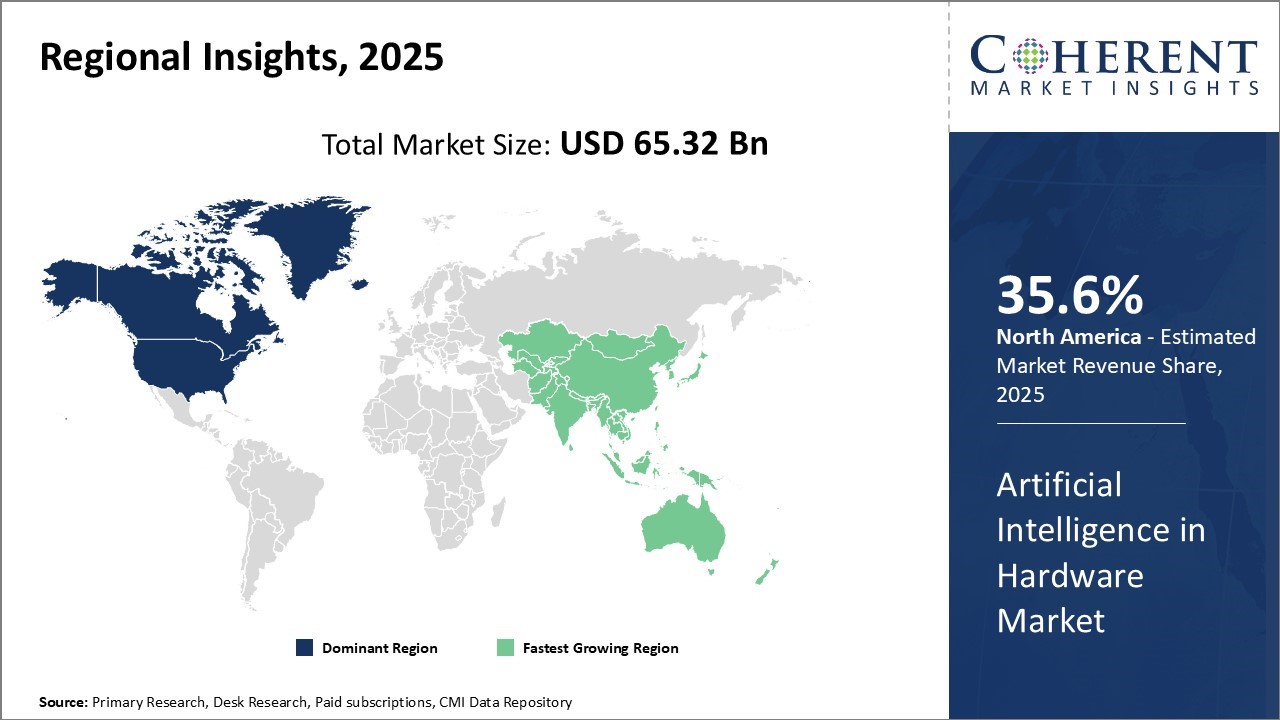
- North America has established itself as the dominant region in the global artificial intelligence in hardware market with 35.6% in 2026.
Market Overview
There is rapid adoption of AI technologies across industries for applications such as robotics, smart homes, and autonomous vehicles can boost demand for specialized AI hardware such as GPUs, chips, and other acceleration hardware during the forecast period. The market growth is driven by increasing investments by major technology players such as Intel, IBM, and Google in AI hardware startups. Widespread availability of low-cost cloud-based AI platforms and growing need for edge analytics and computing can open new avenues for AI hardware vendors in the near future.
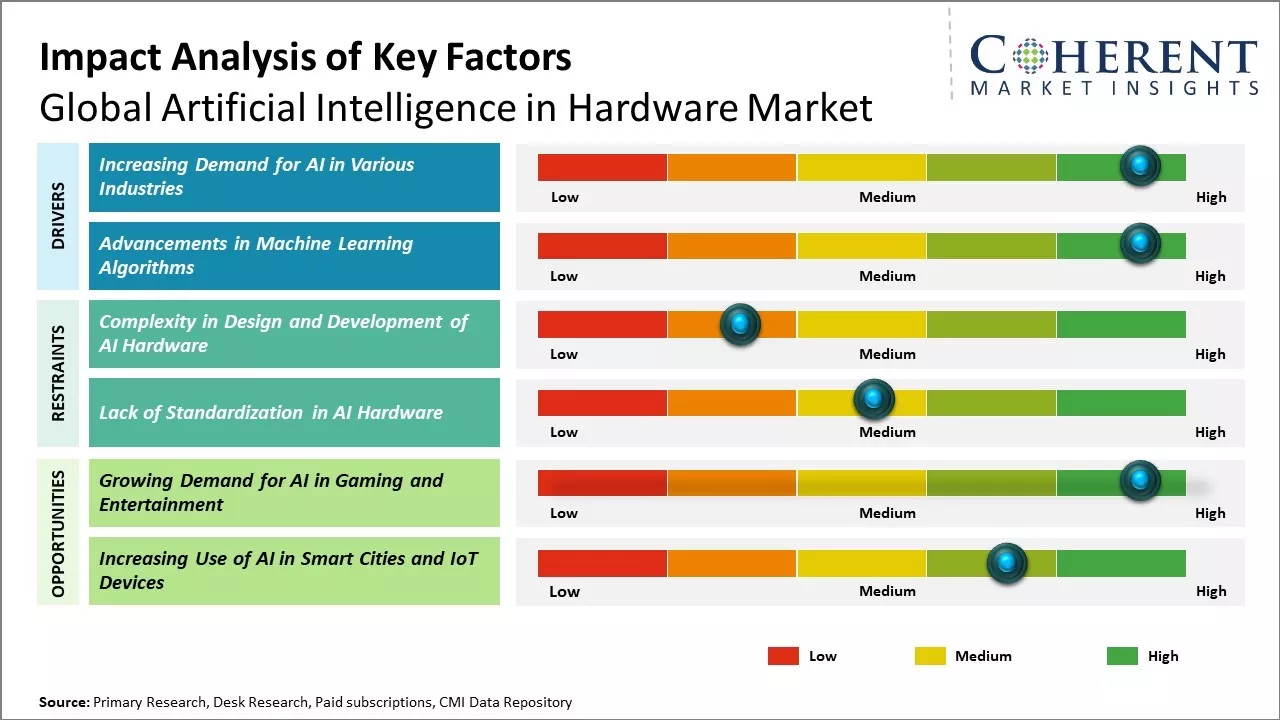
Micro Economic Factors of the Global Artificial Intelligence in Hardware Market
- Companies like AMD are innovating with products like the Instinct MI325X accelerator to compete with rivals like NVIDIA, driving growth in the hardware market by reducing costs and improving efficiency.
- Regional disparities in market growth, such as North America's dominance, are due to concentrated tech hubs and access to skilled labor, showcasing the impact of localized microeconomic factors.
- Enterprises are increasingly demanding AI accelerators that offer high performance while reducing operational expenses, pushing vendors to focus on cost-efficient and scalable hardware solutions.
- The emphasis on cost efficiency and innovation is leading to significant growth in the hardware market, particularly for solutions optimized for energy savings and processing speed.
Market Trends
Increasing Demand for AI in Various Industries
Companies are increasingly adopting AI to streamline operations. In manufacturing, AI is used for predictive maintenance, as seen with BMW and GE Aerospace optimizing machinery upkeep. In healthcare, AI aids diagnosis by analyzing medical images; for example, Aidoc's AI-powered radiology solutions detect urgent conditions in real-time, and Google Health AI focuses on early disease detection.
The transportation sector is also transforming with self-driving cars, exemplified by Tesla's vision-only system using neural networks for navigation. AI's reach extends to drone inspections of energy assets and customer support chatbots. As AI capabilities rapidly grow with computing power and data, more industries like agriculture for resource optimization, such as AI-driven irrigation and urban infrastructure for traffic management, like Bengaluru's BATCS will adopt it, driving demand for specialized AI hardware despite integration challenges.
Advancements in Machine Learning Algorithms
Advanced ML algorithms are solving complex problems by recognizing patterns in large datasets. Deep learning architectures, like CNNs, are key for image recognition in medical imaging. Transfer learning and self-supervised learning enhance efficiency; for example, models like BERT and GPT learn from unlabeled text. Models are also becoming multimodal, processing diverse inputs.
For instance, Google's Gemini and OpenAI's GPT-4o integrate vision, speech, and text. Reinforcement learning enables autonomous learning, as seen in optimizing energy consumption in large buildings. GANs generate synthetic content, with StyleGAN creating realistic faces. The rise of powerful hardware like GPUs and TPUs fuels data-intensive models, driving demand for specialized AI chip solutions.
Opportunity - Growing Demand for AI in Gaming and Entertainment
The gaming and entertainment industry has emerged as a major opportunity area for artificial intelligence in hardware. Applications of AI such as computer vision, motion tracking, predictive analytics, facial recognition, and natural language processing enhances the user experience in games, interactive content and simulations.
The industry is investing heavily in AI techniques to power immersive VR/AR experiences, personalized recommendations, contextual storytelling, lifelike virtual characters and integrated social experiences. This growing demand from gaming and entertainment customers for specialized AI capabilities can boost development of efficient AI hardware accelerators optimized for computer vision, voice and language processing workloads.
- Current Industry Events of 2026
- Market Size Estimation
- Regional Breakdown
- Competitive Landscape
- Customer Intelligence
- Segmental Analysis
- Pricing Analysis
- Key Market Drivers, Challenges & Future Trends
- Customized Insights Section
Current Events and their Impact on the Global Artificial Intelligence in Hardware Market
Current Events | Description and its impact |
U.S. Export Control Policy Shifts |
|
China’s Semiconductor Self-Sufficiency Drive
|
|
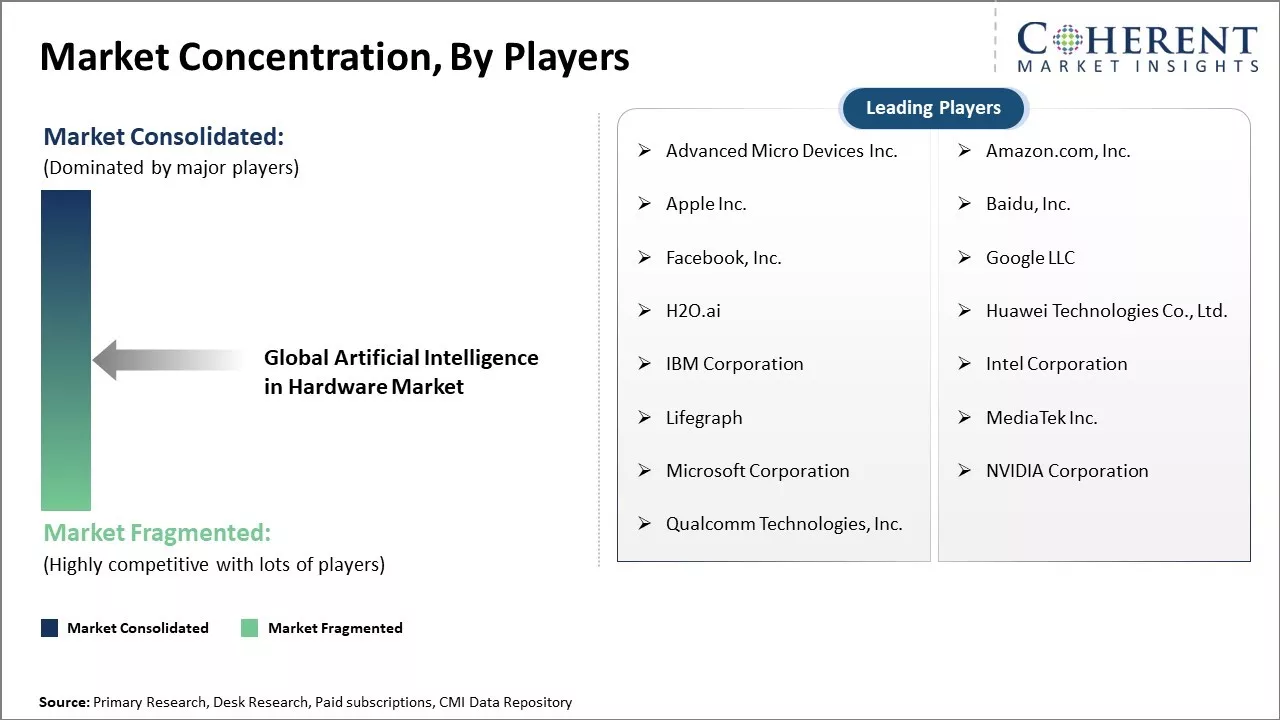
Market Concentration and Competitive Landscape
Segment Insights
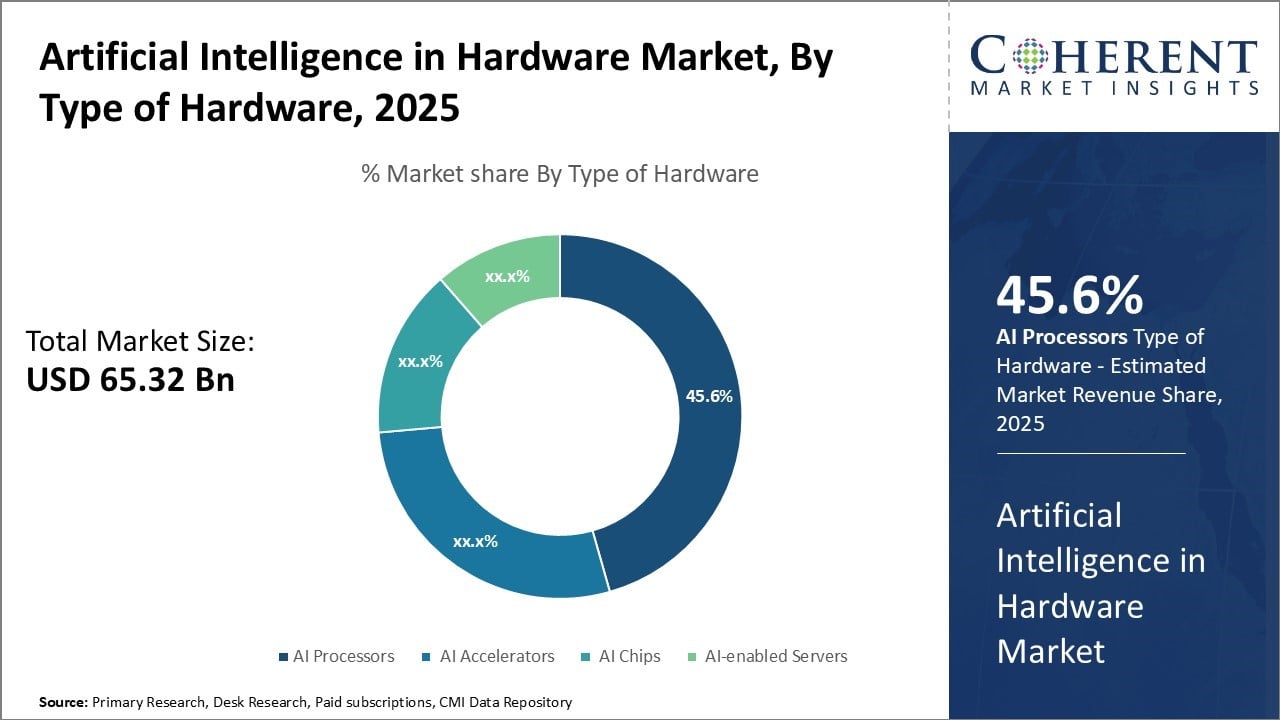
Global Artificial Intelligence in Hardware Market Insights, by Type of Hardware
In terms of type of hardware, AI processors segment is estimated to contribute the 46.6% market share in 2026, owing to growing processing demands of advanced AI techniques. As AI applications become more sophisticated, utilizing techniques such as deep learning, computer vision, and natural language processing, the processing requirements to power these applications have exponentially increased. This has boosted demand for specialized AI processors that can handle these intensive workloads much more efficiently than traditional CPUs or GPUs.
AI processors such as GPUs, Application-Specific Integrated Circuits (ASICs), and neuromorphic chips are designed from the ground up specifically for AI tasks, with dedicated architectures and instruction sets tailored for common AI operations. These offer significantly higher AI performance per watt than alternatives, allowing for the training and deployment of larger and more complex AI models. Leading companies developing AI processors include Nvidia, Intel, Qualcomm, and Graphcore.
In March 2024, NVIDIA launched its Blackwell architecture, including the B200 GPU and GB200 superchip. These new chips offer significantly increased AI processing power, more than quadrupling previous generations, and are designed for complex AI models.
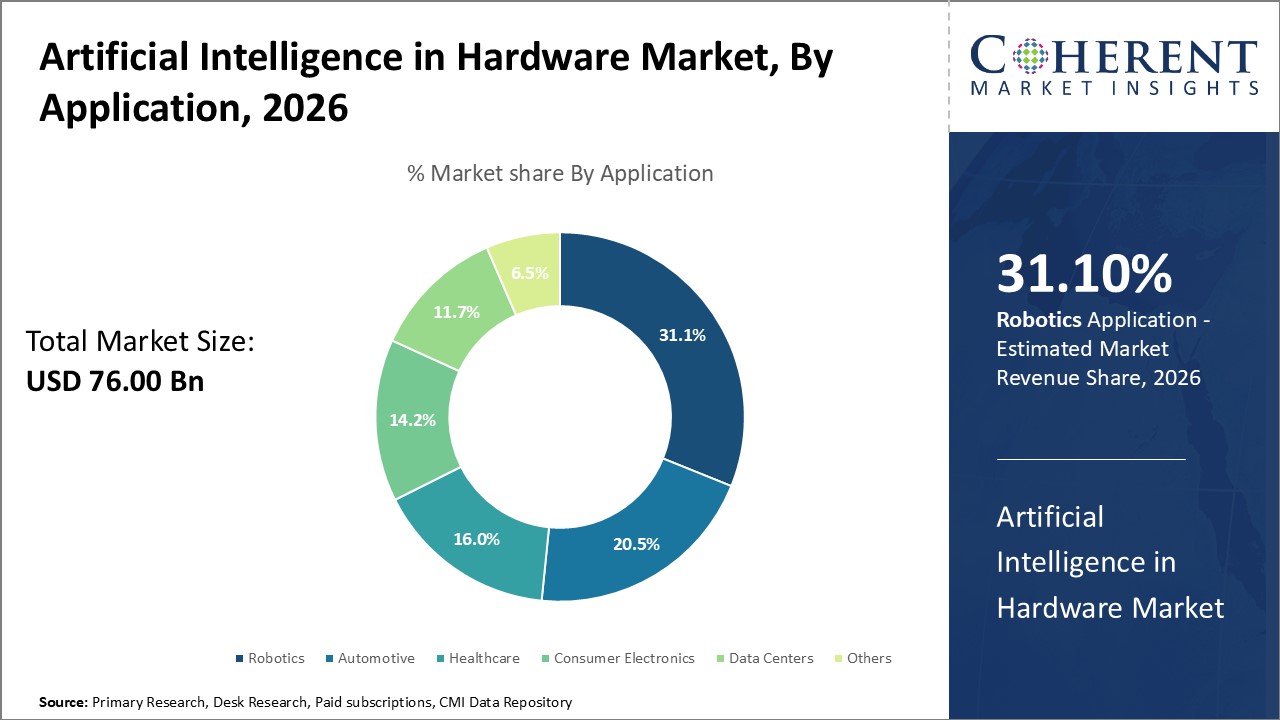
Global Artificial Intelligence in Hardware Market Insights, by Application
In terms of application, robotics segment is estimated to contribute the 31.1% market share in 2026, owing to rising adoption of AI and automation across robotic systems. The integration of AI hardware such as AI chips, accelerators, and edge servers enables sophisticated computer vision, decision making, and motion planning capabilities in robotics. This allows robots to perform complex automated tasks that were previously not possible. Applications include industrial robot arms, autonomous vehicles, medical surgical robots, service robots, and more.
As the economic benefits of robotic automation become clear, many companies are incorporating AI and robotics into their operations to improve productivity, quality control, and workflow efficiency. Demand is especially high from logistics warehouses needing to scale operations as well as factories aiming to enhance production through robotic assembly lines. AI hardware acts as the "brain" powering these robotic systems, interpreting sensor inputs and executing responsive motions in real-time.
Global Artificial Intelligence in Hardware Market Insights, by End-use Industry
In terms of end-use industry, IT and telecommunications segment is estimated to contribute the 32.9% market share in 2026, owing to immense AI infrastructure requirements of modern data centers. As enterprises increasingly rely on cloud platforms and AI-powered web services, data centers witness exponential growth in data volumes and computational workloads. Training and deploying advanced ML models requires vast amounts of processing power, memory, networking, and data storage.
Major cloud providers such as AWS, Microsoft Azure, Google Cloud, IBM Cloud, and Alibaba have embarked on initiatives to integrate AI throughout their infrastructure stacks to support these necessities. This includes deploying AI ASICs, AI accelerators as well as AI frameworks and software to handle recommendation systems, forecasting, security monitoring, maintenance scheduling, and a multitude of other functions. AI chips and AI edge servers are also being distributed to the network edge to enable low-latency AI-based services and applications.
Telecommunication companies are applying AI in 5G networks for dynamic resource allocation, predictive maintenance, fraud detection and more. This widespread adoption of AI hardware and solutions across IT and cloud infrastructure cements the lead of this industry in driving AI hardware demand overall.
Regional Insights
North America Artificial Intelligence in Hardware Market Trends and Analysis
North America has established itself as the dominant region in the global artificial intelligence in hardware market with 35.6% in 2026. With major technology companies like Intel, Nvidia and AMD headquartered in the U.S., the region accounts for the largest number of AI chip startups and suppliers. These companies have made huge investments in innovating AI hardware like processors, systems and edge devices optimized for neural network computations. Sustained focus on R&D has enabled North American firms to commercialize cutting-edge AI chip technologies well ahead of competitors. These also wield significant influence over global technology standards and supply chains catering to AI deployment. The presence of large tech customer base has further accelerated adoption of AI hardware goods and solutions across industries in the region.
Asia Pacific Artificial Intelligence in Hardware Market Trends and Analysis
Asia Pacific is rapidly emerging as the fastest-growing market, largely fueled by China's significant investments. The Chinese government is heavily funding and promoting indigenous innovation, leading to substantial advancements in domestic AI chip manufacturing. The robust electronics manufacturing sector in China enables startups to quickly scale their hardware production. Initiatives like 'Made in China 2026' are enhancing this growth by designating AI processors and edge devices as key strategic areas.
For instance, Chinese AI chipmaker Biren Technology recently raised around ¥1.5 billion (USD 207 million) from state-backed investors and is preparing for a Hong Kong Initial Public Offering (IPO) in 2026. This move is part of China’s broader effort to build homegrown GPU technology to rival global players like Nvidia.
Moreover, several Chinese companies are successfully expanding internationally by utilizing their competitive manufacturing capabilities and expertise. Government policies mandating AI deployment across essential industries are further boosting domestic demand. Other countries in Asia are also increasing their investments to take advantage of the economic opportunities presented by China's ascent as a global AI leader. As local capabilities strengthen, the Asia Pacific region is progressively transforming into a net exporter of AI hardware technologies rather than an importer.
India Artificial Intelligence in Hardware Market Trends and Analysis
India's AI in hardware market is experiencing a "hardware renaissance," driven by soaring demand for specialized processors to power complex AI applications like deep learning and computer vision. While challenges like high development costs and a shortage of expertise exist, government initiatives such as the IndiaAI Mission, approved in 2024, are making significant strides.
IndiaAI mission aims to establish a vast GPU computing infrastructure already exceeding 34,000 GPUs by May 2026 and actively supports the development of indigenous GPUs within the next 3-5 years, signifying India's strong push for self-reliance in cutting-edge AI hardware.
U.S. Artificial Intelligence in Hardware Market Trends and Analysis
The U.S. maintains a leading position in the global artificial intelligence in hardware market, driven by its robust tech ecosystem and substantial R&D investments, which are fueling the demand for specialized AI processors to handle increasingly complex AI workloads. While facing challenges like high development costs and potential tariff impacts, the U.S. continues to innovate, as exemplified by NVIDIA's unveiling of its Blackwell architecture in March 2024. This new generation of GPUs and superchips significantly boosts AI compute performance, showcasing the continuous advancements from leading U.S. companies and reinforced by initiatives like the CHIPS Act.
Germany Artificial Intelligence in Hardware Market Trends and Analysis
Germany is rapidly expanding its AI hardware market, projected to exhibit a Compound Annual Growth Rate (CAGR) of 31.3% from 2026 to 2030. This robust growth is fueled by strategic governmental initiatives, including the "AI Strategy for Germany," which has allocated substantial funding towards AI research and development. Industrial adoption is also on the rise, with nearly 20% of German companies now integrating AI solutions. Furthermore, the nation is actively pursuing "digital sovereignty" by collaborating on dedicated AI cloud infrastructure and "AI factories.
Brazil Artificial Intelligence in Hardware Market Trends and Analysis
Brazil is strengthening its Artificial Intelligence through major government plans and a focused effort to improve its digital setup. This growth comes from key programs like the "Plano Brasileiro de Inteligência Artificial," which works to boost AI abilities in important areas such as public health, farming, and education, with a lot of attention on AI equipment. Also, the government has moved forward with a "National Data Center Policy," which aims to offer benefits and a clear framework for this sector, including ways to lower taxes on AI hardware brought in from other countries. These policies together show Brazil's dedication to encouraging both local and international investment in its growing AI hardware system and becoming a key regional center for AI data storage facilities.
Market Report Scope
Artificial Intelligence in Hardware Market Report Coverage
| Report Coverage | Details | ||
|---|---|---|---|
| Base Year: | 2025 | Market Size in 2026: | USD 76.00 Bn |
| Historical Data for: | 2020 To 2024 | Forecast Period: | 2026 To 2033 |
| Forecast Period 2026 to 2033 CAGR: | 16.4% | 2033 Value Projection: | USD 220.13 Bn |
| Geographies covered: |
| ||
| Segments covered: |
| ||
| Companies covered: | Advanced Micro Devices Inc., Amazon.com, Inc., Apple Inc., Baidu, Inc., Facebook, Inc., Google LLC, .ai, Huawei Technologies Co., Ltd., IBM Corporation, Intel Corporation, Lifegraph, MediaTek Inc., Microsoft Corporation, NVIDIA Corporation, and Qualcomm Technologies, Inc. | ||
| Growth Drivers: |
| ||
| Restraints & Challenges: |
| ||
Global Artificial Intelligence in Hardware Market Industry News
- In June 2025, Samsung Foundry and Synopsys announced an expanded strategic collaboration focused on developing advanced AI chip design solutions. This partnership aims to integrate Synopsys's cutting-edge electronic design automation (EDA) tools with Samsung's foundry process technologies, enabling faster and more efficient development of next-generation AI hardware.
- In June 2025, Axelera AI launched Global Partner Program to Accelerate Development of Customer-Ready Edge AI Inference Solutions.
- In April 2025, Toyota implemented an AI platform using Google Cloud's AI infrastructure to enable factory workers to develop and deploy machine learning models.
- In April 2024, NVIDIA announced its acquisition of Run:ai, a leading platform for orchestrating and managing AI infrastructure.
Analyst View
- The global artificial intelligence in hardware market is booming, fueled by diverse industry adoption, the intense processing needs of deep learning, and the rising demand for real-time data analysis at the edge.
- North America currently leads due to strong tech and research infrastructure, but Asia Pacific is rapidly catching up with significant AI investments, particularly from China's ambition to be a global AI leader.
- While specialized AI processors offer significant opportunities, high development costs and a lack of industry standards pose challenges; however, GPUs remain vital for AI model training due to their flexibility.
Emerging Applications
- Specialized hardware for AI reasoning, from startups like Groq and Tenstorrent, is emerging to handle real-time, complex decision-making in areas like industrial IoT, outperforming traditional CPUs/GPUs with low-latency capabilities.
- The future of AI hardware includes quantum-AI hybrid systems, with companies such as Nvidia and Rigetti exploring architectures that combine quantum processors for intricate calculations e.g., drug discovery with AI chips for real-time data processing.
- These new application areas signify a shift towards highly specialized hardware designed for specific, demanding AI tasks that require rapid adaptation to unstructured data or complex simulations, going beyond general-purpose computing.
Market Segmentation
- By Type of Hardware Insights (Revenue, USD Bn, 2021 - 2033)
- AI Processors
- AI Accelerators
- AI Chips
- AI-enabled Servers
- By Application Insights (Revenue, USD Bn, 2021 - 2033)
- Robotics
- Automotive
- Healthcare
- Consumer Electronics
- Data Centers
- Others
- By End-use Industry Insights (Revenue, USD Bn, 2021 - 2033)
- IT and Telecommunications
- Manufacturing
- Retail
- Automotive
- Healthcare
- Others
- Regional Insights (Revenue, USD Bn, 2021 - 2033)
- North America
- U.S.
- Canada
- Latin America
- Brazil
- Argentina
- Mexico
- Rest of Latin America
- Europe
- Germany
- U.K.
- Spain
- France
- Italy
- Russia
- Rest of Europe
- Asia Pacific
- China
- India
- Japan
- Australia
- South Korea
- ASEAN
- Rest of Asia Pacific
- Middle East
- GCC Countries
- Israel
- Rest of Middle East
- Africa
- South Africa
- North Africa
- Central Africa
- Key Players Insights
- Advanced Micro Devices Inc.
- com, Inc.
- Apple Inc.
- Baidu, Inc.
- Facebook, Inc.
- Google LLC
- ai
- Huawei Technologies Co., Ltd.
- IBM Corporation
- Intel Corporation
- Lifegraph
- MediaTek Inc.
- Microsoft Corporation
- NVIDIA Corporation
- Qualcomm Technologies, Inc.
Sources
Stakeholders
- Senior Executives from AI Hardware Companies
- Product Managers from Semiconductor Market Leaders
- R&D Managers from High-tech Electronics Firms
- Technology Consultants Specializing in AI Hardware Market
- Others
Magazines
- Semiconductor Engineering Magazine
- EE Times
- MIT Technology Review
- Embedded Computing Design
- Others
Journals
- IEEE Transactions on Artificial Intelligence
- Journal of Machine Learning Research
- International Journal of Artificial Intelligence & Applications (IJAIA)
- Others
Newspapers
- The Wall Street Journal
- Financial Times
- The Economic Times
- Business Standard
- Others
Associations
- Semiconductor Industry Association (SIA)
- Institute of Electrical and Electronics Engineers (IEEE)
- Association for the Advancement of Artificial Intelligence (AAAI)
- Computing Technology Industry Association (CompTIA)
- Others
Public Domain Sources
- World Economic Forum
- AI.gov (National Artificial Intelligence Initiative, USA)
- European Commission Trustworthy AI
- National Institute of Standards and Technology (NIST)
- Others
Proprietary Elements
- CMI Data Analytics Tool
- Proprietary CMI Existing Repository of information for last 8 years
Get access to 250+ pages report
Every segment, forecast, competitor profile and data table behind the analysis above — available for instant download.
- ESOMAR Member
- ISO 9001:2015 Certified
- D-U-N-S Registered
- GDPR & CCPA Compliant
Missing comfort of reading report in your local language? Find your preferred language:
Transform your Strategy with Exclusive Trending Reports
Frequently Asked Questions
The Artificial Intelligence in Hardware Market is estimated to be valued at USD 76.00 Bn in 2026, and is expected to reach USD 220.13 Bn by 2033.
The CAGR of the Artificial Intelligence in Hardware Market is projected to be 16.4% from 2026 to 2033.
Increasing demand for AI in various industries and advancements in machine learning algorithms are the major factors driving the growth of the global artificial intelligence in hardware market.
Complexity in design and development of AI hardware and lack of standardization in AI hardware are the major factors hampering the growth of the global artificial intelligence in hardware market.
In terms of type of hardware, AI processors subsegment is estimated to dominate the market in 2026.
Advanced Micro Devices Inc., Amazon.com, Inc., Apple Inc., Baidu, Inc., Facebook, Inc., Google LLC, H2O.ai, Huawei Technologies Co., Ltd., IBM Corporation, Intel Corporation, Lifegraph, MediaTek Inc., Microsoft Corporation, NVIDIA Corporation, and Qualcomm Technologies, Inc. are the major players in the artificial intelligence in hardware market.
North America is expected to lead the global artificial intelligence in hardware market in 2026.