

Location Analytics Market Size and Forecast – 2026 to 2033
Global Location Analytics Market is estimated to be valued at USD 29.40 Bn in 2026. The market is expected to reach USD 92.67 Bn by 2033, growing at a compound annual growth rate (CAGR) of 17.8% from 2026 to 2033.
Key Takeaways
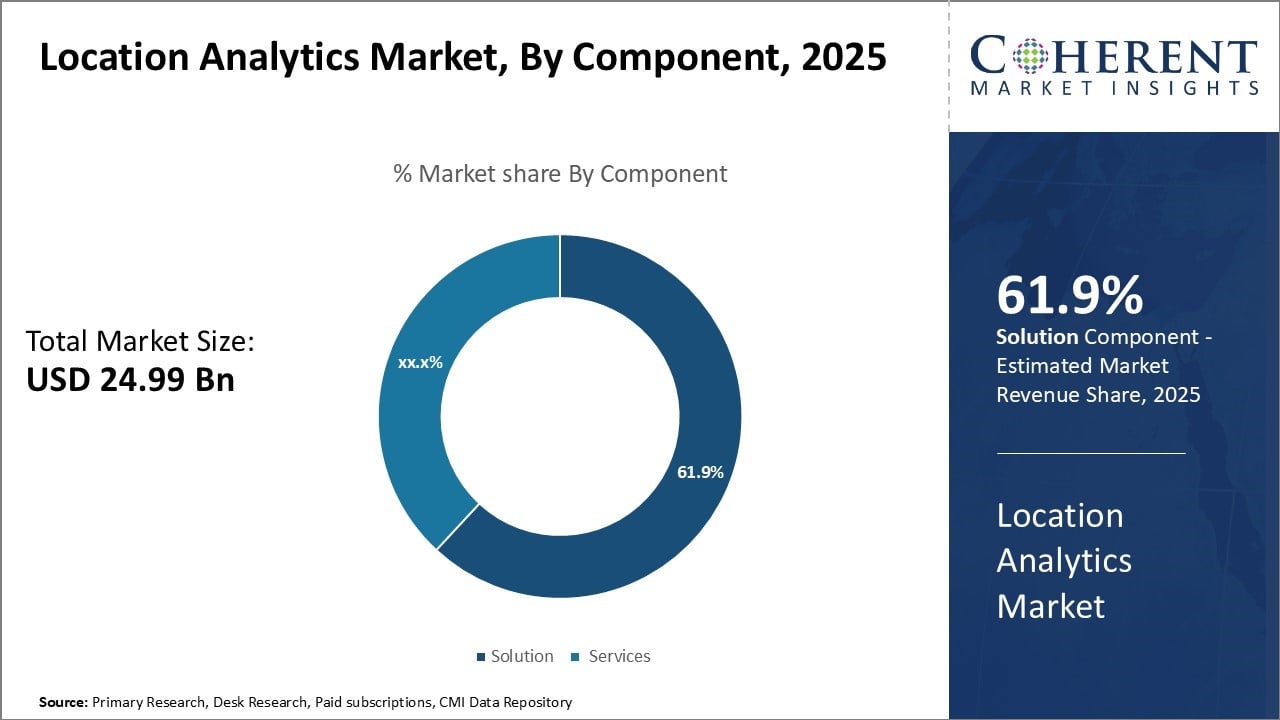
- Based on Component, the Solution segment is expected to lead the market accounting for 62.9% share in 2026, due to the ongoing technological advancements that widen the scope of location-based insights.
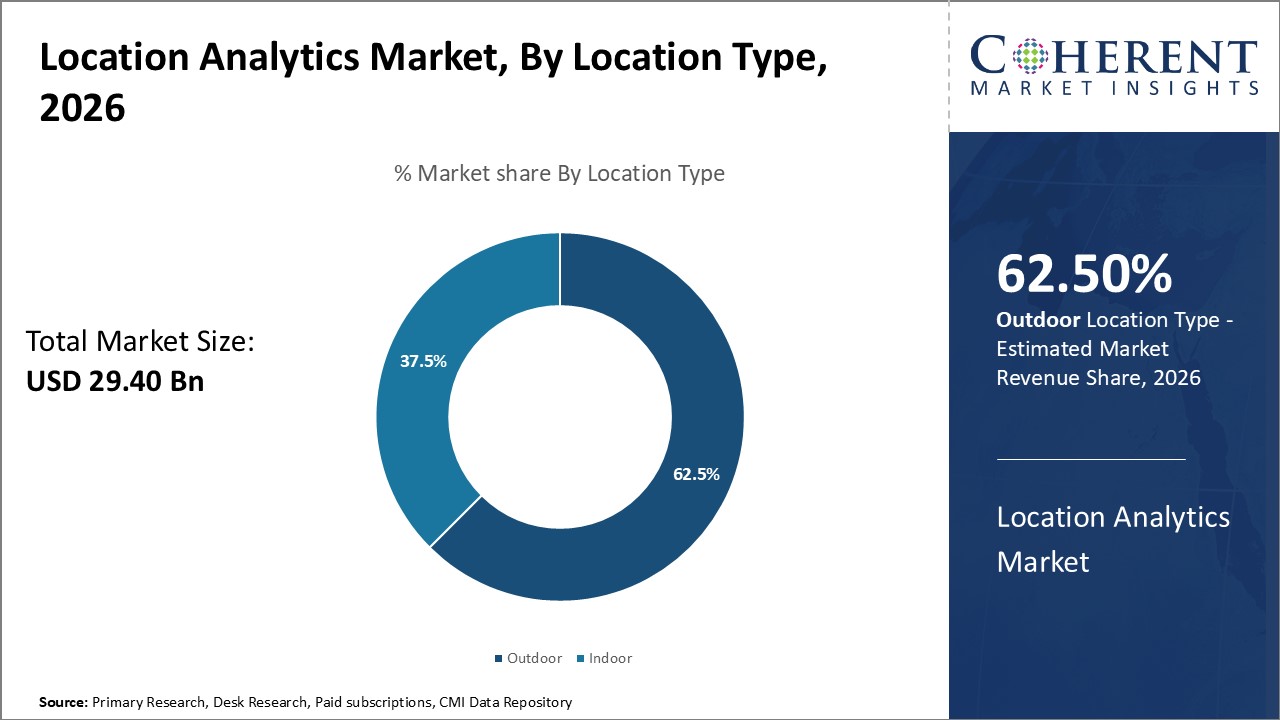
- Based on Location Type, the Outdoor location segment is projected to hold the largest market share in 2026, due to rising demand from various industries.
- Based on Deployment, the Cloud-based segment is expected to capture the highest share of the market in 2026, owing to its requirement for fleet management, supply chain management, efficient route optimization and real-time visibility.
- Based on Industry, the Transportation & Logistics segment is expected to contribute the greatest share of the market in 2026, owing to its requirement for fleet management, supply chain management, efficient route optimization and real-time visibility.
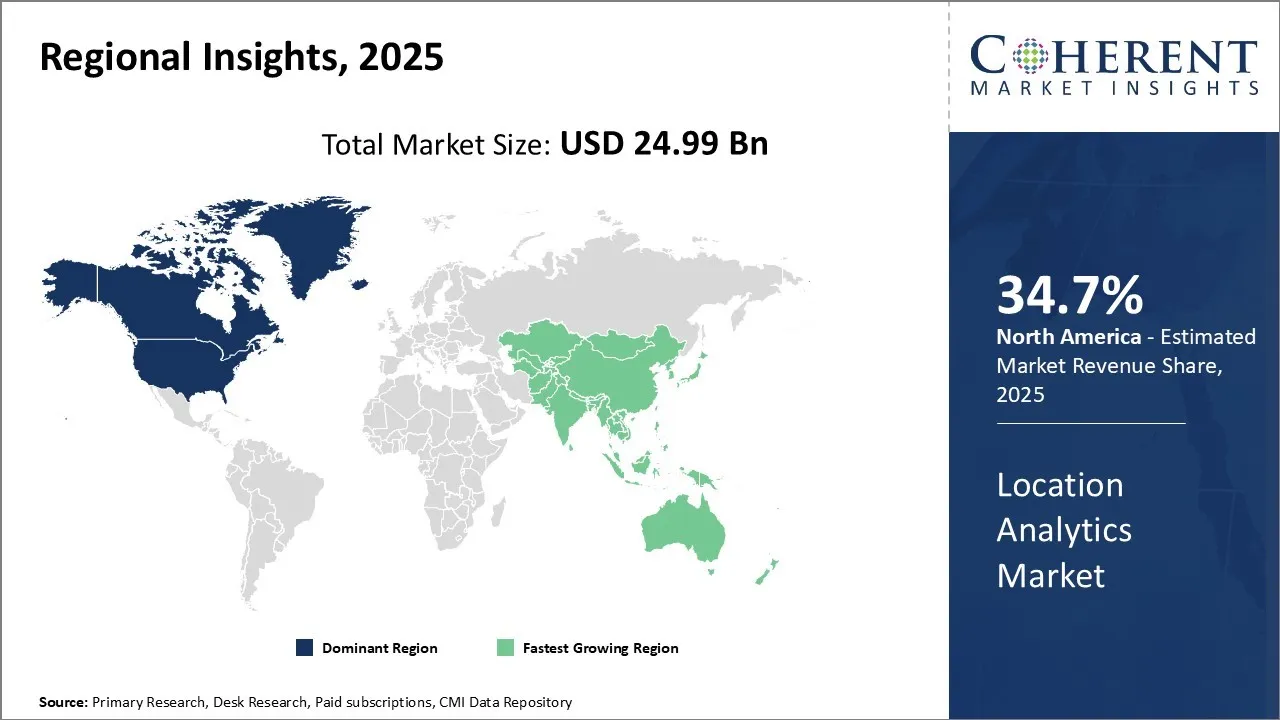
- Based on Region, north America is expected to lead the market, holding a share of 34.7% in 2026. While, Asia Pacific is anticipated to be the fastest-growing region, with an estimated market share of 30.8% in 2026.
Market Overview
The growing adoption of advanced technologies such as Machine Learning, Artificial Intelligence, big data analytics and location data aggregation are driving the Location Analytics solutions market demand across industry verticals. Location analytics is a technology that involves the process of analyzing and interpreting data corresponding to geospatial information. It uses GIS techniques, data mining, visualization, and statistics to extract essential information from spatial data.
Current Events and Its Impact
Current Event | Description and its Impact |
Global Privacy Regulation Enforcement and Data Protection Laws |
|
Economic Recession and Inflation Pressures in Major Markets |
|
Role of Artificial Intelligence (AI) in Location Analytics Market
The AI in location analytics market is rapidly evolving, driven by the integration of artificial intelligence with geospatial technologies. AI enhances the ability to process and interpret vast amounts of location-based data, enabling predictive modeling, real-time insights, and smarter decision-making across industries. Applications span retail, logistics, healthcare, telecom, and urban planning, where AI supports tasks like route optimization, customer behavior analysis, and infrastructure monitoring. Emerging trends include indoor mapping, digital twins, and cloud-native GIS platforms, reflecting a shift toward more dynamic and actionable spatial intelligence. This transformation is reshaping how businesses and governments leverage location data for strategic advantage.
For instance, in June 2025, Google introduced Google Earth AI, a new initiative combining satellite imagery with advanced artificial intelligence to monitor environmental changes globally. The platform enables faster detection of deforestation, urban expansion, and natural disasters. This innovation supports researchers, governments, and NGOs in making data-driven decisions for sustainability and climate resilience.
- Current Industry Events of 2026
- Market Size Estimation
- Regional Breakdown
- Competitive Landscape
- Customer Intelligence
- Segmental Analysis
- Pricing Analysis
- Key Market Drivers, Challenges & Future Trends
- Customized Insights Section
Segmental Insights
Location Analytics Market Insights, By Component - Solutions are Expected to Dominate Due to Technological Advancements
In terms of component, the solution segment is expected to account for 62.9% in 2026 due to the ongoing technological advancements that widen the scope of location-based insights. Varied software tools for indoor mapping, geofencing, geoanalytics, and proximity marketing allow comprehensive extraction of intelligence from device locations. Emerging technologies like Bluetooth beacon integration, Wi-Fi positioning, and GIS mapping extend the Solution segment's applications beyond geography to customized contextual alerts.
For instance, in December 2024, Ooredoo Qatar launched “Ooredoo Flow,” a location analytics solution powered by the TASMU smart city platform. Leveraging anonymized data from over 4.3 million devices, the tool offers insights into demographics and commuting patterns. Built on Microsoft Azure, it supports Qatar’s digital transformation across sectors like transport, healthcare, logistics, environment, and sports.
Location Analytics Market Insights, By Location Type - Outdoor Surging Due To Rising Demand from Various Industries
In terms of location type, the outdoor segment is expected to hold the largest location analytics market share in 2026, due to rising demand from various industries. The outdoor location analytics is primarily driven by the heavy reliance on GPS and IoT-enabled solution for real-time asset monitoring, fleet tracking and route optimization. For outdoor location analytics is commonly observed in industries including transportation, logistics, and retails, which helps in enhancing supply chain visibility, ensures timely deliveries and minimizes fuel cost. Additionally with expanding smart cities, the outdoor location segment is further accelerated.
Location Analytics Market Insights, By Deployment - Cloud-Based Leading Due To Favorable Scalability, and Cost Efficiency
In terms of deployment, the cloud-based segment is expected to contribute the highest share of the market in 2026, due to favorable scalability, cost efficiency, remote accessibility and ability to handle large volume of geospatial date. Majority of the enterprises are preferring the cloud-based location analytics for remote accessibility and integration with AI/ML to generate predictive analytics. Moreover, the shift towards cloud deployment is boosted by the elevated demand for location-based services in e-commerce, retail and smart mobility.
For instance, in August 2025, INRIX unveiled its Signal Analytics API at the ITS World Congress, offering real-time, network-wide traffic signal performance data to agencies and vendors. Alongside the API, INRIX showcased innovations like Road Rules and Compass, enhancing urban mobility and traffic management through AI-powered insights and cloud-based tools.
Location Analytics Market Insights, By Industry - Transportation & Logistics Dominates Owing to Its Requirement for Fleet Management, and Supply Chain Management
In terms of industry, the transportation & logistics segment is projected to capture the greatest share of the market in 2026, owing to its requirement for fleet management, supply chain management, efficient route optimization and real-time visibility. Several companies prefer leveraging their geospatial insights to reduce delay, optimize operation and improve last-mile delivery performance. The expansion in e-commerce and global trade is further growth the segment.
For instance, in November 2024, Hapag-Lloyd partnered with HERE Technologies to enhance global supply chain visibility and efficiency. By integrating HERE’s real-time location data and mapping solutions, the shipping giant aims to optimize container tracking and logistics operations. The collaboration marks a significant step toward smarter, data-driven maritime transport and improved customer service across international trade routes.
Regional Insights
North America Location Analytics Market Analysis & Trends
In North America, the dominance in the location analytics market demand is expected to account for 34.7% market share and can be attributed to robust technology adoption and well-established Location-Based Service (LBS) ecosystem in countries like the US. Major tech companies in the North America are greatly investing in location data and solutions to gain competitive advantage.
For instance, in May 2026, DataPlor launched a Global Mobility product, expanding its foot traffic insights to major international markets. Leveraging mobile location data, the platform offers businesses granular visibility into consumer movement patterns across retail, real estate, and finance sectors. This marks a significant step in delivering scalable location analytics for global decision-making.
Asia Pacific Location Analytics Market Analysis & Trends
The Asia Pacific region is expected to account for 30.8% market share in 2026 due to increasing penetration of mobile devices and rapidly expanding e-commerce sector across developing nations. Countries like China and India are promoting location technology usage through supportive policies and initiatives.
For instance, in August 2026, ideaForge launched the Q6V2 Geo UAV, a cutting-edge drone designed to advance geospatial intelligence. Equipped with high-resolution sensors and AI-powered analytics, the UAV enables precise mapping and surveillance in challenging environments. This innovation marks a significant leap in autonomous aerial data collection for defense, disaster response, and infrastructure monitoring.
Location Analytics Market Outlook for Key Countries
Versatile Demand Driving Growth in U.S. Market
The United States location analytics market demand continues to grow driven by strong demand from industries such as retail, transportation and logistics. Key players including Google and Microsoft are leveraging location insights to enhance various services. The adoption of location analytics technologies and solutions in the U.S. has observed to been grown significantly in recent years, due to wider trends in data availability, connectivity, and customer expectations.
For instance, in June 2026, LexisNexis Risk Solutions unveiled an advanced location intelligence offering, enhancing its suite of geospatial analytics tools. The solution integrates precise address data with behavioral insights to support risk assessment, fraud detection, and customer engagement. This launch strengthens decision-making capabilities across insurance, financial services, and government sectors through enriched spatial context.
China Showcasing High Technological Prowess
China's location analytics market value is shaped by government's 'Digital Silk Road' initiative and growing local enterprises, which are focusing on location as a key technology. Providers are offering customized solutions targeting industries such as automotive and healthcare. E-commerce in particular has been a big driver of the location analytics boom. The scale and complexity of China's logistics network necessitate precise location data to optimize delivery routes, manage warehouse inventories in real-time, and provide accurate estimated arrival windows to customers.
For instance, in July 2026, China unveiled an AI-powered geospatial model for instant 3D building reconstruction, developed by the Moganshan Geospatial Information Laboratory. The technology rapidly generates accurate 3D models from multi-angle images, enhancing urban planning, disaster response, and digital twin applications. This innovation marks a major leap in geospatial intelligence and smart city development.
Japan Leading with Dominance in 5G Technologies
The location analytics market growth in Japan is observed by emergence of 5G technologies. With more people embracing e-commerce and online shopping, businesses have recognized the importance of location data and analytics to better understand customer purchase behavior based on their physical locations. According to Japan's Ministry of Internal Affairs and Communications, the country aims to have 5G coverage in all prefectures by the end of 2026 to support technologies such as IoT, autonomous vehicles.
For instance, in August 2026, Sumitomo Corporation has invested in Ursa Space to support its global expansion and entry into the Japanese market. The partnership aims to enhance satellite-based analytics and geospatial intelligence capabilities. This strategic move strengthens Ursa Space’s presence in Asia and underscores Sumitomo’s commitment to advancing space technology and data-driven decision-making.
Growing Synergy among Technology Companies
The UK’s location analytics market is characterized by continuous collaboration with tech companies, network providers and cities to modernize infrastructure and urban mobility through location services. The UK public transport system utilizes location data from mobile ticketing apps to analyze commuting and travel patterns. This helped transport authorities to strategize schedules and enhance safety protocols as restrictions eased.
For instance, in August 2025, A geospatial intelligence start-up has completed its seed funding round and launched a new app in the UK. The app delivers real-time location-based insights for industries like logistics, infrastructure, and emergency response. This milestone marks a significant step in expanding geospatial capabilities and accelerating the start-up’s growth in the European market.
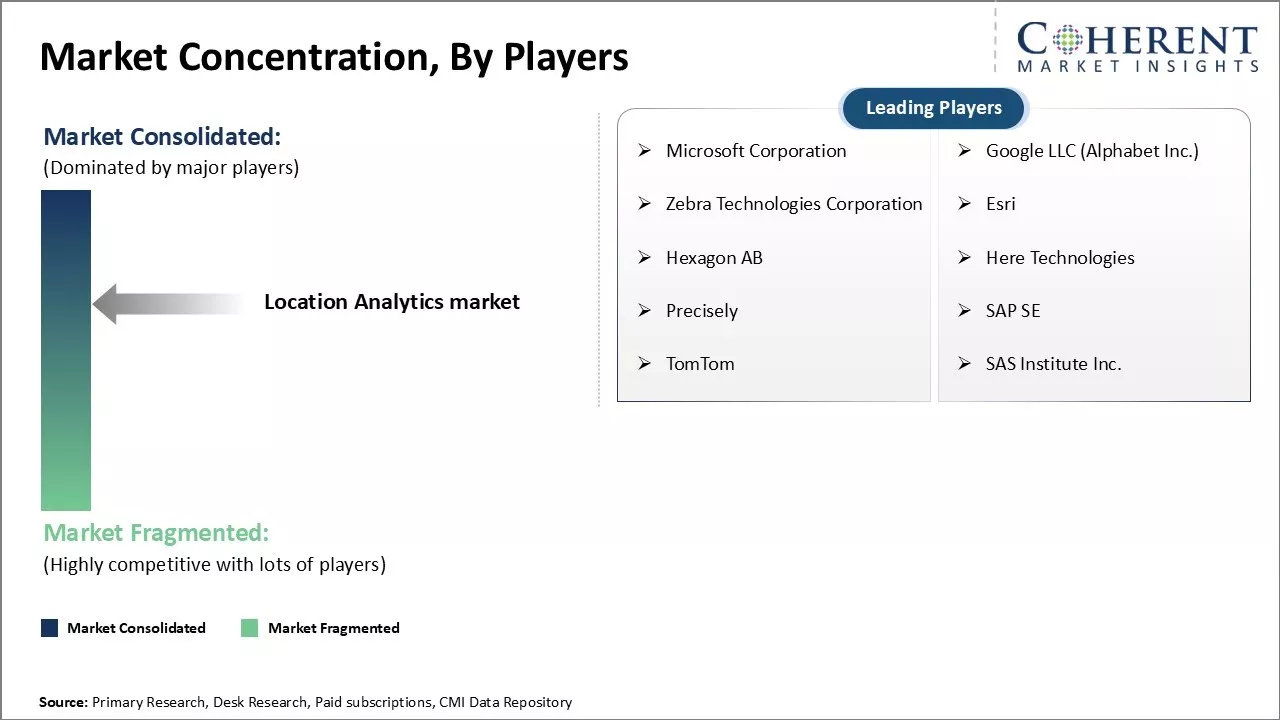
Market Concentration and Competitive Landscape
Market Report Scope
Location Analytics Market Report Coverage
| Report Coverage | Details | ||
|---|---|---|---|
| Base Year: | 2025 | Market Size in 2026: | USD 29.40 Bn |
| Historical Data for: | 2020 To 2024 | Forecast Period: | 2026 To 2033 |
| Forecast Period 2026 to 2033 CAGR: | 17.8% | 2033 Value Projection: | USD 92.67 Bn |
| Geographies covered: |
| ||
| Segments covered: |
| ||
| Companies covered: | Microsoft Corporation, Google LLC (Alphabet Inc.), Zebra Technologies Corporation, Esri, Hexagon AB, Here Technologies, Precisely, SAP SE, TomTom, SAS Institute Inc. | ||
| Growth Drivers: |
| ||
| Restraints & Challenges: |
| ||
Location Analytics Market Growth Driver
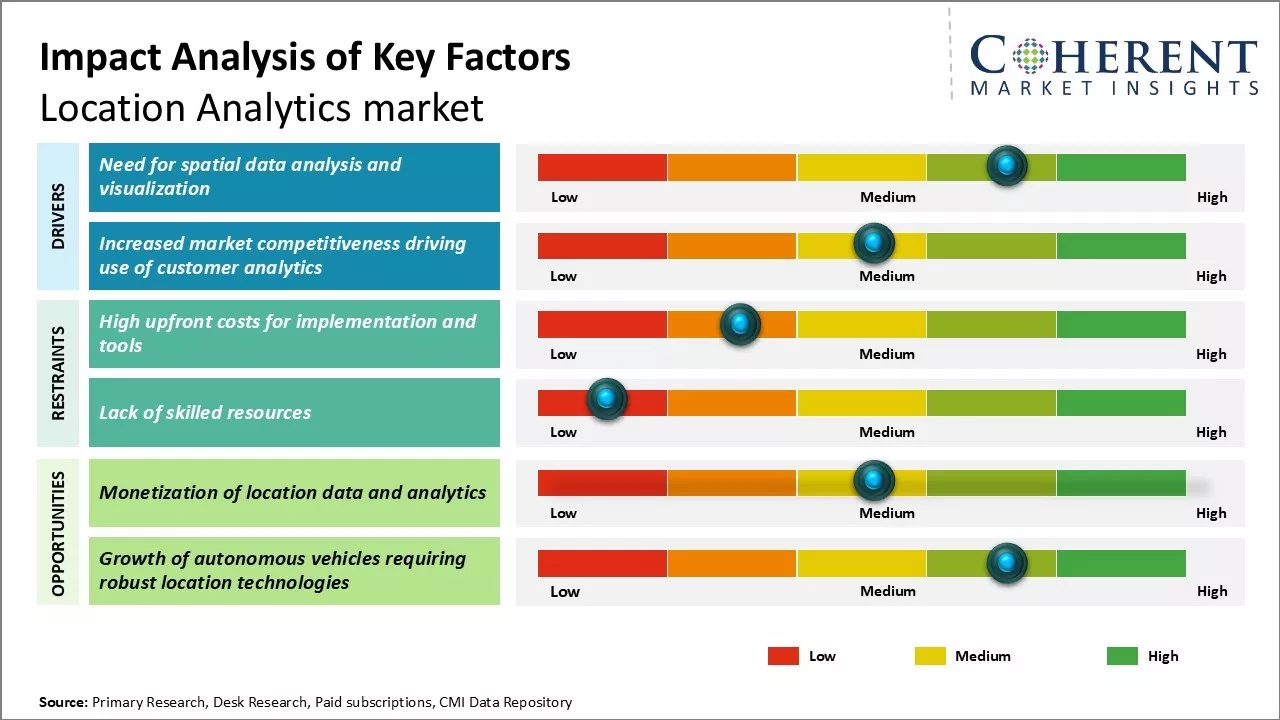
Need for Spatial Data Analysis and Visualization
The modern business landscape gradually relies on gathering and leveraging location data to gain benefit. Understanding where customers and assets are located, and how those locations impact business results, is key to informed decision-making. Yet revealing insights from spatial information requires specialized skill and technology. For organizations lacking dedicated location analytics capabilities, gleaning actionable strategic or tactical perspectives from their geographical data remains a challenge. Thriving in a digital economy demands a strong awareness of customers as dynamic individuals rather than inactive demographics. Competitive pressures spur firms to unlock deeper revelations about client preferences, behaviors and needs on a continuous basis.
Analyst Opinion (Expert Opinion)
Location analytics has moved beyond tactical curiosity to a strategic, revenue-grade capability for companies that treat place as a measurable, optimizable asset. The most commercially consequential deployments are no longer “pilot” experiments; they are mission-critical inputs to site-selection, omni-channel attribution, real-estate portfolio optimization, and store-level merchandising. Leading retail and real-estate practitioners now treat third-party cellphone location streams and in-store sensor telemetry as fundamental signals that materially change decisions about where to open, how to staff, and what assortment to carry.
Moreover, data quality and methodology are the real bottlenecks. Different sensing modalities (GPS pings, cell-tower triangulation, Wi-Fi positioning, beacons) have materially different precision and bias profiles: Wi-Fi and dedicated indoor positioning often achieve meter-level accuracy indoors and outperform raw GPS in dense or indoor settings; consumer smartphone GPS performance varies dramatically by device and context, producing uneven sampling across demographics and geographies. Any claim of “precise” in-store attribution that does not disclose modality, median horizontal accuracy, and sampling representativeness should be treated skeptically.
Speak to the analyst
Want personalized insights?
Take the findings above to one of our principal consultants, or have the report rebuilt around the segments, geographies and competitors you actually track.
Location Analytics Industry News
- In September 2025, the University of Tennessee at Chattanooga (UTC) launched the Center for Applied Geospatial Data Science to advance research in spatial analytics and data-driven decision-making. The center will support interdisciplinary collaboration, workforce development, and innovation in areas such as urban planning, environmental monitoring, and public health, reinforcing UTC’s commitment to cutting-edge geospatial education.
- In June 2025, LexisNexis® Risk Solutions launched LexisNexis® Location Intelligence for Commercial, a next-generation risk assessment tool for U.S. commercial insurance underwriting and renewal. The solution enhances accuracy and automation by combining industry loss data, weather forensics, and detailed property characteristics into predictive risk scores and supporting attributes.
Market Segmentation
- Component Insights (Revenue, USD Bn, 2026 - 2033)
- Solution
- Services
- Location Type Insights (Revenue, USD Bn, 2026 - 2033)
- Indoor
- Outdoor
- Deployment Insights (Revenue, USD Bn, 2026 - 2033)
- On-premise
- Cloud
- Industry Insights (Revenue, USD Bn, 2026 - 2033)
- Transportation and Logistics
- Government and Defense
- BFSI
- Tourism and Hospitality
- Healthcare
- Retail
- Regional Insights (Revenue, USD Bn, 2026 - 2033)
- North America
- U.S.
- Canada
- Latin America
- Brazil
- Argentina
- Mexico
- Rest of Latin America
- Europe
- Germany
- U.K.
- Spain
- France
- Italy
- Russia
- Rest of Europe
- Asia Pacific
- China
- India
- Japan
- Australia
- South Korea
- ASEAN
- Rest of Asia Pacific
- Middle East
- GCC Countries
- Israel
- Rest of Middle East
- Africa
- South Africa
- North Africa
- Central Africa
- Key Players Insights (Revenue, USD Bn, 2021 - 2033)
- Microsoft Corporation
- Google LLC (Alphabet Inc.)
- Zebra Technologies Corporation
- Esri
- Hexagon AB
- Here Technologies
- Precisely
- SAP SE
- TomTom
- SAS Institute Inc.
Sources
Primary Research Interviews from the following stakeholders
Stakeholders
- Interviews with GIS software providers, location data aggregators, IoT solution providers, telecom operators, mobility service providers, and smart city planners across leading global markets.
Specific stakeholders
- Chief digital officers and analytics leads at retail and e-commerce chains
- Urban planning and smart city directors at municipal corporations
- Operations and logistics heads at transportation and logistics hubs
- IT and network heads at telecom operators
- Hospitality and property management analytics teams
- Mobility and ride-hailing operators
- Product managers at GPS, GIS, and IoT device manufacturers
Databases
- World Trade Organization (WTO) Trade Statistics
- UN Comtrade Database
- U.S. Bureau of Economic Analysis (BEA)
- Eurostat – Location & Mobility Data Indicators
- Federal Communications Commission (FCC) Broadband and Geospatial Data, U.S.
- China National Bureau of Statistics – Location & IT Data
- Japan External Trade Organization (JETRO) – ICT and Location Services Data
- Korea Statistical Information Service (KOSIS) – ICT/Geospatial Data
- Directorate General of Commercial Intelligence and Statistics (DGCIS), India
Magazines
- Geospatial World
- Directions Magazine (Location Intelligence & GIS)
- GPS World
- IoT World Today
- SmartCitiesWorld
- Transport Topics (Location & Fleet Analytics Section)
- Logistics Insight Asia
- Mobile Marketing Magazine (Location-Based Advertising Section)
Journals
- International Journal of Geographical Information Science (Taylor & Francis)
- Journal of Location Based Services (Taylor & Francis)
- Computers, Environment and Urban Systems (Elsevier)
- IEEE Transactions on Intelligent Transportation Systems
- Journal of Urban Technology
- International Journal of Information Management
- ISPRS Journal of Photogrammetry and Remote Sensing
Newspapers
- The Wall Street Journal – Tech & Mobility
- The Economic Times – Digital Transformation & Smart Cities
- The Hindu Business Line – Location Analytics & Telecom
- Financial Times – Urban Tech & Geospatial Services
- Nikkei Asia – Location Technologies in Asia-Pacific
- South China Morning Post – Smart City & Technology Section
Associations
- Open Geospatial Consortium (OGC)
- Urban and Regional Information Systems Association (URISA)
- International Telecommunication Union (ITU) – ICT & Location Services
- Geospatial Media and Communications – Industry Forums
- Intelligent Transportation Society (ITS) International
- Indian Society of Geomatics (ISG)
- Smart Cities Council
- European GNSS Agency (GSA)
Public Domain Sources
- National Geospatial-Intelligence Agency (NGA), U.S.
- Ministry of Housing and Urban Affairs (India) – Smart Cities Mission Data
- Ministry of Economy, Trade and Industry (METI), Japan – ICT & GIS Data
- European Space Agency (ESA) – Location & Satellite Data
- Survey of India – Geospatial Data Access
- U.S. Geological Survey (USGS) – Geospatial Open Data
- Reserve Bank of India (RBI) – Digital Economy Reports
- EuroGeographics – Pan-European Geospatial Data
Proprietary Elements
- CMI Data Analytics Tool, and Proprietary CMI Existing Repository of information for last 8 years
Get access to 250+ pages report
Every segment, forecast, competitor profile and data table behind the analysis above — available for instant download.
- ESOMAR Member
- ISO 9001:2015 Certified
- D-U-N-S Registered
- GDPR & CCPA Compliant
Missing comfort of reading report in your local language? Find your preferred language:
Transform your Strategy with Exclusive Trending Reports
Frequently Asked Questions
The Location Analytics Market is estimated to be valued at USD 29.40 Bn in 2026, and is expected to reach USD 92.67 Bn by 2033.
The CAGR of the Location Analytics Market is projected to be 17.8% from 2026 to 2033.
Need for spatial data analysis and visualization and Increased market competitiveness driving use of customer analytics are the major factor driving the growth of Location Analytics market.
High upfront costs for implementation and tools and lack of skilled resources are the major factors hampering the growth of location analytics market.
In terms of component, solution, estimated to dominate the market revenue share in 2026.
Microsoft Corporation, Google LLC (Alphabet Inc.), Zebra Technologies Corporation, Esri, Hexagon AB, Here Technologies, Precisely, SAP SE, TomTom, SAS Institute Inc. are the major players.
North America is expected to lead the location analytics market in 2026.