

Global Data Center Infrastructure Market Size and Forecast – 2026-2033
The global data center infrastructure market is estimated to be valued at USD 53.29 Bn in 2026 and is expected to reach USD 90.10 Bn by 2033, exhibiting a compound annual growth rate (CAGR) of 7.8% from 2026 to 2033.
Key Takeaways of the Global Data Center Infrastructure Market
- The hardware segment leads the market holding an estimated share of 58.4 % in 2026.
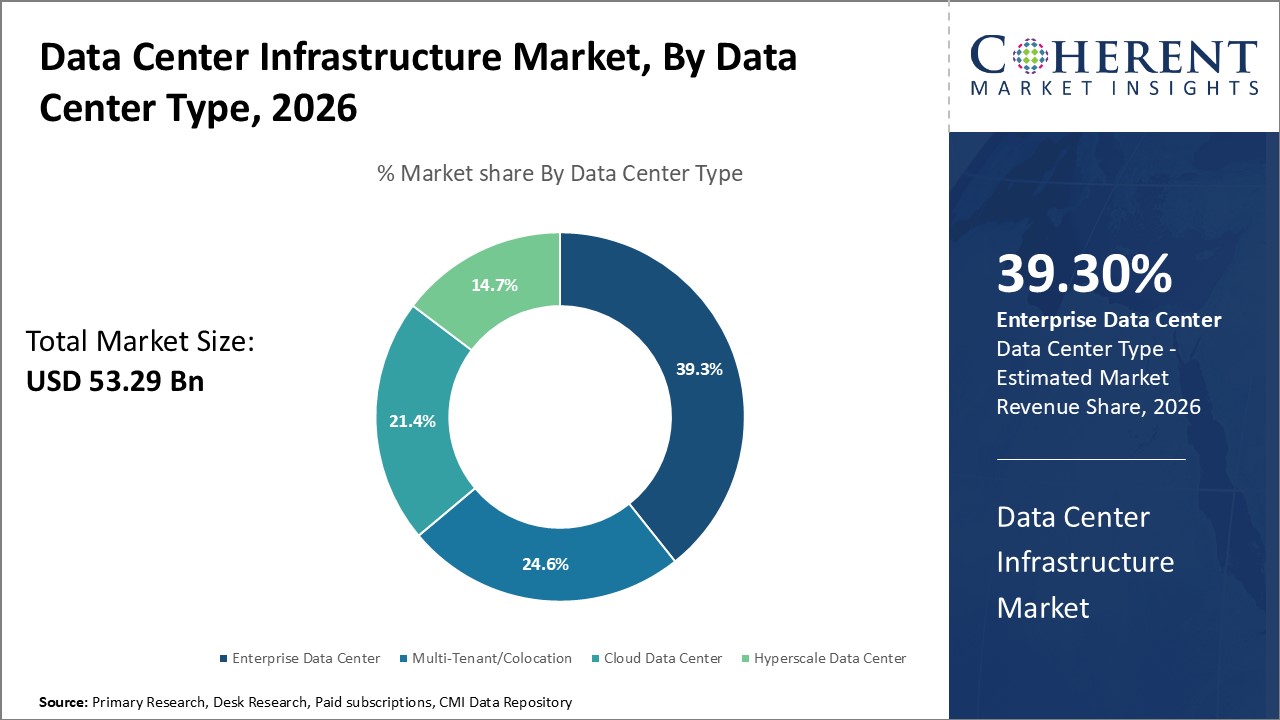
- The enterprise data center segment is expected to dominate with a share of 39.30 % in 2026.
- The IT and telecom segment is projected to lead the market, holding an estimated share of 69.1 % in 2026.
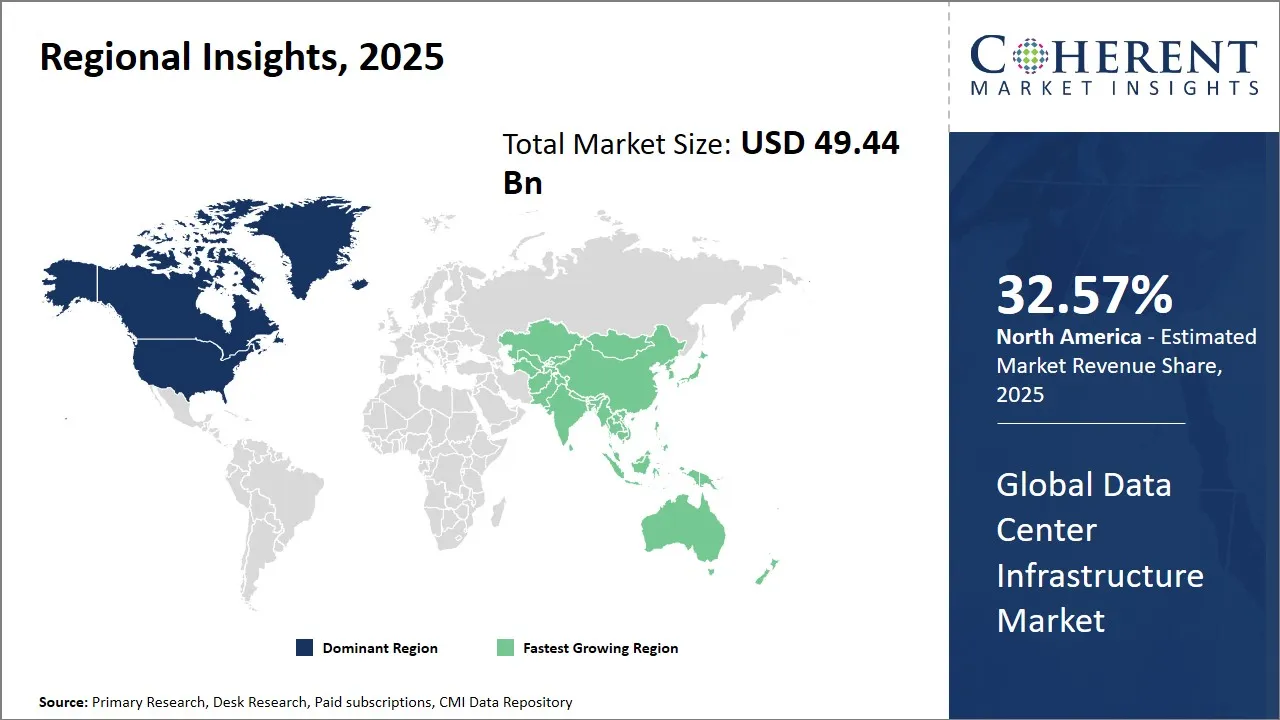
- North America, holding a share of 32.57 % in 2026, is expected to dominate the market.
- Asia Pacific, holding a share of 24.8 % in 2026, is projected to show the fastest growth in the market.
Market Overview
The data center infrastructure sector is seeing fast adoption of sustainable and green technologies aimed at reducing carbon footprints. The use of artificial intelligence and machine learning for predictive maintenance and enhanced operational efficiency is becoming prevalent. Also, the rise in internet of things (IoT) devices and 5G networks is making demand for more robust and scalable data centers. Hybrid and modular data center designs are becoming common, offering flexibility and cost-effectiveness to meet diverse business requirements.
Current Events and Its Impact
Current Events | Description and its impact |
Geopolitical and Trade Developments |
|
Economic and Infrastructure Trends |
|
Regulatory & Data Sovereignty Developments |
|
Segmental Insights
- Current Industry Events of 2026
- Market Size Estimation
- Regional Breakdown
- Competitive Landscape
- Customer Intelligence
- Segmental Analysis
- Pricing Analysis
- Key Market Drivers, Challenges & Future Trends
- Customized Insights Section
Global Data Center Infrastructure Market Insights, By Component – Hardware Leads Because of Robust Demand For Physical Infrastructure, Supporting Growing Data Workloads
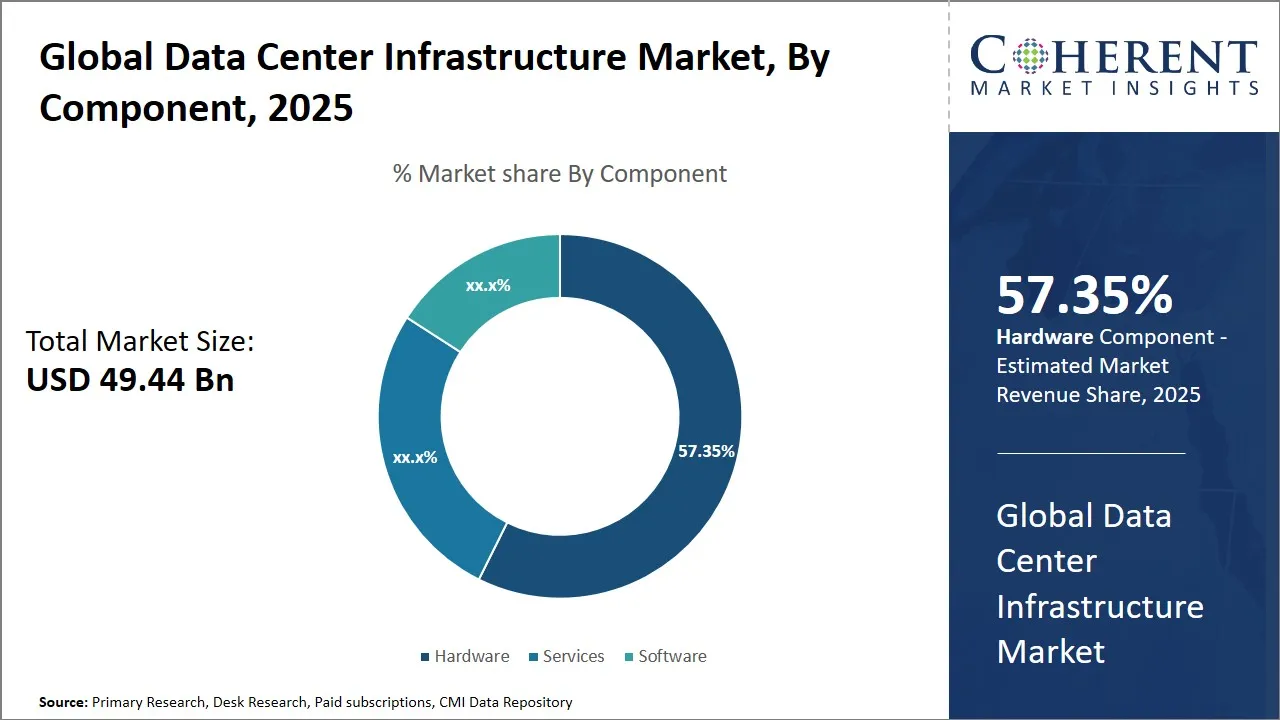
The hardware segment, accounting for 58.4% of the market in 2026, is expected to dominate because of rising demand for servers, storage, networking gear, and cooling systems required to manage vast data volumes and AI workloads. As enterprises increase computing capacity, high-performance servers and Solid State Drive (SSD)-based storage have become mission-critical. Efficient liquid cooling technologies and modular rack systems are also gaining traction as density and energy needs rise. In September 2026, Schneider Electric launched its AI-ready liquid-cooled EcoStruxure solutions, made for high-density servers supporting NVIDIA Graphics Processing Unit (GPU)-based workloads. This shows the sector’s pivot toward advanced physical infrastructure for data-heavy applications.
Global Data Center Infrastructure Market Insights, By Data Center Type – Enterprise Data Centers Lead Because of Customized, Secure Infrastructure Demands and Growing In-House Data Management Capabilities
Holding an estimated 39.30% share in 2026, enterprise data centers are important for organizations looking for full control, regulatory compliance, and customized architecture. Many corporations retain or upgrade in-house facilities to complement cloud strategies and manage sensitive data securely. Hybrid IT adoption—mixing private and public environments—further adds to this trend. IBM’s expansion of its enterprise data center in Madrid (2024) to support hybrid cloud deployments reflects enterprises’ continued investment in secure, compliant, and scalable infrastructure tailored to their operations.
Global Data Center Infrastructure Market Insights, By Industry Vertical – IT and Telecommunication Segment Dominates Because of Fast Digital Transformation and Network Infrastructure Expansion
The IT and telecommunications sector, leading with 69.1% of the market in 2026, is projected to drive data center growth because of growing digital service demand, 5G rollout, and AI integration. Telecom operators and cloud service providers rely heavily on resilient, low-latency data centers to handle increasing data traffic and support distributed edge environments. In June 2026, Verizon announced plans to grow its edge data center network across the U.S. to enhance 5G connectivity and cloud-based enterprise services—showing how telecom-led infrastructure expansion underpins the market’s largest vertical.
Pricing Analysis of the Data Center Infrastructure Market
Component/Cost Category | Estimate (USD) |
Construction cost per MW of commissioned IT load | USD 7,000,000 – USD 12,000,000 per MW |
Annual operational cost (large data-center) | USD 10,000,000 – USD 25,000,000 per year |
Annual cost to power one rack (AI-density ~60kW) | ~USD 61,511 to USD 207,934 |
High-density rack liquid-cooling hardware (one rack) | ~USD 49,860 |
Build cost per square foot (gross) for data-centers | USD 600 – USD 1,100 per sq.ft |
Policy & Incentive Landscape – Global Data Center Infrastructure Market
Region/Jurisdiction | Policy/Incentive Description | Impact for Data Center Infrastructure |
U.S. (Federal) | 100% bonus depreciation on qualified capital equipment placed in service before January 1, 2030; energy-efficient commercial buildings deduction (IRC §179D) for eligible systems. | Improves cash-flow and lowers tax cost for large data-center builds; encourages investment in modern, efficient hardware. |
U.S. (States) | Many states offer sales tax exemptions, property tax abatements, and equipment tax incentives for data-centers investing above certain thresholds. | Lowers upfront CAPEX and ongoing cost base for operators; key factor in site-selection decisions. |
European Union/Europe | EU legislative proposal (Cloud & AI Development Act) aims to streamline permitting of data centers, simplify site identification, and integrate energy/efficiency criteria. | Accelerates deployment, reduces regulatory hurdles; benefits large scale AI-data center projects. |
Nordic countries (Finland, Norway, Sweden) | Historically ultra-low electricity tax-rates or tax relief for data centers; Norway still offers favorable conditions while Finland removed its special rate in 2025. | Attracts data-center investment via lower power & operating cost; changes may shift attractiveness. |
APAC/Selected Developing Countries | Tax holidays (4-7 years), enhanced depreciation of capital equipment, preferential corporate income tax rates as part of incentives for data-centers/infrastructure. | Makes building new data-centers in these markets financially more attractive; supports infrastructure growth. |
South Korea | Industry request for tax credits (20-30% of R&D/ workforce development, 3-12% of facility investment) under “Restriction of Special Tax Treatment Act” to include data centers in metro zones. | If approved, would reduce investment cost for metro-area data-centers and spur urban build-out. |
Supply Chain Ecosystem – Global Data Center Infrastructure Market
Supply Chain Stage | Key Activities/Actors | Comments on Dynamics & Risks |
Raw Materials/Basic Components | Mining and refining of silicon, copper, aluminum, rare earths; production of steel, plastics, PCB substrates. | Lead-times stretch, commodity price volatility; bottlenecks in critical mineral supply. |
Semiconductor & Chip Fabrication | Design houses (e.g., Intel, AMD, NVIDIA), foundries, packaging. | High concentration of suppliers; capacity constraints risk delaying large data-center builds. |
Sub-assemblies & Hardware Modules | OEMs/ODMs (e.g., Jabil) for servers, racks, PDUs, cooling units, integrated systems. | Integration complexity growing; modular build preferred but supply-chain complexity rises. |
Networking/Optical/Cabling | Switches, routers (Cisco Systems, Juniper Networks), fiber optics, cabling infrastructure. | Very few suppliers for certain optical components; long lead times for fiber/cable stock. |
Power & Cooling Infrastructure | UPS, switchgear, generators (Vertiv, Schneider Electric), chillers/liquid cooling. | High CAPEX; critical for reliability; supply disruptions cascade into overall project delays. |
Construction & Facility Build-out | Civil works, MEPS (mechanical, electrical, plumbing), data-hall fit-out, rack installation, commissioning. | Construction lead-times and coordination with equipment delivery are major schedule risks. |
Logistics, Distribution & Deployment | Global shipping, customs & import/export, regional warehousing, on-site integration, testing and commissioning. | Multi-region sourcing increases resilience but also complexity; geopolitical/logistic risk. |
Operations, Maintenance & Spares | Ongoing service, spare-parts supply, monitoring/analytics, retrofit/upgrades, end-of-life recycling. | Lifecycle supply chain matters — spare parts, service contracts increasingly significant. |
Regional Insights
North America Data Center Infrastructure Market Analysis and Trends
North America, holding a share of 32.57% in 2026, is expected to dominate the global data center infrastructure market because of a highly mature technology ecosystem, robust investment from hyperscale cloud service providers, and advanced digital infrastructure. The presence of big industry leaders such as Amazon Web Services (AWS), Microsoft Azure, Google Cloud, and Equinix makes the market’s foothold stronger. These companies have innovated a lot in scalable infrastructure services, colocation facilities, and edge computing solutions, making a competitive yet collaborative environment.
Additionally, government initiatives promoting digital transformation, cybersecurity enhancements, and data sovereignty have fueled the expansion of data center infrastructure. North America’s well-established trade infrastructure and access to cutting-edge hardware suppliers also reduce barriers for quick deployment and upgrades, adding to its market leadership.
Asia Pacific Data Center Infrastructure Market Analysis and Trends
The Asia Pacific region, holding a share of 24.8% in 2026, is projected to exhibit the fastest growth in the global data center infrastructure market because of fast digital adoption, massive urbanization, and an expanding base of internet users. Emerging economies like India, China, and Southeast Asian nations benefit from increasing cloud adoption, e-commerce growth, and government policies emphasizing smart city developments and digital ecosystems.
The regional market’s growth is further added to by huge investments from global players such as Alibaba Cloud, Tencent Cloud, and Huawei, alongside domestic firms expanding their data center footprint. Trade liberalization and improved regulatory frameworks aimed at data security and localization have created a favorable environment for infrastructure development. The ongoing capacity expansion, supported by renewable energy initiatives in countries like Singapore and Japan, also adds to the sustainability credentials of this market.
Global Data Center Infrastructure Market Outlook for Key Countries
U.S. Data Center Infrastructure Market Analysis and Trends
The U.S. data center infrastructure market is an important player in the data center infrastructure domain, seeing a concentration of the world’s largest cloud service providers. Companies like AWS, Microsoft, and Google have built big data center campuses across states such as Virginia, Texas, and California, supporting huge computing workloads for various industries. The U.S. government’s focus on improving cybersecurity and critical infrastructure resilience further adds to modernization and growth of data center capabilities. Innovation in areas like edge computing and AI-driven infrastructure management continues to make demand in the country.
China Data Center Infrastructure Market Analysis and Trends
China data center infrastructure market sees exponential growth backed by government policies promoting digital infrastructure under initiatives like “Digital China” and strong support for 5G deployment. Big local players such as Alibaba Cloud, Tencent, Baidu, and Huawei dominate the landscape, adding to fast data center construction both within major metropolitan zones and inland regions to reduce latency. The country’s strict data privacy and localization laws have made unique operational challenges but simultaneously encouraged robust domestic capacity development. Also, partnerships with global technology firms help facilitate advanced hardware integration and cutting-edge solutions.
India Data Center Infrastructure Market Analysis and Trends
India is becoming a key data center hub in Asia Pacific because of exponential internet penetration and rising cloud adoption among enterprises and startups. The government’s Digital India campaign and incentives for infrastructure investment play big roles in market expansion, pushing domestic and international data center providers to establish facilities. Global companies like NTT, Digital Realty, and global cloud providers are collaborating with local firms such as Nxtra Data and CtrlS to build scalable and energy-efficient infrastructure. The focus on renewable energy usage and data localization mandates further add to the evolving ecosystem.
Germany Data Center Infrastructure Market Analysis and Trends
Germany leads Europe data center infrastructure market because of high industrial demand, strict data protection laws under GDPR, and strong government support for digital transformation initiatives. Companies like Deutsche Telekom, Merck, and e-shelter (a subsidiary of NTT) offer advanced colocation and hyperscale data center services concentrated around Frankfurt, a big digital hub. The country’s industrial sectors—especially automotive and manufacturing—rely heavily on localized, secure data infrastructure, which drives innovation in edge data centers and hybrid cloud environments. Sustainable infrastructure is a big priority, with emphasis on green energy and energy-efficient designs.
Singapore Data Center Infrastructure Market Analysis and Trends
Singapore data center infrastructure market is a strategic gateway for the Asia Pacific region, benefiting from its status as a global financial and digital services hub. The government’s proactive smart city initiatives and robust cybersecurity framework attract global providers such as Equinix, Digital Realty, and ST Telemedia. Singapore’s focus on sustainable infrastructure with substantial investments in renewable energy and water conservation enhances its appeal. Trade openness and a highly connected ecosystem create a conducive environment for rapid deployment of hyperscale and edge data centers, serving not only local demands but also regional multinational businesses.
Investment & Capex Trends – Global Data Center Infrastructure Market
Time Period | Trend/Metric | Value/Estimate (USD) |
Full year 2024 | Global data-center infrastructure CapEx | USD 455 billion |
Q1 2025 | Year-on-year CapEx increase | +53% Y/Y |
Q2 2025 | Year-on-year CapEx increase | +43% Y/Y |
Forecast to 2029 | Compound Annual Growth Rate (CAGR) for CapEx | ≈ 21% CAGR |
Forecast to 2029 | Total global data-center CapEx target | ≈ USD 1.2 trillion |
Energy Efficiency & Sustainability Trends – Global Data Center Infrastructure Market
Trend Category | Description & Key Developments |
Renewable Energy & Low-Carbon Power | The shift to sourcing wind, solar, hydro or other clean energy for data-centers is becoming mainstream; data-center operators are entering long-term PPAs and building on-site generation + battery storage. |
Advanced Cooling Technologies | Adoption of liquid cooling, immersion cooling, free-cooling (air/ambient), rear-door heat-exchangers and containment to reduce cooling energy use which has traditionally consumed ~30-40% of facility energy. |
AI/Automation for Energy Optimization | Use of AI and machine-learning to manage power, cooling, workload placement and predictive maintenance, driving significant energy-savings. |
Waste Heat Reuse & Circular Economy Practices | Heat recovered from data centers being reused for district heating or other purposes; greater focus on embodied carbon and circularity in hardware/supply chain. |
Increased Regulatory & Efficiency Targets | Stricter standards such as lower Power Usage Effectiveness (PUE) targets, greater disclosure of emissions, water-use constraints and sustainable site selection. |
Market Players, Key Development, and Competitive Intelligence
Key Developments
- In September 2025, Schneider Electric, the leader in the digital transformation of energy management and automation, announced new reference designs developed with NVIDIA that significantly accelerate time to deployment and aid operators as they adopt AI-ready infrastructure solutions.
- In August 2025, Vertiv Holdings Co, a global leader in critical digital infrastructure, acquired Waylay NV, a Belgium-based leader in hyperautomation and generative AI software platforms, as part of its continued investment in AI-driven monitoring and control technologies for its power and cooling systems. Vertiv expects this investment to strengthen its ability to enable customers around the world to increase uptime, optimize energy usage, and enhance operational intelligence across its critical digital infrastructure.
- In July 2025, HPE announced the successful completion of its previously announced acquisition of Juniper Networks, Inc., a leader in AI-native networks. The combination positions HPE to capture the growing AI and hybrid cloud market opportunity by creating an industry-leading cloud-native and AI-driven IT portfolio, including a full, modern networking stack.
- In June 2025, Schneider Electric, the leader in the digital transformation of energy management and automation, announced new data center solutions specifically engineered to meet the intensive demands of next-generation AI cluster architectures. Evolving its EcoStruxure Data Center Solutions portfolio, Schneider Electric introduced a Prefabricated Modular EcoStruxure Pod Data Center solution that consolidates infrastructure for liquid cooling, high-power busway and high-density NetShelter Racks.
Top Strategies Followed by Data Center Infrastructure Market Players
- Established market leaders prioritize substantial investments in research and development (R&D) to continuously innovate and deliver high-performance products that meet the evolving demands of hyperscale data centers and cloud service providers.
- Schneider Electric announced a USD 240 million investment in R&D and advanced manufacturing (2024) to develop sustainable, AI-integrated data center solutions and next-gen cooling systems.
- Mid-level players in the data center infrastructure market typically focus on offering cost-effective yet reliable solutions designed to strike a balance between quality and affordability, appealing primarily to price-sensitive consumers such as small to medium enterprises (SMEs) and emerging data center operators.
- Vertiv Holdings expanded its Vertiv SmartMod prefabricated modular data center line (2024), offering scalable and lower-cost deployment options for small and medium enterprises in emerging markets.
- Small-scale players in the data center infrastructure market carve out competitive advantages by concentrating on specialized features and innovative product development that address niche requirements often overlooked by larger corporations.
- EcoDataCenter (Sweden) focuses exclusively on carbon-positive data centers powered by 100% renewable energy and heat reuse systems, positioning itself as a leader in sustainable edge infrastructure.
Market Report Scope
Data Center Infrastructure Market Report Coverage
| Report Coverage | Details | ||
|---|---|---|---|
| Base Year: | 2025 | Market Size in 2026: | USD 53.29 Bn |
| Historical Data for: | 2020 To 2024 | Forecast Period: | 2026 To 2033 |
| Forecast Period 2026 to 2033 CAGR: | 7.8% | 2033 Value Projection: | USD 90.10 Bn |
| Geographies covered: |
| ||
| Segments covered: |
| ||
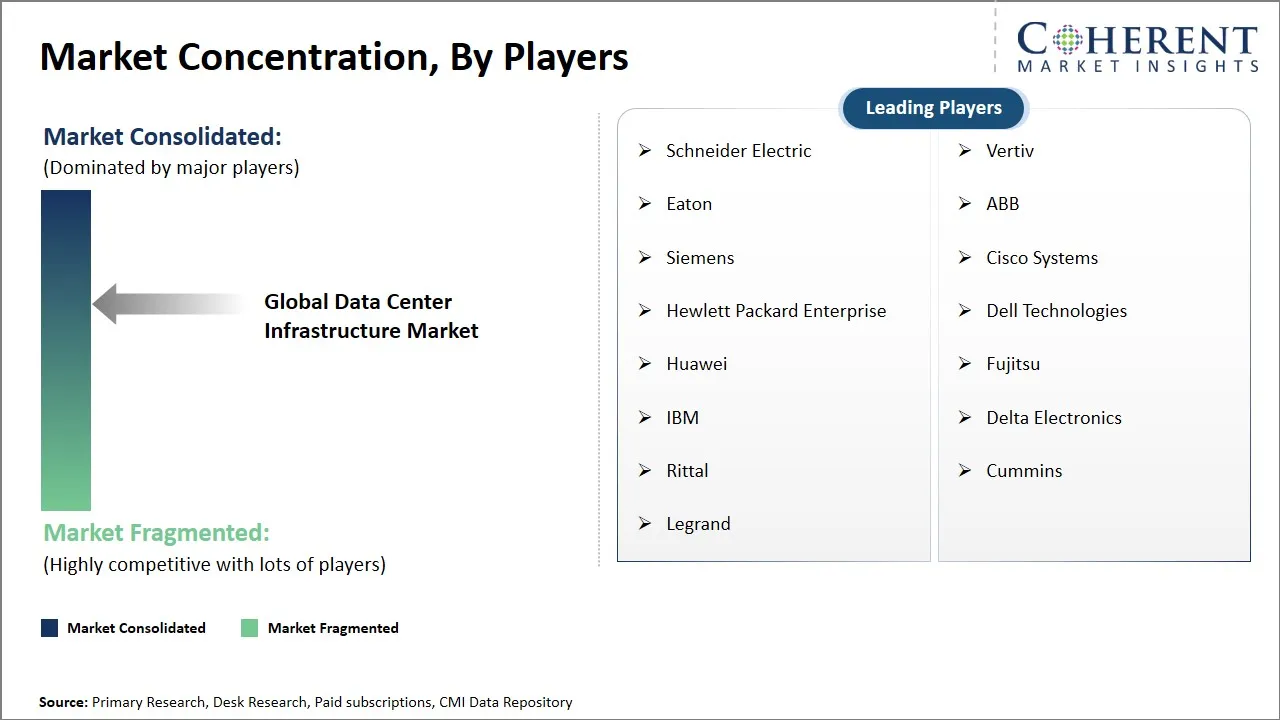
| Companies covered: | Schneider Electric, Vertiv, Eaton, ABB, Siemens, Cisco Systems, Hewlett Packard Enterprise, Dell Technologies, Huawei, Fujitsu, IBM, Delta Electronics, Rittal, Cummins, and Legrand | ||
| Growth Drivers: |
| ||
| Restraints & Challenges: |
| ||
Market Dynamics
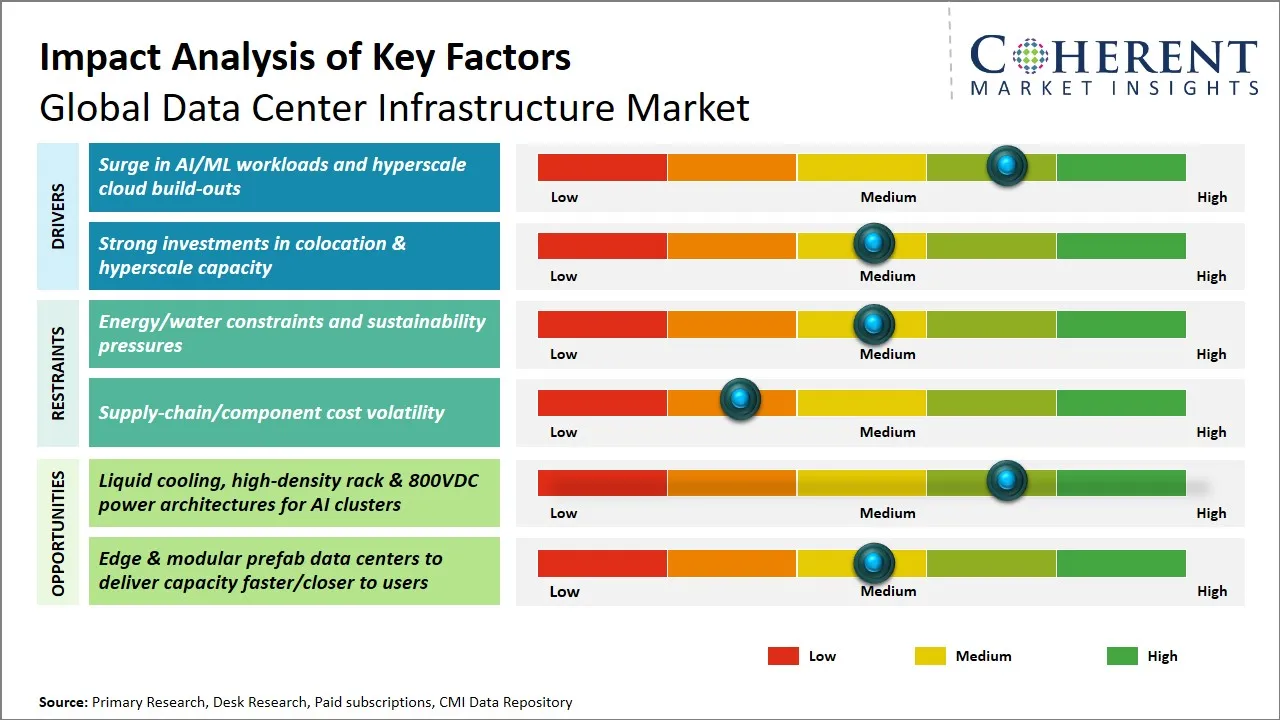
Global Data Center Infrastructure Market Driver – Surge in AI/ML Workloads And Hyperscale Cloud Build-Outs
The explosive growth of AI and ML workloads is accelerating investments in high-performance and scalable data center infrastructure. Hyperscalers such as Microsoft, Google, and Amazon Web Services are expanding capacity to support massive AI model training and inference workloads.
For example, Microsoft announced a USD 10 billion AI infrastructure expansion in 2024, including GPU-optimized data centers across the U.S. and Europe to power OpenAI and Azure AI services. This wave of hyperscale build-outs underpins the next generation of compute-intensive applications, reshaping global data center investment strategies.
Global Data Center Infrastructure Market Opportunity – Liquid Cooling, High-density Rack & 800VDC and Power Architectures for AI Clusters
Data centers face mounting energy and water usage concerns as power densities and cooling demands soar. Governments are imposing stricter efficiency regulations, while operators seek to balance performance with sustainability. For instance, Google’s data center in Mesa, Arizona, faced operational delays in 2024 due to water-use permit restrictions, reflecting the growing environmental scrutiny on hyperscale facilities. This challenge compels industry players to accelerate adoption of greener cooling and renewable energy solutions.
Analyst Opinion (Expert Opinion)
- Despite remarkable strides in computing innovation, the sector remains heavily burdened by its colossal power appetite. As AI workloads surge, operators are caught in a costly tug-of-war between maintaining uptime and meeting sustainability mandates. The market’s credibility increasingly hinges on its ability to decouple performance from excessive energy use.
- The rise of GPU-driven AI clusters is outpacing the industry’s ability to cool them efficiently. Traditional air-based systems are simply not keeping up with the heat density of next-gen servers. Without rapid adoption of liquid and hybrid cooling solutions, even well-funded hyperscalers risk operational inefficiencies and spiraling costs.
- Stricter environmental laws, water-use limitations, and local permitting delays are constraining expansion plans in several key markets. Operators can no longer prioritize speed over sustainability — regulatory compliance and resource availability are becoming decisive factors in data center site selection and long-term competitiveness.
Speak to the analyst
Want personalized insights?
Take the findings above to one of our principal consultants, or have the report rebuilt around the segments, geographies and competitors you actually track.
Market Segmentation
- Component Insights (Revenue, USD Bn, 2021 - 2033)
- Hardware
- Services
- Software
- Data Center Type Insights (Revenue, USD Bn, 2021 - 2033)
- Enterprise Data Center
- Multi-Tenant Data Centers/Colocation Data Centers
- Cloud Data Center
- Hyperscale Data Center
- Industry Vertical Insights (Revenue, USD Bn, 2021 - 2033)
- IT and Telecommunication
- BFSI
- Healthcare and Life Sciences
- Manufacturing
- Government and Public Sector
- Others
- Regional Insights (Revenue, USD Bn, 2021 - 2033)
- North America
- U.S.
- Canada
- Latin America
- Brazil
- Argentina
- Mexico
- Rest of Latin America
- Europe
- Germany
- U.K.
- Spain
- France
- Italy
- Russia
- Rest of Europe
- Asia Pacific
- China
- India
- Japan
- Australia
- South Korea
- ASEAN
- Rest of Asia Pacific
- Middle East
- GCC Countries
- Israel
- Rest of Middle East
- Africa
- South Africa
- North Africa
- Central Africa
- North America
- Key Players Insights
- Schneider Electric
- Vertiv
- Eaton
- ABB
- Siemens
- Cisco Systems
- Hewlett Packard Enterprise
- Dell Technologies
- Huawei
- Fujitsu
- IBM
- Delta Electronics
- Rittal
- Cummins
- Legrand
Sources
Primary Research Interviews
Stakeholders
- Data Center Operators and Facility Managers (e.g., Equinix, Digital Realty, Iron Mountain)
- Cloud Service Providers and Hyperscalers (e.g., AWS, Google Cloud, Microsoft Azure)
- IT Infrastructure Manufacturers and Suppliers (e.g., Schneider Electric, Vertiv, Huawei)
- Network Equipment Providers and System Integrators (e.g., Cisco, Juniper, Dell Technologies)
- Cooling and Power Equipment Vendors (e.g., Stulz, Rittal, Eaton)
- Sustainability and Energy Efficiency Consultants specializing in green data centers
- Data Center Construction and Design Engineering Firms (e.g., AECOM, Turner & Townsend)
Databases
- U.S. Energy Information Administration (EIA)
- International Energy Agency (IEA)
- Cloud Infrastructure Data Index (CIDI)
- Global Data Center Power Consumption Database (GDCPD)
- OECD Digital Economy Dataset
Magazines
- Data Center Frontier
- DataCenter Dynamics (DCD) Magazine
- Mission Critical Magazine
- Power & Cooling Today
- Infrastructure Global
Journals
- Journal of Cloud Computing and Infrastructure Systems
- IEEE Transactions on Cloud Computing
- Journal of Sustainable Computing
- Data Center Engineering & Management Journal
- Journal of Energy-Efficient Systems
Newspapers
- The Wall Street Journal (Technology Section)
- The Financial Express (India)
- Data Center News (Europe Edition)
- The Guardian (Technology & Environment)
- Nikkei Asia Tech Review
Associations
- Uptime Institute
- Green Grid Association
- Telecommunications Industry Association (TIA)
- International Data Center Authority (IDCA)
- Global Data Center Alliance (GDCA)
- American Council for an Energy-Efficient Economy (ACEEE)
Public Domain Sources
- U.S. Department of Energy (DOE)
- EUROSTAT
- United Nations Industrial Development Organization (UNIDO)
- World Bank Data Portal
- International Telecommunication Union (ITU)
- ResearchGate
Proprietary Elements
- CMI Data Analytics Tool, Proprietary CMI Existing Repository of Information for Last 8 Years
Get access to 250+ pages report
Every segment, forecast, competitor profile and data table behind the analysis above — available for instant download.
- ESOMAR Member
- ISO 9001:2015 Certified
- D-U-N-S Registered
- GDPR & CCPA Compliant
Missing comfort of reading report in your local language? Find your preferred language:
Transform your Strategy with Exclusive Trending Reports
Frequently Asked Questions
The global data center infrastructure market is estimated to be valued at USD 53.29 billion in 2026 and is expected to reach USD 90.10 billion by 2033.
The CAGR of global data center infrastructure market is projected to be 7.8% from 2026 to 2033.
Surge in AI/ML workloads and hyperscale cloud build-outs and strong investments in colocation & hyperscale capacity are the major factors driving the growth of the global data center infrastructure market.
Energy/water constraints and sustainability pressures and supply-chain/component cost volatility are the major factors hampering the growth of the global data center infrastructure market.
In terms of component, hardware is estimated to dominate the market revenue share in 2026.
They are driving demand for high-density GPU clusters, advanced cooling, and edge computing infrastructure.
Operators are shifting to renewable energy sources, waste heat reuse, and PUE optimization to reduce carbon impact.