

Global Quantum Key Distribution Market Size and Share Analysis – (2026-2033)
Quantum key distribution market is expected to be worth USD 3,170.9 Mn in 2026 and is set to reach USD 13,660.3 Mn in 2033 at a compound annual growth rate (CAGR) of 23.2% between 2026-2033.
Key Takeaways
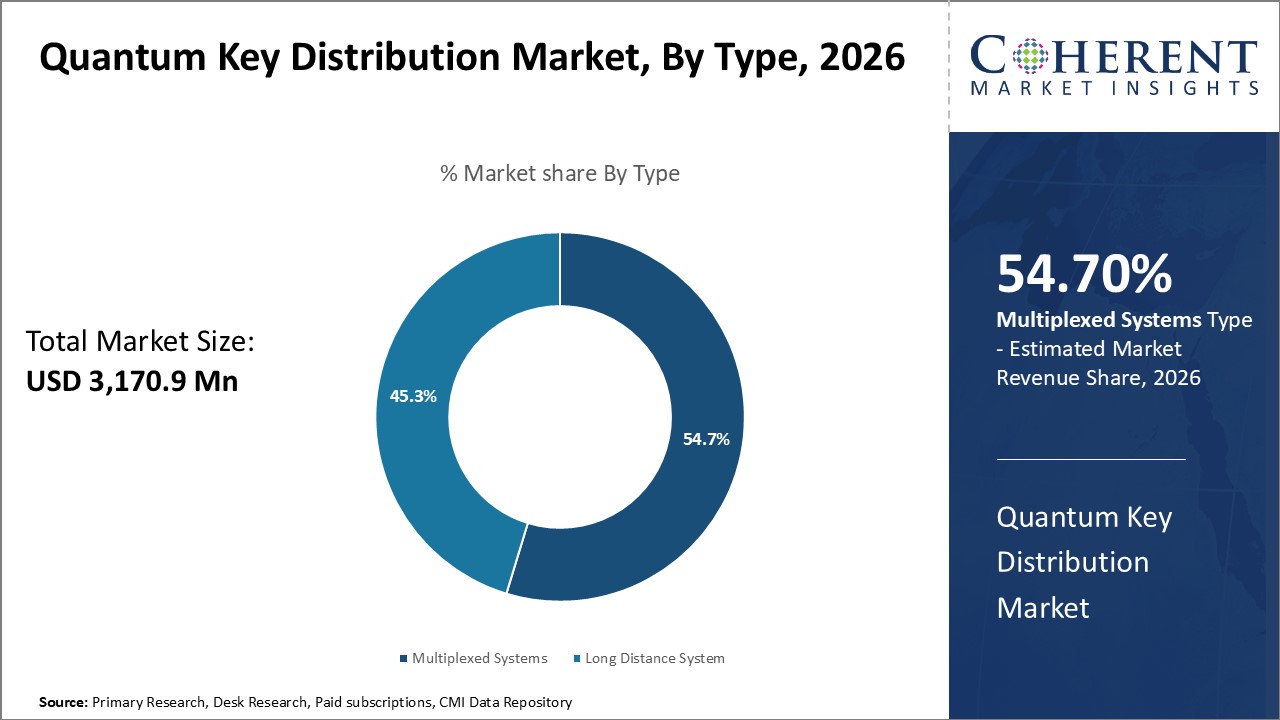
- By Type, Multiplexed System Segment leads the market with 54.7% market share in 2026.
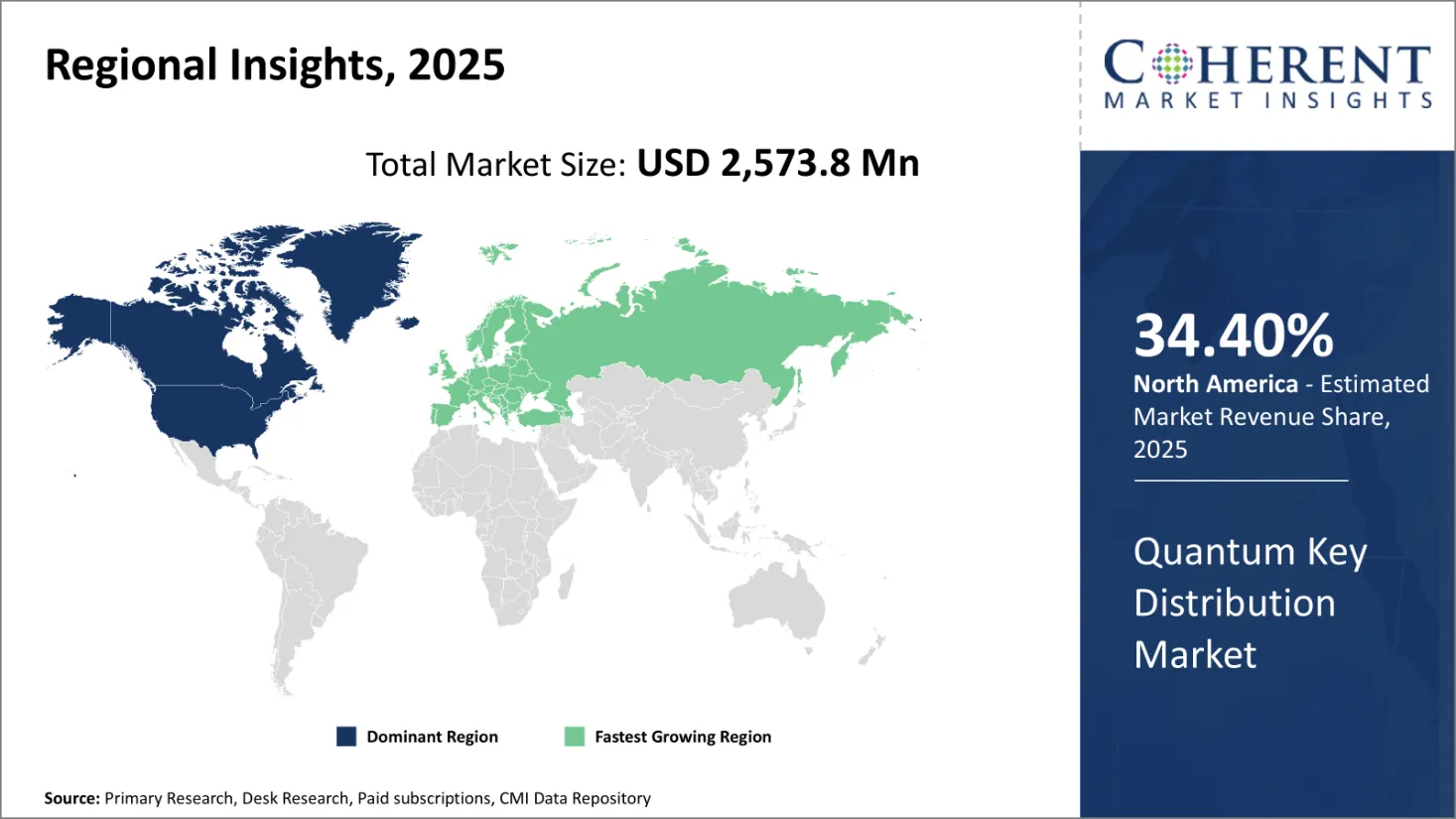
- North America holds the largest market share of quantum key distribution with than 34.4% market share in 2026.
Market Overview
The global Quantum Key Distribution (QKD) market is expanding with lightning speed, driven by the increasing need for safe communication in the context of rising cyber-attacks and the imminent arrival of quantum computing. As increasingly complex encryption methods become out of date by the day, industries such as defence, finance, healthcare, and government are pumping money into quantum-resistant solutions to protect precious data.
For example, in 2024, Toshiba Corporation revealed the successful field deployment of its quantum-secured communications network by an EU banking group using fibre-based QKD technology to safeguard ultra-secure data exchange and transactions.
Current Events and Its Impact on the Global Quantum Key Distribution Market
Current Events | Description and its impact |
Breakthrough in Field Deployment of QKD
|
|
Strategic Acquisition to Bolster European QKD Strength |
|
Role of AI (Artificial Intelligence) in the Global Quantum Key Distribution Market
The quantum key distribution (QKD) market is experiencing a revolutionary transformation as artificial intelligence becomes integral to securing quantum communications. This convergence is reshaping how organizations approach cryptographic security, offering unprecedented levels of protection against cyber threats while optimizing system performance.
For instance, in October 2025, IBM launched Guardium Cryptography Manager, an AI-powered system designed to help enterprises secure data and manage encryption as the era of quantum computing draws closer. The new solution addresses a growing concern in cybersecurity that future quantum machines could break the cryptographic protections that secure most of today’s digital information.
- Current Industry Events of 2026
- Market Size Estimation
- Regional Breakdown
- Competitive Landscape
- Customer Intelligence
- Segmental Analysis
- Pricing Analysis
- Key Market Drivers, Challenges & Future Trends
- Customized Insights Section
Segmental Insights
Quantum Key Distribution Market Insights, by Offering
Based on offering, the solution segment dominates the market with largest quantum key distribution market share. This is attributed by increasing demand for integrated QKD systems that provide end-to-end secure communication, enabling organizations to protect sensitive data against emerging cyber threats.
Quantum Key Distribution Market Insights, by Type
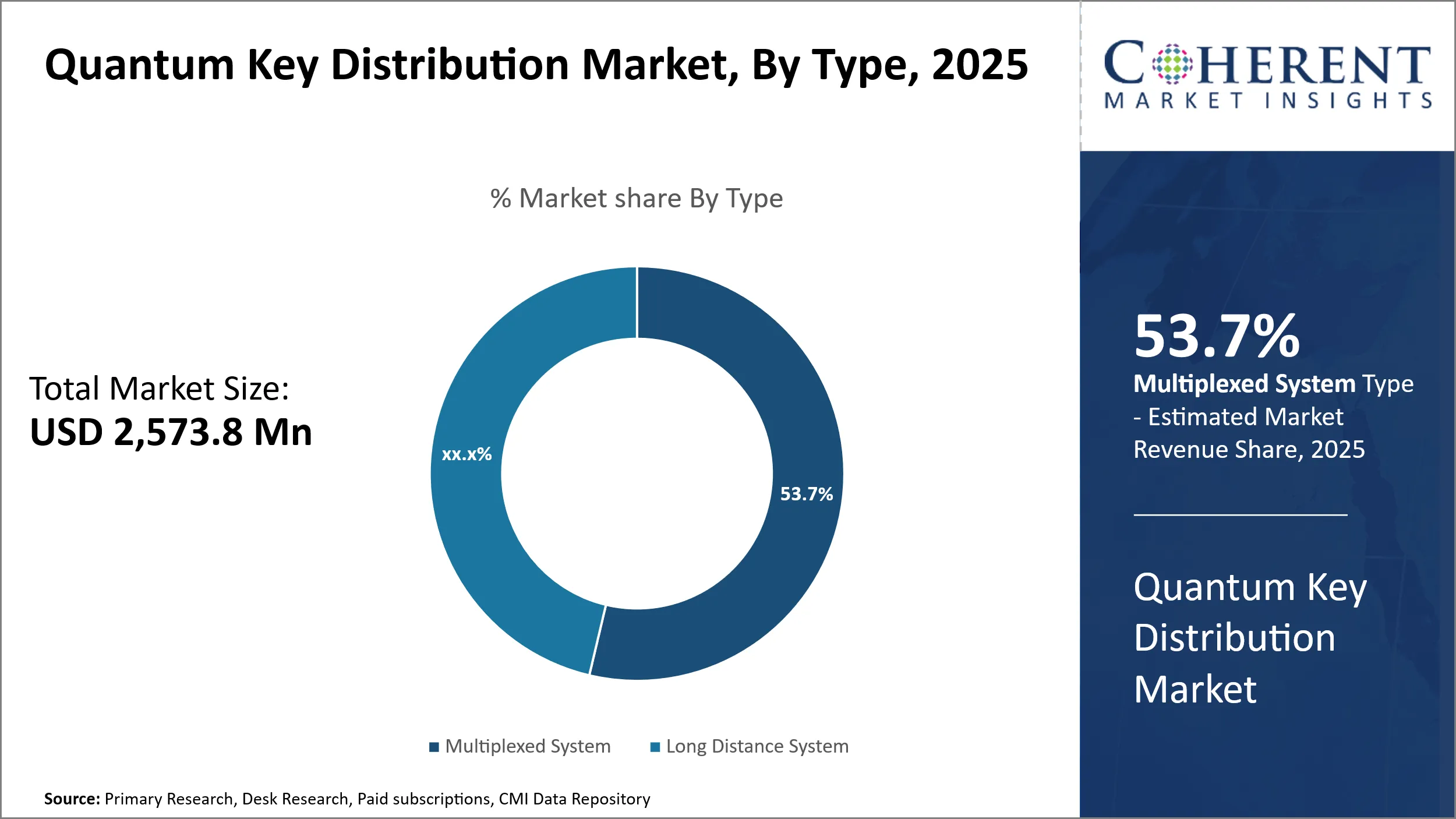
Based on Type, the multiplexed QKD system segment dominates the quantum key distribution market revenue with 54.7% market share. This dominance is driven by its ability to simultaneously transmit multiple quantum keys over a single optical fiber, significantly improving communication efficiency and reducing infrastructure costs.
Multiplexed systems offer enhanced scalability and better integration with existing telecommunication networks, making them highly attractive for large-scale deployments in sectors such as finance, government, and defense.
In July 2025, Toshiba, NEC, and NICT successfully conducted the world’s first demonstration of multiplexed quantum key distribution (QKD) and key generation within a system designed for the IOWN all-photonics network. Developed by NTT, IOWN is a next-generation infrastructure offering ultra-high speed, low latency, and low power consumption
Quantum Key Distribution Market Insights, by Transmission Medium
Based on transmission medium, the fiber-optic cable transmission segment dominates the quantum key distribution market. This is due to its high reliability, low signal loss, and existing widespread infrastructure, which allows for secure and efficient transmission of quantum keys over long distances.
Fiber-optic networks are easier to integrate with current telecommunications systems, making them the preferred choice for industries such as banking, government, and telecommunications.
For instance, in December 2024, Retelit, in collaboration with Telebit, a specialized systems integrator, and ThinkQuantum, a University of Padua spin-off, has announced the completion of a trial using quantum key distribution to secure data transmitted over fiber optic cables.
Quantum Key Distribution Market Insights, by Organization Size
Based on organization size, the SMEs segment dominates the quantum key distribution market during the forecast period, owing to the increasing awareness among small and medium-sized enterprises about the importance of securing sensitive data against evolving cyber threats. SMEs are increasingly adopting cost-effective and scalable QKD solutions to protect intellectual property, customer information, and business communications
Quantum Key Distribution Market Insights, by Vertical
Based on vertical, the BFSI segment dominates the quantum key distribution market during the forecast period, owing to the critical need for securing highly sensitive financial data and transactions against increasingly sophisticated cyber threats. The BFSI sector faces stringent regulatory requirements for data privacy and security, driving the adoption of advanced encryption technologies like QKD to safeguard customer information and prevent fraud.
For instance, in July 2026, QNu Labs has launched two new quantum-safe cybersecurity platforms, QConnect and QVerse, designed to address current and future cyber threats. Designed in India, the platforms cater to various sectors, including defence, government, telecom, BFSI, healthcare, and energy.
Quantum Key Distribution Market Insights, by Deployment Model
Based on deployment model, the on-premises deployment segment dominates the quantum key distribution market during the forecast period, owing to the need for enhanced security, control, and compliance with stringent data protection regulations. Organizations, especially in sectors like government, defense, and finance, prefer on-premises solutions to ensure that sensitive quantum keys and encryption processes remain within their own infrastructure, minimizing the risk of external breaches.
For instance, in April 2026, QNu Lab launched world’s first and unique platform, QShield that enables seamless cryptography management across any environment — cloud, on-premises, or hybrid on the occasion of World Quantum Day
Quantum Key Distribution Market Insights, by Technology
Based on technology, the Quantum key distribution segment dominates the quantum key distribution market during the forecast period, owing to its unparalleled ability to provide theoretically unbreakable encryption by leveraging the principles of quantum mechanics.
Regional Insights
North America Quantum Key Distribution Market Trends and Analysis
North America holds the position of the largest market for quantum key distribution, with over 34.4% share in 2026. North America leads the Quantum Key Distribution market revenue because of a high emphasis on cyber security and advances in technology.
The region boasts an advanced quantum research environment, with renowned universities and research institutes, and is home to major QKD vendors. The presence of major players and government support for quantum technologies contribute to the growth of the Quantum Key Distribution market in North America.
For instance, in March 2026, LuxQuanta unvieled second generation of its NOVA LQ® quantum key distribution (QKD) system at Quantum Europe Space (Hall 6 – Stand 6A8) within the Quantum Flagship of the Mobile World Congress.
Europe Quantum Key Distribution Market Trends and Analysis
Europe is the second-largest quantum key distribution market with a share of more than 26.2% in the year 2026. Europe is another key region in the Quantum Key Distribution market. Switzerland, Germany, and the U.K. are some of the countries that have contributed significantly in the field of quantum research and development.
The government in Europe have been keen on developing quantum technologies and have made huge investments in quantum-related programs. The area also boasts an increasing number of QKD installations, especially in the finance, defense, and government sectors.
For instance, in January 2026, Thales Alenia Space announced the start of the development, manufacturing, verification, and validation phase of the QKD-GEO prototype, Spain’s quantum key distribution system from geostationary orbit.
Quantum Key Distribution Market – Dominating Countries
The U.S. Quantum Key Distribution Market Trends
The U.S. Quantum Key Distribution (QKD) market is experiencing significant growth, driven by rising concerns over data security and the increasing threat of cyberattacks targeting sensitive government, defense, and financial information. As quantum computing advances, traditional encryption methods are becoming vulnerable, prompting heightened interest in quantum-safe communication solutions like QKD.
For instance, in May 2026, IonQ announced plans to launch a global space-to-space and space-to-ground satellite quantum key distribution (QKD) network, highlighting its ambitions to be the first company to have both a quantum network and quantum computer in space.
China Quantum Key Distribution Market Trends
The China Quantum Key Distribution (QKD) market is rapidly advancing, fueled by strong government support, significant investments in quantum research, and the country’s strategic focus on becoming a global leader in quantum technologies. China has already demonstrated leadership in QKD with successful large-scale projects, such as the launch of the world’s first quantum communication satellite, Micius, and the development of extensive ground-based quantum communication networks.
For instance, in March 2026, China has established a quantum key distribution link between Beijing and South Africa, marking its first ultra-secure communication connection in the southern hemisphere.
Recent Developments
- In January 2025, Cloudflare strengthened its cloud-based cybersecurity offering with the addition of post-quantum cryptography to its Zero Trust Network Access solution. This step is intended to protect data as companies direct web browser communications to corporate applications, anticipating quantum computer attacks. Cloudflare intends to provide end-to-end support for all IP protocols with post-quantum cryptography by mid-2025.
- In March 2025, LuxQuanta launched the second-generation NOVA LQ® system, advancing Continuous Variable Quantum Key Distribution (CV-QKD) with a 100 km range, 20 dB loss tolerance, support for multi-receiver networks, and interchangeable receivers for greater efficiency and lower costs.
Analyst View
- The Quantum Key Distribution (QKD) market is being propelled by escalating cybersecurity threats and the urgent need for quantum-resistant encryption solutions. As traditional cryptographic methods face obsolescence from quantum computing advances, QKD’s ability to leverage quantum mechanics for secure key exchange positions it as a critical defence mechanism. Adoption is strongest in sectors prioritizing data integrity, such as government, defence, and financial services, where safeguarding sensitive communications against sophisticated attacks is paramount.
- Drivers include heightened regulatory emphasis on data protection and accelerating investments in quantum-ready infrastructure. Governments worldwide are prioritizing QKD in national security frameworks, with North America leading due to robust federal funding and early standardization efforts. Technological advancements in photonics and satellite-based QKD are expanding deployment scenarios, particularly for cross-border and intercontinental secure communication networks.
Market Report Scope
Quantum Key Distribution Market Report Coverage
| Report Coverage | Details | ||
|---|---|---|---|
| Base Year: | 2025 | Market Size in 2026: | USD 3,170.9 Mn |
| Historical Data for: | 2020 To 2024 | Forecast Period: | 2026 To 2033 |
| Forecast Period 2026 to 2033 CAGR: | 23.2% | 2033 Value Projection: | USD 13,660.3 Mn |
| Geographies covered: |
| ||
| Segments covered: |
| ||
| Companies covered: | MagiO Technologies, Qunatum Xchange, Quantum Circuits, Inc., QEYnet Inc., HP Development Company, L.P., ISARA Corporation, QuEra, ID Quantique, KETS QUANTUM SECURITY LTD., ThinkQuantum S.r.l., LuxQuanta Technologies S.L., Adva Network Security, PacketLight Networks, Ltd., HEQA Security, QTI srl, AUREA Quantum, QuiX Quantum, QuantumCTek Co., Ltd., Toshiba, ZTE Corporation, QuNu Labs Private Limited, QuintessenceLabs, C-DOT, S-Fifteen Instruments Pte. Ltd., SpeQtral Pte Ltd. | ||
| Growth Drivers: |
| ||
| Restraints & Challenges: |
| ||
Global Quantum Key Distribution Market Drivers
- Rising Cyber Attacks
With the rising incidence of sophisticated cyber-attacks, data protection and communication security are becoming an essential demand. The traditional encryption methods are vulnerable to hacking attacks, and quantum computers pose a threat to their security. QKD is a quantum-resistant method that offers unconditional security and hence is a first pick for organizations seeking to secure confidential information.
- Advances in Quantum Computing
Progress in quantum computer technologies is accelerating the urgency for quantum-resistant cryptographic solutions. Quantum computers, so it is claimed, break present-day cryptographic algorithms, making traditional encryption useless. Though organizations wait for future quantum computing, QKD provides a critical first line of defense against quantum attacks.
For instance, Qunu Labs Private Limited. cyber security company has developed a QKD (Quantum Key Distribution) system with more than 100kms range and a QRNG (Quantum Random Number Generator) Chips first by any private company in the nation and some globally. This latest achievement by QNu is a step towards a quantum-safe India.
- Government Programs and Policies
Governments around the globe are now sensing the importance of quantum technology and how it would affect national security. Different governments around the world have made programs and invested funds to advance research and development, including QKD. Government regulations and policies supporting the implementation of secure communication and encryption technology also support the implementation of QKD across industries.
- Greater Requirement for Secure Communication
The globalized world today requires greater secure communication than ever. Industries such as finance, defense, healthcare, and telecommunications handle sensitive information that must be provided with strong protection. QKD offers much better security than ordinary encryption algorithms, ensuring data confidentiality and integrity during transit.
Global Quantum Key Distribution Market Opportunities
- Rising Need for Quantum-Safe Encryption
As quantum computing becomes more of a reality, there is increasing demand for quantum-safe encryption methods. QKD offers a quantum-resistant technique of secure key distribution and is thus a viable choice for organizations wanting to secure their data from potential quantum attacks in the future. The opportunity is in developing and commercializing QKD systems that are easily integratable into current communication infrastructure.
- Quantum Technology Breakthroughs
The continued development of quantum technologies, including photonics, quantum cryptography, and quantum communications, offers scope for innovation in the Quantum Key Distribution market. R&D initiatives geared towards increasing the efficiency, scalability, and usability of QKD systems can realize new opportunities and stimulate the market's growth.
Global Quantum Key Distribution Market Trends
- Increasing Research and Development
The Quantum Key Distribution market is characterized by ongoing research and development activities focused on improving the efficiency, scalability, and practicality of QKD systems. Researchers and industry players are exploring new techniques, protocols, and technologies to enhance the performance of QKD and overcome existing limitations. This trend drives innovation in QKD solutions and fosters the evolution of more robust and commercially viable products.
- Integration with Existing Communication Infrastructure
A notable trend in the Quantum Key Distribution market is the integration of QKD solutions with existing communication infrastructure. Efforts are being made to develop interoperable QKD systems that can work alongside traditional encryption methods, such as classical cryptography and Virtual Private Networks (VPNs). This integration enables a smooth transition to quantum-safe communication while leveraging the existing network infrastructure.
For Instance, in 2023, ID Quantique a Swiss-based quantum cyber security company announced that its Quantis QRNG chips had just received NIST ESV certification on the Independent and Identically Distributed (IID) entropy estimation track. This certification offers the highest attainable security and robustness level for the generation of random bits.
- Standardization and Interoperability
Standardization plays a crucial role in the widespread adoption of QKD solutions. Efforts are underway to establish industry standards and protocols for QKD, ensuring interoperability between different vendors and systems. Standardization initiatives aim to address compatibility issues, promote market growth, and provide a framework for secure and reliable QKD deployments.
- Advances in Quantum Technologies
The advancement of quantum technologies, including photonics, quantum computing, and quantum communication, influences the Quantum Key Distribution market. Innovations in these fields contribute to the development of more efficient and practical QKD systems. For example, advancements in single-photon sources, detectors, and quantum memories enhance the performance of QKD and pave the way for new applications and use cases.
Market Segmentation
- By Offering (Revenue, USD Mn, 2021 - 2033)
- Solution
- Discrete-Variable QKD
- Continuous-Variable QKD
- Service
- Professional Services
- Consulting & Training
- Integration and Deployment
- Support & Maintenance
- Managed Services
- Professional Services
- Solution
- By Type (Revenue, USD Mn, 2021 - 2033)
- Multiplexed QKD System
- Long-Distance QKD Systems
- By Transmission Medium (Revenue, USD Mn, 2021 - 2033)
- Fiber-Optic Cable Transmission
- Satellite-Based Transmission
- By Organization Size (Revenue, USD Mn, 2021 - 2033)
- SMEs (Small and Medium Enterprise)
- Large Enterprises
- By Application (Revenue, USD Mn, 2021 - 2033)
- Network Security
- Data Encryption
- Secure Communication
- Other Application
- By Vertical (Revenue, USD Mn, 2021 - 2033)
- Banking, Financial Services, and Insurance (BFSI)\
- Government & Defense
- Healthcare
- IT & ITES
- Automotive
- Energy & Utilities
- Other Verticles
- By Deployment Model (Revenue, USD Mn, 2021 - 2033)
- On-Premises Deployment
- Cloud-based Deployment
- By Technology (Revenue, USD Mn, 2021 - 2033)
- Quantum Key Distribution (QKD)
- Quantum Random Number Generation (QRNG)
- Quantum Cryptographic Protocols
- By Region (Revenue, USD Mn, 2021 - 2033)
- North America
- U.S.
- Canada
- Latin America
- Brazil
- Mexico
- Argentina
- Rest of Latin America
- Europe
- Germany
- U.K.
- France
- Italy
- Spain
- Russia
- Rest of Europe
- Asia Pacific
- China
- India
- Japan
- Australia
- South Korea
- ASEAN
- Rest of Asia Pacific
- Middle East
- GCC
- Israel
- Rest of Middle East
- Africa
- South Africa
- Central Africa
- North Africa
- North America
- Top Companies in the Quantum Key Distribution Market
- MagiQ Technologies
- Quantum Xchange
- Quantum Circuits, Inc.
- QEYnet Inc.
- HP Development Company, L.P.
- ISARA Corporation
- QuEra
- ID Quantique
- KETS QUANTUM SECURITY LTD.
- ThinkQuantum S.r.l.
- LuxQuanta Technologies S.L.
- Adva Network Security
- PacketLight Networks, Ltd.
- HEQA Security
- QTI srl
- AUREA Technology
- QuiX Quantum
- QuantumCTek Co., Ltd.
- Toshiba
- ZTE Corporation
- QuNu Labs Private Limited
- QuintessenceLabs
- C-DOT
- S-Fifteen Instruments Pte. Ltd.
- SpeQtral Pte Ltd.
Sources
Primary Research Interviews
- Quantum cryptography experts from ID Quantique
- Chief Technology Officers (CTOs) of Toshiba Quantum Technology Division
- Cybersecurity leads at Quintessence Labs
- Government cybersecurity policymakers (e.g., NIST representatives)
- Others
Databases
- IBISWorld (quantum communication industry analysis)
- Others
Magazines
- Quantum Computing Report
- Photonics Media
- Cybersecurity Insights Magazine
- Others
Journals
- Quantum Science and Technology (IOP Publishing)
- IEEE Journal of Quantum Electronics
- Nature Communications (quantum cryptography studies)
- Others
Newspapers
- The Financial Times (quantum tech investment coverage)
- The Wall Street Journal (cybersecurity trends)
- MIT Technology Review
- Others
Associations
- Quantum Industry Alliance (QIA)
- International Society for Optics and Photonics (SPIE)
- Global Quantum Communication Consortium (GQCC)
- Others
Public Domain Sources
- National Institute of Standards and Technology (NIST) publications
- European Space Agency (ESA) quantum communication reports
- U.S. Department of Energy (DOE) quantum initiative documents
- Others
Proprietary Elements
- CMI Data Analytics Tool
- Proprietary CMI Existing Repository of information for last 8 years
*Definition: Quantum Key Distribution is a method of secure communication that utilizes principles from quantum mechanics to establish encryption keys between two parties. QKD ensures the transmission of keys with unconditional security, protecting against eavesdropping and providing future-proof security against quantum computing attacks.
Get access to 250+ pages report
Every segment, forecast, competitor profile and data table behind the analysis above — available for instant download.
- ESOMAR Member
- ISO 9001:2015 Certified
- D-U-N-S Registered
- GDPR & CCPA Compliant
Missing comfort of reading report in your local language? Find your preferred language:
Transform your Strategy with Exclusive Trending Reports
Frequently Asked Questions
The quantum key distribution market size is estimated to be valued at USD 3,170.9 Mn in 2026, and is expected to reach USD 13,660.3 Mn by 2033.
The CAGR of the quantum key distribution industry is projected to be 23.2% from 2026 to 2033.
Increasing cybersecurity threats, advancements in quantum computing technologies, government initiatives, and growing demand for secure communication these factors are driving the quantum key distribution market growth.
The leading type segment in the global market is Long Distance Systems.
Major players operating in the global market include MagiO Technologies, Qunatum Xchange, Quantum Circuits, Inc., QEYnet Inc., HP Development Company, L.P., ISARA Corporation, QuEra, ID Quantique, KETS QUANTUM SECURITY LTD., ThinkQuantum S.r.l., LuxQuanta Technologies S.L., Adva Network Security, PacketLight Networks, Ltd., HEQA Security, QTI srl, AUREA Quantum, QuiX Quantum, QuantumCTek Co., Ltd., Toshiba, ZTE Corporation, QuNu Labs Private Limited, QuintessenceLabs, C-DOT, S-Fifteen Instruments Pte. Ltd., SpeQtral Pte Ltd.
North America is currently the largest market, but the region that will lead in the future may depend on various factors.