

Photonics Market Size and Forecast - 2026 to 2033
Photonics Market is estimated to be valued at USD 1027.9 Mn in 2026 and is expected to reach USD 1,773.1 Mn in 2033, exhibiting a compound annual growth rate (CAGR) of 8.1% from 2026 to 2033.
Key Takeaways
- Based on Application, Image Capture and Display segment is expected to dominate the global market over the forecast period with 22% market share. This is attributed to the development of novel products with advanced technology by market players.
- North America is expected to see substantial growth in the global photonics market during the forecast period with 30.2% market share. This is due to increasing neighbouring markets like safety and protection applications, lighting, production technology, and healthcare.
Market Overview
The photonics industry is witnessing tremendous growth as a result of the rising demand for sophisticated optical technologies in various industries, including telecommunications, healthcare, manufacturing, and defence. People and industries are demanding more efficient, high-performance photonic devices such as lasers, sensors, and imaging systems, which are finding increasing use in several different applications. The advent of the Internet of Things (IoT), artificial intelligence (AI), and the growth of 5G networks are also fueling the need for photonics, with these technologies depending significantly on optical communication and high-speed data transfer.
Current Events And Its Impact
Current Events | Description and its impact |
Advancements in AI Integration |
|
Photonics in Quantum Computing |
|
Pricing Analysis
Pricing in the global photonics market is determined by a number of influencing factors such as the cost of production, technology innovation, demand, and competition. Photonics products such as lasers, sensors, and optical devices often require huge investments in research and development (R&D), which can escalate prices, particularly for new technologies. For instance, sophisticated laser systems or optical sensors applied in highly precise processes like medical diagnostics or aerospace may range from $1,000 to $100,000 based on complexity and performance specifications.
By comparison, standardized parts like optical fibers or simple sensors, which are widely employed in telecommunications, can be priced more competitively from $10 to $500 per unit. Regional variations also come into the picture where products made in low-labor-cost countries like China tend to be cheaper compared to those produced in high-manufacturing-cost regions like Europe or the U.S.
In addition, competition directly affects prices. With a larger number of businesses involved in the photonics industry, especially in mass markets, prices dip because there is higher competition and economies of scale. Nevertheless, for specialty, high-performance products, firms can charge premium prices because there is little competition and special demand. In general, the photonics industry will experience both price consolidation in commodity segments and persistent high prices for advanced technological segments.
- Current Industry Events of 2026
- Market Size Estimation
- Regional Breakdown
- Competitive Landscape
- Customer Intelligence
- Segmental Analysis
- Pricing Analysis
- Key Market Drivers, Challenges & Future Trends
- Customized Insights Section
Role of Ai in Global Photonics Market
AI is being incorporated into photonics systems to increase efficiency in production processes, for example, to optimize photonic device design and production. Machine learning algorithms assist in analyzing vast amounts of data from optical sensors and imaging devices so that real-time decision-making can be achieved in industries such as healthcare, telecommunications, and autonomous vehicles.
In healthcare imaging, AI-driven photonics devices are facilitating quicker and more precise diagnosis by processing optical information from high-end imaging devices such as OCT (Optical Coherence Tomography). In the telecommunication sector, AI assists in the management and optimization of photonic networks to enhance data transmission efficiency and lower operating expenses. In quantum photonics, AI also plays an important role as it makes it possible to advance quantum computing and secure communication networks.
In addition, AI improves the accuracy of photonics-based manufacturing by automating quality control, forecasting equipment maintenance requirements, and reducing defects. This leads to reduced production costs and increased consistency in end products. As AI further advances, its integration with photonics will continue to transform industries, opening innovation opportunities and increasing the overall market size.
Global Photonics Market Drivers
- Growing silicon-based photonics applications to drive the market growth
Silicon photonics is a subfield of photonics that is being developed every day, as it provides an obvious advantage over electric conductors used in semiconductors applied in high-speed transmission systems. This technology will enhance the transmission speed up to 100 Gbps, and firms like Intel, IBM, and Kothura are making progress using this technology.
In March 2024, Intel unveiled the first fully integrated optical compute interconnect (OCI) chiplet at the Optical Fiber Communication Conference (OFC). This OCI chiplet, co-packaged with an Intel CPU, supports 64 channels of 32 Gbps data transmission in each direction over up to 100 meters of fiber optics.
- Increase emphasis on green solutions and superior performance to propel the market growth
In today's times, new technological advancements are happening infrequently without considering environmental effects. Saving the world has become a key consideration in shaping the path of innovations in photonics technology, and, on the contrary, photonics is having a major environmental impact. Therefore, the emphasis on the development of environment-friendly solutions with high performance is rising in the marketplace. This, in return, is likely to spur the expansion of the world photonics market during the forecasting period.
Global Photonics Market Opportunities:
The shifting of the photonics industry from a traditional approach to a contemporary approach is anticipated to give rise to several growth opportunities in the global photonics market throughout the forecast period. The use of new technologies with a focus on healthcare and data communication services is increasing in the photonics industry in a bid to provide better operation levels.
Therefore, the industry is facing ongoing innovations in product design and manufacturing, and it is expected that this will continue in the market year after year. Therefore, the photonics market is expected to face huge opportunities shortly. In February 2025, STMicroelectronics announced the launch of a new photonics chip developed in collaboration with Amazon Web Services (AWS). This chip utilizes light instead of electricity to enhance speed and reduce power consumption in data transceivers.
Increasing developments in information and communication technology are likely to contribute to the growth of the global photonics market, with several growth opportunities over the forecast period. An increase in demand for effective and cross-industry applications and evolving communication technologies is driving market growth. The growth in data communication and the creation of data centers facilitate active use of transceivers and transmitters, with optical or photonic technology at work behind the product.
Global Photonics Market Trends:
- Increased relevance of LiDAR technology is one of the key market trends
LiDAR technology over the last few years has been critical for autonomous driving since it examines the scattering of gases and pollutants in the atmosphere. With the technological advancements in light-based technologies, the innovations are increasing in the industry by offering green solutions to global problems. Consequently, this is fueling the market growth.
In May 2025, Aeva Technologies reported partnering with Airbus UpNext to provide LiDAR sensors for autonomous taxiing tests on gates at Toulouse-Blagnac Airport. The sensors are intended to build 3D maps and sense object movement to increase airport efficiency and decrease pilot workload during taxiing.
- High-speed development in the IC semiconductor miniaturization is an emerging trend.
In addition to the accelerated technological advancements in IC semiconductor equipment miniaturization, the market for X-ray science, imaging, photovoltaics, quantum optics, terahertz technology, optoelectronics, and organic optical communications is likely to grow substantially in the next few years. This is also likely to accelerate the demand for photonics, thus contributing to growth in the global photonics market over the forecast period.
Market Segmentation
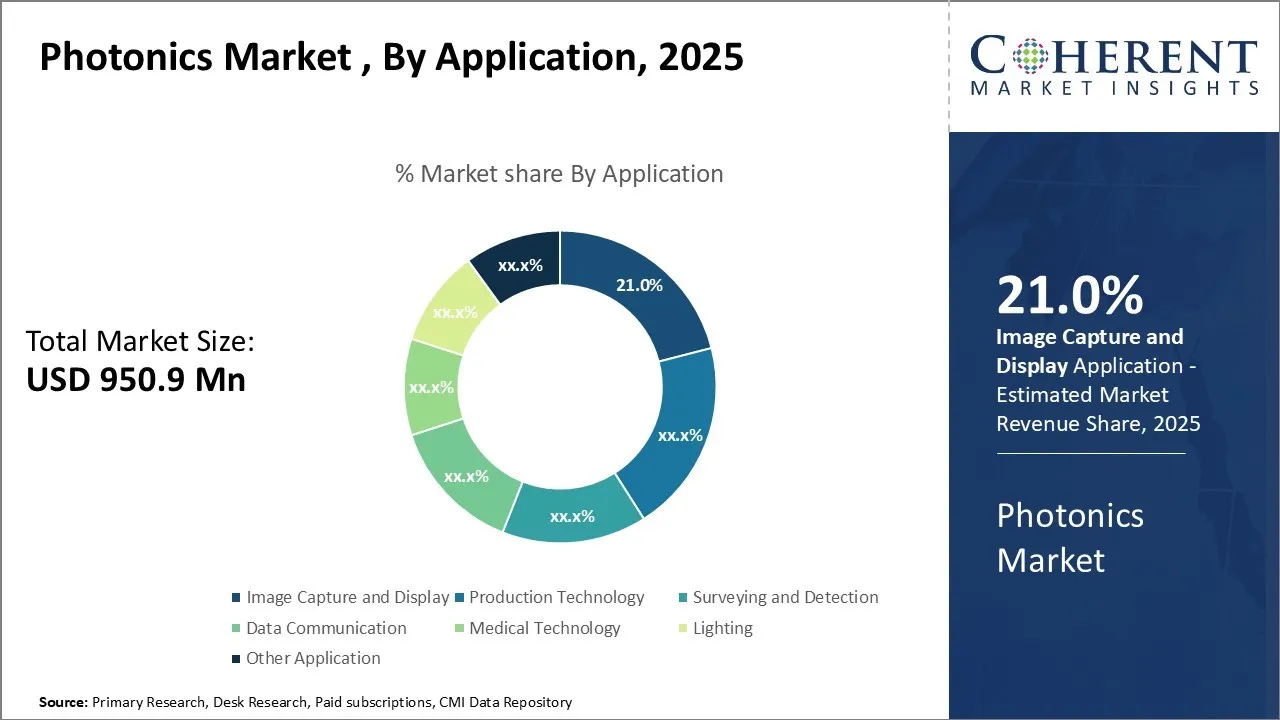
Global Photonics Market insights, by application
Based on Application, the Image Capture and Display is expected to dominate the global market over the forecast period with 22% market share and this is attributed to the development of novel products with advanced technology by market players. Product Technology segment is also expected to witness significant growth in the near future and this is owing to the growing focus of high growth enterprises on boosting the efficiency of their facilities.
Regional Insights
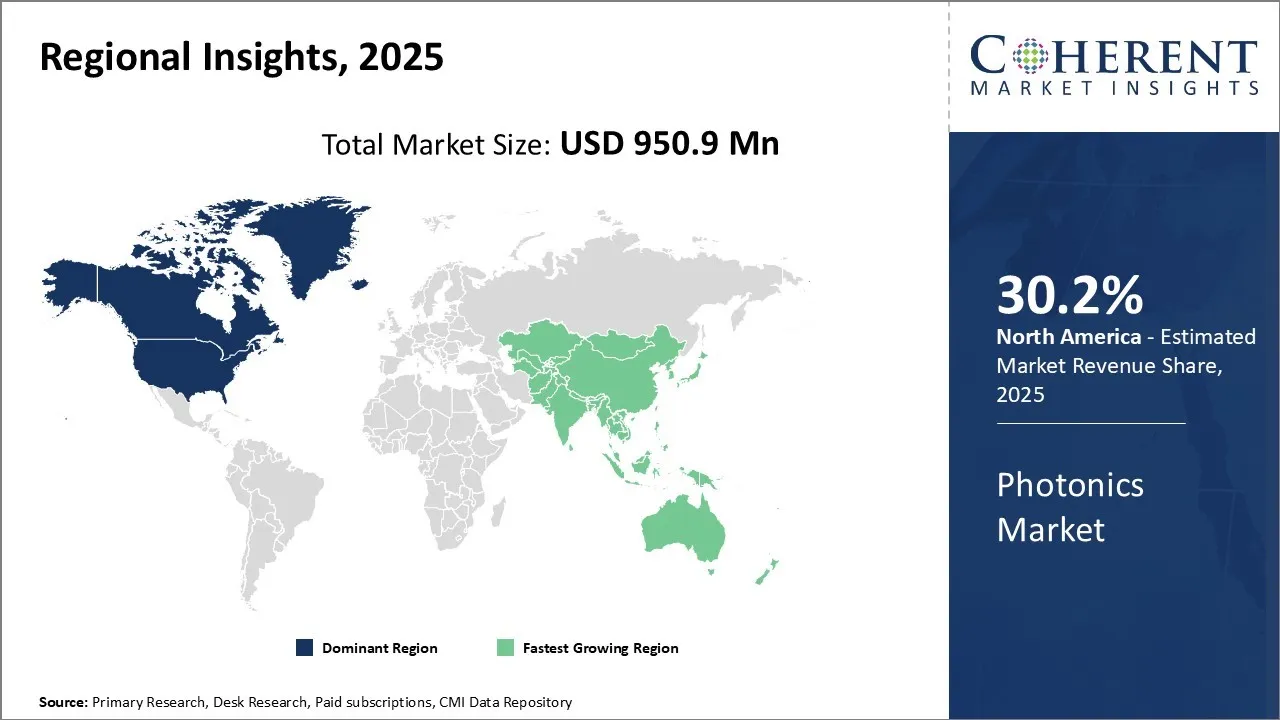
North America Global Photonics Market Analysis and Trends
North America is expected to see substantial growth in the global photonics market during the forecast period. This growth is due to increasing neighbouring markets like safety and protection applications, lighting, production technology, and healthcare. Further, robust expansion of the data centre hardware market in the U.S. as well as availability of numerous market players like HP, Intel Corp., and IBM is also triggering expansion of the global photonics market in the region.
Asia Pacific Global Photonics Market Analysis and Trends
Asia Pacific is also predicted to exhibit high growth in the international photonics market in the forecast period. This is because of regular collaborations between players in the market, investments by large players to accelerate their growth in Japan. In addition to that, the growing economic and electronics market share of China is also propelling the growth of the market.
Global Photonics Market Dominating Countries
United States Photonics Market Analysis and Trend
The United States is a leading force in the international photonics market, due to its highly developed technological infrastructure and high levels of research and development investments. The strong position of the country in telecommunications, healthcare, defense, and electronics industries has promoted the need for sophisticated photonic devices. Large corporations and research centers, especially in Silicon Valley, are responsible for the U.S. dominance in photonics innovation and commercialization.
Germany Photonics Market Analysis and Trend
Germany is a major driver of the European photonics industry, with a reputation for precision engineering and high-tech optical products. The nation's engineering prowess and concentration in industrial automation, lasers, and imaging technologies position it as a leader in photonics research and applications. The government's ongoing support of R&D in photonics combined with a robust base of established photonics players cement Germany's leadership in the international market.
Market Report Scope
Photonics Market Report Coverage
| Report Coverage | Details | ||
|---|---|---|---|
| Base Year: | 2025 | Market Size in 2026: | USD 1027.9 Mn |
| Historical Data for: | 2020 To 2024 | Forecast Period: | 2026 To 2033 |
| Forecast Period 2026 to 2033 CAGR: | 8.1% | 2033 Value Projection: | USD 1,773.1 Mn |
| Geographies covered: |
| ||
| Segments covered: |
| ||
| Companies covered: | Carl Zeiss AG (Scantinel Photonics GmbH), Hamamatsu Photonics KK, Schott AG, Intel Corporation, Photonics SAS (Keopsys), Polatis Photonics Inc., Philips Photonics (Trumpf GmbH), Alcatel-Lucent SA, Osram Licht AG, Molex Inc. (Koch Industries), IPG Photonics, Infinera Corporation, Finisar Corporation, NEC Corporation, and Innolume GmbH. | ||
| Growth Drivers: |
| ||
| Restraints & Challenges: |
| ||
Analyst View
- The photonics industry is undergoing revolutionary expansion fuelled by converging technology needs among target industries. Data centre growth continues to be a leading driver, where hyperscale providers place a top priority on energy-efficient optical interconnects for coping with cloud computing and AI-driven data traffic growth.
- 5G network installations are driving telecom adoption, especially for fronthaul/backhaul networks demanding low-latency, high-bandwidth applications. New opportunities such as LiDAR technology for autonomous cars and quantum computer photonic qubits offer new horizons, which have different commercial applications timelines.
- Market trends increasingly support vertically integrated companies that can provide application-specific solutions, notably for AI accelerator architectures that need photonic co-design customized to requirements. Pressure from regulatory forces demanding energy-efficient technologies also places photonics on the agenda as essential infrastructure for climate-friendly digital transformation. The success drivers will depend on overcoming substrate material constraints and creating interoperable standards for heterogeneous system integration.
Global Photonics Market: Key Developments
- In January 2025, Wave Photonics launched a new silicon nitride process designed specifically for quantum photonics with an accompanying Process Design Kit (PDK). This breakthrough makes it possible to design and manufacture high-performance photonic integrated circuits for quantum, enabling complex quantum photonic systems to be designed and made with increased accuracy and scalability.
- In January 2025, GlobalFoundries revealed that it plans to build an advanced chip packaging and testing facility worth $575 million at its Fab 8 campus in Malta. The facility, backed by a $75 million grant from the U.S. Commerce Department and $20 million from New York state, will be dedicated to photonics technology and will generate 102 jobs. The investment will be used to increase domestic semiconductor manufacturing and serve strategic industries such as automotive, defense, and AI.
Market Segmentation
- Global Photonics Market, By Application
- Surveying and Detection
- Production Technology
- Data Communication
- Image Capture and Display
- Medical Technology
- Lighting
- Other Applications (Traffic and Research)
- Global Photonics Market, By Region
- North America
- Europe
- Asia Pacific
- Latin America
- Middle East & Africa
- Company Profiles
- Hamamatsu Photonics KK
- Intel Corporation
- Polatis Photonics Inc.
- Alcatel-Lucent SA
- Molex Inc. (Koch Industries)
- Infinera Corporation
- NEC Corporation
- Innolume GmbH
- Finisar Corporation
- IPG Photonics
- Osram Licht AG
- Philips Photonics (Trumpf GmbH)
- Photonics SAS (Keopsys)
- Schott AG
- Carl Zeiss AG (Scantinel Photonics GmbH)
Sources
Primary Research Interviews
- ResearchAndMarkets.com silicon photonics analysts
- IDTechEx photonic integrated circuits specialists
- Future Market Insights photonics industry experts
- Photonics.com technology editors
- Other
Databases
- Others
Magazines
- Photonics Media (photonics.com)
- Laser Focus World
- Optics & Photonics News
- Others
Journals
- IEEE Journal of Selected Topics in Quantum Electronics
- Nature Photonics
- Optics Express
- Others
Newspapers
- Business Wire Technology Briefs
- GlobeNewswire Industry Updates
- Photonics.com Market Reports
- Others
Associations
- International Society for Optics and Photonics (SPIE)
- Optical Society (OSA)
- European Photonics Industry Consortium (EPIC)
- Others
Public Domain Sources
- U.S. Department of Energy Photonics Initiatives
- European Commission Horizon Europe Program Documents
- ResearchAndMarkets.com Public Reports
- Others
Proprietary Elements
- CMI Data Analytics Tool
- Proprietary CMI Existing Repository of Information (Last 8 Years)
*Definition:
Photonics is the technology of generating and harnessing light and other forms of radiant energy whose quantum unit is a photon. It involves cutting-edge uses of lasers, optics, fiber-optics and electro-optical devices in numerous fields of technology including aerospace, agriculture, biomedicine, construction, energy, information technology, chemicals, transportation, homeland security, solid state lighting and more.
Get access to 250+ pages report
Every segment, forecast, competitor profile and data table behind the analysis above — available for instant download.
- ESOMAR Member
- ISO 9001:2015 Certified
- D-U-N-S Registered
- GDPR & CCPA Compliant
Missing comfort of reading report in your local language? Find your preferred language:
Transform your Strategy with Exclusive Trending Reports
Frequently Asked Questions
The Photonics Market size is estimated to be valued at USD 1027.9 Mn in 2026, and is expected to reach USD 1,773.1 Mn by 2033.
The CAGR of the global Market is projected to be 8.1% from 2026 to 2033.
Emerging silicon-based photonics applications and Rise in focus on eco-friendly solutions and high performance are fuelling the market.
The Image Capture and Display segment is the leading application segment in the market.
High cost of photonics-enabled devices and stringent regulations regarding environmental impact are the major factors restraining market.
Carl Zeiss AG (Scantinel Photonics GmbH), Hamamatsu Photonics KK, Schott AG, Intel Corporation, Photonics SAS (Keopsys), Polatis Photonics Inc., Philips Photonics (Trumpf GmbH), Alcatel-Lucent SA, Osram Licht AG, Molex Inc. (Koch Industries), IPG Photonics, Infinera Corporation, Finisar Corporation, NEC Corporation, and Innolume GmbH.