

Global Foldable Smartphone Market Size and Forecast 2026-2033
Global foldable smartphone market is estimated to be valued at USD 34.46 Bn in 2026 and is expected to reach USD 124.93 Bn by 2033, exhibiting a compound annual growth rate (CAGR) of 20.2% from 2026 to 2033.
Key Takeaways of the Global Foldable Smartphone Market
- The inward fold segment is estimated to contribute the highest market share of 58.8% in 2026.
- By sales channel, the online segment is estimated to contribute the highest market share of 65.4% in 2026.
- Asia Pacific region, particularly China, currently dominates the global foldable smartphone market with an estimated market share of 55.2% in 2026.
Manufacturing Facilities and Production Capacities
- Samsung has the largest production capacity, with significant output from Vietnam and India, while Chinese brands leverage agile production within China.
- China accounts for 70% of global foldable production, with Vietnam and India serving as key export-focused manufacturing hubs.
Market Overview
The global foldable smartphone market is rapidly expanding, fueled by significant R&D investments from major players driving innovation and adoption. Technological advancements are making foldable designs sleeker and more durable, with new form factors emerging beyond traditional styles.
The widespread availability of 5G connectivity is also a key driver, unlocking new use cases and boosting the demand for the immersive large-screen experiences these devices offer.
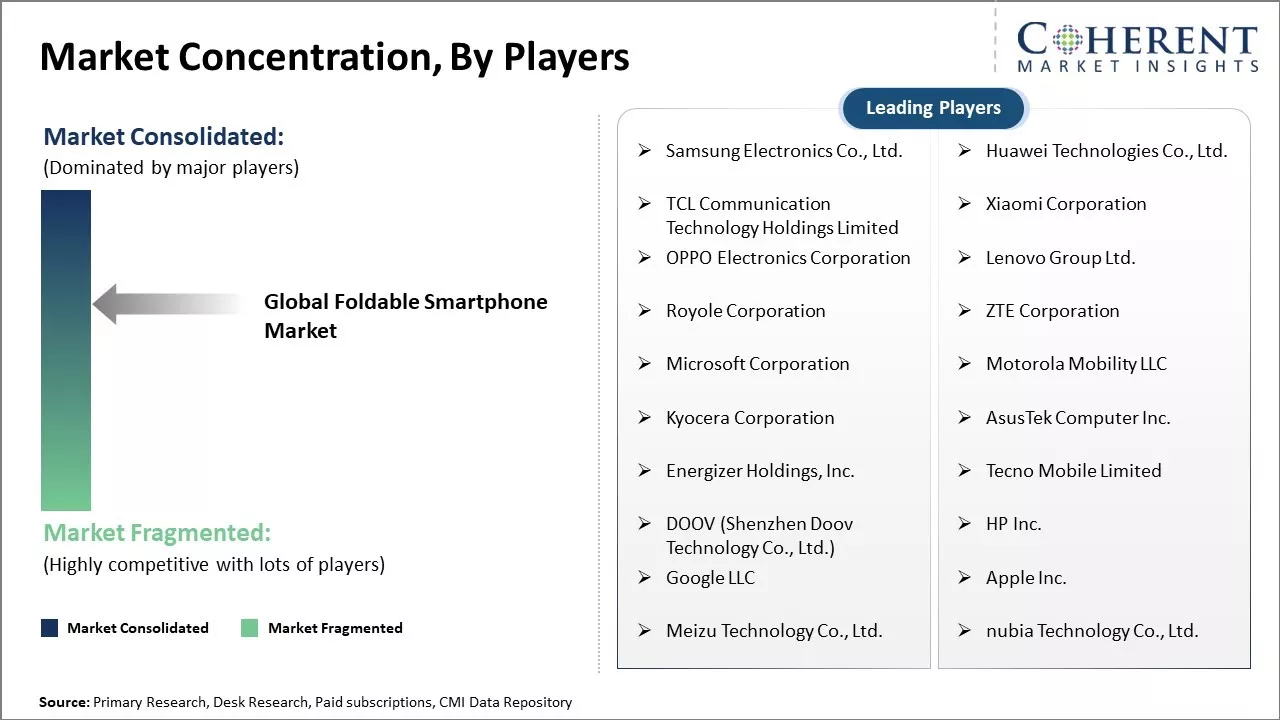
Market Concentration and Competitive Landscape
Impact of AI on Global Foldable Smartphone Market
The foldable smartphone market is in a transitional phase. AI integration is becoming a crucial differentiator that can drive future growth.
- Samsung’s Galaxy Z Fold6 with advanced Galaxy AI tools showcases the benefits of a larger unfolded screen, offering a PC-like multitasking experience. Its dual-screen design makes it easy to run multiple apps at once, making it more appealing for business users.
- Google's Pixel Fold exemplifies AI's practical benefits, using AI-powered camera software for superior image quality and intelligent interface management to streamline multitasking, significantly improving overall user satisfaction and boosting adoption.
- Current Industry Events of 2026
- Market Size Estimation
- Regional Breakdown
- Competitive Landscape
- Customer Intelligence
- Segmental Analysis
- Pricing Analysis
- Key Market Drivers, Challenges & Future Trends
- Customized Insights Section
Current Events and their Impact on the Global Foldable Smartphone Market
Current Events | Description and its impact |
Global Semiconductor Supply Chain Disruptions
|
|
U.S.-China Tech Trade War Escalation |
|
Industry Trends
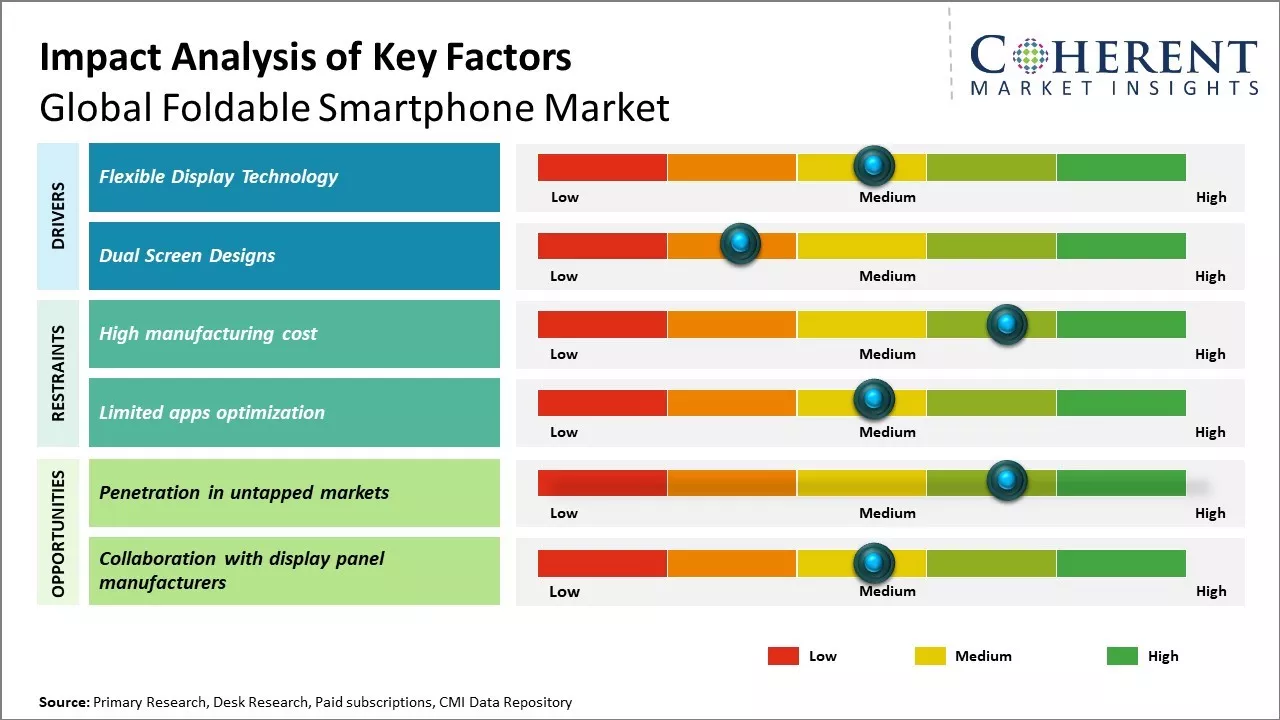
Flexible Display Technology
The advent of flexible display technology has revolutionized smartphone design, enabling foldable models that offer expanded screen real estate. Unlike rigid glass, these displays can bend without damage, exemplified by devices like Samsung's Galaxy Fold. This functionality enhances multimedia and multitasking in a portable form factor, primarily driven by thin, lightweight OLED panels.
For instance, in August 2022, Xiaomi launched the MIX Fold 2, a foldable smartphone featuring a Qualcomm Snapdragon 8+ Gen 1 chipset and a slim 5.4 mm unfolded design, showcasing Xiaomi's proprietary micro waterdrop hinge.
Dual Screen Designs
Beyond fully foldable phones, some companies offer dual-screen designs, like the LG Velvet Dual Screen and Microsoft Surface Duo, which use two separate screens connected by a hinge to expand display area. While not as sleek as true foldables, these are generally more affordable and provide similar multitasking benefits, appealing to users seeking versatility.
Market Opportunity: Penetration in untapped markets
The penetration in untapped markets can offer opportunities for global foldable smartphone market growth. In Latin America, Africa, the Middle East, and South Asia, foldable smartphones are not popular yet. As infrastructure and capabilities continue developing in these areas, more consumers will be able to access and afford innovative form factors like foldable devices.
As the affordability of these devices increases through competition and more accessible price points, foldable smartphones may appeal to previously untapped consumer segments, particularly in emerging regions. Manufacturers that strategically target these regions can capture early adopters and build lasting brand loyalty.
Segmental Analysis
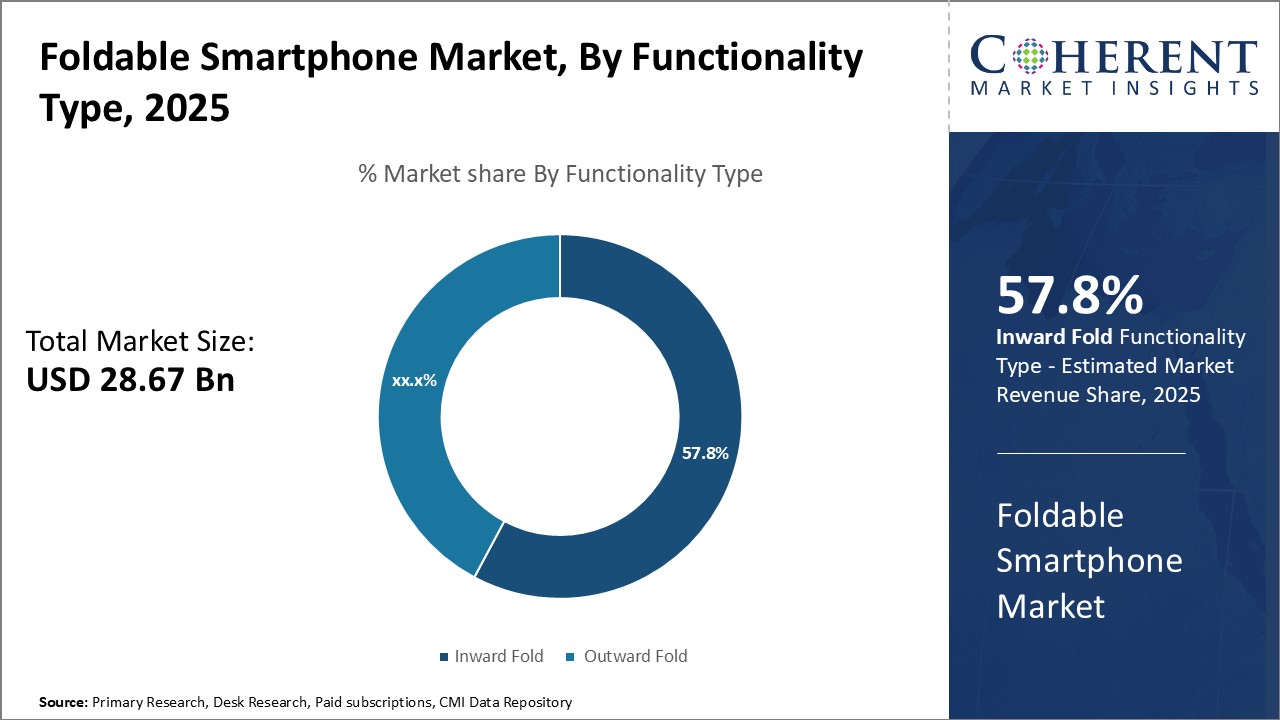
Global Foldable Smartphone Market Insights by Functionality Type
Among functionality type, inward fold segment is estimated to contribute the highest market share of 58.8% in 2026. Devices that fold inward are generally more protective of the display as it folds into the interior of the device rather than exposing it outward. This portability makes inward folding phones highly suitable for travelers and professionals who are constantly on-the-go.
The protective quality of inward folding attracts consumers concerned about display damage. Device makers have also focused heavily on refining the hinge and locking mechanisms for inward folding phones to feel sturdy and provide the impression of a premium product. Hinges have become increasingly resilient to withstand thousands of open-and-close cycles without flexing.
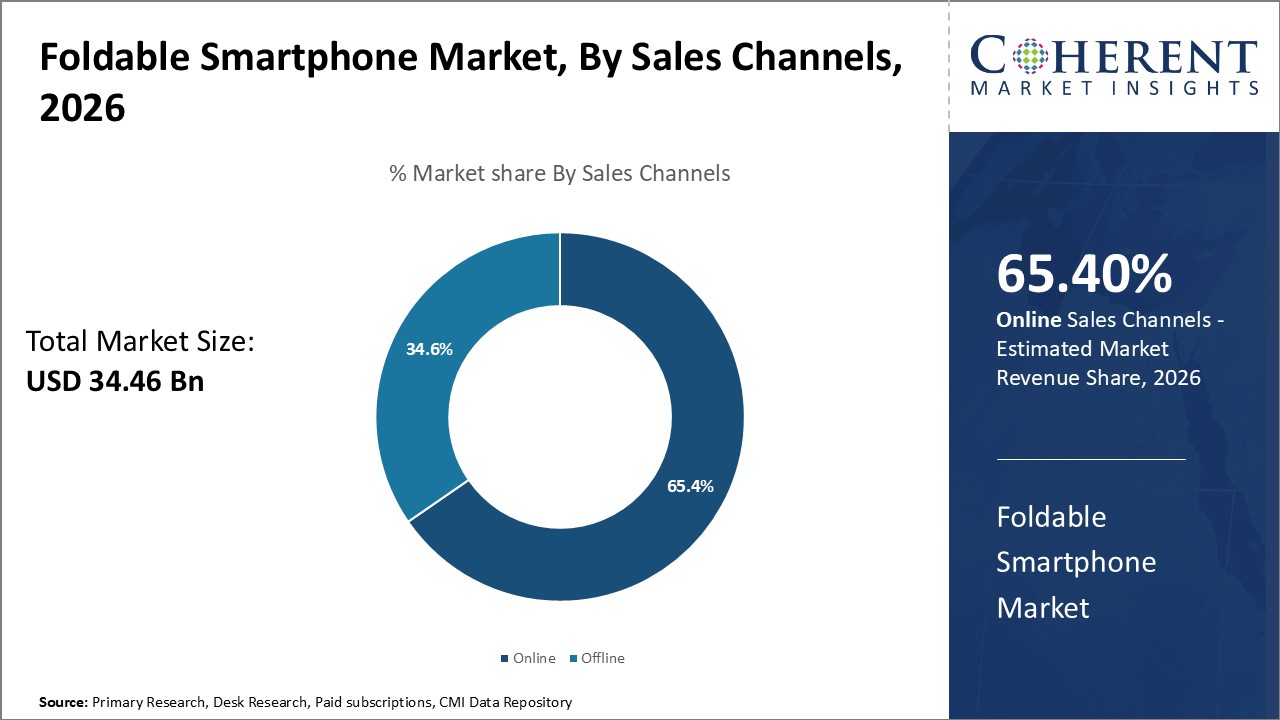
Global Foldable Smartphone Market Insights by Sales Channels
By sales channel, online segment is estimated to contribute the highest market share of 65.4% in 2026, due to the newness of foldable technology and consumers' tendency to research new devices online first before making purchasing decision. The dominance of online sales channels helps build awareness and reviews for foldable smartphones, which can then instill confidence among mainstream consumers and encourage them to consider adopting these innovative devices in the future.
Online retail provides a convenient way for consumers to easily compare foldable phone models, specifications, reviews and price points all in one place. This level of research ability and transparency plays to the sophistication of early foldable phone adopters. It also allows brands to promote pre-order deals and launch exclusives that incentivize purchases through their own websites or affiliate online channels. Due to advancements in technology, more options will become available in brick-and-mortar stores as well.
Regional Insights
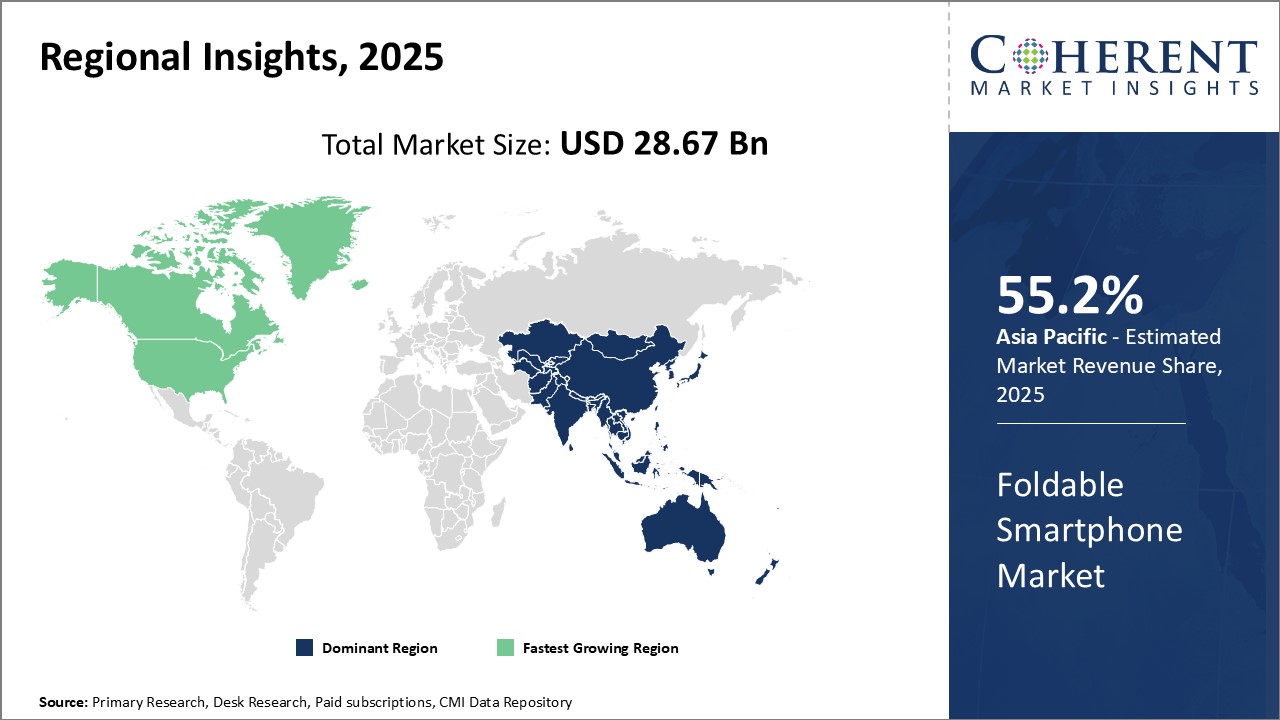
Market Research on Asia Pacific Foldable Smartphone Market: Key Trends and Regional Insights
Asia Pacific region, particularly China, currently dominates the global foldable smartphone market with estimated market share of 55.2% in 2026. Increasing number of domestic Chinese brands such as Huawei, Oppo and Vivo are investing in foldable smartphone research.
This has allowed these brands to rapidly launch affordable mass market models, unlike the expensive niche devices previously only offered by Samsung. The intensely competitive smartphone landscape in China is encouraging constant innovation among domestic players.
North America Foldable Smartphone Industry Trends and Market Analysis
The North America region is poised to be the fastest growing market for foldable smartphones. Major technology companies such as Samsung, Motorola, and Google have established strong research and development centers as well as manufacturing facilities in countries like the U.S. This allows these companies to closely monitor market trends and design foldable smartphones as per the preferences of North American consumers.
Rising disposable incomes in the region translates to a willingness to pay premium prices for innovative new form factors like foldable screens. Carriers also actively promote new device launches through subsidies and installment plans, making the latest foldable phones affordable and driving sales volumes.
U.S. Foldable Smartphone Industry Trends and Market Analysis
The U.S. foldable smartphone market is growing due to tech advancements and consumer interest, though widespread adoption relies on improved durability and affordability. Manufacturers like Samsung, with its iterative Galaxy Z series, are actively addressing these needs, signaling continued growth in this key market.
India Foldable Smartphone Industry Trends and Market Analysis
The India smartphone market, though experiencing a recent dip in shipments in Q1 2026 due to softer consumer demand, continues to be driven by 5G expansion and a growing consumer preference for more advanced and premium devices.
Despite a slight volume decline, the market is seeing value growth, especially in higher-priced segments, as buyers increasingly seek feature-rich phones, including those with AI capabilities. Brands are strategically leveraging both online and physical retail channels, and local manufacturing is further strengthening India's role in the global smartphone supply chain.
Market Report Scope
Foldable Smartphone Market Report Coverage
| Report Coverage | Details | ||
|---|---|---|---|
| Base Year: | 2025 | Market Size in 2026: | USD 34.46 Bn |
| Historical Data for: | 2020 To 2024 | Forecast Period: | 2026 To 2033 |
| Forecast Period 2026 to 2033 CAGR: | 20.2% | 2033 Value Projection: | USD 124.93 Bn |
| Geographies covered: |
| ||
| Segments covered: |
| ||
| Companies covered: | Samsung Electronics Co., Ltd., Huawei Technologies Co., Ltd., TCL Communication Technology Holdings Limited, Xiaomi Corporation, OPPO Electronics Corporation, Lenovo Group Ltd., Royole Corporation, ZTE Corporation, Microsoft Corporation, Motorola Mobility LLC, Kyocera Corporation, AsusTek Computer Inc., Energizer Holdings, Inc., Tecno Mobile Limited, DOOV (Shenzhen Doov Technology Co., Ltd.), HP Inc., Google LLC, Apple Inc., Meizu Technology Co., Ltd., Nubia Technology Co., Ltd. | ||
| Growth Drivers: |
| ||
| Restraints & Challenges: |
| ||
Global Foldable Smartphone Industry News
- Motorola's Adaptive Display concept phone, showcased at Barcelona’s Mobile World Congress in February 2024, revolutionizes the foldable phone landscape by offering unparalleled versatility and adaptability. Unlike traditional foldable phones that merely fold in half, the Adaptive Display can bend into various forms to cater to diverse user needs. Its most striking feature is the ability to wrap around the wrist, transforming into a 6.9-inch smartwatch.
- On October 19, 2023, OPPO, the world's leading smart device brand, launched its innovative Find N3 and Find N3 Flip foldable smartphones globally, offering groundbreaking experiences in imaging, design, and usability.
- In October 2023, OnePlus Technology Co., Ltd. launched its flagship folding smartphone, OnePlus Open.
Analyst View
- Asian manufacturers, primarily Samsung, Huawei, Oppo, Xiaomi, and Vivo, dominate the global foldable smartphone market. China is predicted to lead early foldable phone sales, thanks to the region's quick embrace of new technologies.
- The foldable smartphone market is growing due to tech improvements and consumer interest in new designs, with brands focusing on making them more durable and affordable for wider adoption. While foldable smartphones offer a futuristic appeal, they remain a niche product. The durability concerns, high price points, and the need for optimized software experiences are still barriers to mass adoption.
Market Segmentation
- Functionality Type Insights (Revenue, USD Bn, 2021 - 2033)
- Inward Fold
- Outward Fold
- Sales Channel Insights (Revenue, USD Bn, 2021 - 2033)
- Online
- Offline
- Regional Insights (Revenue, USD Bn, 2021 - 2033)
- North America
- U.S.
- Canada
- Latin America
- Brazil
- Argentina
- Mexico
- Rest of Latin America
- Europe
- Germany
- U.K.
- France
- Russia
- Rest of Europe
- Asia Pacific
- China
- India
- Japan
- Australia
- South Korea
- ASEAN
- Rest of Asia Pacific
- Middle East & Africa
- GCC Countries
- Israel
- South Africa
- Rest of Middle East & Africa
- Key Players Insights
- Samsung Electronics Co., Ltd.
- Huawei Technologies Co., Ltd.
- TCL Communication Technology Holdings Limited
- Xiaomi Corporation
- OPPO Electronics Corporation
- Lenovo Group Ltd.
- Royole Corporation
- ZTE Corporation
- Microsoft Corporation
- Motorola Mobility LLC
- Kyocera Corporation
- AsusTek Computer Inc.
- Energizer Holdings, Inc.
- Tecno Mobile Limited
- DOOV (Shenzhen Doov Technology Co., Ltd.)
- HP Inc.
- Google LLC
- Apple Inc.
- Meizu Technology Co., Ltd.
- Nubia Technology Co., Ltd.
Sources
Databases:
- International Data Corporation (IDC)
- Euromonitor International
- Others
Magazines:
- Forbes
- Wired
- TechCrunch
- Digital Trends
- Others
Journals:
- International Journal of Mobile Communications
- Journal of Telecommunications and Information Technology
- Journal of Information Technology Research
- Others
Newspapers:
- The Wall Street Journal
- Financial Times
- The Economic Times
- The Guardian
- Others
Associations:
- GSM Association (GSMA)
- Consumer Technology Association (CTA)
- International Telecommunication Union (ITU)
- Telecommunications Industry Association (TIA)
- Others
Public Domain sources:
- World Bank Open Data
- United States Census Bureau
- European Commission Open Data Portal
- Government Publications (Industry Reports)
- Others
Proprietary Elements:
- CMI Data Analytics Tool, Proprietary CMI Existing Repository of Information for Last 8 Years.
*Definition: Global foldable smartphone market caters to smartphones that have a flexible display which allows the device's screen to bend and fold, increasing its screen size. These innovative phones can transform from a smartphone into a small tablet by unfolding the device. Major brands like Samsung, Huawei, and Motorola have launched foldable phones in this burgeoning market. With flexible AMOLED displays and dynamic form factors, foldable smartphones promise enhanced screen real estate and portability. However, their high prices and early adoption risks remain.
Get access to 250+ pages report
Every segment, forecast, competitor profile and data table behind the analysis above — available for instant download.
- ESOMAR Member
- ISO 9001:2015 Certified
- D-U-N-S Registered
- GDPR & CCPA Compliant
Missing comfort of reading report in your local language? Find your preferred language:
Transform your Strategy with Exclusive Trending Reports
Frequently Asked Questions
The Foldable Smartphone Market is estimated to be valued at USD 34.46 Bn in 2026, and is expected to reach USD 124.93 Bn by 2033.
The CAGR of the Foldable Smartphone Market is projected to be 20.2% from 2026 to 2033.
Flexible display technology and dual screen designs are the major factors driving the growth of global foldable smartphone market.
High manufacturing cost and limited apps optimization are the major factors hampering the growth of global foldable smartphone market.
In terms of functionality type, inward fold segment is estimated to dominate the market in 2026.
Samsung Electronics Co., Ltd., Huawei Technologies Co., Ltd., TCL Communication Technology Holdings Limited, Xiaomi Corporation, OPPO Electronics Corporation, Lenovo Group Ltd., Royole Corporation, ZTE Corporation, Microsoft Corporation, Motorola Mobility LLC, Kyocera Corporation, AsusTek Computer Inc., Energizer Holdings, Inc., Tecno Mobile Limited, DOOV (Shenzhen Doov Technology Co., Ltd.), HP Inc., Google LLC, Apple Inc., Meizu Technology Co., Ltd., Nubia Technology Co., Ltd. are the major players.
Asia Pacific is expected to lead the global foldable smartphone market in 2026.