

Commercial Telematics Market Size & Trends
Commercial Telematics Market is estimated to be valued at USD 99.68 Bn in 2026 and is expected to reach USD 285.12 Bn in 2033, exhibiting a compound annual growth rate (CAGR) of 16.2% from 2026 to 2033.
Key Takeaways
- Based on Offering, the Solutions segment holds the largest market share in 2026 due to the increasing need for real-time fleet tracking, driver behavior monitoring, predictive maintenance, and insurance telematics.
- Based on End User, the Transportation And Logistics segment acquired the prominent market share in 2026 due to the rising need for fleet optimization and cost pressure and efficiency.
- Based on Sales Channel, OEM Segment acquires the largest share owing to the growing trend of factory-fitted telematics systems.
- Based on region, North America is estimated to lead the market with a share of 37.3% in 2026. While, Asia Pacific is anticipated to be the fastest growing region during the forecast period.
Market Overview
Commercial telematics refers to the use of communications and informatics in the field of commercial vehicles. This includes the integration of various technologies such as GPS (Global Positioning System), vehicle tracking systems, communication devices, sensors, and data analytics to monitor and manage commercial fleets. Commercial telematics provides real-time information and insight into vehicle location, speed, fuel economy, driver behavior, and vehicle diagnostics. This data is sent to a central system where it is analyzed to optimize fleet operations, improve driver safety, reduce fuel costs, improve maintenance schedules, and increase overall efficiency. The rising commercial telematics market demand is driven by the need for cost control, regulatory compliance, and smarter logistics solutions across industries.
Current Events and their Impact on the Commercial Telematics Market
Current Event | Description and Its Impact |
Regulatory Transformation and Compliance Requirements |
|
Next-Generation Connectivity Infrastructure Deployment |
|
Role of Artificial Intelligence (AI) Into the Commercial Telematics Market
Commercial telematics solutions are increasingly integrating advanced analytics and Artificial intelligence (AI) technologies to process the large amounts of data collected from vehicles. Machine learning algorithms can analyze this data to derive meaningful insights, identify patterns, and predict outcomes. AI-powered capabilities such as driver behavior monitoring, predictive maintenance, and route optimization are gaining traction, enabling companies to make data-driven decisions and improve operational efficiency. By combining telematics data with AI-driven predictive analytics, organizations can anticipate maintenance needs and proactively address potential issues. Machine learning algorithms can analyze vehicle performance data, detect anomalies, and predict when maintenance or repairs will be required. This allows fleet managers to plan maintenance activities, reduce downtime, and prevent costly outages.
In April 2025, Azuga, a leader in fleet management and video telematics, introduced its new SafetyCam Plus and SafetyCam Pro, next‑generation AI‑powered dashcams engineered to shift fleet safety from passive monitoring to proactive risk prevention. The dual‑facing cameras deliver real‑time voice alerts for tailgating, rolling stops, lane departures, distraction, and drowsiness, while automatically capturing impact events and crash data to aid claims.
- Current Industry Events of 2026
- Market Size Estimation
- Regional Breakdown
- Competitive Landscape
- Customer Intelligence
- Segmental Analysis
- Pricing Analysis
- Key Market Drivers, Challenges & Future Trends
- Customized Insights Section
Segmental Insights
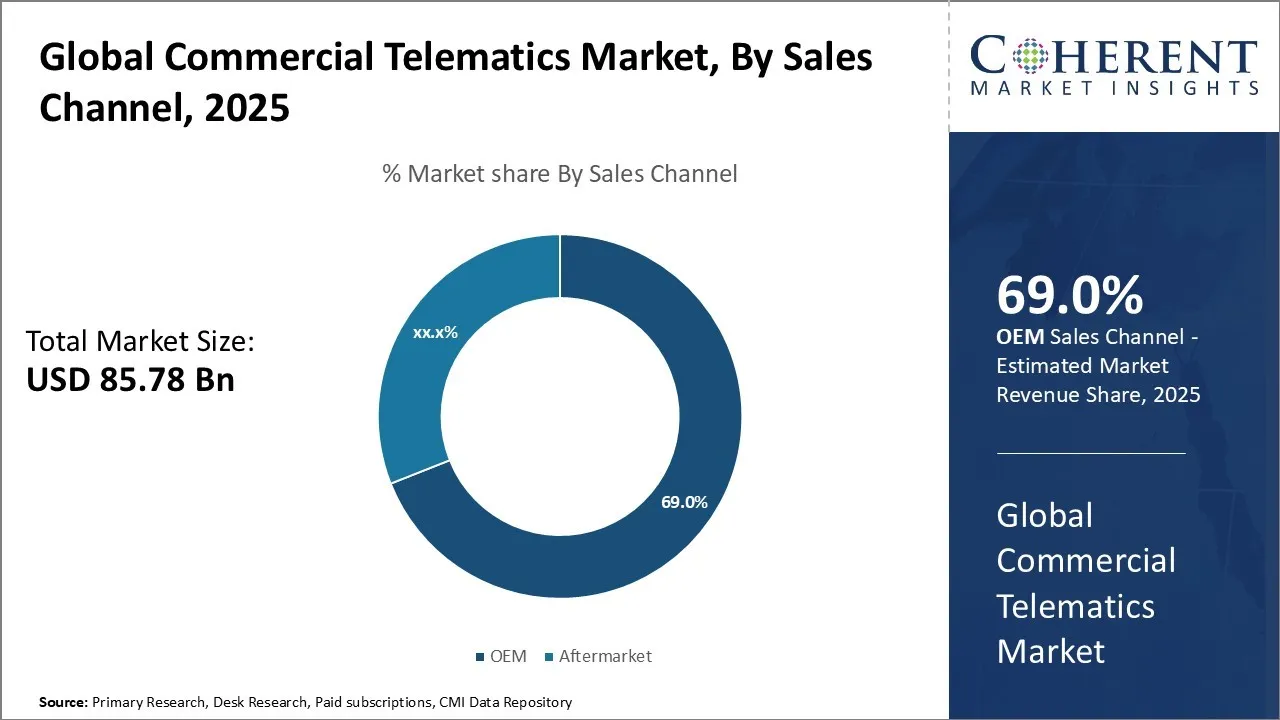
Commercial Telematics Market Insights, By Sales Channel - OEM Holds the Most Prominent Share
In terms of sales channel, the OEM segment is expected to contribute the largest share of the market in 2026 owing to the growing trend of factory-fitted telematics systems. OEMs are now embedding telematics solutions directly into vehicles during production, eliminating the need for aftermarket installations and ensuring seamless integration with vehicle systems. This shift is largely driven by regulatory mandates around vehicle safety, emissions monitoring, and driver behavior analytics, especially in North America and Europe. Fleet owners increasingly prefer OEM solutions due to the added benefits of manufacturer-backed warranties, support, and continuous software updates. Additionally, as connected and electric commercial vehicles gain traction, OEMs are leveraging proprietary telematics platforms to offer real-time diagnostics, performance optimization, and predictive maintenance services. This enhances fleet efficiency while strengthening brand loyalty, making the OEM segment a key driver in the commercial telematics market.
In July 2025, Teletrac Navman, a Vontier company, launched OEM Telematics, a direct-integration solution that connects factory‑fitted vehicle telematics hardware to its flagship TN360 fleet management platform. By simply entering a vehicle’s VIN into TN360, fleet managers gain instant access to critical data, vehicle ID, location, usage patterns, speed, fuel levels, and EV battery state of charge without removing vehicles from service for aftermarket installs.
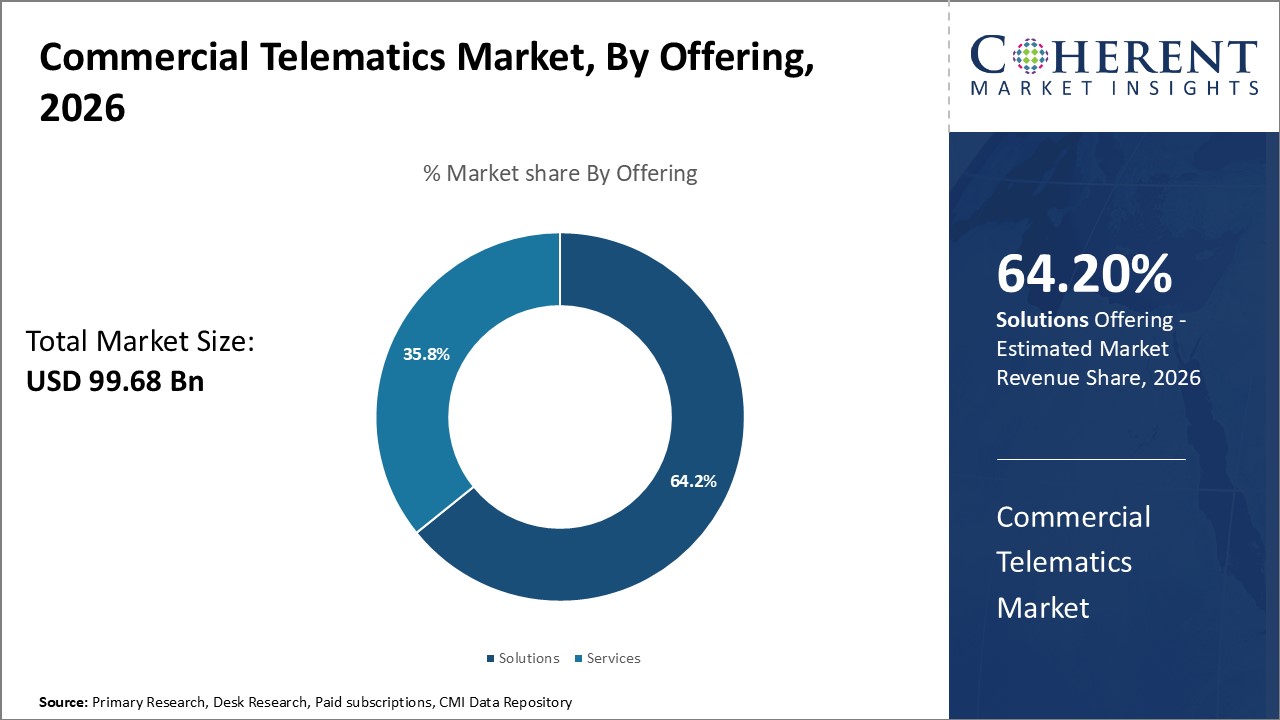
Commercial Telematics Market Insights, By Offering - T he Fleet/Asset Management holds the dominant share on account of the rising Demand for Real-Time Tracking & Driver Behavior Monitoring System
In terms of offering, the solutions segment acquires the prominent market share in 2026, due to the increasing need for real-time fleet tracking, driver behavior monitoring, predictive maintenance, and insurance telematics. These solutions offer direct operational benefits such as improved fuel efficiency, route optimization, and enhanced driver safety, critical for logistics, transportation, and delivery-focused sectors.
Among the solution types, the fleet/asset management sub-segment is particularly in demand as companies look to optimize fleet utilization and reduce costs in a competitive logistics environment. Fleet management systems monitor driver behavior (e.g., idling, harsh braking) and route inefficiencies, helping cut down fuel usage and maintenance costs. Additionally, with increasing road safety regulations and mandates like the Electronic Logging Device (ELD) rule in the U.S., telematics supports compliance and reduces liability by monitoring driver hours, behavior, and vehicle health. In essence, fleet/asset management is the cornerstone of commercial telematics adoption, enabling real-time decision-making, reduced operational costs, and increased safety, making it the most demanded application in the market, under the solution segment which leads both in revenue generation and adoption rate within the commercial telematics market.
In March 2024, Targa Telematics expanded its fleet-management portfolio with the rollout of Viasat Fleet Start and Advanced Solutions. Integrated into Targa’s IoT platform, the new offerings deliver real‑time insights on vehicle diagnostics, driver behavior, fuel use, emissions, and Stolen Vehicle Recovery (SVR).
Commercial Telematics Market Insights, By End User - Transportation and Logistics Acquires the largest share on account of the Rising Need for Fleet Optimization and Cost Pressure
In terms of end user, the transportation and logistics segment is expected to contribute the highest share of the global commercial telematics market in 2026, due to the rising need for fleet optimization and cost pressure and efficiency. Telematics helps logistics companies track vehicle location, route efficiency, and fuel consumption in real-time. This significantly improves route planning, delivery times, and asset utilization. Rising fuel prices, driver shortages, and intense competition push companies to adopt telematics to reduce operating costs through better fuel management and predictive maintenance.
In June 2025, German trailer OEM Krone, in partnership with Platform Science unveiled an integrated trailer telematics solution at the Transport Logistic 2025 exhibition in Munich. The platform offers seamless connectivity for prime movers and trailers in a single unified system, aiming to enhance fleet visibility, operational efficiency, and data-driven logistics management.
Regional Insights
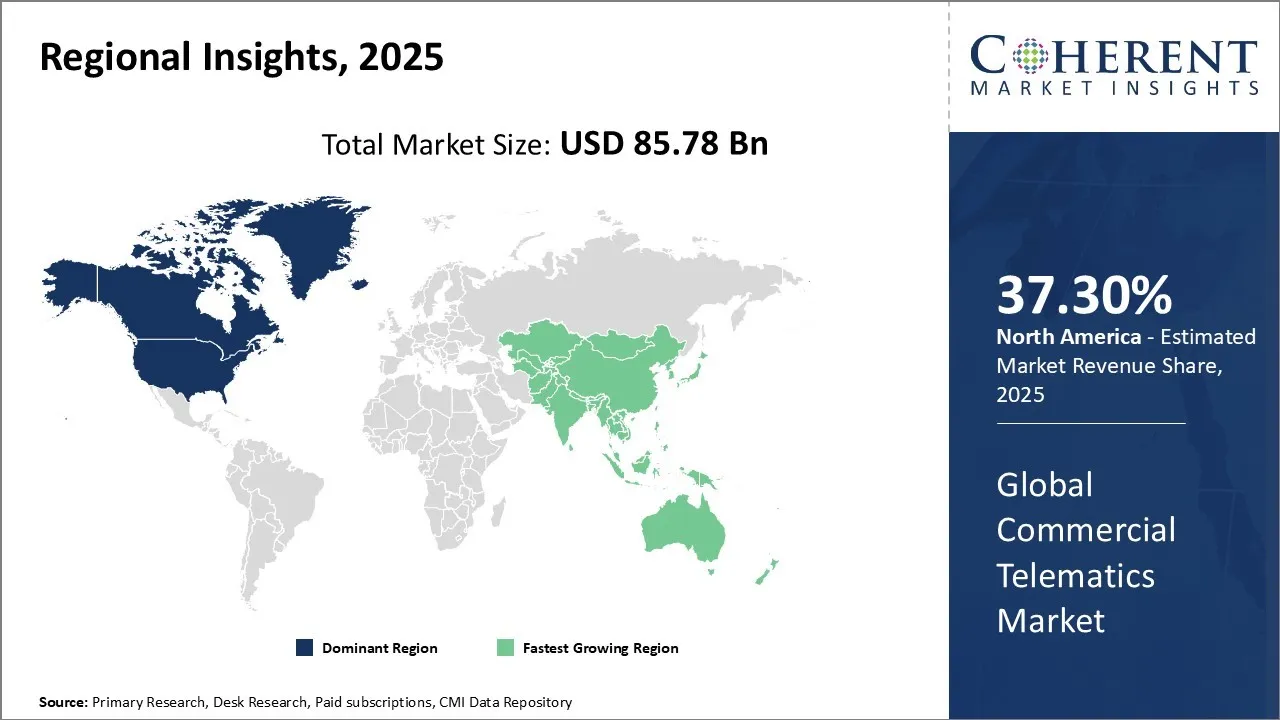
North America Commercial Telematics Market Analysis & Trends
North America, holding an estimated share of 37.30% in 2026, dominates the commercial telematics market share, supported by several converging factors. Regulatory mandates such as the U.S. Electronic Logging Device (ELD) rule have compelled fleet operators to adopt telematics for compliance and safety monitoring. The region’s advanced digital infrastructure, with widespread access to IoT, GPS, and 4G/5G connectivity, further supports seamless integration of telematics solutions. Additionally, the high volume of commercial vehicle usage across industries like logistics, construction, and delivery services fuels the need for real-time fleet tracking, route optimization, and fuel efficiency management.
For instance, in June 2026, Geotab Inc. and Mercedes‑Benz USA launched a new OEM‑integrated telematics solution that streams data directly from factory‑installed connectivity systems in Mercedes‑Benz vehicles into Geotab’s MyGeotab platform.
Asia Pacific Commercial Telematics Market Analysis & Trends
Asia Pacific region is expected to exhibit prominent growth in the market during the forecast period. The Asia Pacific region is witnessing a strong demand due to rapid urbanization, expansion of smart infrastructure, and increasing adoption of digital fleet management solutions. Countries such as China, India, and Southeast Asian nations are experiencing a logistics boom driven by the rise of e-commerce and last-mile delivery services. This surge in commercial transportation is creating a pressing need for real-time vehicle tracking, route optimization, and driver behavior monitoring. Moreover, governments in the region are introducing stricter regulations on road safety, emissions, and vehicle performance, which are accelerating the adoption of telematics for compliance and fleet efficiency. Rising fuel costs and the growing need to reduce operational expenses are further encouraging logistics providers and fleet operators to invest in telematics solutions.
For Instance, in June 2024, Planet Electric introduced an electric light commercial vehicle. The pioneering model will feature an industry‑first weight sensor integrated telematics system, enabling real‑time cargo weight tracking and range estimation, optimizing logistics efficiency, route planning and cost savings.
Commercial Telematics Market Outlook Country-Wise
The U.S. Commercial Telematics Market Trends
The United States leads in commercial telematics adoption due to its large fleet base, early digitization, and demand for operational efficiency. Real-time freight tracking, cold chain monitoring, and predictive maintenance are key focus areas. Growing use of insurance telematics and compliance with mandates like the ELD rule further fuel adoption. With rising pressure to reduce fuel costs and emissions, telematics is essential for optimizing U.S. fleet operations, driving strong commercial telematics market growth.
China Commercial Telematics Market Trends
China is a major growth driver in the commercial telematics market due to its vast logistics industry, smart transportation policies, and rapid EV adoption. Government-backed initiatives promote fleet digitization for real-time tracking, safety, and emission compliance. With China leading in commercial EV deployment, telematics is crucial for battery monitoring, route optimization, and fleet management. Focus areas include urban freight tracking, EV fleet analytics, and traffic data integration, driven by smart city development and investments from tech giants like Huawei and Baidu.
India Commercial Telematics Market Trends
India is a key growth driver in the commercial telematics market, fueled by the AIS 140 mandate requiring vehicle tracking in public transport, and a rapidly growing e-commerce sector demanding efficient fleet management. The government's Smart Cities Mission is also pushing adoption in school and public transport systems. Additionally, rising fuel costs and operational efficiency needs are encouraging the use of telematics for route optimization, fuel monitoring, and driver behavior analytics, making India a major hub for telematics innovation and demand.
Market Report Scope
Commercial Telematics Market Report Coverage
| Report Coverage | Details | ||
|---|---|---|---|
| Base Year: | 2025 | Market Size in 2026: | USD 99.68 Bn |
| Historical Data for: | 2020 To 2024 | Forecast Period: | 2026 To 2033 |
| Forecast Period 2026 to 2033 CAGR: | 16.2% | 2033 Value Projection: | USD 285.12 Bn |
| Geographies covered: |
| ||
| Segments covered: |
| ||
| Companies covered: | Verizon Communications Inc., AT&T Inc., TomTom N.V., MiX Telematics Limited, OnStar Corporation, Bayerische Motoren Werke AG (BMW), Trimble Inc., Zonar Systems, Inc., Omnitracs LLC, Inseego Corporation, AirIQ Inc., Bridgestone Corporation, General Motors Company (GM), Geotab Inc., Michelin Group, Octo Telematics S.p.A., Omnitracs, LLC, Bell Atlantic Corporation, Continental AG | ||
| Growth Drivers: |
| ||
| Restraints & Challenges: |
| ||
Global Commercial Telematics Market Drivers
- Ease of vehicle diagnosis
Advanced diagnostic systems are expected to drive the growth of the commercial telematics market. In-vehicle systems with advanced diagnostic capabilities provide vehicle data to both auto dealers and customers to help predict potential vehicle problems before they occur. For fleet management, connected solutions make it easier to track vehicle records, determine which vehicles have traveled the furthest, and provide service accordingly. The diagnostic service provided is an efficient way to diagnose the condition of your vehicle. This gives consumers control over vehicle maintenance, saving money and time by avoiding unnecessary costs and breakdowns. The system provides consumers with maintenance schedules and timely reminders.
A diagnostic system tracks the vehicle's smoke emissions and fuel consumption, thereby monitoring the condition of the engine. This service sends detailed reports about vehicles to decision-makers who determine vehicle maintenance schedules. Therefore, the simplification of vehicle diagnostics using mobile applications is expected to drive market growth.
Global Commercial Telematics Market Opportunities
- Intelligent transportation system
Safety services provided by vehicles equipped with telematics solutions are a good example of cutting-edge aftermarket technology that exchanges data between vehicles and humans. Safety combines communications and automotive technologies designed to improve vehicle efficiency, reduce fuel consumption and maintenance costs, enhance safety measures, and improve the overall driving experience for drivers. It's a thing. Capabilities such as live traffic updates, automated fare transactions, insurance telematics, roadside assistance during accidents and breakdowns, and intelligent routing and tracking are increasingly in demand. These innovations are opening significant growth avenues for major players, especially as businesses and governments push for smarter mobility solutions. As a result, the commercial telematics market forecast indicates strong expansion, driven by increased adoption of advanced safety and fleet optimization tools.
- Improved performance of autonomous vehicles
There are several solutions on the market that collect, manage, study, interpret, and analyze driving data for a given driver. Vehicles equipped with telematics systems generate enormous amounts of data every minute, improving the customer experience and creating new business opportunities in the field of autonomous driving.
Global Commercial Telematics Market Trends
- Connected Vehicles and IoT Integration
The integration of commercial telematics into connected cars and the broader Internet of Things (IoT) ecosystem is a key trend shaping the commercial telematics market research landscape. Telematics systems are advancing with vehicle-to-vehicle (V2V) and vehicle-to-infrastructure (V2I) communication capabilities, enabling real-time data exchange between vehicles, fleet operators, and external devices. This connectivity supports enhanced fleet management, predictive maintenance, and data-driven decision-making, ultimately improving operational efficiency, safety, and cost-effectiveness for commercial fleet operators.
In January 2025, Treon, a leading IoT company, launched Treon Connect Vehicle Monitoring—a new solution that gives fleet and operations teams comprehensive insight into vehicle condition, usage, and performance, regardless of type, manufacturer, or location. Such innovations are proliferating the commercial telematics market share.
Analyst Opinion (Expert Opinion)
The commercial telematics market value is undergoing a strategic shift, moving beyond basic fleet tracking into becoming an operational intelligence layer for logistics, mining, utilities, and even public transportation sectors.
The players who treat telematics as a compliance tool, primarily for ELD (Electronic Logging Device) or DVIR (Driver Vehicle Inspection Report) mandates are being outpaced by those integrating telematics into predictive maintenance, driver risk scoring, and load optimization algorithms. A case in point is Trimble’s Fleet Management Suite, which now supports real-time vehicle-health analytics, offering clients measurable reductions in unscheduled downtime up to 27% in certain logistics fleets operating across North America.
The granularity of data ingestion and the ability to monetize data at the operations level is transforming the market. For instance, in the European Union, telematics data is increasingly being fed into dynamic insurance pricing models under usage-based insurance (UBI) frameworks. A German transportation firm utilizing Bosch’s connected fleet solution achieved not only reduced fuel consumption (by 9.3% over nine months) but also secured UBI-linked insurance rebates demonstrating how the market is transcending its traditional value proposition.
Another critical inflection point is data ownership. With data now treated as a strategic asset, OEMs like Volvo Trucks and Daimler are establishing proprietary telematics ecosystems to ensure data sovereignty. Their refusal to rely on third-party telematics service providers marks a clear signal: the future of commercial telematics is tightly tied to the OEM’s ability to monetize vehicle intelligence.
Speak to the analyst
Want personalized insights?
Take the findings above to one of our principal consultants, or have the report rebuilt around the segments, geographies and competitors you actually track.
Key Developments
- In June 2025, Cambridge Mobile Telematics (CMT), a telematics provider, rolled out a suite of AI enhancements designed to transform insurance response and engagement. The new AI‑powered Roadside Assistance automatically detects events like flat tires or mechanical breakdowns, enabling proactive support to drivers.
- In June 2025, MetOcean Telematics launched its latest satellite IoT devices: STREAM1 and STREAM1 OEM, powered by the next‑generation Iridium Certus 9704 transceiver. The new devices support the Iridium Messaging Transport (IMT®) protocol for greater payload capacity, reduced latency, and lower power consumption, enabling transmission of JSON‑formatted data up to 100 KB. Use cases include fleet and asset tracking, agricultural sensing, maritime monitoring, worker safety, and cellular backup in remote areas.
- In May 2025, Roadzen Inc. of UK, Global Insurance Management Ltd (GIM), teamed up with a telematics providers to introduce a Unified Vehicle Protection solution in the UK automotive retail and finance sectors. This partnership promises to provide a combined real‑time telematics‑enabled asset tracking with Guaranteed Asset Protection (GAP) insurance.
- In February 2025, Thermo King® launched its latest telematics innovation: TracKing® Smart Trailer Telematics. The system equips fleet operators with real‑time, 360° visibility into trailer health and cargo status, monitoring tire pressure, brake condition, door position, lights, axle weight, cargo temperature (±0.9 °F), and even interior and rear video coverage.
Market Segmentation
- Global Commercial Telematics Market, By Offering (Revenue, USD Bn, 2021 - 2033)
- Solutions
- Fleet/Asset Management
- Navigation and Location Based
- Infotainment
- Insurance Telematics
- V2v and V2i
- Tele-health
- Remote Alarm & Monitoring
- Services
- Design & Consulting
- Integration & Deployment
- Maintenance & Training
- Solutions
- Global Commercial Telematics Market, By End User (Revenue, USD Bn, 2021 - 2033)
- Transportation and Logistics
- Insurance
- Healthcare
- Media & Entertainment
- Vehicle Manufacturers/Dealers
- Government agencies
- Global Commercial Telematics Market, By Sales Channel (Revenue, USD Bn, 2021 - 2033)
- OEM
- Aftermarket
- Global Commercial Telematics Market, By Region (Revenue, USD Bn, 2021 - 2033)
- North America
- U.S.
- Canada
- Latin America
- Brazil
- Argentina
- Mexico
- Rest of Latin America
- Europe
- Germany
- U.K.
- Spain
- France
- Italy
- Russia
- Rest of Europe
- Asia Pacific
- China
- India
- Japan
- Australia
- South Korea
- ASEAN
- Rest of Asia Pacific
- Middle East
- GCC Countries
- Israel
- Rest of Middle East
- Africa
- South Africa
- North Africa
- Central Africa
- North America
- Key Companies Insights (Revenue, USD Bn, 2021 - 2033)
- Verizon Communications Inc.
- AT&T Inc.
- TomTom N.V.
- MiX Telematics Limited
- OnStar Corporation
- Bayerische Motoren Werke AG (BMW)
- Trimble Inc.
- Zonar Systems, Inc.
- Omnitracs LLC
- Inseego Corporation
- AirIQ Inc.
- Bridgestone Corporation
- General Motors Company (GM)
- Geotab Inc.
- Michelin Group
- Octo Telematics S.p.A.
- Omnitracs, LLC
- TRI
- Bell Atlantic Corporation
- Continental AG
Sources
Primary Research Interviews from the following stakeholders
Stakeholders
- Interviews with vehicle OEMs, Tier-1 telematics suppliers, fleet management companies, insurance providers, logistics tech firms, and city mobility authorities across major telematics-adopting regions.
Specific Stakeholders
- Telematics product managers at commercial vehicle OEMs
- Connected mobility strategists at logistics giants
- Fleet operations heads at bus and truck fleet operators
- CIOs and digital leads at commercial vehicle leasing companies
- Insurance innovation officers at telematics-driven insurers
- City transport planning officials and ITS project coordinators
- Product development leads at telematics device OEMs and connected module suppliers
Databases
- International Transport Forum (ITF) – Road Freight and Urban Mobility Data
- UN Economic Commission for Europe (UNECE) – Vehicle Regulations Database
- Ministry of Road Transport and Highways (MoRTH), India
- Federal Motor Carrier Safety Administration (FMCSA), U.S.
- European Automobile Manufacturers Association (ACEA)
- China Transportation & Logistics Statistics Yearbook
- Korea Transport Institute (KOTI)
- Transport Canada – Commercial Fleet Statistics
- Japan Ministry of Land, Infrastructure, Transport and Tourism (MLIT)
Magazines
- Telematics News
- Fleet Equipment Magazine
- Transport Topics
- Connected World
- Fleet Owner
- Commercial Carrier Journal (CCJ)
- ITS International
- Smart Highways Magazine
Journals
- IEEE Transactions on Intelligent Transportation Systems
- Journal of Transportation Technologies
- International Journal of Automotive Technology
- Telematics and Informatics (Elsevier)
- Journal of Transport Geography
- Vehicle System Dynamics
Newspapers
- The Wall Street Journal – Mobility & Logistics
- The Economic Times – Commercial Mobility and Fleet
- Financial Times – Tech & Transport Integration
- The Hindu Business Line – Auto Tech & Policy
- Nikkei Asia – Logistics & Telematics
- South China Morning Post – Smart Transport
Associations
- ITS America (Intelligent Transportation Society of America)
- European Telecommunications Standards Institute (ETSI) – ITS Group
- Truck and Engine Manufacturers Association (EMA)
- Automotive Component Manufacturers Association of India (ACMA)
- Society of Automotive Engineers (SAE International)
- International Road Transport Union (IRU)
- Global Platform for Sustainable Urban Transport (SUTP)
- China Urban Transport Association (CUTA)
Public Domain Sources
- Ministry of Electronics and Information Technology (MeitY), India – Automotive and IoT Division
- National Highway Traffic Safety Administration (NHTSA), U.S.
- National Institute for Transforming India (NITI Aayog) – Urban Mobility Reports
- European Commission – Mobility and Transport Reports
- U.S. Department of Transportation (DOT) – Smart Mobility Projects
- Japan Automobile Research Institute (JARI)
- India’s Centre for Railway Information Systems (CRIS) – Freight Telematics
- Reserve Bank of India (RBI) – Transport Sector Outlook
Proprietary Elements
- CMI Data Analytics Tool, and Proprietary CMI Existing Repository of information for last 8 years
*Definition: “Commercial telematics is the integration of telecommunications and information technology into commercial vehicles to improve fleet management, increase operational efficiency, and provide a range of value-added services. Telematics systems use various technologies such as global positioning system (GPS), mobile networks, sensors, and data analytics to collect and transmit real-time data on vehicle location, performance, driver behavior, and other relevant metrics.”
Get access to 250+ pages report
Every segment, forecast, competitor profile and data table behind the analysis above — available for instant download.
- ESOMAR Member
- ISO 9001:2015 Certified
- D-U-N-S Registered
- GDPR & CCPA Compliant
Missing comfort of reading report in your local language? Find your preferred language:
Transform your Strategy with Exclusive Trending Reports
Frequently Asked Questions
The Commercial Telematics Market is estimated to be valued at USD 99.68 Bn in 2026, and is expected to reach USD 285.12 Bn by 2033.
The CAGR of the Commercial Telematics Market is projected to be 16.2% from 2026 to 2033.
Rise in trend of connectivity solutions and ease of vehicle diagnosis is expected to offer lucrative opportunities are fuelling the market.
The OEM is the leading sales channel segment in the market.
Threat of data hacking and high installation cost is expected to restrain the market.
Verizon Communications Inc., AT&T Inc., TomTom N.V., MiX Telematics Limited, OnStar Corporation, Bayerische Motoren Werke AG (BMW), Trimble Inc., Zonar Systems, Inc., Omnitracs LLC, Inseego Corporation, AirIQ Inc., Bridgestone Corporation, General Motors Company (GM), Geotab Inc., Michelin Group, Octo Telematics S.p.A., Omnitracs, LLC, Bell Atlantic Corporation, and Continental AG.
GPS tracking, engine diagnostics, driver behavior monitoring, geofencing, fuel usage data, and real-time communication are core Commercial Telematics features.