

Artificial Intelligence in Automotive Market Size and Share Analysis - 2026 To 2033
The Artificial Intelligence in Automotive Market size is anticipated to grow at a CAGR of 22.1% with USD 9.13 Bn in 2026 and is expected to reach USD 36.95 Bn in 2033. The primary drivers are defined by the adoption of advanced driver-assistance systems, development of autonomous and software-defined vehicles, expansion of connected-car services, stricter vehicle-safety regulations, and rising demand for in-vehicle experiences. According to the European Commission, all new motor vehicles sold in the EU have been required since July 2024 to integrate driver-assistance technologies. This regulatory shift is accelerating demand for AI processors, computer-vision systems, sensor-fusion platforms, predictive maintenance solutions, and intelligent cockpit technologies across the automotive industry.
Key Takeaways
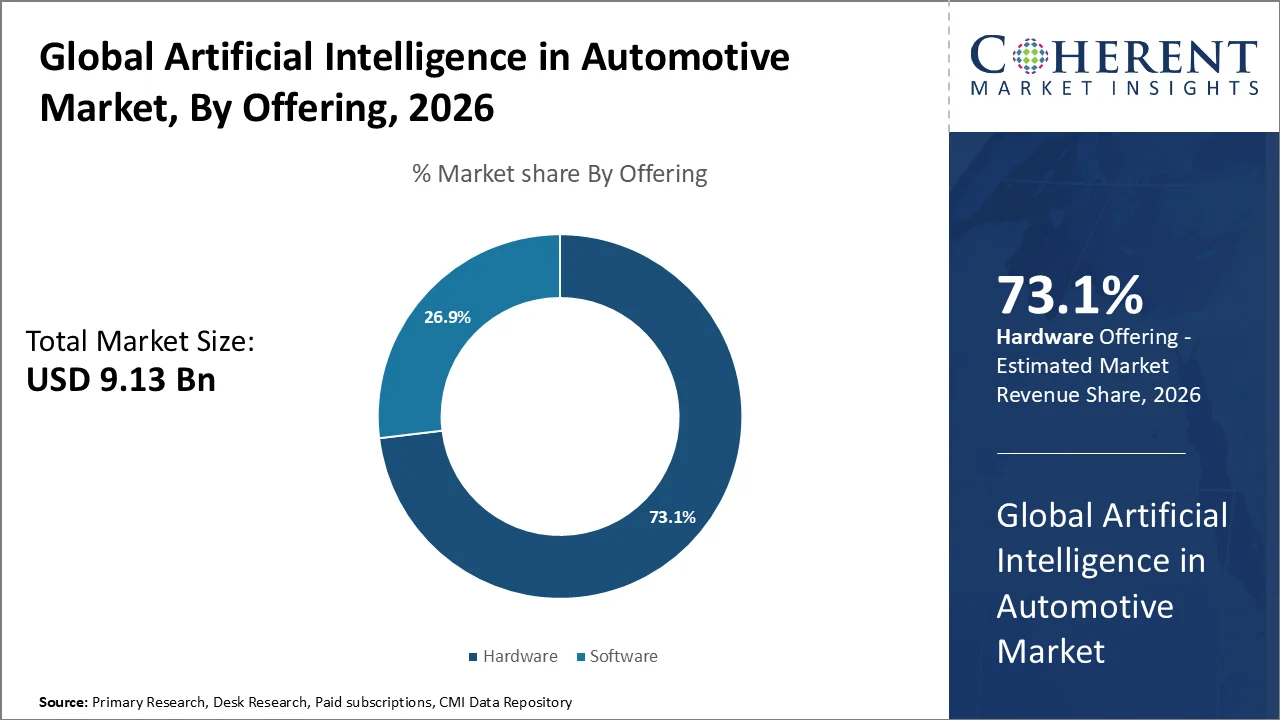
- The hardware segment is likely to dominate the market with 73.1% in 2026. The segment’s growth is owing to the increasing integration of AI processors, GPUs, cameras, radar, LiDAR, and electronic control units. Modern vehicles incorporate approximately 1,000–3,500 semiconductor components.
- The deep learning segment is set to lead with 37.5% in 2026. The segment’s growth is owing to the capabilities in object detection, sensor fusion, driver monitoring, and real-time decision-making.
- The semi-autonomous segment is expected to dominate the market with a share of 68.5% in 2026. The segment’s growth is owing to the widespread deployment of AI-enabled ADAS. The NHTSA requires automatic emergency braking to become standard in new passenger cars and light trucks by 2029.
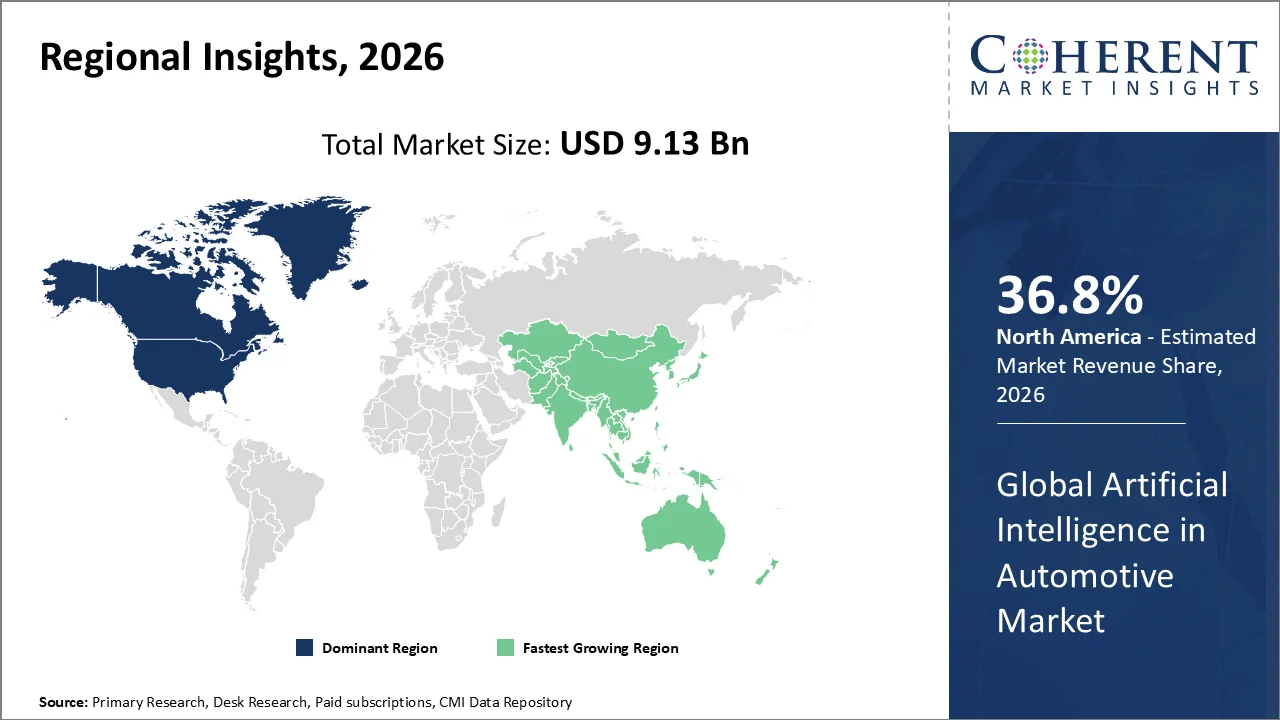
- North America is expected to acquire the prominent share of 36.8% in 2026. The region’s growth is owing to the strong automotive AI research, supportive safety regulations, and early autonomous-driving adoption. Waymo currently provides more than 500,000 fully autonomous electric-vehicle trips per week.
Segmental Insights
Why is Hardware Segment Acquiring the Largest Share?
On the basis of offering, the hardware segment is projected to account for the largest Artificial Intelligence in Automotive Market share of 73.1% in 2026. The segment’s growth is owing to the rising installation of cameras, radar, LiDAR, domain controllers, AI accelerators, high-performance processors, memory, and power-management components required for advanced driver assistance, autonomous driving, in-cabin monitoring, and intelligent battery management.
The International Energy Agency reported that global electric-car sales are expected to reach 23 million in 2026, representing 28% of total car sales, expanding the addressable base for centralized computing and sensor-rich vehicle architectures. NHTSA estimates that its automatic emergency braking standard could save at least 360 lives and prevent 24,000 injuries annually, reinforcing automakers’ need for reliable perception and processing hardware.
In January 2026, ZF and Qualcomm announced a scalable ADAS platform combining the ZF ProAI supercomputer with Snapdragon Ride system-on-chips. This highlights the continued investment in integrated automotive AI hardware.
- Current Industry Events of 2026
- Market Size Estimation
- Regional Breakdown
- Competitive Landscape
- Customer Intelligence
- Segmental Analysis
- Pricing Analysis
- Key Market Drivers, Challenges & Future Trends
- Customized Insights Section
Semi-autonomous hold the Largest Market Share
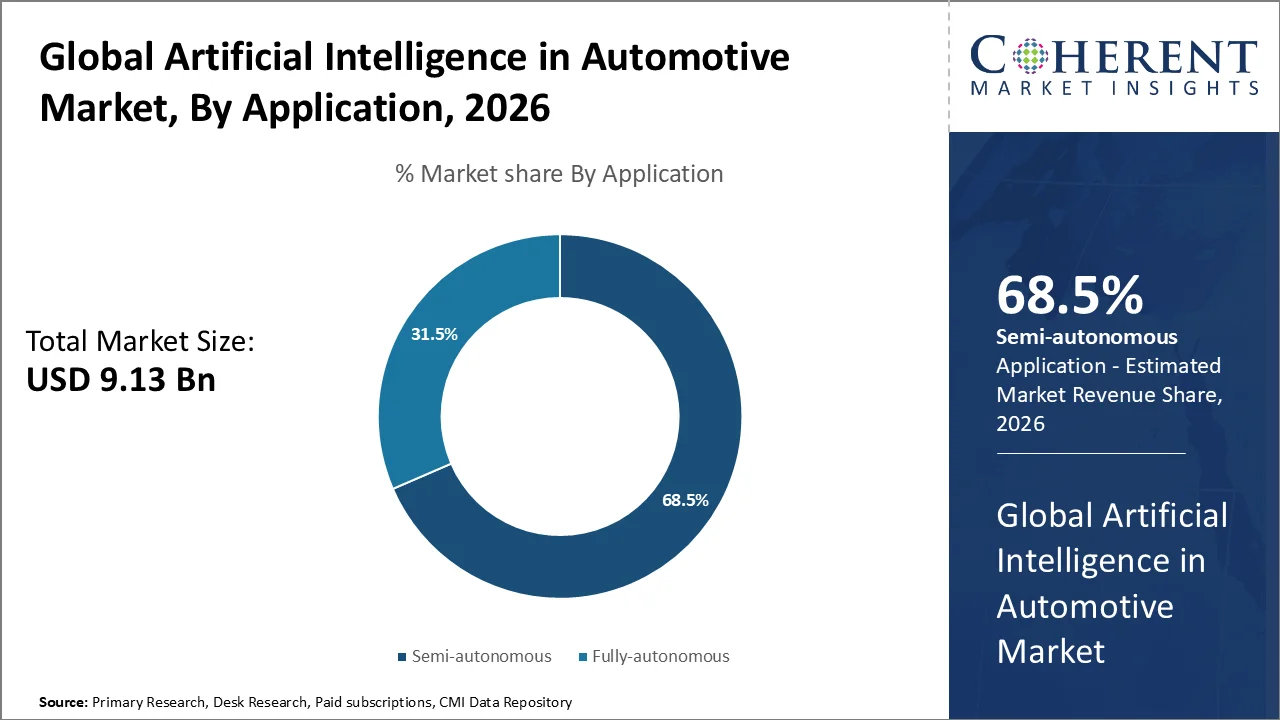
On the basis of application, the semi-autonomous segment lead with a major 68.5% share in 2026. The growth is owing to the adoption of AI-enabled automatic emergency braking, lane-keeping assistance, blind-spot intervention, driver-monitoring, and adaptive safety functions that assist motorists while retaining human control.
NHTSA reported that 39,254 people died in U.S. motor-vehicle crashes in 2024, thereby highlighting the continuing need for collision-avoidance as well as driver-assistance technologies. In Europe, the European Commission estimated approximately 19,400 road deaths in 2025, despite a 3% annual decline, thereby strengthening the policy support for intelligent vehicle safety systems.
In August 2025, Clemson University unveiled Deep Orange 16, a semi-autonomous off-road rapid-response vehicle designed for extreme emergency conditions. The prototype demonstrates continual investment in integrated automotive AI, hybrid propulsion, terrain mapping, medical monitoring, autonomous rescue capabilities, and advanced safety.
Market Drivers
Automated Driving is Transforming the Artificial Intelligence in Automotive Market in Germany
Germany is an important automotive AI innovation centre owing to its established vehicle-manufacturing ecosystem, premium automotive brands, engineering expertise, semiconductor collaborations, and growing adoption of software-defined vehicle architectures. German manufacturers are integrating centralized computing platforms, high-resolution cameras, radar systems, driver-monitoring technologies, intelligent navigation, natural-language interfaces, and over-the-air software functionality into new vehicle platforms.
In September 2025, BMW Group and Qualcomm introduced the Snapdragon Ride Pilot automated driving system. It debuted in the BMW iX3 and supports capabilities ranging from entry-level safety functions to Level 2+ highway and urban automated driving. Qualcomm stated that the system had been validated in more than 60 countries and was targeted for availability in more than 100 countries during 2026. More than 1,400 specialists across Germany, the U.S., Sweden, Romania, and the Czech Republic contributed to the technology’s development.
End-to-End AI and Centralized Computing: Major Breakthroughs in the Artificial Intelligence in Automotive Market
End-to-end automotive AI uses neural networks to transform raw camera, radar, lidar, positioning, and vehicle data into driving decisions. Conventional automated-driving architectures divide perception, mapping, prediction, planning, and control into separate modules. End-to-end AI increasingly connects these activities through unified learning systems trained on large volumes of real-world and simulated driving data.
In March 2026, Qualcomm and Wayve announced a technical collaboration integrating Wayve AI Driver with the Snapdragon Ride Platform. The pre-integrated system is designed to support capabilities ranging from entry-level hands-off driver assistance to future hands-off and eyes-off automated driving.
Current Events and Their Impact on the Artificial Intelligence in Automotive Market
Current Event | Description and its Impact |
2026 EU General Safety Regulation Expansion for AI-Enabled Vehicle Safety
|
|
2025 U.S. Automated Vehicle Framework and Regulatory Streamlining |
|
Artificial Intelligence in Automotive Market Trends
- The rising adoption of AI-enabled advanced driver-assistance systems is improving collision avoidance, lane guidance, parking assistance, and real-time driving decisions worldwide across passenger cars, commercial vehicles, and premium mobility platforms.
- Software-defined vehicles use centralized computing, over-the-air updates, and machine-learning platforms to personalize performance, diagnostics, infotainment, and vehicle functions.
- In-cabin AI adoption is expanding through driver-monitoring, voice assistants, occupant detection, gesture control, and fatigue-warning systems, thereby improving safety as well as user experience.
- Electric-vehicle growth supports automotive AI because battery management, energy optimization, predictive maintenance, charging recommendations, and integrated vehicle control require advanced analytics. In 2025, the global electric-car sales exceeded 20 million, representing one in four new cars sold worldwide. The IEA reported in May 2026 that progress in AI and computing power is disproportionately benefiting EVs, particularly automated driving and integrated control.
- The growing road-safety concerns are speeding up the AI adoption through automatic emergency braking, pedestrian detection, driver monitoring, and collision-warning systems. The World Health Organization reported in 2026 that road crashes cause approximately 1.16 million deaths annually and remain the leading cause of death among people aged 5–29, thereby strengthening demand for intelligent automotive safety technologies.
Regional Insights
North America Dominates Owing to the Extensive Autonomous-Vehicle Testing
The North America region accounts for 36.8% of the market share in 2026. The region’s growth is owing to the autonomous-vehicle testing, safety regulation, and public investment in intelligent mobility. California DMV reported that permitted autonomous vehicles logged more than 9 million testing miles between December 2024 and November 2025, demonstrating the region’s validation environment for AI perception, navigation, and decision-making systems.
In February 2026, Waymo introduced the Waymo World Model, a generative AI system designed to create large-scale, realistic driving simulations. The model helps train and evaluate autonomous-driving software across complex road conditions, rare events, and diverse environments.
Asia Pacific Artificial Intelligence in Automotive Market Trends
Asia Pacific is expected to witness strong growth in market over the forecast period. The region’s growth is owing to the expansion of intelligent connected vehicles, autonomous-driving trials, supportive regulations, and investments in vehicle-road-cloud infrastructure. China’s State Council Information Office reported that more than 32,000 kilometers of roads had been opened for intelligent connected vehicle testing by the end of 2024. It also stated that cumulative autonomous-driving test mileage exceeded 120 million kilometers, generating datasets for AI-based perception, navigation, decision-making, and vehicle-control systems.
In July 2026, China-based XPENG launched the MONA L03, an AI-enabled intelligent SUV featuring the XOS 6 smart-cockpit operating system, Turing AI-assisted driving, an AI-controlled chassis, multilingual voice interaction, and driver-incapacitation assistance. The firm plans to introduce the model across 65 countries, thereby supporting wider commercialization of automotive AI technologies.
AI Investment and Digital Cockpit Launch Are Accelerating the Artificial Intelligence in Automotive Market in Canada
Canada is an important Artificial Intelligence in Automotive Market owing to its automotive manufacturing base, AI research capabilities, and connected-vehicle innovation ecosystem. In February 2026, the Government of Canada stated that its national AI strategy had invested more than USD 2 billion in talent, computing infrastructure, and research, thereby supporting connected as well as autonomous automotive technologies.
In January 2026, Canada-based Magna launched a portfolio of NVIDIA DRIVE Hyperion-compatible electronic control units and vehicle-integration services. The offering supports the deployment of the NVIDIA DRIVE AV software stack on DRIVE AGX Thor computing platforms. This allows the automakers to develop AI-powered automated-driving, perception, active-safety, and software-defined vehicle functions.
Japan Artificial Intelligence in Automotive Market Trends
Japan’s Artificial Intelligence in Automotive Market is gaining momentum as software-defined vehicles, automated-driving systems, and intelligent safety technologies receive stronger policy and industry support. Japan’s Ministry of Economy, Trade and Industry targets a 30% share of global software-defined vehicle unit sales in both 2030 and 2035, thereby indicating domestic investment in automotive software, data platforms, and AI capabilities.
In April 2026, Toyota and Woven by Toyota unveiled the Woven City AI Vision Engine and Integrated ANZEN System. These technologies combine visual, behavioral, vehicle, and infrastructure data to predict movement, detect risks, and provide context-aware driving assistance for safer connected mobility applications.
Who are the Major Companies in Artificial Intelligence in Automotive Industry
Some of the major key players in Artificial Intelligence in Automotive Market are Qualcomm Inc., Tesla Inc., Volvo Car Corporation, BMW AG, Audi AG, General Motors Company, Ford Motor Company, Toyota Motor Corporation, Hyundai Motor Corporation, Uber Technologies Inc., and Apple Inc.
Key News
- In January 2026, Leapmotor and Qualcomm introduced a cross-domain central computer using Snapdragon Cockpit Elite and Snapdragon Ride Elite platforms. The system integrates cockpit, driver assistance, body control, and connectivity functions into one computing architecture. It supports up to 13 cameras, lidar, millimetre-wave radar, ultrasonic sensors, and more than 30 driver-assistance functions.
- In January 2026, Qualcomm expanded Snapdragon Digital Chassis adoption through collaborations with Google and global automakers, advancing agentic AI and centralized vehicle computing. Its platforms power over 75 million vehicles, highlighting continued investment in integrated automotive AI hardware and software architectures.
Market Report Scope
Artificial Intelligence in Automotive Market Report Coverage
| Report Coverage | Details | ||
|---|---|---|---|
| Base Year: | 2025 | Market Size in 2026: | USD 9.13 Bn |
| Historical Data for: | 2020 To 2024 | Forecast Period: | 2026 To 2033 |
| Forecast Period 2026 to 2033 CAGR: | 22.1% | 2033 Value Projection: | USD 36.95 Bn |
| Geographies covered: |
| ||
| Segments covered: |
| ||
| Companies covered: | Qualcomm Inc., Tesla Inc., Volvo Car Corporation, BMW AG, Audi AG, General Motors Company, Ford Motor Company, Toyota Motor Corporation, Hyundai Motor Corporation, Uber Technologies Inc., and Apple Inc. | ||
| Growth Drivers: |
| ||
| Restraints & Challenges: |
| ||
Analyst Opinion
- Artificial intelligence in automotive is driven by the urgent need for safer mobility. Around 1.19 million people die annually in road traffic crashes worldwide. Therefore, market expansion is not merely technology-led—it is supported by the continuing need to reduce driver errors, collisions, injuries, and fatalities.
- AI-enabled advanced driver-assistance systems are becoming standard vehicle features. The U.S. National Highway Traffic Safety Administration requires automatic emergency braking including pedestrian detection in new passenger cars and light trucks beginning in 2029, thereby supporting the sustained investment in cameras, sensors, processors, and AI software.
- Autonomous-driving technology is gaining substantial commercial traction with Waymo recording more than 100 million fully autonomous miles on public roads and delivering over 500,000 autonomous electric-vehicle trips weekly. This growing real-world deployment is expected to strengthen confidence in AI-based mobility, encourage regulatory development, and increase demand for deep learning, computer vision, sensor fusion, and high-performance automotive computing technologies across developed and emerging markets.
Speak to the analyst
Want personalized insights?
Take the findings above to one of our principal consultants, or have the report rebuilt around the segments, geographies and competitors you actually track.
Market Segmentation
- By Offering (Revenue, USD Bn, 2021-2033)
- Hardware
- Software
- By Technology (Revenue, USD Bn, 2021-2033)
- Deep learning
- Machine learning
- Infotainment Systems
- IoT (Internet of Things)
- Cognitive Capabilities
- By Application (Revenue, USD Bn, 2021-2033)
- Semi-autonomous
- Fully-autonomous
- By Region (Revenue, USD Bn, 2021-2033)
- North America
- U.S.
- Canada
- Latin America
- Brazil
- Mexico
- Argentina
- Rest of Latin America
- Europe
- Germany
- U.K.
- France
- Italy
- Spain
- Russia
- Rest of Europe
- Asia Pacific
- China
- India
- Japan
- Australia
- South Korea
- ASEAN
- Rest of Asia Pacific
- Middle East
- GCC
- Israel
- Rest of Middle East
- Africa
- South Africa
- Central Africa
- North Africa
- North America
Source
Primary Research Interviews
- Automotive OEM executives
- Tier 1 automotive suppliers
- Autonomous driving technology developers
- Artificial intelligence and machine learning specialists
- Automotive software engineers
- Advanced driver-assistance systems (ADAS) experts
- Fleet operators and mobility service providers
- Automotive semiconductor manufacturers
- Technology distributors and system integrators
- Key opinion leaders (KOLs) in automotive AI and autonomous mobility
Databases
- International Organization of Motor Vehicle Manufacturers (OICA)
- National Highway Traffic Safety Administration (NHTSA)
- U.S. Department of Transportation (DOT)
- European Commission Mobility and Transport Database
- Eurostat
- Organisation for Economic Co-operation and Development (OECD)
- World Bank
- International Energy Agency (IEA)
Magazines
- Automotive News
- Automotive World
- SAE Automotive Engineering
- Autocar Professional
- WardsAuto
- MIT Technology Review
Journals
- IEEE Transactions on Intelligent Transportation Systems
- IEEE Transactions on Vehicular Technology
- Journal of Autonomous Vehicles and Systems
- Transportation Research Part C: Emerging Technologies
- International Journal of Automotive Technology
- SAE International Journal of Connected and Automated Vehicles
Newspapers
- The New York Times
- The Guardian
- The Wall Street Journal
- Financial Times
- Nikkei Asia
Associations
- Society of Automotive Engineers International (SAE International)
- International Organization of Motor Vehicle Manufacturers (OICA)
- Alliance for Automotive Innovation
- European Automobile Manufacturers’ Association (ACEA)
- Automotive Component Manufacturers Association of India (ACMA)
- European Association of Automotive Suppliers (CLEPA)
- Intelligent Transportation Society of America (ITS America)
Public Domain Sources
- Company annual reports and investor presentations
- Automotive OEM and technology-provider press releases
- Government transportation and road-safety publications
- Vehicle registration and production databases
- Patent databases and technology filings
- Autonomous vehicle testing and disengagement reports
- Regulatory publications concerning ADAS, autonomous driving, cybersecurity, and vehicle safety
- Publicly available merger, acquisition, partnership, and investment announcements
Proprietary Elements
- CMI Data Analytics Tool
- Proprietary CMI Existing Repository of Information for Last 10 Years
Get access to 250+ pages report
Every segment, forecast, competitor profile and data table behind the analysis above — available for instant download.
- ESOMAR Member
- ISO 9001:2015 Certified
- D-U-N-S Registered
- GDPR & CCPA Compliant
Missing comfort of reading report in your local language? Find your preferred language:
Transform your Strategy with Exclusive Trending Reports
Frequently Asked Questions
The Artificial Intelligence in Automotive Market is expected to reach USD 36.95 Bn in 2033.
Major players operating in the global Artificial Intelligence in Automotive Market include Qualcomm Inc., Tesla Inc., Volvo Car Corporation, BMW AG, Audi AG, General Motors Company, Ford Motor Company, Toyota Motor Corporation, Hyundai Motor Corporation, Uber Technologies Inc., and Apple Inc.
The high implementation costs, cybersecurity and data privacy threats, and regulatory fragmentation the key factors hampering growth of the market.
The rising demand for autonomous and semi-autonomous vehicles, strict government safety regulations, and consumer expectations for connected, personalized in-vehicle experiences is boosting the demand for Artificial Intelligence in Automotive.
The Artificial Intelligence in Automotive Market is anticipated to grow at a CAGR of 22.1% between 2026 and 2033.
Among regions, North America is expected to account for a largest market share in the global Artificial Intelligence in Automotive Market over the forecast period.
The global Artificial Intelligence in Automotive Market is on a steady upward trajectory owing to the software-defined vehicles, advanced driver assistance systems (ADAS), and edge-computing processing hardware.