

Automotive Motors Market Size and Forecast – 2026 to 2033
Automotive Motors Market is estimated to be valued at USD 36.39 Bn in 2026 and is expected to reach USD 57.67 Bn in 2033, exhibiting a compound annual growth rate (CAGR) of 6.8% from 2026 to 2033.
Key Takeaways
- By Product Type, Direct current brushed motors hold the largest market share in 2026 owing to technical drivers of brushed DC motors in automotive applications.
- By Application, Comfort Motors acquired the prominent market share of 46% in 2026 owing to electrification of vehicle comfort systems.
- By Vehicle Type, Passenger car led the overall Automotive Motors Market growth in 2026 on account of increase in comfort & convenience features.
- By Electric Vehicle, Battery Electric Vehicle dominates the overall market with an estimated share in 2026 owing to the electrification of the powertrain.
- By Region, Asia Pacific dominates the overall market with an estimated share of 29% in 2026 on account of high automotive production volume across developing economies.
Market Overview
The rising vehicle electrification, increasing adoption of advanced driver assistance systems (ADAS), and the growing integration of comfort and convenience features actively drive the automotive motors market. Automakers are accelerating the shift to electric vehicles, which increases the demand for high-efficiency traction and auxiliary motors. Consumers also seek features like power windows, seats, and automation, prompting manufacturers to install more motors across all vehicle types. Technological innovations and regulatory efforts to improve fuel efficiency further boost the electric motors market revenue.
Current Events and their Impact on the Automotive Motors Market
Current Events | Description and its impact |
Policy and Regulatory Shifts |
|
Technological Advancements |
|
Investment and Production Trends |
|
End-user Feedback and Unmet Needs in the Automotive Motors Market
End-user Feedback and Unmet Needs
- Demand for Enhanced Motor Durability: End-users report a need for automotive motors with improved durability to withstand harsh operating conditions. Motors that last longer reduce maintenance frequency and costs, increasing vehicle reliability and customer satisfaction. Manufacturers are challenged to develop more robust motor designs without compromising performance or cost-efficiency.
- Need for Quieter Operation: Consumers increasingly expect quieter vehicle operation, especially in electric and hybrid vehicles. End-users highlight the importance of reducing motor noise and vibrations to enhance comfort and driving experience. This drives demand for advanced motor designs and sound-dampening technologies in automotive motors.
- Requirement for Higher Energy Efficiency: End-users seek motors that maximize energy efficiency to extend battery life and reduce overall vehicle energy consumption. Improving motor efficiency is crucial for electric vehicles to meet range expectations, prompting manufacturers to innovate in motor materials and control systems to optimize power use.
- Current Industry Events of 2026
- Market Size Estimation
- Regional Breakdown
- Competitive Landscape
- Customer Intelligence
- Segmental Analysis
- Pricing Analysis
- Key Market Drivers, Challenges & Future Trends
- Customized Insights Section
Segmental Insights
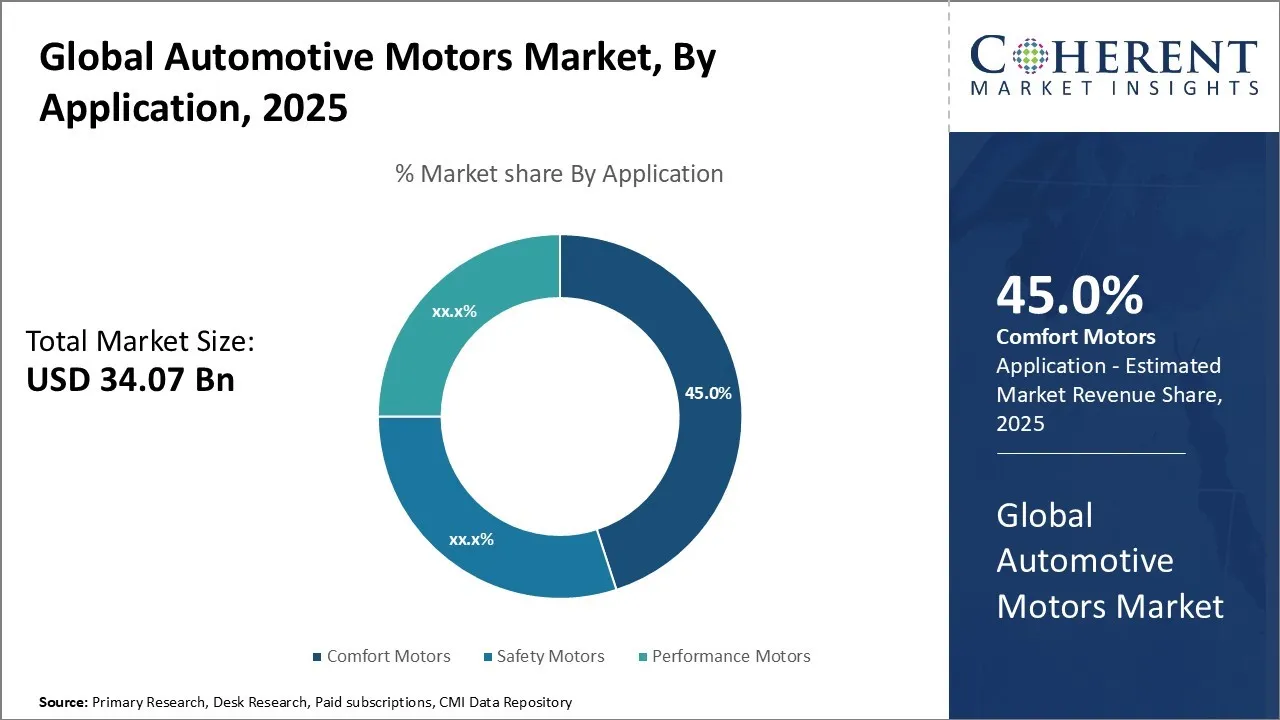
Automotive Motors Market Insights, By Application: Comfort Motors contribute the highest share of the market owing to its platform standardization across vehicle segments
Comfort Motors acquired the prominent market share of 46.0% in 2026. The growing consumer demand for enhanced in-vehicle comfort and convenience actively drives the use of comfort motors in the automotive motors market. Automakers install motorized systems like power seats, windows, mirrors, sunroofs, and climate control to fulfill these expectations. The rise of mid-range and premium vehicles increases the need for reliable, compact electric motors. As electronic control units advance, manufacturers integrate comfort motors into smart systems, enabling automated and personalized adjustments that enhance the overall driving experience. For instance, in June 2025, Tata Motors launched the highly anticipated Harrier.ev as its flagship passenger EV in India, positioning the new electric SUV as an off-road-focused lifestyle vehicle. The company also equips it with a multi-link rear suspension featuring Frequency Dependent Damping (FDD) to enhance comfort.
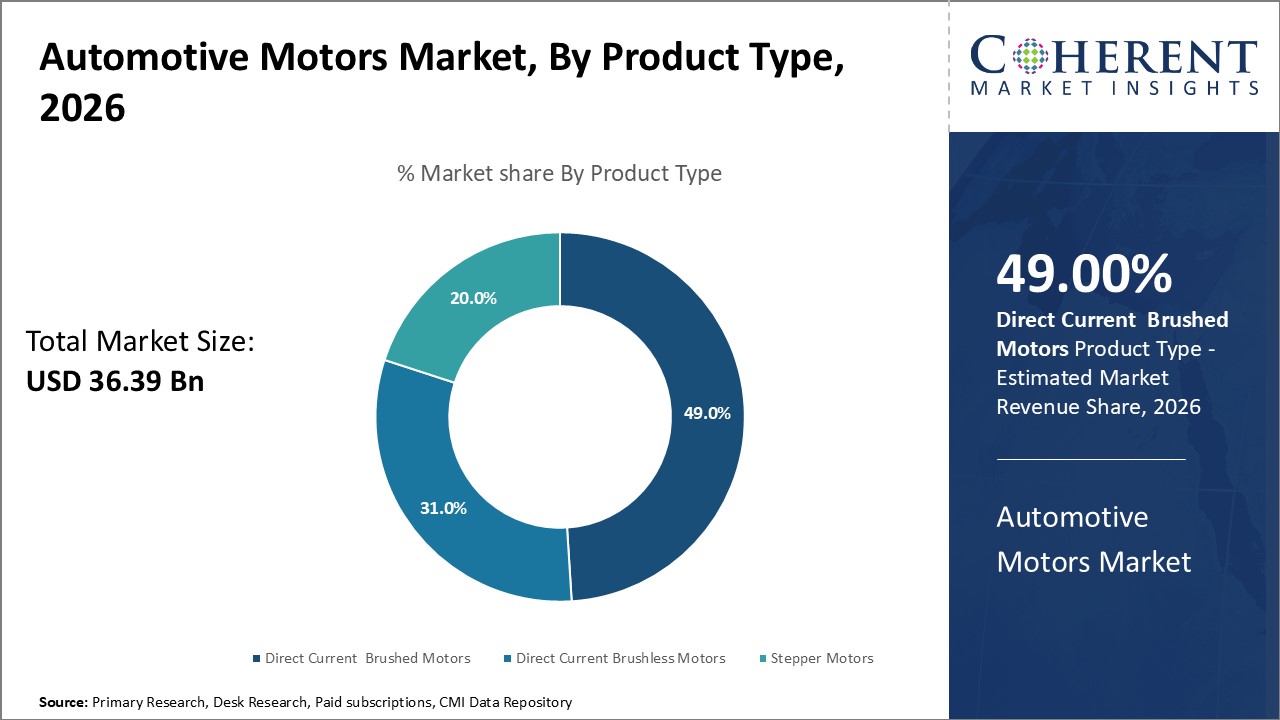
Automotive Motors Market Insights, By Product Type: Direct Current Brushed Motors contribute the highest share of the market owing to its automotive applications still using brushed dc motors
Automakers drive the use of direct current brushed motors in the automotive motors market due to their low cost, simple design, and proven reliability in legacy systems. They continue to install these motors in applications like power windows, seat adjusters, windshield wipers, and HVAC blowers because of their easy control and established performance. Manufacturers favor their seamless integration with basic electronics, especially in entry-level and mid-range vehicles. While brushless motors are gaining ground, brushed DC motors still play a key role in comfort and body control systems. For instance, in March 2025, Toshiba Electronic Devices & Storage Corporation begun mass-producing the "TB9103FTG," a gate driver IC designed for automotive brushed DC motors. These include latch and lock motors used in power backdoors and power slide doors, as well as drive motors for power windows and power seats. Such innovations are accelerating the automotive motors market growth.
Automotive Motors Market Insights, By Vehicle Type: Passenger Car contribute the highest share of the market owing to its integration of smart electronics and ecus
Automakers drive the automotive motors market in the passenger car segment by continuously adopting advanced technologies that improve performance, safety, and comfort. They install various electric motors for powertrain functions, such as traction and auxiliary systems, as well as for body and comfort features like windows, seats, and climate control. Apart from this, the growing consumer demand for smarter, more efficient vehicles motivates manufacturers to add more motors in passenger cars. Additionally, regulations and electrification trends encourage the industry to develop motors that enhance fuel efficiency and reduce emissions. For instance, in March 2025, Tata Motors, in partnership with automotive distributor DIMO, launched a new range of passenger vehicles in Sri Lanka today, offering both internal combustion engine (ICE) models and electric vehicles (EVs). The growing launch of advanced passenger vehicle is accelerating the automotive motors market demand.
Automotive Motors Market Insights, By Electric Vehicle: Battery Electric Vehicle contribute the highest share of the market owing to its advanced comfort and interior features
Automakers drive the automotive motors market by using battery electric vehicles (BEVs) that rely fully on electric motors for propulsion and auxiliary functions. They require high-efficiency traction motors to replace internal combustion engines, along with numerous auxiliary motors for cooling, steering, braking, and comfort systems. Increasing emphasis on sustainability and stricter emission regulations push manufacturers to create advanced motor technologies. Consumers’ demand for smooth, quiet, and responsive driving experiences also motivates innovation in motor design and integration within BEVs. For instance, in November 2024, Japanese manufacturer Suzuki unveiled its first fully electric car for the global market, the e-Vitara. The company will begin producing the electric B-SUV at its Gujarat plant in India starting spring 2025 and plans to launch it in Europe and other markets by summer 2025.
Regional Insights
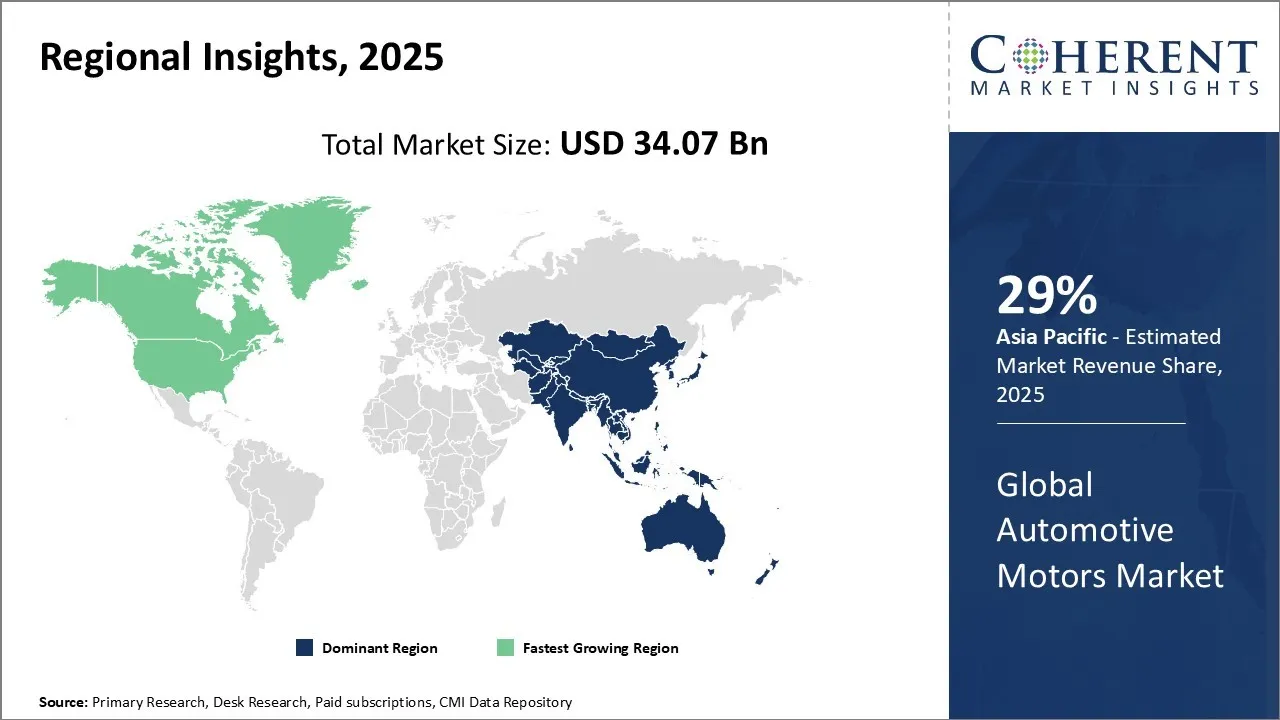
Asia Pacific Automotive Motors Market Trends
Asia Pacific dominates the overall market with a share of 29%. The Asia Pacific automotive motors market is rapidly transforming as electric vehicle (EV) adoption and motor technology advancements accelerate. China leads the region by significantly increasing EV sales and producing a large share of global electric vehicles. India also experiences a surge in EV adoption, supported by government initiatives promoting electric mobility. This shift drives demand for high-efficiency motors, including traction and auxiliary types, to meet modern vehicles’ performance and energy efficiency needs. Manufacturers improve motor performance and durability by integrating silicon carbide (SiC) semiconductors in motor controllers. For instance, in September 2024, Rolls-Royce Motor Cars launched the Cullinan Series II in India, marking a major milestone in the Asia Pacific region. The updated super-luxury SUV features new technologies, materials, design enhancements, and innovative bespoke options, further accelerating the automotive motors market demand.
North America Automotive Motors Market Trends
The growing popularity of electric vehicles (EVs) drives demand for high-efficiency motors, including traction and auxiliary types, to meet performance and energy efficiency standards. Automakers invest in motor technologies to support the transition to electrified powertrains. Major manufacturers, such as General Motors and Ford, increase their investments in EV production and motor development within the United States. Government measures encouraging domestic manufacturing and reducing supply chain dependence actively propel the expansion of the automotive motors market. For instance, in January 2026, Japan-based Honda Motor plans to launch a small electric vehicle (EV) priced under $30,000 in North America as part of its strategy to strengthen its presence in the battery-powered car market. The growing introduction of electric vehicle is propelling the automotive motors adoption.
China Automotive Motors Market Trends
China’s NEV market is rapidly growing, with NEVs making up about half of all passenger car sales by 2024. This growth drives demand for high-efficiency motors, including traction and auxiliary types, to meet performance and energy efficiency standards. The electric vehicle industry in China focuses on developing high-power-density and high-speed motors. These innovations aim to boost vehicle performance and efficiency, responding to increasing demand for longer driving ranges and improved driving experiences. For instance, in March 2026, Japan's Toyota began selling a $20,000 smart electric car in China this week, aiming to win over buyers with advanced features that rival those of Chinese competitors, as the company intensifies efforts to reclaim market share in the world’s largest auto market.
Japan Automotive Motors Market Trends
Japan’s automobile industry is rapidly shifting toward electric vehicles, driving up demand for high-efficiency motors, including traction and auxiliary types, to meet performance and energy efficiency standards. Automakers are investing in motor technologies to support powertrain electrification. Additionally, the integration of Internet of Things (IoT) technologies is revolutionizing Japan’s smart motor sector by enhancing operational efficiency and enabling predictive maintenance. For instance, in January 2026, South Korea’s Hyundai Motor introduced an affordable compact electric car in Japan, aiming to break into a market dominated by local automotive giants known for their established hybrid petrol-electric technologies.
Market Report Scope
Automotive Motors Market Report Coverage
| Report Coverage | Details | ||
|---|---|---|---|
| Base Year: | 2025 | Market Size in 2026: | USD 36.39 Bn |
| Historical Data for: | 2020 To 2024 | Forecast Period: | 2026 To 2033 |
| Forecast Period 2026 to 2033 CAGR: | 6.8% | 2033 Value Projection: | USD 57.67 Bn |
| Geographies covered: |
| ||
| Segments covered: |
| ||
| Companies covered: | Siemens AG, Robert Bosch GmbH, Continental AG, Denso Corporation, Magna International, Mitsubishi Electric Corporation, Valeo S.A., Mahle Group, Nidec Corporation, and Borgwarner Inc. | ||
| Growth Drivers: |
| ||
| Restraints & Challenges: |
| ||
Automotive Motors Market Trend
- Rise of Electrification and Electric Vehicles
The automotive motors market is rapidly evolving due to the increasing shift toward electrification and electric vehicles (EVs). Automakers are replacing traditional internal combustion engines with electric motors for propulsion and auxiliary functions. This shift drives demand for high-efficiency traction and auxiliary motors that deliver superior performance, longer driving ranges, and lower emissions. Continuous innovation in battery technology and motor design further accelerates this trend, transforming the overall automotive landscape and pushing manufacturers to invest heavily in electric motor development.
- Growth of Smart and Connected Motor Technologies
Smart motor technologies equipped with sensors and connectivity features are gaining traction in the automotive market. Integration of IoT and AI enables real-time motor monitoring, predictive maintenance, and improved operational efficiency. These intelligent motors support advanced driver assistance systems (ADAS) and autonomous driving by providing precise motor control. Automakers and suppliers increasingly adopt these technologies to enhance vehicle safety, reliability, and user experience, fostering innovation and digital transformation within the automotive motors sector.
Automotive Motors Market News
- In May 2025, Dunkermotoren broadened its controller lineup with the launch of the new BGE 8060 dPro motor controller.
- In June 2025, Toshiba Electronic Devices & Storage Corporation began sample shipments of the “TB9M001FTG,” the second product in its SmartMCD™ motor control driver series. This microcontroller features an integrated relay driver and LIN transceiver, enabling it to drive relays and control two brushed DC motors, making it ideal for automotive applications.
- In May 2025, Jameel Motors, a leading mobility solutions provider and preferred partner of top automotive brands, signed an agreement with Geely Auto, a globally recognized auto group known for its commitment to innovation and safety, to distribute new energy passenger vehicles (NEVs) in Poland.
- In May 2025, Terra Motors, known for producing L3 e-rickshaws in India for last-mile connectivity at speeds below 25 kmph, is now launching a full-fledged electric autorickshaw, the Kyoro+, priced at Rs 3.65 lakh on-road in Uttar Pradesh.
- In February 2024, Attron Automotive has launched its electric motors and controllers at the Bharat Mobility Expo 2024. The company showcased three Alpha Series motors along with an advanced controller, all designed to deliver faster, more efficient, and higher-performance electric vehicles.
Analyst Opinion (Expert Opinion)
- The automotive motors market is at a critical inflection point, driven by the sophistication of motor technologies and strategic shifts within OEMs.
- The rapid advancement in AI-driven motor control systems is not just a feature enhancement but a fundamental paradigm shift. Companies like Bosch and Continental are pioneering AI-enabled motors capable of real-time adaptive response, optimizing energy use dynamically according to driving conditions, which was unthinkable a few years ago. This capability will become a standard expectation rather than a luxury.
- On the consumer side, feedback consistently highlights a growing intolerance for traditional motor noise and vibrations, especially in BEVs, where the absence of engine sound exposes these shortcomings starkly. This has forced manufacturers to accelerate R&D in quiet motor designs — for example, Nidec’s development of ultra-quiet brushless DC motors that reduce audible noise by over 30% compared to previous generations.
- However, the market is not without challenges. Supply chain constraints, especially the global shortage of semiconductors and rare-earth materials critical for motor production, have exposed vulnerabilities. Companies with vertically integrated supply chains, such as Toyota, demonstrate resilience by securing resources upfront, underscoring a strategic imperative for others.
Speak to the analyst
Want personalized insights?
Take the findings above to one of our principal consultants, or have the report rebuilt around the segments, geographies and competitors you actually track.
Market Segmentation
- Global Automotive Motor Market, By Product Type (Revenue, USD Bn, 2021 - 2033)
- Direct Current Brushed Motors
- Direct Current Brushless Motors
- Stepper Motors
- Global Automotive Motor Market, By Application (Revenue, USD Bn, 2021 - 2033)
- Performance Motors
- Comfort Motors
- Safety Motors
- Global Automotive Motor Market, By Vehicle Type (Revenue, USD Bn, 2021 - 2033)
- Sub-Segment
- Passenger Cars
- Two/Three Wheelers
- Commercial Vehicles
- Light Commercial Vehicles
- Heavy Commercial vehicles
- Global Automotive Motor Market, By Electric Vehicle (Revenue, USD Bn, 2021 - 2033)
- Plug-in Hybrid Electric Vehicle (PHEV)
- Hybrid Electric Vehicle (HEV)
- Battery Electric Vehicle (BEV)
- Global Automotive Motor Market, By Region (Revenue, USD Bn, 2021 - 2033)
- North America
- U.S.
- Canada
- Latin America
- Brazil
- Argentina
- Mexico
- Rest of Latin America
- Europe
- Germany
- U.K.
- Spain
- France
- Italy
- Russia
- Rest of Europe
- Asia Pacific
- China
- India
- Japan
- Australia
- South Korea
- ASEAN
- Rest of Asia Pacific
- Middle East
- GCC Countries
- Israel
- Rest of Middle East
- Africa
- South Africa
- North Africa
- Central Africa
- North America
- Key Players Insights
- Siemens AG
- Robert Bosch GmbH
- Continental AG
- Denso Corporation
- Magna International
- Mitsubishi Electric Corporation
- Valeo S.A.
- Mahle Group
- Nidec Corporation
- Borgwarner Inc.
Sources
Primary Research Interviews
- Automotive engineers
- Motor design specialists
- OEM product managers
- Supply chain executives
- Industry experts from leading automotive manufacturers and motor suppliers
Databases
- SAE Mobilus
- IEEE Xplore Digital Library
- National Transportation Library
- US Patent and Trademark Office (USPTO) database
- China National Knowledge Infrastructure (CNKI)
Magazines
- Automotive Engineering Magazine
- Electric & Hybrid Vehicle Technology International
- Motor Magazine
- Automotive News
- EE Times
Journals’
- IEEE Transactions on Industrial Electronics
- Journal of Power Electronics
- Journal of Vehicle Engineering
- Electric Machines and Drives Journal
- Journal of Automotive Engineering
Newspapers
- The Wall Street Journal – Automotive Section
- The New York Times – Automotive News
- Nikkei Asia
- The Guardian – Environment and Technology
- Automotive World News
Associations
- Society of Automotive Engineers (SAE)
- Institute of Electrical and Electronics Engineers (IEEE)
- International Electric Vehicle Symposium (EVS)
- Automotive Parts Manufacturers’ Association (APMA)
- Japan Automobile Manufacturers Association (JAMA)
Public Domain Sources
- U.S. Department of Energy reports
- Ministry of Industry and Information Technology China publications
- Patent filings
- Vehicle registration statistics
- Environmental policy documents
Proprietary Elements
- CMI Data Analytics Tool, and Proprietary CMI Existing Repository of information for last 8 years
Get access to 250+ pages report
Every segment, forecast, competitor profile and data table behind the analysis above — available for instant download.
- ESOMAR Member
- ISO 9001:2015 Certified
- D-U-N-S Registered
- GDPR & CCPA Compliant
Missing comfort of reading report in your local language? Find your preferred language:
Transform your Strategy with Exclusive Trending Reports
Frequently Asked Questions
The Automotive Motors Market is estimated to be valued at USD 36.39 Bn in 2026, and is expected to reach USD 57.67 Bn by 2033.
Major players operating in the market include Siemens AG, Robert Bosch GmbH, Continental AG, Denso Corporation, Magna International, Mitsubishi Electric Corporation, Valeo S.A., Mahle Group, Nidec Corporation, and Borgwarner Inc.
Among vehicle type, the passenger cars segment held the dominant position in the market in 2021, and is expected to retain its dominance throughout the forecast period.
Increasing demand of electric vehicles is one of the major factors that is expected to drive the market growth over the forecast period.
The CAGR of the Automotive Motors Market is projected to be 6.8% from 2026 to 2033.
Among regions, Asia Pacific held a dominant position in the market in 2021, and is expected to retain its dominance over the forecast period.