

Robotaxi Market Analysis & Forecast: 2026-2033
Global Robotaxi Market is estimated to be valued at USD 5,301.7 Mn in 2026 and is expected to reach USD 262,659.8 Mn by 2033, exhibiting a compound annual growth rate (CAGR) of 74.6% from 2026 to 2033.
Key Takeaways
- By propulsion type, internal combustion engine (ICE)-based autonomous vehicles are projected to dominate with 78.3% market share in 2026, largely due to their entrenched infrastructure and established vehicle platforms.
- By application, passenger transportation segment is estimated to contribute the highest market share of 61.9% in 2026, owing to its convenience and flexibility for commuters.
- By component, LiDAR segment is estimated to contribute the highest market share of 45.7% in 2026, owing to its superior perception capabilities essential for safe autonomous driving.
- By Level of Autonomy, Level 4 autonomy is expected to achieve the most significant growth rate in the global market in 2026, particularly in controlled urban zones and geo-fenced environments.
- By Region, Europe is projected to hold the largest share of the global robotaxi market at 36% in 2026, driven by strong regulatory frameworks and government initiatives promoting autonomous mobility.
Market Overview
Advancements in technology can make robotaxis safer and more affordable, thus, public opinion is expected to shift more favorably towards driverless vehicles. Major technology companies and automakers have been investing heavily in developing robotaxis, and this will help to improve the services offered and cut costs down to levels that are competitive with traditional taxis. Widespread deployment of robotaxis in certain regions is expected around 2030, depending on market's regulatory environment and infrastructure readiness. If costs come down sharply and performance rises to surpass human-driven vehicles, the robotaxi market could become larger than currently estimated.
Current Events and Its Impact on the Global Robotaxi Market
Event | Description and Impact |
Autonomous Vehicle Technology Advancements and AI Breakthroughs |
|
Regulatory Framework Evolution and Safety Standards |
|
Major Corporate Strategic Moves and Partnerships |
|
Pricing Analysis
The robotaxi market is rapidly transforming urban transportation, with pricing closely tied to technology level and region. Premium fully autonomous services, led by Waymo, charge $3.50–4.00 base fares and $2.25–2.85 per mile, targeting tech-savvy urban users, while Cruise historically offered $3 base fares and $2.15 per mile with a safety-focused approach, though its service is currently paused. Semi-autonomous and hybrid options, including Tesla FSD, Uber AV, and Lyft Level 5, offer rides with dynamic or volume-based pricing integrated into existing rideshare ecosystems, ranging from $1.20–2.50 per mile. Budget-focused providers in China, such as AutoX and Baidu Apollo Go, prioritize mass-market accessibility, pricing rides between $0.80–1.50 per mile. In the U.S., average robotaxi rates are $1.80–3.50 per mile, with premium cities commanding 20–30% higher fares due to regulatory and insurance costs. Overall, the market exhibits a clear tiered structure balancing innovation, accessibility, and profitability.
- Current Industry Events of 2026
- Market Size Estimation
- Regional Breakdown
- Competitive Landscape
- Customer Intelligence
- Segmental Analysis
- Pricing Analysis
- Key Market Drivers, Challenges & Future Trends
- Customized Insights Section
Role of Artificial intelligence (AI) in Global Robotaxi Market
Artificial intelligence is central to the robotaxi revolution, enabling vehicles to navigate complex urban environments safely and efficiently. Companies like Waymo integrate deep learning, computer vision, and neural networks to process real-time data from cameras, LiDAR, radar, and GPS, identifying pedestrians, cyclists, and traffic signals. Trained on millions of miles of real and simulated driving data, these systems make split-second decisions that prioritize safety while optimizing route efficiency. AI also drives predictive maintenance, demand forecasting, and dynamic pricing.
For example, Cruise in San Francisco uses AI-powered fleet management to analyze traffic patterns, events, and historical data, reducing wait times by up to 30% while maximizing vehicle utilization. In China, Baidu’s Apollo Go leverages AI for Level 4 autonomous driving, achieving zero major accidents and cutting transportation costs by nearly 50% compared to traditional taxis. AI is thus reshaping urban mobility, making autonomous transport safer, faster, and more accessible.
Segmental Insights
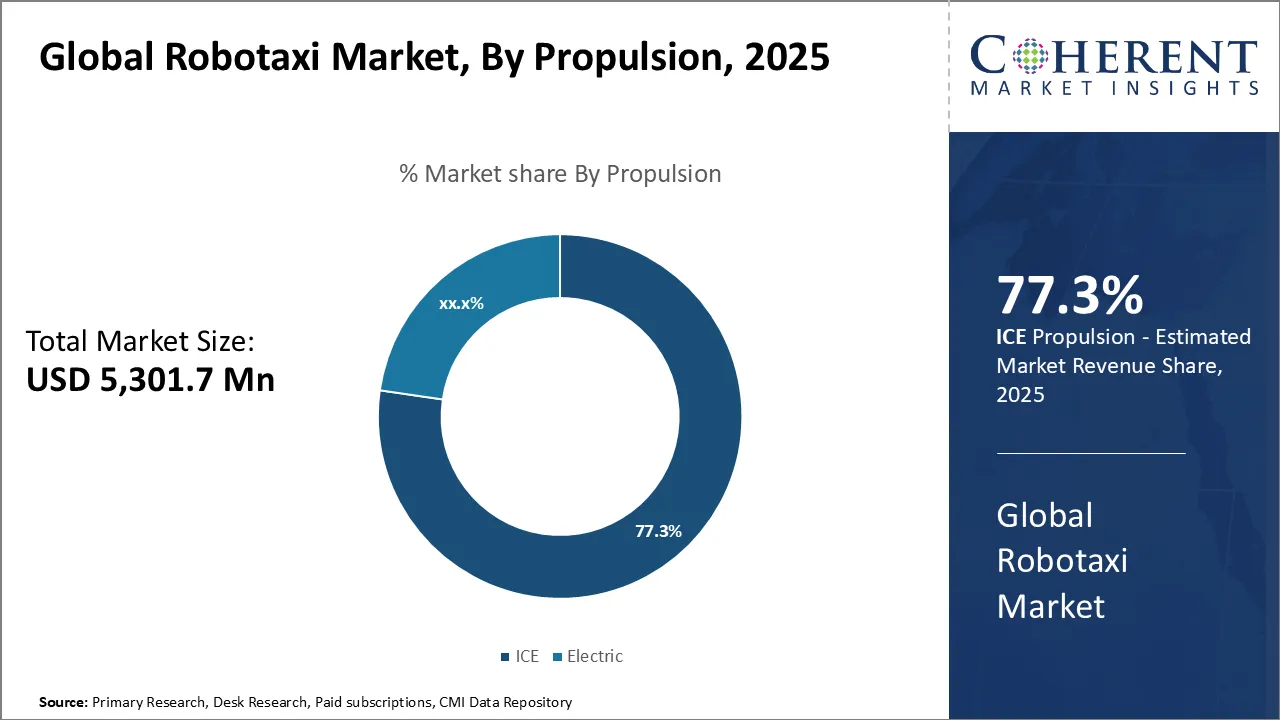
Global Autonomous Vehicle Market Insights, By Propulsion: ICE acquires the largest share
By propulsion type, internal combustion engine (ICE)-based autonomous vehicles are projected to dominate with 78.3% market share in 2026, largely due to their entrenched infrastructure and established vehicle platforms. However, electric propulsion is emerging rapidly, holding 22.7% of the market in the same year. EV platforms are highly compatible with autonomous technologies due to their advanced electronic architecture, which facilitates seamless integration of sensors, AI systems, and drive-by-wire controls. Furthermore, the sustainability push and supportive regulations across North America, Europe, and Asia accelerate adoption of electric autonomous fleets for ride-hailing and goods delivery. Hybrid propulsion remains significant in transitional markets where charging infrastructure is limited.
For instance, in October 2024, Hyundai Motor Company entered a multi-year strategic partnership with Waymo, agreeing to integrate Waymo’s sixth-generation fully autonomous “Waymo Driver” technology into Hyundai’s all-electric IONIQ 5 SUVs. These vehicles are slated to be assembled at Hyundai’s new Metaplant facility in Georgia, USA, and deployed over multiple years as part of the Waymo One autonomous ride-hailing fleet. This move underscores Hyundai’s strong growth trajectory in electric vehicle (EV)-based autonomy and its shift toward scaling robotaxi commercialization.
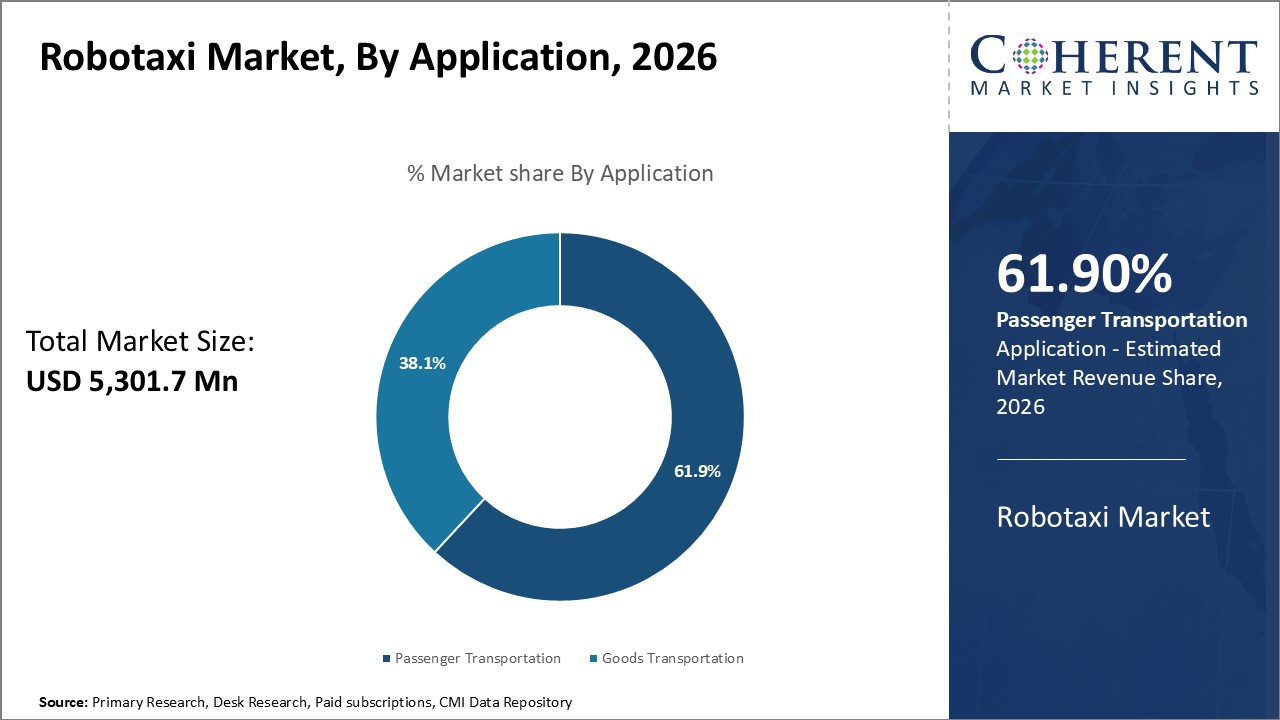
Global Robotaxi Market Insight, By Application: Passenger Transportation segment dominates the market owing to convenience and flexibility
By application type, passenger transportation segment is estimated to contribute the highest market share of 61.9% in 2026, owing to its convenience and flexibility for commuters. Robotaxis allow passengers to hail a driverless vehicle directly from their smartphone instead of waiting for public transportation. For instance, in June 2024, Waymo made its fully autonomous ride-hailing service available to all residents of San Francisco no more waitlist. Anyone with the Waymo One app could summon a driverless Jaguar I-PACE robotaxi directly from their phone and start a ride within the city 24/7.
This on-demand model makes transportation much more convenient as compared to relying on fixed bus or train schedules. Passengers have flexibility to travel exactly when these people want without any delays. Robotaxis also pick up and drop off passenger’s right at their pickup/drop off locations, thus, saving commuters time spent walking to/from bus stops or train stations. The door-to-door service experience is similar to ride-hailing but without the concern of traffic causing lateness. This is further accelerating the robotaxi market growth.
Global Robotaxi Market Insight, By Component: LiDAR segment dominates the market owing to reliability and cost-effectiveness
By component, LiDAR segment is estimated to contribute the highest market share of 44.7% in 2025, owing to its superior perception capabilities essential for safe autonomous driving. While cameras and radars provide useful redundant sensing, only LiDAR sensors emit laser pulses that can accurately map surroundings in 3D regardless of lighting conditions or time-of-day. For instance, in May 2025, at Google I/O, Waymo co-CEO Dmitri Dolgov demonstrated how Waymo’s robotaxis, equipped with five lidars, six radars, and 29 cameras, can detect hazards that cameras alone might miss. In one example, lidar spotted a pedestrian in a Phoenix dust storm before the cameras could see them. Dolgov described this as the system’s “superhuman sensing ability,” highlighting why LiDAR is considered essential for safe robotaxi operations.
The precise distance measurements from millions of laser points allow self-driving systems to perceive obstacles, road boundaries and attribute meanings to complex scenes in a way that cameras alone cannot. This unmatched spatial awareness is critical for robotaxis performing complex navigation tasks like lane changing, intersection crossing and unprotected turns amidst mixed traffic scenarios.
As the industry moves towards higher levels of autonomy requiring no oversight, the need for reliable sensing able to handle any environment increases. LiDAR offers the most robust perception solution to avoid accidents and gain consumer trust necessary for widespread robotaxi adoption. Although the upfront costs of LiDAR are higher than other components, the value it provides in safety makes it the ideal long-term sensor choice for OEMs and ride-hailing firms aiming commercialization at scale.
Global Autonomous Vehicle Market Insights, By Level of Autonomy: Level 4 autonomy Acquires the largest market share
By Level of Autonomy, Level 4 autonomy is expected to achieve the most significant growth rate in the global market, particularly in controlled urban zones and geo-fenced environments. Unlike lower levels, Level 4 systems can handle all driving tasks in predefined operational design domains without human intervention, making them attractive for robo-taxis, shuttles, and logistics fleets
For instance, in November 2024, Baidu's Apollo Go received approval from Hong Kong's Transport Department to conduct autonomous vehicle trials in North Lantau. The approval allows Baidu to operate up to 10 autonomous vehicles in the area, initially with a backup operator on board.
Regional Insights
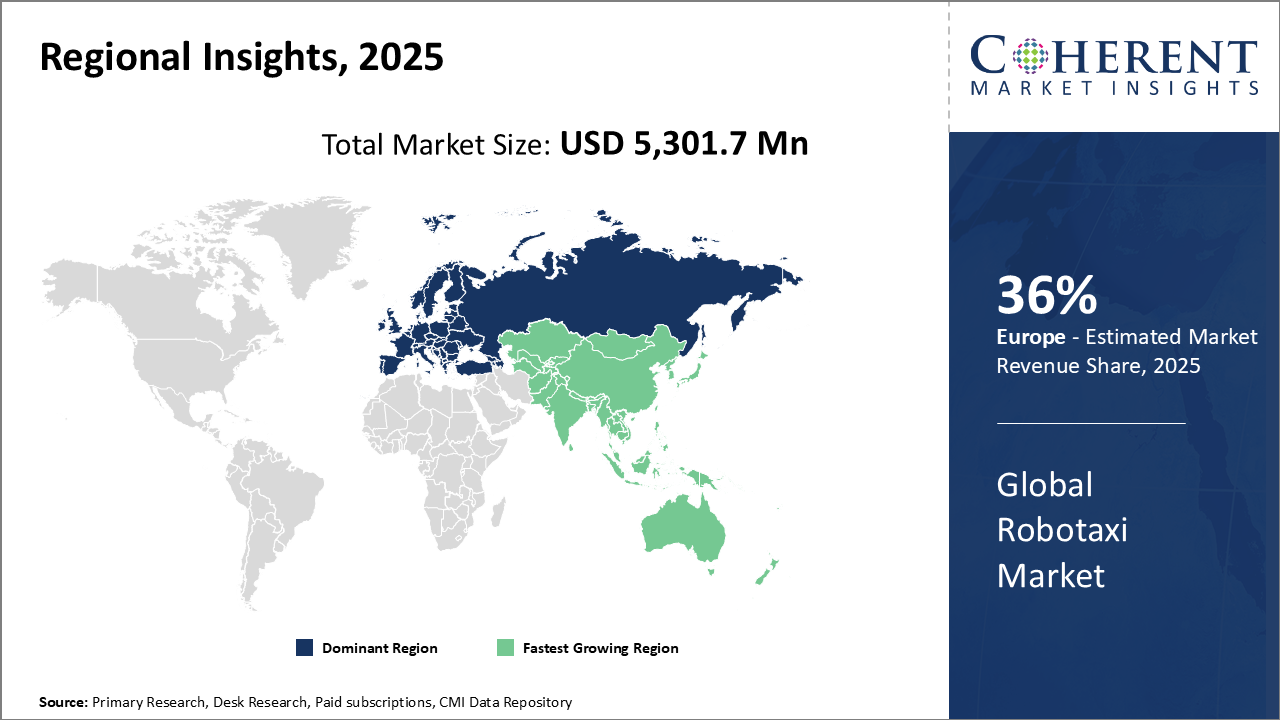
Europe Robotaxi Market Trends
Europe is projected to hold the largest share of the global robotaxi market at 36% in 2026, driven by strong regulatory frameworks and government initiatives promoting autonomous mobility. Countries such as Germany, France, and the United Kingdom are spearheading deployment efforts through large-scale pilot programs and favorable infrastructure development.
European automakers, including BMW, Volkswagen, and Daimler, are investing heavily in robotaxi technologies, leveraging their expertise in premium automotive engineering and partnerships with AI-driven mobility firms. The region also benefits from stringent sustainability goals, which align with the integration of electric autonomous fleets into urban mobility systems.
For instance, in May 2024, Renault Group, in collaboration with its partner WeRide, launched an open-road trial of two autonomous minibuses during the Roland-Garros tennis tournament in Paris. This marked the first full-scale autonomous shuttle deployment in Europe, covering over 1,000 km and transporting nearly 700 passengers. The shuttles, equipped with advanced sensors including 10 cameras and 8 LiDAR units, demonstrated the viability of autonomous electric vehicles in urban public transport. This initiative underscores Europe's commitment to integrating sustainable and efficient mobility solutions into its urban infrastructure.
North America Robotaxi Market Trends
North America regional market for robotaxis, projected to hold 22.8% of the global market share in 2026. The United States and Canada drive regional demand due to the presence of leading players such as Cruise, and Motional, which operate extensively across major cities. With expansive roadways and urban layouts in hubs like San Francisco, Phoenix, and Detroit, North America provides an optimal testing ground for robotaxi technologies.
The region benefits from a supportive regulatory environment that enables companies to conduct trials with fewer restrictions compared to other markets. Robust investment from automakers and tech giants such as GM and Ford, who have collectively invested billions into autonomous mobility, further accelerates growth. Municipalities are also embracing robotaxi adoption, partnering with industry leaders to deploy commercial services. For instance, in August 2026, San Francisco initiated a pilot program allowing robotaxis from companies like Waymo, Uber Black, and Lyft Black to operate on a previously car-free section of Market Street between 10th Street and the Embarcadero.
Asia Pacific Robotaxi Market Trends
Asia Pacific is the fastest-growing regional market for robotaxis, expected to account for 33.1% of the global market during 2026–2032. The region’s rapid expansion is driven by the large-scale commercialization of autonomous mobility in China, where government support and favorable policies promote nationwide deployment. The Chinese government aims to integrate robotaxis into major cities by 2026, with dedicated infrastructure and tailored regulatory frameworks fostering large-scale rollouts.
Key metropolitan areas such as Beijing, Shanghai, Guangzhou, and Shenzhen offer ideal conditions for pilot projects, thanks to dense populations, advanced digital infrastructure, and early adoption of 5G and V2X technologies. Domestic leaders are aggressively expanding, while international players form partnerships to accelerate entry into the Chinese market.
For instance, in May 2026, WeRide, a Chinese autonomous vehicle company, announced an expanded strategic cooperation agreement with Tencent Cloud. This partnership aims to support WeRide's research and development in autonomous driving technologies, facilitate the commercialization of its robotaxi services, and assist in the company's international market expansion.
Global Robotaxi Market Outlook – Country-Wise
United States Robotaxi Market Trends
The United States is the core driver of the North American robotaxi market share, hosting major leaders such as Waymo, Cruise, and Motional. Cities including San Francisco, Phoenix, and Austin have become early testing and deployment hubs due to their diverse traffic conditions and open regulatory environments. U.S. municipalities are increasingly supportive of pilot programs, and states such as California and Arizona have introduced frameworks to encourage commercialization.
For instance, in June 2024, Waymo, the autonomous vehicle company owned by Alphabet, announced that its driverless ride-hailing service, Waymo One, was now available to everyone in San Francisco. Previously, access had been limited to those on a waitlist, but this expansion marked a significant milestone in the company's efforts to scale its autonomous services. This is further proliferating the robotaxi market share.
China Robotaxi Market Trends
China dominates the Asia Pacific robotaxi market, with strong government backing and aggressive deployment targets. The Chinese government aims to commercialize robotaxis across major cities by 2026, supported by investments in 5G, V2X infrastructure, and AI-enabled mobility systems. Leading players such as Baidu Apollo, Pony.ai, and AutoX are rapidly scaling their fleets. Pilot programs in Beijing, Shanghai, Guangzhou, and Shenzhen have already transported thousands of passengers, accelerating public adoption. For instance, in May 2026, Baidu's Apollo Go received an updated pilot license in Hong Kong, allowing it to double the number of operating robotaxis and expand testing areas. This move marked a significant step in Baidu's international expansion efforts.
Germany Robotaxi Market Trends
Germany is the frontrunner in Europe’s robotaxi market, driven by its world-class automotive sector and innovation-friendly policies. German automakers including BMW, Volkswagen, and Daimler are actively developing autonomous mobility solutions and integrating them into robotaxi pilot programs. The government has implemented regulatory frameworks to allow testing and limited deployment of Level 4 autonomous vehicles on public roads.
In August 2026, Lyft and Baidu announced a major partnership to transform urban mobility in Europe. They plan to launch Baidu's next-gen Apollo Go RT6 robotaxis in Germany and the UK by 2026, pending regulatory approval, with plans to expand to thousands of vehicles across the continent.
Market Report Scope
Robotaxi Market Report Coverage
| Report Coverage | Details | ||
|---|---|---|---|
| Base Year: | 2025 | Market Size in 2026: | USD 5,301.7 Mn |
| Historical Data for: | 2020 To 2024 | Forecast Period: | 2026 To 2033 |
| Forecast Period 2026 to 2033 CAGR: | 74.6% | 2033 Value Projection: | USD 262,659.8 Mn |
| Geographies covered: |
| ||
| Segments covered: |
| ||
| Companies covered: | AutoX, Inc., Baidu¸ BMW AG, GM Cruise LLC, and Hyundai Motor Company | ||
| Growth Drivers: |
| ||
| Restraints & Challenges: |
| ||
Rising need for convenient and faster mode of transportation
Due to busy lifestyles and traffic congestion in major cities around the world, there is rising need amongst people for a convenient and faster mode of transportation. Commuting to work or for personal errands is becoming a chore for many people due to long hours spent stuck in traffic. People have less free time and want to utilize it effectively rather than wasting it sitting in vehicles. Robotaxis offer a convenient solution as these can maneuver nimbly through traffic and reach destinations faster than conventional taxi services. Users can book a robotaxi through a mobile app and the vehicle can pick them up from their location within minutes. This helps save a significant amount of time otherwise spent driving or waiting for public transportation.
For instance, in August 2025, New York City allowed Waymo to test up to eight autonomous vehicles in Manhattan and downtown Brooklyn as part of a pilot program running until late September 2025. While the vehicles are not yet carrying passengers, they operate with a test driver behind the wheel, navigating the city’s busy streets. This initiative highlights the growing interest in robotaxis as a convenient and faster transportation solution capable of maneuvering efficiently through dense urban traffic.
The autonomous driving technology powering robotaxis also means that these can operate round the clock without needing breaks. Thus, customers will have access to transportation services even late at night or very early morning when other options are limited. Working professionals with unpredictable schedules find robotaxis useful. Robotaxis can fill an important gap and meet the first and last mile connectivity needs of people. The service will be hassle-free as users will not have to find parking, pay for fuel or bother with tickets or fines. As more high-tech features are added, the entire commuting experience will become seamless, personalized and engaging for passengers.
Growing popularity of the shared mobility-on-demand model
In recent years, shared mobility sector has experienced tremendous growth with new platforms and services disrupting traditional modes of transportation. Ride-hailing through apps has become a mainstream option for urban travellers while bike and scooter sharing have taken off in several cities. This new shared mobility-on-demand model provides users flexibility and access while avoiding the high costs of personal vehicle ownership. It has captured people's imagination as a convenient, affordable and environment-friendly way to travel within cities. Robotaxis provides true driverless mobility, this can operate as self-driving taxis or function within a ride-sharing network.
For instance, in August 2025, Waymo received its first permit to test autonomous vehicles in New York City. This move reflects the growing adoption of robotaxis as part of the shared mobility-on-demand model, complementing Waymo’s existing operations in cities like San Francisco, Phoenix, and Austin. This is further propelling the robotaxi market revenue.
Analyst Viewpoint
- Global robotaxi market growth is driven by advancements in self-driving technology and declining costs. Major players like Waymo, Cruise and Tesla have already begun testing their driverless vehicles on public roads. Declining costs of sensors and computing power can make robotaxis a commercially viable proposition for ride-hailing companies to deploy at scale. However, high upfront investments and regulatory uncertainty can hamper widespread adoption of robotaxi.
- Europe emerged as the dominant region driven by strong regulatory frameworks and government initiatives promoting autonomous mobility. Countries such as Germany, France, and the United Kingdom are spearheading deployment efforts through large-scale pilot programs and favorable infrastructure development.
- Asia Pacific growth in the market is driven by R&D investment and testing of autonomous vehicles. Chinese technology giants like Baidu, Pony.ai and WeRide are vigorously working to commercialize full self-driving taxis in major Chinese cities over the next 5 years. Geographical constraints and lower costs provide China an edge over North America and Europe in pilot projects and scaling of robotaxi fleets.
Robotaxi Industry News
- In July 2025, Baidu announced a multi-year partnership with Uber to deploy its Apollo Go autonomous vehicles on the ride-hailing platform in multiple international markets. This collaboration aims to expand the reach of Baidu’s robotaxi services beyond China.
- In May 2025, Waymo expanded its self-driving car service in the Bay Area by opening up fare-based rides in a 27-square-mile area that includes parts of Palo Alto, Mountain View, Los Altos, and a small section of Sunnyvale. This expansion marks the largest for Waymo in the Bay Area to date, although the new service area remains separate from its existing service in San Francisco.
Market Segmentation
- Application Type Insights (Revenue, USD Mn, 2026 - 2033)
- Goods Transportation
- Passenger Transportation
- Propulsion Insights (Revenue, USD Mn, 2026 - 2033)
- Electric
- ICE
- Level of Autonomy (Revenue, USD Mn, 2026 - 2033)
- Level Four
- Level FIve
- Component Insights (Revenue, USD Mn, 2026 - 2033)
- Camera
- Radar
- LiDAR
- Ultrasonic Sensors
- Regional Insights (Revenue, USD Mn, 2026 - 2033)
- North America
- U.S.
- Canada
- Latin America
- Brazil
- Argentina
- Mexico
- Rest of Latin America
- Europe
- Germany
- U.K.
- Spain
- France
- Italy
- Russia
- Rest of Europe
- Asia Pacific
- China
- India
- Japan
- Australia
- South Korea
- ASEAN
- Rest of Asia Pacific
- Middle East & Africa
- South Africa
- GCC Countries
- Israel
- Rest of Middle East & Africa
- North America
- Key Players Insights (Revenue, USD Mn, 2021 - 2033)
- AutoX, Inc.
- Baidu
- BMW AG
- GM Cruise LLC
- Hyundai Motor Company
Sources
Primary Research Interviews
- Autonomous vehicle technology developers and engineers
- Ride-hailing service operators and fleet managers
- Automotive OEMs and Tier-1 suppliers
- Transportation regulators and policy makers
- Others
Databases
- IHS Markit Automotive Database
- Statista Mobility Market Outlook
- BloombergNEF Transport Database
- Automotive News Data Center
- Others
Magazines
- Automotive News
- SAE Magazine
- MIT Technology Review
- IEEE Spectrum
- Others
Journals
- Transportation Research Part C: Emerging Technologies
- IEEE Transactions on Intelligent Transportation Systems
- Journal of Intelligent Transportation Systems
- Others
Newspapers
- The Wall Street Journal
- Financial Times
- Reuters
- TechCrunch
- The Guardian
- Others
Associations
- Society of Automotive Engineers (SAE International)
- Intelligent Transportation Society of America (ITS America)
- Association for Unmanned Vehicle Systems International (AUVSI)
- National Association of City Transportation Officials (NACTO)
- Others
Public Domain Sources
- U.S. Department of Transportation reports
- European Commission Digital Single Market publications
- National Highway Traffic Safety Administration (NHTSA) guidelines
- McKinsey Global Institute studies
- Others
Proprietary Elements
- CMI Data Analytics Tool
- Proprietary CMI Existing Repository of information for last 8 years
*Definition: Robotaxi is an autonomous electric vehicle designed for ride-hailing and ride-sharing services. It uses an array of sensors like lidar, radar and cameras to navigate road conditions without human intervention. Passengers can book and pay for rides through a smartphone app, which dispatches the nearest available Robotaxi. The vehicle's self-driving system is equipped with advanced mapping and navigation capabilities to safely transport riders to their destinations within urban areas.
Get access to 250+ pages report
Every segment, forecast, competitor profile and data table behind the analysis above — available for instant download.
- ESOMAR Member
- ISO 9001:2015 Certified
- D-U-N-S Registered
- GDPR & CCPA Compliant
Missing comfort of reading report in your local language? Find your preferred language:
Transform your Strategy with Exclusive Trending Reports
Frequently Asked Questions
The Robotaxi Market is estimated to be valued at USD 5,301.7 Mn in 2026, and is expected to reach USD 262,659.8 Mn by 2033.
The CAGR of the Robotaxi Market is projected to be 74.6% from 2026 to 2033.
Rising need for convenient and faster mode of transportation and growing popularity of the shared mobility-on-demand model are the major factors driving the growth of global robotaxi market.
Regulatory barriers and consumer trust and technology reliability are the major factors hampering the growth of global robotaxi market.
In terms of application type, passenger transportation segment is estimated to dominate the market in 2026.
AutoX, Inc., Baidu¸ BMW AG, GM Cruise LLC, and Hyundai Motor Company are the major players.
Asia Pacific is expected to lead the global robotaxi market in 2026.