

Traffic Management System Market Size and Share Analysis - 2026 To 2033
The Traffic Management System Market size is anticipated to grow at a CAGR of 12.4%, from USD 37.5 Bn in 2026 to approximately USD 85.0 Bn in 2033. The growth of the market is mainly driven by increased traffic congestion, urbanization, increasing investments in smart city technology, and use of intelligent transport systems. The expanding deployment of real-time traffic monitoring, adaptive signal control, automated incident detection and connected-mobility solutions is enabling transportation authorities to improve traffic flow, road safety and incident response. According to the 2025 TomTom Traffic Index, Mexico City recorded an average congestion level of 75.9%, while drivers lost approximately 184 hours during rush-hour traffic during the year.
Key Takeaways
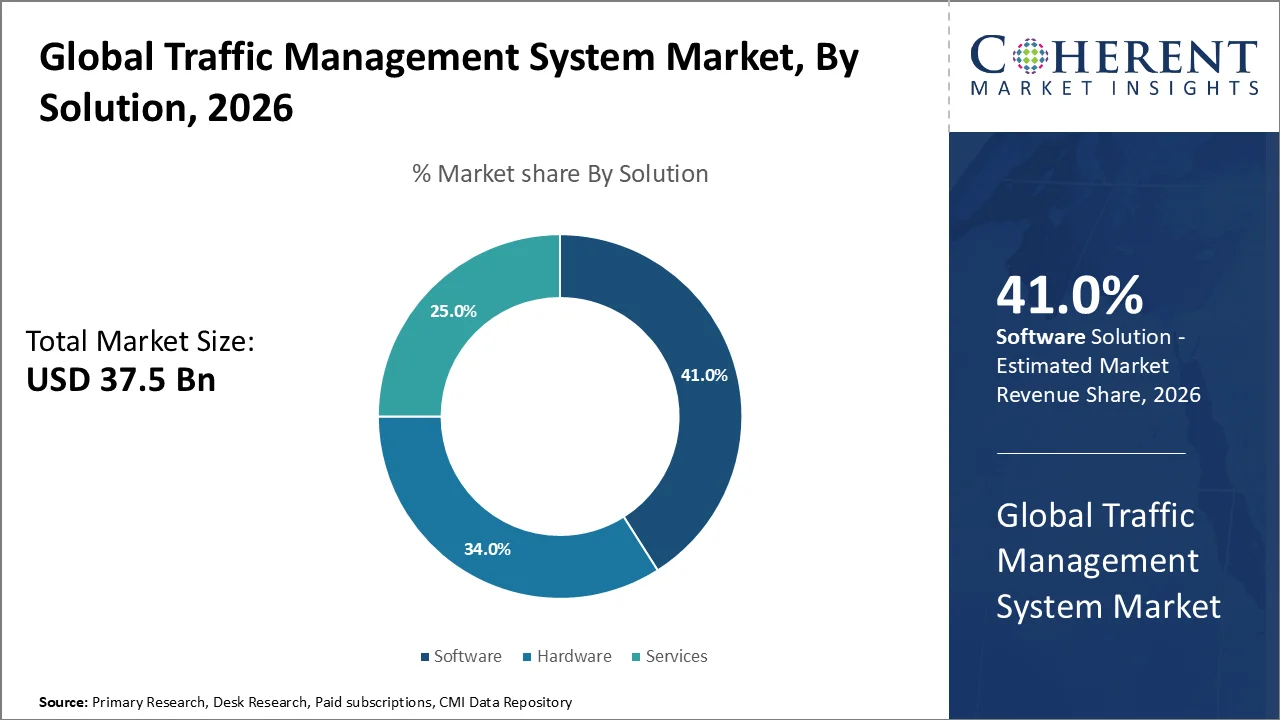
- The software segment is expected to dominate the market with approximately 41.0% share in 2026. The segment’s growth is owing to the increasing adoption of AI-powered traffic platforms, cloud-based control systems, predictive traffic analytics, automated incident detection, and integrated traffic-control software. The U.S. Department of Transportation reported 122 Stage 1 and seven active Stage 2 SMART projects, supporting the deployment of advanced transportation data, software, sensors, and traffic-management technologies.
- The smart signaling segment is estimated to lead the software category with approximately 42.0% share in 2026. The segment’s growth is owing to the transition from fixed-time signals to adaptive systems that use real-time sensor information and analytical algorithms to modify signal timings. A 2025 U.S. Department of Transportation assessment reported that adaptive signal-control deployments generated travel-time savings of up to 51% during weekdays and 43% during weekends at four locations in the Phoenix area. Implementations across eight Florida corridors also reduced overall travel time by more than 9%.
- The surveillance cameras segment is projected to occupy the largest share in the hardware market, accounting for roughly 36.0% in 2026. The growth of this market is attributed to the use of AI-powered cameras for the detection of vehicles, number plate recognition, congestion, traffic rule enforcement, and incident detection. As of June 2025, more than 84,000 CCTV surveillance cameras have been deployed in the 100 Smart Cities in India, along with red-light violation detection and automatic number-plate recognition systems.
- The Urban Traffic Management and Control System segment is expected to lead the systems category with 38.9% share in 2026. The segment’s growth is owing to increasing investments in centralized command centres, coordinated signaling networks, real-time traffic monitoring, public-transport management, and citywide incident-response platforms. All 100 Indian Smart Cities have established Integrated Command and Control Centres using technologies such as AI, IoT, and data analytics.
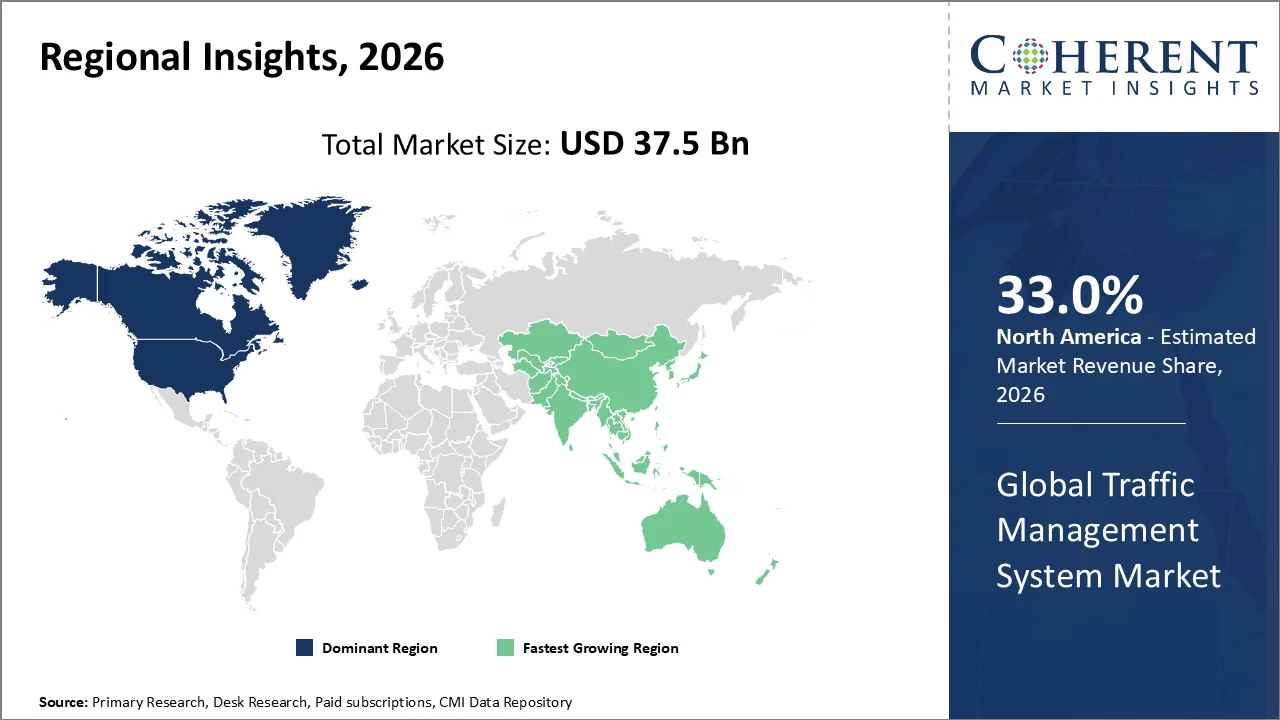
- North America is expected to dominate the global traffic management system market with approximately 33.0% share in 2026. The region’s growth is owing to the widespread deployment of intelligent transportation systems, advanced traffic-control centres, adaptive signaling, connected-vehicle infrastructure, AI-enabled surveillance, and strong government support for road-safety technologies. According to the Federal Highway Administration’s 2024 Urban Congestion Trends Report, average daily congestion across 52 major U.S. metropolitan areas increased to approximately 3 hours and 23 minutes in 2024, representing an increase of 38 minutes compared with 2023.
Market Drivers
Government Investment in Intelligent Transportation Infrastructure is Accelerating Market Growth
Government funding for road safety, congestion management, and intelligent transportation infrastructure is becoming a major driver of the traffic management system market. Transportation authorities are increasingly investing in adaptive traffic signals, integrated corridor management, traffic-monitoring sensors, digital control centres, automated enforcement, and real-time incident-management platforms.
The U.S. Safe Streets and Roads for All initiative has received around USD 1.0 billion per year for the period from FY2022 to FY2026. It helps implement local road safety initiatives and fosters innovation of new techniques and technologies that could save lives and prevent severe injury incidents. This funding situation creates prospects for traffic analysis software, surveillance systems, intelligent signals, and automatic incident detection.
In June 2026, the U.S. Department of Transportation opened the FY2025–FY2026 Advanced Transportation Technology and Innovation program, with up to USD 120 million available for advanced transportation deployments.
Connected-Vehicle and V2X Deployment is Transforming Traffic Management Systems
The growing deployment of vehicle-to-everything communication is transforming conventional traffic-management systems into connected mobility networks. V2X infrastructure enables vehicles to exchange information with traffic signals, roadside units, other vehicles, pedestrians, and transportation-control centres. This allows traffic authorities to improve signal coordination, detect hazards, provide collision warnings, and manage congestion in real time.
In November 2024, the U.S. Federal Communications Commission finalized technical and operational rules for cellular vehicle-to-everything systems. The rules retained the upper 30 MHz of the 5.9 GHz spectrum band, 5.850 GHz to 5.925 GHz, for intelligent transportation system operations and established requirements for C-V2X roadside and onboard equipment. The regulatory clarity is expected to encourage transportation agencies and technology providers to increase investment in connected traffic infrastructure.
Current Events and Their Impact on the Traffic Management System Market
Current Event | Description and its Impact |
European Union Implements Expanded Intelligent Transport Systems Data Requirements (2025–2026) |
|
India Expands Electronic Traffic Enforcement and ATMS Integration on National Highways (2025) |
|
- Current Industry Events of 2026
- Market Size Estimation
- Regional Breakdown
- Competitive Landscape
- Customer Intelligence
- Segmental Analysis
- Pricing Analysis
- Key Market Drivers, Challenges & Future Trends
- Customized Insights Section
Segmental Insights
Why is Software Acquiring the Largest Share?
On the basis of solution, the software segment is projected to account for the largest Traffic Management System Market share of approximately 41.0% in 2026. The segment’s growth is owing to the rising adoption of cloud-based traffic-control platforms, AI-powered traffic analytics, real-time journey monitoring, automated incident detection, adaptive signal optimization, and integrated command-and-control software.
The European Union also reported that Intelligent Transport System corridor projects funded under the Connecting Europe Facility have helped avoid at least 75 road fatalities, prevent approximately 2,000 injuries, and generate estimated annual savings of at least EUR 55 million during the previous five years.
In June 2024, Transport for London completed the migration of its traffic-signal management system to a cloud-based Real Time Optimiser. The system supports a network of approximately 6,400 traffic-signal sites across London. Nearly 4,000 junctions, 1,500 pedestrian crossings, and more than 16,000 traffic detectors were transferred to the new platform within two weeks without disrupting road-network operations.
Why is Smart Signaling Leading the Software Category?
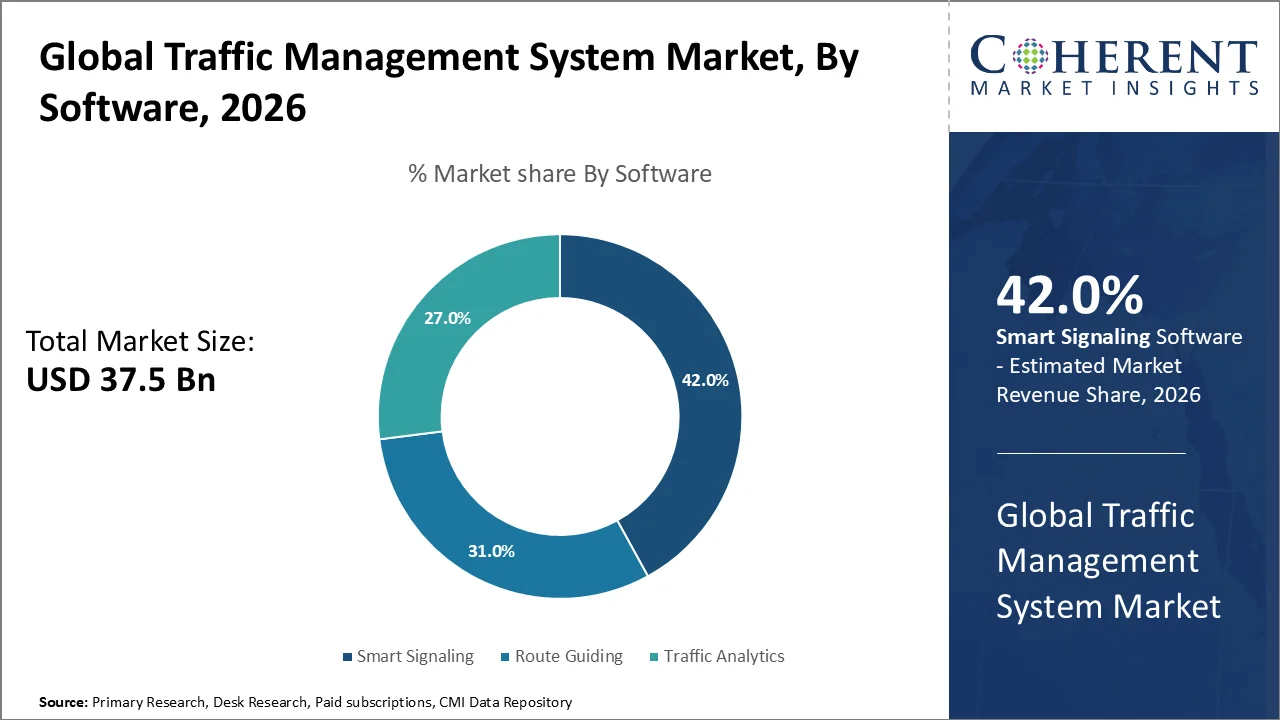
On the basis of software, the smart signaling segment is estimated to account for the largest share of approximately 42.0% in 2026. The segment’s growth is owing to the transition from fixed-time traffic signals toward systems that use real-time traffic information, automated performance measurements, connected-vehicle data, and analytical algorithms to continuously adjust signal timings.
A 2026 U.S. Department of Transportation report stated that Kansas City’s Operation Green Light program manages more than 750 signalized intersections across a nine-county region. A full-scale expansion could benefit an additional 1,550 intersections across 31 managing agencies. The initial proof of concept evaluated four traffic-data and analytics platforms across six corridors covering 137 signalized intersections.
In August 2025, Yunex Traffic announced the implementation of its Yutraffic FUSION multimodal network-control system in Dubai, making Dubai the first city in the Middle East to deploy the technology.
Why are Surveillance Cameras Acquiring the Largest Hardware Share?
On the basis of hardware, the surveillance cameras segment is estimated to account for the largest share of approximately 36.0% in 2026. The segment’s growth is owing to the extensive use of cameras for congestion monitoring, automatic number-plate recognition, red-light enforcement, speed detection, incident verification, vehicle classification, bus-lane enforcement, and AI-based video analytics.
Transport for London reported in March 2025 that its road-network infrastructure included 795 street CCTV cameras, 292 tunnel cameras, 579 spot-speed cameras, and 248 red-light or combined red-light-and-speed cameras. Its wider road-user charging network also included 2,678 cameras associated with the 2023 ULEZ expansion.
In January 2025, Axis Communications launched the AXIS Q1800-LE License Plate Camera and AXIS Q1800-LE-3 License Plate Kit, developed specifically for traffic surveillance, road-safety enforcement, and smart-city applications.
Urban Traffic Management and Control Systems Hold the Largest Market Share
On the basis of systems, the Urban Traffic Management and Control System segment is projected to lead with approximately 38.9% share in 2026. The segment’s growth is owing to the need for citywide platforms that integrate traffic signals, surveillance cameras, incident-management systems, sensors, route information, journey-time monitoring, and traffic-control centres within a unified operating environment.
Singapore’s Land Transport Authority operates an intelligent transportation network covering more than 160 kilometres of expressways and road tunnels. Its iTransport platform integrates traffic information from sensors, control systems, and other ITS infrastructure into a unified platform used by a 24-hour Operations Control Centre for traffic monitoring and incident management.
In April 2025, Kapsch TrafficCom announced that Madrid had selected its EcoTrafix Mobility Platform and Mobility Data Platform to modernize the city’s traffic-management operations.
Traffic Management System Market Trends
- The increasing integration of artificial intelligence and automated decision-making is transforming traffic-management centres from monitoring facilities into predictive control environments. The European Commission’s 2026 ITS implementation review reported that member states are introducing automated systems capable of adjusting variable speed limits using weather conditions, road information, and advanced situational-awareness data. The review also identified growing deployment of traffic forecasting, automated incident management, and multi-source data-processing applications.
- The rising adoption of digital twins is enabling authorities to simulate congestion, infrastructure disruptions, roadworks, and emergency scenarios before implementing changes on physical road networks. In 2026, the U.K. Department for Transport introduced a GBP 30 million Integrated Transport Digital Twin programme to support four to six regional trials through 2030. The programme initially identified 14 local transport authorities with the capability to participate in corridor- and region-level digital twin projects.
- The growing use of multimodal and cloud-based signal-priority systems is improving coordination between road traffic, buses, pedestrians, and cyclists. A 2026 U.S. Department of Transportation implementation report found that a cloud-based transit signal-priority pilot operating across nine signalized intersections in Orange County reduced average bus signal delay by more than 30% at the pilot intersections. The technology operated across different traffic controllers and agency systems, demonstrating the scalability of cloud-based traffic management.
Regional Insights
North America Dominates Owing to Advanced Transportation Infrastructure and Early Technology Adoption
North America is expected to have 33.0% share of the global Traffic Management System Market by 2026. The regional market is estimated to expand at a CAGR of around 11.7% during 2026 and 2035. The dominance of the region is attributed to its well-developed road network and early adoption of AI-driven traffic management systems among others.
Recent U.S. deployments demonstrate the continued shift toward intelligent traffic control. In February 2026, Charleston, South Carolina, received USD 1 million through the U.S. Department of Transportation’s SMART program to deploy AI-enabled adaptive traffic signals along the heavily travelled Calhoun Street corridor. The system is intended to improve signal operation and reduce unsafe interactions between vehicles and pedestrians.
Asia Pacific Emerges as the Fastest-Growing Regional Market
Asia Pacific is expected to be the fastest-growing Traffic Management System Market, expanding at an estimated CAGR of approximately 13.7% from 2026 to 2035. Regional growth is owing to rapid urbanization, increasing vehicle ownership, large-scale smart-city programs, expanding road networks, and government investment in AI, IoT, 5G, connected vehicles, and intelligent transport infrastructure. China is projected to be one of the region’s fastest-growing national markets, with an estimated CAGR of approximately 13.3% during the same period.
In September 2025, China’s Ministry of Transport and six other government agencies issued the “Artificial Intelligence Plus Transportation” implementation policy. The policy aims for widespread use of AI across major transportation scenarios by 2027 and deep integration of AI throughout the transportation industry by 2030.
Federal Road-Safety Funding and Connected Signal Technologies are Accelerating the Traffic Management System Market in the United States
The U.S. Traffic Management System Market is witnessing strong growth owing to large-scale road-safety investments, modernization of signalized intersections, increasing deployment of AI-based traffic analytics, and the integration of connected vehicles with roadside infrastructure.
In December 2025, the Federal Highway Administration published research on advanced traffic-signal optimization in a cooperative driving automation environment. The system enables vehicles to exchange speed, location, and intended-path information with roadside units, which then optimize signal timings in real time.
China Traffic Management System Market Trends
China is expected to witness strong growth in the Traffic Management System Market owing to the expansion of smart highways, vehicle-road-cloud integration, AI-based infrastructure monitoring, growing road-traffic volumes, and government-led deployment of intelligent transport technologies.
China’s Ministry of Transport reported that the country’s total road network reached 5.58 million kilometres by the end of 2025, including approximately 199,400 kilometres of expressways. The country also operated around 80,200 public bus and trolleybus routes, covering a combined route length of approximately 1.78 million kilometres.
Who are the Major Companies in Traffic Management System Industry
Some of the major key players in Traffic Management System Market are Accenture PLC, Atkins Group, Affiliated Computer Services, Inc., Alstom SA, Cisco Systems, Inc., Cubic Corporation, ESRI, GE Transportation, IBM, Indra, Ineo, Kapsch, LG CNS, and Schneider Electric.
Key News
- In July2026, Esri expanded its ArcGIS Community Maps Program to allow governments and transportation authorities to share real-time road-closure information directly with Google Maps and Waze. More than 100 communities worldwide were already contributing authoritative closure data through the program.
- In May 2026, Kapsch TrafficCom announced the deployment of India’s first Cooperative Intelligent Transport Systems project on an expressway near New Delhi. The project combines connected-vehicle communication, AI-enabled video sensors, real-time congestion detection, work-zone warnings, and the Kapsch TrafficAssist mobile application.
Market Report scope
Traffic Management System Market Report Coverage
| Report Coverage | Details | ||
|---|---|---|---|
| Base Year: | 2025 | Market Size in 2026 | USD 37.5 Bn |
| Historical Data for: | 2020 To 2024 | Forecast Period: | 2026 To 2033 |
| Forecast Period 2026 to 2033 CAGR: | 12.4% | 2033 Value Projection: | USD 85.0 Bn |
| Geographies covered: |
| ||
| Segments covered: |
| ||
| Companies covered: | Accenture PLC, Atkins Group, Affiliated Computer Services, Inc., Alstom SA, Cisco Systems, Inc., Cubic Corporation, ESRI, GE Transportation, IBM, Indra, Ineo, Kapsch, LG CNS, and Schneider Electric. | ||
| Growth Drivers: |
| ||
| Restraints & Challenges: |
| ||
Analyst Opinion
- The Traffic Management System Market is increasingly supported by government-backed digital transport infrastructure programs. In July 2025, the European Commission selected 94 transport projects for nearly EUR 2.8 billion in funding, including projects supporting Cooperative Intelligent Transport Systems to improve road safety and traffic flow. Such programs will create sustained procurement opportunities for traffic-management software, connected roadside equipment, control centres, and real-time data platforms.
- Publicly funded research is accelerating the transition from conventional traffic monitoring toward connected, cooperative, and automated mobility. Horizon Europe opened a EUR 101.5 million funding call covering Connected, Cooperative and Automated Mobility, multimodal transport systems, and transport safety and resilience. This investment is expected to strengthen the development of vehicle-to-infrastructure communication, adaptive traffic control, automated incident response, and interoperable mobility platforms.
- Rapid urbanization will remain a structural growth factor for traffic-management systems. According to the United Nations’ World Urbanization Prospects 2025, cities accommodate 45% of the global population of 8.2 billion, while the number of megacities increased from eight in 1975 to 33 in 2025, including 19 in Asia. The concentration of people, vehicles, public transport, and commercial activity within urban areas will increase demand for smart signaling, traffic analytics, journey-time management, and centralized urban traffic-control systems.
Speak to the analyst
Want personalized insights?
Take the findings above to one of our principal consultants, or have the report rebuilt around the segments, geographies and competitors you actually track.
Market Segmentation
- By Solution (Revenue, USD Bn, 2021-2033)
- Hardware
- Software
- Services
- By Software (Revenue, USD Bn, 2021-2033)
- Smart Signaling
- Route Guiding
- Traffic Analytics
- By Hardware (Revenue, USD Bn, 2021-2033)
- Display Boards
- Sensors
- Surveillance Cameras
- Others
- By Systems (Revenue, USD Bn, 2021-2033)
- Urban Traffic Management and control (UTMC) System
- Adaptive Traffic Control (ATC) System
- Journey Time Management (JTM) System
- Predictive Traffic Modeling (PTM) System
- Incident Detection and Location (IDL) System
- Dynamic Traffic Management (DTM) System
- By Region (Revenue, USD Bn, 2021-2033)
- North America
- U.S.
- Canada
- Latin America
- Brazil
- Mexico
- Argentina
- Rest of Latin America
- Europe
- Germany
- U.K.
- France
- Italy
- Spain
- Russia
- Rest of Europe
- Asia Pacific
- China
- India
- Japan
- Australia
- South Korea
- ASEAN
- Rest of Asia Pacific
- Middle East
- GCC
- Israel
- Rest of Middle East
- Africa
- South Africa
- Central Africa
- North Africa
- North America
Sources
Primary Research Interviews
- Traffic management system manufacturers and solution providers
- Intelligent transportation system software developers
- Traffic-control centre operators and transport authorities
- Urban mobility planners and smart-city officials
- Traffic engineers and transportation consultants
- Road infrastructure and highway project managers
- Public-transit agencies and municipal traffic departments
- System integrators, sensor providers, and surveillance technology specialists
- Connected-vehicle and V2X technology experts
- Key opinion leaders in intelligent transportation and urban mobility
Databases
- World Bank
- Organisation for Economic Co-operation and Development
- United Nations Department of Economic and Social Affairs
- International Transport Forum
- European Commission Mobility and Transport Database
- U.S. Department of Transportation
- Federal Highway Administration
- National Highway Traffic Safety Administration
- Eurostat
- UNECE Transport Statistics Database
- International Road Federation World Road Statistics
- Asian Development Bank Data Library
Magazines
- ITS International
- Traffic Technology Today
- Smart Cities World
- Intelligent Transport
- Intertraffic World
- Roads & Bridges
- Traffic Management Today
- Smart Transportation Management
Journals
- IEEE Transactions on Intelligent Transportation Systems
- Transportation Research Part C: Emerging Technologies
- Transportation Research Record
- International Journal of Intelligent Transportation Systems Research
- IET Intelligent Transport Systems
- Journal of Advanced Transportation
- Transport Policy
- Accident Analysis & Prevention
- European Transport Research Review
Newspapers
- The New York Times
- The Guardian
- The Wall Street Journal
- Financial Times
- Reuters
- Bloomberg
- The Economic Times
- China Daily
Associations
- ITS America
- ERTICO–ITS Europe
- International Road Federation
- Institute of Transportation Engineers
- World Road Association
- International Association of Public Transport
- Transportation Research Board
- ITS Asia-Pacific
- National Electrical Manufacturers Association
- Open Mobility Foundation
Public Domain Sources
- Company annual reports and investor presentations
- Government transport budgets and infrastructure plans
- Smart-city project reports and tender documents
- Traffic authority publications and congestion reports
- Road-safety statistics and highway performance reports
- Intelligent transportation system deployment reports
- Vehicle-to-everything regulations and technical standards
- Company press releases, product launches, and contract announcements
- Patent databases such as WIPO, USPTO, and Google Patents
- Publicly available urban mobility and traffic-management project reports
- Standards publications from ISO, IEEE, SAE International, and ETSI
Proprietary Elements
- CMI Data Analytics Tool
- Proprietary CMI Existing Repository of Information for the Last 10 Years
Get access to 250+ pages report
Every segment, forecast, competitor profile and data table behind the analysis above — available for instant download.
- ESOMAR Member
- ISO 9001:2015 Certified
- D-U-N-S Registered
- GDPR & CCPA Compliant
Missing comfort of reading report in your local language? Find your preferred language:
Transform your Strategy with Exclusive Trending Reports
Frequently Asked Questions
The Traffic Management System Market is expected to reach approximately USD 85.0 Bn by 2033, compared with USD 37.5 Bn in 2026.
Major players operating in the global Traffic Management System Market include Accenture PLC, Atkins Group, Affiliated Computer Services, Inc., Alstom SA, Cisco Systems, Inc., Cubic Corporation, ESRI, GE Transportation, IBM, Indra, Ineo, Kapsch, LG CNS, and Schneider Electric.
High initial investment and deployment costs, complex integration with legacy traffic infrastructure, cybersecurity concerns, limited interoperability, and high maintenance requirements are key factors hampering market growth.
Increasing adoption of intelligent transportation systems, rising urban traffic congestion, government investment in smart-city infrastructure, connected-vehicle deployment, and growing demand for real-time traffic monitoring are driving market growth.
The Traffic Management System Market is anticipated to grow at a CAGR of 12.4% between 2026 and 2033.
North America is expected to dominate the global market with approximately 33.0% share in 2026, supported by advanced transportation infrastructure, connected intersections, adaptive signaling, and government investment in intelligent transportation systems.
Asia Pacific is expected to be the fastest-growing region, with an estimated CAGR of approximately 13.7% from 2026 to 2035. Growth is supported by smart-city programs, expanding road networks, rising vehicle ownership, and investments in AI, IoT, 5G, and connected mobility infrastructure.