

Connected Vehicles Market Size and Forecast
The global connected vehicles market is estimated to be valued at USD 95.50 Bn in 2026 and is expected to reach USD 221.95 Bn by 2033, growing at a compound annual growth rate (CAGR) of 12.8% from 2026 to 2033.
Key Takeaways
- By Vehicle type, passenger cars are expected to contribute the highest market share of 56.5%in 2026 owing to modern consumers' increasing demand for convenience and connectivity features in their vehicles.
- By End-User Industry, Aftermarket segment is expected to contribute the highest market share of 54.6% in 2026 due to the segment's focus on optimizing commercial fleet management operations through connectivity solutions.
- By Communication, Vehicle-to-vehicle contributes the highest market share of 46.8% in 2026 as it facilitates critical safety applications that automakers and drivers prioritize.
- By Connectivity, Satellite is expected to contribute the highest market share in 2026 as it enables advanced safety, and autonomy.
- By Region, North America is the leading market and is expected to account for 48.0% market share in 2026 as consumer demand & safety expectations.
Market Overview
The connected vehicles market growth is attributed to increasing demand for connected services such as fleet management, predictive maintenance, usage-based insurance and other connectivity solutions in commercial vehicles. In addition, increasing adoption of advanced driving assistance systems and government mandates for vehicle safety and connectivity are fueling the market growth. However, lack of standardization in connectivity protocols and high costs associated with the implementation of connected vehicle solutions are some of the challenges inhibiting the market growth. Still, upcoming opportunities around autonomous driving, blockchain, and 5G connectivity are expected to provide new growth avenues for connected vehicles market in coming years.
Current Events and their Impact on the Connected Vehicles Market
Current Events | Description and its impact |
Geopolitical and Regulatory Developments |
|
Technological Advancements and Standardization Efforts |
|
End-user Feedback and Unmet Needs in the Connected Vehicles Market
End-user Feedback and Unmet Needs
- Demand for Seamless Connectivity: Users often face inconsistent or interrupted connectivity in low-network zones, especially in rural or mountainous areas. End-users expect uninterrupted services for navigation, streaming, and communication. Better network integration, multi-carrier support, and satellite-based connectivity remain unmet needs, especially for those relying heavily on connected features during long drives.
- Concerns Over Data Privacy: Many consumers are concerned about how vehicle data is collected, stored, and shared. There is a growing demand for transparency and better control over personal information. End-users want manufacturers to implement clear privacy policies, stronger encryption, and options to opt out of certain data tracking features.
- Frustration with Complex Interfaces: Users often find infotainment systems and touch interfaces unintuitive or distracting. Overly complicated menus and slow system responses impact the user experience. There is a clear need for simplified, voice-activated, and responsive UI designs that ensure minimal distraction and seamless interaction during driving.
- Current Industry Events of 2026
- Market Size Estimation
- Regional Breakdown
- Competitive Landscape
- Customer Intelligence
- Segmental Analysis
- Pricing Analysis
- Key Market Drivers, Challenges & Future Trends
- Customized Insights Section
Segmental Insights
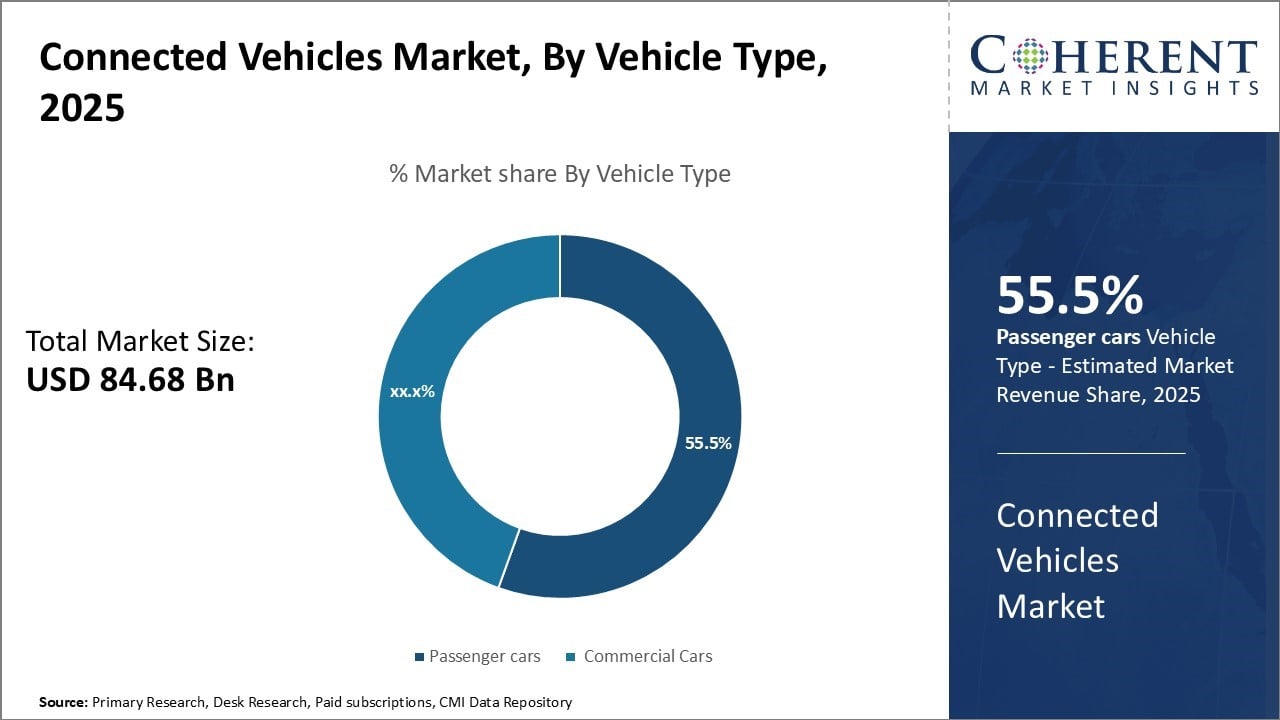
Connected Vehicles Market Insights, by Vehicle Type
Passenger Cars contribute the highest share of the market owing to its consumer demand & in‑vehicle experience
Passenger cars are expected to contribute the highest market share of 56.5% in 2026. Driven by younger demographics and rapid advancements in mobile technology, there is a growing need for seamless integration of smartphones and in-vehicle systems among passenger car owners. The ability to manage vehicle diagnostics, receive real-time navigation assist, monitor fleet usage, access infotainment like music and media, and leverage advanced safety features through connectivity has become an important decision factor. For instance, in June 2025, Mozee, a modular agile transit (MAT) company, collaborated with a global corporate communications management company. As part of this collaboration, 46 Labs will provide the mobile communications infrastructure to support Mozee’s expanding fleet of autonomous, electric multi-passenger vehicles.
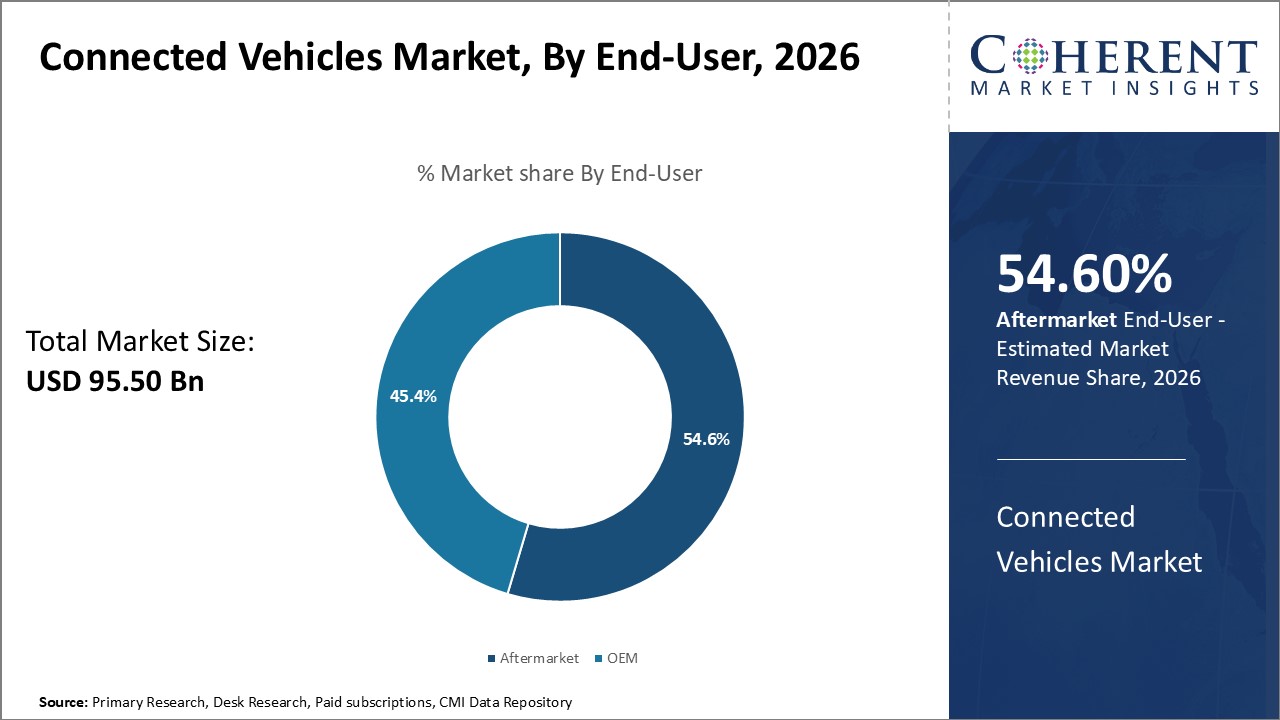
Connected Vehicles Market Insights, by End-User
Aftermarket contribute the highest share of the market owing to its rising demand for telematics & ADAS retrofit
The Aftermarket segment is expected to contribute the highest market share of 54.6% in 2026. Fleet owners and operators recognize the scope connected vehicles offer in maximizing asset utilization, reducing downtime, scheduling predictive maintenance, monitoring driver behavior, streamlining logistics and ensuring regulatory compliance. For instance, in October 2024, General Motors launched ACDelco, its leading aftermarket spare parts brand, in Uzbekistan and introduced gold engine oil as the first product in the lineup. This is further propelling the connected vehicles market share.
Connected Vehicles Market Insights, by Communication
Vehicle-to-Vehicle contribute the highest share of the market owing to its smart cities & traffic management
Vehicle-to-vehicle contributes the highest market share of 46.8% in 2026. Connected car technologies based on vehicle-to-vehicle communication are finding more success compared to other applications owing to the strong emphasis on advancing road safety. Technologies such as forward collision warning, blind spot monitoring, do-not-pass warning and left turn assist that leverage real-time data shared between connected vehicles are highly effective in preventing accidents attributed to line-of-sight and human error.
For instance, in May 2025, Hyundai Motor India Limited (HMIL) developed the vehicle digital passport, an innovative connected car technology, to give Bluelink-enabled Hyundai vehicles a digital identity using data analytics.
Connected Vehicles Market Insights, by Connectivity
Satellite contributes the highest share of the market owing to its filling coverage gaps beyond cellular
Satellite connectivity drives the demand for connected vehicles by enabling smooth communication in areas without cellular coverage, such as rural and remote regions. As vehicles become more autonomous and data-driven, satellite networks ensure continuous connectivity for diagnostics, safety, and infotainment. Additionally, integrating hybrid networks that combine satellite and 5G enhances service reliability and supports the expansion of connected vehicle applications across a wide range of locations.
In June 2025, LG Innotek successfully developed the world's first "third-generation automotive 5G communication module," which supports satellite communication over 5G broadband (NR-NTN) with a bandwidth of approximately 30MHz.
Regional Insights
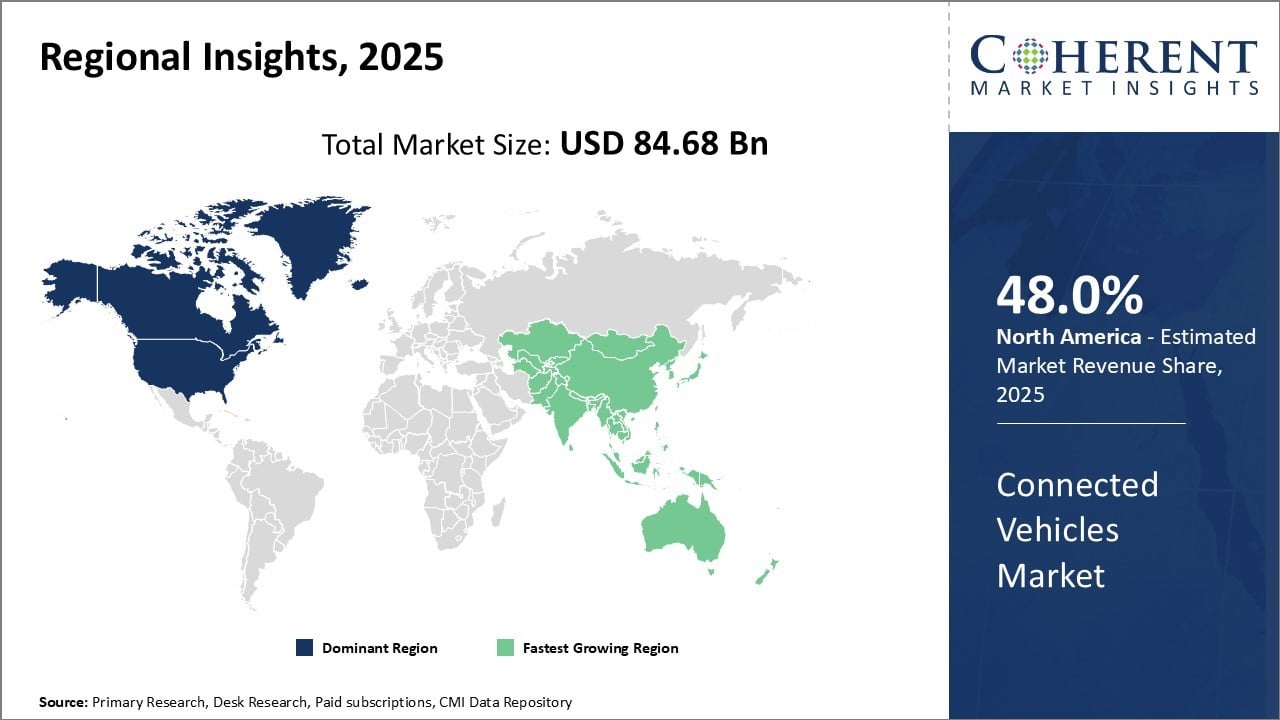
North America Connected Vehicles Market Trends
North America is the leading market and is expected to account for 48.0% market share in 2026. The growth can be attributed to strong government support for connected and autonomous vehicle technologies. Countries such as the US and Canada have implemented regulations that promote research and development in connectivity solutions. Additionally, the presence of major automotive OEMs and technology companies in the region is driving innovations.
For instance, in August 2024, The U.S. Department of Transportation has set specific targets and deadlines to deploy vehicle-to-everything (V2X) technologies nationwide in an effort to enhance road safety and efficiency.
Asia Pacific Connected Vehicles Market Trends
The Asia Pacific region is expected to exhibit the fastest growth, led by China, Japan and South Korea. The governments of these countries are actively working to build connected infrastructure and encourage adoption of connected vehicles. Local automakers are also ramping up their connected car portfolios. Companies like Toyota, Honda and Hyundai are at the forefront of bringing advanced connectivity features to mainstream vehicles.
For instance, in June 2026, Singtel launched its upgraded Multi-Domestic Connectivity solution in partnership with floLIVE, a cloud-native IoT connectivity provider, to enable seamless, secure, and regulatory-compliant global IoT deployments.
United States Connected Vehicles Market Trends
The rise of autonomous vehicle testing is bringing new opportunities for connected vehicle technology adoption. Several states have passed new laws supporting autonomous vehicle testing on public roads and the US Department of Transportation has provided guidance for safe deployment of these vehicles. For instance, automakers logged over 130,000 miles of autonomous vehicle testing in California alone in 2021 (California Department of Motor Vehicles).
For instance, in June 2026, Verizon Business established an edge transportation exchange to enable communication and the exchange of vital information between vehicles, pedestrians, and connected roadway infrastructure.
China Connected Vehicles Market Trends
China's market continues to grow exponentially on the back of supportive policies and growing consumer appetite for connected mobility solutions. Industry partnerships between automakers like SAIC, GAC and tech giants Alibaba and Baidu are fueling innovations. The rapid integration of connectivity features in new vehicles has also increased demand for high-speed cellular networks, hardware components, and cloud-based solutions to enable diverse in-vehicle applications and services. This is supported by the Chinese government's continued investments and policy backing for 5G infrastructure development across the country.
For instance, in February 2024, Geespace, a subsidiary of Chinese automaker Zhejiang Geely Holding Group, added 11 more low-Earth orbit (LEO) satellites to its planned global constellation, which is primarily designed to support connected and autonomous vehicles.
Market Players, Key Development, and Competitive Intelligence
Connected Vehicles Market News
- In March 2025, Toyota Motor Corp. partnered with Transatel, a division of NTT DATA and a leading global cellular connectivity provider, to support the rollout of connected car services in Latin America. Toyota now equips its LATAM-market vehicles with Transatel’s multi-network (e)SIM cards to enable features such as telematics and onboard Wi-Fi hotspots.
- In April 2025, Volkswagen Group launched a major product offensive at Auto Shanghai 2025, introducing intelligent, fully connected vehicles to cater to the growing Chinese industry. This next generation of ICVs is set to unlock new market segments and attract a broader customer base in China’s highly competitive automotive landscape.
- In December 2024, Under the signed agreement, GAC Group and Huawei developed an electric car brand. The partnership combines GAC's expertise in vehicle manufacturing with Huawei's strengths in information and communication technology to create a new generation of smart, connected vehicles.
- In March 2024, The US launched a new wave of tech crackdowns on China, citing "national security" as the reason, and is now targeting the automotive industry—a rapidly expanding sector led by electric vehicles (EVs) and widely praised by numerous countries.
Market Report Scope
Connected Vehicles Market Report Coverage
| Report Coverage | Details | ||
|---|---|---|---|
| Base Year: | 2025 | Market Size in 2026: | USD 95.50 Bn |
| Historical Data for: | 2020 To 2024 | Forecast Period: | 2026 To 2033 |
| Forecast Period 2026 to 2033 CAGR: | 12.8% | 2033 Value Projection: | USD 221.95 Bn |
| Geographies covered: |
| ||
| Segments covered: |
| ||
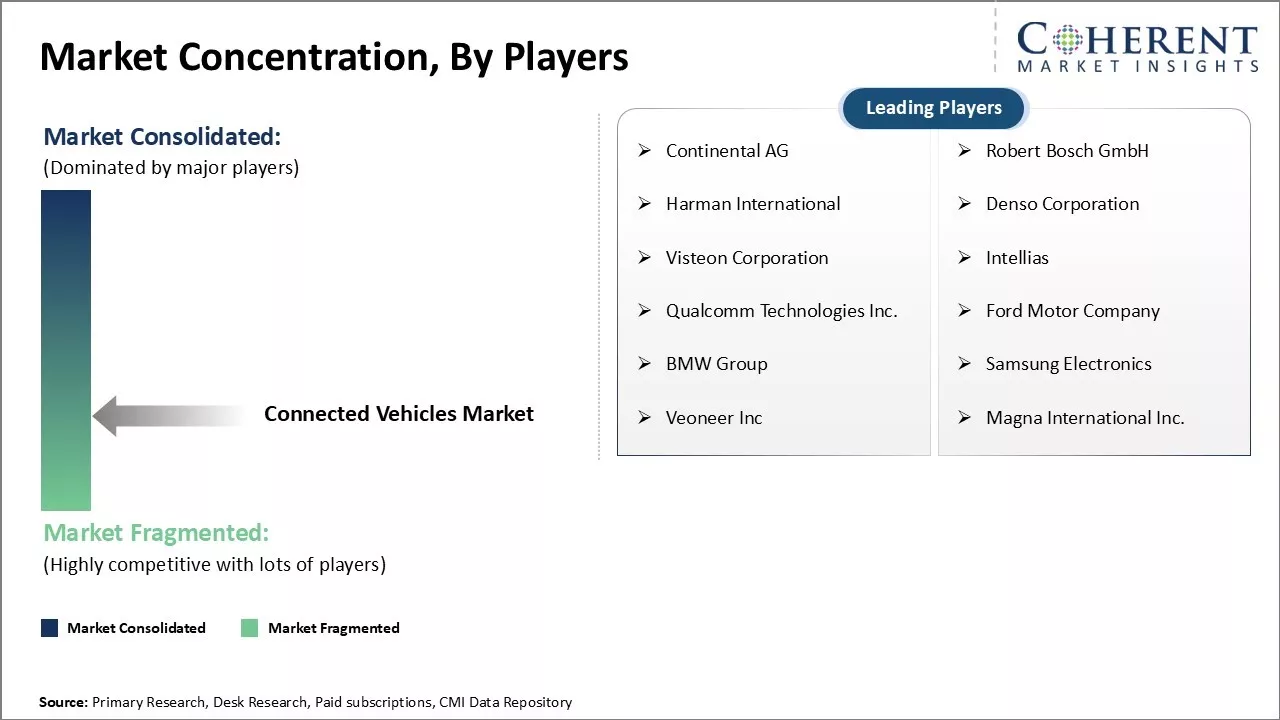
| Companies covered: | Continental AG, Robert Bosch GmbH, Harman International, Denso Corporation, Visteon Corporation, Intellias, Qualcomm Technologies Inc., Ford Motor Company, BMW Group, Samsung Electronics, Veoneer Inc, Magna International Inc. | ||
| Growth Drivers: |
| ||
| Restraints & Challenges: |
| ||
Connected Vehicles Market Trend
AI-Driven Infotainment & Predictive Systems
Automakers are revolutionizing in-car experiences by integrating AI technologies. They deploy voice assistants, such as ChatGPT-based systems, to offer conversational controls and personalized content. Predictive maintenance tools powered by AI identify potential issues and schedule services before failures occur. Infotainment systems adjust in real time to user preferences, providing customized playlists and navigation. Looking ahead, companies like Helm.ai are leading the shift toward hands-free driving with AI-powered, vision-first autonomous camera systems.
OTA & Software-Defined Vehicles (SDVs)
Automakers are transforming vehicles into software-defined products by delivering over-the-air updates. They now remotely provide performance improvements, feature upgrades, and security patches without requiring dealership visits. This shift turns vehicles from fixed hardware into adaptive systems that gain value over time. It also encourages modular, subscription-based features while minimizing recalls and promoting continuous technological advancement.
Connected Vehicles Market Opportunity
Scope for Advanced Applications of Connected Vehicles Technology for Market
The growing capabilities of connected vehicles technologies open up significant opportunities to develop advanced applications that can drive the market to new heights. Connected vehicles allow for innovative IoT-based services integrated with other technologies like artificial intelligence, cloud computing etc. This scope to develop applications in areas such as autonomous driving, advanced navigation, telematics, infotainment, fleet management and predictive maintenance can boost the connected vehicles market.
Analyst Opinion (Expert Opinion)
- The connected vehicles market is no longer a futuristic promise—it's a disruptive reality actively reshaping how automakers, tech firms, and even governments approach transportation. In my view, the real inflection point isn’t connectivity itself, but how data ownership, AI-driven services, and ecosystem monetization are rearchitecting the value chain.
- More notably, Tesla’s approach to OTA updates is setting an irreversible precedent. By deploying new features like “Full Self-Driving” beta or range improvements without physical upgrades, Tesla proves that the long-term value of a vehicle lies in its software—not its chassis. Traditional automakers are scrambling to catch up, with over 80% of OEMs now investing in software-defined vehicle platforms.
- Yet, the most underappreciated battleground is data ownership. With each vehicle generating 25GB of data per hour, questions around who owns, analyzes, and profits from this information will define competitive advantage. Players like Google (via Android Automotive), Amazon (Alexa Auto), and Apple (CarPlay Next Gen) are staking early claims—not to sell hardware, but to dominate in-vehicle user time.
- In conclusion, connected vehicles are not just a feature—they are the foundation for a new automotive business model, where data, software, and cross-industry collaboration determine winners. OEMs that continue to treat connectivity as an add-on rather than a core asset will fall behind. This market will reward companies that not only connect cars—but connect ecosystems.
Speak to the analyst
Want personalized insights?
Take the findings above to one of our principal consultants, or have the report rebuilt around the segments, geographies and competitors you actually track.
Market Segmentation
- By Vehicle Type Insights (Revenue, USD, 2021 - 2033)
- Passenger cars
- Commercial Cars
- By End-user Industry Insights (Revenue, USD, 2021 - 2033)
- Aftermarket
- OEM
- By Communication Insights (Revenue, USD, 2021 - 2033)
- Vehicle-to-vehicle
- Vehicle-to-pedestrian
- Vehicle-to-infrastructure
- By Connectivity Insights (Revenue, USD, 2021 - 2033)
- DSRC
- Cellular
- Satellite
- Wi-Fi
- Regional Insights (Revenue, USD, 2021 - 2033)
- North America
- U.S.
- Canada
- Latin America
- Brazil
- Argentina
- Mexico
- Rest of Latin America
- Europe
- Germany
- U.K.
- Spain
- France
- Italy
- Russia
- Rest of Europe
- Asia Pacific
- China
- India
- Japan
- Australia
- South Korea
- ASEAN
- Rest of Asia Pacific
- Middle East
- GCC Countries
- Israel
- Rest of Middle East
- Africa
- South Africa
- North Africa
- Central Africa
- North America
- Key Players Insights (Revenue, USD Bn, 2021 - 2033)
- Continental AG
- Robert Bosch GmbH
- Harman International
- Denso Corporation
- Visteon Corporation
- Intellias
- Qualcomm Technologies Inc.
- Ford Motor Company
- BMW Group
- Samsung Electronics
- Veoneer Inc.
- Magna International Inc.
Sources
Primary Research interviews
- Discussions with automotive OEM R&D heads
- Interviews with Tier 1 suppliers focused on telematics and ADAS
- Feedback from mobility-as-a-service (MaaS) platform operators
- Insights from government transport officials involved in V2X pilot programs
Databases
- IEEE Xplore Digital Library (connected vehicle standards, AI integration)
- U.S. National Highway Traffic Safety Administration (NHTSA) crash and V2V data
- Euro NCAP database (ADAS and connectivity ratings)
- Transport Canada Connected Vehicle Field Test data
Magazines
- Automotive News (North America trends in connected services)
- WardsAuto (connected technology coverage)
- Autocar Professional (OEM connectivity strategies in APAC)
- Car and Driver Tech (consumer-facing innovations in connected cars)
Journals’
- IEEE Transactions on Intelligent Transportation Systems
- Transportation Research Part C Emerging Technologies
- Journal of Advanced Transportation
- Vehicular Communications (Elsevier)
Newspapers
- The Wall Street Journal (automaker earnings tied to connected services)
- The Financial Times (OEM–tech firm partnerships, e.g., Qualcomm, Apple)
- The New York Times (public perception and policy on connected/autonomous vehicles)
- The Guardian (data privacy and security issues in connected mobility)
Associations
- Society of Automotive Engineers (SAE International – J3016, J2735 standards)
- 5G Automotive Association (5GAA)
- Intelligent Transportation Society of America (ITS America)
- European Telecommunications Standards Institute (ETSI)
Public Domain sources
- U.S. Department of Transportation (DOT) – Connected Vehicle Pilot Deployment Program
- Federal Communications Commission (FCC) decisions on 5.9 GHz spectrum
- European Commission – Mobility & Transport policy papers on C-ITS
- Japan’s MLIT – Connected car policy frameworks and pilot results
Proprietary Elements
- CMI Data Analytics Tool, and Proprietary CMI Existing Repository of information for last 8 years
Get access to 250+ pages report
Every segment, forecast, competitor profile and data table behind the analysis above — available for instant download.
- ESOMAR Member
- ISO 9001:2015 Certified
- D-U-N-S Registered
- GDPR & CCPA Compliant
Missing comfort of reading report in your local language? Find your preferred language:
Transform your Strategy with Exclusive Trending Reports
Frequently Asked Questions
The Connected Vehicles Market is estimated to be valued at USD 95.50 Bn in 2026, and is expected to reach USD 221.95 Bn by 2033.
The CAGR of the Connected Vehicles Market is projected to be 12.8% from 2026 to 2033.
Growing concerns regarding vehicle safety and Increasing demand for infotainment applications are the major factor driving the growth of Connected Vehicles Market.
Data privacy and security concerns and High research and development costs are the major factor hampering the growth of Connected Vehicles Market.
In terms of Vehicle Type, Passenger cars are estimated to dominate the market revenue share 2026.
Continental AG, Robert Bosch GmbH, Harman International, Denso Corporation, Visteon Corporation, Intellias, Qualcomm Technologies Inc., Ford Motor Company, BMW Group, Samsung Electronics, Veoneer Inc, Magna International Inc. are the major players.
North America is expected to lead the Connected Vehicles Market in 2026.