

Sanitation Vehicles Market Size and Share Analysis - Growth Trends and Forecast (2026 - 2033)
The Sanitation Vehicle Market is projected to grow at a CAGR of 5.4%, reaching USD 4,880 Mn by 2026 and USD 7,050 Mn by 2033. This growth is supported by rising urbanization (over 56% global urban population), increasing municipal solid waste generation (expected ~3.8 billion tonnes annually by 2050), and strong government initiatives for smart cities. Demand is further driven by stricter environmental regulations and adoption of automated, electric, and eco-friendly sanitation vehicles.
Key Takeaways from the Sanitation Vehicle Market Report
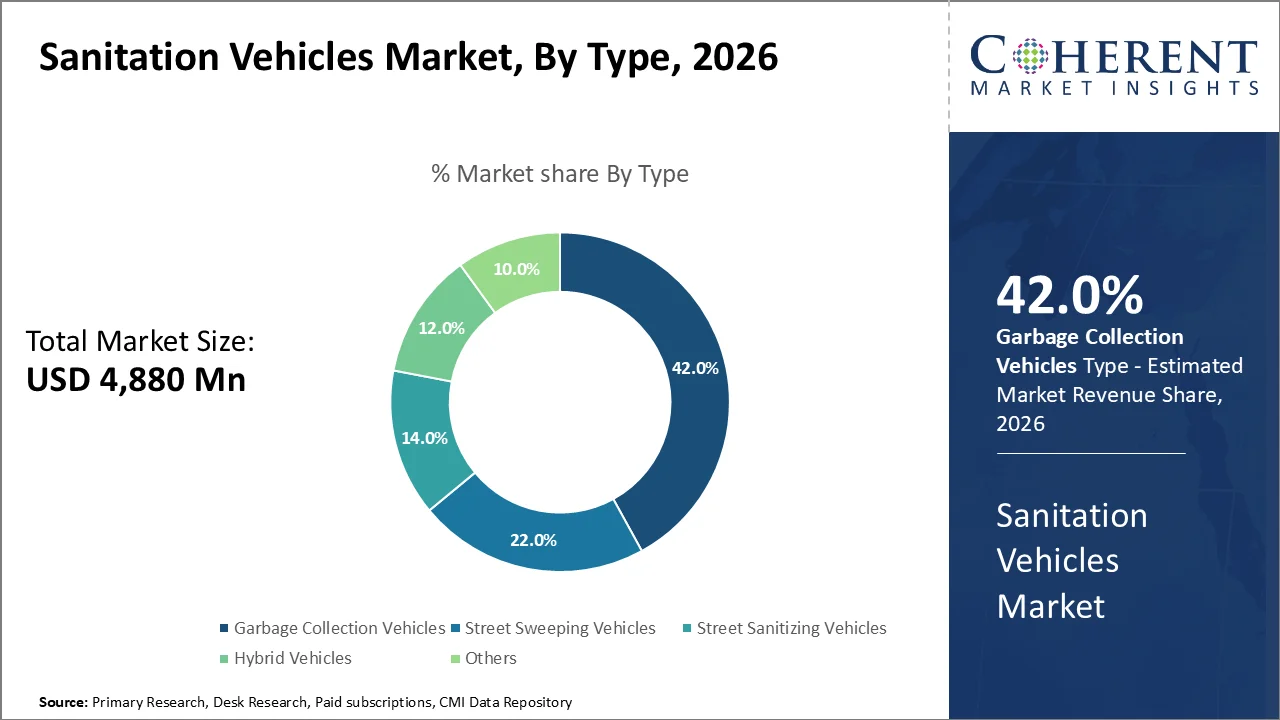
- Garbage Collection Vehicles are expected to account for the largest share of 42% in 2026, driven by their critical role in daily municipal waste management operations and rising urban waste generation. According to the World Bank, global municipal solid waste generation is projected to increase to 3.4–3.8 billion tons per year by 2050, significantly boosting demand for efficient collection fleets.
- Municipal Corporations are expected to hold a dominant share of 52% in 2026, due to their central role in providing sanitation and waste management services.
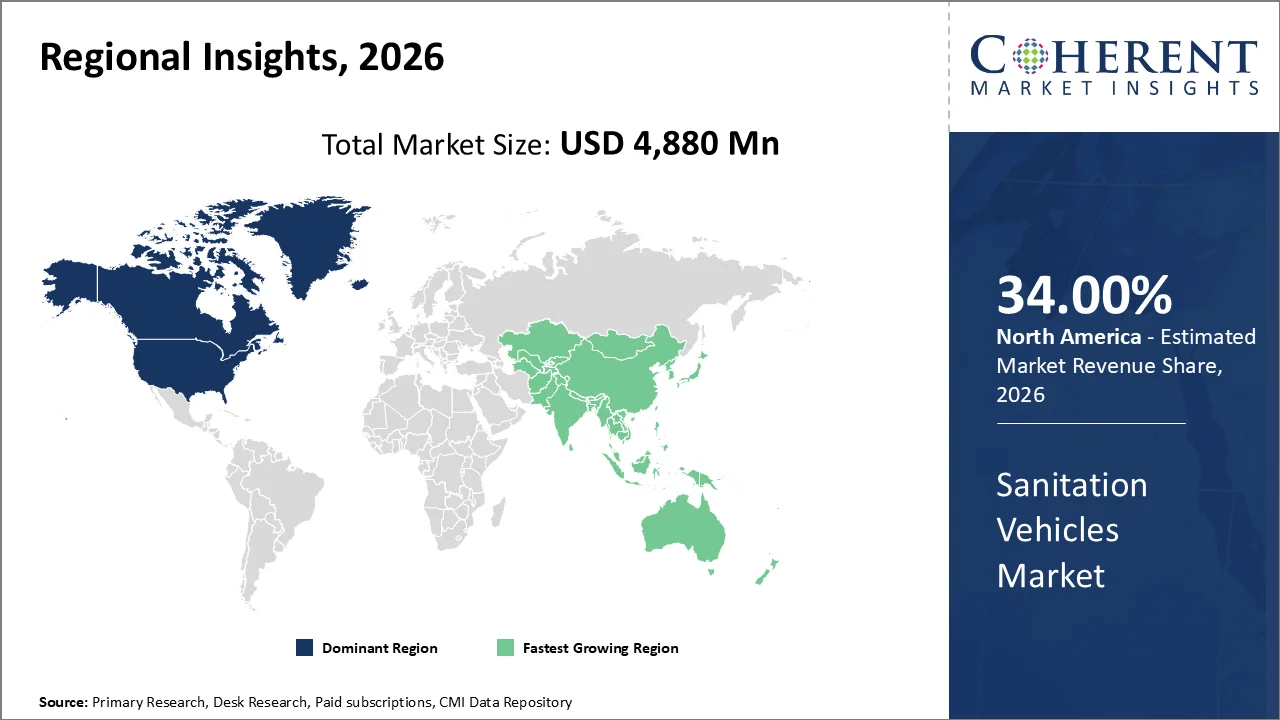
- North America is projected to capture the largest market share of 34% in 2026, driven by advanced waste management infrastructure, higher municipal spending, and rapid adoption of electric and automated sanitation vehicles. According to the U.S. Environmental Protection Agency (EPA), the United States alone generates over 290 million tons of municipal solid waste annually, necessitating advanced sanitation systems and fleet modernization.
Segmental Insights
Why do Garbage Collection Vehicles Acquire the Largest Market Share?
In the sanitation vehicle market, the maximum market share is expected to be held by the Garbage Collection Vehicles segment in the year 2026 at about 42%. The reason these vehicles have such a significant market share is that they are an important part of sanitation infrastructure in both developing and developed countries. They are also very important for municipalities' normal garbage collection. Urban areas have been growing, the population density has been rising, and so has the amount of solid garbage produced.
In January 2025, Oshkosh Corporation (McNeilus) unveiled the Volterra ZFL electric refuse collection vehicle, a fully integrated zero-emission garbage truck designed for municipal waste operations.
- Current Industry Events of 2026
- Market Size Estimation
- Regional Breakdown
- Competitive Landscape
- Customer Intelligence
- Segmental Analysis
- Pricing Analysis
- Key Market Drivers, Challenges & Future Trends
- Customized Insights Section
Which End User segment dominates the market?
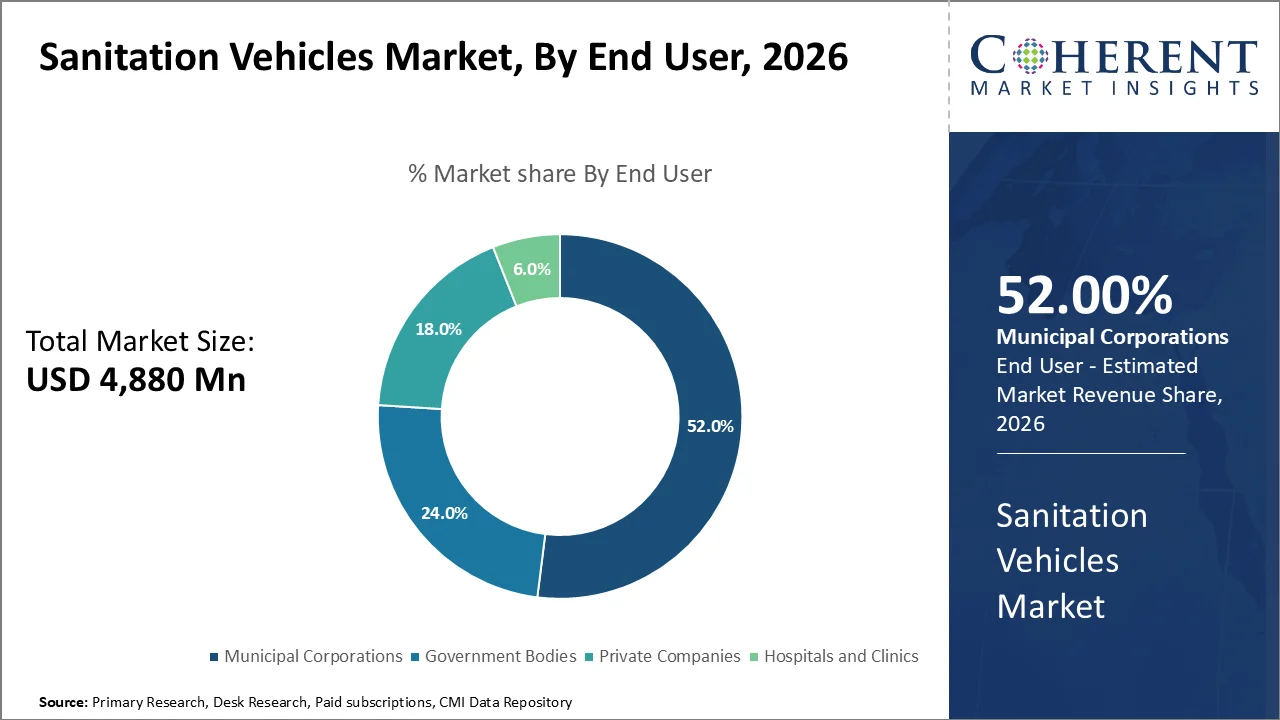
Municipal Corporation has the largest market share that is 52% and is mainly due to their contribution in ensuring cleanliness in urban areas. It owns maximum numbers of sanitation vehicles, and also it plays a major role in purchasing, distribution, and maintenance of waste management products.
The growing number of government initiatives like smart cities and missions for urban cleaning helps in strengthening the presence of Municipal Corporation in the market. New technologies used in sanitation vehicles comprise GPS, automation, and electrical drives.
In February 2026, Nagpur Municipal Corporation added 25 garbage collection vehicles along with fire and heavy-duty sanitation machines to strengthen door-to-door waste collection across city zones.
Rising Smart Waste Management Innovations are Transforming the Sanitation Vehicle Market in Urban Infrastructure
Innovations used in waste management strategies improve the efficiency of sanitation processes in urban settings. The implementation of new technologies and innovation in terms of sanitary methods has become a trend for numerous local governmental agencies and private firms owing to increased efficiency and savings. Implementation of IoT sensor technology in garbage management, GPS, and route optimization saves fuel. Electricity or hybrid fuel-driven sanitation vehicles are frequently encountered in cities.
In August 2025, Oshkosh Corporation introduced innovative electric garbage trucks and autonomous waste collection solutions, featuring AI-powered systems and next-generation automation technologies to enhance urban waste management efficiency.
Current Events and Their Impact on the Sanitation Vehicles Market
Current Event | Description and its Impact |
2026 Smart City Expansion & Municipal Fleet Electrification Programs (India, EU, U.S.) |
|
Improvement in Emission Standards and Requirements for Zero-Emissions (EU & California, 2025-2026) |
|
Sanitation Vehicles Market Trends
- Rising adoption of electric and zero emission sanitation trucks is revolutionizing municipal waste truck fleets around the world due to the stringent environmental laws and policies. Municipalities are increasingly replacing diesel fuel waste trucks with electric trucks to cut down carbon emissions.
- Utilization of technologies such as IoT, AI, and GPS in smart waste management will facilitate the efficiency of sanitation vehicle operations. Utilizing the GPS system along with other smart bins will be useful in saving costs on fuel as well as preventing overflows.
- Rapid deployment of smart city-based waste management infrastructure is leading to increased use of waste collection systems that are connected. Municipalities are using technology to monitor waste generation as well as manage their fleets.
- Government schemes such as smart cities, cleanliness campaigns, and emission standards have accelerated the pace of upgrading the fleet. The government is now more positive about the promotion of electric cars, digital tracking systems, and automatic garbage collectors.
Regional Insights
North America dominates owing to advanced sanitation infrastructure and rapid fleet modernization
North America will have the highest share of the market by 2026, which is estimated at 34% due to the existence of an efficient waste management program, high expenditure on public utilities, and having been among the first regions to employ electric cars as well as trucks for automated garbage collection. As of early 2026, SMC deploys more than 680 vehicles each day for door-to-door waste collection and transport. North America has strict environmental policies that aim at minimizing carbon emission and sustainable development.
Asia Pacific Sanitation Vehicles Market Trends
The Asia Pacific is expected to emerge as the highest growing region from 2026 to 2033, attributed to the high pace of urbanization, the rising production of municipal solid wastes, and extensive government funding towards smart cities and mobility solutions. Rapid urbanization (70% by 2050), sharp growth in municipal solid waste (3.8 billion tonnes by 2050), and multi-trillion-dollar smart city investments are collectively driving demand for advanced urban mobility and sanitation solutions globally. Countries like China, India, Japan, and Southeast Asia have invested substantially in sanitary facilities, leading to a rising demand for garbage trucks and street sweepers.
In March 2026, Switch Mobility (India) unveiled a new range of electric municipal vehicles including a 140 km electric garbage tipper at Municipalika 2026.
Growing Municipal Waste Pressure is Accelerating the Sanitation Vehicles Market Demand in the United States
The U.S. sanitation vehicle market has experienced significant growth rates due to increased garbage disposal activities in cities, municipal fleets replacement, and rapid technology adoption in relation to automation and electrical energy application for waste management purposes. Large US municipalities have been investing heavily in setting up new sanitation infrastructure facilities.
In January 2025, Oshkosh Corporation (McNeilus) launched the Volterra ZFL electric refuse collection truck in the USA. The vehicle is equipped with zero emissions, automated lifting mechanisms, artificial intelligence safety systems, and telematics capabilities. This product launch signals a shift toward electric and intelligent fleets in the sanitation departments of US cities.
Japan Sanitation Vehicles Market Forecast
The Japan sanitation vehicle industry is projected to experience moderate growth in the coming years due to high urbanization and aging rate, high efficiency in waste management processes, and heavy focus from the government on creating clean and smart cities. Almost 30% of Japan’s population comprises of aged people, which indicates continuous need for municipal wastes.
In October 2025, Mitsubishi Fuso Truck and Bus Corporation showcased next-generation electric and hydrogen-based sanitation vehicle thoughts at the Japan Mobility Show 2025 in Tokyo.
Who are the Major Companies in Sanitation Vehicles Industry
Some of the major key players in sanitation vehicles are Ceec Trucks Industry, Dongfeng Motor, Cheng Li, Curbtender, Cnhtc, Zoomlion, Foton car, Fujian Longma sanitation, Dennis Eagle, Labrie Enviroquip, Faun, McNeilus Truck & Manufacturing, EZ Pack, and Bridgeport Manufacturing.
Key News
- In March 2026, CEEC delivered 10 Isuzu ELF garbage compactor trucks to Nigeria, strengthening municipal waste collection fleets in West Africa.
- In January 2025, McNeilus Truck & Manufacturing (USA) launched the Volterra ZFL electric refuse collection truck in North America.
- In November 2025, CEEC supplied Isuzu rear loader and hook loader garbage trucks to Ecuador municipal operators, supporting urban sanitation modernization.
Market Report Scope
Sanitation Vehicles Market Report Coverage
| Report Coverage | Details | ||
|---|---|---|---|
| Base Year: | 2025 | Market Size in 2026: | USD 4,880 Mn |
| Historical Data for: | 2020 To 2024 | Forecast Period: | 2026 To 2033 |
| Forecast Period 2026 to 2033 CAGR: | 5.4% | 2033 Value Projection: | USD 7,050 Mn |
| Geographies covered: |
| ||
| Segments covered: |
| ||
| Companies covered: | Ceec Trucks Industry, Dongfeng Motor, Cheng Li, Curbtender, Cnhtc, Zoomlion, Foton car, Fujian Longma sanitation, Dennis Eagle, Labrie Enviroquip, Faun, McNeilus Truck & Manufacturing, EZ Pack, and Bridgeport Manufacturing | ||
| Growth Drivers: |
| ||
| Restraints & Challenges: |
| ||
Analyst Opinion
- Sanitation vehicles market is driven by unavoidable urban necessity rather than discretionary demand. Global municipal solid waste generation exceeds 2 billion tons annually and is expected to rise steadily with rapid urbanization. This waste production is increasing yearly due to urbanization, resulting in continual demand for sanitation vehicle services.
- Municipal corporations continue to be the major growth drivers in the market. More than 50% of sanitation vehicles purchased around the world today are purchased by municipal corporations that have upgraded their older fleets of diesel sanitation vehicles.
- Electrification along with integration of intelligent fleets is creating new dynamics in market competition. The industry data reveals an increasing trend for electric garbage trucks, where major OEMs are incorporating AI-assisted routing optimization, IoT-based tracking systems, and automated loading systems. Although the process is still at its nascent stage, it can be foreseen that the shift towards zero emission fleets will have far-reaching implications on procurement trends in the next few year.
Speak to the analyst
Want personalized insights?
Take the findings above to one of our principal consultants, or have the report rebuilt around the segments, geographies and competitors you actually track.
Market Segmentation
- By Type
- Garbage Collection Vehicles
- Street Sanitizing vehicles
- Street Sweeping Vehicles
- Hybrid Vehicles
- Others
- By End User
- Municipal Corporations
- Private Companies
- Hospitals and Clinics
- Government Bodies
- By Region
- North America
- U.S.
- Canada
- Latin America
- Brazil
- Mexico
- Argentina
- Rest of Latin America
- Europe
- Germany
- U.K.
- France
- Italy
- Spain
- Russia
- Rest of Europe
- Asia Pacific
- China
- India
- Japan
- Australia
- South Korea
- ASEAN
- Rest of Asia Pacific
- Middle East
- GCC
- Israel
- Rest of Middle East
- Africa
- South Africa
- Central Africa
- North Africa
- North America
Sources
Primary Research Interviews
- Municipal corporation officials
- Urban waste management authorities
- Sanitation fleet operators
- Waste management service providers (PPP contractors)
- OEM manufacturers (garbage trucks, street sweepers, EV sanitation vehicles)
- Fleet managers and logistics heads
- Smart city project consultants
- Key opinion leaders (KOLs) in urban infrastructure and waste management
Databases
- World Bank – Urban Development & Solid Waste Data
- United Nations Environment Programme (UNEP)
- OECD Environmental Statistics
- International Energy Agency (IEA) – Clean Energy & Transport Data
- U.S. Environmental Protection Agency (EPA)
- Eurostat (EU Waste Management Database)
- National government municipal and sanitation departments
Magazines
- Waste Advantage Magazine
- Waste Today Magazine
- Municipal Solid Waste Management Magazine
- Smart Cities World
- Environmental Science & Engineering Magazine
Journals
- Waste Management (Elsevier)
- Journal of Cleaner Production
- Resources, Conservation & Recycling
- Environmental Research Letters
- International Journal of Sustainable Transportation
Newspapers
- The New York Times
- The Guardian
- The Wall Street Journal
- The Times of India
- South China Morning Post
Associations
- International Solid Waste Association (ISWA)
- Solid Waste Association of North America (SWANA)
- European Waste Management Association (FEAD)
- United Nations Habitat (UN-Habitat)
- Clean Cities Coalition Network (U.S. DOE)
Public Domain Sources
- Company Annual Reports and Investor Presentations (Oshkosh, Volvo, FAUN, Dongfeng, Zoomlion, CNHTC, Foton)
- Government Smart City Mission Reports
- Municipal Waste Management Policy Documents
- Environmental Protection Agency (EPA) publications
- World Bank Urban Infrastructure Reports
- Open-access sustainability and climate action reports
Proprietary Elements
- CMI Data Analytics Tool
- Proprietary CMI Market Intelligence Repository (10+ years historical data)
- Internal sanitation vehicles shipment & fleet deployment database
- OEM-level pricing and contract tracking dataset
Get access to 250+ pages report
Every segment, forecast, competitor profile and data table behind the analysis above — available for instant download.
- ESOMAR Member
- ISO 9001:2015 Certified
- D-U-N-S Registered
- GDPR & CCPA Compliant
Missing comfort of reading report in your local language? Find your preferred language:
Transform your Strategy with Exclusive Trending Reports
Frequently Asked Questions
The Sanitation Vehicles Market is expected to surpass USD 7,050 Mn by 2033.
Major players operating in the global sanitation vehicles market include Oshkosh Corporation (McNeilus), CNHTC (Sinotruk), Dongfeng Motor, Zoomlion, Foton Motor, FAUN Umwelttechnik, Dennis Eagle, Labrie Enviroquip, Curbtender, Fujian Longma, CEEC Trucks Industry, Cheng Li, EZ Pack, and Bridgeport Manufacturing.
High capital investment required for electric and automated sanitation vehicles, along with limited charging infrastructure and high maintenance costs, are key factors restraining market growth.
Rising urbanization, increasing municipal solid waste generation, strict environmental regulations, and government smart city initiatives are major factors driving market growth.
The Sanitation Vehicles Market is anticipated to grow at a CAGR of around 5.4% between 2026 and 2033.
Among regions, North America is expected to hold the largest market share in 2026, driven by advanced waste management infrastructure and early adoption of electric sanitation vehicles.
Sanitation vehicles are specialized commercial vehicles used for waste collection, street cleaning, and urban sanitation management, including garbage trucks, street sweepers, and vacuum trucks.