

Hybrid Vehicles Market Size and Forecast: 2026 to 2033
Hybrid Vehicles Market is estimated to be valued at USD 777.68 Bn in 2026 and is expected to reach USD 2,597.25 Bn in 2033, exhibiting a compound annual growth rate (CAGR) of 18.8% from 2026 to 2033.
Key Takeaways
- By Hybrid Type, Full-Hybrid hold the largest market share of 35.7% in 2026 owing to the fuel efficiency & rising fuel costs.
- By Vehicle Type, Passenger Car expected to hold largest market share in 2026 owing to the fuel economy / rising fuel & operational costs.
- By Region, North America dominates the overall market with an estimated share of 42.2% in 2026 owing to the government regulations & incentives.
Market Overview
Consumers and governments are driving the rapid expansion of the hybrid vehicles market by prioritizing fuel efficiency, lower emissions, and sustainable mobility. Improved battery technology, regenerative braking, and efficient powertrains are enhancing performance and reliability, making hybrids a practical choice over conventional vehicles. Growing urbanization, rising fuel costs, and supportive government policies are encouraging adoption across passenger cars, SUVs, and commercial vehicles. Automakers are actively introducing a wider range of hybrid models to attract environmentally conscious buyers seeking cost-effective, convenient, and eco-friendly transportation.
Current Events and Its Impact on the Hybrid Vehicles Market
Current Events | Description and its impact |
|
Geopolitical and Regulatory Developments |
| · |
Technological Innovations and Supply Chain Dynamics |
| · |
Competitive Landscape and Industry Collaborations |
| · |
Segmental Insights

- Current Industry Events of 2026
- Market Size Estimation
- Regional Breakdown
- Competitive Landscape
- Customer Intelligence
- Segmental Analysis
- Pricing Analysis
- Key Market Drivers, Challenges & Future Trends
- Customized Insights Section
Hybrid Vehicles Market Insights, By Hybrid Type - Full Hybrid contribute the highest share of the market owing to its technological improvements and better performance
Full-Hybrid hold the largest market share of 35.7% in 2026. Consumers are increasingly driving the demand for full-hybrid vehicles as they seek a balance between fuel efficiency and convenience. Full hybrids combine self-charging electric systems with internal combustion engines, reducing fuel consumption and emissions without needing external charging. Rising environmental awareness, stricter emission regulations, and heavy urban traffic are making full hybrids especially appealing for city driving. Advances in battery technology and regenerative braking are boosting performance and reliability, while automakers actively expand hybrid offerings to provide diverse, practical, and sustainable options for everyday use. For instance, in November 2025, Toyota began producing the new Aygo X Hybrid at its Kolín plant, making it Europe’s first full hybrid in the A-segment and the non-plug-in car with the lowest CO₂ emissions. Such innovations are accelerating the hybrid vehicles industry demand
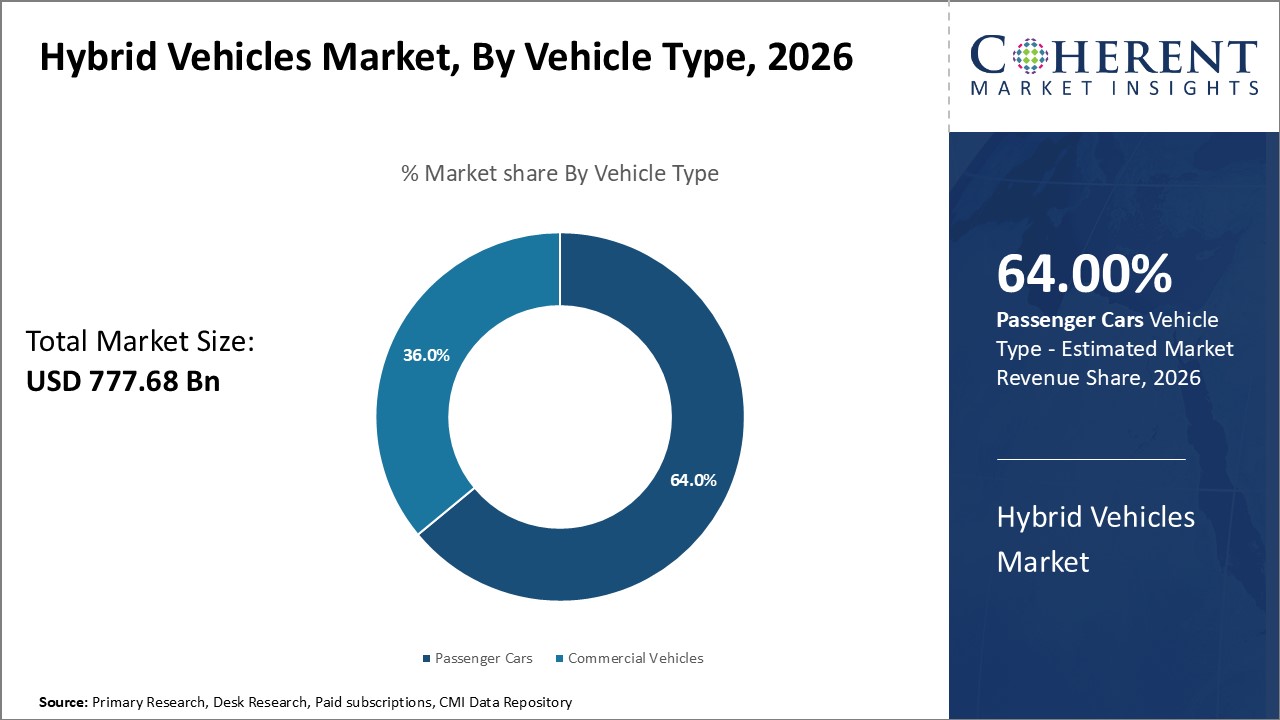
Hybrid Vehicles Market Insights, By Vehicle Type - Passenger Car contribute the highest share of the market owing to its rising disposable incomes
Consumers are driving the growth of hybrid passenger cars by seeking efficient, eco-friendly, and cost-effective transportation. Rising fuel costs and urban traffic congestion make buyers choose hybrids, which deliver lower emissions and better fuel economy. Governments encourage adoption through incentives and stricter environmental regulations, while advancements in batteries and powertrains improve performance and reliability. Automakers are actively launching a wider range of hybrid passenger models, offering practical and convenient options that satisfy sustainability goals and the changing preferences of modern urban drivers. For instance, in August 2025, Honda Cars India planned to launch five new SUVs by 2030. It will enter the EV market with a new SUV in 2026, add a hybrid option to the Elevate, and introduce a new 7-seater to compete with the Tata Safari and Mahindra XUV700.
Role of AI (Artificial Intelligence) in the Hybrid Vehicles Market
Automakers are transforming the hybrid vehicles market by integrating Artificial Intelligence (AI) to boost efficiency, safety, and performance. AI systems actively optimize energy use between electric motors and internal combustion engines, enhancing fuel economy and lowering emissions. AI-powered driver-assistance features, including adaptive cruise control and predictive braking, improve safety and driving comfort. Additionally, AI enables predictive maintenance, real-time diagnostics, and intelligent route planning, helping vehicles operate more efficiently. The industry increasingly leverages AI to develop smarter, more responsive, and sustainable hybrid vehicles. For instance, in June 2025, Geely unveiled its NordThor AI Electric Hybrid 2.0 powertrain, delivering major gains in fuel efficiency and driving range by integrating large AI models with advanced energy systems.
Regional Insights

North America Hybrid Vehicles Market Trends
North America dominates the overall market with an estimated share of 42.2% in 2026. Automakers and consumers in North America are increasingly adopting hybrid vehicles as they position them as a practical alternative between gas-only cars and full electric vehicles. Enhanced battery systems, efficient powertrains, and a growing lineup of hybrid SUVs and trucks attract buyers seeking reliability, fuel efficiency, and convenience. Governments encourage this shift through incentives, rising fuel costs, and stricter emission standards. Many drivers are favoring hybrids over fully electric models, valuing their practicality, familiarity, and flexibility for everyday driving. For instance, in March 2026, Nissan announced it will launch over 10 new and updated models in North America, each featuring next-generation technologies and a mix of powertrains, including e-POWER, plug-in hybrids, EVs, and advanced combustion engines, to attract more customers and strengthen its competitiveness.
Europe Hybrid Vehicles Market Trends
Automakers and consumers across Europe are increasingly adopting hybrid vehicles as a practical alternative between traditional petrol/diesel cars and fully electric vehicles. Advances in hybrid technology, growing environmental awareness, and stricter emissions and urban-driving regulations are encouraging buyers to choose hybrids for their fuel efficiency and lower emissions. Governments and regulators actively support this shift through policies and incentives promoting cleaner mobility. Meanwhile, automakers are expanding hybrid offerings across compact cars, SUVs, and city cars, providing consumers with flexible, sustainable, and cost-effective options. For instance, in February 2026, Lynk & Co announced the European launch of its 08 plug-in hybrid SUV, which offers a 200 km WLTP electric range—the longest in its segment—and supports DC fast charging.
United States Hybrid Vehicles Market Trends
American automakers and consumers are increasingly choosing hybrid vehicles as a practical step between conventional gasoline-powered cars and fully electric vehicles. Buyers favor hybrids because they save fuel, reduce emissions, and avoid the range anxiety and charging challenges associated with pure EVs. Growing interest is driven by improved hybrid drivetrains, a wider variety of models, and the declining appeal of EVs in certain segments. At the same time, hybrid registrations are rising as more drivers replace older vehicles with electrified alternatives. For instance, in November 2026, Toyota has started producing its first North American EV batteries in North Carolina, which will be shipped to plants in Alabama and Kentucky to power hybrid vehicles.
United Kingdom Hybrid Vehicles Market Trends
Automakers and consumers in the UK are increasingly adopting hybrid vehicles as a practical alternative to conventional petrol and diesel cars. Buyers are choosing hybrids due to lower running costs, rising fuel prices, and growing environmental awareness, favoring them over fully electric or traditional vehicles. Expanding model availability across compact cars, SUVs, and other segments enhances their appeal, providing flexibility without sacrificing affordability or convenience. As urban emissions regulations tighten and attitudes toward ICE vehicles shift, hybrids provide a balanced and accessible route to cleaner mobility. For instance, in June 2026, Chinese automaker BYD launched its cheapest model in the UK as part of its bid to surpass Tesla as the world’s largest electric carmaker, already outselling Tesla when hybrid vehicles are included.
End-user Feedback and Unmet Needs in the Hybrid Vehicles Market
- Reliability & Maintenance Concerns: Many hybrid‑vehicle owners report that the dual‑powertrain (engine + electric motor + battery) increases mechanical complexity, leading to occasional reliability issues, more costly maintenance and repair, and difficulty in diagnosing problems. Specialized servicing is often required, which can be a pain point for owners.
- High Up‑front Cost & Value Uncertainty: Though fuel savings appeal to buyers, the initial purchase price of hybrid vehicles remains significantly higher compared to conventional petrol/diesel cars — making many potential buyers reluctant. For some, the long‑term fuel and savings benefits are not yet convincing enough to offset the premium.
- Battery & Long‑Term Ownership Worries: Even though battery lifetimes and warranties have improved, many consumers remain apprehensive about battery degradation, replacement costs, and long‑term durability. This concern discourages some users, especially those uncertain about resale value and maintenance over many years.
Hybrid Vehicles Market Trend
Growing Shift Toward Fuel Efficiency and Pragmatism
Consumers — especially in India — are increasingly favoring hybrid vehicles as an efficient middle ground between traditional combustion‑engine cars and full EVs. Rising fuel costs and awareness of emissions are pushing buyers toward hybrids, as they deliver better mileage and lower emissions without the need for extensive charging infrastructure. The hybrid appeal lies in combining practicality (engine + electric motor) with savings and cleaner mobility — which resonates well among urban and semi-urban families.
Market Growth Driving OEMs to Expand Hybrid Lineups
Automakers that once focused primarily on petrol/diesel or EVs are now rapidly expanding their hybrid offerings. Brands are launching multiple hybrid models — including sedans, SUVs and MPVs — to tap rising consumer demand. This growing portfolio diversity signals that hybrids are becoming core to long-term product strategy. Such moves reflect evolving market dynamics and manufacturers’ efforts to stay aligned with shifting buyer preferences.
Hybrid Vehicles Market Opportunity
Infrastructure‑Friendly Alternative to Pure EVs
In places where charging infrastructure is inadequate — in smaller cities or semi-urban / rural areas — hybrids shine. They eliminate “range‑anxiety” and dependence on charging availability, yet deliver better fuel efficiency than pure ICE (internal combustion engine) cars. That makes them ideal for buyers who want cleaner driving but lack reliable access to EV charging. This gives hybrids a broad addressable market beyond just urban users.
Market Report Scope
Hybrid Vehicles Market Report Coverage
| Report Coverage | Details | ||
|---|---|---|---|
| Base Year: | 2025 | Market Size in 2026: | USD 777.68 Bn |
| Historical Data for: | 2020 To 2024 | Forecast Period: | 2026 To 2033 |
| Forecast Period 2026 to 2033 CAGR: | 18.8% | 2033 Value Projection: | USD 2,597.25 Bn |
| Geographies covered: |
| ||
| Segments covered: |
| ||
| Companies covered: | Toyota Motor Corporation, Nissan Motor Co. Ltd., Honda Motor Company Ltd., Hyundai Motor Company, Kia Motors Corporation, Daimler AG, Volvo Group, Volkswagen Group, BMW AG, Ford Motor Company, Mitsubishi Motors Corporation, and BYD Co. Ltd. | ||
| Growth Drivers: |
| ||
| Restraints & Challenges: |
| ||
Hybrid Vehicles Market News
- In December 2025, BYD launched its Sealion 6 plug-in hybrid SUV in Japan, priced from ¥3,982,000 (~USD 26,700), marking BYD Japan’s first PHEV and the country’s lowest-priced PHEV SUV.
- In October 2025, Maruti Suzuki India plans to launch its first small hybrid car—likely the Fronx compact SUV with an in-house strong hybrid powertrain.
- In December 2025, Lotus filed official approval documents in China for its new plug-in hybrid SUV, the Lotus “For-Me,” marking the first PHEV version of the Eletre SUV
Analyst Opinion (Expert Opinion)
- The present trend in India demonstrates that hybrids are no longer a niche compromise but have become a core part of automakers’ strategy. In the first quarter of FY2026, sales of strong‑hybrid electric vehicles more than doubled — from ~12,111 units in Q1 FY2025 to ~26,460 in Q1 FY2026. This dramatic growth suggests that buyers are recognizing hybrids not just for fuel‑efficiency but also for reliability in a market still challenged by charging‑infrastructure gaps.
- Moreover, the consumer preference appears to be shifting decisively toward hybrid vehicles: a recent survey across Indian cities showed that 38 % of prospective car buyers picked hybrids as their preferred festive‑season purchase, ahead of petrol vehicles and pure electric cars. This reveals a latent demand for “transitional” green mobility — buyers seem comfortable with hybrid technology that blends familiar ICE engines and electric power, avoiding “range anxiety” that still plagues EV adoption.
- From an industry standpoint, hybrids offer automakers a pragmatic path for compliance with upcoming stricter fuel‑efficiency and emissions norms without requiring a full‑scale shift to battery‑electric models. Several major OEMs — previously conservative about hybridization — are now actively launching hybrid variants, signalling that hybrids will play a strategic role in balancing regulatory compliance, consumer demand, and production feasibility.
- Recent data suggest that in FY2025, electric vehicles (EVs) overtook hybrids in overall passenger‑vehicle sales volume in India — marking a critical inflection point. As charging infrastructure expands and battery costs drop, EVs risk eroding the hybrid market’s advantage. This transition could pressure hybrid adoption unless hybrids evolve — for example by offering better fuel economy, lower ownership cost, or plug‑in capability.
- Apart from this, hybrids presently occupy a pivotal “bridge” role between conventional ICE vehicles and full electrification. Given uncertainties around charging infrastructure, battery supply chains, and consumer comfort with EVs, hybrids represent a practical, scalable compromise — especially in urbanizing yet infrastructure-limited regions. However, sustaining this position will demand continuous innovation, cost‑effective hybrid platforms, and clearly communicated value propositions from OEMs.
Speak to the analyst
Want personalized insights?
Take the findings above to one of our principal consultants, or have the report rebuilt around the segments, geographies and competitors you actually track.
Market Segmentation
- Global Hybrid Vehicles Market, By Hybrid Type
- Micro-hybrid
- Mild-hybrid
- Full-hybrid
- Plug-in Hybrid
- Global Hybrid Vehicles Market, By Vehicle
- Passenger Cars
- Commercial Vehicles
- Regional Insights (Revenue, USD Bn, 2021 - 2033)
- North America
- U.S.
- Canada
- Latin America
- Brazil
- Argentina
- Mexico
- Rest of Latin America
- Europe
- Germany
- U.K.
- Spain
- France
- Italy
- Russia
- Rest of Europe
- Asia Pacific
- China
- India
- Japan
- Australia
- South Korea
- ASEAN
- Rest of Asia Pacific
- Middle East
- GCC Countries
- Israel
- Rest of Middle East
- Africa
- South Africa
- North Africa
- Central Africa
- North America
- Key Players Insights
- Toyota Motor Corporation
- Nissan Motor Co. Ltd.
- Honda Motor Company Ltd.
- Hyundai Motor Company
- Kia Motors Corporation
- Daimler AG
- Volvo Group
- Volkswagen Group
- BMW AG
- Ford Motor Company
- Mitsubishi Motors Corporation
- BYD Co. Ltd.
Sources
Primary Research interviews
- Interviews with automotive engineers and R&D heads of hybrid vehicle manufacturers
- Discussions with supply chain managers in battery and electric motor production
- Interviews with fleet managers using hybrid vehicles
- Insights from government officials in transport and energy ministries
Databases
- International Energy Agency (IEA) databases
- U.S. Department of Energy (DOE) vehicle and fuel data
- European Environment Agency (EEA) statistics
- National Highway Traffic Safety Administration (NHTSA) vehicle registrations
- World Bank transport and energy statistics
Magazines
- Automotive Engineering Magazine
- Green Car Reports
- Electric & Hybrid Vehicle Technology International
- AutoWeek
Journals
- International Journal of Automotive Technology
- Journal of Cleaner Production
- Transportation Research Part D: Transport and Environment
- Energy Policy
Newspapers
- The New York Times – Automotive Section
- The Guardian – Transport and Environment Section
- Financial Times – Automotive Industry Section
- The Wall Street Journal – Energy & Automotive
Associations
- Society of Automotive Engineers (SAE)
- Electric Drive Transportation Association (EDTA)
- International Council on Clean Transportation (ICCT)
- Alliance for Automotive Innovation
Public Domain sources
- Government reports on emissions standards and incentives
- Patent filings for hybrid vehicle technologies
- Public corporate filings of automotive manufacturers
- Technical standards published by ISO and IEC
Proprietary Elements
- CMI Data Analytics Tool
- Proprietary CMI Existing Repository of information for last 8 years
Get access to 250+ pages report
Every segment, forecast, competitor profile and data table behind the analysis above — available for instant download.
- ESOMAR Member
- ISO 9001:2015 Certified
- D-U-N-S Registered
- GDPR & CCPA Compliant
Missing comfort of reading report in your local language? Find your preferred language:
Transform your Strategy with Exclusive Trending Reports
Frequently Asked Questions
The Hybrid Vehicles Market is estimated to be valued at USD 777.68 Bn in 2026, and is expected to reach USD 2,597.25 Bn by 2033.
The CAGR of the Hybrid Vehicles Market is projected to be 18.8% from 2026 to 2033.
Government initiatives and positive impact of hybrid vehicles on environment are fuelling the market.
The Full Hybrid segment is the leading segment in the market.
High cost and shortage of suitable EV infrastructure are the major factors restraining growth of the market.
Toyota Motor Corporation, Nissan Motor Co. Ltd., Honda Motor Company Ltd., Hyundai Motor Company, Kia Motors Corporation, Daimler AG, Volvo Group, Volkswagen Group, BMW AG, Ford Motor Company, Mitsubishi Motors Corporation, and BYD Co. Ltd.