

Automotive Transmission Systems Market Size and Forecast — 2026-2033
The Global Automotive Transmission Systems Market size is estimated to be valued at USD 78.05 billion in 2026 and is expected to reach USD 132.03 billion by 2033, exhibiting a compound annual growth rate (CAGR) of 7.8% from 2026 to 2033.
Overview
Automotive transmission systems are mechanical components that transfer power from the engine to the drive wheels while controlling vehicle speed and torque. Products include manual transmissions, automatic transmissions, continuously variable transmissions (CVTs), and dual-clutch systems. Advanced transmission systems incorporate electronic controls and smart software for optimized fuel efficiency, performance, and driver comfort. The market serves passenger vehicles, commercial vehicles, and electric and hybrid vehicles, with a focus on durability, efficiency, and emission reduction.
Key Takeaways
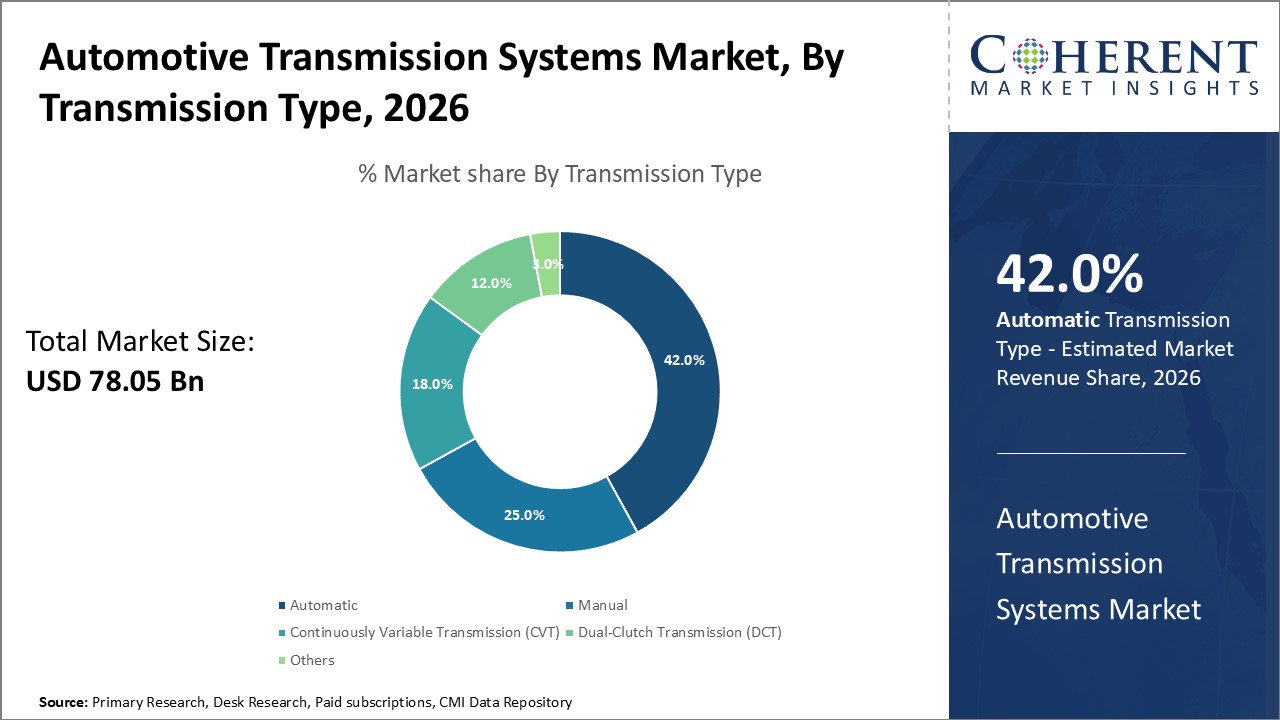
Automotive Transmission Type segment highlights: Automatic transmissions retain a leading 42% market share, driven by their rising incorporation in hybrid vehicles, whereas CVT units are the fastest-growing subsegment owing to superior fuel efficiency attributes. Manual transmissions continue to hold relevance due to cost-effectiveness but at a declining growth rate.
Vehicle Type segment reflects robust growth in the Electric Vehicles category, propelled by government subsidies and increasing consumer adoption; Passenger Cars dominate industry share due to volume production, while Commercial Vehicles capture growing interest with advanced transmission solutions tailored for heavy-duty applications.
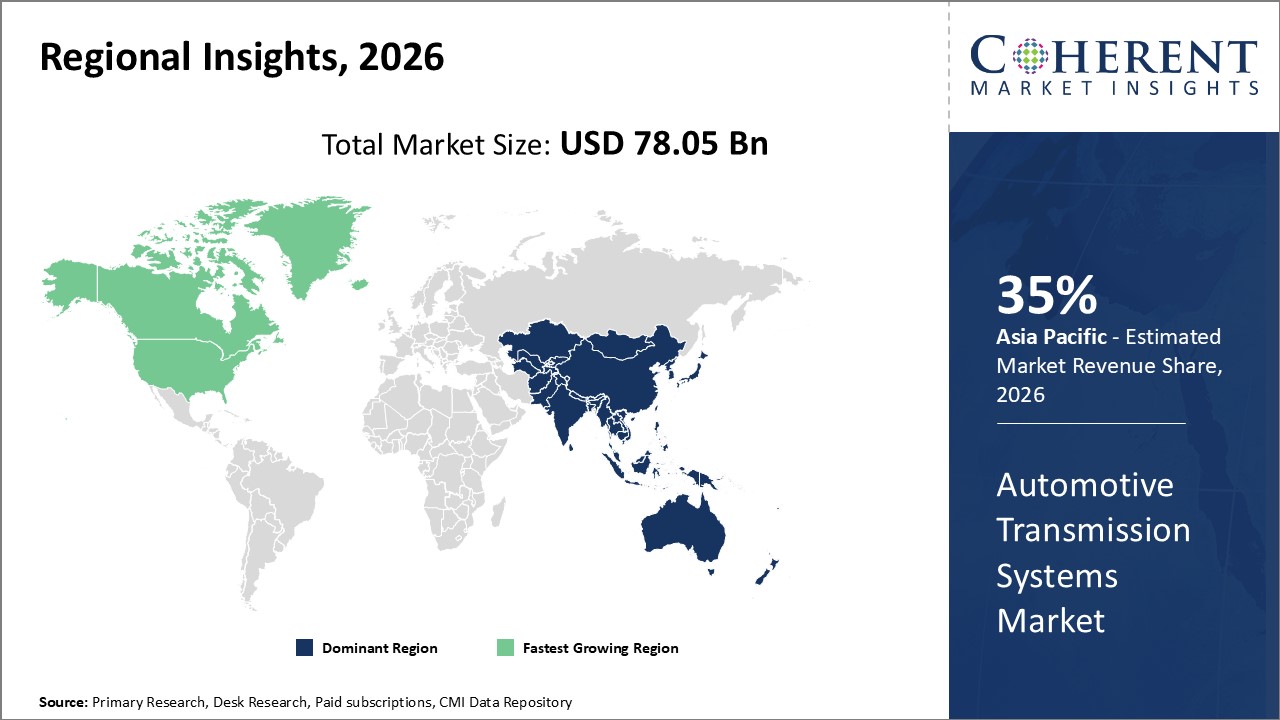
Asia Pacific leads regionally with over 35% market share, bolstered by manufacturing hubs in China and India and supportive government policies promoting electrification and export-oriented growth. Meanwhile, North America is the fastest-growing region at a CAGR of approximately 8.2%, driven by innovation in automated transmissions and EV penetration. Europe remains a steady market focusing on emission compliance and luxury vehicle segment transmissions.
Automotive Transmission Systems Market Segmentation Analysis
Automotive Transmission Systems Market Insights, By Transmission Type
In terms of Transmission Type, Automatic transmissions dominate with 42% market share. Automatic transmissions are favored for their seamless gear shifts and are increasingly integrated into hybrid vehicles for improved fuel economy and driving comfort. CVTs represent the fastest-growing subsegment, driven by their superior efficiency and adaptability in passenger cars, particularly in Japan and Asia Pacific markets. Manual transmissions remain prevalent in cost-sensitive regions but are shrinking in market relevance due to rising consumer preference for automated options.
Automotive Transmission Systems Market Insights, By Vehicle Type
Passenger Cars hold the largest industry share, supported by volume production and consistent demand worldwide. Electric Vehicles, however, are the fastest-growing segment, stimulated by electrification mandates and consumer preference for cleaner technologies. Hybrid Vehicles are also witnessing rapid uptake due to transitional fuel efficiency benefits. Commercial Vehicles demand durable and high-capacity transmissions designed to support heavier payloads and diverse operational environments.
Automotive Transmission Systems Market Insights, By Components
Gearbox remains the dominating subsegment due to its critical role in defining vehicle performance, accounting for the majority of transmission system revenue. Control Systems are the fastest-growing component driven by increasing electronic integration for adaptive shifting and energy management, crucial in EV and hybrid powertrains. Clutch components maintain relevance mainly in manual and automated manual transmissions, although their growth is moderate as automated systems gain traction.
Automotive Transmission Systems Market Trends
The automotive transmission systems market continues its shift toward electrification with increasing integration of multi-speed transmissions in EVs and hybrids that offer improved efficiency and driving dynamics.
Advancements in electronic control units (ECUs) enable adaptive transmission behavior, exemplified by Hyundai Mobis’s smart transmission controlling power delivery in real-time, reducing energy loss significantly.
Increasing urban congestion and environmental regulations incentivize the development of CVTs that optimize fuel consumption through seamless gear ratios, evident from a 23% uptick in CVT adoption in Japan in 2026.
Moreover, lightweight material usage reduces system weight and enhances vehicle performance, with aluminum-based transmissions becoming standard in many passenger vehicles.
Automotive Transmission Systems Market Insights, By Geography
Asia Pacific Automotive Transmission Systems Market Analysis and Trends
Asia Pacific currently holds a dominant 35% share in the automotive transmission systems market, largely owing to robust automotive manufacturing bases in China, India, Japan, and South Korea. Government initiatives encouraging local production and electric vehicle adoption, along with export-driven automotive supply chains, underpin this leadership. Major companies like JATCO and Aisin Seiki have significantly invested in this region, accelerating technological advancements and production efficiencies.
North America Automotive Transmission Systems Market Analysis and Trends
North America is poised for the fastest growth with a CAGR of approximately 8.2%, fueled by intensified research in automated and multi-speed transmissions for electric and commercial vehicles. The U.S. market benefits from supportive federal emission regulations and incentives fostering adoption of advanced transmission technologies. Companies such as BorgWarner and Allison Transmission have launched new product lines tailored for electric trucks and commercial applications, driving dynamic growth in the region.
Automotive Transmission Systems Market Outlook for Key Countries
USA Automotive Transmission Systems Market Analysis and Trends
The United States remains a critical hub for automotive transmission systems innovation and deployment, supported by stringent emissions standards and rising EV adoption. In 2026, the U.S. accounted for over 28% of North America’s market revenue with notable contributions from companies like BorgWarner and Allison Transmission, which introduced advanced automated transmissions tailored for electric trucks and hybrid commercial vehicles. Federal programs incentivizing fuel-efficient vehicle manufacturing have also accelerated growth, propelling business strategies focused on lightweight materials and integrated control systems.
China Automotive Transmission Systems Market Analysis and Trends
China’s automotive transmission systems market is characterized by high production volume and rapid electrification. With over 30% of the Asia Pacific market share, China remains the world’s largest automotive producer and consumer, deeply influencing market trends. Companies such as JATCO and Aisin have substantial manufacturing presence in China, continually scaling operations to meet increasing domestic demand for hybrid and electric vehicles. Government mandates aiming at a 25% share of NEVs (New Energy Vehicles) in new car sales by 2026 have driven rapid adoption of advanced transmission systems tailored for these vehicles, supporting robust business growth in the region.
Analyst Opinion
Increasing production capacity in Asia Pacific has been a significant supply-side indicator; for example, India’s transmission component manufacturing expanded by over 12% in 2025, boosting export potential and regional market share. This enhancement is aligned with automotive OEMs’ expansion plans, driving the overall market revenue upwards.
On the demand side, the rising penetration of dual-clutch and continuously variable transmissions (CVTs) in passenger vehicles has catalyzed higher market growth. In 2026, CVT-equipped vehicles accounted for approximately 29% of new passenger cars in Japan, demonstrating a clear preference for smoother driving experiences and better fuel efficiency.
Pricing evolution has also played a role; the trend toward lightweight aluminum and composite transmission components has reduced system costs by an estimated 5–8% annually since 2023, supporting accelerated adoption without compromising durability.
Diverse use cases, particularly within commercial vehicles and electric trucks in North America, have propelled the integration of advanced multi-speed transmissions. Tesla’s introduction of a multi-speed transmission for its electric semi-truck in late 2025 reflects growing market demand for versatile systems capable of handling various load and speed requirements.
- Current Industry Events of 2026
- Market Size Estimation
- Regional Breakdown
- Competitive Landscape
- Customer Intelligence
- Segmental Analysis
- Pricing Analysis
- Key Market Drivers, Challenges & Future Trends
- Customized Insights Section
Market Scope
| Report Coverage | Details | ||
|---|---|---|---|
| Base Year: | 2025 | Market Size in 2026: | USD 78.05 billion |
| Historical Data for: | 2020 To 2024 | Forecast Period: | 2026 To 2033 |
| Forecast Period 2026 to 2033 CAGR: | 7.8% | 2033 Value Projection: | USD 132.03 billion |
| Geographies covered: |
| ||
| Segments covered: |
| ||
| Companies covered: | ZF Friedrichshafen AG, Aisin Seiki Co., Ltd., BorgWarner Inc., JATCO Ltd., Getrag (Magna Powertrain), Honeywell International Inc., Eaton Corporation, Schaeffler AG, Hyundai Mobis, AAM (American Axle & Manufacturing), Valeo SA, Allison Transmission Holdings Inc., Dana Incorporated. | ||
| Growth Drivers: |
| ||
Automotive Transmission Systems Market Growth Factors
Key factors driving the automotive transmission systems market growth include: increasing demand for fuel-efficient transmission technologies resulting from stringent emissions regulations globally; the penetration of electric and hybrid vehicles pushing manufacturers toward innovative transmission solutions compatible with electric powertrains; and technological advancements in automated transmissions enhancing driving comfort and safety features. For instance, in 2025, China introduced new fuel economy standards, which accelerated CVT adoption by more than 20% among passenger cars. Additionally, ongoing research in lightweight materials is reducing transmission system weight by up to 15%, contributing to enhanced vehicle performance and reduced emissions. Urbanization and rising vehicle ownership in developing markets further broaden the addressable market scope and revenues.
Automotive Transmission Systems Market Development
In 2025, Skoda Auto and Volkswagen India announced that by 2026 several of their India-market 2.0 models (including Kushaq, Slavia, Taigun, and Virtus) will receive a new 8-speed torque converter automatic transmission (sourced from Aisin). This is meant to replace the existing 6-speed automatic (AQ250), improving performance, driving comfort, and fuel efficiency, especially under the upcoming stricter fuel-economy / emissions norms.
In 2025, Tata Motors launched its Curvv SUV lineup and introduced a 7-speed dual-clutch automatic (DCT) option for its 1.5-litre diesel variant. This marks the first time a mass-market SUV segment in India combines a diesel engine with a DCT, aiming to give drivers smoother shifting and better efficiency in a competitive segment.
Key Player
Leading companies of the market:
ZF Friedrichshafen AG
Aisin Seiki Co., Ltd.
BorgWarner Inc.
JATCO Ltd.
Getrag (Magna Powertrain)
Honeywell International Inc.
Schaeffler AG
Hyundai Mobis
AAM (American Axle & Manufacturing)
Allison Transmission Holdings Inc.
Dana Incorporated
Several market players have adopted competitive strategies that have reshaped the industry landscape. ZF Friedrichshafen’s announcement in 2025 of a new generation 8-speed automatic transmission designed specifically for hybrid vehicles has increased its market presence in the Asia Pacific region by 15% year-over-year. BorgWarner’s strategic expansion into transmission control electronics in 2023 yielded a 9% increase in business growth by aligning with electric powertrain manufacturers. Meanwhile, JATCO has leveraged cost leadership by optimizing its production lines in India, reducing production costs by nearly 8%, which enhanced its competitiveness in emerging Asian markets.
Automotive Transmission Systems Market Future Outlook
The market is expected to grow strongly with the increasing adoption of hybrid and electric vehicles, stringent emission norms, and consumer demand for enhanced fuel efficiency. Advanced transmission systems with integrated electronic controls, adaptive learning, and AI-based optimization will play a key role in improving performance and reducing emissions. Lightweight materials, durability improvements, and energy-efficient designs will continue to shape product development. The push for global automotive electrification and next-generation vehicle technologies will further drive the adoption of advanced transmission solutions across passenger and commercial vehicle segments.
Automotive Transmission Systems Market Historical Analysis
The automotive transmission systems market has transitioned from conventional manual gearboxes to advanced automatic, continuously variable (CVT), and dual-clutch transmission systems. Historically, manual transmissions dominated due to lower production costs, but rising consumer demand for enhanced fuel efficiency, smoother driving experiences, and superior performance accelerated the adoption of automatic and electronically controlled transmissions. The emergence of hybrid and electric vehicles introduced further complexity, requiring advanced transmission solutions that integrate electronic controls and optimize torque, power delivery, and energy efficiency. Technological advancements and increasing regulatory focus on emission reduction have significantly influenced transmission system innovation.
Sources
Primary Research interviews:
Automotive Design Engineers
Powertrain Specialists
Transmission Component Manufacturers
Vehicle Testing Analysts
Databases:
Society of Automotive Engineers (SAE)
International Organization of Motor Vehicle Manufacturers (OICA)
Magazines:
Automotive World
Transmission Digest
Automotive Engineering
Auto Tech Review
Journals:
SAE International Journal of Engines
International Journal of Automotive Technology
Journal of Mechanical Design
Vehicle System Dynamics
Newspapers:
Automotive News
The Economic Times (Auto)
The Hindu Business Line (Automotive)
Financial Times (Mobility)
Associations:
Society of Automotive Engineers (SAE)
International Automotive Task Force (IATF)
Automotive Component Manufacturers Association (ACMA)
European Automobile Manufacturers Association (ACEA)
Get access to 250+ pages report
Every segment, forecast, competitor profile and data table behind the analysis above — available for instant download.
- ESOMAR Member
- ISO 9001:2015 Certified
- D-U-N-S Registered
- GDPR & CCPA Compliant
Missing comfort of reading report in your local language? Find your preferred language:
Transform your Strategy with Exclusive Trending Reports
Frequently Asked Questions
The market is dominated by leading companies including ZF Friedrichshafen AG, Aisin Seiki Co., BorgWarner Inc., and JATCO Ltd., which have substantial manufacturing capabilities and hold significant market share globally.
The market is projected to grow from USD 78.05 billion in 2026 to approximately USD 132.03 billion by 2033, driven by increased production of electric and hybrid vehicles and advanced transmission technologies.
Passenger cars currently dominate the market; however, electric vehicles and commercial vehicles are emerging as high-growth sectors due to evolving powertrain requirements and stricter emissions regulations.
The market will witness a sustained transition toward electrified transmissions, smart control systems, and lightweight materials, supported by government incentives aimed at reducing vehicular emissions globally.
Competition centers on technology innovation, cost-efficiency, and supply chain optimization. Challenges include adapting legacy manufacturing facilities for electric transmission components and volatile raw material prices.
Strategies focus on forging OEM partnerships, expanding production capacities in emerging markets, and investing in R&D for next-generation transmissions such as electrified and automated systems.