

Start-stop Battery Market Size and Share Analysis - Growth Trends and Forecasts (2026 - 2033)
The Start-stop Battery Market is anticipated to grow at a CAGR of 22.9% with USD 14.6 Bn share in 2026 and is expected to reach USD 61.3 Bn in 2033. The global Start‑Stop Battery Market is gaining traction as vehicle manufacturers integrate stop‑start systems to enhance efficiency and meet evolving fuel economy standards. According to the 2025 EPA Automotive Trends Report published in February 2026, stop‑start technology was installed in about 58 % of all new gasoline non‑hybrid vehicles in model year 2024 an indicator of widespread adoption ahead of 2026. Regulatory emphasis on reducing idle fuel use and lowering emissions continues to support advanced AGM and EFB battery demand, while OEMs and aftermarket channels expand offerings in response to growing global environmental and efficiency priorities.
Source: U.S. EPA
Key Takeaways
- Lead-acid Battery is expected to account the largest share of 88.7% in 2026, because AGM and EFB variants provide affordable high-cranking power, proven safety, wide OEM/aftermarket availability, and mature recycling infrastructure. EPA’s Automotive Trends Report, published in February 2026, reported stop-start systems in 58% of new gasoline non-hybrid vehicles in model year 2024, while BCI’s 2023 study cited 99% U.S. lead-battery recycling rate.
- Conventional vehicle will dominate with 68.2% in 2026, because internal combustion engine (ICE) cars still constitute the majority of global vehicle registrations, with petrol/diesel vehicles far outnumbering electrified models in key markets. Data from the 2025 EPA Automotive Trends Report, published February 2026, shows widespread adoption of non‑hybrid stop‑start tech across conventional ICE light‑duty vehicles in model year 2024, reflecting their continued prevalence.
Source: Epa.gov
- Europe is expected to acquire the dominant share of 38.0% in 2026, due to strict emissions standards and high adoption of micro‑hybrid technologies in conventional and electrified vehicles. According to the ACEA “Vehicles on European roads 2026” report, published January 15, 2026, Europe had 256 million cars on its roads in 2024, underpinning strong demand for efficiency‑boosting start‑stop systems amid regulatory and consumer efficiency priorities. Europe leads the start‑stop battery market due to stringent CO₂ emission performance standards and environmental policy drivers that boost efficiency technologies in conventional vehicles. European Commission data published February 2026 shows average CO₂ emissions from new passenger cars in the EU fell 28% between 2019 and 2024, underpinning strong demand for stop‑start systems to meet regulatory targets and reduce fuel use.
Increasing demand for AGM and EFB batteries
The increasing demand for AGM (Absorbent Glass Mat) and EFB (Enhanced Flooded Battery) types is driving the start‑stop battery market growth because advanced regulatory frameworks emphasize battery sustainability, performance, and lifecycle management across Europe and other markets. For instance, in August 2023, the European Commission’s Batteries Regulation, which entered into force and continues evolving through 2026, strengthens requirements for safer, more durable batteries placed on the EU market, promoting innovation in automotive battery technologies that support micro‑hybrid start‑stop systems. This regulatory push encourages automakers to adopt higher‑performance AGM and EFB variants that can handle frequent engine cycling while meeting stricter environmental and safety standards, bolstering market demand and technological investment in start‑stop battery solutions. The regulation’s ongoing implementation reflects broader official efforts to make batteries more efficient, sustainable, and compliant with circular‑economy goals, indirectly supporting the wider adoption of advanced lead‑acid chemistries in 2026 and beyond.
Source: European Commission; Baker McKenzie
Integration of AI and Smart Technologies is Revolutionizing the Start-Stop Battery Market
The integration of AI and smart technologies is accelerating growth in the start‑stop battery market by enabling advanced battery management and predictive analytics that enhance reliability and efficiency. For instance, in April 2026, government initiatives such as the U.S. EPA’s 2025 AI Use Case Inventory, illustrate official recognition of AI’s expanding role across sectors, including energy and emissions reduction systems where AI can optimize component performance and lifespan. Meanwhile, regulatory frameworks like the EU’s AI Act, progressing toward full applicability by August 2026, promote the safe deployment of AI across industries, encouraging innovation in smart vehicle systems that monitor battery health, optimize start‑stop sequences, and reduce energy waste. As AI‑driven diagnostics and real‑time optimization become embedded in modern vehicles, OEMs and aftermarket providers increasingly adopt intelligent battery solutions, boosting adoption of start‑stop systems that align with efficiency, emissions, and performance goals.
- Current Industry Events of 2026
- Market Size Estimation
- Regional Breakdown
- Competitive Landscape
- Customer Intelligence
- Segmental Analysis
- Pricing Analysis
- Key Market Drivers, Challenges & Future Trends
- Customized Insights Section
Current Events and Their Impact on the Start-stop Battery Market
Current Event | Description and its Impact |
EU Tightens Emissions Type‑Approval Rules in 2026 |
|
India Advances Fuel Efficiency Norms (CAFE‑III) Draft in 2026 |
|
Germany Launches EV Purchase Grants from January 2026 |
|
Increasing Government Initiative and Support |
|
UK Proposes Stricter Euro 7 Emission Standards for New Vehicles |
|
India Mandates Real‑World Fuel Efficiency Testing from October 2026 |
|
Segmental Insights
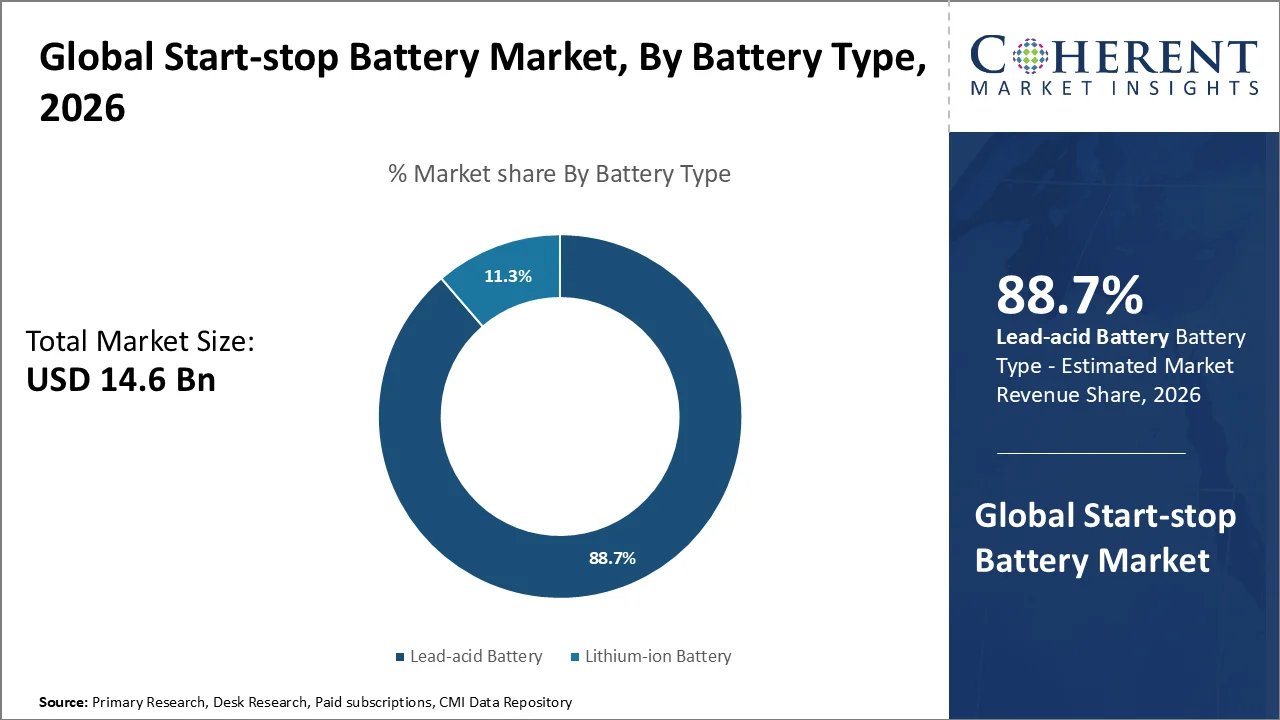
Why is Lead-acid Battery Acquiring the Largest Market Share?
Lead-acid Battery is projected to account for the largest share of start-stop battery market in 2026, representing approximately 88.7% of the total volume. Lead‑acid batteries continue to dominate the start‑stop automotive battery segment largely because they provide high surge current necessary to restart internal combustion engines, a capability deeply documented in public‑domain technical literature and standards defining automotive battery functions. Lead‑acid starter batteries are designed to supply very high current outputs (hundreds of amps) needed for cold‑cranking and repeated micro‑starts, which is essential for engine stop‑start systems where the alternator may not always be charging the battery continuously. Their established global manufacturing and recycling infrastructure, recognized by the European automotive industry as a closed‑loop circular economy with very high collection and reuse rates, further supports their continued usage in mass‑market vehicles despite alternatives emerging. Moreover, lead‑acid technology is low‑cost, widely understood, and robust across a broad range of temperatures and service conditions, characteristics confirmed by public descriptions of lead‑acid battery properties. This combination of performance, cost, and mature ecosystem underpins its dominance in start‑stop applications as of 2026.
Moreover, Official EU waste statistics show that all EU countries achieved at least 65 % recycling efficiency for lead‑acid batteries in 2023, with many reporting efficiencies above 80 %, demonstrating robust legal frameworks that support closed‑loop reuse of materials. Under the EU Battery Regulation (Regulation 2023/1542), binding targets require 75 % minimum recycling efficiency for lead‑acid batteries by end‑2025, underscoring governments’ focus on circularity for this technology. These numeric benchmarks from government and regulatory sources confirm why, as of 2026, lead‑acid remains the dominant start‑stop battery technology in mainstream vehicles.
Source: European Commission; EUR-Lex
Conventional Vehicle holds the Largest Market Share
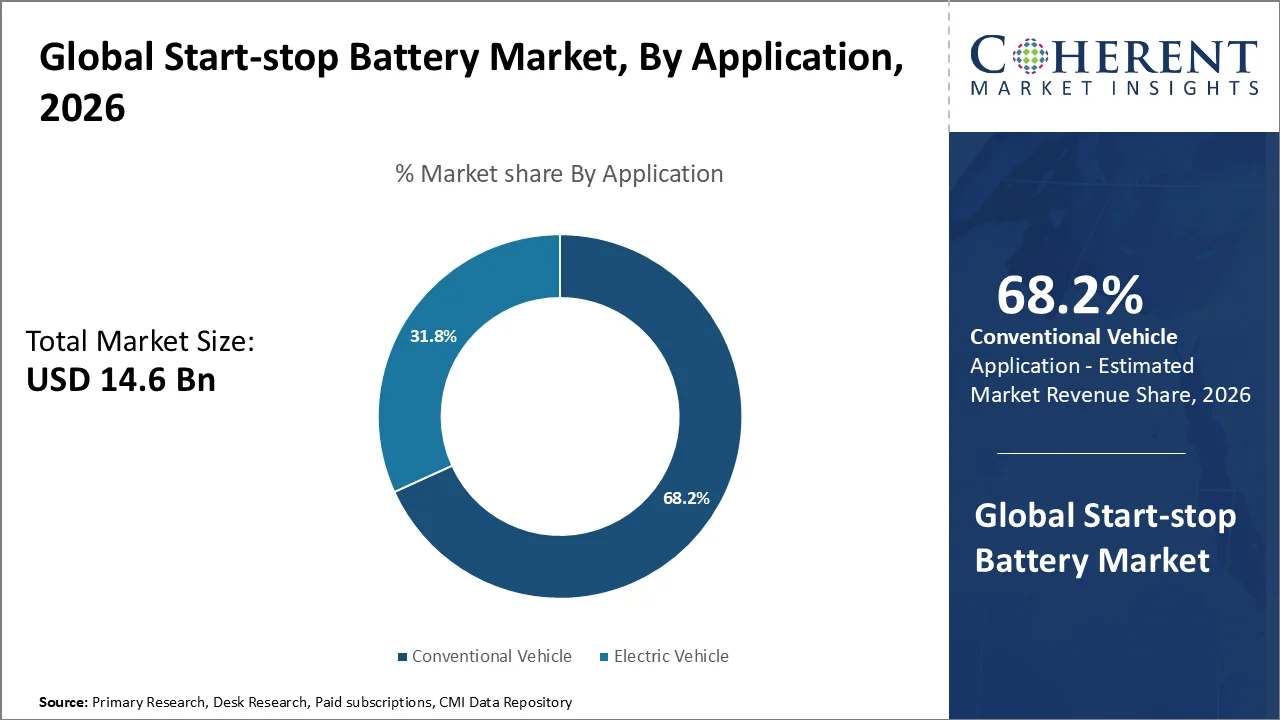
Conventional vehicle dominates the market, accounting for a significant 68.2% share in 2026. In 2026, the Conventional Vehicle segment remains dominant in the Start‑Stop Battery market primarily because auto makers worldwide continue to equip internal combustion engine (ICE) vehicles with idling shutdown technology to meet regulatory fuel‑economy and emissions targets cost‑effectively rather than fully electrify fleets. Official industry trend reports such as the U.S. EPA’s 2025 Automotive Trends Report show that ICE and mild‑hybrid vehicles still constitute the vast majority of new light‑duty vehicles offered for sale, supporting broad start‑stop system fitment as a standard efficiency feature. Start‑stop systems, originally popularized on hybrids, are now widely applied across conventional passenger cars and light trucks because they deliver measurable fuel savings of approximately 3 %–10 % in urban driving (with some authoritative sources reporting up to 12 % potential savings) without major drivetrain redesigns. Government‑linked emission reduction frameworks such as Corporate Average Fuel Economy (CAFE) in the U.S. and similar CO₂ standards in major markets incentivize OEMs to adopt start‑stop systems on ICE vehicles as a least‑cost compliance route ahead of full electrification. As a result, even in 2026, conventional vehicles continue to generate high volumes of start‑stop battery demand due to established production volumes, mature supply chains, and regulatory compliance strategies.
Start-stop Battery Market Trends
- Regulatory shifts impacting adoption: In February 2026, the U.S. EPA removed federal incentive credits for automatic start‑stop systems previously used to improve fuel economy as part of a deregulatory action eliminating emissions credits tied to the feature. This could reduce automatic inclusion of start‑stop tech in new U.S. vehicles, affecting start‑stop battery demand domestically.
- Evolving government fuel economy benchmarks: The 2025 EPA Automotive Trends Report (published Feb 2026) continues to show widespread application of stop‑start technology across vehicle technologies as manufacturers seek to meet fuel economy and emissions targets through diverse methods, including enhanced battery systems and hybrid electrification.
- Battery management and end ‑ of ‑ life focus: EPA initiatives in 2026 to establish best practices for battery collection and recycling (with guidance due by September 30, 2026) signal growing regulatory attention on battery lifecycle management, which could influence start‑stop battery standards and secondary market practices.
- OEM diversification of technologies: Government reports highlight that manufacturers are increasingly adopting multiple technologies (stop‑start, hybrids, direct injection, turbocharging) simultaneously to achieve efficiency improvements, indicating that start‑stop batteries remain part of broader fuel economy strategies rather than stand‑alone solutions.
- Fuel-efficiency compliance is supporting Asia Pacific growth: China’s government announced stricter vehicle fuel-efficiency standards effective January 1, 2026, reducing fuel-consumption limits for traditional energy and hybrid passenger vehicles by around 18%. For a 1.5-ton automatic vehicle, fuel use is capped at 7.74 liters per 100 km, encouraging start-stop and efficient battery systems in ICE and hybrid vehicles.
- Australia’s vehicle efficiency policy is pushing OEMs toward efficient ICE and hybrid platforms: The Australian Government’s New Vehicle Efficiency Standard came into effect in 2025 and continues to influence 2026 vehicle supply. The government states that new passenger cars in Australia use around 20% more fuel than in the U.S., supporting adoption of fuel-saving systems such as start-stop, mild hybrid, and efficient battery management.
- Europe is moving toward stricter lifecycle and emissions compliance: The European Commission states that passenger cars account for around 16% of EU CO₂ emissions, while vans account for around 3%. Euro 7 rules apply from 29 November 2026 for new M1 and N1 vehicle types, strengthening pressure on OEMs to use efficient combustion, hybrid, and battery-supported systems.
Regional Insights
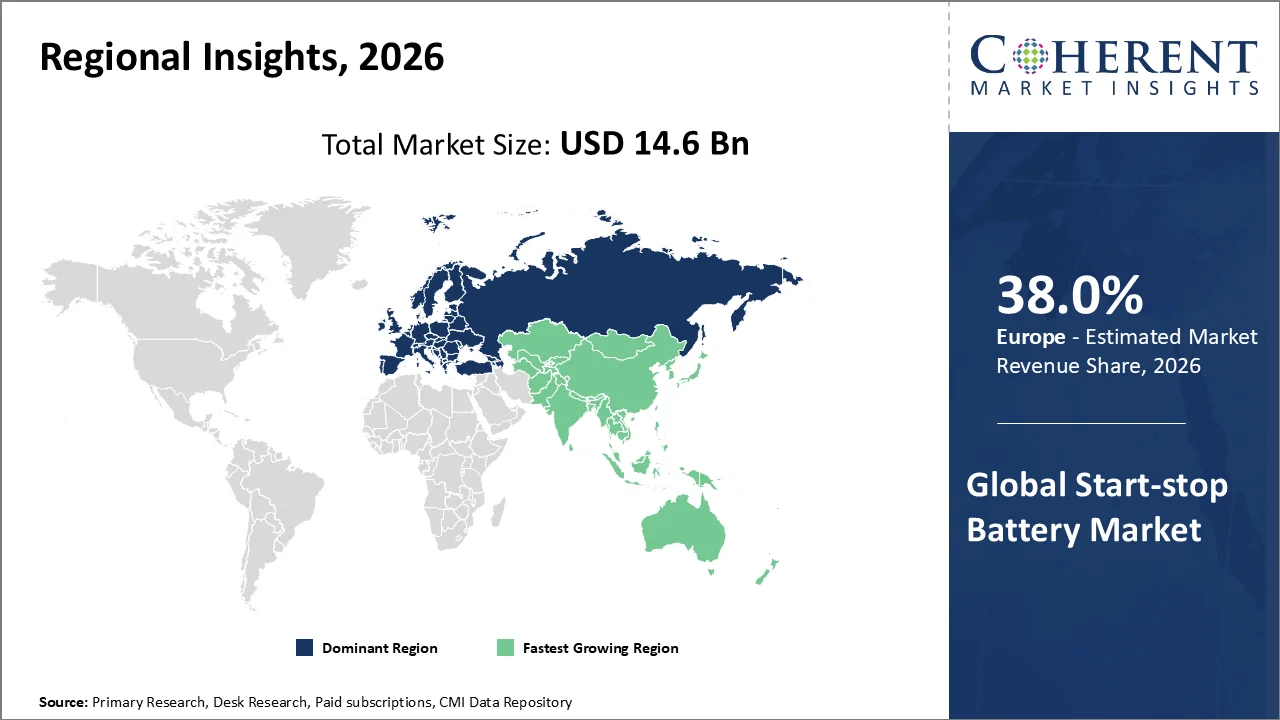
Europe dominates owing to Strong Technological Infrastructure
Europe account 38.0% market share in 2026, because it hosts one of the world’s largest and most advanced automotive industries, backed by strong government regulation and a massive vehicle fleet where start‑stop systems help meet emissions targets. For instance, in 2026, according to the European Commission’s official Climate Action data, average CO₂ emissions from new passenger cars in the EU fell 28 % between 2019 and 2024 due largely to efficiency technologies like start‑stop systems that reduce idling emissions in internal combustion and hybrid vehicles even as electrification grows. In EU new car registrations in early 2026, hybrids still held the largest market share (around 38.6 % in January 2026), with petrol and diesel cars comprising about 30 %, indicating vast continued relevance of start‑stop equipped vehicles. Europe’s manufacturing scale (with major OEMs including Volkswagen, Mercedes‑Benz, and BMW) and stringent CO₂ performance standards under Regulation (EU) 2019/631 further encourage widespread adoption of start‑stop technologies across conventional and mild‑hybrid vehicles, driving robust regional demand.
Source: European Commission; Eustat; acea.auto
Asia Pacific Start-stop Battery Market Trends
The Asia-Pacific region is poised to be as the fastest-growing region through 2026-2033, because multiple governments are implementing stringent fuel‑efficiency and emissions standards in 2026 that encourage automakers to use technologies like start‑stop systems on conventional and hybrid vehicles to reduce idle‑time fuel use. For instance, China’s government enforced new national fuel consumption limits effective January 1, 2026, reducing allowable fuel use by about 18 % for passenger cars to curb energy use and emissions, pushing OEMs toward fuel‑saving technologies. In Australia, the New Vehicle Efficiency Standard (NVES) was introduced from 2025 and continues into 2026, mandating CO₂ targets for new passenger and light vehicles, indirectly boosting demand for efficiency features like start‑stop. Meanwhile, several Asia Pacific markets (e.g., India) are tightening fuel consumption and emissions regulations alongside gradual adoption of global test procedures, further increasing regional penetration of start‑stop technology across large conventional vehicle fleets making the Asia Pacific market’s growth rate the highest globally.
Growing Investment & Largest Automotive Manufacturing Hub is Accelerating the Start-stop Battery Market Demand in Germany
The Germany start-stop battery market dominates Europe market. As of 2026, Germany continues to be the dominant country in the Europe Start‑Stop Battery market largely because it remains Europe’s largest passenger car market and manufacturing hub, making it a key source of demand for start‑stop systems fitted on conventional and micro‑hybrid vehicles. According to official German Federal Motor Transport Authority (KBA) data, Germany recorded 948,567 new passenger car registrations from January to April 2026, showing continued strong market activity across powertrain types, including petrol, diesel and hybrid vehicles where start‑stop systems are widely used to improve urban fuel efficiency and reduce idling emissions. While electric vehicles are growing, government statistics show conventional petrol and diesel cars still form a substantial part of the market in 2026; for example, in the first quarter of 2026, 22.7 % of new cars were petrol and 13.8 % were diesel alongside a 40.4 % hybrid share, indicating that a significant portion of newly registered vehicles still rely on internal combustion engines supplemented by start‑stop technology. This mix underlines Germany’s continued relevance as a major regional market where a large fleet of conventional and light‑hybrid vehicles supports robust demand for start‑stop batteries, reinforced by its status as the largest automotive economy in Europe.
China Start-stop Battery Market Trends
China has become the biggest player in the Asia Pacific start-stop battery market because it combines massive vehicle production with tightening fuel‑efficiency regulations that encourage wide adoption of fuel‑saving technologies on internal combustion and hybrid vehicles. In 2026, China’s vehicle production and sales remained among the world’s largest, with new energy vehicles (NEVs) including hybrids accounting for over 53.2 % of new car sales in April 2026 according to official China Association of Automobile Manufacturers data published by China Daily/Xinhua on May 11, 2026, reflecting rapid electrification alongside continued ICE and start‑stop demand. China also implemented stricter national fuel efficiency standards effective January 1, 2026, reducing allowable fuel consumption by ~18 % for passenger vehicles, pushing OEMs to integrate technologies like start‑stop systems for compliance. This regulatory push, combined with high vehicle volumes and expanding automotive output, drives accelerated demand for start‑stop batteries across conventional and mild‑hybrid vehicles in the region.
China’s dominance in the Asia Pacific start‑stop battery market stems from its overwhelming leadership in automotive battery production and EV ecosystem scale. In 2025, China’s total EV battery installations reached 769.7 GWh, accounting for more than four‑fifths of the domestic battery mix, with lithium‑iron phosphate (LFP) chemistry alone at 625.3 GWh as reported by the China Automotive Battery Innovation Alliance (data published Jan 16, 2026). Major Chinese manufacturers like Contemporary Amperex Technology Co. Limited and BYD Auto captured significant market share, enabling local OEMs such as Volkswagen’s China joint ventures to source batteries domestically at scale. China’s robust manufacturing clusters, vast industrial ecosystem, and government‑facilitated production infrastructure have made it the leading regional hub for automotive and start‑stop battery output into 2026.
Who are the Major Companies in Start-stop Battery Market
Some of the major key players in Start-stop battery market are A123 System LLC, ATLASBX Co., Ltd, East Penn Manufacturing, Exide Technologies, GS Yuasa International Ltd., Johnson Controls, Leoch Battery, Inc., Panasonic Corporation, Saft America, Inc., and Tianneng Power International Co., Ltd.
Key News
- In May 2026, Volkswagen‑backed Gotion High‑Tech launched its “Gnascent” sodium‑ion battery brand, introducing high‑energy density cells with up to 261 Wh/kg, suitable for automotive and lightweight vehicle applications a step toward broader battery technology innovation that also benefits energy demands in hybrid and start‑stop systems.
- In January 2026, FORVIA HELLA, automotive supplier officially introduced its next‑generation Intelligent Battery Sensor (IBS) a critical monitoring component for start‑stop systems and 12 V power networks with plans for mass production in China by mid‑2026, improving battery life and safety through real‑time charge and health monitoring.
Market Report Scope
Start-stop Battery Market Report Coverage
| Report Coverage | Details | ||
|---|---|---|---|
| Base Year: | 2025 | Market Size in 2026: | USD 14.6 Bn |
| Historical Data for: | 2020 To 2024 | Forecast Period: | 2026 To 2033 |
| Forecast Period 2026 to 2033 CAGR: | 22.9% | 2033 Value Projection: | USD 61.3 Bn |
| Geographies covered: |
| ||
| Segments covered: |
| ||
| Companies covered: | A123 System LLC, ATLASBX Co., Ltd, East Penn Manufacturing, Exide Technologies, GS Yuasa International Ltd., Johnson Controls, Leoch Battery, Inc., Panasonic Corporation, Saft America, Inc., and Tianneng Power International Co., Ltd. | ||
Analyst Opinion
- The automotive start‑stop battery market is increasingly becoming a core strategic component of vehicle electrification and emission‑reduction strategies as global regulators tighten fuel‑efficiency and CO₂ standards. In 2026, start‑stop systems are standard equipment on an estimated 55 % of new light vehicles worldwide, nearly doubling adoption over the past six years, driven by cost‑effective compliance with fleet CO₂ targets. This trend reinforces that start‑stop battery demand is becoming non‑discretionary for OEMs seeking regulatory certification and urban fuel‑efficiency gains.
- Emission and fuel savings remain a critical driver, with start‑stop systems documented to reduce fuel consumption by up to 10 % in city driving by shutting the engine off when idle, directly lowering urban congestion emissions and enhancing real‑world efficiency benefits reflected in regulatory fuel‑economy policies like CAFÉ norms that offer credits for such technologies. Furthermore, in Europe, regulatory frameworks such as the EU Batteries Regulation and the European Green Deal actively support sustainable and efficient battery usage and recycling, underpinning the broader adoption of start‑stop and advanced battery technologies within passenger vehicles while aligning with circular economy goals (EU regulation and recycling targets published 2023–2025).
- Industry leaders are integrating advanced battery chemistries and energy management systems into start‑stop applications to meet cycle durability and performance expectations. For instance, AGM and EFB batteries engineered for start‑stop duty support 3–4× higher cycle life compared with conventional batteries, making them essential for modern micro‑hybrid and mild hybrid platforms.
- Europe dominates the start‑stop battery market due to strict emission and fuel-efficiency regulations under the EU Green Deal and Battery Regulation, which mandate widespread adoption of stop‑start systems and sustainable battery recycling. In 2026, over 65 % of new European passenger cars are equipped with start‑stop systems, supported by high recycling efficiency of lead-acid batteries, reinforcing both regulatory compliance and market growth.
- The Asia Pacific region, led by China’s large passenger vehicle production base and stringent domestic fuel economy standards, has emerged as a major growth hub. In 2025, Asia Pacific accounted for approximately 38.6 % of global start‑stop battery revenue, reflecting localized OEM adoption and expanding aftermarket replacement demand as start‑stop‑equipped cars age.
Speak to the analyst
Want personalized insights?
Take the findings above to one of our principal consultants, or have the report rebuilt around the segments, geographies and competitors you actually track.
Market Segmentation
- By Battery Type (Revenue, USD Bn, 2021-2033)
- Lead-acid Battery
- Absorbent Glass Mat
- Enhanced Flooded Battery
- Lithium-ion Battery
- Lead-acid Battery
- By Application (Revenue, USD Bn, 2021-2033)
- Conventional Vehicle
- Electric Vehicle
- By Region (Revenue, USD Bn, 2021-2033)
- North America
- U.S.
- Canada
- Latin America
- Brazil
- Mexico
- Argentina
- Rest of Latin America
- Europe
- Germany
- U.K.
- France
- Italy
- Spain
- Russia
- Rest of Europe
- Asia Pacific
- China
- India
- Japan
- Australia
- South Korea
- ASEAN
- Rest of Asia Pacific
- Middle East
- GCC
- Israel
- Rest of Middle East
- Africa
- South Africa
- Central Africa
- North Africa
- North America
Sources
Primary Research Interviews
- Interviews with automotive engineers, vehicle fleet managers, and R&D heads to understand start‑stop battery adoption challenges, integration with conventional and hybrid drivetrains, and battery lifecycle performance under urban stop‑start conditions.
- Insights from battery manufacturers, OEM technical specialists, and energy storage solution providers on advancements in AGM, EFB, and lithium‑ion start‑stop batteries, charging/discharging efficiency, and thermal management technologies.
- Discussions with industry analysts, automotive consultants, and market advisors to evaluate global and regional market trends, competitive dynamics, regulatory impacts, and the influence of emission standards on start‑stop battery uptake.
- Conversations with fleet operators, government transport authorities, and procurement decision‑makers to assess investment considerations, implementation challenges in large fleets, maintenance practices, and compliance with fuel‑efficiency and emissions regulations.
Databases
- U.S. Environmental Protection Agency (EPA)-Vehicle and Fuel Economy Database
- European Automobile Manufacturers Association (ACEA) - Vehicle Statistics Database
- China Association of Automobile Manufacturers (CAAM)
- International Energy Agency (IEA)
- Eurostat (EU Transport and Vehicle Fleet Statistics)
Magazines
- Automotive News Europe (Vehicle Technology Section)
- Battery Technology Magazine (Start-Stop and Automotive Batteries)
- EE Times (Automotive & Energy Storage Section)
- Green Car Reports (Hybrid & Start-Stop Vehicle Coverage)
- Charged EVs Magazine (Battery Systems & Efficiency Technologies)
Journals
- Journal of Power Sources (Elsevier)
- Journal of Energy Storage (Elsevier)
- IEEE Transactions on Vehicular Technology
- Journal of Automotive Engineering (SAE International)
- Journal of Advanced Transportation (Hindawi)
Newspapers
- Financial Times (Automotive and Energy Section)
- The Wall Street Journal (Autos & Green Energy Section)
- The New York Times (Automotive & Technology Section)
- The Guardian (Sustainable Mobility Section)
- Nikkei Asia (Automotive Industry Section)
Associations
- Society of Automotive Engineers (SAE International)
- European Battery Alliance (EBA)
- International Council on Clean Transportation (ICCT)
- Automotive Battery Consortium (USABC)
- China Battery Industry Association (CBIA)
Public Domain Sources
- U.S. Department of Energy Vehicle Technologies Office Reports (DOE)
- European Commission Transport & Mobility Policy Documents
- U.S. EPA Fuel Economy & Greenhouse Gas Reports
- National Renewable Energy Laboratory (NREL) Vehicle & Battery Studies
- Public OEM Reports and Sustainability/Investor Presentations (Volkswagen, BMW, Toyota)
Proprietary Elements
- CMI Data Analytics Tool
- Proprietary CMI Existing Repository of information for last 10 years
Get access to 250+ pages report
Every segment, forecast, competitor profile and data table behind the analysis above — available for instant download.
- ESOMAR Member
- ISO 9001:2015 Certified
- D-U-N-S Registered
- GDPR & CCPA Compliant
Missing comfort of reading report in your local language? Find your preferred language:
Transform your Strategy with Exclusive Trending Reports
Frequently Asked Questions
The Start-stop Battery Market is expected to reach USD 61.3 Bn in 2033.
Major players operating in the global Start-stop Battery Market include A123 System LLC, ATLASBX Co., Ltd, East Penn Manufacturing, Exide Technologies, GS Yuasa International Ltd., Johnson Controls, Leoch Battery, Inc., Panasonic Corporation, Saft America, Inc., and Tianneng Power International Co., Ltd.
Battery life and performance concerns and limited awareness in emerging markets are the major factors hampering the growth of the start-stop battery market.
Increasing environmental concerns and consumer preference for fuel-efficient vehicles and increasing demand for AGM and EFB batteries are the factors driving the growth of the start-stop battery market.
The Start-stop Battery Market is anticipated to grow at a CAGR of 22.9% between 2026 and 2033.
Among regions, North America is expected to account for a largest market share in the global Start-stop Battery Market over the forecast period.
A start‑stop battery powers vehicles equipped with start‑stop systems, which automatically turn off the engine during idling and restart it when needed, improving fuel efficiency, reducing emissions, and supporting repeated engine start cycles compared to conventional starter batteries.