

Global Sports Utility Vehicle (SUV) Market Size and Forecast — 2026 - 2033
The Global Sports Utility Vehicle (SUV) Market size is estimated to be valued at USD 820 billion in 2026 and is expected to reach USD 1,340 billion by 2033, exhibiting a compound annual growth rate (CAGR) of 7.2% from 2026 to 2033.
Overview
The Sports Utility Vehicle (SUV) market is driven by growing consumer preference for vehicles that offer a combination of spacious interiors, elevated driving position, versatility, and enhanced safety features. Rising disposable incomes, urbanization, and improving road infrastructure are encouraging SUV adoption across both developed and emerging markets. The increasing availability of compact, mid-size, and luxury SUV models has expanded the customer base, while advancements in fuel efficiency and powertrain technologies have improved vehicle performance. Additionally, the rapid introduction of electric and hybrid SUVs, coupled with strong demand for advanced connectivity, comfort, and driver-assistance features, continues to support robust market growth worldwide.
Key Takeaways
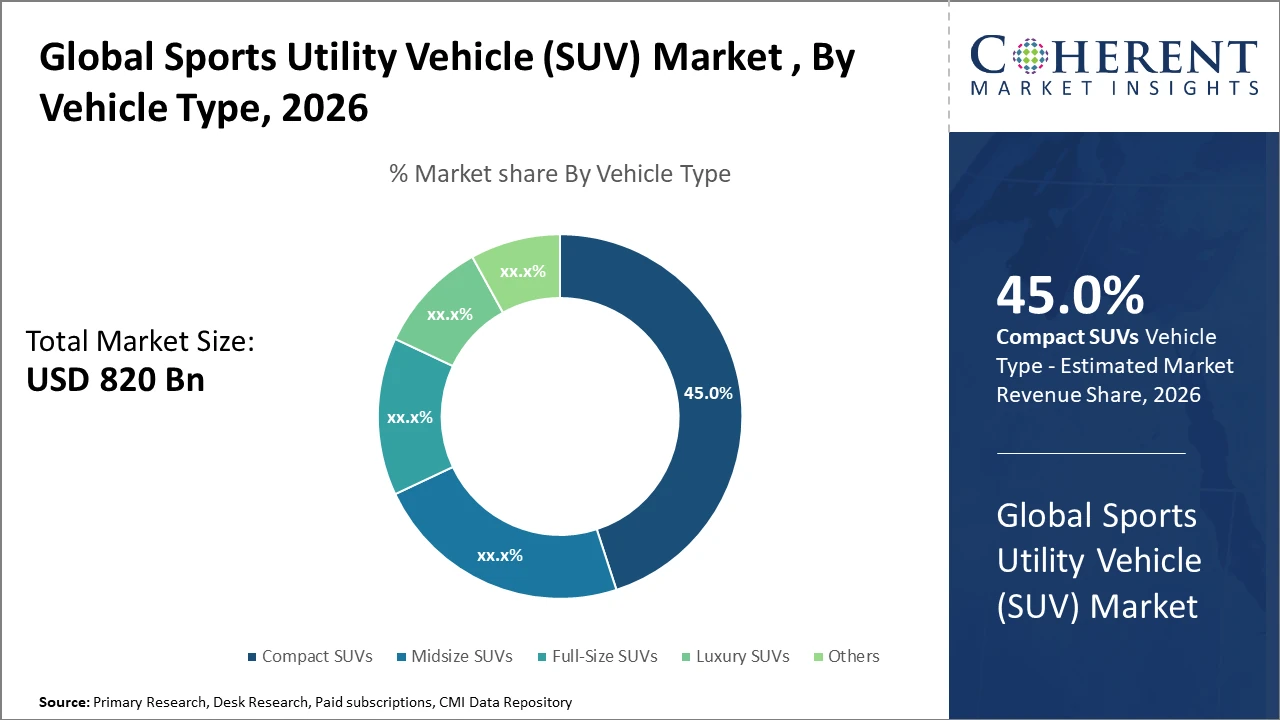
The compact SUV segment dominates the market, holding over 45% share in 2026 due to its affordability, practicality, and versatility for urban and family use.
Electric SUVs are the fastest-growing segment, registering a CAGR of around 20% as consumers and automakers shift toward sustainable mobility solutions.
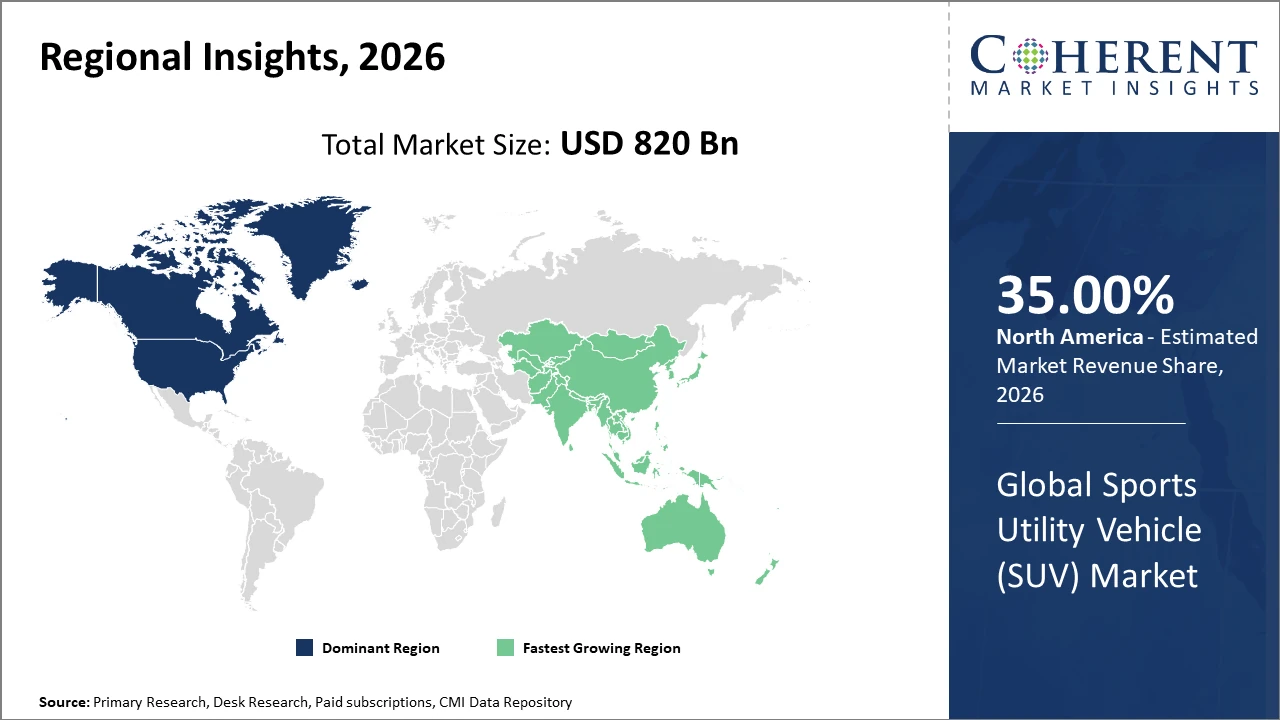
North America leads the global SUV market with approximately 35% share, driven by strong OEM presence and high demand for full-size and luxury SUVs.
Asia Pacific is the fastest-growing region with a CAGR exceeding 9%, supported by rapid urbanization, rising incomes, and expanding automotive production.
Government incentives and increasing EV infrastructure are further accelerating SUV electrification trends across major global markets.
Global Sports Utility Vehicle (SUV) Market Segmentation Analysis
Global Sports Utility Vehicle (SUV) Market Insights, By Vehicle Type
Compact SUVs dominate the global SUV market with approximately 45.3% share, driven by their affordability, fuel efficiency, and suitability for urban driving conditions. Their versatility makes them the preferred choice among a broad consumer base worldwide. Luxury SUVs represent the fastest-growing subsegment, supported by rising disposable incomes and increasing demand for advanced features, premium comfort, and cutting-edge technology, particularly in North America and Europe. Mid-size SUVs continue to attract families due to their balance of space, performance, and practicality.
Global Sports Utility Vehicle (SUV) Market Insights, By Fuel Type
Gasoline-powered SUVs dominate the global market due to their well-established fueling infrastructure, lower upfront cost, and wide availability across all regions. However, Electric SUVs are the fastest-growing segment, registering over 20% annual growth, driven by strict emission regulations, government incentives, and rising consumer preference for sustainable mobility. Hybrid SUVs serve as a transitional solution, combining internal combustion engines with electric systems to improve fuel efficiency and reduce emissions without full electrification dependency. Diesel SUVs, once favored for high torque and long-distance efficiency, are declining due to stricter environmental regulations in Europe and North America.
Global Sports Utility Vehicle (SUV) Market Insights, By Sales Channel
OEM sales channels dominate the global SUV market as they enable direct manufacturer-to-consumer transactions, streamlined pricing, and controlled product positioning for new vehicle launches. Online sales channels are the fastest-growing segment, supported by rapid digital transformation, increasing consumer comfort with virtual purchasing, and the expansion of e-commerce automotive platforms. Dealership networks remain highly important, particularly in emerging markets, where personalized assistance and physical vehicle inspection drive purchasing decisions. Aftermarket channels contribute to long-term revenue through maintenance and upgrades but hold a smaller share of initial sales.
Global Sports Utility Vehicle (SUV) Market Trends
The SUV market is rapidly shifting toward electrification, with electric SUV launches accelerating as major OEMs expand their EV portfolios globally.
Electric SUV sales are rising strongly, with leading brands such as Tesla and Volkswagen recording over 35% combined growth in 2025.
Autonomous driving technology is becoming a key trend, with Level 2 and Level 3 systems expected to account for over 18% of SUVs by 2028.
Subscription-based ownership models are disrupting traditional sales, offering flexibility and boosting customer engagement.
Ford’s subscription service saw a 40% increase in subscribers in 2025, reflecting growing acceptance of usage-based vehicle access models.
Global Sports Utility Vehicle (SUV) Market Insights, By Geography
North America Global Sports Utility Vehicle (SUV) Market Analysis and Trends
North America dominates the global Sports Utility Vehicle (SUV) market, accounting for approximately 35% share in 2026. This leadership is supported by a highly developed automotive industry, strong OEM presence, and continuous investments in innovation, production capacity, and electrification. U.S. consumers exhibit a strong preference for full-size and luxury SUVs, driven by comfort, performance, and advanced technology features. Strict emission regulations and favorable financing options further support market expansion and sustained demand. Leading manufacturers such as Ford Motor Company and General Motors are heavily investing in electric SUVs, autonomous driving technologies, and next-generation mobility solutions, reinforcing the region’s strong competitive position and long-term growth outlook.
Asia Pacific Global Sports Utility Vehicle (SUV) Market Analysis and Trends
Asia Pacific is the fastest-growing region in the global SUV market, registering a CAGR exceeding 9%. This growth is driven by rapid urbanization, rising disposable incomes, and strong government support for electric vehicle adoption, particularly in China and India. Expanding middle-class populations are increasing demand for compact, mid-size, and electric SUVs. The presence of major regional automakers such as Tata Motors, Geely, and Suzuki enhances product availability and localization strategies tailored to consumer preferences. Additionally, rapid infrastructure development, improved road networks, and favorable trade policies are supporting automotive production and distribution, further accelerating SUV market expansion across emerging economies in the Asia Pacific region.
Global Sports Utility Vehicle (SUV) Market Outlook for Key Countries
USA Global Sports Utility Vehicle (SUV) Market Analysis and Trends
The United States is a key contributor to the global SUV market, driven by strong demand for full-size and luxury SUVs. Consumer preference remains high due to spacious design, advanced features, and high performance capabilities. In 2025, Ford’s introduction of the electric Maverick and General Motors’ expansion of the Chevy Bolt EUV lineup contributed to an estimated 8% year-over-year revenue increase in the SUV segment. The market benefits from advanced manufacturing infrastructure, extensive dealership networks, and strong incentives promoting electric vehicle adoption. Additionally, rising acceptance of hybrid and battery electric SUVs reflects compliance with tightening emission standards and growing environmental awareness among consumers.
Germany Global Sports Utility Vehicle (SUV) Market Analysis and Trends
Germany plays a significant role in the global SUV market, driven by its strong automotive manufacturing base and premium vehicle production. Leading German automakers focus heavily on mid-size and luxury SUVs, integrating advanced technologies such as hybrid powertrains, electric drivetrains, and intelligent driver assistance systems. Market trends highlight a rapid shift toward electric SUVs, supported by stringent EU emission regulations and sustainability targets. Consumer preference is also shifting toward premium comfort, safety, and connectivity features. German manufacturers are investing heavily in R&D to enhance vehicle efficiency, aerodynamics, and lightweight materials, positioning the country as a key hub for innovation in high-performance and electrified SUV segments.
Analyst Opinion
Supply-side growth in the SUV market is supported by an approximately 8% global expansion in production capacity in 2024, driven by new manufacturing plants focused on electric SUVs, with China and the USA leading output.
Demand-side trends show rising imports of compact and mid-size SUVs in emerging markets, especially Asia Pacific and Latin America, with India recording a 12% increase in SUV imports in early 2025.
Pricing has stabilized in the mid-tier SUV segment despite inflation, with North American average prices remaining around USD 42,000 in 2025 due to improved supply chain efficiency.
SUVs are increasingly used across diverse applications, including family transport, commercial mobility, and off-road usage, while the rental SUV segment recorded a 15% CAGR in revenue from 2024 to 2026.
- Current Industry Events of 2026
- Market Size Estimation
- Regional Breakdown
- Competitive Landscape
- Customer Intelligence
- Segmental Analysis
- Pricing Analysis
- Key Market Drivers, Challenges & Future Trends
- Customized Insights Section
Market Scope
| Report Coverage | Details | ||
|---|---|---|---|
| Base Year: | 2025 | Market Size in 2026: | USD 820 billion |
| Historical Data for: | 2020 To 2024 | Forecast Period: | 2026 To 2033 |
| Forecast Period 2026 to 2033 CAGR: | 7.2% | 2033 Value Projection: | USD 1340 billion |
| Geographies covered: |
| ||
| Segments covered: |
| ||
| Companies covered: | Toyota Motor Corporation, Ford Motor Company, BMW Group, General Motors, Tata Motors, Audi AG, Land Rover, Renault Group, Subaru Corporation, Volvo Cars | ||
| Growth Drivers: |
| ||
Global Sports Utility Vehicle (SUV) Market Growth Factors
The global SUV market is experiencing strong growth driven by rising consumer preference for fuel-efficient and technologically advanced vehicles, particularly electric SUVs supported by government incentives and stricter emission regulations. Rapid urbanization and evolving lifestyles are increasing demand for compact and mid-size SUVs, especially in emerging economies where affordability and practicality are key purchasing factors. Continuous advancements in safety systems, infotainment, and connectivity features are further enhancing consumer appeal and driving replacement demand. Additionally, the expansion of shared mobility platforms and rental services is boosting fleet utilization of SUVs, creating new revenue streams and broadening the overall market scope across both developed and developing regions.
Global Sports Utility Vehicle (SUV) Market Development
In June 2026, Leapmotor announced the start of pre-orders for its updated Leapmotor C10, Leapmotor C11, and Leapmotor C16 models, with the official launch scheduled for June 16. Customers can reserve the vehicles and access exclusive pre-order benefits by placing a refundable deposit of 1,000 yuan (approximately US$147). The company has not yet disclosed pricing details for the three flagship SUVs.
Key Players
Leading Companies of the Market
Toyota Motor Corporation
Tata Motors
BMW Group
General Motors
Renault Group
Volvo Cars
Ford Motor Company
Land Rover
Audi AG
Subaru Corporation
Several market players have adopted aggressive electrification strategies to strengthen their position in the global SUV market. For example, Toyota launched its new hybrid SUV line in 2025, which significantly improved its competitiveness and increased its market share in Asia Pacific by around 5% within the first year, supported by strong demand for fuel-efficient and low-emission vehicles. Similarly, Ford is expanding its electric SUV production at its Michigan plant, with plans to raise manufacturing capacity by approximately 30% by 2026. This expansion enhances Ford’s ability to meet growing demand in North America and reinforces its strategic shift toward electrification and next-generation mobility solutions.
Global Sports Utility Vehicle (SUV) Market Future Outlook
The global SUV market is expected to witness strong and sustained growth, driven by rising consumer preference for spacious, versatile, and feature-rich vehicles. Future demand will increasingly shift toward electric and hybrid SUVs as governments enforce stricter emission regulations and promote clean mobility solutions. Automakers are expected to focus on lightweight materials, advanced aerodynamics, and battery efficiency to enhance performance and range. Integration of autonomous driving technologies, connected infotainment systems, and advanced safety features will further define next-generation SUVs. Emerging markets in Asia Pacific will remain key growth hubs, while premium and luxury SUV segments will continue expanding in developed economies globally.
Global Sports Utility Vehicle (SUV) Market Historical Analysis
The global SUV market has evolved significantly over the past decades, transitioning from rugged off-road utility vehicles to highly versatile and technology-driven passenger vehicles. Initially dominated by full-size, fuel-intensive models, the market gradually shifted toward compact and mid-size SUVs due to rising urbanization and fuel efficiency concerns. The 2000s and 2010s saw rapid growth driven by consumer preference for higher seating positions, safety, and spacious interiors. Technological advancements such as advanced driver-assistance systems, improved fuel efficiency, and later hybrid integration further accelerated adoption. In recent years, electrification trends and stricter emission regulations have reshaped the market, pushing manufacturers toward sustainable and connected SUV platforms globally.
Sources
Primary Research Interviews:
Automotive OEM manufacturers, SUV production facility managers, tier-1 automotive suppliers, and vehicle dealership network operators involved in SUV design, manufacturing, and distribution.
Automotive engineers, mobility experts, EV and hybrid system developers, regulatory compliance specialists, safety certification authorities, and R&D professionals specializing in SUV platforms, electrification, and autonomous driving technologies.
Magazines:
Automotive News – Coverage of global SUV sales trends, OEM strategies, and electrification shifts in the SUV segment.
Car and Driver – Insights into SUV performance trends, new model launches, and consumer preferences.
Motor Trend – Updates on SUV innovation, luxury SUV developments, and off-road vehicle advancements.
Journals:
SAE International Journal of Vehicle Dynamics, Stability, and NVH – Research on SUV performance, safety systems, and vehicle dynamics.
Transportation Research Part D: Transport and Environment – Studies on emissions, fuel efficiency, and environmental impact of SUVs.
Energy Policy – Research on automotive energy transition, EV adoption, and regulatory impacts on SUVs.
Newspapers:
Financial Times – Coverage of automotive industry investments, SUV market expansion, and global mobility trends.
Reuters – Reporting on vehicle production, EV transitions, and supply chain dynamics in the SUV market.
Bloomberg – Insights into automakers, SUV sales performance, and electrification strategies.
Associations:
Society of Automotive Engineers – Standards and research on vehicle safety, SUV design, and powertrain systems.
International Organization of Motor Vehicle Manufacturers – Industry statistics, production data, and global SUV market trends.
European Automobile Manufacturers Association – Policy guidance, emission regulations, and SUV market insights in Europe.
Get access to 250+ pages report
Every segment, forecast, competitor profile and data table behind the analysis above — available for instant download.
- ESOMAR Member
- ISO 9001:2015 Certified
- D-U-N-S Registered
- GDPR & CCPA Compliant
Missing comfort of reading report in your local language? Find your preferred language:
Transform your Strategy with Exclusive Trending Reports
Frequently Asked Questions
The global SUV market is led by major automotive manufacturers such as Toyota Motor Corporation, Ford Motor Company, Audi AG, and Tata Motors. These companies maintain dominance through continuous innovation, large-scale production capabilities, and strong investments in electrification and advanced mobility technologies.
The SUV market is projected to grow from USD 820 billion in 2026 to USD 1,340 billion by 2033, registering a CAGR of 7.2% during the forecast period, driven by rising global demand and technological advancements.
The Gasoline-powered SUVs segment presents the largest growth opportunity.
Market trends will increasingly focus on electrification, autonomous driving technologies, connected vehicle ecosystems, and digital sales platforms, reshaping both consumer behavior and industry competition.
The market is highly competitive and innovation-driven, with key challenges including supply chain disruptions, raw material price volatility, and tightening emission regulations requiring continuous technological adaptation.
Common strategies include direct-to-consumer sales models, vehicle subscription services, strategic technology partnerships, expansion of electric vehicle portfolios, and localized manufacturing to improve market responsiveness.