

Hydrogen Vehicle Market Size and Forecast — 2026 - 2033
The Global Hydrogen Vehicle Market size is estimated to be valued at USD 15.6 billion in 2026 and is expected to reach USD 58.9 billion by 2033, exhibiting a compound annual growth rate (CAGR) of 20.2% from 2026 to 2033.
Overview
The hydrogen vehicle market is driven by growing demand for zero-emission transportation, stringent government regulations on vehicle emissions, and increasing investments in clean energy infrastructure. Governments across regions are promoting hydrogen mobility through subsidies, tax incentives, and national hydrogen strategies to support decarbonization goals. Rising concerns over air pollution and climate change are encouraging the adoption of fuel cell electric vehicles (FCEVs) as an alternative to conventional internal combustion engine vehicles. In addition, the expansion of hydrogen refueling networks, advancements in fuel cell technology, improved vehicle range, and growing commercial fleet applications are accelerating market growth worldwide.
Key Takeaways
The passenger car segment dominates the Hydrogen Vehicle market with a 46% share, supported by continuous investments in fuel cell technology advancements and increasing consumer awareness regarding zero-emission transportation solutions.
Proton Exchange Membrane (PEM) fuel cells account for nearly 65% of total industry revenue due to their high efficiency, lightweight structure, quick start-up capability, and fast hydrogen refueling performance.
Asia Pacific leads the global market in terms of revenue share, driven by strong government support, expanding hydrogen infrastructure, and the presence of major automotive and fuel cell manufacturers across countries such as China, Japan, and South Korea.
North America is emerging as the fastest-growing regional market, registering a CAGR of more than 22% during the forecast period due to rising hydrogen infrastructure investments, fleet electrification programs, and increasing adoption of clean transportation technologies.
Hydrogen Vehicle Market Segmentation Analysis
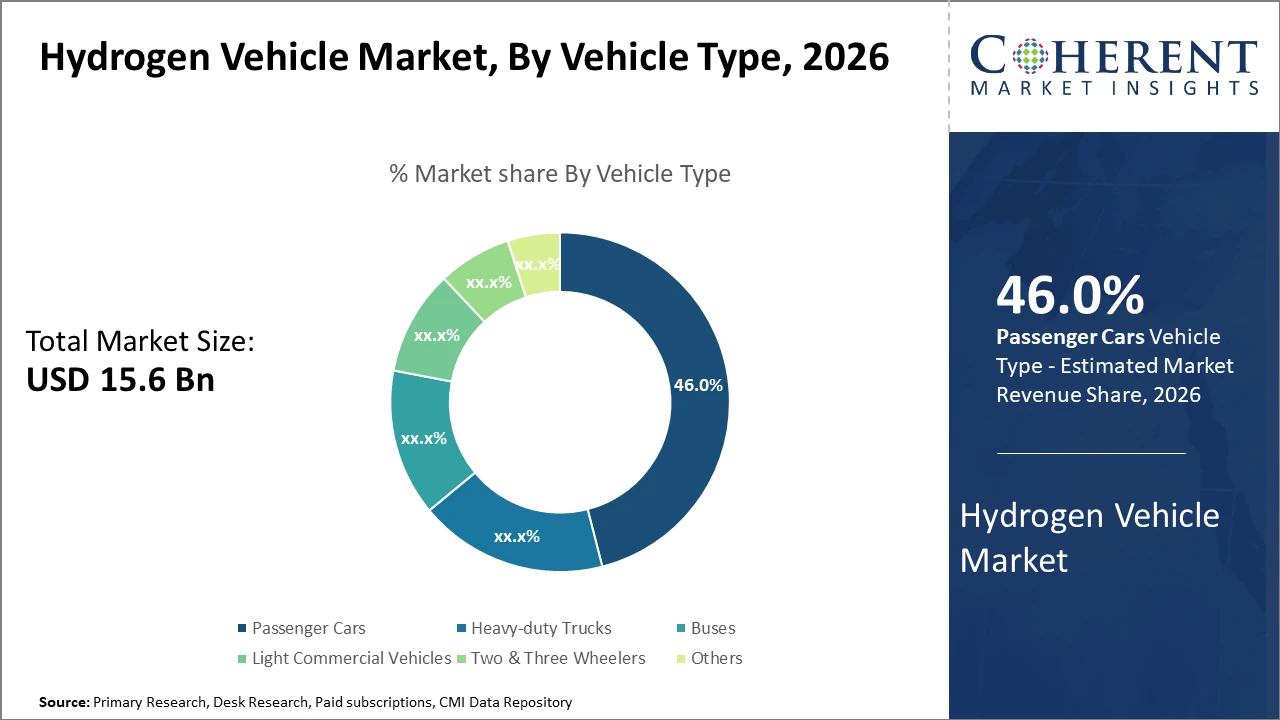
Hydrogen Vehicle Market Insights, By Vehicle Type
Passenger Cars dominate the Hydrogen Vehicle market due to rising consumer acceptance, expanding hydrogen refueling infrastructure, and improvements in fuel cell efficiency that support longer driving ranges and lower operating costs. The segment accounts for a significant share of overall market revenue as automotive manufacturers continue investing in zero-emission mobility solutions. Heavy-Duty Trucks are the fastest-growing segment, driven by stringent emission regulations and increasing adoption in long-distance freight transportation. Hydrogen-powered buses are gaining popularity in public transit electrification programs, particularly across Asia Pacific. Light Commercial Vehicles support urban logistics operations, while Two and Three Wheelers present strong growth potential in emerging markets because of affordability and energy efficiency benefits.
Hydrogen Vehicle Market Insights, By Application
Personal Transport dominates the Hydrogen Vehicle market due to rising adoption of fuel cell passenger vehicles among private consumers and increasing government incentives encouraging zero-emission mobility solutions. Growing awareness regarding environmental sustainability and advancements in hydrogen refueling infrastructure are further strengthening segment growth. Commercial Vehicles represent the fastest-growing category, supported by rising demand for low-emission freight transportation and regulatory policies promoting cleaner logistics operations. Public Transit applications are expanding steadily through hydrogen-powered bus deployment programs across Europe and Asia Pacific aimed at urban decarbonization. Industrial Vehicles are also witnessing gradual adoption in specialized sectors such as mining, warehousing, and port operations where efficient heavy-duty performance is required.
Hydrogen Vehicle Market Insights, By Fuel Cell Type
Proton Exchange Membrane (PEM) Fuel Cells dominate the Hydrogen Vehicle market due to their high efficiency, lightweight design, fast start-up capability, and suitability for passenger vehicle applications. These fuel cells play a critical role in advancing hydrogen-powered mobility and are widely adopted by major automotive manufacturers. Solid Oxide Fuel Cells are emerging as the fastest-growing segment because of their high energy efficiency, fuel flexibility, and growing use in heavy-duty commercial transportation. Alkaline Fuel Cells maintain niche applications in stationary and backup power systems.
Hydrogen Vehicle Market Trends
The Hydrogen Vehicle market is increasingly shifting toward green hydrogen adoption, supported by rapid advancements in electrolyzer technologies and renewable hydrogen production capacity worldwide.
Countries such as China and South Korea significantly expanded electrolyzer installations by more than 45% in 2025, accelerating the development of sustainable hydrogen ecosystems.
Automotive manufacturers are introducing multi-segment vehicle platforms that combine hydrogen fuel cell and battery-electric technologies to address diverse transportation and commercial mobility requirements.
North America has emerged as a major hub for heavy-duty hydrogen vehicle deployment, particularly in freight and logistics applications requiring long driving ranges and rapid refueling capabilities.
Between 2024 and 2026, hydrogen-powered truck fleets in California and Texas surpassed 1,500 deployed units, reflecting growing investments in clean transportation infrastructure and zero-emission commercial mobility initiatives.
Hydrogen Vehicle Market Insights, By Geography
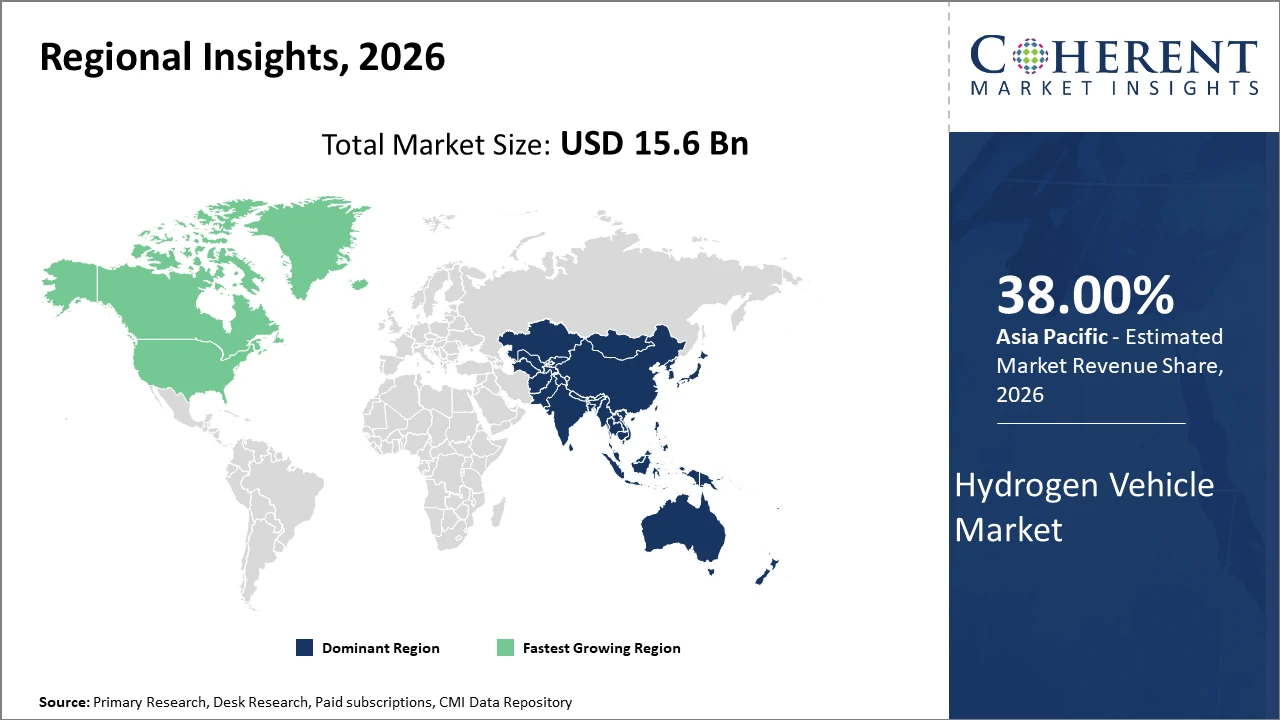
Asia Pacific Hydrogen Vehicle Market Analysis and Trends
Asia Pacific dominates the Hydrogen Vehicle market due to strong government support, large-scale hydrogen infrastructure investments, and rapid advancements in fuel cell technologies across China, Japan, and South Korea. These countries collectively account for more than 38% of global market revenue, supported by favorable clean energy policies, industrial collaborations, and expanding hydrogen refueling networks. The region benefits from the strong presence of leading automotive and fuel cell manufacturers that are actively commercializing hydrogen-powered passenger cars, buses, and commercial vehicles. Rising demand for zero-emission transportation, coupled with investments in green hydrogen production and public transit electrification, continues to strengthen Asia Pacific’s leadership position in the global hydrogen mobility industry.
North America Hydrogen Vehicle Market Analysis and Trends
North America is projected to be the fastest-growing region in the Hydrogen Vehicle market, expanding at a CAGR of approximately 22.5% from 2026 to 2033. The region’s growth is driven by strong regulatory support promoting zero-emission transportation, particularly in clean trucking and public transit sectors. Governments and private companies are heavily investing in hydrogen refueling infrastructure to accelerate fuel cell vehicle adoption across commercial fleets. Rising deployment of hydrogen-powered heavy-duty trucks, buses, and logistics vehicles is further strengthening market expansion. In addition, increasing collaborations between automotive manufacturers, energy providers, and transportation agencies are supporting innovation and large-scale commercialization of hydrogen mobility solutions across North America.
Hydrogen Vehicle Market Outlook for Key Countries
USA Hydrogen Vehicle Market Analysis and Trends
The United States represents a rapidly expanding Hydrogen Vehicle market supported by strong federal and state-level investments in hydrogen infrastructure and clean transportation initiatives. California serves as the leading regional hub, accounting for more than 60% of the country’s hydrogen refueling stations by 2026 due to aggressive zero-emission vehicle policies and infrastructure funding programs. Major companies such as Nikola Corporation and Cummins are collaborating with government agencies to deploy hydrogen-powered commercial trucks nationwide. Regulatory initiatives including the Clean Trucks Program are accelerating adoption, supporting commercial fleet electrification, and driving substantial market revenue growth across the United States.
Germany Hydrogen Vehicle Market Analysis and Trends
Germany represents a leading market for hydrogen vehicles in Europe due to strong government support for clean mobility, advanced automotive manufacturing capabilities, and increasing investments in hydrogen infrastructure. The country is actively promoting fuel cell electric vehicles (FCEVs) through national hydrogen strategies, subsidies, and partnerships between automotive companies and energy providers. Rising demand for zero-emission transportation in public transit, logistics, and heavy-duty trucking sectors is accelerating market growth. Germany is also expanding its hydrogen refueling station network to support wider vehicle adoption. Technological advancements in fuel cell systems and collaborations among major automakers continue to strengthen Germany’s position in the hydrogen mobility market.
Analyst Opinion
Fuel cell system production capacity has expanded significantly, with leading manufacturers increasing fuel cell stack output by more than 30% in 2024 to meet rising global demand for hydrogen-powered vehicles. In 2025, a major automotive manufacturer expanded its hydrogen vehicle production facility to an annual capacity of 50,000 units, supporting anticipated market growth.
Hydrogen refueling infrastructure development continues to accelerate globally, with more than 1,200 hydrogen refueling stations operational worldwide by early 2026. Europe and Asia Pacific together accounted for over 60% of total infrastructure deployment, strengthening hydrogen vehicle adoption in commercial and urban transportation sectors.
Hydrogen vehicle adoption is diversifying across passenger cars, buses, trucks, and commercial fleets, creating multiple growth opportunities within the market. In 2025, hydrogen-powered commercial trucks recorded approximately 15% annual market share growth due to regulations focused on freight transportation decarbonization.
Declining hydrogen production costs through renewable energy integration, combined with government incentives such as subsidies and tax benefits in countries including the United States and South Korea, significantly boosted hydrogen vehicle market revenue and accelerated industry expansion during 2024 and 2025.
- Current Industry Events of 2026
- Market Size Estimation
- Regional Breakdown
- Competitive Landscape
- Customer Intelligence
- Segmental Analysis
- Pricing Analysis
- Key Market Drivers, Challenges & Future Trends
- Customized Insights Section
Market Scope
| Report Coverage | Details | ||
|---|---|---|---|
| Base Year: | 2025 | Market Size in 2026: | USD 15.6 billion |
| Historical Data for: | 2020 To 2024 | Forecast Period: | 2026 To 2033 |
| Forecast Period 2026 to 2033 CAGR: | 20.2% | 2033 Value Projection: | USD 58.9 billion |
| Geographies covered: |
| ||
| Segments covered: |
| ||
| Companies covered: | Toyota, Hyundai, Nikola Corporation, BMW AG, Cummins Inc, Bosch, Hino Motors, NEL Hydrogen, Plug Power Inc., Tata Motors | ||
| Growth Drivers: |
| ||
Hydrogen Vehicle Market Growth Factors
The Hydrogen Vehicle market is expanding rapidly due to growing investments in hydrogen refueling infrastructure across Europe and Asia Pacific, supported by government initiatives aimed at improving accessibility in urban and suburban areas. Advancements in fuel cell technology have significantly enhanced efficiency while reducing manufacturing and component costs, encouraging broader adoption across passenger and commercial vehicle segments. Increasing demand for zero-emission heavy-duty vehicles in logistics and public transportation sectors is also accelerating market revenue growth. In addition, government incentives such as tax benefits, subsidies, and clean mobility programs introduced in countries including the United States and Germany during 2024 have reduced ownership costs and strengthened both consumer and fleet adoption rates.
Hydrogen Vehicle Market Development
In December 2025, India advanced its hydrogen mobility initiatives with the launch of a pilot project featuring Toyota's Mirai fuel cell electric vehicle (FCEV) to evaluate its performance under real-world operating conditions.
Key Players
Leading Companies of the Market
Toyota
Hyundai
Nikola Corporation
Hino Motors
BMW AG
Tata Motors
Cummins Inc.
NEL Hydrogen
Plug Power Inc.
Bosch
Leading companies in the Hydrogen Vehicle market are increasingly adopting aggressive expansion strategies including strategic partnerships, joint ventures, and substantial investments in research and development to strengthen their competitive position. For instance, Toyota Motor Corporation collaborated with major hydrogen infrastructure providers in Japan, contributing to a 40% increase in hydrogen vehicle deployments between 2024 and 2026. Similarly, Hyundai Motor Company expanded its hydrogen-powered heavy-duty truck operations through government-supported pilot projects in South Korea, resulting in approximately 25% growth in commercial hydrogen vehicle market revenue during 2025.
Hydrogen Vehicle Market Future Outlook
The future outlook for the Hydrogen Vehicle market remains highly optimistic, supported by increasing global focus on carbon neutrality, clean transportation, and sustainable energy adoption. Expanding hydrogen refueling infrastructure, advancements in fuel cell efficiency, and declining hydrogen production costs are expected to accelerate market growth over the coming years. Heavy-duty trucks, buses, and commercial fleets are likely to witness strong adoption due to their need for long driving ranges and rapid refueling capabilities. Government incentives, emission regulations, and investments in green hydrogen projects will further strengthen industry expansion. Strategic collaborations among automotive manufacturers, energy providers, and governments are also expected to drive innovation and commercialization globally.
Hydrogen Vehicle Market Historical Analysis
The Hydrogen Vehicle market has evolved significantly over the past two decades, driven by growing environmental concerns and the need for alternative clean transportation technologies. Early development focused on prototype fuel cell vehicles and limited infrastructure projects supported mainly by government research initiatives. Between 2015 and 2025, stricter global emission regulations and increasing investments in hydrogen production accelerated commercialization of hydrogen-powered passenger cars, buses, and heavy-duty trucks. Major automotive manufacturers expanded fuel cell vehicle programs while governments introduced subsidies and infrastructure funding. Advancements in fuel cell efficiency, hydrogen storage systems, and refueling technologies improved vehicle performance, reliability, and adoption across commercial and public transportation sectors worldwide.
Sources
Primary Research Interviews:
Hydrogen vehicle manufacturers, fuel cell technology providers, automotive OEMs, hydrogen infrastructure developers, fleet operators, transportation authorities, and distributors involved in hydrogen mobility and fuel cell vehicle deployment.
Automotive engineers, clean energy specialists, hydrogen production experts, regulatory authorities, battery and fuel cell researchers, and R&D directors specializing in fuel cell systems, hydrogen storage technologies, zero-emission transportation, and sustainable mobility innovations.
Magazines:
Hydrogen Insight – Insights into hydrogen mobility, fuel cell vehicle advancements, and clean energy transportation developments.
Automotive World – Coverage of hydrogen vehicle technologies, automotive innovation, and alternative fuel market trends.
Mobility Tech Asia – Updates on electric and hydrogen-powered transportation infrastructure, smart mobility, and automotive sustainability strategies.
Journals:
International Journal of Hydrogen Energy – Research on hydrogen production, fuel cell systems, and hydrogen-powered transportation technologies.
Journal of Power Sources – Studies focused on fuel cells, energy storage systems, and vehicle electrification advancements.
Energy Conversion and Management – Research related to sustainable transportation, hydrogen mobility, and clean energy integration.
Newspapers:
Financial Times – Coverage of hydrogen investments, clean transportation initiatives, and automotive industry transformation trends.
Reuters – Reporting on hydrogen vehicle launches, fuel cell technology developments, and global regulatory updates.
Bloomberg – Insights into strategic partnerships, hydrogen infrastructure investments, and mergers within the hydrogen mobility sector.
Associations:
Hydrogen Council – Industry initiatives, hydrogen mobility strategies, and global clean energy transition developments.
Fuel Cell and Hydrogen Energy Association – Research updates, policy advocacy, and fuel cell vehicle market developments.
International Energy Agency – Insights into hydrogen adoption trends, transportation decarbonization, and global energy transition policies.
Get access to 250+ pages report
Every segment, forecast, competitor profile and data table behind the analysis above — available for instant download.
- ESOMAR Member
- ISO 9001:2015 Certified
- D-U-N-S Registered
- GDPR & CCPA Compliant
Missing comfort of reading report in your local language? Find your preferred language:
Transform your Strategy with Exclusive Trending Reports
Frequently Asked Questions
Leading companies in the Hydrogen Vehicle market include Toyota Motor Corporation, Hyundai Motor Company, Nikola Corporation, Hino Motors, and Tata Motors, all recognized for expanding hydrogen vehicle production and advancing fuel cell technologies globally.
The Hydrogen Vehicle market is projected to grow from USD 15.6 billion in 2026 to approximately USD 58.9 billion by 2033, registering a CAGR of 20.2% during the forecast period due to advancements in fuel cell technology, infrastructure expansion, and supportive government policies.
Personal transport segment present the largest growth opportunities, particularly hydrogen-powered heavy-duty trucks and logistics fleets driven by increasing freight transportation decarbonization initiatives.
Future market trends are expected to focus on expansion of hydrogen refueling infrastructure, declining green hydrogen production costs, improvements in fuel cell efficiency, and integration of smart and autonomous vehicle technologies.
The market is highly competitive, characterized by continuous innovation in fuel cell systems, strategic partnerships, and infrastructure investments. Major challenges include high capital costs, hydrogen supply chain limitations, and infrastructure deployment complexity.
Companies commonly adopt strategies such as joint ventures, government collaborations, vertical integration, investments in hydrogen infrastructure, and partnerships with energy providers to accelerate commercialization and market penetration.