

Electric Vehicle Power Inverter Market Size and Trends - 2026 to 2033
The Global Electric Vehicle Power Inverter Market is estimated to be valued at USD 10.69 Bn in 2026 and is expected to reach USD 45.77 Bn by 2033, exhibiting a compound annual growth rate (CAGR) of 23.1% from 2026 to 2033.
Key Takeaways
- Based on Vehicle Type, the Battery Electric Vehicles (BEVs) segment is expected to lead the market with 44.2% share in 2026, driven by eco-conscious consumers and supportive government policies.
- Based on Application, the Passenger Cars segment is projected to account for 69% share of the market in 2026, fueled by rising demand for family-friendly, long-range electric vehicles.
- Based on Distribution Channel, the OEM (Original Equipment Manufacturers) segment is expected to hold 72.8% share of the market in 2026, driven by regulatory mandates and strategic electrification initiatives.
- Based on Region, North America is set to lead the electric vehicle power inverter market in 2026, with 41.1% share. While, Europe is anticipated to be the fastest growing region.
Market Overview
Factors such as rising sales of electric vehicles globally along with initiatives by governments across countries to promote the adoption of electric vehicles are expected to significantly drive the demand for electric vehicle power inverters. Growing consumer inclination towards sustainable mobility solutions along with increasing investments by leading automotive OEMs in developing electric vehicle fleet are further expected to support the growth of this market between 2025 and 2032. Key players in the market are also focusing on the development of innovative inverters with higher power ratings and efficiencies to cater to the evolving needs of OEMs. This will further fuel the electric vehicle power inverter market growth over the next few years.
Current Events and their Impact on the Electric Vehicle Power Inverter Market
Current Event | Description and its Impact |
China's EV Market Dominance and Supply Chain Control |
|
US-China Technology Trade Tensions and Decoupling |
|
Price-Influencing Factors
Factor | Category | Description | Estimated Price Range (USD) |
Semiconductor Material | Silicon IGBT | Standard material, lower cost, used in 400V systems | $300–$800 per unit |
Silicon Carbide (SiC) | 20–40% more expensive, better efficiency, used in 800V systems | $500–$1,200 per unit | |
Voltage Architecture | 400V Systems | Common in mass-market EVs, cost-effective | $400–$900 per unit |
800V Systems | Advanced insulation and cooling, used in high-performance EVs | $800–$1,500 per unit | |
Power Output Range | Up to 100 kW | Used in compact EVs and hybrids | $300–$700 per unit |
301–600 kW | Used in commercial and luxury EVs | $1,000–$2,500 per unit | |
Integration Level | Standalone Inverter | Basic configuration, larger footprint | $400–$900 per unit |
Integrated (e-axle, CIDD) | Combines inverter with motor/brake, compact and efficient | $1,000–$2,000 per unit |
- Current Industry Events of 2026
- Market Size Estimation
- Regional Breakdown
- Competitive Landscape
- Customer Intelligence
- Segmental Analysis
- Pricing Analysis
- Key Market Drivers, Challenges & Future Trends
- Customized Insights Section
Segmental Insights
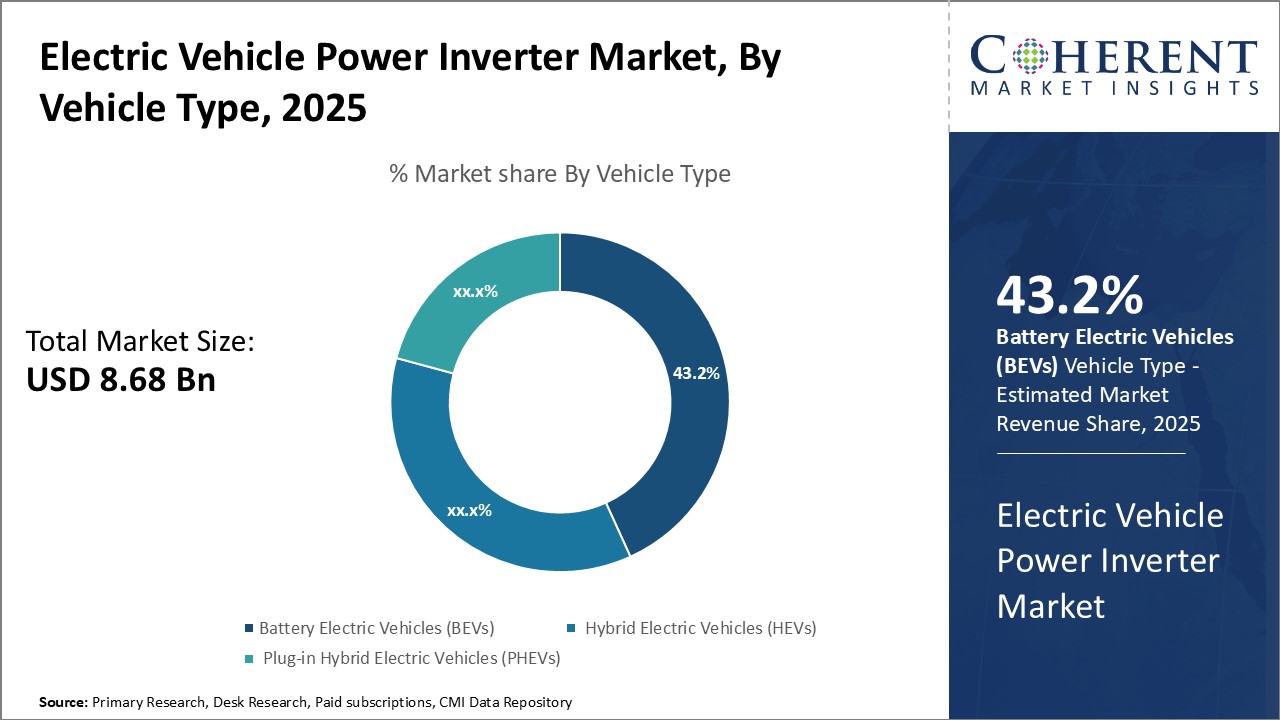
Electric Vehicle Power Inverter Market Insights, By Vehicle Type: Battery Electric Vehicles (BEVs) Are Set to Dominate, Driven by Eco-Conscious Consumers and Supportive Government Policies
In terms of vehicle type, the battery electric vehicles (BEVs) segment is expected to hold 44.2% share of the market in 2026 owing to the rising environmental awareness among consumers and stringent government regulations regarding vehicle emissions. BEVs have zero tailpipe emissions making them an attractive option for environmentally conscious customers.
Growing climate change concerns are compelling both individuals and organizations to reduce their carbon footprint by opting for green transportation. Also, favorable government policies aimed at promoting electric mobility such as subsidies and tax benefits on purchase of EVs are fueling the sales of BEVs.
For instance, in October 2025, DENSO announced that its newest inverter and battery management technologies are now used in Toyota's new BEV, the bZ4X. The advanced inverter includes the highest power density in the world and loses less power. The battery management system makes charging safer and more efficient. This is a big step forward for DENSO's work on next-generation electric vehicle technology.
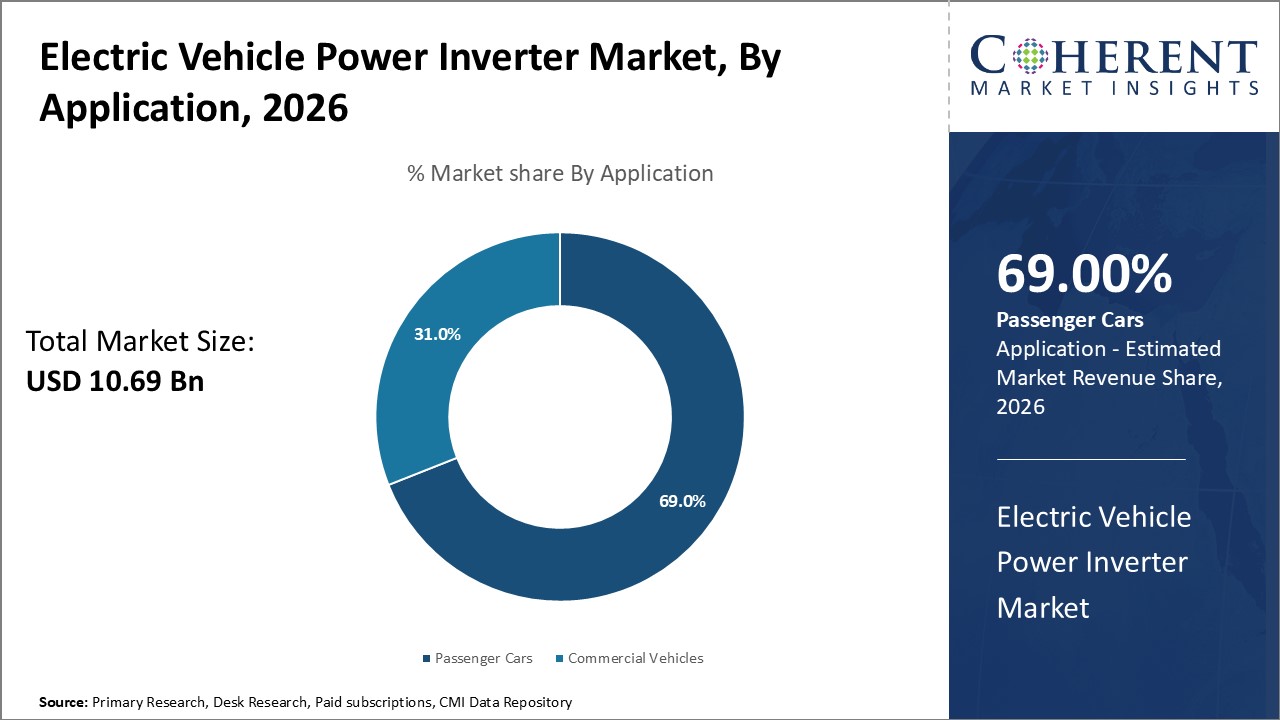
Electric Vehicle Power Inverter Market Insights, By Application: Passenger Cars Are Surging Fueled by Rising Demand for Family-Friendly, Long-Range Electric Vehicles
In terms of application, the passenger cars segment is expected to hold 69% share of the market in 2026 owing to growing preference for family electric cars. Passenger vehicles accounted for a major share of overall electric vehicle sales as they are being increasingly adopted by family customers who require larger vehicles for daily commute and longer drives. Leading automakers have launched several affordable long-range BEV and PHEV options like SUVs and sedans to tap into this burgeoning customer segment.
Moreover, low maintenance and excellent driving range of new-age electric passenger cars is attracting first-time buyers. These factors are expected to maintain the momentum of electric passenger vehicle sales over the next few years with the rising popularity of family EVs.
For instance, in February 2025, BMW Group unveiled a groundbreaking electric drive concept featuring 800V technology for its upcoming Neue Klasse passenger cars. The new system integrates the motor, transmission, and power electronics, enabling faster charging and greater efficiency. This innovation marks a major leap in BMW’s electrification strategy, enhancing performance and range in next-generation electric vehicles.
Electric Vehicle Power Inverter Market Insights, By Sales Channel: OEMs Are Set to Capture Dominance Driven by Regulatory Mandates and Strategic Electrification Initiatives
In terms of sales channel, the OEM (Original Equipment Manufacturers) segment is expected to hold 72.8% share of the market in 2026 owing to stringent regulatory compliance for vehicle makers. Many governments have mandated electric vehicle production quotas for automakers as a move towards carbon neutrality. Such regulations are leaving no choice for OEMs but to boost internal EV development and devote substantial investments towards building electric vehicles portfolios.
Apart from regulations, leading automakers view electric mobility as a strategic long-term opportunity and are proactively undertaking electrification drives.
For instance, in July 2025, BorgWarner signed an important contract with a top Chinese OEM to provide its advanced dual inverter technology for new electric vehicles. The inverters work with both 400V and 800V systems and are more efficient and scalable. This deal strengthens BorgWarner's position in the EV power electronics market and shows that OEMs are putting greater resources into electrification.
Regional Insights
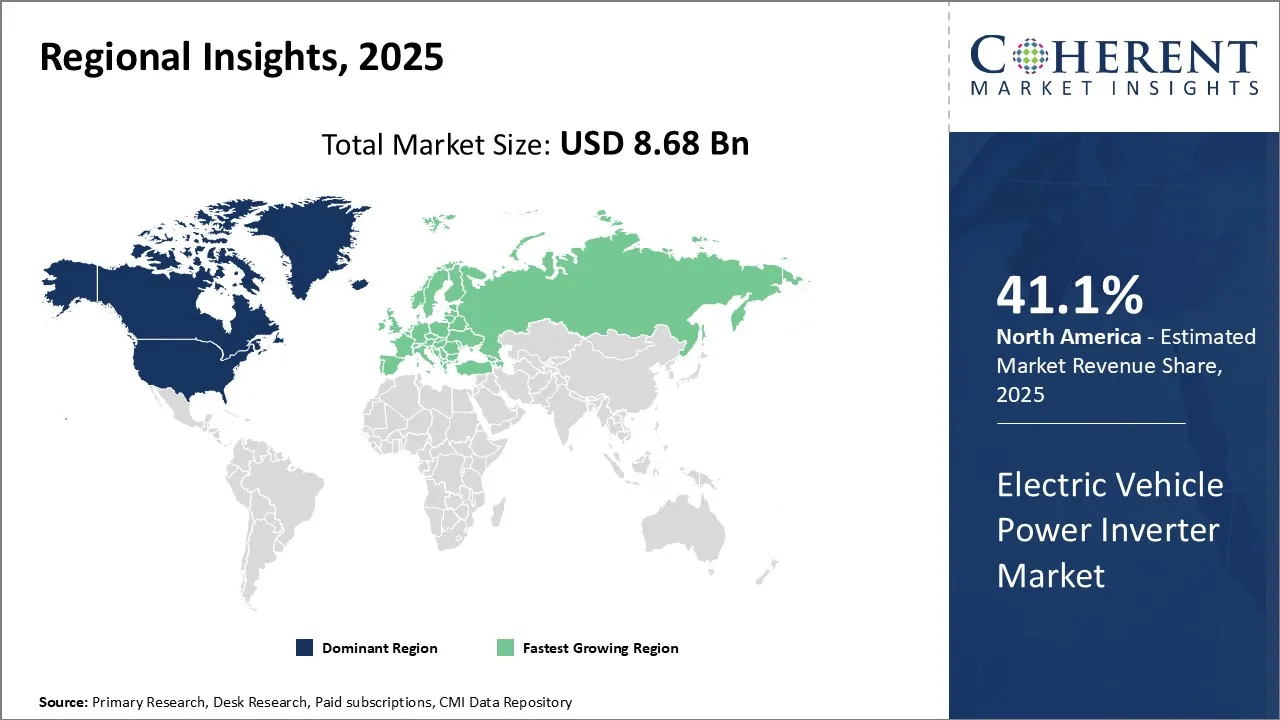
North America Electric Vehicle Power Inverter Market Analysis & Trends
North America dominates the electric vehicle power inverters market globally with an estimated 41.1% share in 2025. With the government aggressively promoting the adoption of EVs through subsidies and regulations. This has resulted in exponential growth of the domestic inverter market as well.
For instance, in July 2025, ON Semiconductor and Schaeffler worked together to make a new EliteSiC-based platform for plug-in hybrid electric cars. The partnership's main goal is to improve the thermal performance and power density of high-efficiency traction inverters. The platform supports advanced electrification for next-generation automotive applications and is aimed at global markets, especially Europe and North America.
Europe Electric Vehicle Power Inverter Market Analysis & Trends
Europe has emerged as the second largest and fastest growing region for EV power inverters. Stricter emissions regulations coupled with government subsidies and initiatives are driving massive EV adoption across major European countries like Germany, France, and the U.K. This is fueling the demand for inverters within the region. Additionally, presence of leading global automakers provides a captive market for European inverter manufacturers.
For instance, in June 2025, Evert, a German company, released a wallbox that includes a bidirectional EV charger, a PV inverter, and an energy management system. The system is made for connecting vehicles to homes and the grid. It allows solar panels, electric cars, and the grid work together to move energy more efficiently. This new idea helps people move around in a way that is good for the environment and use energy wisely in both homes and businesses in Europe.
Electric Vehicle Power Inverter Market Outlook Country-Wise
The U.S. Electric Vehicle Power Inverter Market Trends
The market for electric vehicle power inverters in the U.S. is booming as many more individuals are buying electric vehicles, the government is giving consumers incentives to buy them, and people want drivetrains that are more efficient. To meet sustainability goals, improve range, and support 400V and 800V architectures, car companies are putting money into advanced inverter technologies. This leads to an increase of demand at home for new power electronics solutions.
For instance, in November 2025, Wolfspeed highlighted its new 1200 V silicon carbide power modules at PCIM Europe 2025 in Germany. These modules are meant for high-efficiency EV traction inverters. The modules work with both 400 V and 800 V architectures and have better thermal and power density. This launch makes Wolfspeed's role in improving global electric vehicle power electronics even stronger.
Germany Electric Vehicle Power Inverter Market Trends
Germany in particular has demonstrated immense potential with its pioneering efforts to transition to electric mobility. Several top-tier German automotive suppliers have developed advanced inverter technologies and designs for premium EV models. This has enhanced Europe's competitive strength in the high-end segment of the market. Furthermore, Germany and other nations actively promote innovation and manufacturing within the domestic EV supply chain to boost local economies.
For instance, in April 2025, Energy Island Power, a German startup, has released a bidirectional EV charging kit that lets energy flow from the car to the home. The system works with solar inverters and home grids to simulate PV output and send AC power to homes. It was made for European markets and helps people live in a more environmentally friendly way by integrating smart EVs and solar panels.
Market Report Scope
Electric Vehicle Power Inverter Market Report Coverage
| Report Coverage | Details | ||
|---|---|---|---|
| Base Year: | 2025 | Market Size in 2026: | USD 10.69 Bn |
| Historical Data for: | 2020 To 2024 | Forecast Period: | 2026 To 2033 |
| Forecast Period 2026 to 2033 CAGR: | 23.1% | 2033 Value Projection: | USD 45.77 Bn |
| Geographies covered: |
| ||
| Segments covered: |
| ||
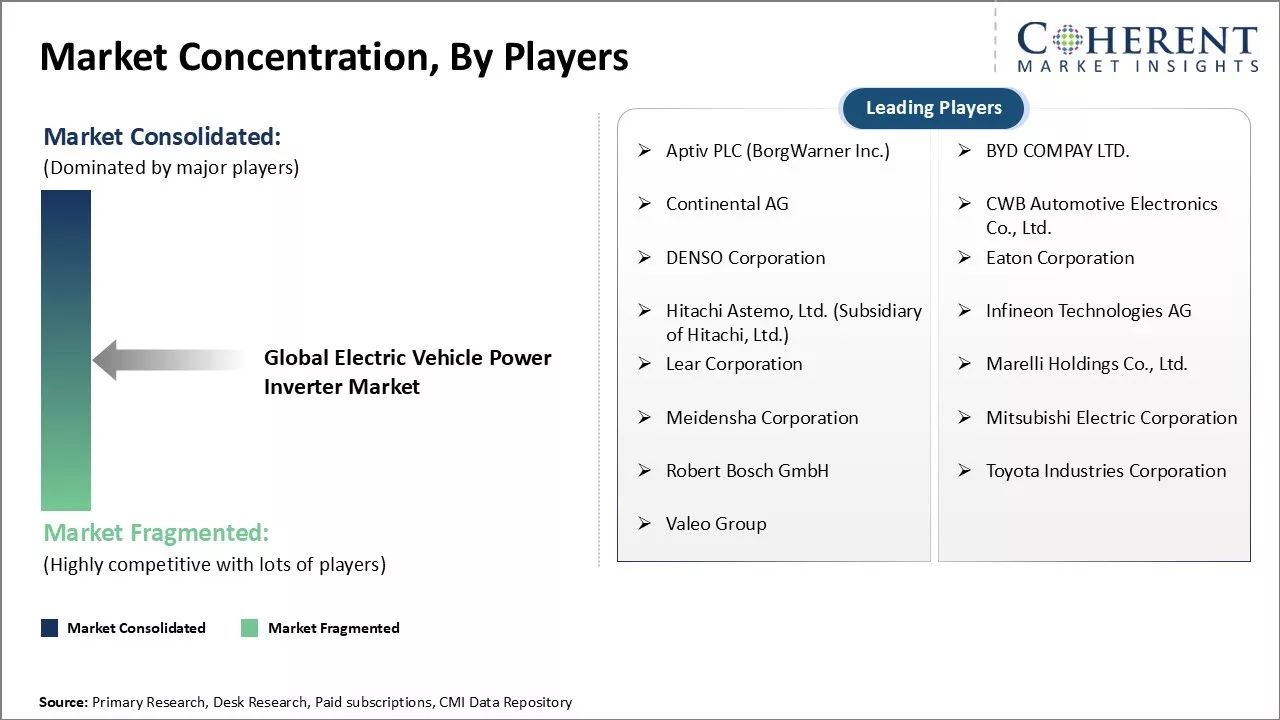
| Companies covered: | Aptiv PLC (BorgWarner Inc.), BYD COMPAY LTD., Continental AG, CWB Automotive Electronics Co., Ltd., DENSO Corporation, Eaton Corporation, Hitachi Astemo, Ltd. (Subsidiary of Hitachi, Ltd.), Infineon Technologies AG, Lear Corporation, Marelli Holdings Co., Ltd., Meidensha Corporation, Mitsubishi Electric Corporation, Robert Bosch GmbH, Toyota Industries Corporation, and Valeo Group | ||
| Growth Drivers: |
| ||
| Restraints & Challenges: |
| ||
Electric Vehicle Power Inverter Market Driver
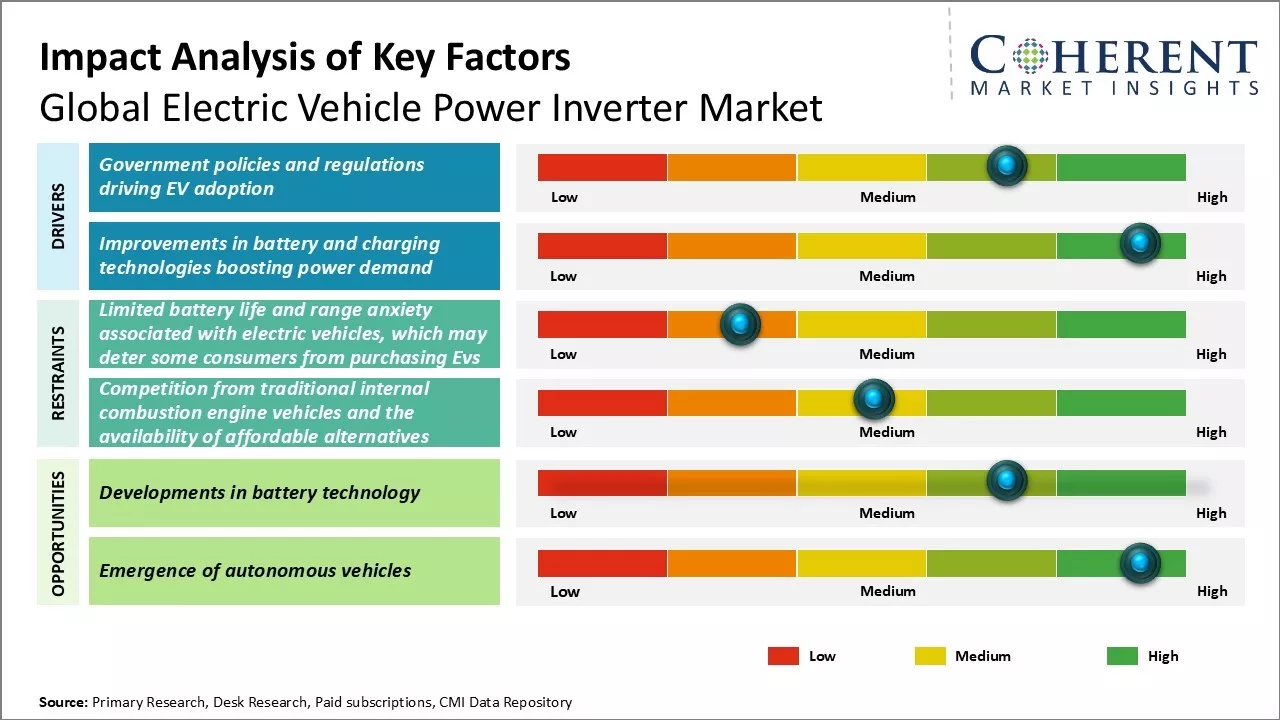
Government policies and regulations driving EV adoption
Many governments around the world are pushing for greater adoption of electric vehicles as a way to reduce carbon emissions from the transportation sector. Providing financial incentives for EV purchases and establishing corporate average fuel economy standards are compelling automakers to increase their electric vehicle offerings. Some nations have even announced plans to eventually phase out combustion engine vehicles. These policy initiatives are driving increased demand for EVs, which in turn is fueling growth in the electric vehicle power inverter market.
Market Concentration and Competitive Landscape
Improvements in battery and charging technologies boosting power demand
Another key driver is the ongoing improvements in battery energy density and charging infrastructure. Battery packs are getting lighter and more powerful with every generation, allowing EVs to travel further on a single charge. Fast charging networks are also expanding, easing customers' range anxiety. These advances are encouraging more consumers to select electric vehicles, knowing that long trips are now feasible. However, higher battery capacities and faster charging rates place greater demands on the electric drivetrain components including the inverter.
Electric Vehicle Power Inverter Market Opportunities
Developments in Battery Technology Opportunity
The global electric vehicle power inverter market forecast is poised for strong growth over the coming years driven by advancements in battery technology. Continuous research and development is extending EV battery life and range. Major battery manufacturers are launching new lithium-ion battery chemistries, as well as solid-state batteries, which promise higher energy densities and faster charging. Increased battery capacity allowing for longer driving ranges between charges helps alleviate ‘range anxiety’ concerns. Automakers are partnering with battery suppliers to utilize these advanced batteries featuring 350-400 miles of range in new electric vehicle models. Widespread battery cost reductions are also supporting the rising popularity of EVs. Further battery innovations will strengthen the EV market by improving performance and addressing current limitations that may prevent wider consumer acceptance.
Analyst Opinion (Expert Opinion)
As increased numbers of individuals around the world buy electric vehicles (EVs), the Electric Vehicle Power Inverter Market value is changing swiftly. As a growing number of companies switch to 800-V and higher platforms, inverter needs are changing. These systems charge 35–40% faster and are 5–10% more efficient than standard 400-V designs. This trend is leading to widespread use of silicon carbide (SiC) power devices, as shown by the fact that global SiC shipments will grow by more than 60% between 2022 and 2024.
Cost-effectiveness is still a big deal. The average cost of inverters has gone down from US$900–1,100 in 2019 to US$650–800 in 2024. This is due to semiconductor yields have improved and vertical integration has increased. SiC-based inverters also make things lighter by 15% to 20% and work better in heat. Thermal management is still very important because efficiency drops by 2–4% when junction temperatures go above 150°C. This is why liquid cooling and advanced thermal materials are becoming more popular.
The regionalization of supply chains is getting stronger, and by 2026, the global capacity for SiC wafers is expected to double. The market's direction favors inverter architectures with high voltage, software optimization, and strong semiconductor integration.
Speak to the analyst
Want personalized insights?
Take the findings above to one of our principal consultants, or have the report rebuilt around the segments, geographies and competitors you actually track.
Electric Vehicle Power Inverter Industry News
- In November 2025, Henkel released two new thermal potting materials for electric vehicle powertrain parts, such as inverters. These are the Bergquist TLB 4000 SLT and TLB 2000 SLT. These solutions are made for global markets and have better thermal conductivity and mechanical protection. This makes EV power electronics more reliable and better performing in Europe, North America, and Asia.
- In October 2025, Valeo signed contracts to provide its new dual inverter solution to two of China's largest car makers. The inverters work with both 400V and 800V systems, making EV platforms more efficient and flexible. This is an important move for Valeo in China's fast-growing electric vehicle market and this also shows that the company is a leader in power electronics innovation.
- In July 2025, At the Automotive Engineering Exposition 2024 in Yokohama, Japan, Hitachi Astemo displayed its newest technologies for electrification. A thin-type inverter and an in-wheel motor that combines the inverter and brake systems were two of the most interesting things. These new ideas are meant to make electric vehicles more efficient and help the world become carbon neutral. They are aimed at global markets with small, high-performance powertrain solutions.
Market Segmentation
- Vehicle Type Insights (Revenue, US$ Bn, 2026 - 2033)
- Battery Electric Vehicles (BEVs)
- Hybrid Electric Vehicles (HEVs)
- Plug-in Hybrid Electric Vehicles (PHEVs)
- Application Insights (Revenue, US$ Bn, 2026 - 2033)
- Passenger Cars
- Commercial Vehicles
- Distribution Channel Insights (Revenue, US$ Bn, 2026 - 2033)
- Original Equipment Manufacturer (OEM)
- Aftermarket
- Regional Insights (Revenue, US$ Bn, 2026 - 2033)
- U.S.
- Canada
- Brazil
- Argentina
- Mexico
- Rest of Latin America
- Germany
- U.K.
- Spain
- France
- Italy
- Russia
- Rest of Europe
- China
- India
- Japan
- Australia
- South Korea
- ASEAN
- Rest of Asia Pacific
- GCC Countries
- Israel
- South Africa
- Rest of Middle East & Africa
- North America
- Latin America
- Europe
- Asia Pacific
- Middle East & Africa
- Key Players Insights
- Aptiv PLC (BorgWarner Inc.)
- BYD COMPAY LTD.
- Continental AG
- CWB Automotive Electronics Co., Ltd.
- DENSO Corporation
- Eaton Corporation
- Hitachi Astemo, Ltd. (Subsidiary of Hitachi, Ltd.)
- Infineon Technologies AG
- Lear Corporation
- Marelli Holdings Co., Ltd.
- Meidensha Corporation
- Mitsubishi Electric Corporation
- Robert Bosch GmbH
- Toyota Industries Corporation
- Valeo Group
Sources
Primary Research Interviews
- EV Power Inverter Manufacturers
- Electric Vehicle OEMs (Passenger Cars & Commercial Vehicles)
- Tier-1 Automotive Component Suppliers
- Automotive Power Electronics Engineers
- Battery & Motor System Integrators
- EV Charging Infrastructure Experts
- Others
Databases
- Bloomberg Terminal
- Thomson Reuters Eikon
- S&P Global Mobility
- Euromonitor International
- Others
Magazines
- Automotive News
- Power Electronics News
- Electronics Weekly
- EE Times
- Charged Electric Vehicles Magazine
- Others
Journals
- IEEE Transactions on Power Electronics
- IEEE Transactions on Vehicular Technology
- Journal of Power Electronics
- International Journal of Automotive Technology
- Others
Newspapers
- Financial Times
- The Wall Street Journal
- Reuters
- Bloomberg News
- Nikkei Asia (EV & Battery Section)
- Others
Associations
- International Energy Agency (IEA) – Global EV Outlook
- Society of Automotive Engineers (SAE International)
- European Automobile Manufacturers’ Association (ACEA)
- Electric Power Research Institute (EPRI)
- International Council on Clean Transportation (ICCT)
- Others
Public Domain Sources
- U.S. Department of Energy (DOE) – Vehicle Technologies Office
- National Renewable Energy Laboratory (NREL)
- European Environment Agency (EEA)
- Japan Automobile Manufacturers Association (JAMA)
- World Bank Open Data
- Government Statistical Offices
- Others
Proprietary Elements
- CMI Data Analytics Tool
- Proprietary CMI Existing Repository of information for the last 8 years
Get access to 250+ pages report
Every segment, forecast, competitor profile and data table behind the analysis above — available for instant download.
- ESOMAR Member
- ISO 9001:2015 Certified
- D-U-N-S Registered
- GDPR & CCPA Compliant
Missing comfort of reading report in your local language? Find your preferred language:
Transform your Strategy with Exclusive Trending Reports
Frequently Asked Questions
The Electric Vehicle Power Inverter Market is estimated to be valued at USD 10.69 Bn in 2026, and is expected to reach USD 45.77 Bn by 2033.
The CAGR of the Electric Vehicle Power Inverter Market is projected to be 23.1% from 2026 to 2033.
Government policies and regulations driving EV adoption and improvements in battery and charging technologies boosting power demand are the major factors driving the growth of global electric vehicle power inverter market.
Limited battery life and range anxiety associated with electric vehicles, which may deter some consumers from purchasing EVs and competition from traditional internal combustion engine vehicles and the availability of affordable alternatives are the major factors hampering the growth of global electric vehicle power inverter market.
In terms of vehicle type, the battery electric vehicles (BEVs) segment is estimated to dominate the market revenue share in 2026.
Aptiv PLC (BorgWarner Inc.), BYD COMPAY LTD., Continental AG, CWB Automotive Electronics Co., Ltd., DENSO Corporation, Eaton Corporation, Hitachi Astemo, Ltd. (Subsidiary of Hitachi, Ltd.), Infineon Technologies AG, Lear Corporation, Marelli Holdings Co., Ltd., Meidensha Corporation, Mitsubishi Electric Corporation, Robert Bosch GmbH, Toyota Industries Corporation, and Valeo Group are the major players.
North America is expected to lead the global electric vehicle power inverter market in 2026.