

Battery Market Size and Trends - 2026 to 2033
Global battery market is estimated to be valued at USD 178.97 Bn in 2026 and is expected to reach USD 573.49 Bn by 2033, exhibiting a compound annual growth rate (CAGR) of 18.1% from 2026 to 2033.
Key Takeaways
- Based on Type, the primary Battery segment is expected to lead the market with 68.6% share in 2026, driven by convenience, reliability, and long shelf-life.
- Based on Technology, the Lithium-ion Batteries segment is expected to hold 32.9% share of the market in 2026, driven by high energy density and falling costs.
- Based on Application, the Automotive Batteries segment is projected to account for 39.62% share of the market in 2026, driven by EV growth and micromobility trends.
- Based on Region, Asia Pacific is set to lead the battery market with 42% share in 2026. While, North America is projected to be the fastest growing region.
Market Overview
Global battery market growth is driven by increasing demand for EVs and energy storage systems across the globe. Lithium-ion batteries continue to dominate the transportation and stationary storage applications due to their high energy density. Furthermore, decreasing prices of lithium-ion batteries makes EVs and energy storage more viable and affordable. Governments around the world are also supporting the shift to sustainable technologies by providing various incentives and subsidies for EVs and renewable energy projects. This increasing focus on reducing emissions is expected to boost demand for batteries over the next decade.
Current Events and Its Impacts on the Battery Market
Current Event | Description and its Impact |
Electric Vehicle Market Acceleration and Policy Shifts |
|
Breakthrough Battery Technologies and R&D Developments |
|
What is the worldwide consumption of battery?
In the first half of 2025, global EV battery installations reached 504.4 GWh, marking a 37.3% year‑on‑year increase. Electric vehicles, including BEVs, PHEVs, and HEVs, remained the largest consumers, accounting for over 85% of demand. CATL led the market with 190.9 GWh (38% share), followed by BYD at 89.9 GWh.
Overall energy sector demand for batteries, including EVs and storage, hit an unprecedented 1 TWh in 2024, with weekly demand surpassing annual levels from just a decade earlier. Electric trucks showed the fastest growth, with demand rising 75% in 2024, now representing about 3% of total EV battery consumption.
- Current Industry Events of 2026
- Market Size Estimation
- Regional Breakdown
- Competitive Landscape
- Customer Intelligence
- Segmental Analysis
- Pricing Analysis
- Key Market Drivers, Challenges & Future Trends
- Customized Insights Section
Segmental Insights
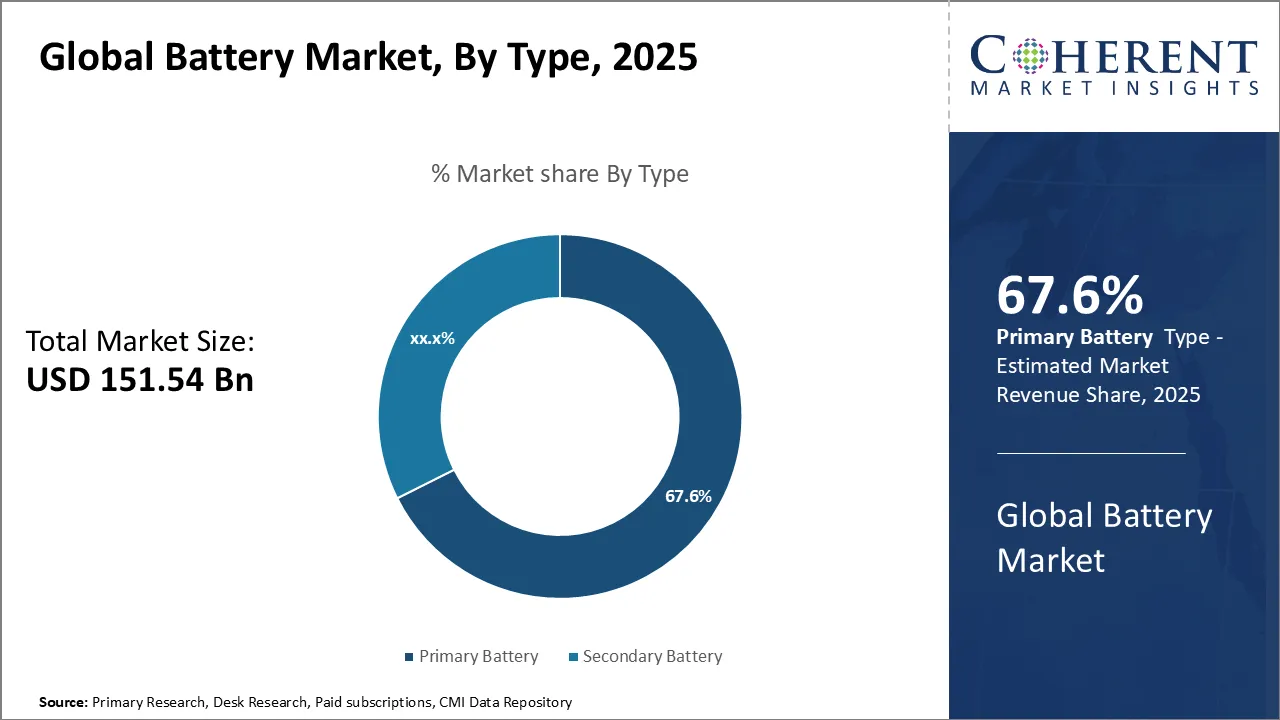
Battery Market Insights, By Type - Convenience and reliability boosts adoption of primary battery
By type, primary battery segment is estimated to contribute the highest market share of 68.6% in 2026, owing to its convenience and reliability characteristics. Primary batteries, also called disposable or single-use batteries, provide a portable and convenient power source for many common consumer devices. The simplicity of primary batteries makes them attractive for devices that only require intermittent power for things like remote controls, toys, flashlights, calculators and more. Not requiring recharging means these batteries can power devices immediately without extra charging steps. This on-demand usability is a driving factor in their widespread adoption.
Primary batteries also provide reliable energy even after long periods of non-use. Stored on a shelf for months or years, primary batteries can still power devices when needed due to their sealed and non-rechargeable design. This long shelf-life makes them well-suited for emergency use cases and applications requiring standby power.
For instance, in July 2025, Nordic Semiconductor's nPM2100 Power Management IC is now being made in large numbers for use in primary batteries. It is made for devices that use non-rechargeable batteries, like alkaline or lithium coin cells, and it makes them use less power and last longer. This new technology works with IoT sensors, medical devices, and portable electronics that need disposable primary batteries.
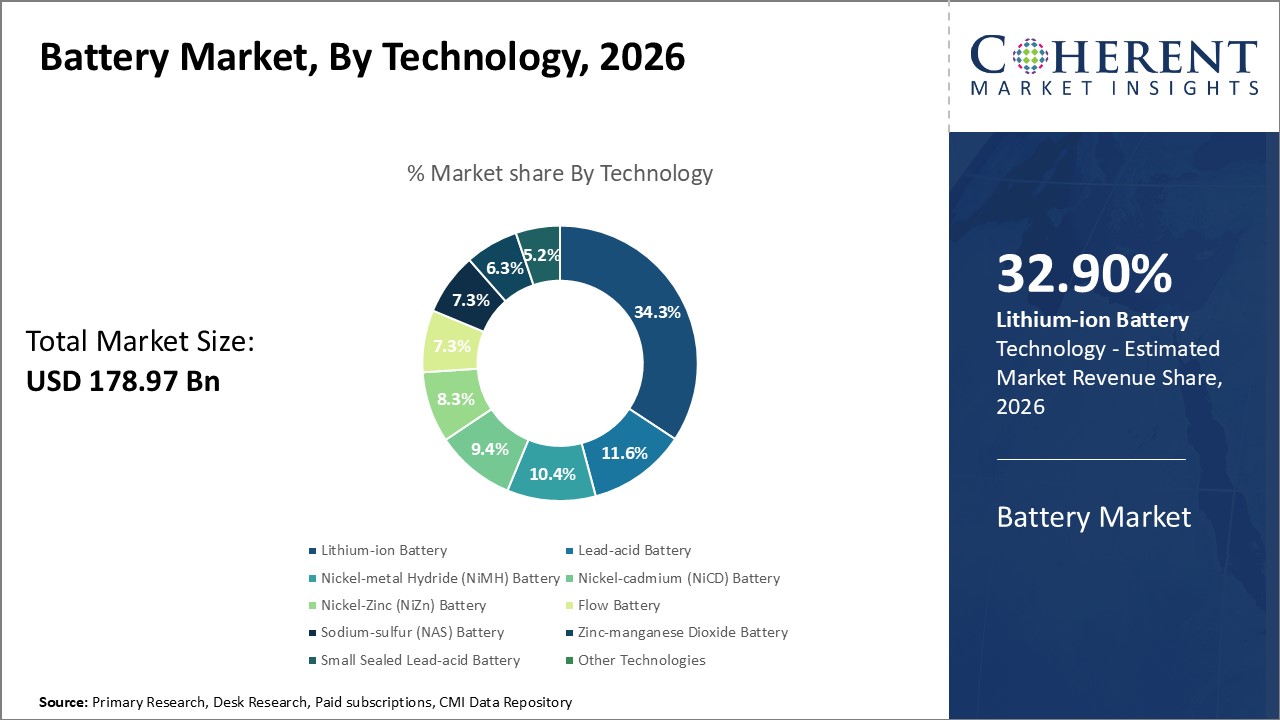
Battery Market Insights, By Technology - Energy density and costs push Lithium-ion technology forward
By technology, lithium-ion battery segment is estimated to contribute the highest market share of 32.9% in 2026 due to its high energy density and falling production costs. Lithium-ion possesses several advantages over other rechargeable battery types, most notably a substantially higher energy density by volume and weight. This allows Lithium-ion to power devices for longer runtimes utilizing a smaller and lighter form factor.
The energy density benefits of Lithium-ion have made it the technology of choice for many consumer electronics and is enabling the electrification of other industries like automotive. As costs fall due to growing economies of scale in battery cell production, Lithium-ion is also becoming more cost competitive relative to its energy output versus older technologies. Lower costs are further driving adoption and range expansion into new applications.
For instance, in September 2025, Ashwini Vaishnaw, India's Union Minister, opened TDK Corporation's new lithium-ion battery plant in Sohna, Haryana. The factory will make 200 million battery packs a year, which is enough to meet 40% of India's needs for laptops, wearables, and mobile phones. It helps Atmanirbhar Bharat, makes 5,000 jobs, and makes India's electronics manufacturing ecosystem stronger.
Battery Market Insights, By Application - Rise of electrified transportation boosts automotive batteries segment
By application, automotive batteries segment is estimated to contribute the highest market share of 39.62% in 2026, due to rising electric vehicle production and emerging mobility trends. Global commitments to reduce vehicle emissions and dependence on fossil fuels are accelerating the electrification of automotive powertrains. A growing variety of plug-in electric vehicles (EVs) like electric cars, hybrids and fuel cell vehicles require large, high-performance battery solutions.
Meanwhile, emerging micromobility solutions like electric scooters and bikes are utilizing smaller lithium-ion batteries for urban transportation alternatives. Battery-powered modes of individual transportation are on the rise to reduce urban congestion and pollution. This emergence of diverse electrified vehicles across small scooters to large trucks is fuelling exponential growth of automotive batteries segment.
For instance, by 2027, Toyota will release the first electric vehicle (EV) in the world with a solid-state battery. Compared to regular lithium-ion batteries, these new automotive batteries promise to charge faster, last longer, and be safer. This breakthrough is an important advancement forward for electric vehicle technology. It will make future eco-friendly transportation options work better and be more reliable.
Regional Insights
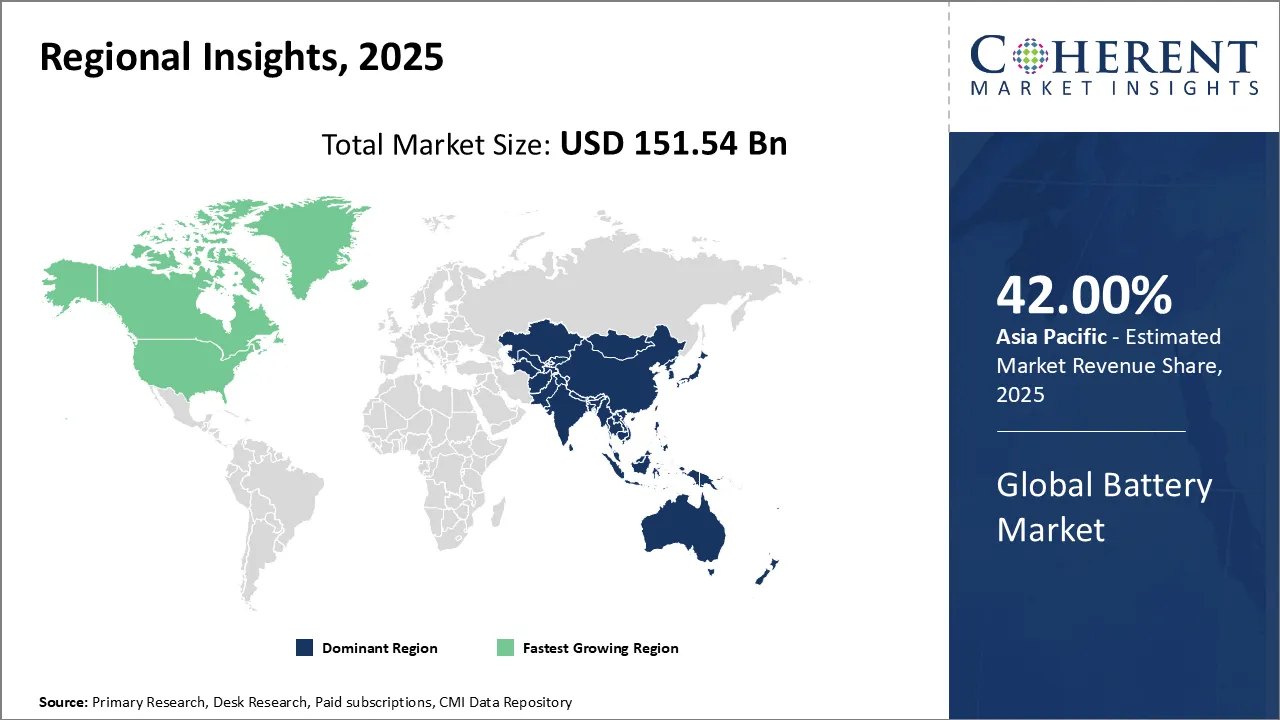
Asia Pacific Battery Market Analysis & Trends
Asia Pacific battery market has been witnessing strong growth over the past decade and currently dominates the global battery market with share of 42.0% in 2026. The region is also the fastest growing region with CAGR of 22.92% in 2026. The region is home to leading battery manufacturers and several top automotive brands.
Strong focus on the automotive industry has propelled battery demand, especially for lithium-ion batteries which are frequently used in electric vehicles. Stringent emission regulations have pushed many automakers to increase electric vehicle production. This has significantly boosted the battery market as the batteries remain the key component of any electric vehicle. Additionally, demand from other applications such as consumer electronics and energy storage is also driving the battery market growth.
For instance, in December 2026, Indofast Energy started a battery-swapping franchise program in India that can make you up to 30% more money. The project adds to the infrastructure for electric vehicles, reduces down on charging downtime, and supports clean transportation. Franchise partners have a lot of room for growth, and the program speeds up the use of electric vehicles and makes India's sustainable energy ecosystem stronger.
North America Battery Market Analysis & Trends
North America is projected to be the fastest growing region, due to rapid EV adoption, renewable energy integration, and growing need for grid-scale storage. Expanding consumer electronics and industrial applications also drive growth. Valued at over USD 115 billion, the market thrives on lithium-ion dominance, sustainability goals, and technological advancements.
For instance, in November 2026, Toyota opened its first battery factory outside of Japan, in North Carolina, USA. The plant helps electric vehicles grow in North America and makes local supply chains stronger. This smart move makes Toyota more competitive, helps manufacturing in the area, and adds to the growing need for car batteries.
Battery Market Outlook Country-wise
China Battery Market Trends
In 2026, China's battery market demand skyrockets as additional individuals are buying electric cars, renewable energy storage is growing, and consumer electronics sales are strong. Supply chains are driven by government policies, the ability to make things locally, and new solid-state technologies. China makes the most batteries in the world, meeting its own needs and supplying international markets with cutting-edge technologies.
For instance, in November 2026, China started making its first high-capacity all-solid-state batteries. The breakthrough is an important way forward for next-generation battery technology because it improves the range, safety, and performance of electric vehicles. This progress puts China at the top of the list for solid-state innovation, which may result in longer-range electric vehicles and more environmentally friendly transportation.
The U.S. Battery Market Trends
The US battery market is expected to be in high demand in 2026 since greater numbers of individuals are buying electric cars, there is a need for renewable energy storage, and manufacturing in the US is growing. Growth is driven by government incentives, goals for sustainability, and new technologies. Consumer electronics and large-scale projects increase demand even more, which strengthens America's battery supply chain and energy independence.
For instance, in December 2026, Anthro Energy planned to open a state-of-the-art battery factory in Louisville, Kentucky, which is expected to make America's battery supply chain stronger. The plant focuses on next-generation technology and makes it easier to use electric vehicles, store renewable energy, and make electronics. This milestone improves the country's ability to make things and makes the US a leader in battery innovation.
Market Report Scope
Battery Market Report Coverage
| Report Coverage | Details | ||
|---|---|---|---|
| Base Year: | 2025 | Market Size in 2026: | USD 178.97 Bn |
| Historical Data for: | 2020 To 2024 | Forecast Period: | 2026 To 2033 |
| Forecast Period 2026 to 2033 CAGR: | 18.1% | 2033 Value Projection: | USD 573.49 Bn |
| Geographies covered: |
| ||
| Segments covered: |
| ||
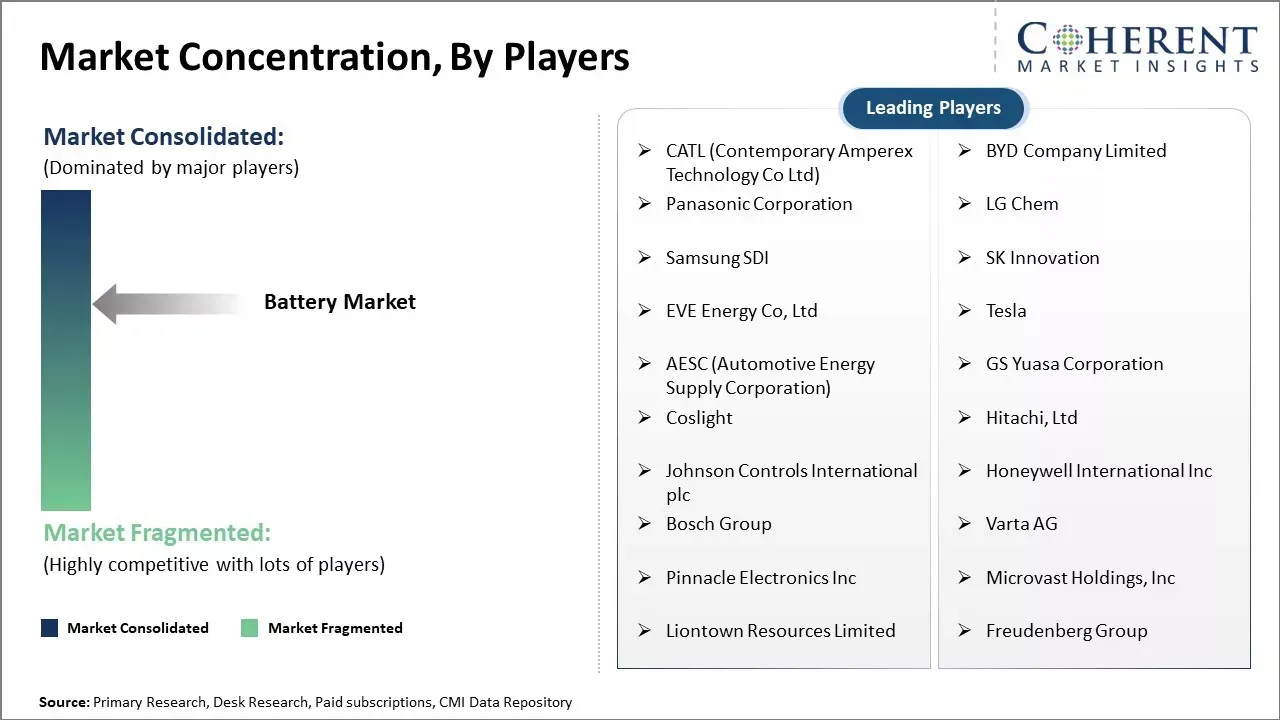
| Companies covered: | CATL (Contemporary Amperex Technology Co Ltd) , BYD Company Limited , Panasonic Corporation , LG Chem , Samsung SDI , SK Innovation , EVE Energy Co, Ltd , Tesla , AESC (Automotive Energy Supply Corporation), GS Yuasa Corporation , Coslight , Hitachi, Ltd , Johnson Controls International plc , Honeywell International Inc, Bosch Group , Varta AG , Pinnacle Electronics Inc, Microvast Holdings, Inc, Liontown Resources Limited, Freudenberg Group | ||
| Growth Drivers: |
| ||
| Restraints & Challenges: |
| ||
Battery Market Driver
How does EV adoption boost battery market demand?
Growing concern over environmental pollution and rising fuel costs have resulted in increased focus on developing more sustainable transportation solutions. Electric vehicles that run on advanced battery technologies are emerging as a viable alternative to fuel-based vehicles. Several automobile manufacturers have ramped up investments in electric vehicles in response to tightening emission norms and shifting consumer preferences towards green mobility options.
Battery electric vehicles and plug-in hybrid electric vehicles provide comparable driving ranges to gasoline vehicles and allow consumers to refuel using electricity from the grid instead of gasoline. The upfront costs of EVs are compensated over time through lower fuel and maintenance expenses. Supportive government initiatives such as purchase incentives and investments in charging infrastructure are encouraging more consumers to make the switch to EVs.
How does battery backup use drive market demand?
The constant evolution of digital technologies and increasing usage of smart devices have heightened the importance of uninterrupted access to electricity. Power outages remain a persistent problem in many parts of the world, owing to aging electrical infrastructure, natural calamities and grid failure risks. To safeguard against unexpected disruptions in power supply, industrial facilities, telecom towers, data centers and buildings have been strengthening their dependency on battery backup reserves.
Lithium-ion batteries are the technology of choice for such backup power applications due to their high energy density, long service life and relatively lower self-discharge rates compared to lead-acid alternatives. In remote and off-grid areas lacking access to centralized power networks, batteries play a vital role in energizing essential needs through micro-grid and solar-plus-storage solutions. The growing energy needs of a digitally connected world along with instability in conventional grids is propelling the battery storage industry. As reliance on backup power grows, there will be a corresponding rise in demand for advanced battery packs that can effectively deliver on reliability, performance and long-term cost viability.
Battery Market Opportunities
How will the surge in EVs and electronics impact battery market demand?
The rise of electric vehicles and electronics presents significant growth opportunities for the market. Battery demand is expected to surge over the next decade. Government backing for clean technologies is driving substantial research and development investments into innovative battery chemistries such as solid-state, lithium-sulfur, and lithium-air, which offer the potential to revolutionize performance.
Market Concentration and Competitive Landscape
Analyst Opinion (Expert Opinion)
The battery market is expanding quickly in terms of structure, due to faster electrification and more energy storage systems being used. In 2024, shipments of lithium-ion batteries around the world reached about 1,545 GWh, which is an immense rise over the previous year. More than 1,050 GWh of power batteries were used in electric vehicles. Batteries for stationary energy storage grew faster, because of grid balancing and the use of renewable energy.
The ability to make things is still growing swiftly. It is expected that global production capacity for rechargeable batteries will exceed 2 TWh per year. This is due to large investments in gigafactories and upstream supply chains. China is still the main place where lithium-ion batteries are made, making up almost four-fifths of the world's total output. This is since it has easy access to raw materials, cell manufacturing, and pack assembly. Battery production in China has grown by double digits, and both lithium iron phosphate and ternary chemistries are being used in more vehicles and storage systems.
As technology improves, standards for performance are changing. Over the past ten years, the average energy density of batteries has steadily increased, while the cost per kilowatt-hour has dropped sharply. This has made batteries more affordable and sped up their use in electric vehicles, consumer electronics, and industrial storage systems. Electric vehicle sales growth of more than 25% per year continuing to be a major driver of demand.
Overall, the battery market is becoming a key part of the industrial sector that supports electrification of transportation and modern energy infrastructure. Competitive positioning is based on scale, efficiency, and chemistry optimization.
Speak to the analyst
Want personalized insights?
Take the findings above to one of our principal consultants, or have the report rebuilt around the segments, geographies and competitors you actually track.
Recent Developments
- In December 2025, Juniper Green has ordered a 60 MWh merchant battery energy storage system, which is a significant advance forward for India's renewable energy industry. The project makes the grid more reliable, helps clean energy integration, and shows that more money is going into large-scale battery solutions. This shows India's commitment to building a sustainable power infrastructure and making the switch to clean energy.
- In December 2025, Adani Group started a battery storage project in India that can hold 3.53 GWh of energy. This is expected to integrate renewable energy and keep the grid stable. This major initiative helps India reach its clean energy goals, makes the power supply more reliable, and shows that the country needs more advanced battery solutions. This makes India a key player in building sustainable energy infrastructure.
- In November 2025, Bihar Batteries planned to launch sodium-ion batteries for commercial use in 2026. These batteries are going to be a different option from lithium-ion batteries. This new technology helps India meet its growing energy storage needs, makes things more sustainable, and strengthens domestic manufacturing. The project shows how serious India is about next-generation battery solutions while demonstrating how it is helping to build clean energy infrastructure.
- In June 2025, Cummins India Limited released battery energy storage systems to make India's power infrastructure stronger. These systems make it easier to use renewable energy, make the grid more reliable, and help growth that lasts. The project shows that there is a growing need for advanced battery technologies, making India an important player in the shift to clean energy and future energy security.
Market Segmentation
- Type Insights (Revenue, USD Bn, 2026 - 2033)
- Primary Battery
- Secondary Battery
- Technology Insights (Revenue, USD Bn, 2026 - 2033)
- Lead-acid Battery
- Lithium-ion Battery
- Nickel-metal Hydride (NiMH) Battery
- Nickel-cadmium (NiCD) Battery
- Nickel–zinc (NiZn) Battery
- Flow Battery
- Sodium–sulfur (NAS) Battery
- Zinc-manganese Dioxide Battery
- Small Sealed Lead-acid Battery
- Other Technologies
- Application Insights (Revenue, USD Bn, 2026 - 2033)
- Automotive Batteries
- Industrial Batteries
- Portable Batteries
- Power Tools Batteries
- SLI Batteries
- Other Applications
- Regional Insights (Revenue, USD Bn, 2026 - 2033)
- North America
- U.S.
- Canada
- Latin America
- Brazil
- Argentina
- Mexico
- Rest of Latin America
- Europe
- Germany
- U.K.
- Spain
- France
- Italy
- Russia
- Rest of Europe
- Asia Pacific
- China
- India
- Japan
- Australia
- South Korea
- ASEAN
- Rest of Asia Pacific
- Middle East & Africa
- South Africa
- GCC Countries
- Israel
- Rest of Middle East & Africa
- Key Players Insights (Revenue, USD Bn, 2021 - 2033)
- CATL (Contemporary Amperex Technology Co Ltd)
- BYD Company Limited
- Panasonic Corporation
- LG Chem
- Samsung SDI
- SK Innovation
- EVE Energy Co, Ltd
- Tesla
- AESC (Automotive Energy Supply Corporation)
- GS Yuasa Corporation
- Coslight
- Hitachi, Ltd
- Johnson Controls International plc
- Honeywell International Inc
- Bosch Group
- Varta AG
- Pinnacle Electronics Inc
- Microvast Holdings, Inc
- Liontown Resources Limited
- Freudenberg Group
Sources
Primary Research Interviews
- Lithium-ion Battery Manufacturers
- Solid-State Battery Developers
- Battery Pack & Module Integrators
- Electric Vehicle (EV) OEMs and Tier-1 Suppliers
- Energy Storage System (ESS) Integrators
- Battery Materials Suppliers (Cathode, Anode, Electrolyte)
- Recycling & Second-Life Battery Service Providers
- Power Electronics & Battery Management System (BMS) Engineers
- Energy Storage Technology Consultants
- Others
Databases
- Bloomberg Terminal
- Benchmark Mineral Intelligence
- Wood Mackenzie
- Others
Magazines
- Battery Technology Magazine
- Energy Storage News
- PV Tech
- Power Engineering Magazine
- Chemical Engineering Magazine
- Automotive World
- Others
Journals
- Journal of Power Sources
- Journal of Energy Storage
- Energy & Environmental Science
- Advanced Energy Materials
- Electrochimica Acta
- Solid State Ionics Journal
- Nature Energy
- Others
Newspapers
- Financial Times
- The Wall Street Journal
- Reuters
- Bloomberg News
- Nikkei Asia
- Others
Associations
- International Battery Association (IBA)
- Battery Council International (BCI)
- International Energy Agency (IEA)
- Advanced Automotive Battery Conference (AABC)
- European Battery Alliance (EBA)
- Society of Automotive Engineers (SAE)
- Others
Public Domain Sources
- U.S. Department of Energy (DOE) – Office of Electricity & EERE
- International Energy Agency (IEA)
- National Renewable Energy Laboratory (NREL)
- European Commission – Energy & Mobility Directorate
- World Bank Open Data
- U.S. Geological Survey (USGS) – Minerals Data
- Others
Proprietary Elements
- CMI Data Analytics Tool
- Proprietary CMI Existing Repository of Information for the Last 8 Years
Get access to 250+ pages report
Every segment, forecast, competitor profile and data table behind the analysis above — available for instant download.
- ESOMAR Member
- ISO 9001:2015 Certified
- D-U-N-S Registered
- GDPR & CCPA Compliant
Missing comfort of reading report in your local language? Find your preferred language:
Transform your Strategy with Exclusive Trending Reports
Frequently Asked Questions
The Battery Market is estimated to be valued at USD 178.97 Bn in 2026, and is expected to reach USD 573.49 Bn by 2033.
The CAGR of the Battery Market is projected to be 18.1% from 2026 to 2033.
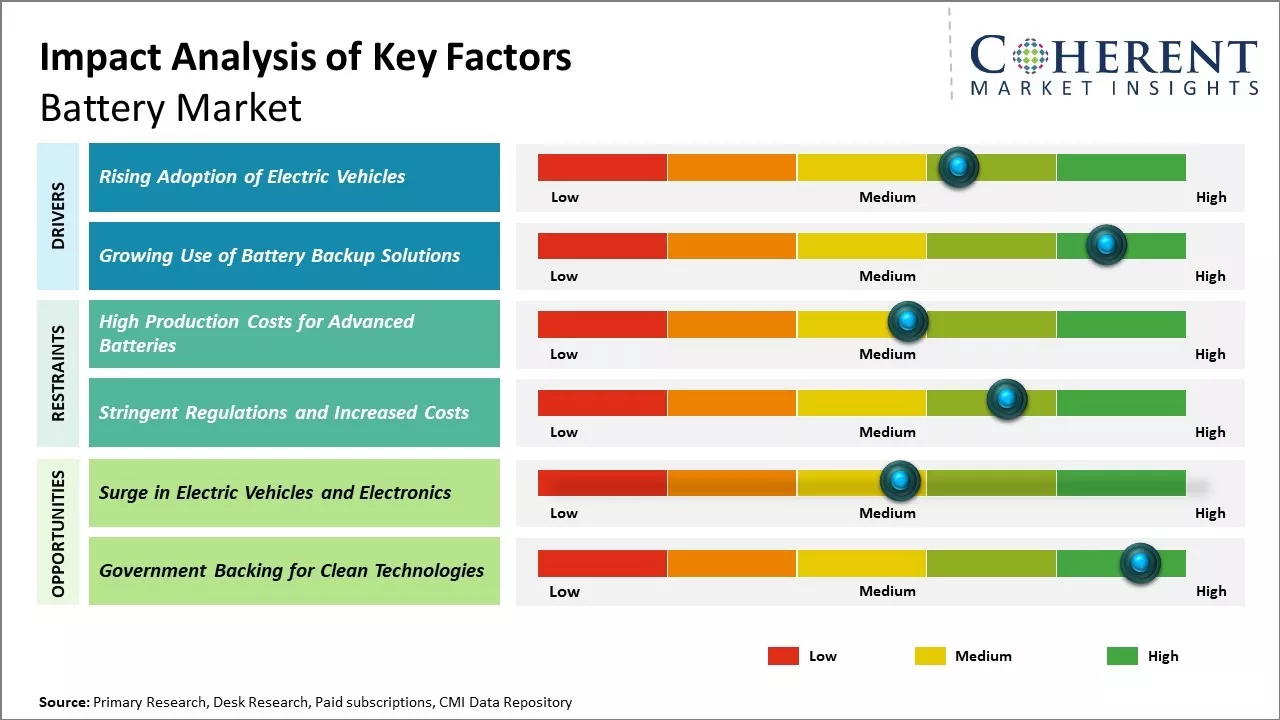
Rising adoption of electric vehicles and growing use of battery backup solutions are the major factors driving the growth of global battery market.
High production costs for advanced batteries and stringent regulations and increased costs are the major factors hampering the growth of global battery market.
In terms of type, primary battery segment is estimated to dominate the market in 2026.
CATL (Contemporary Amperex Technology Co Ltd) , BYD Company Limited , Panasonic Corporation , LG Chem , Samsung SDI , SK Innovation , EVE Energy Co, Ltd , Tesla , AESC (Automotive Energy Supply Corporation), GS Yuasa Corporation , Coslight , Hitachi, Ltd , Johnson Controls International plc , Honeywell International Inc, Bosch Group , Varta AG , Pinnacle Electronics Inc, Microvast Holdings, Inc, Liontown Resources Limited , Freudenberg Group are the major players.
Asia Pacific is expected to lead the global battery market in 2026.