

Solid State Battery Market Size and Forecast: 2026 to 2033
Solid State Battery Market is estimated to be valued at USD 2,748.7 Mn in 2026 and is expected to reach USD 28,116.7 Mn in 2033, exhibiting a compound annual growth rate (CAGR) of 39.4% from 2026 to 2033.
Key Takeaways
- By Application, Consumer & Portable Electronics hold the largest market share of 34.3% in 2026 owing to the demand for compact, high-performance portable devices.
- By Capacity, 20mAh-500mAh expected to hold largest market share in 2026 owing to the energy density and compact volume.
- By Battery Type, Thin film battery acquired the prominent market share of 90.5% in 2026 owing to its demand for compact, lightweight and flexible power sources.
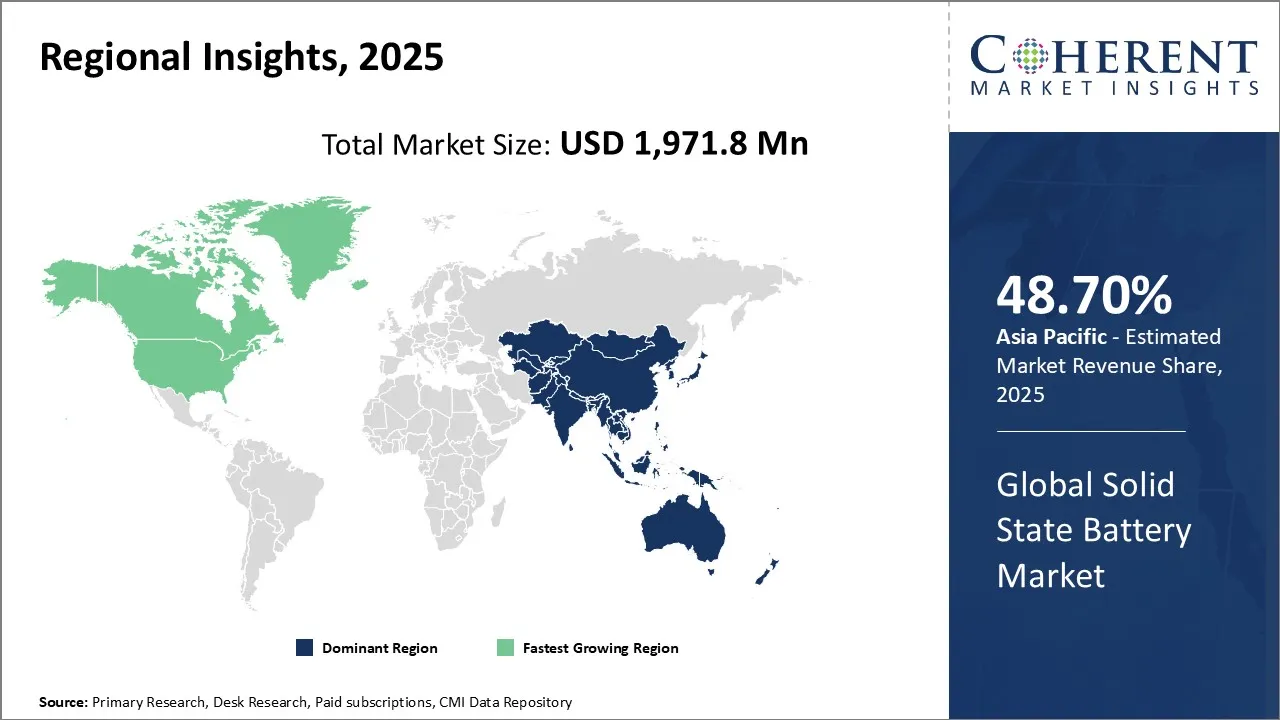
- By Region, Asia Pacific dominates the overall market with an estimated share of 48.7% in 2026 owing to the rapid growth of consumer electronics and portable devices.
Market Overview
The solid-state battery market is expanding quickly as industries pursue safer, higher-energy storage for consumer electronics, electric vehicles, medical devices, and IoT systems. Companies adopt solid electrolytes to achieve better safety, energy density, and durability than traditional lithium-ion batteries. Advances in materials science, the surge in compact electronic devices, and strong investment from automotive and technology firms are accelerating commercialization. Although high production costs and complex manufacturing still pose obstacles, continuous R&D and scaling efforts are driving the market toward broader adoption.
Current Events and Its Impact on the Solid State Battery Market
Current Events | Description and its impact |
Geopolitical and Supply Chain Dynamics |
|
Technological Innovations and Commercialization |
|
Economic and Investment Climate |
|
Segmental Insights
- Current Industry Events of 2026
- Market Size Estimation
- Regional Breakdown
- Competitive Landscape
- Customer Intelligence
- Segmental Analysis
- Pricing Analysis
- Key Market Drivers, Challenges & Future Trends
- Customized Insights Section
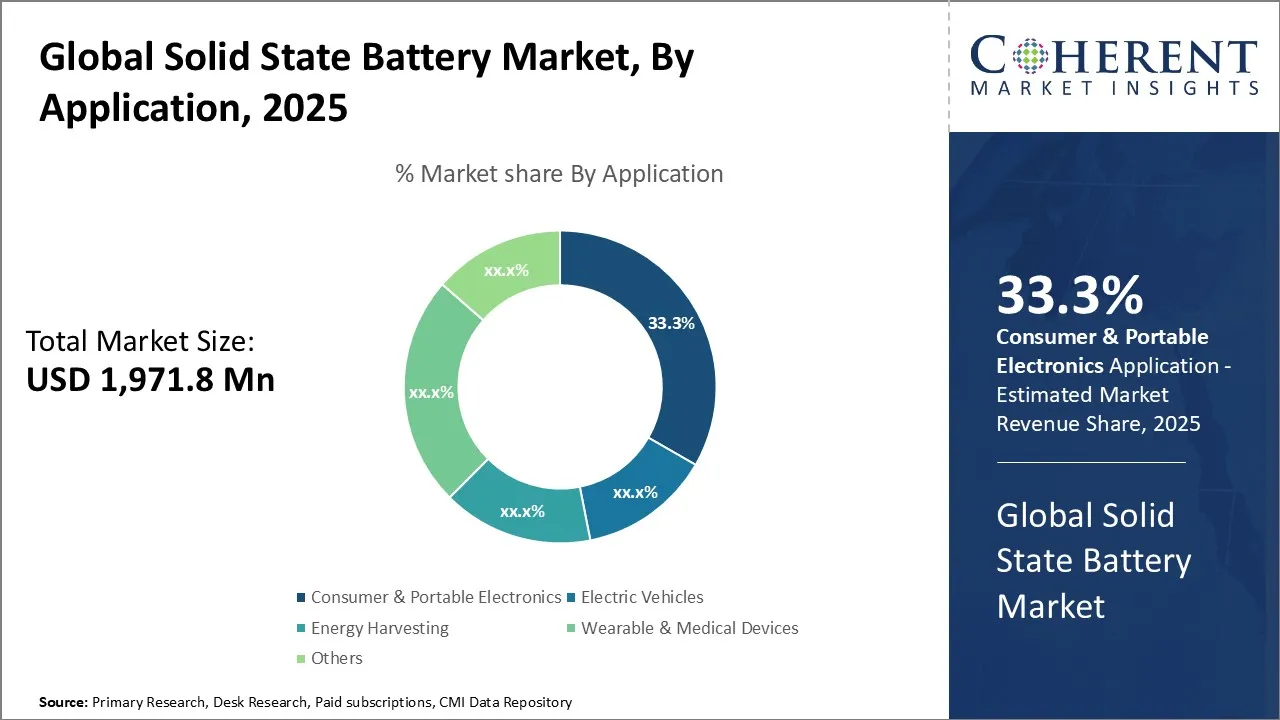
Solid State Battery Market Insights, By Application - Consumer & Portable Electronics contribute the highest share of the market owing to its enhanced safety and reliability
Consumer & Portable Electronics hold the largest market share of 34.3% in 2026. Consumer and portable electronics manufacturers are boosting demand for solid-state batteries as they aim for safer, slimmer, and longer-lasting power solutions. They design compact wearables, advanced smartphones, and lightweight laptops that require high-energy batteries suited for small spaces. Solid-state technology delivers greater safety and reliability, making it ideal for devices used frequently and worn on the body. Growing adoption of smart accessories and connected gadgets further accelerates the move toward solid-state systems that provide stronger performance and longer device life.
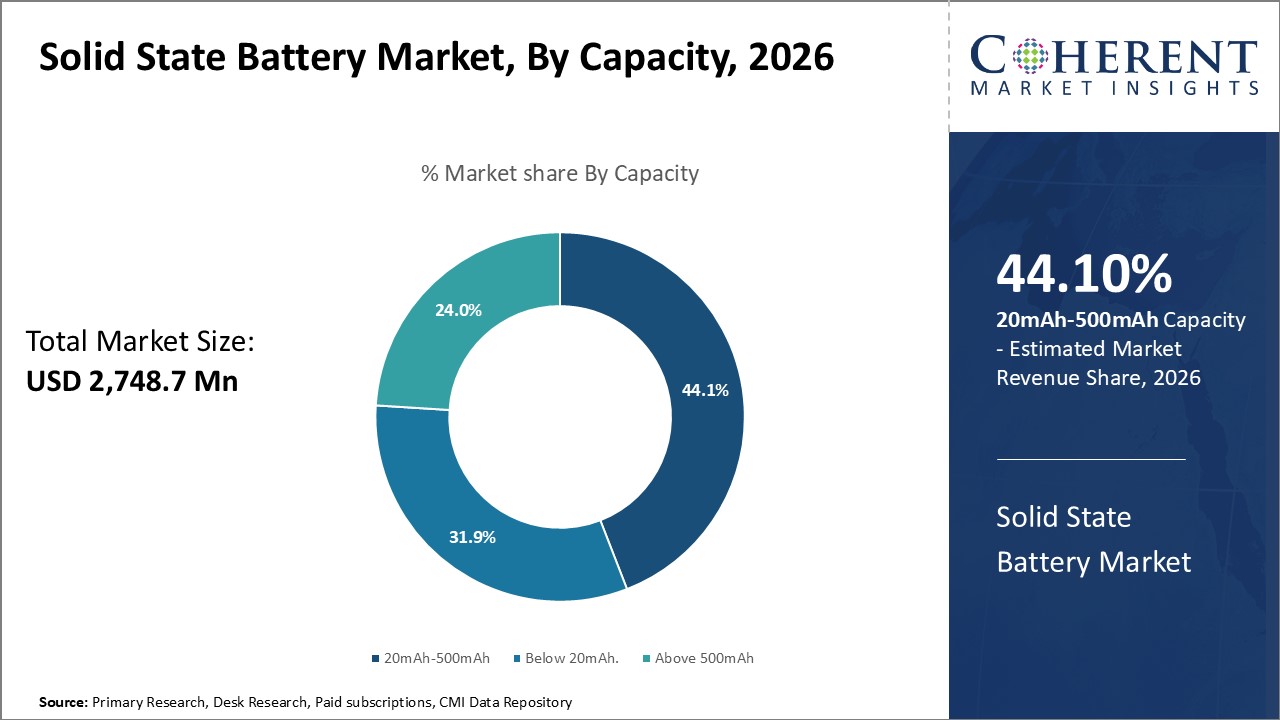
Solid State Battery Market Insights, By Capacity - 20mAh-500mAh contribute the highest share of the market owing to its safety, reliability, and durability
Manufacturers are increasingly adopting 20 mAh–500 mAh solid-state batteries as wearables, small electronics, and IoT sensors demand compact and reliable power. These batteries deliver high energy density in a small format, fitting easily into devices such as fitness trackers, medical patches, smart tags, and portable tools. Their enhanced safety, long cycle life, and stable performance enable continuous operation with minimal maintenance. Rising development of miniaturized electronics further accelerates the move toward this capacity range for efficient and durable energy solutions.
Solid State Battery Market Insights, By Battery Type - Thin film battery contributes the highest share of the market owing to its improved safety and stability vs conventional batteries
Thin film battery acquired the prominent market share of 90.5% in 2026. Manufacturers are increasingly adopting thin-film solid-state batteries as they develop wearables, medical devices, smart cards, and IoT sensors that require ultra-thin, lightweight, and flexible power sources. These batteries deliver high energy density, improved safety, and long-lasting performance in compact designs, making them perfect for miniaturized electronics. Advances in materials and production techniques have boosted their reliability and scalability, while rising demand for portable and connected devices accelerates adoption. Their flexibility and ability to fit unconventional shapes drive broader use in emerging applications.
For instance, in February 2025, Elevated Materials, a newly established company backed by TPG’s Rise Climate Fund and Applied Materials, has entered the battery market. The company produces ultra-thin, uniform lithium films and aims to enhance battery performance by applying decades of vacuum roll-to-roll processing expertise and leveraging hundreds of patents from Applied Materials.
Regional Insights
Asia Pacific Solid State Battery Market Trends
Asia Pacific dominates the overall market with an estimated share of 48.7% in 2025. The Asia‑Pacific region is emerging as a global hub for solid‑state batteries as manufacturers respond to rising demand for consumer electronics, expanding EV production, and government support for clean energy and battery innovation. China, Japan, and South Korea are driving large-scale EV manufacturing and investing heavily in R&D, while growing need for compact, high-performance batteries in smartphones, wearables, and IoT devices boosts solid-state adoption. Advances in materials and manufacturing are enhancing production feasibility, and supportive energy and environmental policies encourage SSB use in vehicles, electronics, and energy storage.
For instance, in November 2025, China advanced its electric vehicle development by launching its first production line for all-solid-state batteries, with Guangzhou Automobile Group (GAC) leading the initiative.
North America Solid State Battery Market Trends
North America is establishing itself as a key hub for solid‑state battery development as companies respond to strong EV demand, leverage robust R&D and manufacturing infrastructure, and benefit from supportive public policies. U.S. automakers and battery start-ups are collaborating to introduce next‑generation solid‑state batteries to the EV market, while incentives for clean energy and local production drive investments in pilot and precursor projects. Simultaneously, rising demand for safer, high-performance batteries in consumer electronics and energy storage is accelerating regional adoption.
India Solid State Battery Market Trends
India’s solid-state battery (SSB) market is emerging as a crucial driver of the country’s EV and energy-storage growth. Domestic companies and startups are leveraging global innovations and local incentives to develop solid-electrolyte systems for vehicles and stationary storage. SSBs offer higher energy density, faster charging, and improved safety, attracting commercial EV and energy storage sectors. Widespread adoption depends on ramping up production, securing high-purity materials, and making these batteries more cost-competitive than conventional lithium-ion technology.
United States Solid State Battery Market Trends
The U.S. solid-state battery market is rapidly advancing as battery manufacturers and automakers work to commercialize next-generation energy storage for EVs, electronics, and grid systems. Domestic companies are expanding pilot production, while collaborations between battery technology firms and major automakers drive solid-electrolyte designs toward real-world use. Solid-state batteries attract attention for their higher energy density, faster charging, longer lifespan, and improved safety over lithium-ion batteries. Widespread adoption still requires addressing cost, manufacturing scale, and supply-chain challenges.
End-user Feedback and Unmet Needs in the Solid State Battery Market
- Performance and Reliability Expectations: End-users value higher energy density, faster charging, and longer lifespan in solid-state batteries. Many reports satisfaction with safety improvements but seek more consistent performance under varied temperatures. They also desire batteries that maintain capacity over repeated cycles without degradation, highlighting the need for robust and reliable technology across real-world conditions.
- Cost and Affordability Concerns: While solid-state batteries offer advanced benefits, end-users often cite high upfront costs as a barrier to adoption. Customers want pricing that competes with conventional lithium-ion alternatives, especially for electric vehicles and consumer electronics. Lower production expenses and scalable manufacturing are key factors influencing broader market acceptance.
- Supply Chain and Availability Challenges: End-users frequently experience delays due to limited production capacity and raw material constraints. They emphasize the need for a secure, localized supply chain to avoid shortages and maintain timely delivery. Reliable availability is critical for both commercial applications like EV fleets and consumer products, shaping purchasing decisions.
Solid State Battery Market Trend
Electric Vehicle Adoption Driving Demand
The growing adoption of electric vehicles is a primary catalyst for solid-state battery development. Automakers and startups are investing heavily in solid-electrolyte technology to deliver higher energy density, faster charging, and improved safety. End-users increasingly prefer batteries that reduce fire risks and offer longer lifespans, especially for commercial fleets and premium EVs. Collaborations between battery manufacturers and automotive firms aim to bring scalable, road-ready solutions that can compete with conventional lithium-ion cells in both performance and reliability.
Expansion in Energy Storage Solutions
Solid-state batteries are gaining attention in stationary energy storage applications. Utilities and renewable energy projects are exploring these batteries for grid balancing, backup power, and off-grid solutions. Their enhanced stability and thermal safety reduce operational risks, making them attractive for large-scale deployments. Research focuses on improving cycle life and integrating solid-state systems with existing infrastructure, while governments and private investors support pilot projects to demonstrate long-term viability and cost-effective alternatives to conventional storage technologies.
Solid State Battery Market Opportunity
Next-Generation Electric Vehicles
Solid-state batteries offer a major opportunity in the EV sector, where demand for higher energy density, faster charging, and enhanced safety is growing. Automakers seek batteries that can extend driving range while reducing fire risks. Companies investing in pilot production and modular battery packs can capture early-mover advantages, particularly in premium EVs and commercial fleets, positioning solid-state technology as a cornerstone of future mobility solutions and helping accelerate the transition from traditional lithium-ion systems
Market Report Scope
Solid State Battery Market Report Coverage
| Report Coverage | Details | ||
|---|---|---|---|
| Base Year: | 2025 | Market Size in 2026: | USD 2,748.7 Mn |
| Historical Data for: | 2020 To 2024 | Forecast Period: | 2026 To 2033 |
| Forecast Period 2026 to 2033 CAGR: | 39.4% | 2033 Value Projection: | USD 28,116.7 Mn |
| Geographies covered: |
| ||
| Segments covered: |
| ||
| Companies covered: | Solvay, Samsung SDI Co., Ltd., Cymbet Corporation, Panasonic Corporation, Saft, BrightVolt Inc., and Solid Power | ||
| Growth Drivers: |
| ||
| Restraints & Challenges: |
| ||
Solid State Battery Market News
- In October 2025, Toyota developed all-solid-state batteries, aiming to launch its first EV by 2027 with longer range and faster charging, following a new partnership with Sumitomo Metal Mining Co. to mass-produce cathode materials.
Analyst Opinion (Expert Opinion)
- The worldwide push toward solid‑state battery technology is no longer speculative hype — we are witnessing real momentum. For instance, Idemitsu Kosan recently initiated design of a large pilot facility to mass‑produce solid electrolytes — aiming for “world‑class” output volumes by 2027–2028. That kind of upstream commitment signals that materials supply, once a show‑stopper, is being addressed.
- Simultaneously, cutting‑edge battery developers are posting tangible breakthroughs: SoftBank and Enpower Japan validated solid‑state cells with a specific energy of 350 Wh/kg — a figure that puts these batteries into realistic competition with high‑end lithium‑ion cells for applications beyond niche use, such as drones or aerospace platforms.
- On the automotive front, strategic alliances are shifting the debate away from “if” to “when.” For example, Toyota together with Sumitomo Metal Mining recently unveiled a new cathode material for all‑solid‑state batteries, underscoring their intention to deploy SSBs in EVs by 2027–2028.This level of vertical integration — from materials to cells to final vehicle design — dramatically reduces the risk that SSBs remain lab curiosities.
Speak to the analyst
Want personalized insights?
Take the findings above to one of our principal consultants, or have the report rebuilt around the segments, geographies and competitors you actually track.
Market Segmentation
- Global Solid State Battery Market, By Application
- Consumer & Portable Electronics
- Electric Vehicles
- Energy Harvesting
- Wearable & Medical Devices
- Others
- Global Solid State Battery Market, By Capacity
- Below 20mAh
- 20mAh-500mAh
- Above 500mAh
- Global Solid State Battery Market, By Battery Type
- Thin Film Battery
- Portable Battery
- Regional Insights (Revenue, USD Mn, 2021 - 2033)
- North America
- U.S.
- Canada
- Latin America
- Brazil
- Argentina
- Mexico
- Rest of Latin America
- Europe
- Germany
- U.K.
- Spain
- France
- Italy
- Russia
- Rest of Europe
- Asia Pacific
- China
- India
- Japan
- Australia
- South Korea
- ASEAN
- Rest of Asia Pacific
- Middle East
- GCC Countries
- Israel
- Rest of Middle East
- Africa
- South Africa
- North Africa
- Central Africa
- North America
- Key Players Insights
- Solvay
- Samsung SDI Co., Ltd.
- Cymbet Corporation
- Panasonic Corporation
- Saft
- BrightVolt Inc.
- Solid Power
Sources
Primary Research interviews
- Battery manufacturers and developers
- Raw material suppliers (e.g., electrolyte and electrode producers)
- Automotive OEMs integrating solid-state batteries
- Energy storage solution providers
- Academic researchers and scientists specializing in battery technologies
- Industry experts and technical consultants
Databases
- IEEE Xplore Digital Library
- Scopus
- ScienceDirect
- PubChem
- Materials Project
Magazines
- Battery Technology Magazine
- Advanced Energy Materials Magazine
- Electrochemical Energy Reviews
- Energy Storage Journal
Journals
- Journal of Power Sources
- Journal of The Electrochemical Society
- Solid State Ionics
- Advanced Energy Materials
- Energy & Environmental Science
Newspapers
- The New York Times (Technology/Energy sections)
- The Guardian (Science/Energy sections)
- Financial Times (Energy & Automotive sections)
- Reuters (Technology and Energy news)
Associations
- The Electrochemical Society (ECS)
- International Battery Association (IBA)
- Society of Automotive Engineers (SAE)
- European Association for Storage of Energy (EASE)
Public Domain sources
- US Department of Energy (DOE) reports
- European Commission energy reports
- Patent filings via Google Patents and WIPO
- Government energy and innovation publications
- Scientific conference proceedings
Proprietary Elements
- CMI Data Analytics Tool
- Proprietary CMI Existing Repository of information for last 8 years
Get access to 250+ pages report
Every segment, forecast, competitor profile and data table behind the analysis above — available for instant download.
- ESOMAR Member
- ISO 9001:2015 Certified
- D-U-N-S Registered
- GDPR & CCPA Compliant
Missing comfort of reading report in your local language? Find your preferred language:
Transform your Strategy with Exclusive Trending Reports
Frequently Asked Questions
The Solid State Battery Market is estimated to be valued at USD 2,748.7 Mn in 2026, and is expected to reach USD 28,116.7 Mn by 2033.
The CAGR of the Solid State Battery Market is projected to be 39.4% from 2026 to 2033.
Growing penetration of electric vehicles and expanding consumer electronics market are fuelling growth of the market.
The Consumer and portable electronics segment is the leading component segment in the market.
High costs of raw materials is the major factors restraining growth of the market.
Solvay, Samsung SDI Co., Ltd., Cymbet Corporation, Panasonic Corporation, Saft, BrightVolt Inc., and Solid Power