

Global Swipe Sensors Market Size and Forecast — 2026-2033
Global swipe sensors market is estimated to be valued at USD 3.94 Bn in 2026 and is expected to reach USD 11.15 Bn by 2033, exhibiting a compound annual growth rate (CAGR) of 16.0% from 2026 to 2033.
 Swipe sensors are widely used in smartphones, tablets, laptops and other consumer electronics. Miniaturization and improved functionalities are boosting demand for swipe sensors from OEMs in these industries. Advancements in fingerprint recognition technologies is also augmenting the market growth.
Global swipe sensors market is expected to witness significant growth over the forecast period. Extensive research and development (R&D) investments by sensor manufacturers to develop more accurate and durable sensors is expanding the potential applications. Integration of swipe sensors in wearable devices, internet-of-things (IoT) applications, access control systems and point of sale terminals is expected to create new revenue streams for the market players. However, high costs of biometric technologies and privacy concerns related to fingerprint data security could hinder the mass adoption of swipe sensors.
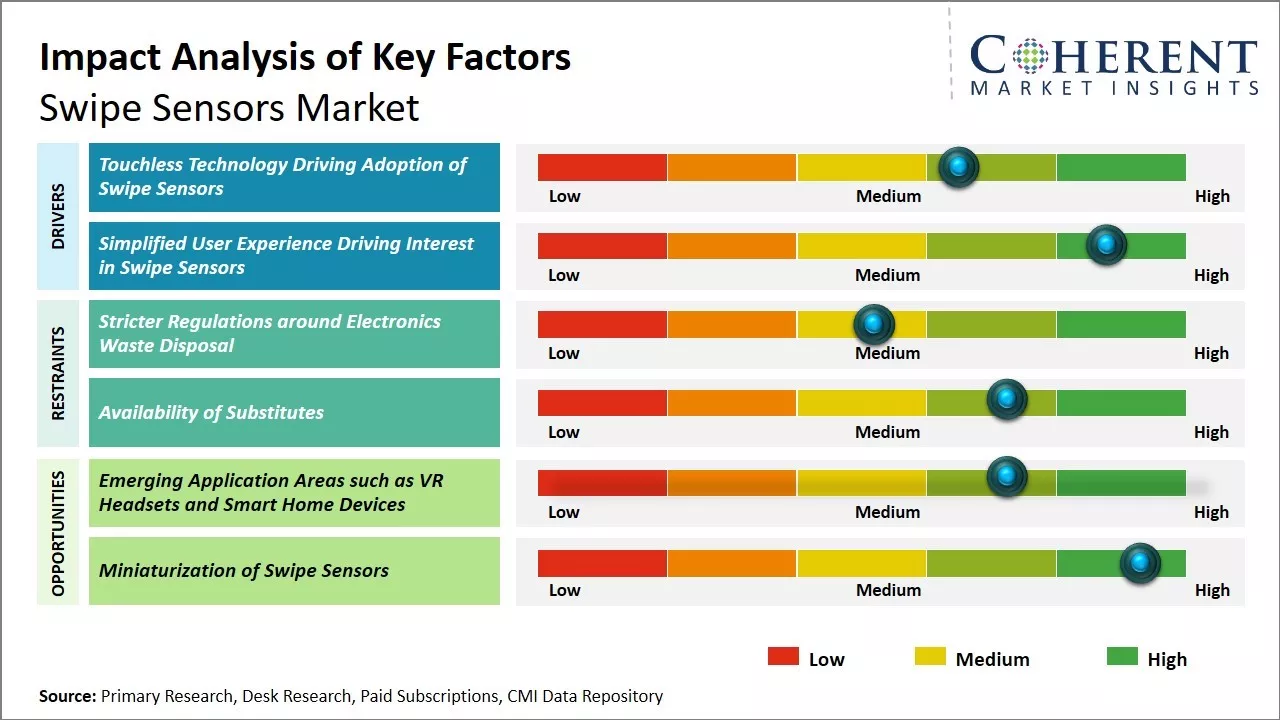
Touchless Technology Driving Adoption of Swipe Sensors
With the ongoing COVID-19 pandemic heightening concerns around hygiene and sharing of surfaces, there has been growing interest in hands-free and touchless technologies across industries. Swipe sensors are increasingly becoming an attractive option for applications that traditionally relied on buttons, touchscreens or keypads. Their ability to recognize gestures and commands through simple swiping motions without any direct contact with the device surface provides an additional layer of reassurance to users. For instance, FIBARO, an automation solution provider, offers FIBARO Swipe - a revolutionary battery gesture control pad that allows to control devices in Z-Wave network without actually touching anything. Its features includes swipe up, down, left, right, make a circular gesture and use sequences to get full and intuitive control of devices.
Manufacturers of consumer electronics, appliances, elevators and other automated systems have turned to swipe sensors to deliver a seamlessly touchless experience. Hotels and other hospitality businesses are upgrading their in-room controls and entertainment interfaces with swipe sensors to allay guest concerns. Even traditional sectors like banking and retail are exploring swipe sensor integration into ATMs, self-checkout counters, and payment terminals. Governments and organizations are actively promoting the development and adoption of touchless technologies through awareness campaigns and directives. Safety standards are also getting updated to mandate contactless user interactions wherever feasible. Together, these trends are boosting demand for swipe sensors across a wide array of end-use industries.
Insights, By Type
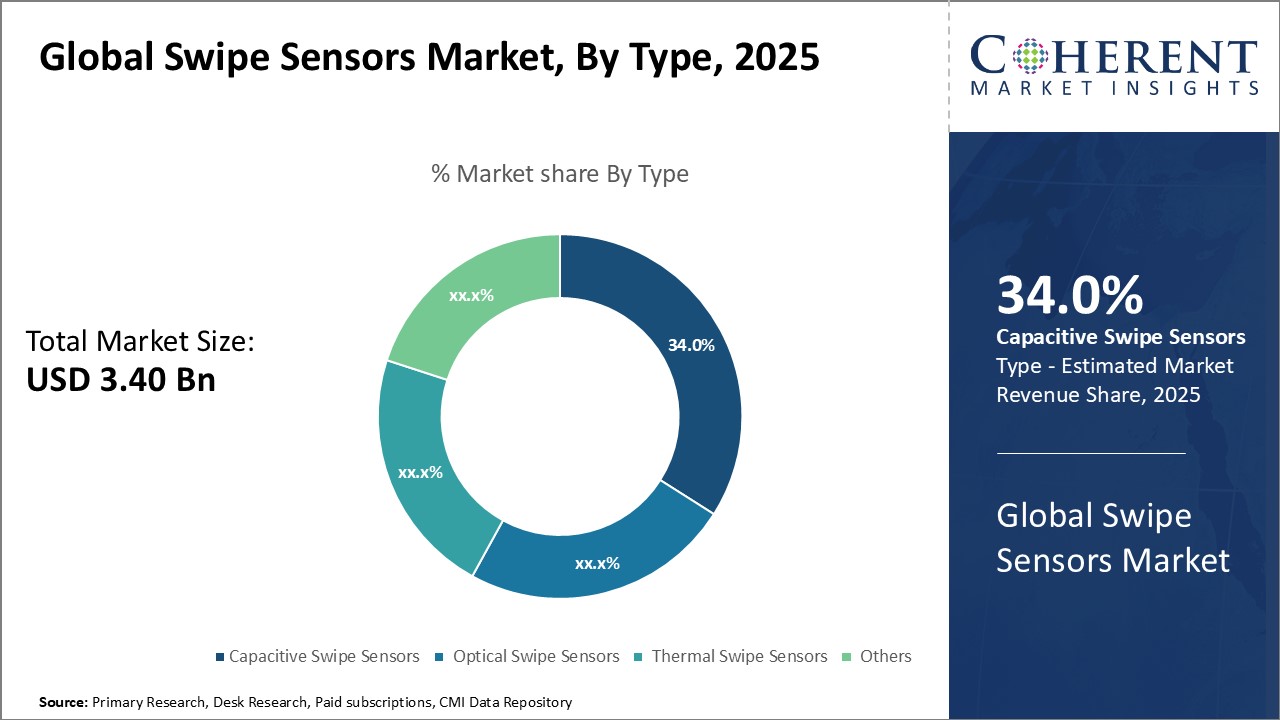 Insights, By Type, Capacitive swipe sensors drive innovation in touch interfaces
Capacitive swipe sensors segment is estimated to contribute the highest share of 35.0% in 2026 in the market owing to their outstanding reliability and functionality. Capacitive swipe sensors enable intuitive touch gestures like swipes that emulate physical controls. Their multi-touch ability supports advanced gestures for navigation, selection, and input.
Capacitive swipe sensors are highly responsive to touch, while remaining impervious to environmental factors. This makes them well-suited for integrated applications across diverse industrial and consumer products. Compared to alternatives, capacitive sensing enables thinner and more aesthetically pleasing embedded designs. Broad compatibility with various materials allows capacitive swipe integration into complex interfaces and multi-material constructions. These also consume relatively low power and extending battery life in mobile devices. For instance, Fingerprints, a Sweden –based biometrics solution provider, offers capacitive sensor solution for PCs, in combination with tailored software and algorithm, which perform fast fingerprint matching in line with the highest security standards while optimizing user convenience.
Advanced microfabrication has driven down costs while enhancing performance of capacitive swipe sensors. Miniaturization enables ubiquitous integration into ever smaller devices and form factors without compromises to functionality. Continuous technological advancement also expands the range of interactive touch experiences capacitive sensing enables. As interfaces across industries become more intuitive, motion-based and immersive, capacitive swipe sensors will remain essential drivers of interface innovation.
Insights, By Industry Vertical
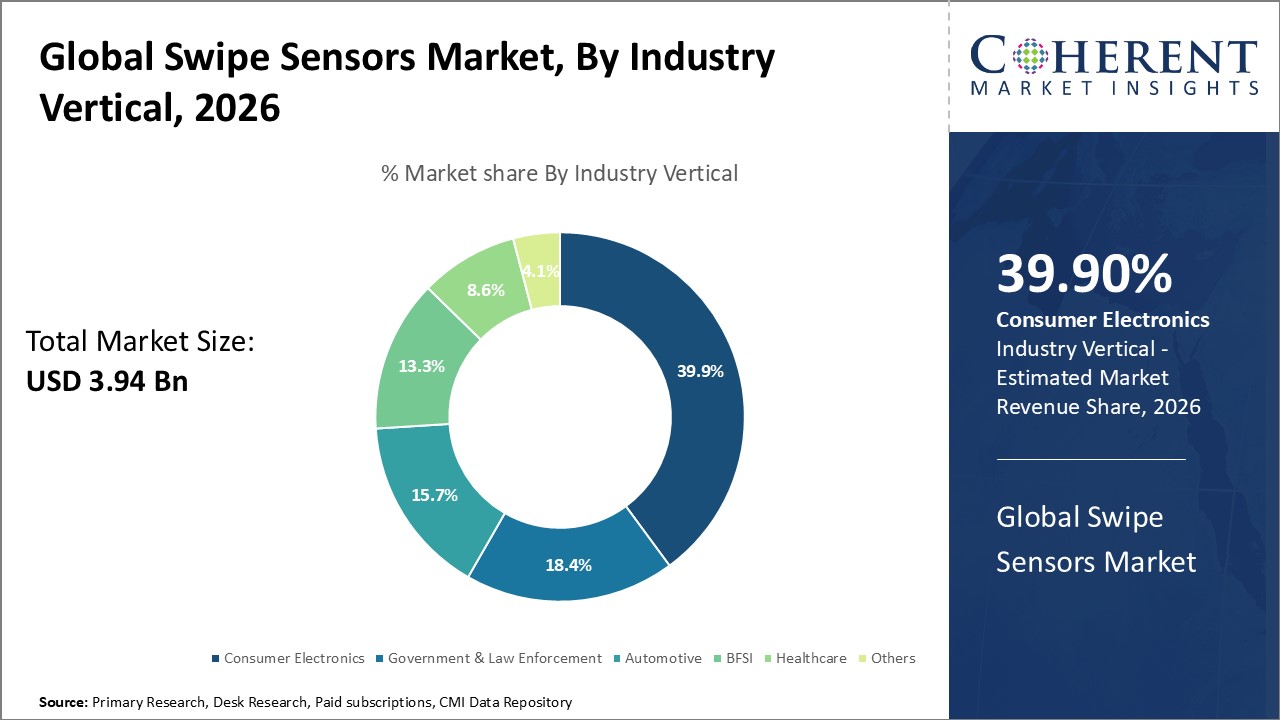
Insights, By Industry Vertical, Consumer electronics dominates the market
Consumer electronics is estimated to contribute the highest share of 39.9% in 2026 in the global swipe sensors market owing to extensive adoption in smartphones, tablets and wearables. Immersive interactive experiences demand seamless and intuitive interfaces that mimic physical controls. Swipe gestures have become universal language of control for touchscreens across these devices.
Smartphone screens serve as main interfaces and processing myriad daily tasks. Advanced swipe sensors facilitate navigation between home screens and apps, as well as precise inputs. In tablets, swipes optimize content viewing and multi-tasking across large, high-resolution touchscreens. Wearables integrate swipe sensors to deliver intuitive one-handed control suitable for compact form factors. Gesture capabilities stimulate interactive functionality in augmented/virtual reality (AR/VR) applications as well.
Consumer demand drives constant innovation in consumer electronics features and design. Slim bezel-less screens maximize visual real estate while preserving tactile usability. Multi-function dynamic interfaces adapt content and controls based on swipe paths and speeds. Advanced swipe recognition supports device-specific vocabularies of swipe gestures for personalized preferences. As immersive experiences proliferate across form factors, swipe sensors will continue optimizing seamless and intuitive touch interaction central to consumer experience.
Regional Insights
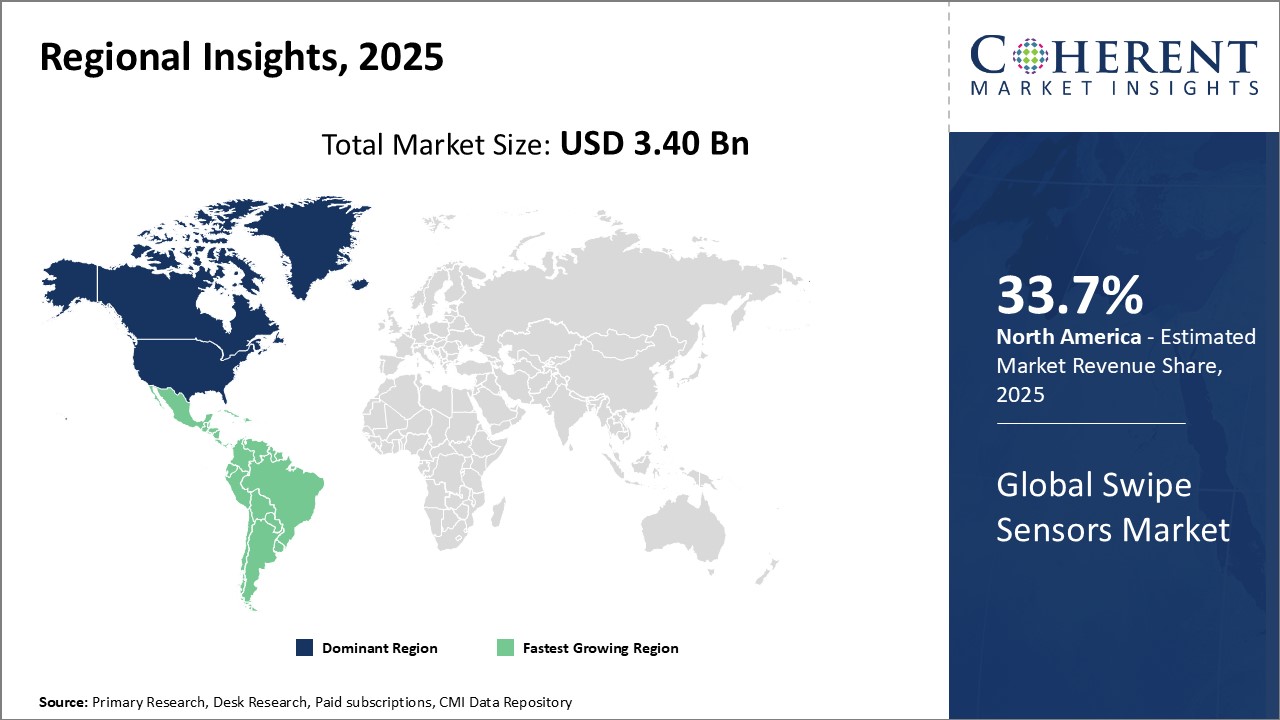 North America continues to dominate the global swipe sensors market due to strong presence of key market players and high adoption rate of advanced technologies in countries like the U.S. and Canada. The region is estimated to hold the market share of 33.7% in 2026 in the swipe sensors market driven by robust industrial and manufacturing sector employing automation at large scale. Majority of swipe sensor requirements come from sectors like automotive, consumer electronics, healthcare and manufacturing industries.
Being an early technology adopter, presence of advanced infrastructure and availability of skilled workforce has encouraged swipe sensor manufacturers to establish production and distribution facilities across North America. This has ensured steady supply and minimized procurement costs for end users. Furthermore, growing applications of swipe sensors in smartphones, tablets, wearables and smart home devices has boosted the regional consumption. Strong local consumption coupled with re-exports to Latin American countries has enabled North America to maintain its leadership position in the global swipe sensors market.
The Asia Pacific region has emerged as the fastest growing market for swipe sensors over the last few years. Rapid industrialization, rising disposable incomes, and increasing adoption of consumer electronic products have majorly driven the regional market growth. China continues to be the major contributor to Asia Pacific owing to large production base of electronic goods and components. Countries like South Korea, Japan, Taiwan, and India are also witnessing substantial rise in adoption of swipe sensor enabled devices and equipment across various applications.
Escalating electronics production in Asia supported by inexpensive workforce and availability of raw materials has attracted swipe sensor manufacturers to establish production facilities. This has augmented regional supply and competitiveness versus imports. Simultaneously, strong export focus of Asia Pacific nations has increased foreign sales of swipe sensors. Therefore, efforts to strengthen local manufacturing coupled with growing international consumption will continue aiding Asia Pacific to maintain its position as the fastest developing regional market.
Market Players, Key Development, and Competitive Intelligence
 Simplified User Experience Driving Interest in Swipe Sensors
Modern tech-savvy users have grown accustomed to seamless and intuitive interfaces that are delivered by smartphones, tablets, and other touch-enabled devices. There is now an expectation of minimize clicks, taps, and button presses needed to accomplish routine tasks. Swipe sensors address this demand elegantly due to their ability to interpret a range of touchless swipe gestures as commands or inputs. For instance, FingerPrint Cards AB, a biometrics solution provider, offers FPC1080A-2E swipe sensor which is ideal option for most standard authentication and touch control systems, especially those associated with mobile phones and portable devices. This extra compact swipe sensor includes built-in hardware with regular image capture capabilities, as well as motion and automatic detection mechanism options.
Product designers are leveraging the expressiveness of swipe gestures to simplify app functionality, menus and settings navigation on devices. Common gestures like swipes from edges can quickly switch between tasks or views. Diagnostics tools, entertainment systems, and other specialized equipment relying on gestures are adopting swipe sensors for their ease of use. In industrial and enterprise applications, swipe sensors improve wearable interaction and allow flexible customization of controls for special needs. Their resistance to dirt, liquid, grease and other harsh environmental elements also make them suitable for ruggedized devices.
The emphasis on simplified usability is driving broad evaluation of swipe sensors as an alternative to physical buttons or touchscreens. Their natural, intuitiveness is finding applications in new form factors like curved screens, foldables, and rollables.
- Current Industry Events of 2026
- Market Size Estimation
- Regional Breakdown
- Competitive Landscape
- Customer Intelligence
- Segmental Analysis
- Pricing Analysis
- Key Market Drivers, Challenges & Future Trends
- Customized Insights Section
Market Report Scope
Global Swipe Sensors Market Report Coverage
| Report Coverage | Details | ||
|---|---|---|---|
| Base Year: | 2025 | Market Size in 2026: | USD 3.94 Bn |
| Historical Data for: | 2020 To 2024 | Forecast Period: | 2026 To 2033 |
| Forecast Period 2026 to 2033 CAGR: | 16.0% | 2033 Value Projection: | USD 11.15 Bn |
| Geographies covered: |
| ||
| Segments covered: |
| ||
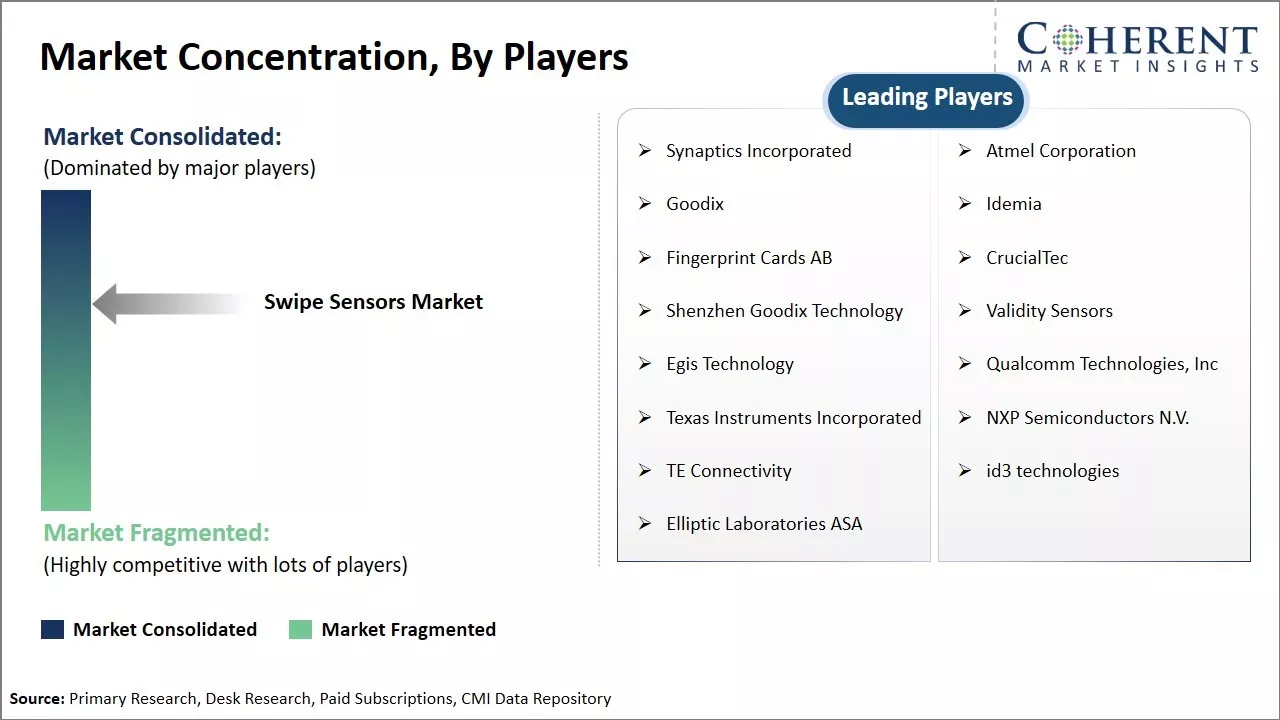
| Companies covered: | Synaptics Incorporated, Atmel Corporation, Goodix, Idemia, Fingerprint Cards AB, CrucialTec, Shenzhen Goodix Technology, Validity Sensors, Egis Technology, Qualcomm Technologies, Inc, Texas Instruments Incorporated, NXP Semiconductors N.V., TE Connectivity, id3 technologies, Elliptic Laboratories ASA | ||
| Growth Drivers: |
| ||
| Restraints & Challenges: |
| ||
Analyst Opinion (Expert Opinion)
 Market Challenges: Stricter Regulations around Electronics Waste Disposal
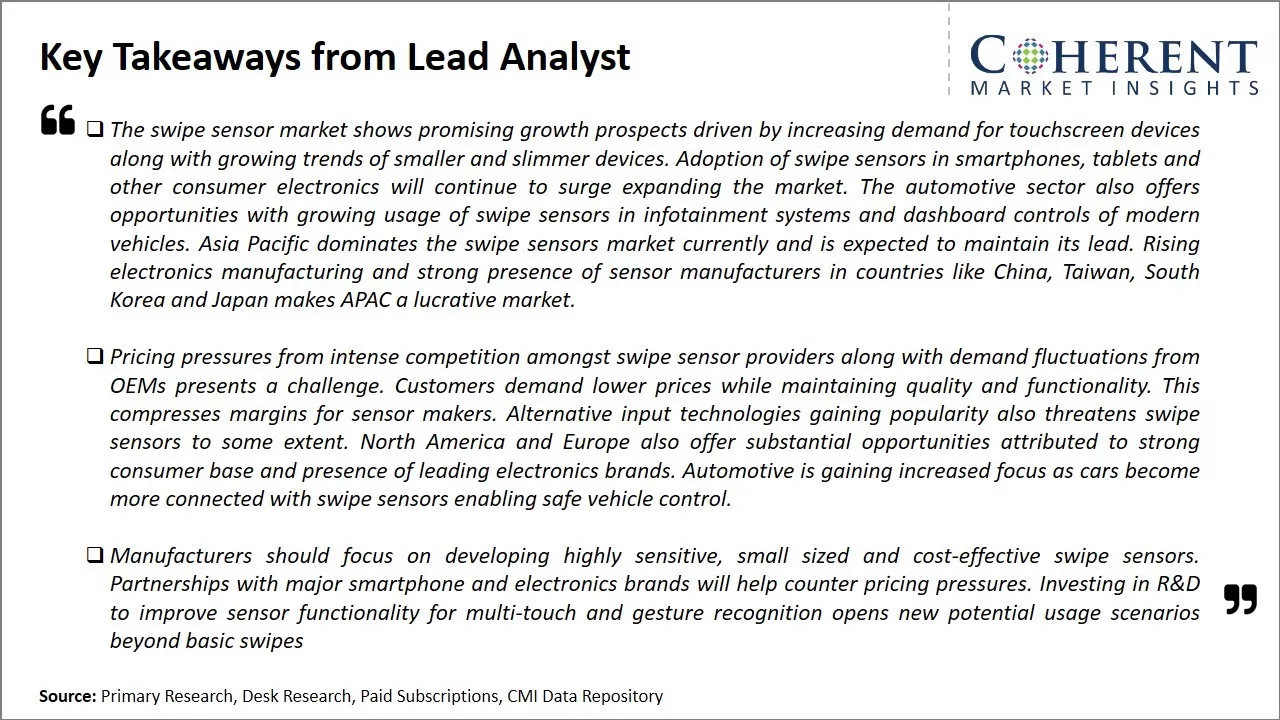
Global swipe sensors market faces several challenges. Smartphones and other devices with touchscreens have become the norm, reducing demand for physical buttons and sliders that use swipe sensors. Stricter regulations around electronics waste disposal also present an obstacle as swipe sensors contain hazardous materials. Manufacturers must overcome these reliability issues to maintain customers.
Market Opportunities: Emerging Application Areas such as VR Headsets and Smart Home Devices
Global swipe sensors market also possesses opportunities for growth. As virtual and augmented reality (AR) technologies expand, new applications for swipe sensors are emerging in areas like VR headsets and smart home devices. Automobiles also integrate more sensors and screens, opening an avenue for innovative swipe control interfaces.
Speak to the analyst
Want personalized insights?
Take the findings above to one of our principal consultants, or have the report rebuilt around the segments, geographies and competitors you actually track.
Market Segmentation
- Type Insights (Revenue, USD BN, 2021 - 2033)
- Capacitive Swipe Sensors
- Optical Swipe Sensors
- Thermal Swipe Sensors
- Others
- Industry Vertical Insights (Revenue, USD BN, 2021 - 2033)
- Consumer Electronics
- Government & Law Enforcement
- Automotive
- BFSI
- Healthcare
- Others
- Regional Insights (Revenue, USD BN, 2021 - 2033)
- North America
- U.S.
- Canada
- Latin America
- Brazil
- Argentina
- Mexico
- Rest of Latin America
- Europe
- Germany
- U.K.
- Spain
- France
- Italy
- Russia
- Rest of Europe
- Asia Pacific
- China
- India
- Japan
- Australia
- South Korea
- ASEAN
- Rest of Asia Pacific
- Middle East & Africa
- GCC Countries
- Israel
- Rest of Middle East & Africa
- North America
- Key Players Insights
- Synaptics Incorporated
- Atmel Corporation
- Goodix
- Idemia
- Fingerprint Cards AB
- CrucialTec
- Shenzhen Goodix Technology
- Validity Sensors
- Egis Technology
- Qualcomm Technologies, Inc
- Texas Instruments Incorporated
- NXP Semiconductors N.V.
- TE Connectivity
- id3 technologies
- Elliptic Laboratories ASA
Get access to 250+ pages report
Every segment, forecast, competitor profile and data table behind the analysis above — available for instant download.
- ESOMAR Member
- ISO 9001:2015 Certified
- D-U-N-S Registered
- GDPR & CCPA Compliant
Missing comfort of reading report in your local language? Find your preferred language:
Transform your Strategy with Exclusive Trending Reports
Frequently Asked Questions
The Global Swipe Sensors Market is estimated to be valued at USD 3.94 Bn in 2026, and is expected to reach USD 11.15 Bn by 2033.
The CAGR of the Global Swipe Sensors Market is projected to be 16.0% from 2026 to 2033.
Touchless Technology Driving Adoption of Swipe Sensors and Simplified User Experience Driving Interest in Swipe Sensors are the major factor driving the growth of Swipe Sensors Market.
Stricter Regulations around Electronics Waste Disposal and Availability of Substitutes are the major factor hampering the growth of Swipe Sensors Market.
In terms of Type, Capacitive Swipe Sensors, estimated to dominate the market revenue share 2026.
Synaptics Incorporated, Atmel Corporation, Goodix, Idemia, Fingerprint Cards AB, CrucialTec, Shenzhen Goodix Technology, Validity Sensors, Egis Technology, Qualcomm Technologies, Inc, Texas Instruments Incorporated, NXP Semiconductors N.V., TE Connectivity, id3 technologies, Elliptic Laboratories ASA are the major players.
North America is expected to lead the Swipe Sensors Market.