

Tractors Market Size and Trends – 2026-2033
The Global Tractors Market is estimated to be valued at USD 94.60 Bn in 2026 and is expected to reach USD 142.17 Bn by 2033, exhibiting a compound annual growth rate (CAGR) of 6.0% from 2026 to 2033.
Key Takeaways of the Global Tractors Market
- Based on Power Output, the below 40 HP segment is expected to lead the market, holding an estimated share of 44.7% in 2026, as it is best for small farms.
- Based on Drive Type, the Two-Wheel Drive (2WD) segment is projected to dominate with a share of 60.1% in 2026, owing to its flexible and affordable characteristics.
- Based on Application, the Agriculture segment is projected to capture 66.8% share of the market in 2026, due to the evolving farmland across the world.
- The Asia Pacific region is expected to lead the market, accounting for 37.05% of the market share in 2026.
- The Latin America region is expected to be the fastest-growing region, holding a share of 7.2% in 2026.
Market Overview
The global tractors market demand is growing steadily because of more mechanization in farming, new technologies, and a growing need for environmentally friendly farming solutions. Governments all over the world are giving money and other benefits to farmers to get them to use modern farming tools. This is making the market grow even faster. But the high costs of starting up and the changing prices of raw materials make it hard for most people to use it. The future of the industry will be shaped by the use of AI, IoT, and automation in tractors. These technologies will make farming more efficient, productive, and environmentally friendly.
Current Events and Its Impact
Current Event | Description and its Impact |
Technological Advancement and Digital Agriculture |
|
Climate Change and Environmental Regulations |
|
Price Analysis
Entry-level models under 30 HP remain popular in developing regions, priced between $4,000 to $7,000, catering to smallholder farmers and compact land operations. Mid-range tractors in the 31–50 HP category, widely used across Asia, Africa, and Latin America, typically range from $7,000 to $11,000, offering a balance of affordability and functionality.
In developed markets like North America and Europe, demand is rising for high-powered tractors above 50 HP, often equipped with advanced features such as GPS guidance, autonomous capabilities, and emission-compliant engines. These models can cost anywhere from $12,000 to $25,000 or more, depending on brand and technology. Premium electric and hydrogen-powered tractors, like those recently launched in Japan and China are pushing boundaries, with prices expected to exceed $30,000 due to cutting-edge components and limited production.
Globally, manufacturers are tailoring offerings to regional needs, from rugged utility tractors in South America to compact orchard models in Europe. The price landscape reflects not just horsepower, but a growing emphasis on fuel efficiency, digital integration, and climate-smart farming solutions.
- Current Industry Events of 2026
- Market Size Estimation
- Regional Breakdown
- Competitive Landscape
- Customer Intelligence
- Segmental Analysis
- Pricing Analysis
- Key Market Drivers, Challenges & Future Trends
- Customized Insights Section
Segmental Insights
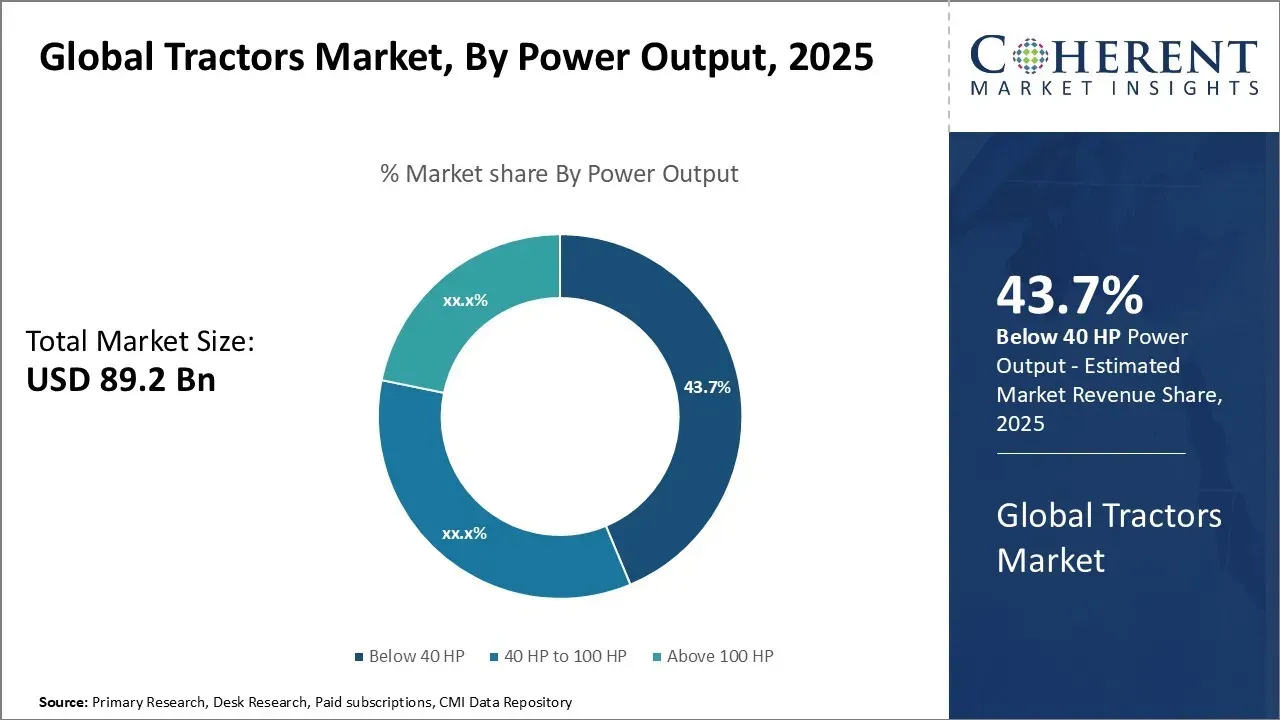
Tractors Market Insights, By Power Output - below 40 HP Segment Dominates Owing to its Sustainability for Small Farmers
In terms of power output, the below 40 HP segment is expected to have the largest tractors market share of 44.7% in 2026, as it is best for small farms. Smallholder farmers prefer tractors with less than 40 horsepower due to their low cost and light work on farms up to 5 hectares in size. These basic tractors are best for plowing, planting, and harvesting on family-run farms. They need less power than mid-sized and heavy-duty tractors; they use less fuel and need less maintenance, which is what marginal farmers need. Tractors with less than 40 HP are also easy to move around, which makes them great for farming in tight spaces. They are even more reliable and easy to fix owing to their simple mechanical designs. This is especially true in remote rural areas where getting technical help is hard.
For instance, in February 2025, Swaraj Tractors, a Mahindra Group brand, unveiled five new models in the 30–42 HP category under its Naya Swaraj range, aimed at small and medium-scale farmers. These tractors offer enhanced power, reliability, and versatility, featuring dual clutch, 4WD, IPTO, and a lift capacity of 1650 kg. With a 6-year/6000-hour warranty and comfort upgrades like deluxe seats and digital controls, the launch reinforces Swaraj’s commitment to advancing Indian agriculture.
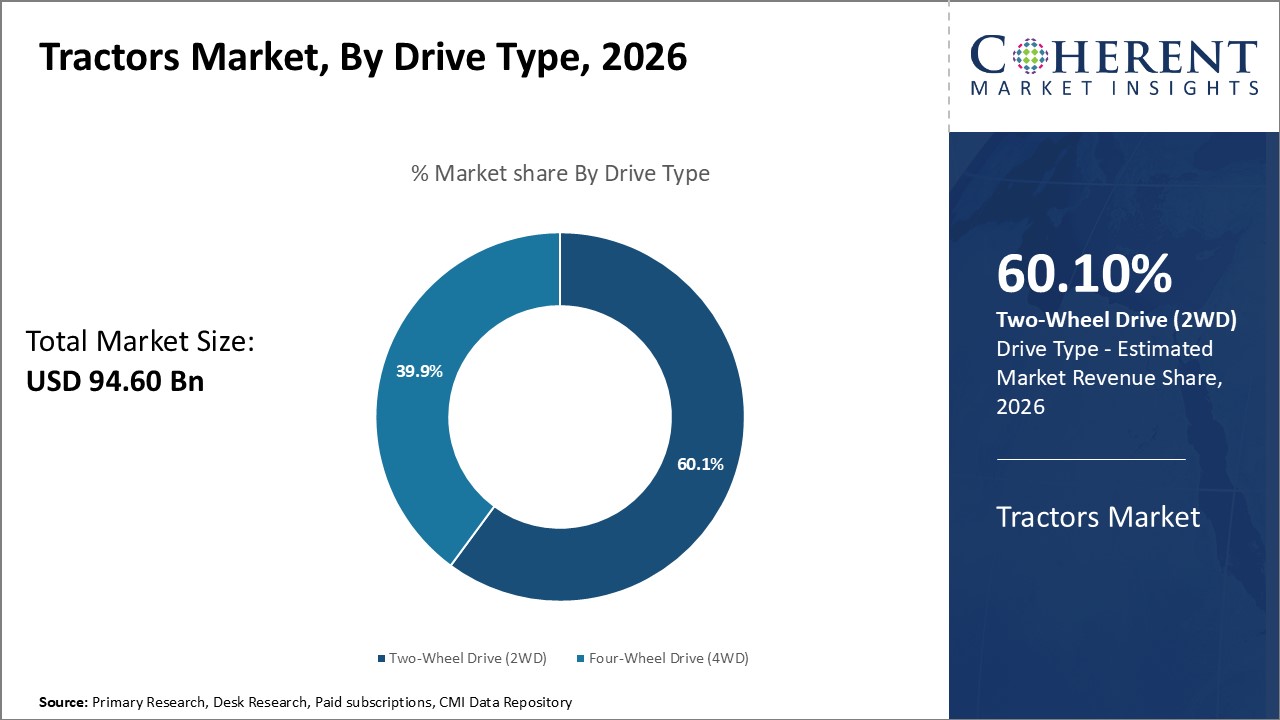
Tractors Market Insights, By Drive Type - Two-Wheel Drive (2WD) Leads Owing to Versatility and Affordability
In 2026, the Two-Wheel Drive (2WD) segment is expected to have the highest share of the market, capturing 60.1% owing to its flexible and affordable characteristics. Most 2WD tractors are not designed for heavy-duty work that needs a lot of power. They are made for general farming work. They are cheaper to manufacture than 4WD models as they have less complicated mechanics. Therefore, they have rear-wheel drive. Recent changes have also made 2WD tractors better at their jobs. Newer transmission systems can now work with more types of soil because they have more traction control options. Advanced hydraulics and precise parts make attachments work even better. Digital tools make it even easier to run machines. These kinds of technological improvements have made 2WD tractors useful for more than just basic farming. They can now be used in a number of related fields, such as land development, horticulture, and moving materials. Even though mechanization is becoming more common around the world, there is still a lot of demand for it because it can be used for many things and is cheap.
For instance, in February 2025, Farmtrac launched seven new models under its Promaxx Series, ranging from 39 HP to 47 HP, designed to boost farming efficiency and comfort. The lineup includes 2WD and 4WD variants like the 39 Promaxx, 42 Promaxx, and 47 Promaxx, featuring Real Maxx OIB brakes, power steering, and 12+3 gearboxes. With prices between ₹6.5–9.2 lakh and a 5-year warranty, these tractors promise durability, fuel efficiency, and enhanced safety for Indian farmers.
Tractors Market Insights, By Application Insights – Evolving Agricultural Practices
In terms of application, it is expected that the agriculture segment will hold the largest share of the market in 2026, with 66.8% of it owing to the growing demand for agriculture equipment. There is a lot of farmlands in the world, and the needs of workers are changing. Farmers all over the world still need tractors to plow, seed, spray, harvest, and do many other things on crop and livestock farms. But tractors are used for more than just traditional farming. Modern tractor models are making it possible for GPS, auto-steer, and telemetry to help with input use, keep track of activities, and boost output. Increasingly, people are also using vertical farming. It uses small agriculture tractors that are made for growing plants in greenhouses and indoors. At the same time, the mechanization of dairy and cattle operations is relying more and more on specialized tractors for feeding, handling manure, and veterinary work. New tractor applications are being developed to meet the needs of modern commercial agriculture because of changes in farming practices and the wide range of foods people eat around the world. This change that is still going on will keep the agricultural sector as the main source of tractor demand.
For instance, in January 2025, VST Tillers Tractors Ltd. presented its latest range of innovative farm equipment at Krushi Odisha 2025, including tractors, power weeders, and precision implements. The lineup highlights VST’s commitment to smart, sustainable agriculture with advanced technology for small and marginal farmers. The company also emphasized its digital solutions and after-sales support, reinforcing its role in transforming Indian farming practices.
Regional Insights
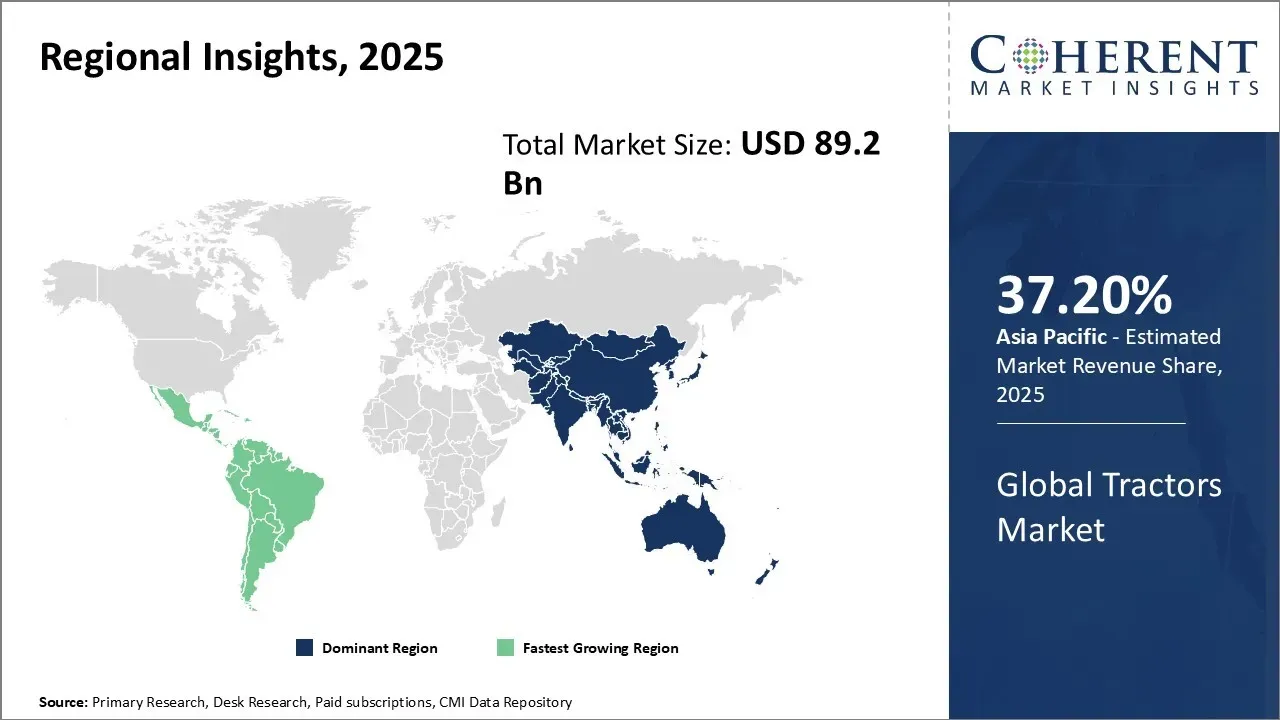
Asia Pacific Tractors Market Trends
In 2026, Asia Pacific is expected to have the biggest share of the tractors market revenue, 37.2%. The region’s dominance in the tractors market can be attributed to the high crop production coupled with relatively larger farm sizes as compared to other regions. The established agriculture industry and presence of leading global tractor manufacturers have further aided market growth. Deere and Company, AGCO, and CNH Industrial are some of the biggest companies in the area with big market shares.
For instance, in September 2026, Kubota introduced the world’s first autonomous hydrogen-powered tractor, the X-Drive, marking a major leap in sustainable farming technology. Revealed at a Tokyo expo, the X-Drive uses fuel cell power and AI-based navigation to operate without a driver, aiming to reduce emissions and labor costs. Kubota plans to commercialize the tractor by 2027, reinforcing its commitment to innovation and climate-friendly agriculture.
Latin America Tractors Market Trends
By 2026, Latin America is expected to grow the fastest rate and have a 7.2% share of the global market. The rise of commercial farming, the use of precision agriculture, and the government's efforts to modernize farming methods have all led to more tractor sales in the area. Some of the biggest markets are Brazil, Argentina, and Mexico. They are seeing more money go into mechanizing farming and a growing need for strong tractors to make big farms more productive.
For instance, in November 2024, TAFE (Tractors and Farm Equipment Limited), India’s second-largest tractor manufacturer, has strengthened its global presence by exporting tractors to South America. The company’s versatile range, known for durability and fuel efficiency, is now available in markets like Chile and Paraguay. With tailored models suited to local farming needs, TAFE aims to support agricultural growth and mechanization across the region.
Tractors Market Outlook for Key Countries
U.S. Tractors Market Trends
The U.S. The tractor market is getting stronger owing to farmers are making more money, there is more demand for farm goods in other countries, and precision farming technologies are getting better. More and more farmers are using electric, GPS-guided, and self-driving tractors to get more work done faster. In the US, Deere and Company sells the most tractors. It does this with the help of its loyal customers, strong dealer network, and constant innovation. Other important international companies with big market shares are CNH Industrial (Case IH & New Holland) and AGCO Corporation (Massey Ferguson & Fendt). Local companies like Kubota USA and Versatile Tractors focus on specific markets, especially in the compact and high-horsepower tractor categories.
For instance, in August 2026, Fendt, a brand of AGCO Corporation, unveiled its 1000 Vario Gen4 tractor and the all-new Optimum Planter at the 2026 Farm Progress Show. The Gen4 tractor features enhanced power, precision, and operator comfort, while the Optimum Planter introduces cutting-edge seed placement and agronomic technology. These innovations reflect Fendt’s commitment to advancing productivity and sustainability in modern farming.
China Tractors Market Trends
The market for tractors in China is growing quickly due to the government continues to focus on modernizing agriculture, there is a lot of land that can be farmed, and more people are using machines to farm. The Made in China 2026 program and other subsidy programs encourage farmers to switch from manual work to advanced machinery, which boosts sales even more. Dongfeng Agricultural Machinery, YTO Group, and Foton Lovol are some of the most famous local companies that make things. They make cheap, high-tech tractors that can do a lot of different things on farms in China.
Domestic brands stay ahead of big companies like Deere and Company, Kubota, and CNH Industrial by making things in the country, saving money, and getting help from the government.
For instance, in September 2026, China introduced its first-ever autonomous electric tractor, the Honghu T70, designed to revolutionize smart farming. Developed by a Chinese tech firm, the T70 features AI-powered navigation, a 6-hour runtime, and zero emissions. With capabilities like obstacle avoidance and remote operation, it aims to boost productivity while supporting eco-friendly agriculture. The launch marks a major milestone in China’s push for agricultural automation.
India Tractors Market Trends
India is still the best place to buy low-horsepower tractors. Most of the time, this is because small and marginal farmers need small, fuel-efficient machines. Mahindra & Mahindra is still the biggest company in this market, and they sell a lot of low-cost tractors. TAFE (Tractors and Farm Equipment Limited), Sonalika International, and Escorts Kubota are some other well-known Indian brands that help the market grow a lot.
For instance, in September 2026, CNH Industrial has showcased its first India-made compact tractor, designed for small farms and horticulture, at its Greater Noida facility. Built for efficiency and maneuverability, the tractor reflects CNH’s commitment to local manufacturing and innovation. The launch marks a strategic move to expand its footprint in India’s growing agricultural machinery market.
Brazil Tractors Market Trends
Brazil's demand for tractors is rising rapidly due to high-value crops are growing, farms are becoming more mechanized, and more money is being put into large-scale farming. The country grows a lot of corn, sugarcane, and soybeans, people want tractors that are more powerful and high-tech. AGCO Corporation (Massey Ferguson and Valtra) and CNH Industrial (New Holland and Case IH) are two of the biggest companies that are making money off of Brazil's mechanization boom. Agrale and other local businesses are very important because they make tractors that are cheap, last a long time, and are perfect for small and medium-sized farms. This helps farmers who don't have a lot of money get the tools they need.
For instance, in April 2026, New Holland Agriculture celebrated its 50th anniversary in Brazil at Expointer, Latin America’s biggest farm show. The company showcased its legacy of innovation, sustainability, and farmer partnerships, highlighting advanced machinery and smart farming solutions. The milestone reflects New Holland’s deep commitment to Brazilian agriculture and its vision for the future of farming in the region. This is further accelerating the tractors market demand.
Market Players, Key Development, and Competitive Intelligence
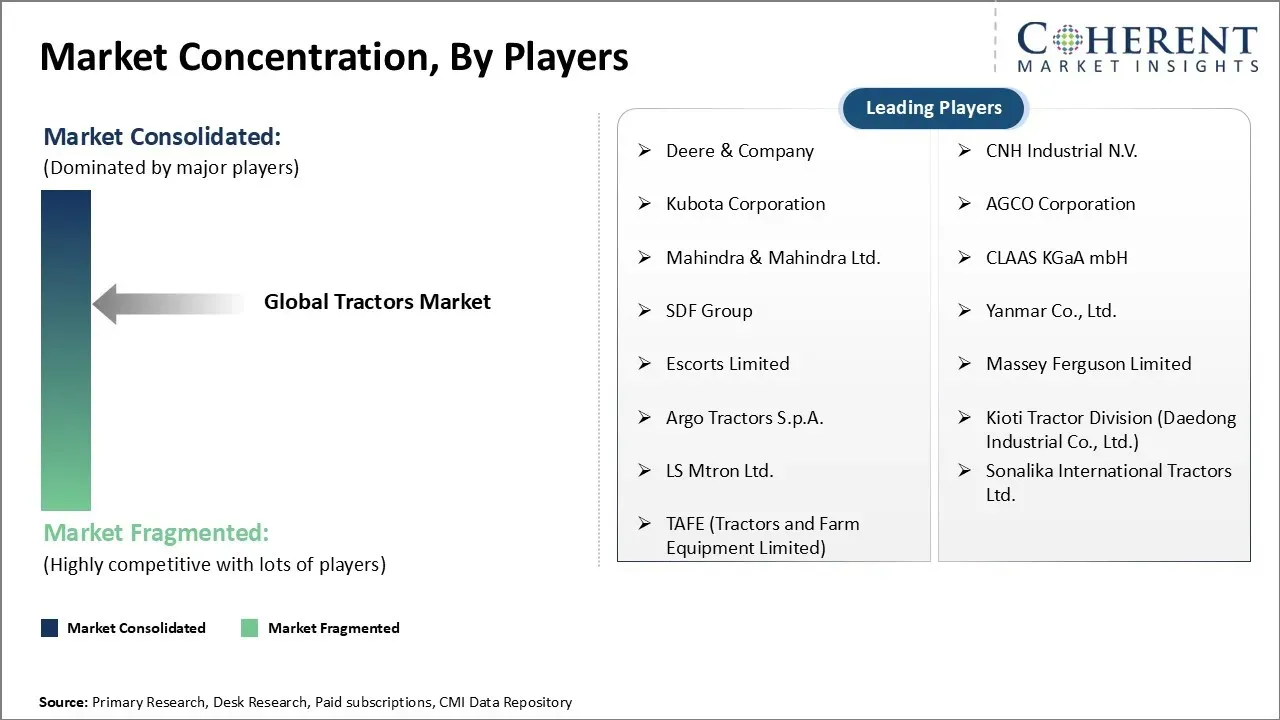
Key Developments
- In August 2025, Escorts Kubota introduced the Kubota MU4201 tractor in India, blending Japanese engineering with Indian farming needs. Powered by a 45 HP engine, the MU4201 offers 8+2 gear options, oil-immersed brakes, and a lifting capacity of 1640 kg. Priced around ₹7.15 lakh, it promises fuel efficiency, durability, and comfort, making it ideal for a range of agricultural tasks.
- In August 2023, VST Tillers Tractors, an India-based manufacturer specializing in tractors and tillers, declared its intention to invest USD 11.5 Mn (INR 100 crore) in establishing a dedicated research and development center
- In August 2023, Mahindra and Mahindra, in a collaborative effort with Mitsubishi Mahindra Agriculture Machinery, a farm equipment provider, launched a new line of tractors under the OJA platform in Cape Town, South Africa.
Market Report Scope
Tractors Market Report Coverage
| Report Coverage | Details | ||
|---|---|---|---|
| Base Year: | 2025 | Market Size in 2026: | USD 94.60 Bn |
| Historical Data for: | 2020 To 2024 | Forecast Period: | 2026 To 2033 |
| Forecast Period 2026 to 2033 CAGR: | 6.0% | 2033 Value Projection: | USD 142.17 Bn |
| Geographies covered: |
| ||
| Segments covered: |
| ||
| Companies covered: | Deere & Company, CNH Industrial N.V., Kubota Corporation, AGCO Corporation, Mahindra & Mahindra Ltd., CLAAS KGaA mbH, SDF Group, Yanmar Co., Ltd., Escorts Limited, Massey Ferguson Limited, Argo Tractors S.p.A., Kioti Tractor Division (Daedong Industrial Co., Ltd.), LS Mtron Ltd., Sonalika International Tractors Ltd., and TAFE (Tractors and Farm Equipment Limited) | ||
| Growth Drivers: |
| ||
| Restraints & Challenges: |
| ||
Market Dynamics
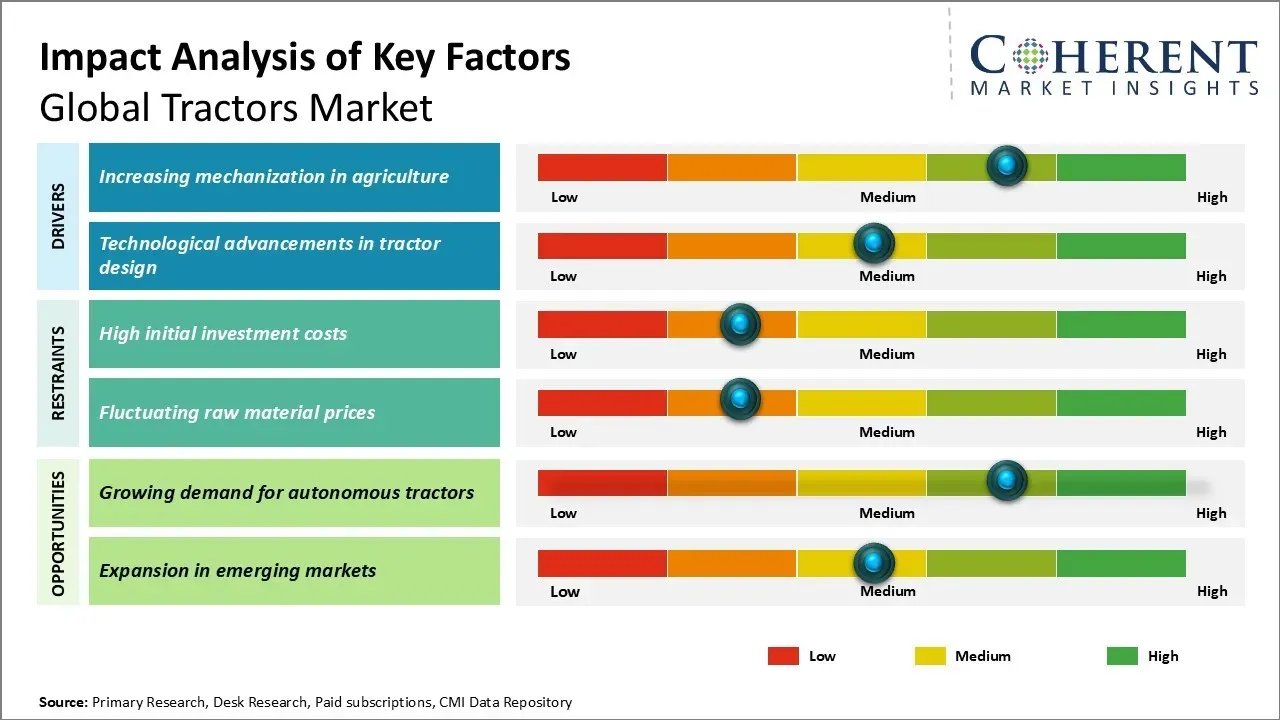
Global Tractors Market Driver
Increasing mechanization in agriculture
Rising global food demand and shrinking arable land have driven farmers toward mechanization, with tractors playing a key role in modern agriculture. Tractors enable faster, more efficient farming operations like ploughing, sowing, and harvesting, reducing reliance on manual labor and boosting productivity. As labor costs rise and workforce availability declines, tractors help cut production costs, especially for large farms. Manufacturers now offer affordable models for small and marginal farmers too. Overall, tractors enhance efficiency, increase crop output, and support year-round farming. Government subsidies and policies promoting mechanization are further fueling global tractor demand.
Technological Advancements in Tractor Design
Technological advancements in tractor design are significantly influencing the global tractors market share, driving innovation and reshaping competitive dynamics. Modern tractors now incorporate precision agriculture technologies such as GPS, IoT sensors, and AI-based systems, enabling farmers to optimize operations, reduce input costs, and enhance crop yields. These features have made technologically advanced tractors more appealing, especially in developed markets, thereby expanding the market share of manufacturers investing in smart farming solutions. Additionally, the emergence of electric and hybrid tractors addresses environmental concerns and rising fuel costs, attracting sustainability-focused buyers and boosting adoption. In regions with small and marginal farms, compact and affordable smart tractors are gaining popularity, contributing to market growth in emerging economies. Autonomous tractors and telematics-enabled models are also gaining traction, offering labor-saving benefits and remote monitoring capabilities that improve efficiency and uptime. Furthermore, modular designs with customizable attachments enhance versatility, allowing farmers to perform multiple tasks with a single machine. These innovations, coupled with supportive government policies and subsidies for mechanization, are accelerating the shift toward modern tractor solutions and reshaping the global tractors market share landscape.
Global Tractors Market Opportunity
Growing Demand for Autonomous Tractors
One major opportunity for the global tractors market lies in the growing demand for autonomous tractors. With advancements in technologies such as GPS, sensors, and artificial intelligence, autonomous tractors that can drive, plow, seed, and harvest by themselves are fast becoming a reality. Several tractor manufacturers have already unveiled prototype autonomous tractors with varying levels of automation. The demand for autonomous tractors is expected to drastically increase over the coming years as their benefits become more apparent. Autonomous tractors can help address labor shortages faced by farmers worldwide. They also improve efficiency, allow for round-the-clock utilization and free up human workers for more value-added tasks. If developed and marketed appropriately, autonomous tractors have the potential to revolutionize agriculture practices and accelerate the pace of farm mechanization globally. This emerging trend represents a huge growth opportunity for tractor manufacturers to tap into new revenue streams in the upcoming years.
Analyst Opinion (Expert Opinion)
- The global tractors market is poised for steady growth, driven by increasing mechanization in agriculture and ongoing technological innovations. The integration of autonomous and electric tractors is expected to revolutionize farming practices, offering enhanced efficiency and sustainability.
- However, the market faces challenges such as high initial investment costs and fluctuating raw material prices, which may hinder adoption, especially among small and medium-sized farmers
- Asia Pacific remains the dominant region due to its large agricultural base and supportive government initiatives promoting mechanization. Meanwhile, Latin America is emerging as the fastest-growing market, propelled by expanding agricultural activities and modernization efforts.
Speak to the analyst
Want personalized insights?
Take the findings above to one of our principal consultants, or have the report rebuilt around the segments, geographies and competitors you actually track.
Market Segmentation
- Power Output Insights (Revenue, USD Bn, 2026 - 2033)
- Below 40 HP
- 40 HP to 100 HP
- Above 100 HP
- Drive Type Insights (Revenue, USD Bn, 2026 - 2033)
- Two-Wheel Drive (2WD)
- Four-Wheel Drive (4WD)
- Application Insights (Revenue, USD Bn, 2026 - 2033)
- Agriculture
- Construction
- Forestry
- Others
- Regional Insights (Revenue, USD Bn, 2026 - 2033)
- North America
- U.S.
- Canada
- Latin America
- Brazil
- Argentina
- Mexico
- Rest of Latin America
- Europe
- Germany
- U.K.
- Spain
- France
- Italy
- Russia
- Rest of Europe
- Asia Pacific
- China
- India
- Japan
- Australia
- South Korea
- ASEAN
- Rest of Asia Pacific
- Middle East
- GCC Countries
- Israel
- Rest of Middle East
- Africa
- South Africa
- North Africa
- Central Africa
- Key Players Insights (Revenue, USD Bn, 2021 - 2033)
- Deere & Company
- CNH Industrial N.V.
- Kubota Corporation
- AGCO Corporation
- Mahindra & Mahindra Ltd.
- CLAAS KGaA mbH
- SDF Group
- Yanmar Co., Ltd.
- Escorts Limited
- Massey Ferguson Limited
- Argo Tractors S.p.A.
- Kioti Tractor Division (Daedong Industrial Co., Ltd.)
- LS Mtron Ltd.
- Sonalika International Tractors Ltd.
- TAFE (Tractors and Farm Equipment Limited)
Sources
Primary Research Interviews from the following stakeholders
Stakeholders
- Interviews with tractor manufacturers, OEMs, component suppliers (engines, hydraulics, transmissions), dealers/distributors, farmer cooperatives, agricultural equipment rental companies, and large-scale farm operators across global markets.
Specific stakeholders
- Procurement and farm mechanization heads at agri-businesses and cooperatives (e.g., Amul, CHS Inc., Fonterra)
- Farm managers and operators at large-scale agricultural farms (e.g., Cargill farms, Olam Agri)
- Tractor dealers and rental service providers in emerging markets (e.g., Mahindra Farm Equipment dealers, Escorts Kubota partners)
- Heads of agricultural universities and mechanization research institutes (e.g., Indian Agricultural Research Institute, Wageningen University & Research)
- Government agriculture extension officers and rural development authorities
- Component suppliers in drivetrains, hydraulics, tires, and precision farming systems
- Heads of smart farming technology companies (IoT, GPS, and autonomous tractor systems)
Databases
- Food and Agriculture Organization (FAO) Statistics
- United Nations Comtrade Database
- World Bank Agriculture & Rural Development Data
- OECD Agriculture Statistics
- U.S. Department of Agriculture (USDA) Economic Research Service
- Eurostat – Agriculture & Equipment Statistics
- India Directorate General of Commercial Intelligence and Statistics (DGCIS)
- China Customs Statistics
- Japan External Trade Organization (JETRO) – Agriculture Machinery Trade Data
- Korea Customs Service Data Portal
Magazines
- Farm Equipment Magazine
- Successful Farming
- Agricultural Equipment Technology (AET) Magazine
- The Farmer’s Journal
- AgriBusiness Global
- Agrimachinery News
- Tractor & Farming Heritage Magazine
- AgriMachinery World
Journals
- Journal of Agricultural Engineering
- Biosystems Engineering (Elsevier)
- Precision Agriculture (Springer)
- Journal of Terramechanics
- Journal of Farm Machinery and Power
- Agricultural Systems (Elsevier)
- Transactions of the ASABE (American Society of Agricultural and Biological Engineers)
Newspapers
- The Wall Street Journal – Agribusiness & Industry Section
- The Economic Times – Agriculture & Rural Economy
- The Hindu Business Line – Farm & Machinery
- Financial Times – Agriculture & Equipment Coverage
- Nikkei Asia – Industrial Machinery & Agri-equipment
- South China Morning Post – Agriculture & Trade
Associations
- Tractor and Mechanization Association (TMA), India
- Association of Equipment Manufacturers (AEM), U.S.
- European Agricultural Machinery Association (CEMA)
- Japan Agricultural Machinery Manufacturers Association (JAMMA)
- Brazilian Association of Machinery and Equipment (ABIMAQ)
- American Society of Agricultural and Biological Engineers (ASABE)
- Federation of Indian Chambers of Commerce & Industry (FICCI) – Agri Machinery Division
- Confederation of Indian Industry (CII) – Agriculture & Farm Equipment Council
Public Domain Sources
- Ministry of Agriculture & Farmers’ Welfare (Government of India)
- Reserve Bank of India (RBI) – Reports on Agricultural Credit and Mechanization
- NITI Aayog – Agriculture & Farm Mechanization Studies
- Ministry of Economy, Trade and Industry (METI), Japan – Agricultural Equipment Reports
- U.S. International Trade Commission (USITC) – Farm Equipment Trade Data
- European Commission – Agriculture and Rural Development Reports
- FAO Mechanization Strategy Reports
- World Bank Group – Agricultural Productivity & Equipment Reports
Proprietary Elements
- CMI Data Analytics Tool, and Proprietary CMI Existing Repository of information for last 8 years
Get access to 250+ pages report
Every segment, forecast, competitor profile and data table behind the analysis above — available for instant download.
- ESOMAR Member
- ISO 9001:2015 Certified
- D-U-N-S Registered
- GDPR & CCPA Compliant
Missing comfort of reading report in your local language? Find your preferred language:
Transform your Strategy with Exclusive Trending Reports
Frequently Asked Questions
The global tractors market is estimated to be valued at USD 89.20 Billion in 2025 and is expected to reach USD 132.36 Billion by 2032.
The CAGR of the global tractors market is projected to be 5.8% from 2025 to 2032.
Increasing mechanization in agriculture and technological advancements in tractor design are the major factors driving the growth of the global tractors market.
High initial investment costs and fluctuating raw material prices are the major factors hampering the growth of the global tractors market.
In terms of power output, the below 40 HP segment is estimated to dominate the market revenue share in 2025.
Deere & Company, CNH Industrial N.V., Kubota Corporation, AGCO Corporation, Mahindra & Mahindra Ltd., CLAAS KGaA mbH, SDF Group, Yanmar Co., Ltd., Escorts Limited, Massey Ferguson Limited, Argo Tractors S.p.A., Kioti Tractor Division (Daedong Industrial Co., Ltd.), LS Mtron Ltd., Sonalika International Tractors Ltd., and TAFE (Tractors and Farm Equipment Limited) are the major players.
Asia Pacific is expected to lead the global tractors market, holding a share of 37.2% in 2025.