

Agriculture Equipment Market Size and Trends
The global agriculture equipment market is estimated to be valued at USD 191.83 Bn in 2026 and is expected to reach USD 288.44 Bn by 2033, exhibiting a compound annual growth rate (CAGR) of 6.0% from 2026 to 2033.
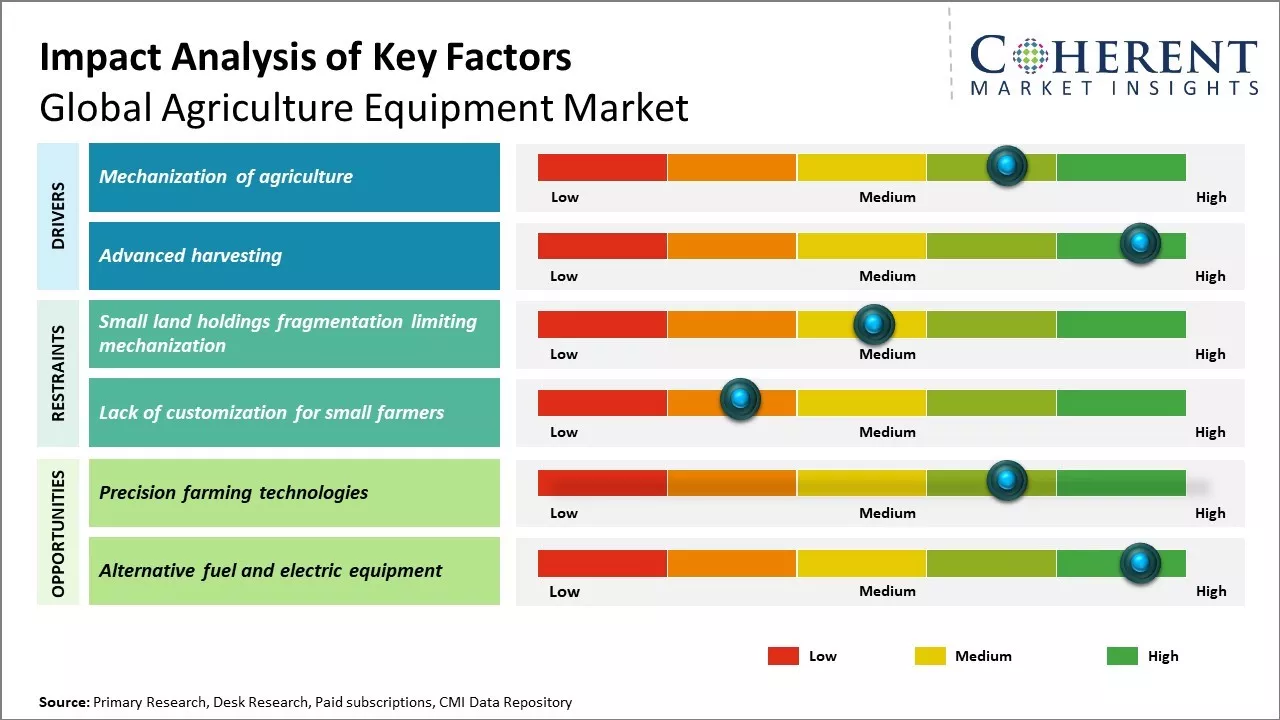
Key Takeaways
- Based on Product Type, Tractors segment is projected to hold around 33.2% shares in the global market in 2026.
- On the basis of Application, Land Development & Seed Bed Preparation division is estimated to hold around 41.8% shares in 2026.
- Regionally, North America is poised to dominate the global market with 38.1% shares during the forecast period.
Market Overview
The agriculture equipment market has been witnessing consistent growth over the past few years. Farm mechanization has become imperative owing to shortage of labor and increase in farm size and scale of operation. The trend towards more productive and efficient equipment such as tractors, harvesters, and milking machines has increased significantly. Moreover, growing concerns towards food security across nations due to ever increasing global population has raised the demand for higher crop and livestock yields. This has promoted the greater adoption of agriculture equipment and technologies suiting varying crop production conditions. The inclination towards smart equipment integrated with advanced technologies including IoT, AI and telematics offers potential growth prospects. Governments across nations have also been supporting farm mechanization through subsidies and finance schemes in order to boost agricultural production.
Current Events and their Impact on the Agriculture Equipment Market
Current Event | Description and its Impact |
Increasing frequency of droughts and floods |
|
Global Supply Chain Disruptions and Semiconductor Shortages |
|
Integration of AI (Artificial Intelligence) in Agricultural Equipment
Integration of artificial intelligence into agriculture equipment is best used to conduct labour-intensive farming which spares farmers from indulging in other essential tasks. One of the biggest incorporations of AI in farming is noticed to be automated tractors or self-driving farmer equipment. These driverless tractors have the potential to harvest 24x7 and they are able to withstand any weather conditions resulting in lowering a farmer’s stress. These tractors are lightweight and reduce soil compaction compared to the traditional heavy tractors.
In February 2024, the engineering students from ICAR-DWR, Jabalpur had built Rakshak, an AI-powered laser-weeding robot that combated weeds without tampering with the crops.
- Current Industry Events of 2026
- Market Size Estimation
- Regional Breakdown
- Competitive Landscape
- Customer Intelligence
- Segmental Analysis
- Pricing Analysis
- Key Market Drivers, Challenges & Future Trends
- Customized Insights Section
Agriculture Equipment Market Drivers
Mechanization of agriculture
Over the past few decades, farmers around the world have been shifting from traditional farming practices involving manual labor to a more mechanized system involving various agriculture equipment. The labor-intensive nature of farming activities such as plowing, planting, fertilizing, spraying, and harvesting makes it an arduous and time-consuming process if done manually.
Agricultural machinery helps address this issue by performing such tasks much more efficiently. Tractors, harvesters, planting equipment, and other automated machines minimize the dependency on manual labor, allowing farmers to cover larger acreage in a shorter period of time. This translates to higher productivity and more significant yields.
As farms continue to grow in size globally to cater to the rising demand for food, reliance on farm equipment and machinery has increased considerably. Large-scale commercial farming now depends heavily on the use of various motorized implements for seeding, tillage operations, applying fertilizers and crop protection chemicals, and automated harvesting solutions.
Traditional manual methods are no longer feasible or economical for handling huge tracts of farmland. Mechanical equipment takes care of complex cultivation tasks with unmatched speed, consistency and reliability. This has fueled strong demand over the years with no signs of slowing down.
The mechanization drive is further boosted by the declining availability of agricultural labor in many countries. Farmers now face increasing challenges to find sufficient manpower for labor-intensive farming activities. Aging farmer populations and younger generations moving to urban occupations have caused widespread labor shortages. Equipment helps address this problem by reducing dependency on human labor, improving productivity even with fewer resources.
Advanced harvesting
Growing concerns around the environmental impact of agriculture is another key factor driving demand for advanced farming equipment. As population increases exert mounting pressure on limited arable land and water resources, there is a pressing need to optimize resource usage for higher yields in a sustainable manner.
Precision farming techniques made possible through innovative farm machinery go a long way in addressing this need. GPS technology, soil sensors, variable rate technology, and other smart functionalities help minimize wastage of inputs. Precision seeding and controlled application of fertilizers and chemicals based on soil insights prevent overuse and spillage into the environment.
Segmental Insights
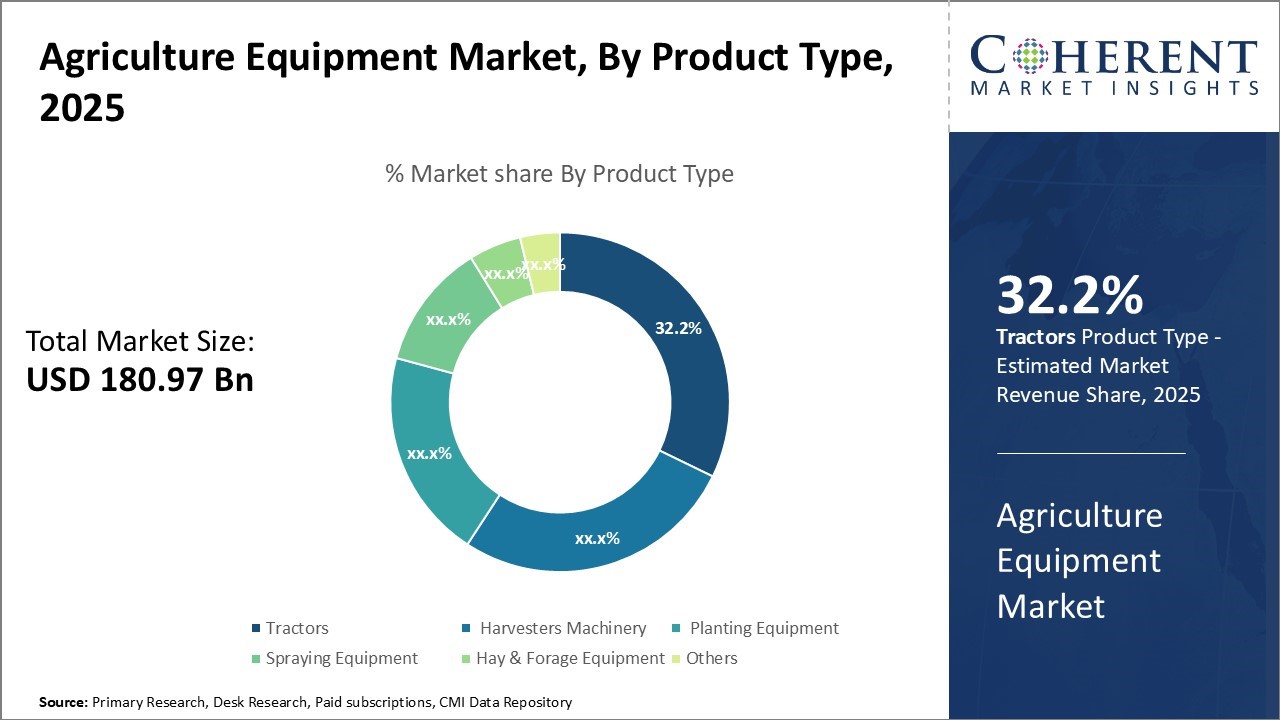
Agriculture Equipment Market Insights, By Product Type: Tractors contributes the highest share of the market owing to increasing mechanization needs
Tractors are expected to hold 33.2% share in the global agriculture equipment market in 2026 owing to their utility across various farming operations. With growing farm sizes and increasing need for mechanization, tractors have become indispensable for ploughing large tracts of land in limited time. Their power and ability to tow or operate various farm attachments efficiently make tractors highly desirable for tasks like seed bed preparation, sowing, spraying of fertilizers and pesticides, harvesting and transportation of produce.
Additionally, continual technology upgrades in tractors are further driving their adoption. Advanced features in new generation tractors such as GPS, telemetry and auto-guidance systems are helping boost productivity and optimize input usage. Powerful and fuel-efficient engines also improve efficiency. Manufacturers increasingly focusing on comfy cabins, improved ergonomics and safety features are making tractor operations more user-friendly. The addition of multi-function controls and simplified hydraulic systems allow easy operation of attachments.
Government schemes for farm mechanization in many countries also promote tractor sales. Subsidies and finance schemes specially designed for tractors and farm equipment have enhanced affordability for smallholder farmers as well. On the other hand, rising labor costs and lack of farm workers are leaving farmers with no option but to adopt mechanized solutions. This increasing mechanization translates into robust demand for tractors.
For instance, in September 2025, Mahindra & Mahindra, the world’s largest tractor manufacturer by volume, launched its future-ready range of tractors – the Mahindra OJA – in Australia.
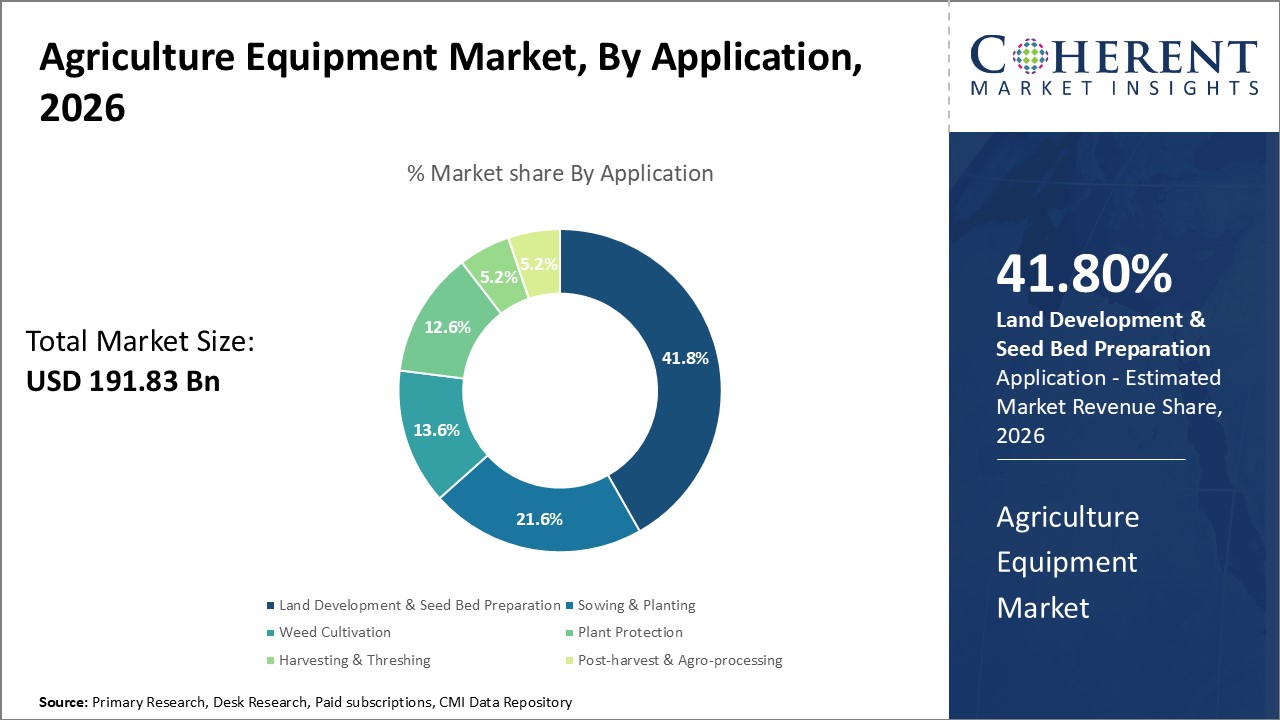
Agriculture Equipment Market Insights, By Application: Land development & seed bed preparation contributes the highest share of the market owing to vital preparatory functions
The land development & seed bed preparation segment is expected to dominate the global agriculture equipment market with 41.8% share in 2026 owing to the indispensable nature of these preparatory functions. Proper land preparation forms the foundation for achieving high crop productivity and yields. It involves operations such as plowing, disking, harrowing, leveling, and forming beds which are crucial for ensuring proper tillage, pulverizing soil structure, removing weeds and providing an even seeding base.
Timely completion of land preparation activities also determines the planting schedule and subsequent cropping cycle. The larger tractor segments and associated farm tools required for heavy tillage and soil conditioning tasks translates into bulk demand from this segment. With increasing mechanization, tractors, rotavators, disc harrows and other land development equipment see extensive yearly use. Moreover, mulching appliances and seed-drills are gaining popularity for their targeting placement of seeds and conservation of moisture.
The demand is particularly pronounced in developing regions where farmers are still upgrading from manual land preparation to powered farm machinery. Standardizing land development practices further spurs replacement demand for modernized equipment with advanced functions. Growing adoption of mulching, minimum or zero tillage techniques also present opportunities with new product varieties. Contract farming and mechanized leasing services are expanding the market reach for this segment.
Regional Insights
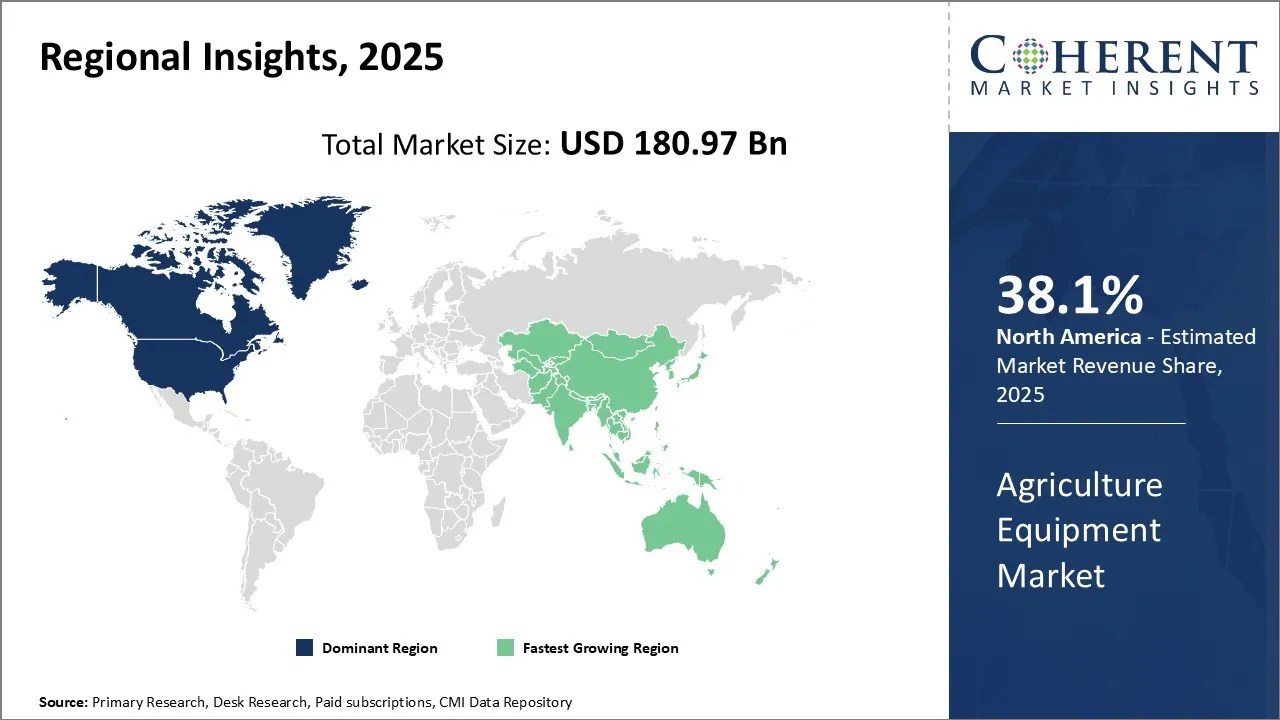
North America Agriculture Equipment Market Analysis and Trends
North America has established itself as the dominant region in the global agriculture equipment market. The region is expected to account for 38.1% of the market share in 2026. The U.S. agriculture equipment market has a strong presence with leading players operating from the region for decades. Major product launches and innovations regularly happen from the U.S. as companies invest heavily in R&D.
The region also sees high mechanization rates with farm sizes being large on average. This has ensured the demand for high-capacity equipment such as large tractors remains robust. Strong distribution networks of manufacturers provide farmers easy access to the latest machinery. Trade relations also support a dynamic market as import tariffs on most equipment categories are low or nil between the U.S. and Canada.
For instance, in July 2026, Huida Tech launched its operations in North America, offering smart farming solutions designed to meet the needs of large-scale producers across the United States and Canada.
Asia Pacific Agriculture Equipment Market Analysis and Trends
Asia Pacific has emerged as the fastest growing regional market for agricultural implements globally. Rapid growth in agricultural output to meet rising food demand from growing populations is a big factor supporting equipment adoption. Counties such as India and China are also undergoing machinery upgrades as farm labor becomes scarce. This has accelerated the mechanization of tasks and tractor sales.
Local manufacture is increasing with global OEMs setting up manufacturing bases to cater to the large home market as well as for exports within Asia Pacific and to Africa. India in particular has incentivized local production under its Make in India program. However, due to lower average farm sizes, the market sees strong demand for sub-compact tractors and small power equipment. Exports from Asia Pacific have been rising as well with cost competitiveness and free trade agreements aiding shipments.
For instance, in march 2023, New Holland Agriculture, a brand of CNH Industrial, had launched two of its latest tractor models — Blue Series Simba 30 and 5620 Power King - TREM IV — in the Andhra Pradesh and Telangana regions at the KISAN Agri Show in Hyderabad.
Europe Agriculture Equipment Market Analysis and Trends
While Europe has a developed agriculture market as well, growth has been relatively slower compared to other regions. Mature mechanization levels and stringent emission regulations have kept demand growth steady rather than exponential. However, precision farming technologies uptake has been rapid with strong focus on sustainability.
European manufacturers have a strong foothold in specialty crops equipment and remain technology leaders in automation and precision agricultural solutions. Local expertise in these categories is then exported globally through strong distributor networks, ensuring the region sustains its prominent position.
For instance, in March 2024, the French company SIZA Robotics launched its commercial pre-series of an autonomous robot for vegetable and beet crops. The machine, named TOOGO, became available for orders and was scheduled for release in 2026.
Agriculture Equipment Market – Dominating Countries
The U.S. Agriculture Equipment Market Trends
The U.S. is considered as the dominating country in the global agriculture equipment market in 2026, owing to its advanced farming technologies, strong mechanization rates, extensive adoption of precision agriculture, significant investments in R&D, and the presence of leading global equipment manufacturers.
For instance, in April 2026, American agricultural machinery giant John Deere launched production in Kostanay, Kazakhstan, marking a milestone in the country’s strategy to localize industrial output and reduce reliance on imports.
China Agriculture Equipment Market Trends
China is considered as the dominating country in the global agriculture equipment market in 2026, due to its large-scale agricultural production, rapid mechanization of farming practices, strong government support through subsidies and modernization programs, growing demand for high-efficiency equipment, and the presence of a robust domestic manufacturing base for agricultural machinery.
For instance, in October 2024, ComNav unveiled its new products at The China International Agricultural Machinery Exhibition.
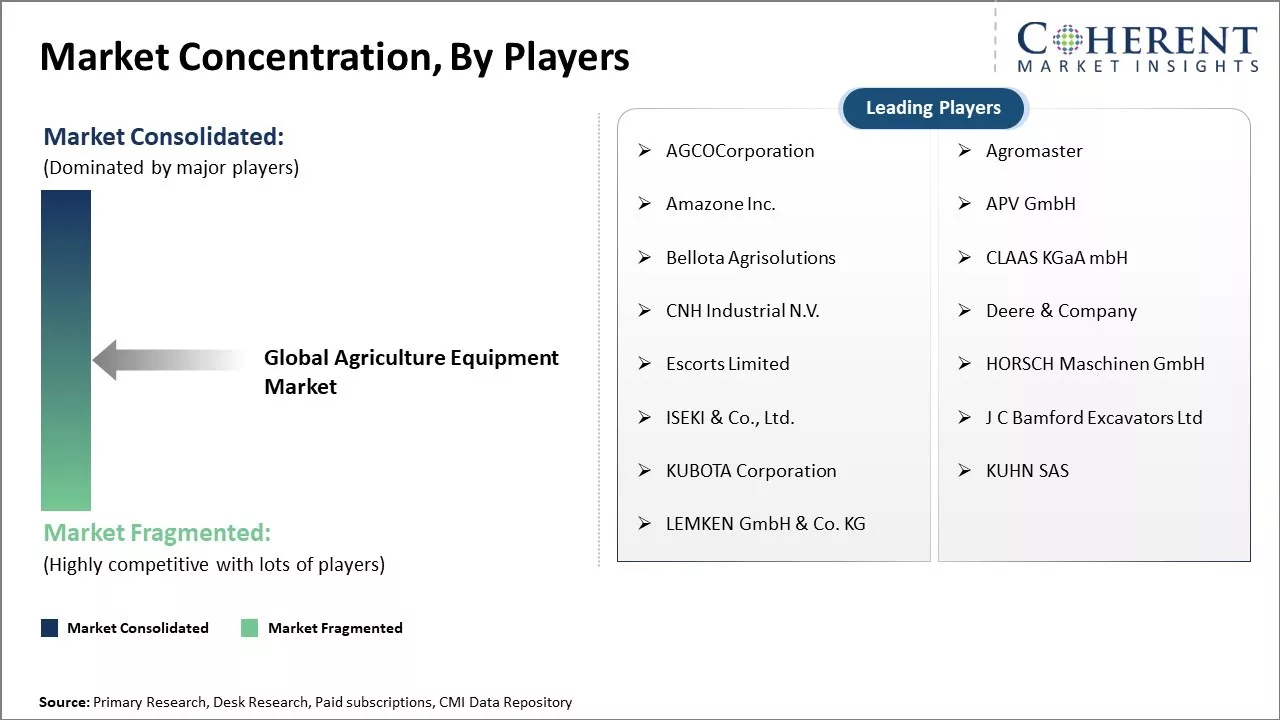
Market Concentration and Competitive Landscape
Key Takeaways from Analyst
- The global agriculture equipment market is projected to witness steady growth in the coming years. The market is driven by rising mechanization of farms across major agriculture producing nations as labor costs continue to increase. Adoption of advanced machinery that improves efficiency and productivity will support demand. However, high initial purchase cost of modern equipment remains a constraint, especially in price-sensitive developing regions.
- North America is expected to continue their dominance due to well-established distribution networks and strong demand for imported high-tech machinery. Nevertheless, the market in Asia Pacific is likely to emerge as the fastest growing region supported by large cultivatable areas and increasing farm sizes in countries like India and China. Governments in Asia Pacific are also promoting mechanization through subsidies which is positively impacting sales.
- Diversification into organic and contractual farming presents new prospects for equipment makers to tap. Precision farming technologies that optimize inputs will gain traction. Manufacturers are developing solutions based on IoT, data analytics and telematics to enhance farm management. Collaborations with agrochemical firms provide cross-selling opportunities. The shift to alternative fuels and electric vehicles in agriculture is still at a nascent stage but shows promise.
Agriculture Equipment Industry News
- In October 2025, Gromax Agri Equipment Ltd., a joint venture between Mahindra & Mahindra Ltd. and the Government of Gujarat, launched eight new tractors across the 2WD and 4WD categories. The line-up included India’s first factory-fitted cabin tractor in the sub-50 HP segment.
- In July 2023, Deere & Company, a global leader in agricultural equipment, acquired Smart Apply, Inc., a precision spraying equipment company. The acquisition will allow Deere &Company to leverage Smart Apply, Inc.'s Intelligent Spray Control System to help growers address challenges around rising input costs, labor shortages, regulatory requirements, and sustainability goals by reducing chemical and water use while optimizing crop yields.
Market Report Scope
Agriculture Equipment Market Report Coverage
| Report Coverage | Details | ||
|---|---|---|---|
| Base Year: | 2025 | Market Size in 2026: | USD 191.83 Bn |
| Historical Data for: | 2020 To 2024 | Forecast Period: | 2026 To 2033 |
| Forecast Period 2026 to 2033 CAGR: | 6.0% | 2033 Value Projection: | USD 288.44 Bn |
| Geographies covered: |
| ||
| Segments covered: |
| ||
| Companies covered: | AGCOCorporation, Agromaster, Amazone Inc., APV GmbH, Bellota Agrisolutions, CLAAS KGaA mbH, CNH Industrial N.V., Deere & Company, Escorts Limited, HORSCH Maschinen GmbH, ISEKI & Co., Ltd., J C Bamford Excavators Ltd, KUBOTA Corporation, KUHN SAS, and LEMKEN GmbH & Co. KG | ||
| Growth Drivers: |
| ||
| Restraints & Challenges: |
| ||
Agriculture Equipment Market Opportunities: Precision farming technologies
Precision farming through the use of latest technologies has a huge potential to significantly impact the global agriculture equipment market in a positive way. Precision farming relies on gathering data through satellite imagery and sensor technology to optimize crop production. It allows farmers to vary the rate of fertilizer application, watering, and other inputs based on soil conditions and crop needs within single fields. This precision application helps maximize yields while minimizing costs and environmental impact.
For example, precision soil sampling can produce detailed digital soil maps at sub-meter resolution to help optimize nutrient and lime application across fields. Sensor technology is also helping farmers implement variable rate seeding based on soil quality. Drones and robots equipped with cameras, LiDAR and other sensors can regularly monitor crop health and detect issues like weeds, pests or diseases early on when treatment costs are lower. Analytics tools then use this spatial data to produce prescription maps for targeted application of inputs. All of this precision enables more efficient farm management practices and higher productivity.
Market Segmentation
- Product Type Insights (Revenue, US$ Bn, 2020 - 2032)
- Tractors
- Harvesters Machinery
- Planting Equipment
- Irrigation & Crop Processing Equipment
- Spraying Equipment
- Hay & Forage Equipment
- Others
- Application Insights (Revenue, US$ Bn, 2020 - 2032)
- Land Development & Seed Bed Preparation
- Sowing & Planting
- Weed Cultivation
- Plant Protection
- Harvesting & Threshing
- Post-harvest & Agro-processing
- Regional Insights (Revenue, US$ Bn, 2020 - 2032)
- North America
- U.S.
- Canada
- Latin America
- Brazil
- Argentina
- Mexico
- Rest of Latin America
- Europe
- Germany
- U.K.
- Spain
- France
- Italy
- Russia
- Rest of Europe
- Asia Pacific
- China
- India
- Japan
- Australia
- South Korea
- ASEAN
- Rest of Asia Pacific
- Middle East & Africa
- GCC Countries
- Israel
- South Africa
- Rest of Middle East & Africa
- North America
- Key Players Insights
- AGCOCorporation
- Agromaster
- Amazone Inc.
- APV GmbH
- Bellota Agrisolutions
- CLAAS KGaA mbH
- CNH Industrial N.V.
- Deere & Company
- Escorts Limited
- HORSCH Maschinen GmbH
- ISEKI & Co., Ltd.
- J C Bamford Excavators Ltd
- KUBOTA Corporation
- KUHN SAS
- LEMKEN GmbH & Co. KG
Sources
Primary Research Interviews
- Agriculture equipment manufacturers and suppliers
- Farm equipment dealers and distributors
- Large-scale farmers and agricultural cooperatives
- Agricultural technology consultants and advisors
- Others
Databases
- FAO Statistical Database (FAOSTAT)
- USDA National Agricultural Statistics Service (NASS)
- World Bank Agriculture & Rural Development Data
- Others
Magazines
- Farm Equipment Magazine
- Progressive Farmer
- Successful Farming
- AgriMarketing Magazine
- Others
Journals
- Journal of Agricultural Engineering Research
- Applied Engineering in Agriculture
- Agricultural Systems Journal
- Others
Newspapers
- Farm Journal
- AgWeb News
- DTN/Progressive Farmer
- Agri-Pulse
- Others
Associations
- Association of Equipment Manufacturers (AEM)
- American Society of Agricultural and Biological Engineers (ASABE)
- International Association of Agricultural Economists (IAAE)
- National Association of Agricultural Contractors (NAAC)
- Others
Public Domain Sources
- Government agricultural department publications
- International trade organization reports
- Agricultural census data
- Patent databases and filings
- Others
Proprietary Elements
- CMI Data Analytics Tool
- Proprietary CMI Existing Repository of information for last 8 years
Definition: The global agriculture equipment market consists of companies that manufacture and distribute various types of farm machinery and equipment used in agricultural activities around the world. This includes tractors, harvesters, irrigation and crop processing equipment, planting equipment, milking machines and dairy equipment. The market has seen rapid growth and technological advancement in recent years driven by the increasing global population, rising demand for food supplies and the need to boost agricultural productivity and efficiency on a global scale. Key players in this market help equip farmers and support food production worldwide.
Get access to 250+ pages report
Every segment, forecast, competitor profile and data table behind the analysis above — available for instant download.
- ESOMAR Member
- ISO 9001:2015 Certified
- D-U-N-S Registered
- GDPR & CCPA Compliant
Missing comfort of reading report in your local language? Find your preferred language:
Transform your Strategy with Exclusive Trending Reports
Frequently Asked Questions
The Agriculture Equipment Market is estimated to be valued at USD 191.83 Bn in 2026, and is expected to reach USD 288.44 Bn by 2033.
The CAGR of the Agriculture Equipment Market is projected to be 6.0% from 2026 to 2033.
Mechanization of agriculture and advanced harvesting are the major factors driving the growth of the Global Agriculture Equipment Market.
Small land holdings fragmentation limiting mechanization and lack of customization for small farmers are the major factors hampering the growth of the Global Agriculture Equipment Market.
In terms of product type, tractors is estimated to dominate the market revenue share in 2026.
AGCOCorporation, Agromaster, Amazone Inc., APV GmbH, Bellota Agrisolutions, CLAAS KGaA mbH, CNH Industrial N.V., Deere & Company, Escorts Limited, HORSCH Maschinen GmbH, ISEKI & Co., Ltd., J C Bamford Excavators Ltd, KUBOTA Corporation, KUHN SAS, and LEMKEN GmbH & Co. KG are the major players.
North America is expected to lead the Global Agriculture Equipment Market in 2026.