

Gas Leak Detector Market Size and Trends
Global gas leak detector market is estimated to be valued at USD 4,140.5 Mn in 2026 and is expected to reach USD 6,267.1 Mn by 2033, exhibiting a compound annual growth rate (CAGR) of 6.1% from 2026 to 2033.
Key Takeaways
- Based on Product Type, the Portable Gas Leak Detector segment is expected to account for 60.7% share in 2026, due to their flexibility, ease of use, and ability to provide real-time monitoring in multiple environments.
- Based on Application, the Industrial segment leads the market with the largest share in 2026, due to their critical role in ensuring workplace safety and compliance with stringent government regulations.
- Based on Technology, the Electrochemical segment is expected to dominate the market with highest share in 2026, due to their high sensitivity, accuracy, and cost-effectiveness in detecting toxic gases.
- Based on Region, North America is expected to lead the market, holding a share of 33.1% in 2026. While Asia Pacific is anticipated to be the fastest growing region, with a market share of 31.6% in 2026.
Market Overview
Growing safety concerns about gas leakages and increasing awareness about industrial safety are expected to drive gas leak detector market demand. Moreover, strict government regulations regarding worker safety and industry compliance are further augmenting market growth. Various industries, such as oil and gas, chemical, and petrochemical plants, are extensively deploying gas leak detectors to prevent accidents and safeguard workers from hazardous environments. Technological advancements in gas detection solutions have also enhanced accuracy, productivity, and efficiency. Additionally, the adoption of Internet of Things (IoT) integrated wireless gas detectors is expected to significantly contribute to the market growth during the forecast period.
Current Events and their Impact on the Gas Leak Detector Market
Current Event | Description and its Impact |
Regulatory Environment Transformation |
|
Climate Change and Infrastructure Resilience |
|
IoT-based Gas Leak Detector Market
The IoT-based gas leak detector market is witnessing rapid growth as industries increasingly adopt connected safety solutions to enhance workplace safety and operational efficiency. These smart detectors leverage Internet of Things (IoT) technology to provide real-time monitoring, remote alerts, and automated reporting of gas leaks, enabling faster response times and minimizing potential hazards. Key drivers include the rising demand for industrial safety compliance, expansion of the oil & gas and chemical sectors, and technological advancements in wireless communication and sensor technologies. Moreover, IoT-enabled gas detectors allow integration with centralized control systems, predictive maintenance platforms, and cloud analytics, enhancing data-driven decision-making and operational efficiency. Growing adoption of these solutions is significantly boosting the Gas Leak Detector Market Share, as more industries replace conventional detection systems with advanced IoT-enabled devices, and this trend is expected to continue over the forecast period.
For instance, in July 2024, A recent study published in the SSRG International Journal of Electrical and Electronics Engineering introduces an innovative IoT-based gas leakage detection system tailored for Somalia. The system employs advanced gas sensors and real-time monitoring to detect leaks with high accuracy. This approach aims to prevent hazardous explosions, safeguard human lives, and protect the environment.
- Current Industry Events of 2026
- Market Size Estimation
- Regional Breakdown
- Competitive Landscape
- Customer Intelligence
- Segmental Analysis
- Pricing Analysis
- Key Market Drivers, Challenges & Future Trends
- Customized Insights Section
Segmental Insights
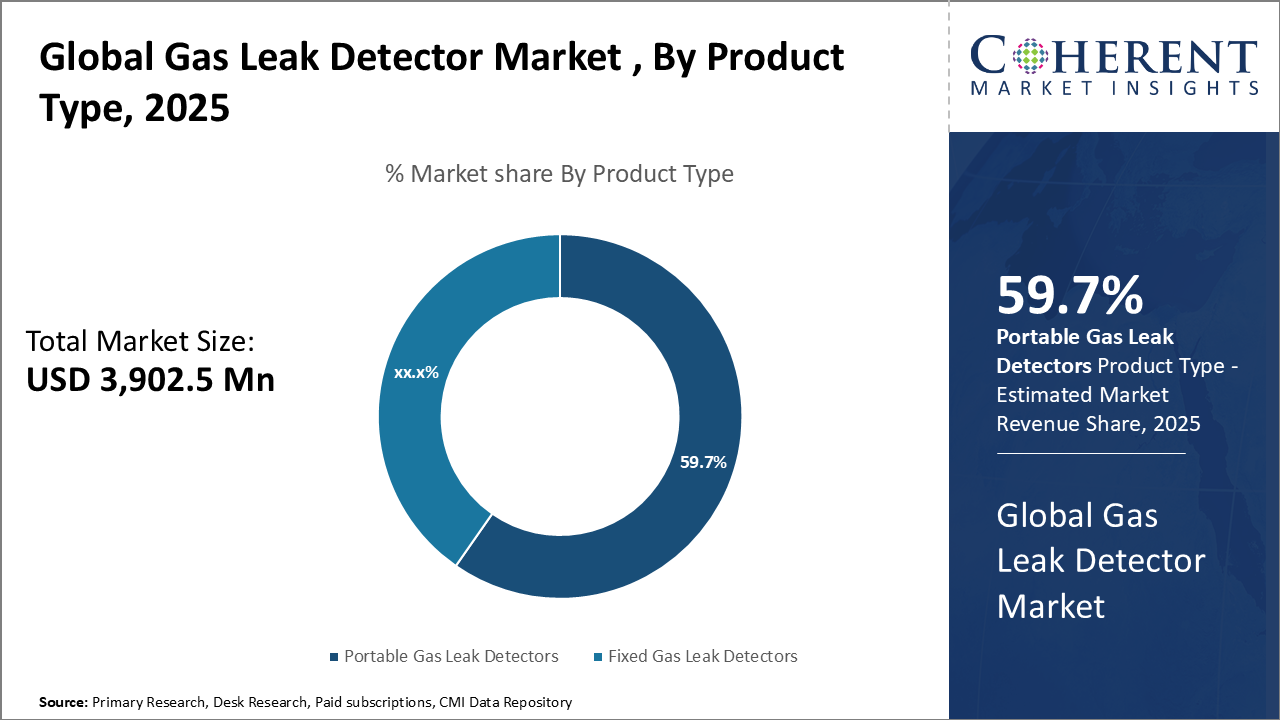
Gas Leak Detector Market Insights, By Product Type: Flexibility and Ease of Use Drive the Demand for Portable Gas Leak Detectors
In terms of product type, portable gas leak detectors segment is estimated to hold the highest share of the market of 60.7% in 2026 due to their flexibility, ease of use, and ability to provide real-time monitoring in multiple environments. Unlike fixed detectors, portable devices allow workers to carry them across different sites, making them ideal for industries such as oil & gas, mining, construction, and chemical processing, where leaks can occur in unpredictable locations. Their compact size, battery-powered operation, and advanced features such as multi-gas detection, digital displays, and wireless connectivity enhance safety and compliance. Increasing use for emergency response, confined space entry, and routine safety inspections further strengthens their adoption.
For instance, in September 2024, Picarro, a leader in gas leak and emissions management, introduced a state-of-the-art handheld device designed to transform on-foot natural gas leak investigations by enabling a fully traceable, digital workflow. The compact, ergonomic tool delivers part-per-billion methane and ethane detection with rapid response, significantly enhancing leak-find rates and eliminating false negatives typical of part-per-million detectors.
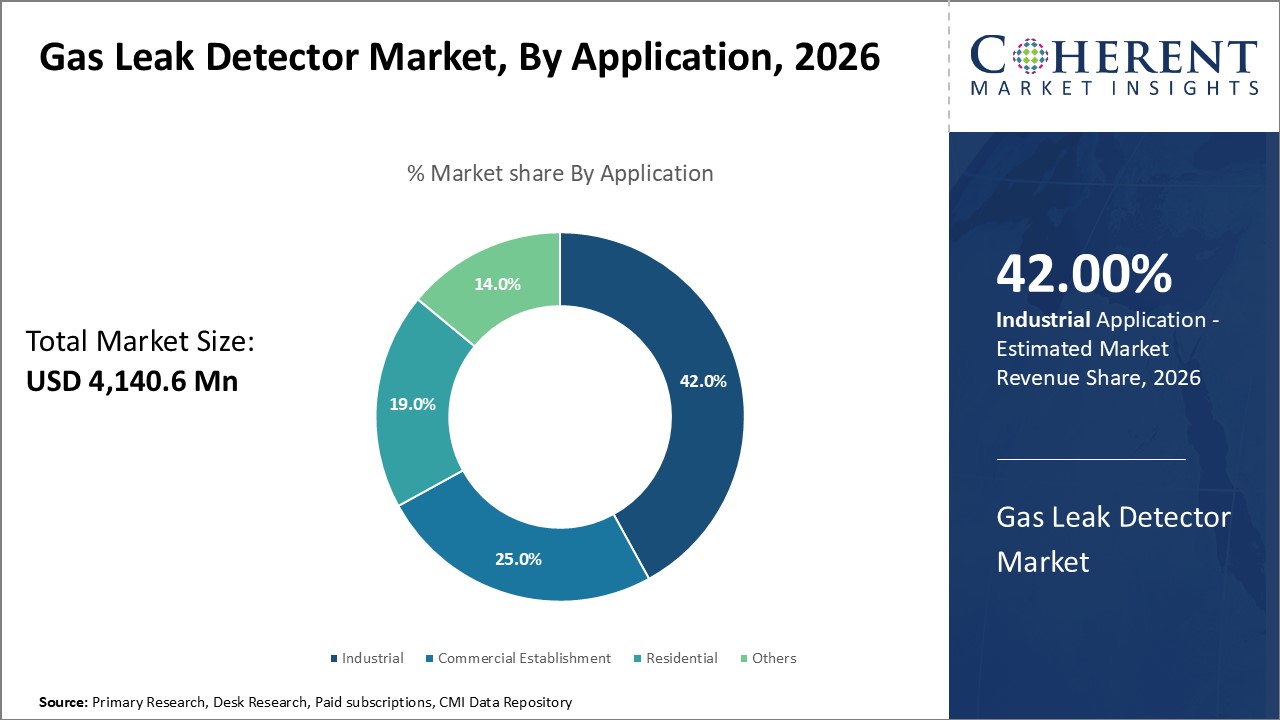
Gas Leak Detector Market Insights, By Application: Need to Ensure Workplace safety Fuels the Industrial Adoption of Gas Leak Detectors
In terms of application, industrial segment is estimated to hold the highest share of the market in 2026, due to their critical role in ensuring workplace safety and compliance with stringent government regulations. Industries such as oil & gas, chemicals, power generation, and manufacturing handle hazardous and flammable gases, making reliable detection systems essential to prevent accidents, explosions, and worker exposure. The rising number of large-scale industrial projects and expansion of petrochemical plants, particularly in Asia-Pacific and the Middle East, is further driving adoption.
For instance, in June 2025, ANYbotics introduced an advanced robotic gas leak detection solution using its autonomous legged robot, ANYmal. Equipped with cutting-edge gas sensors and AI-driven navigation, the robot is designed to autonomously inspect industrial facilities, identify leaks, and enhance workplace safety. The solution reduces human exposure to hazardous environments and lowers inspection costs. ANYmal’s mobility enables it to operate in complex, hard-to-reach industrial sites, including oil, gas, and chemical plants.
Gas Leak Detector Market Insights, By Technology – Electrochemical Segment Is Led by the High Sensitivity of Gas Leak Detector
In terms of technology, electrochemical segment is estimated to hold the highest share of the market in 2026, due to their high sensitivity, accuracy, and cost-effectiveness in detecting toxic gases such as carbon monoxide, hydrogen sulfide, chlorine, and ammonia. These detectors are widely adopted in industries like oil & gas, chemicals, mining, and manufacturing, where worker safety and compliance with stringent occupational health regulations are critical. Their compact size, low power consumption, and ability to provide real-time monitoring make them suitable for both portable and fixed installations. Moreover, increasing government mandates for workplace safety and the rising need for affordable detection technologies in emerging markets further drive the adoption of electrochemical gas leak detectors.
For instance, in April 2024, onsemi unveiled the CEM102, a groundbreaking miniaturized analog front-end (AFE) designed for highly accurate, ultra-low-power electrochemical sensing in industrial, environmental, and healthcare applications. Featuring a compact 1.884 × 1.848 mm footprint and industry-leading power efficiency including just 3.5 μA in active measurement mode, the CEM102 enables battery-operated devices like air-quality detectors, food-processing monitors, and wearable medical sensors.
Regional Insights
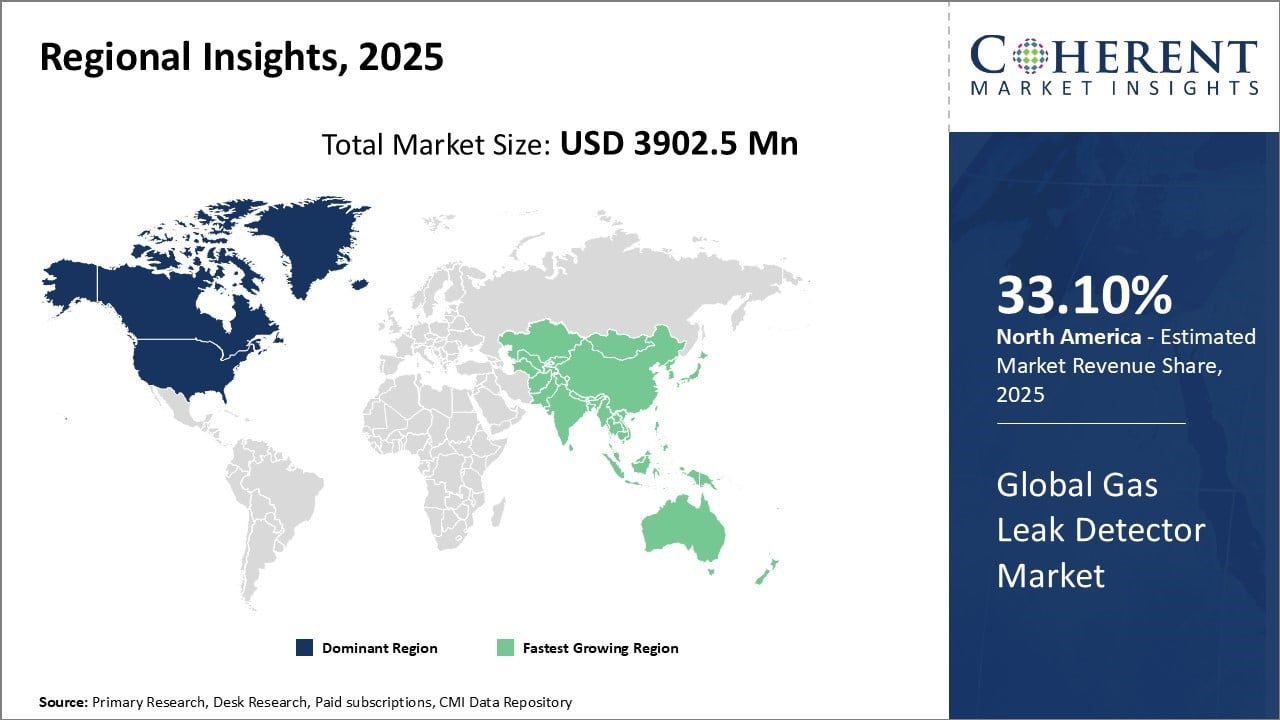
North America Gas Leak Detector Market Analysis & Trends
North America is expected to account for the greatest revenue share of 33.10% in 2026 driven by strict safety regulations from OSHA and EPA, coupled with the region’s extensive oil & gas, chemical, and manufacturing industries where gas detection is critical. Rising adoption of IoT-enabled wireless detectors, presence of leading players, and continuous investment in advanced sensor technologies further fuel demand. Moreover, strong awareness of worker safety and past industrial accidents have accelerated the deployment of advanced gas leak detection systems.
For instance, in May 2026, Honeywell launched a groundbreaking Hydrogen Leak Detector (HLD) that promises real-time detection of microscopic hydrogen leaks as small as 50 parts per million, owing to advanced Thermal Conductivity Detection technology. The sensor requires no recalibration or manual intervention for up to 10 years, significantly reducing maintenance costs and downtime. It can be deployed across industrial equipment, power generators, and vehicles, enhancing safety across hydrogen-powered systems.
Asia Pacific Gas Leak Detector Market Analysis & Trends
The Asia Pacific region exhibits the fastest growth in the gas leak detector market with a projected share of 31.6% in 2026, due to rapid industrialization in countries like China, India, and Southeast Asian nations, especially in oil & gas, chemical, and petrochemical sectors. Stringent safety regulations and growing awareness about worker protection are driving the adoption of advanced gas leak detection systems. Increased use of IoT-enabled, wireless, and smart detectors offering real-time monitoring, along with expanding energy production and infrastructure projects, is further boosting the gas leak detector market in the region.
Gas Leak Detector Market Outlook for Key Countries
The U.S. Gas Leak Detector Market Trends
The U.S. accounts for the largest share at 25.9%, driven by stringent industrial safety regulations, high adoption of advanced safety technologies, and a strong presence of oil & gas, chemical, and manufacturing industries. Companies prioritize gas leak detection to comply with OSHA standards and prevent costly industrial accidents.
For instance, in March 2026, Emerson introduced the Rosemount™ 625IR Fixed Gas Detector, a state-of-the-art safety solution for industrial environments. Utilizing advanced optical absorption detection technology, the 625IR offers ultra-fast response times, swiftly identifying hydrocarbon gas leaks before they escalate into hazardous situations. Its robust design incorporates dual infrared sources and receivers, ensuring continuous self-calibration and minimizing false alarms.
The U.K. Gas Leak Detector Market Trends
With 5.6% share, the U.K. market demand is fueled by regulatory mandates for worker safety, growing awareness of industrial hazards, and investments in oil, gas, and chemical sectors. Modern facilities increasingly adopt IoT-enabled gas detectors to enhance safety and monitoring efficiency.
For instance, in June 2026, Kentec Electronics introduced the K-Detect-iON, a calibration-free flammable gas detector designed to enhance safety in Battery Energy Storage Systems (BESS). Notably, it is the only UL 2075-certified hydrogen sensor that requires no calibration for at least 10 years, reducing maintenance costs. The device detects both volatile organic compounds (VOCs) and hydrogen, offering rapid response and robust performance.
China Gas Leak Detector Market Trends
China holds 11.1% of the market, reflecting its rapid industrialization and expansion of petrochemical, chemical, and energy sectors. The government enforces strict safety and environmental standards, driving companies to deploy advanced gas leak detection systems.
For instance, in May 2026, at the 2026 World Gas Congress in Beijing, ABB highlighted its leadership in gas leak detection and quality monitoring. The company showcased its MobileGuard™ system, a laser-based vehicle-mounted solution that detects gas leaks over 1,000 times more sensitively and 10 times faster than traditional methods. Additionally, ABB presented the HoverGuard™ drone for inspecting hard-to-reach pipelines and the portable MicroGuard™ for on-foot surveys. For gas quality monitoring, ABB introduced the Sensi+™ analyzer, which simultaneously measures multiple contaminants like hydrogen sulfide, water, and carbon dioxide.
GCC Countries Gas Leak Detector Market Trends
The 3.4% share in GCC countries is supported by substantial investments in oil & gas infrastructure, petrochemical facilities, and industrial safety initiatives. Advanced gas leak detection solutions are increasingly adopted to safeguard workers and assets in high-risk environments.
For instance, in May 2026, Honeywell inaugurated a new gas detector assembly line at the Masdar Innovation Centre in Abu Dhabi, UAE. This facility will manufacture advanced gas detection solutions, enhancing safety across industrial sectors such as oil and gas, chemicals, and utilities. The move underscores Honeywell’s commitment to regional innovation and aligns with the UAE’s goals for industrial diversification and sustainability.
Market Concentration and Competitive Landscape
Analyst Opinion (Expert Opinion)
The gas leak detector market value is shifting from regulatory compliance to becoming central in operational safety and risk management. Advanced ultrasonic and infrared detectors, capable of detecting leaks within 0.1 seconds, are replacing older catalytic sensors, particularly in oil and gas facilities where delays can be catastrophic. The U.S. Chemical Safety Board has reported over 600 hydrocarbon release incidents since 2015, underscoring the urgency for faster, more accurate solutions.
IoT-enabled detectors are gaining traction in North America and Europe, with PHMSA noting a 20% reduction in pipeline accidents where automated monitoring is used. Meanwhile, Japan has extended deployment to over 40 million homes, illustrating expansion into residential and commercial settings.
However, adoption remains uneven. Middle Eastern projects are rapidly deploying advanced detectors, while cost-sensitive markets in Latin America and Africa still rely on older technologies. The market is thus evolving into one where speed, accuracy, and connectivity are strategic necessities rather than optional upgrades.
Speak to the analyst
Want personalized insights?
Take the findings above to one of our principal consultants, or have the report rebuilt around the segments, geographies and competitors you actually track.
Recent Developments
- In August 2025, Teledyne Gas & Flame Detection (GFD) launched the PS DUO, a portable dual-gas detector designed to enhance safety in hazardous environments. Utilizing passive diffusion sensing, the device simultaneously monitors gases such as carbon monoxide (CO), hydrogen sulphide (H₂S), sulphur dioxide (SO₂), ammonia (NH₃), oxygen (O₂), hydrogen (H₂), nitrogen dioxide (NO₂), and ozone (O₃). It features real-time monitoring with audible, visual, and vibrating alarms, and offers wireless connectivity for data retrieval.
- In January 2025, DD-Scientific, a gas sensor technology company, introduced the MceL gas sensor, a breakthrough in miniaturized electrochemical sensing. With dimensions of just 8.3mm x 14.4mm, the MceL reduces sensor volume by 75%, enabling manufacturers to develop more compact, wearable, and feature-rich instruments.
- In October 2024, Flyability introduced a flammable gas sensor for its Elios 3 drone, enhancing safety during confined space inspections. Developed in collaboration with NevadaNano, the sensor detects over 14 common combustible gases, including hydrogen, with 0.1% LEL resolution. It identifies both gas type and concentration, providing real-time in-flight data to pilots.
Market Report Scope
Gas Leak Detector Market Report Coverage
| Report Coverage | Details | ||
|---|---|---|---|
| Base Year: | 2025 | Market Size in 2026: | USD 4,140.5 Mn |
| Historical Data for: | 2020 To 2024 | Forecast Period: | 2026 To 2033 |
| Forecast Period 2026 to 2033 CAGR: | 6.1% | 2033 Value Projection: | USD 6,267.1 Mn |
| Geographies covered: |
| ||
| Segments covered: |
| ||
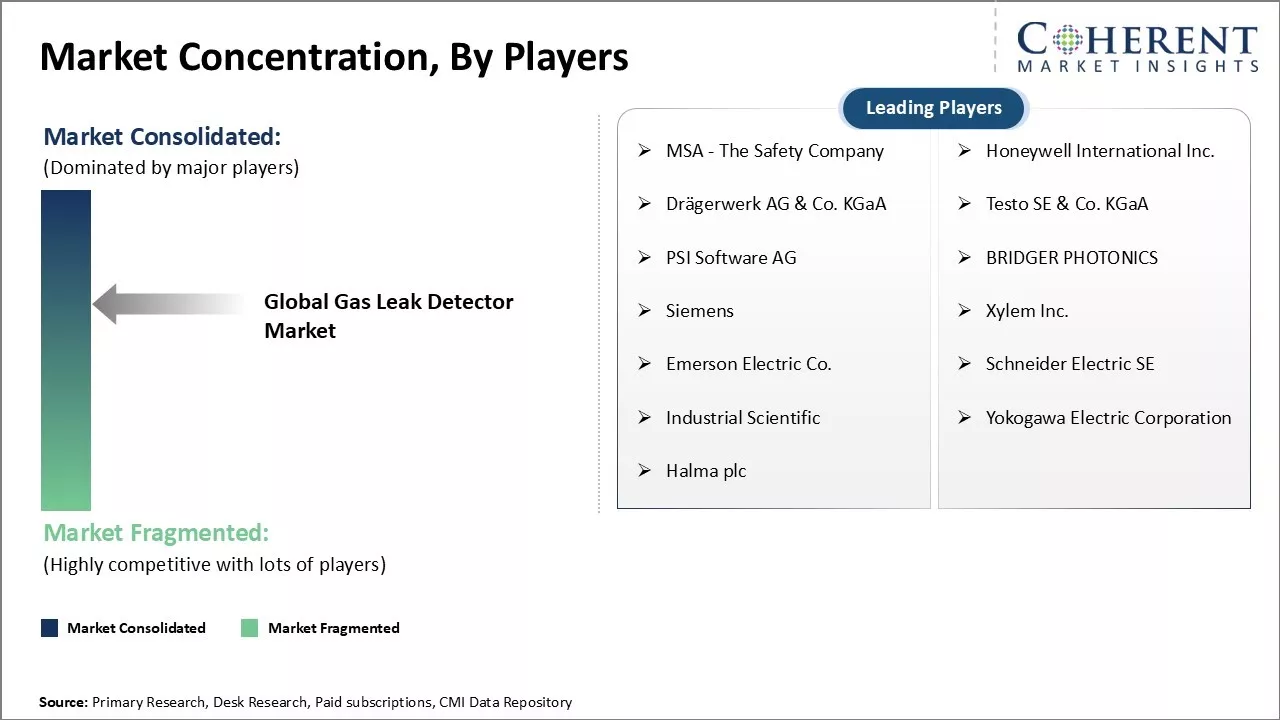
| Companies covered: | MSA - The Safety Company, Honeywell International Inc., Drägerwerk AG & Co. KGaA, Testo SE & Co. KGaA, PSI Software AG. | ||
| Growth Drivers: |
| ||
| Restraints & Challenges: |
| ||
Gas Leak Detector Market Driver
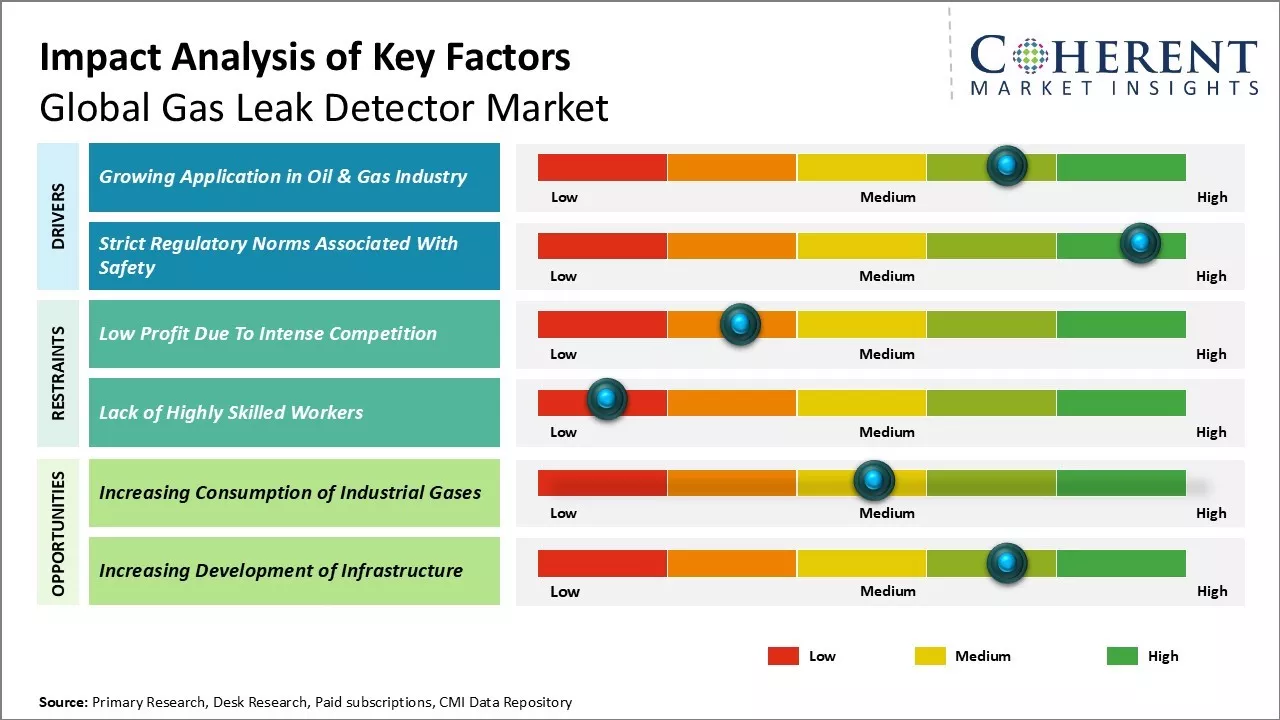
- Growing Application in Oil & Gas Industry
The global oil and gas industry has seen immense growth in the past few decades. With increasing exploration and production activities, the risks associated with gas leaks have also risen substantially. Gas leaks, if not detected on priority, can lead to hazardous situations like fires and explosions. For instance, in July 2024, Emerson's Incus Ultrasonic Gas Leak Detector is revolutionizing safety in the oil and gas industry by addressing limitations of traditional detection methods. Unlike catalytic bead or infrared detectors, ultrasonic sensors detect gas leaks before hazardous concentrations form, providing immediate alerts. These detectors are unaffected by environmental factors like wind or noise and offer wide coverage, up to a 40-meter radius per sensor.
- Strict Regulatory Norms Associated with Safety
Strict regulatory norms associated with safety are a major driver of growth in the gas leak detector market research. Governments and safety authorities worldwide have established stringent regulations to ensure worker protection and environmental safety in industries such as oil & gas, chemical, petrochemical, and manufacturing. Compliance with standards set by organizations like OSHA, EPA, and ISO mandates the installation of reliable gas leak detection systems in workplaces handling hazardous gases. These regulations not only require regular monitoring and reporting of gas leaks but also encourage the adoption of advanced technologies, including IoT-enabled and wireless gas detectors. As companies strive to meet these legal and safety requirements, the demand for sophisticated gas detection solutions rises, making regulatory compliance a key factor influencing market trends and expansion opportunities.
Gas Leak Detector Market Opportunity
- Development of portable & wireless gas leak detectors
The development of portable and wireless gas leak detectors holds significant promise to unlock new opportunities in the Gas Leak Detector Market Forecast. Portable detectors offer increased convenience, flexibility, and an extended range of inspection, allowing industries to monitor hazardous areas more effectively. According to the International Energy Agency's 2022 report, global gas demand is projected to increase by over 25% from 2020 to 2050 under current policies. Reliable leak monitoring will be essential to support this growth while mitigating climate and safety risks. Portable and wireless detectors are expected to play a key role by improving coverage, speed, and precision of inspections, thereby driving market expansion in the coming years.
Market Segmentation
- By Product Type Insights (Revenue, USD Mn, 2019 - 2033)
- Portable Gas Leak Detectors
- Fixed Gas Leak Detectors
- By Application Insights (Revenue, USD Mn, 2019 - 2033)
- Industrial
- Commercial Establishment
- Residential
- Others
- By Technology Insights (Revenue, USD Mn, 2019 - 2033)
- Electrochemical
- Infrared
- Semiconductor/MOS
- Ultrasonic
- Others (Holographic, etc.)
- By Regional Insights (Revenue, USD Mn, 2019 - 2033)
- North America
- U.S.
- Canada
- Latin America
- Brazil
- Argentina
- Mexico
- Rest of Latin America
- Europe
- Germany
- U.K.
- Spain
- France
- Italy
- Russia
- Rest of Europe
- Asia Pacific
- China
- India
- Japan
- Australia
- South Korea
- ASEAN
- Rest of Asia Pacific
- Middle East
- GCC Countries
- Israel
- Rest of Middle East
- Africa
- South Africa
- North Africa
- Central Africa
- North America
- Key Players Insights (Revenue, USD Mn, 2021 - 2033)
- MSA The Safety Company
- Honeywell International Inc.
- Drägerwerk AG & Co. KGaA
- Testo SE & Co. KGaA
- PSI Software AG
- BRIDGER PHOTONICS
- Siemens
- Xylem Inc.
- Emerson Electric Co.
- Schneider Electric SE
- Industrial Scientific
- Yokogawa Electric Corporation
- Halma plc
Sources
Primary Research Interviews from the following stakeholders
Stakeholders
- Interviews with gas leak detector manufacturers, safety equipment suppliers, process automation solution providers, industrial safety officers, facility managers, and procurement heads across leading global markets.
Specific Stakeholders
- HSE (Health, Safety & Environment) managers in oil & gas companies
- Plant managers and safety engineers in petrochemical and chemical processing plants
- Facility and safety heads at power generation units
- Safety compliance officers in mining operations
- Procurement heads at commercial building management firms
- Instrumentation and automation consultants in industrial sectors
- Product managers at OEMs and component suppliers
Databases
- UN Comtrade Database
- World Trade Organization (WTO) Trade Statistics
- U.S. Energy Information Administration (EIA)
- Eurostat
- U.S. Bureau of Economic Analysis (BEA)
- Japan External Trade Organization (JETRO)
- China Customs Statistics
- Korea Customs Service Data Portal
- Directorate General of Commercial Intelligence and Statistics (DGCIS), India
- International Energy Agency (IEA)
Magazines
- Industrial Safety & Hygiene News (ISHN)
- Occupational Health & Safety (OH&S) Magazine
- Hydrocarbon Engineering
- Chemical Engineering Magazine
- Oil & Gas Journal
- Process Safety Progress
- Plant Services Magazine
- Fire & Safety Journal International
Journals
- Journal of Loss Prevention in the Process Industries (Elsevier)
- Process Safety and Environmental Protection (Elsevier)
- IEEE Sensors Journal
- Measurement (Elsevier)
- Journal of Hazardous Materials
- Safety Science (Elsevier)
- International Journal of Occupational Safety and Ergonomics
Newspapers
- The Wall Street Journal – Energy & Industry
- The Economic Times – Energy & Chemicals
- The Hindu Business Line – Infrastructure & Energy
- Financial Times – Oil & Gas Industry Reports
- Nikkei Asia – Industrial Equipment & Energy
- South China Morning Post – Chemicals & Industry Coverage
- Gulf News – Oil, Gas & Energy
Associations
- American Petroleum Institute (API)
- International Society of Automation (ISA)
- National Fire Protection Association (NFPA)
- European Committee for Standardization (CEN) – Gas Detection Standards
- International Electrotechnical Commission (IEC) – Gas Detector Standards
- Indian Gas Exchange (IGX)
- Occupational Safety and Health Administration (OSHA), U.S.
- Confederation of Indian Industry (CII) – Energy & Chemicals Forum
Public Domain Sources
- U.S. Department of Energy (DOE)
- National Institute of Standards and Technology (NIST), U.S.
- Ministry of Economy, Trade and Industry (METI), Japan
- Petroleum Planning & Analysis Cell (PPAC), India
- Ministry of Petroleum and Natural Gas (MoPNG), India
- U.S. Environmental Protection Agency (EPA)
- European Chemicals Agency (ECHA)
- NITI Aayog – Energy Reports
- Reserve Bank of India (RBI) – Industrial Safety & Energy Reports
Proprietary Elements
- CMI Data Analytics Tool, and Proprietary CMI Existing Repository of information for last 8 years
Get access to 250+ pages report
Every segment, forecast, competitor profile and data table behind the analysis above — available for instant download.
- ESOMAR Member
- ISO 9001:2015 Certified
- D-U-N-S Registered
- GDPR & CCPA Compliant
Missing comfort of reading report in your local language? Find your preferred language:
Transform your Strategy with Exclusive Trending Reports
Frequently Asked Questions
Global gas leak detector market is estimated to be valued at USD 4,140.5 Mn in 2026 and is expected to reach USD 6,267.1 Mn by 2033.
The CAGR of the Gas Leak Detector Market is projected to be 6.1% from 2026 to 2033.
Growing application in oil & gas industry and strict regulatory norms associated with safety are the major factors driving the growth of the global gas leak detector market.
Low profit due to intense competition and lack of highly skilled workers are the major factors hampering the growth of the global gas leak detector market.
In terms of product type, the portable gas leak detectors segment is estimated to dominate the market revenue share in 2026.
MSA - The Safety Company, Honeywell International Inc., Drägerwerk AG & Co. KGaA, Testo SE & Co. KGaA, PSI Software AG, are the major players.
North America is expected to lead the global gas leak detector market in 2026.