

Microscale 3d Printing Market Size and Forecast — 2026 - 2033
The Global Microscale 3D Printing Market size is estimated to be valued at USD 1.2 billion in 2026 and is expected to reach USD 3.8 billion by 2033, exhibiting a compound annual growth rate (CAGR) of 16.5% from 2026 to 2033.
Overview
The microscale 3D printing market encompasses advanced printing technologies and materials designed for creating highly precise, small-scale structures used across electronics, biomedical, and microengineering applications. Key products include stereolithography (SLA) printers, two-photon polymerization systems, micro-extrusion printers, and inkjet-based microprinters, capable of fabricating components with micron-level accuracy. Materials range from photopolymers and biocompatible resins to conductive inks and metallic powders, enabling customized, functional parts. These products are applied in medical devices, microfluidic chips, sensors, and microelectronics, offering high resolution, rapid prototyping, and complex geometry capabilities. Continuous innovation in printers and materials is expanding their adoption across research, industrial, and healthcare sectors.
Key Takeaways
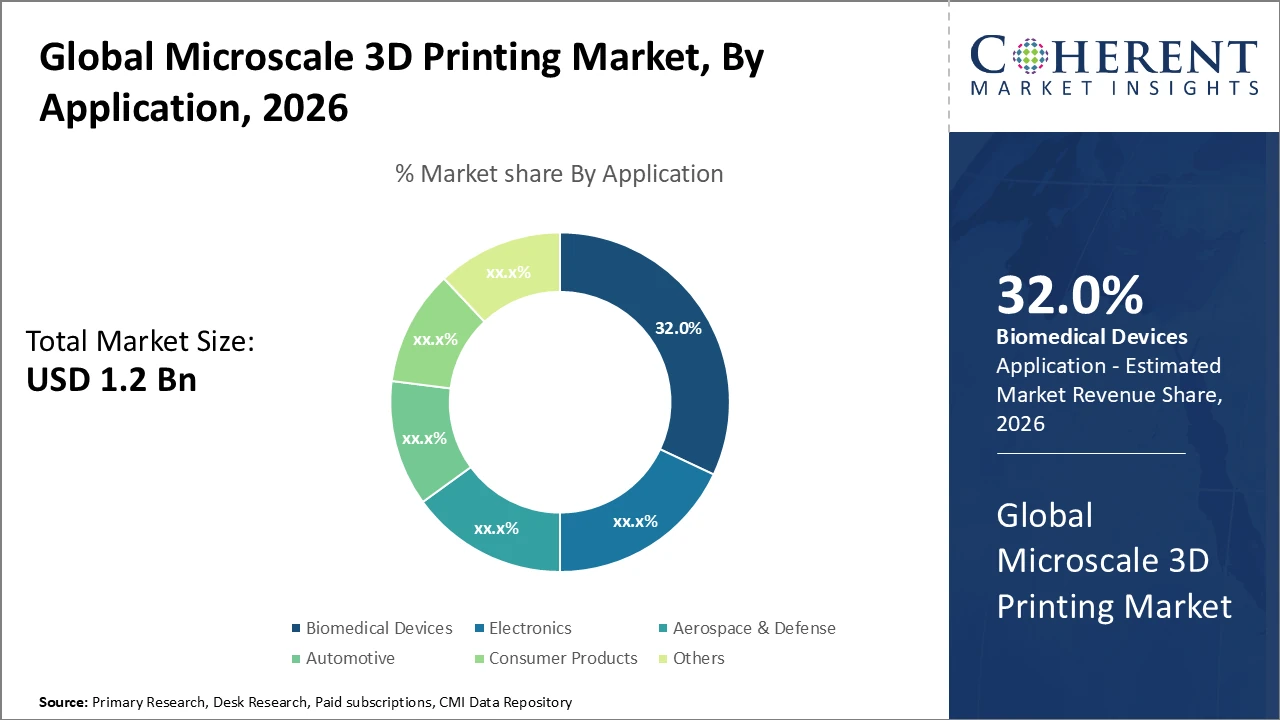
The Biomedical Devices subsegment holds a dominant share in market segments due to increasing demand for personalized healthcare solutions and micro-engineered implants, accounting for 32% of the microscale 3D printing market share in 2026.
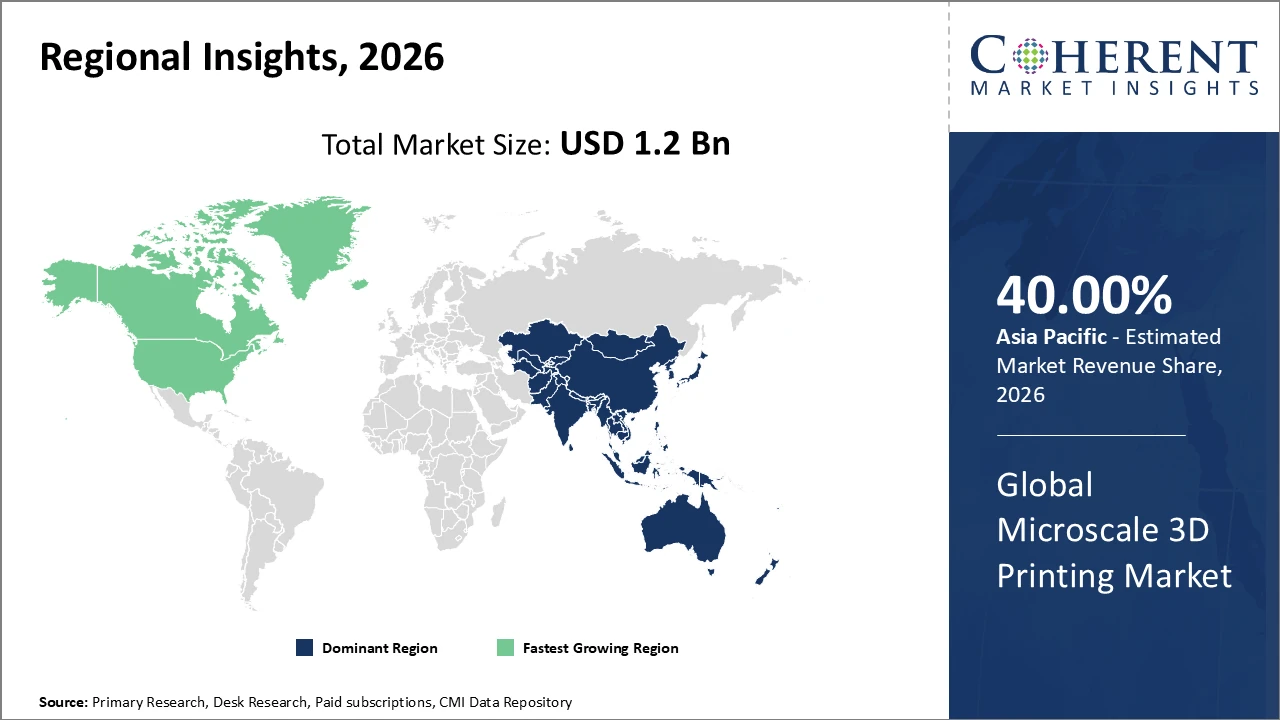
Asia Pacific commands the largest regional industry share, supported by a strong manufacturing ecosystem and government initiatives promoting the adoption of microfabrication technologies.
North America presents significant growth opportunities due to its advanced industrial infrastructure and increasing application of microscale 3D printing in aerospace and defense sectors.
Microscale 3d Printing Market Segmentation Analysis
Microscale 3d Printing Market Insights, By Application
Biomedical devices dominate the microscale 3D printing market with a 32% share, driven by growing demand for patient-specific surgical tools and implants. Advances in biocompatible materials and high-resolution printing enable complex micro-architectures for tissue scaffolds and implantables. The aerospace and defense segment is the fastest-growing application, leveraging microscale printing for lightweight, durable components in avionics and propulsion systems. Electronics accounts for a significant share by producing miniaturized circuits and sensors, while automotive applications focus on microfluidic devices and sensor prototyping.
Microscale 3d Printing Market Insights, By Material
Polymers dominate the microscale 3D printing market, holding a 45% share, valued for their flexibility, biocompatibility, and ease of processing, making them ideal for biomedical scaffolds, wearable electronics, and microfluidic devices. Metals represent the fastest-growing subsegment, driven by aerospace and defense applications requiring lightweight, high-strength micro-components produced through metal nanoparticle inks and direct metal printing. Ceramics are used in specialized areas such as micro-optics and high-temperature sensors due to their thermal and chemical stability. Composites combine materials to provide multifunctional properties, essential for aerospace and automotive microscale parts.
Microscale 3d Printing Market Insights, By Technology
Two-Photon Polymerization leads the microscale 3D printing market with a 28% share, valued for its unmatched resolution enabling nanoscale feature fabrication, critical for biomedical devices and microelectronics. It is rapidly adopted in academic and industrial R&D for ultra-precise prototyping. Micro Stereolithography provides a cost-effective solution with high resolution, ideal for faster prototyping cycles. Inkjet-based printing offers multi-material versatility, widely used in electronics and sensor manufacturing. Laser-Induced Forward Transfer (LIFT) is gaining traction for precise deposition of conductive thin films in printable electronics.
Microscale 3d Printing Market Trends
Recent market trends in microscale 3D printing show a strong shift toward ultra-high precision manufacturing, driven by advancements in photopolymerization and laser-based printing technologies.
Research in 2025 demonstrated that microscale 3D printers with sub-5 micron resolution could reduce part failures by up to 30%, benefiting biomedical and electronics applications.
Hybrid manufacturing systems that combine additive and subtractive processes are gaining traction, improving component integrity and reducing surface roughness, with successful implementation in aerospace part fabrication reported in 2026.
Sustainability considerations are increasingly influencing material selection and process optimization, with green polymer composites achieving revenue growth of over 20% year-on-year in 2024.
Microscale 3d Printing Market Insights, By Geography
Asia Pacific Microscale 3d Printing Market Analysis and Trends
In Asia Pacific, the microscale 3D printing market is driven by a well-established electronics manufacturing ecosystem, supportive government policies promoting Industry 4.0, and significant investments in research and development. China and Taiwan lead the regional market. The presence of major market players with extensive supply chains and local production facilities facilitates faster adoption of microscale printing technologies. Additionally, growing demand from automotive, biomedical, and wearable electronics applications in countries like India and Japan strengthens the region’s market leadership, positioning Asia Pacific as a key hub for innovation and growth.
North America Microscale 3d Printing Market Analysis and Trends
North America is experiencing the fastest growth in the microscale 3D printing market, with a CAGR exceeding 18%, largely driven by its adoption in aerospace and defense applications. The U.S. government’s focus on advanced manufacturing through funding initiatives, research programs, and innovation incentives has created a supportive environment for market expansion. Key industry players are collaborating with major defense contractors to develop specialized microscale printing solutions, enhancing performance and application versatility. These partnerships are enabling the production of high-precision, lightweight, and durable components for critical defense and aerospace systems.
Microscale 3d Printing Market Outlook for Key Countries
USA Microscale 3d Printing Market Analysis and Trends
The USA continues to be a key market for microscale 3D printing, driven by extensive adoption in biomedical and aerospace sectors and strong government support for technology development and commercialization. In 2025, the country accounted for over 35% of North America’s market revenue. Leading companies such as 3D Systems Corporation and Formlabs have expanded their service offerings to include customized medical devices and aerospace components. Collaborations between academic institutions and industrial players further enhance innovation, enabling rapid technology advancement. This dynamic ecosystem fosters significant business growth, strengthens market competitiveness, and supports the adoption of emerging microscale 3D printing trends across critical industries.
Germany Microscale 3d Printing Market Analysis and Trends
Germany’s microscale 3D printing market benefits from the country’s advanced manufacturing capabilities, especially in automotive and precision engineering sectors. Companies are integrating microscale 3D printing with Industry 4.0 practices to produce high-precision components with reduced lead times and improved efficiency. In 2024, German manufacturers contributed approximately 25% of Europe’s microscale printing revenue. Market players focus on optimizing additive manufacturing processes while leveraging government incentives that promote sustainable and energy-efficient production technologies. These factors strengthen Germany’s position as a central hub for innovation and adoption of microscale 3D printing, reinforcing its influence in both the regional and broader European market.
Analyst Opinion
Rapid improvements in printing resolution and accuracy are driving the microscale 3D printing market, with several manufacturers achieving sub-10 micron resolutions in 2025, enabling ultra-fine structures for medical implants and microelectronics, contributing to a 14% revenue increase in these sectors.
Material innovations tailored for microscale applications, such as biocompatible polymers and conductive inks, are expanding market opportunities; in 2024, a leading polymer nano-composite saw a 25% surge in demand, reflecting the impact of advanced materials on market share.
Expanding use cases in aerospace and high-frequency device industries require performance-critical, weight- and dimension-sensitive components, with aerospace manufacturers increasing imports of microscale printed parts by 18% in 2026.
Regional export-import dynamics influence market forecasts; Asia Pacific’s exports of microscale 3D printed microstructures to Europe grew 22% in 2025, demonstrating robust supply chain integration and international collaboration supporting sustained market growth.
- Current Industry Events of 2026
- Market Size Estimation
- Regional Breakdown
- Competitive Landscape
- Customer Intelligence
- Segmental Analysis
- Pricing Analysis
- Key Market Drivers, Challenges & Future Trends
- Customized Insights Section
Market Scope
| Report Coverage | Details | ||
|---|---|---|---|
| Base Year: | 2025 | Market Size in 2026: | USD 1.2 billion |
| Historical Data for: | 2020 To 2024 | Forecast Period: | 2026 To 2033 |
| Forecast Period 2026 to 2033 CAGR: | 16.5% | 2033 Value Projection: | USD 3.8 billion |
| Geographies covered: |
| ||
| Segments covered: |
| ||
| Companies covered: | Nanoscribe GmbH, 3D Systems Corporation, Carbon Inc., Kreon Technologies, Envision TEC, Formlabs, Nano Dimension, Protolabs, XYZprinting, XYZnano | ||
| Growth Drivers: |
| ||
Microscale 3d Printing Market Growth Factors
The microscale 3D printing market is driven by continuous technological innovations that enhance printing resolution, enabling the fabrication of highly detailed microstructures essential for next-generation devices. Rising demand from the healthcare sector for customized biomedical implants and scaffolds further fuels growth, evidenced by a 19% increase in biomedical microfabrication activities in 2025. Additionally, electronics miniaturization and the growing adoption of wearable devices and IoT components boost the need for microscale 3D printing solutions. Government initiatives and incentives in regions such as North America and Asia Pacific supporting advanced manufacturing and sustainable production further accelerate market expansion and industrial adoption.
Microscale 3d Printing Market Development
In October 2025, Boston Micro Fabrication (BMF), a leader in micro-precision 3D printing, announced that the USPTO granted U.S. Patent No. 12,420,486 B2 for its “Multi-Scale System for Projection Micro Stereolithography,” covering the dual-resolution optical system behind BMF’s microArch D1025 printer.
Key Players
Leading Companies of the Market
Nanoscribe GmbH
3D Systems Corporation
Kreon Technologies
Envision TEC
Formlabs
Nano Dimension
Protolabs
XYZprinting
XYZnano
Competitive strategies in the microscale 3D printing market focus on significant R&D investment and strategic partnerships. For example, EnvisionTEC’s collaboration with a major biomedical firm in 2025 led to the development of new materials compatible with microscale 3D printing, increasing its market revenue by 12%. Similarly, Nano Dimension expanded its aerospace client base, resulting in a 20% growth in contracts by late 2024, strengthening its industry position. Additionally, several companies have adopted customized service models targeting niche applications such as personalized medicine and microfluidics, driving business growth and reinforcing their influence on emerging industry trends.
Microscale 3d Printing Market Future Outlook
The future of the microscale 3D printing market is poised for strong growth, driven by ongoing advancements in high-resolution printing technologies and material innovations. Increasing demand from healthcare for patient-specific implants, as well as from electronics, aerospace, and defense industries for miniaturized, high-precision components, will continue to expand market opportunities. Integration with hybrid manufacturing and Industry 4.0 initiatives will enhance production efficiency and component performance. Additionally, government support and sustainability-focused initiatives in regions like North America and Asia Pacific will promote adoption of eco-friendly materials and processes. Continuous R&D and emerging applications will sustain long-term market growth.
Microscale 3d Printing Market Historical Analysis
The microscale 3D printing market has experienced steady growth over the past decade, driven by increasing demand for high-precision microstructures in biomedical, electronics, and aerospace applications. Early adoption focused on polymers and photopolymerization technologies, while metals, ceramics, and composites gradually gained traction for industrial and defense applications. North America and Europe led the market due to advanced manufacturing infrastructure, strong R&D investments, and supportive government policies. Asia Pacific emerged as a key growth region with rapid industrialization, electronics manufacturing, and government-backed Industry 4.0 initiatives. Continuous technological improvements in printing resolution, material versatility, and process integration have historically expanded applications and shaped the competitive landscape.
Sources
Primary Research Interviews:
Microscale 3D printer manufacturers and product managers
Industrial and biomedical equipment OEMs
Electronics, aerospace, and defense component suppliers
Research institutions and academic laboratories using microscale 3D printing
Magazines:
Additive Manufacturing – Industry Updates & Technological Innovations
3D Printing Industry – Materials, Applications, and Market News
TCT Magazine – 3D Printing and Microfabrication Insights
Manufacturing Today – Advanced Manufacturing and Industrial Applications
Journals:
Journal of Micromechanics and Microengineering – Microfabrication Research
Additive Manufacturing – Process Innovation & Material Studies
Journal of Manufacturing Science and Engineering – High-Precision Printing Applications
Materials Today – Microscale 3D Printing Materials and Applications
Newspapers:
The Wall Street Journal – Industrial and Additive Manufacturing News
Financial Times – Technology and Manufacturing Sector Updates
Reuters – 3D Printing Market Developments
Bloomberg – Advanced Manufacturing and Industrial Technology Trends
Associations:
ASTM International – Additive Manufacturing Standards Committee
Society of Manufacturing Engineers (SME)
International Additive Manufacturing Network (IAMN)
Additive Manufacturing Users Group (AMUG)
Get access to 250+ pages report
Every segment, forecast, competitor profile and data table behind the analysis above — available for instant download.
- ESOMAR Member
- ISO 9001:2015 Certified
- D-U-N-S Registered
- GDPR & CCPA Compliant
Missing comfort of reading report in your local language? Find your preferred language:
Transform your Strategy with Exclusive Trending Reports
Frequently Asked Questions
The dominant players include Nanoscribe GmbH, 3D Systems Corporation, and Nano Dimension, which maintain market leadership through advanced technological innovations and strategic client acquisitions.
The market is projected to grow from USD 1.2 billion in 2026 to approximately USD 3.8 billion by 2033, driven by increasing adoption in biomedical, electronics, and aerospace sectors.
The biomedical devices industry offers the largest growth opportunity, fueled by rising demand for micro-engineered implants and customized medical devices.
Trends will focus on AI-based design optimization, hybrid manufacturing techniques, and the adoption of eco-friendly materials, reflecting a shift toward sustainable, high-precision production.
The competitive landscape is defined by rapid innovation, significant R&D investments, and strategic partnerships with industry verticals, while challenges include high material costs and technical barriers in achieving microscale resolution and consistency.
Companies typically pursue partnerships, targeted product development for niche applications, service customization, and aggressive technological advancements to penetrate specialized markets such as biomedical and aerospace.