

Industrial Routers Market Size and Share Analysis - Growth Trends and Forecast (2026 - 2033)
The global industrial routers market size is expected to reach approximately USD 1,845 Mn in 2026 and is projected to grow at a compound annual growth rate (CAGR) of 9.2% during the forecast period (2026-2033), totaling USD 3,416.4 Mn by 2033. This growth is attributable to increasing adoption of industrial automation, rising deployment of Industrial Internet of Things (IIoT) solutions, growing demand for secure and reliable communication networks in manufacturing facilities.
Key Takeaways from the Industrial Routers Market Report
- Wired industrial routers are expected to lead the market with a share of 55% in 2026 because industrial facilities prioritize low latency, cybersecurity, and deterministic communications for critical operations. For instance, HMS Networks’ 2025 Industrial Network Report found that Ethernet-based industrial networks accounted for 76% of newly installed industrial network nodes globally in 2025, highlighting strong industrial reliance on wired connectivity for manufacturing and automation environments. However, demand for wireless routers is poised to grow at a higher CAGR during the forecast period.
- Manufacturing & processing industry is set to account for the largest market share of 29% in 2026 due to industry 4.0 deployment, industrial IoT adoption, predictive maintenance, and factory automation. For instance, the International Federation of Robotics reported that 542,000 industrial robots were installed globally in 2024, showing increasing automation investments across manufacturing facilities.
- North America is likely to retain its dominance over the global industrial routers industry with a share of 40% in 2026, owing to rising adoption of industrial automation, increasing investments in smart manufacturing initiatives, expanding implementation of Industry 4.0 technologies, and rising demand for secure industrial networking solutions. For instance, the National Institute of Standards and Technology (NIST) reported that the U.S. manufacturing industry accounted for USD 2.3 trillion in value added, highlighting the region’s strong industrial base and accelerating digital manufacturing transformation that supports demand for industrial networking infrastructure.
- Asia Pacific, holding a share of over 30% in 2026, is anticipated to emerge as the fastest-growing market for industrial routers during the forecast period, thanks to rapid industrialization, increasing adoption of industrial IoT (IIoT) technologies, expanding manufacturing activities, rising investments in smart factories and Industry 4.0 initiatives, and growing deployment of 5G and industrial communication networks.
Industrial Routers Market Overview
The global industrial routers market is expected to register strong growth during the forecast period. This is primarily due to increasing adoption of industrial automation, rising demand for secure and reliable communication networks, and expanding integration of smart manufacturing technologies across industries like manufacturing, energy, transportation, and utilities. In addition, rising need for real-time data transmission, remote monitoring capabilities, and advancements in wireless communication technologies are supporting market expansion are expected to support market expansion during the forthcoming period.
Industrial routers are networking devices designed to securely transmit data packets across industrial networks and enable reliable communication between connected devices and systems. Their rising adoption across manufacturing, railways, oil & gas, energy, and other industries is providing impetus for the growth of industrial routers market.
Increasing adoption of industrial automation and robotics across manufacturing operations is fostering industrial routers market growth. Industrial routers facilitate remote monitoring, diagnostics, and maintenance of industrial equipment by enabling secure connectivity between devices and control systems.
Rapid advances in machine to machine (M2M) communications are generating new avenues of growth for industrial routers. Industrial applications require increasing use of M2M technologies for prediction of failures, machine monitoring, and process improvement. Interconnection of machines is driving the need for efficient routers that can handle substantial amounts of data traffic.
Similarly, deployment of 5G and advanced wireless technologies are positively impacting sales of industrial routers. Organizations in the contemporary world are adopting wireless industrial routers to achieve low latency, higher bandwidth, and flexible deployment in factories and remote sites.
Segmental Insights
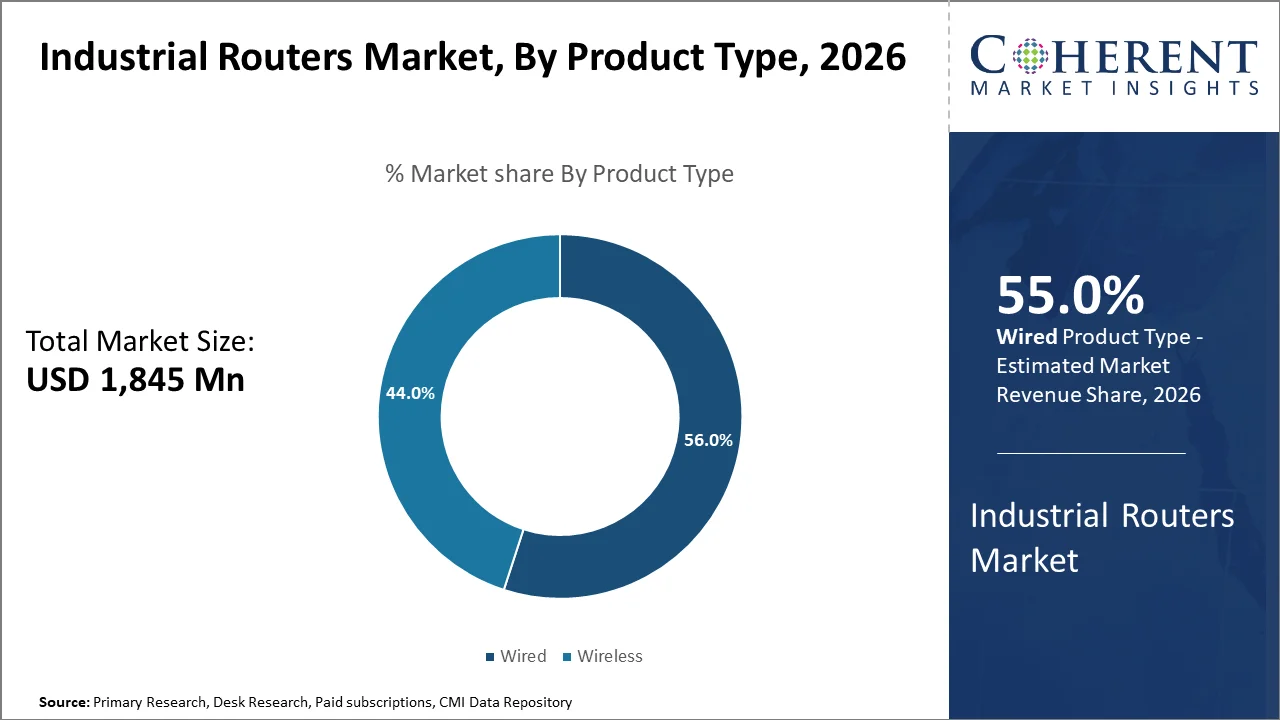
Which is the Best-Selling Product Type in the Industrial Routers Market?
Wired Routers Dominate Due to Reliability and Stable Connectivity
According to Coherent Market Insights’ latest industrial routers market analysis, wired segment is expected to lead the market, accounting for a revenue share of 55% in 2026. This can be attributed to their high reliability, secure communication capabilities, and stable network connectivity in industrial environments where uninterrupted operations are critical.
Wired industrial routers are widely preferred across manufacturing facilities, energy plants, transportation infrastructure, and industrial automation systems. This is because they offer low latency, reduced signal interference, and consistent performance compared to wireless alternatives.
Industries which are exposed to challenging environments prefer wired connectivity options, where communication between machines can take place smoothly. Furthermore, the growing trend towards implementing Industry 4.0 and IIoT in industries has been one reason why the market for wired industrial routers continues to grow, because reliable connectivity is needed for the operations.
- Current Industry Events of 2026
- Market Size Estimation
- Regional Breakdown
- Competitive Landscape
- Customer Intelligence
- Segmental Analysis
- Pricing Analysis
- Key Market Drivers, Challenges & Future Trends
- Customized Insights Section
Which End User Segment Leads the Industrial Routers Market?
Manufacturing & Processing Industry Remains the Largest End User Segment
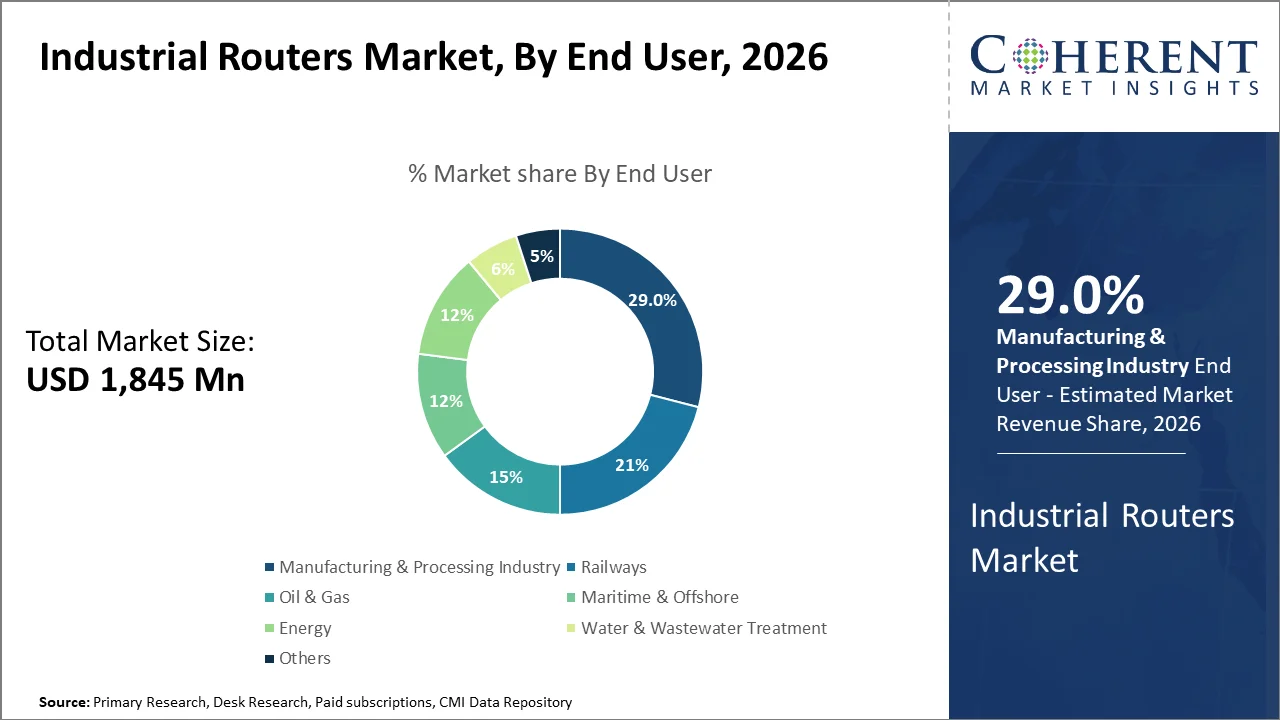
By end user, manufacturing & processing industry is projected to account for a prominent market revenue share of 29% in 2026. This is mostly due to increasing adoption of industrial automation, smart manufacturing technologies, and Industrial Internet of Things (IIoT) solutions across production facilities.
Industrial routers play a key role in enabling secure and reliable machine-to-machine (M2M) communication, remote monitoring, predictive maintenance, and real-time data exchange between connected devices and centralized systems. As a result, their demand is increasing rapidly across manufacturing and processing plants.
Industrial Routers Market Growth Drivers
Expansion of Industry 4.0 and Smart Manufacturing
Industries in the contemporary world are rapidly adopting automation, smart factories, and connected production systems to improve operational efficiency as well as reduce costs and increase throughput. This trend is expected to drive strong demand for industrial routers during the forecast period. Industrial routers provide reliable networking infrastructure that supports machine-to-machine (M2M) communication, real-time monitoring, and automated workflows essential for industrial IoT (IIoT) and Industry 4.0 environments.
Industrial Routers Market Opportunities
Rising Adoption of Industrial IoT (IIoT)
Increasing adoption of the Industrial Internet of Things (IIoT) is expected to create lucrative growth opportunities for the industrial routers market during the forthcoming period. Rising usage of IoT sensors and devices results in the generation of huge amounts of data in industrial settings. These routers facilitate secure and efficient data transmission among machines, control systems, and cloud systems. Hence, this trend is driving the market across major end-use industries such as manufacturing, transportation, and utilities.
Industrial Routers Market Trends
Rising Need for Cybersecurity in Industrial Networks
There is a sharp increase in cybersecurity incidents as operational technology (OT) networks become more connected, thereby expanding the attack surface of industrial infrastructure. According to our research – Vedere Labs, OT perimeter devices such as industrial routers and firewalls accounted for 67% of observed cyberattacks in a 90-day honeypot study, significantly higher than directly exposed control systems like PLCs.
This suggests that attackers are increasingly targeting edge connectivity devices that bridge IT and OT environments, positioning industrial routers as key entry points for cyber intrusions. In response, manufacturers are integrating security capabilities such as VPNs, firewalls, Zero Trust architectures, and secure remote access into industrial routers. This ongoing shift toward secure, intelligent networking infrastructure is expected to drive growth in the industrial routers market during the forecast period.
Impact of AI on the Industrial Router Market
Artificial intelligence is increasingly being used in the industrial routers segment as well. It is revolutionizing the functioning and operation of routers. Artificial intelligence enables routers to analyze the network usage pattern and allocate bandwidth accordingly. This greatly improves the network performance for users, especially in cases where many devices are connected to the network at once.
In addition, AI-driven security features in routers can detect and respond to cyberthreats in real time. They offer smarter protection against malware and unauthorized access. Rising popularity of AI-based routers is expected to boost the global industrial router market revenue in the coming period. Companies like Cisco Systems and Juniper Networks are using AI to make their routers smarter as well as improve network management. For instance, Juniper Networks unveiled its enhanced AI-native routing portfolio in February 2025.
Current Events and Their Impact on the Industrial Routers Market
Current Event | Description and its Impact |
Expansion of Private 5G Industrial Networks (2025–2026) |
|
Industrial Cybersecurity Regulations Tighten Globally |
|
Regional Insights
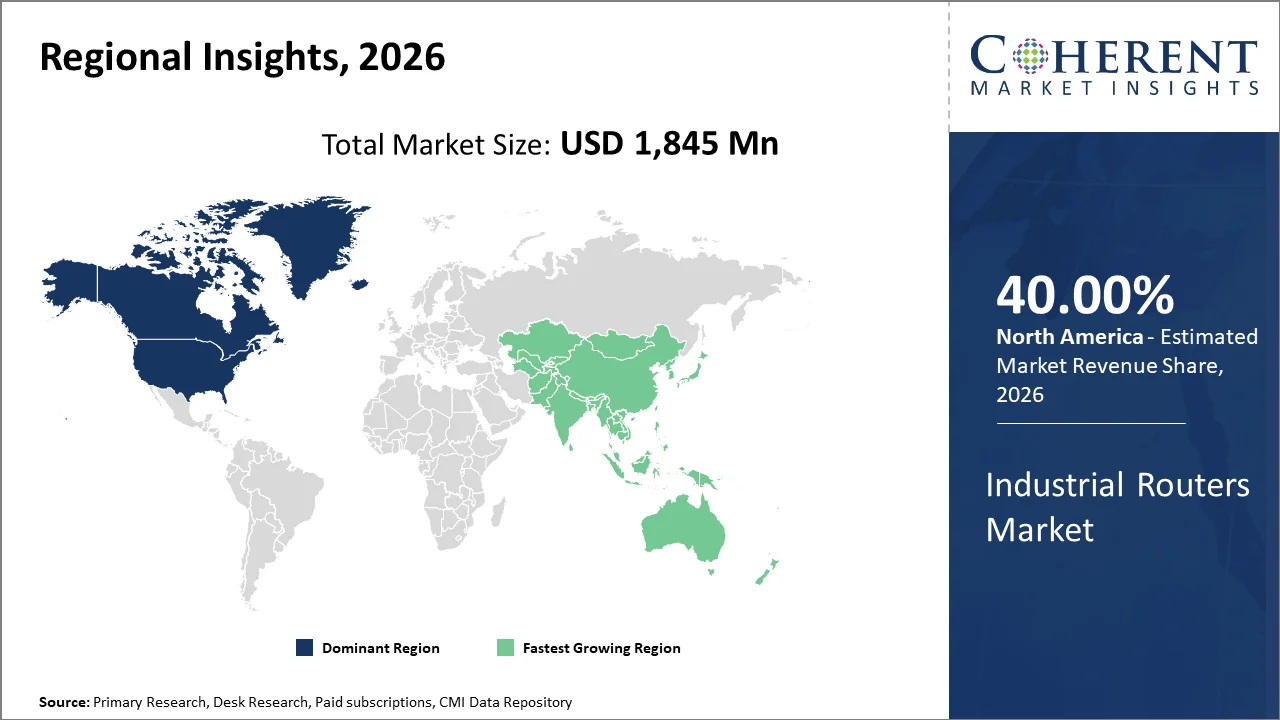
North America Holds the Largest Share in the Industrial Routers Market
North America is expected to dominate the global Industrial routers market, accounting for a share of 40% in 2026. This can be attributed to strong adoption of IIoT, smart manufacturing, and cybersecurity-focused industrial networking, along with rapid modernization of critical infrastructure such as energy grids and transportation systems.
Increasing industrial digitalization and security demand is boosting North America industrial router market. For example, Cisco’s industrial networking insights highlight that nearly 89% of industrial organizations consider cybersecurity compliance a top priority, which is accelerating the deployment of secure industrial routers across OT networks. In addition, the U.S. continues to invest heavily in smart infrastructure, with widespread use of industrial routers in utilities, oil & gas, and transportation systems to ensure real-time monitoring and reliable connectivity across connected industrial assets.
Asia Pacific Becoming a Central Hub for Industrial Router Manufacturers
Asia Pacific is poised to emerge as a hotbed for manufacturers of industrial routers during the forecast period, capturing a share of 30% in 2026. This is mostly due to rapid industrialization, expansion of manufacturing hubs, and large-scale adoption of Industry 4.0, IIoT, and factory automation technologies across China, India, Japan, and Southeast Asia.
Infrastructure expansion and digital transformation initiatives are boosting Asia Pacific industrial routers market. For instance, Asia Pacific has seen massive deployment of industrial IoT systems, with China, Japan, and India leading smart factory development and large-scale automation projects.
China alone accounts for millions of connected industrial assets as part of national smart manufacturing initiatives. This, in turn, is driving demand for reliable industrial routers to support machine-to-machine communication, remote monitoring, and edge connectivity in industrial environments.
Industrial Routers Market Outlook – Country-wise
U.S. Industrial Routers Market Trends
The U.S. is expected to remain a leading market for industrial routers during the forecast period. This is mostly due to expansion of 5G infrastructure, industrial IoT deployment, and strong demand from aerospace, defense, and automotive sectors, where secure and high-speed industrial connectivity is critical for operations and R&D activities.
Increasing use of cloud-based industrial applications is also fueling industrial router demand. As industries across the U.S. migrate toward cloud platforms for data analytics and control systems, industrial routers play a key role in ensuring continuous, secure data transmission between edge devices and cloud servers.
China Industrial Routers Market Forecast
China’s industrial routers industry is poised to exhibit robust growth during the assessment period. This is attributable to large-scale telecom infrastructure development, smart manufacturing initiatives, and rapid industrial automation. Similarly, increasing adoption of IoT-enabled factory systems across major industrial provinces and rise of edge computing is boosting the industrial routers market value in the nation.
Expansion of smart transportation and smart cities is also creating a conducive environment for the growth of industrial routers market in China. Projects involving smart traffic systems, connected railways, and intelligent surveillance systems rely heavily on industrial routers for uninterrupted communication across distributed networks.
Who are the Major Companies in the Industrial Routers Market?
Some of the major players in Industrial Routers Market are Juniper Networks, Inc., Netgear Inc., ZTE Corporation, Cisco Systems, Inc., Inseego Corporation, Dell Technologies, Inc., Micromax Technology, Ericsson, Inc., TP-Link Technologies Co., Ltd, Alcatel-Lucent Enterprises, Huawei Technologies Co., Ltd., and Advantech Co., Ltd.
Key Strategies Adopted by Industry Players
Top Industrial Routers companies are adopting various strategies to expand their regional presence as well as boost their sales growth. These include new product launches, mergers, acquisitions, partnerships, facility expansions, and distribution agreements.
Recent Developments in the Industrial Routers Market
- In March 2026, Inseego Corp. launched a new enterprise device called the MiFi PRO M4. It is a 5G mobile router built to provide fast and secure wireless internet for business users in different locations.
- In July 2025, Lantronix Inc. launched its NTC-500 Series rugged industrial-grade 5G wireless router. The product is designed to reduce deployment costs and improve enterprise connectivity and mobility.
- In September 2024, NETGEAR expanded its Nighthawk WiFi 7 lineup by launching the RS600, RS500, and RS200 routers. These models are designed to deliver faster speeds and improved WiFi performance.
- In May 2024, Teltonika launched its new M-Series industrial routers, including the RUTM08, RUTM09, RUTM10, and RUTM11. These routers are designed for industrial networking applications that require reliable and secure connectivity.
Market Report Scope
Industrial Routers Market Report Coverage
| Report Coverage | Details | ||
|---|---|---|---|
| Base Year: | 2025 | Market Size in 2026: | USD 1,845 Mn |
| Historical Data for: | 2020 To 2024 | Forecast Period: | 2026 To 2033 |
| Forecast Period 2026 to 2033 CAGR: | 9.2% | 2033 Value Projection: | USD 3,416.4 Mn |
| Geographies covered: |
| ||
| Segments covered: |
| ||
| Companies covered: | Juniper Networks, Inc., Netgear Inc., ZTE Corporation, Cisco Systems, Inc., Inseego Corporation, Dell Technologies, Inc., Micromax Technology, Ericsson, Inc., TP-Link Technologies Co., Ltd, Alcatel-Lucent Enterprises, Huawei Technologies Co., Ltd., and Advantech Co., Ltd. | ||
| Growth Drivers: |
| ||
| Restraints & Challenges: |
| ||
Analyst Opinion (Expert Opinion)
- Industrial routers are becoming essential as factories adopt automation and smart manufacturing. These routers help machines, sensors, and control systems exchange data securely and in real time, improving operational efficiency as well as reducing downtime.
- Industrial IoT (IIoT) expansion is creating strong demand for industrial networking equipment. Industrial routers play a key role by enabling reliable connectivity between industrial assets and cloud or edge systems for monitoring and predictive maintenance.
- Cybersecurity is becoming a major focus in industrial networking environments. According to Cisco’s 2024 State of Industrial Networking Report, 89% of respondents said cybersecurity compliance is very or extremely important, increasing the need for secure industrial routers with advanced protection capabilities.
Speak to the analyst
Want personalized insights?
Take the findings above to one of our principal consultants, or have the report rebuilt around the segments, geographies and competitors you actually track.
Market Segmentation
- By Product Type Insights ( Revenue, US$ Mn, 2021 - 2033)
- Wired
- Wireless
- By End User Insights ( Revenue, US$ Mn, 2021 - 2033)
- Railways
- Oil & Gas
- Maritime & Offshore
- Water & Wastewater Treatment
- Road Infrastructure
- Energy
- Manufacturing & Processing Industry
- Others
- By Region Insights ( Revenue, US$ Mn, 2021 - 2033)
- North America
- U.S.
- Canada
- Latin America
- Brazil
- Argentina
- Mexico
- Rest of Latin America
- Europe
- Germany
- U.K.
- Spain
- France
- Italy
- Russia
- Rest of Europe
- Asia Pacific
- China
- India
- Japan
- Australia
- South Korea
- ASEAN
- Rest of Asia Pacific
- Middle East
- GCC Countries
- Israel
- Rest of Middle East
- Africa
- South Africa
- North Africa
- Central Africa
- North America
Sources
Primary Research interviews
- Industrial router manufacturers
- Network infrastructure providers
- Industrial automation solution providers
- IoT technology experts
- Telecom equipment distributors
- System integrators and industrial networking specialists
- Supply chain and procurement managers
- Manufacturing industry professionals
- Technology adoption specialists
- Channel partners and industry stakeholders
Databases
- UN Comtrade Database
- World Bank Open Data
- International Trade Centre (ITC) Trade Map
- Eurostat Database
- OECD Statistics Database
- National Bureau of Statistics databases
- Government trade and manufacturing databases
- Company annual reports and financial filings
Magazines
- Industrial Ethernet Book
- Automation World
- Control Engineering
- Manufacturing Today
- Industrial Networking Magazine
- Electronic Design
- Machine Design
Journals
- IEEE Communications Magazine
- IEEE Internet of Things Journal
- Journal of Industrial Information Integration
- International Journal of Communication Systems
- Journal of Network and Systems Management
- Sensors Journal
- International Journal of Advanced Manufacturing Technology
Newspapers
- Financial Times
- The Wall Street Journal
- Business Standard
- The Economic Times
- Nikkei Asia
- The Guardian (Business Section)
Associations
- Industrial Internet Consortium (IIC)
- International Society of Automation (ISA)
- Institute of Electrical and Electronics Engineers (IEEE)
- Telecommunications Industry Association (TIA)
- Ethernet Alliance
- 5G Alliance for Connected Industries and Automation (5G-ACIA)
- GSMA
Public Domain sources
- Government publications and regulatory databases
- White papers from technology organizations
- Company investor presentations and SEC filings
- Corporate sustainability and annual reports
- Trade publications and technical publications
- Patent databases
- Industry standards documentation
- Import-export statistics databases
- Public infrastructure and telecom deployment reports
Proprietary Elements
- CMI Data Analytics Tool
- Proprietary CMI Existing Repository of information for last 10 years
Get access to 250+ pages report
Every segment, forecast, competitor profile and data table behind the analysis above — available for instant download.
- ESOMAR Member
- ISO 9001:2015 Certified
- D-U-N-S Registered
- GDPR & CCPA Compliant
Missing comfort of reading report in your local language? Find your preferred language:
Transform your Strategy with Exclusive Trending Reports
Frequently Asked Questions
The global market is estimated to be valued at USD 1,845 Mn in 2026.
The global Industrial Routers Market value is expected to reach USD 3,416.4 Mn by 2033.
The global market is poised to exhibit a CAGR of 9.2% from 2026 to 2033.
Major growth factors include expansion of Industry 4.0 and smart manufacturing and rising adoption of industrial IoT (IIoT).
Wired industrial routers dominate the market with a share of 55% in 2026.
Some major companies in the Industrial Routers Market include Juniper Networks, Inc., Netgear Inc., ZTE Corporation, Cisco Systems, Inc., Inseego Corporation, Dell Technologies, Inc., Micromax Technology, Ericsson, Inc., TP-Link Technologies Co., Ltd, Alcatel-Lucent Enterprises, Huawei Technologies Co., Ltd., and Advantech Co., Ltd.
North America is set to lead the market with a share of 40% in 2026.