

Forklift Truck Market Size & Forecast
Forklift Truck Market is estimated to be valued at USD 91,930.9 Mn in 2026 and is expected to reach USD 1,98,203.4 Mn in 2033, exhibiting a compound annual growth rate (CAGR) of11.6% from 2026 to 2033.
Key Takeaways
- Based on Product Type, the Industrial Counterbalance Forklifts segment leads the market holding an estimated share of 75.3% in 2026, due to their versatility, ease of operation, and suitability for a wide range of applications across industries.
- Based on Class, the Class III segment leads the market holding the largest share of the market in 2026, due to the rapid growth of e-commerce, retail, and warehousing operations, where frequent movement of goods in confined spaces is required.
- Based on Propulsion, the Electric Power segment is expected to dominate with substantial share of the market in 2026, due to their eco-friendliness, cost efficiency, and regulatory compliance.
- Based on Lifting Capacity, the Below 5 Ton Lifting Capacity segment expected to lead the market with the greatest share in 2026, due to their versatility, compact size, and suitability for a wide range of indoor and outdoor applications.
- Based on End-Use Industry, the Warehouse and Distribution Centers segment is expected to hold the maximum share of the market in 2026, due to the surge in e-commerce, retail, and third-party logistics (3PL) operations, which require efficient material handling for high-volume goods.
- Based on Region, Asia Pacific is estimated to lead the market with a share of 43.8% in 2026. While, Europe is considered as the fastest growing region in the forklift truck market with 30.8% share in 2025.
Market Overview
The global forklift truck market is witnessing steady growth, driven by increasing demand for efficient material handling across industries such as e-commerce, automotive, manufacturing, and logistics. As global manufacturers invest in automation and sustainable handling solutions, the forklift truck market demand is expected to evolve further with emphasis on safety, cost-efficiency, and cleaner fuel alternatives.
Current Events and Its Impact
Current Event | Description and Its Impact |
Geopolitical Tensions and Trade Policy Shifts |
|
Economic Pressures and Industrial Demand Fluctuations |
|
Price Analysis of the Forklift Truck Market
Type of Forklift | Average Price Range (USD) |
Class V ICE Forklifts (Diesel/LPG) | $20,000 – $40,000 |
Electric Counterbalance Forklifts (Class I/II) | $25,000 – $50,000 |
Autonomous Forklifts (AGVs/Robotic) | $70,000+ |
Hydrogen Fuel Cell Forklifts | $80,000 – $100,000 |
- Current Industry Events of 2026
- Market Size Estimation
- Regional Breakdown
- Competitive Landscape
- Customer Intelligence
- Segmental Analysis
- Pricing Analysis
- Key Market Drivers, Challenges & Future Trends
- Customized Insights Section
Role of Artificial Intelligence (AI) on Forklift Truck
Artificial Intelligence (AI) is transforming the forklift truck market by improving automation, safety, and efficiency in material handling. AI-powered forklifts use sensors, LiDAR, and computer vision for autonomous navigation, obstacle detection, and collision avoidance, reducing reliance on human operators. They also enable smart load detection, predictive maintenance, and optimized route planning, lowering downtime and operational costs.
In June 2025, ELOKON launched ELOshieldAI, an advanced AI-powered safety system that combines tagless vision detection with its proven UWB-based ELOshield technology. Designed for industrial environments, it significantly enhances forklift safety by offering flexible protection options: AI-based pedestrian detection from the forklift, on-body alerts via ELOshield badges, or a combination of both—ensuring robust and reliable proximity protection.
Segmental Insights
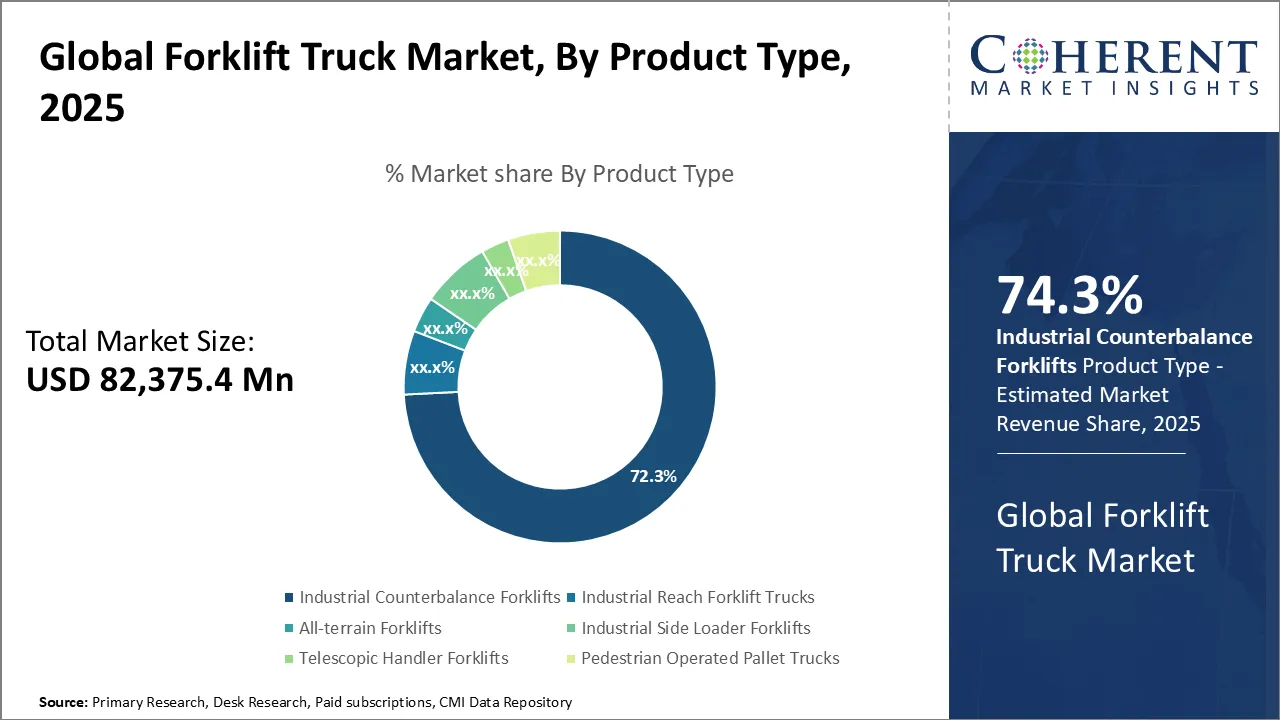
Forklift Truck Market Insights, By Product Type: Industrial Counterbalance Forklifts Acquires the Largest share owing to its Versatility and Ease of Operation
In terms of Product Type, the Industrial Counterbalance Forklifts segment is expected to contribute 75.3% share of the market in 2026, due to their versatility, ease of operation, and suitability for a wide range of applications across industries. Industrial counterbalance forklifts do not require outriggers or extended arms, making them compact and easier to maneuver in tight spaces which is ideal for indoor warehouses, docks, and container yards. They can handle various load types and weights, making them suitable for industries like manufacturing, logistics, retail, and construction. They are one of the most commonly used forklift types globally, with a standardized driving experience, reducing the need for specialized operator training.
For Instance, in logistics hubs like Singapore’s Tuas Port, counterbalance forklifts are widely used due to their ability to operate efficiently in high-density stacking zones and container handling yards.
In September 2024, Crown Equipment introduced the Crown C-B Series 80V electric counterbalance forklifts with pneumatic tires, offering load capacities between 5,000 and 7,000 pounds.
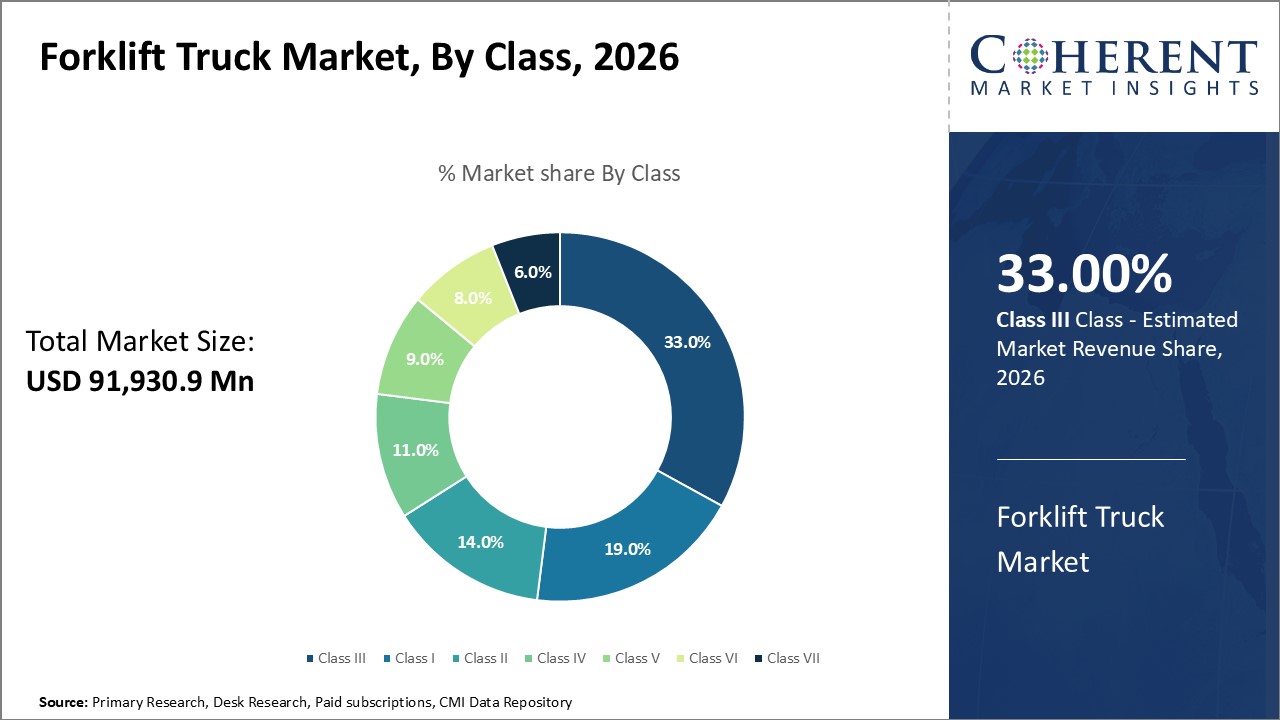
Forklift Truck Market Insights, By Class: Class III Segment Dominates Due to Rapid Growth in E-Commerce, Retail and Warehousing Operations
In terms of class, the class III segment is projected to account for the largest share in 2026, due to the rapid growth of e-commerce, retail, and warehousing operations, where frequent movement of goods in confined spaces is required. These forklifts are compact, cost-efficient, and easy to maneuver, making them ideal for last-mile operations, loading docks, and small to medium-sized warehouses. Additionally, their low maintenance costs, electric operation, and sustainability benefits align with the growing push for eco-friendly equipment. The increasing adoption of automated and semi-automated pallet trucks is further boosting demand for Class III forklifts.
For instance, in August 2024, Godrej & Boyce, a unit of the Godrej Enterprises Group, introduced India’s first lithium-ion battery-powered forklift truck equipped with a fully indigenous Battery Management System (BMS), developed in collaboration with Log9 Materials. Industries including automotive, FMCG, consumer durables, pharmaceuticals and retail, especially e-commerce are expected to benefit.
Forklift Truck Market Insights, By Propulsion: Electric Power Acquires the Largest share owing to its Eco-Friendliness & Cost Efficiency
In terms of propulsion, the electric power segment dominates the market with largest share in 2026 due to their eco-friendliness, cost efficiency, and regulatory compliance. Unlike internal combustion engines, electric forklifts produce zero emissions, making them ideal for indoor operations in warehouses, food processing units, and pharmaceuticals where air quality is critical.
Additionally, lower maintenance costs and longer operational lifespan make them attractive for businesses aiming to reduce total cost of ownership. The growing push for sustainable logistics and strict emissions regulations in regions like Europe and North America further support this shift. For example, in 2024, several U.S. states introduced incentive programs for warehouses to transition to electric industrial vehicles, accelerating adoption.
In August 2024, Hyster launched its J2.0–3.5XTLG series of fully electric, lithium-ion forklift trucks capable of lifting up to 3.5 tonnes. Designed for both indoor warehouses and outdoor yards, these models deliver combustion-engine performance with zero emissions, halved energy costs, and maintenance-free batteries. Featuring opportunity charging during breaks, spacious weatherproof cabins, 34% improved mast visibility, superelastic tyres, and high ground clearance, the range ensures robust operation across industries, from wood and metal to construction materials. This is further accelerating the forklift truck market share.
Forklift Truck Market Insights, By Lifting Capacity: Below 5 Ton Lifting Capacity Holds the Largest Share on account of its Versatility and Compact Size
In terms of lifting capacity, the below 5 ton lifting capacity segment is expected to hold the dominant position with a largest share in 2026, due to their versatility, compact size, and suitability for a wide range of indoor and outdoor applications. These models are particularly favored in warehouses, retail centers, small manufacturing units, and logistics hubs where heavy lifting is not required, but maneuverability in confined spaces is critical. Their lower operating and maintenance costs compared to higher-capacity forklifts make them an economical choice for businesses with moderate material handling needs.
In February 2025, Toyota Material Handling Europe launched its latest range of electric counterbalanced forklifts, the Traigo48 series, offering 1.5–2.0 ton capacities and top speeds up to 20 km/h, with lift heights reaching 7.5 m. Featuring both three‑ and four‑wheel models, these trucks come with lithium‑ion or lead‑acid battery options, plus Toyota’s SyncoDrive system for up to 18% energy savings over earlier models.
Forklift Truck Market Insights, By End User Industry: Warehouse and Distribution Centers Segment Dominates the market share Due to Surge in E-commerce, Retail, and Third-Party Logistics Operations
In terms of end user industry, the warehouse and distribution centers segment is expected to capture the highest share of the market in 2026, due to the surge in e-commerce, retail, and third-party logistics (3PL) operations, which require efficient material handling for high-volume goods. Forklifts are essential for loading and unloading shipments, stacking pallets, and moving inventory across large facilities. The rise of same-day and next-day delivery models has further increased the need for speed, precision, and automation in warehouses. Additionally, the growing adoption of automated and electric forklifts supports sustainability goals while improving productivity, making warehouses and distribution centers the dominant demand driver in the forklift trucks market.
For instance, in April 2025, Kao Corporation has implemented fully automated truck loading using automated forklifts at its Toyohashi Plant’s next-generation warehouse. The innovation automates the entire logistics chain from product reception to truck loading, enhancing efficiency in the warehouse while addressing labor shortages.
Regional Insights
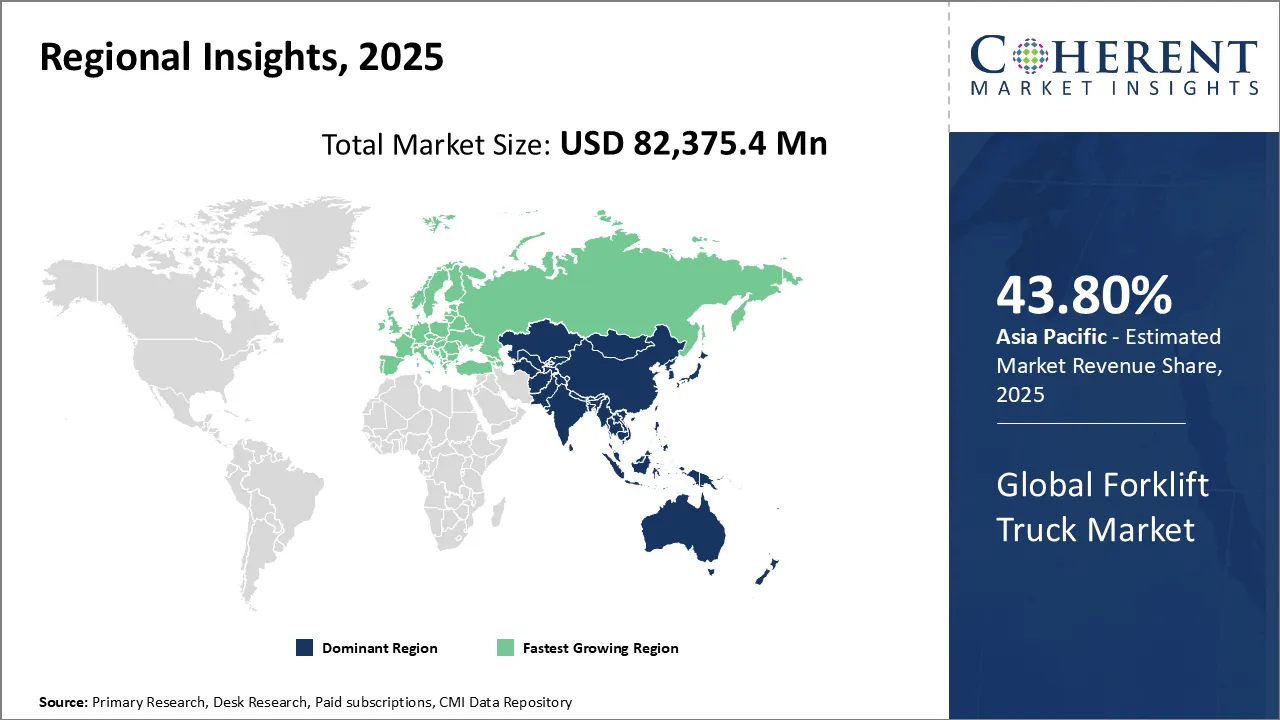
Asia Pacific Forklift Truck Market Analysis & Trends
In Asia Pacific, the dominance in the forklift truck market is estimated with a 43.80% share in 2026. This is attributed to soaring demand in key economies such as China, India, and Japan. This growth is being propelled by rapid industrialization, surging warehouse expansion, and one of the world’s fastest-growing e‑commerce sectors.
For instance, in India, logistics infrastructure is expanding rapidly. The warehouse developer IndoSpace announced its plan to boost investment in Tamil Nadu by 41%, reflecting rising demand for industrial parks serving e-commerce, automotive, and FMCG manufacturers. This infrastructure growth is directly lifting demand for material handling solutions like forklift trucks to support efficient logistics operations. Similarly, Japan is innovating logistics operations with futuristic automation, further accelerating the forklift truck market share.
Europe Forklift Truck Market Analysis & Trends
Europe is expected to exhibit the fastest growth in the forklift truck market during forecast period, holding 30.8% market share in 2026, driven partially by a surge in autonomous and automated intralogistics solutions. A standout example occurred at LogiMAT 2024 in Stuttgart, where VisionNav Robotics premiered its VNST20 PRO autonomous forklift, equipped with 3D LiDAR SLAM positioning and Robot Control System (RCS) technology. This vehicle performed a real-time demonstration of trailer truck loading and unloading in just 45 minutes, showcasing its adaptability and precision for European logistics centers.
In April 2026, STEF Group, Europe’s leading provider of temperature-controlled food transport and logistics, launched two hydrogen initiatives in partnership with Toyota Material Handling Europe and Plug Power. The projects, based in Athis-Mons (France) and Torrejón de Ardoz (Spain), aim to create a full hydrogen ecosystem by combining green hydrogen production with hydrogen-powered forklifts at these sites.
Forklift Truck Market Outlook Country-Wise
The U.S. Forklift Truck Market Trends
The United States remains a key driver in the global forklift truck market, holding 24.8% market share in 2026, due to its mature warehousing, retail, and logistics infrastructure. The country faces ongoing labor shortages in the material handling sector, which has accelerated the adoption of automation technologies. Major players like Amazon are leading this shift by heavily investing in automated fulfillment centers across the country.
For example, in late 2024, Amazon announced the expansion of several robotics-enabled warehouses in states like California and Ohio, where fleets of electric and autonomous forklifts are being deployed to streamline operations and reduce dependency on manual labor. This move not only boosts productivity but also underscores the growing trend toward smart intralogistics systems in the U.S. market.
Germany Forklift Truck Market Trends
The Germany forklift trucks market is expected to contribute 9.8% share, driven by its strong industrial base, particularly in automotive manufacturing, machinery, and logistics. With Germany being a logistics hub in Europe, demand is rising from warehousing, e-commerce fulfillment centers, and distribution facilities. Moreover, the country’s emphasis on Industry 4.0 adoption, automation, and electrification is accelerating the use of advanced forklifts, including electric and automated models.
For instance, in August 2026, Linde Material Handling unveiled the Xi-Roadster, an enhanced electric counterbalance forklift within its expanded Xi-series, offering a load capacity up to two tonnes across seven new models. Designed with operator safety and productivity in mind, the three- and four-wheel variants feature an overhead guard that omits the traditional A-pillar to improve visibility.
China Forklift Truck Market Trends
China leads the forklift truck market with 18.6% of share in 2026, due to rapid industrialization, large-scale manufacturing, and rising automation in logistics. Government initiatives like Made in China 2026 and smart factory development have boosted demand for electric and automated forklifts. Major players such as JD.com and Alibaba are expanding smart logistics parks with autonomous forklift fleets to streamline warehousing.
In 2024, JD.com scaled its automated warehouse network, while Alibaba’s Cainiao Network deployed intelligent material handling systems. This push toward automation continues to fuel high-volume forklift purchases across China’s manufacturing and e-commerce sectors, further contributing.
Brazil Forklift Truck Market Trends
The Brazil forklift trucks market is growing steadily with a 5.6% market share, supported by expansion in manufacturing, agriculture, and retail distribution networks. The rise of agribusiness exports, modernization of ports, warehouses, and logistics infrastructure, and government-backed infrastructure development projects are creating strong demand. The ongoing shift toward e-commerce logistics and urban distribution centers is further driving adoption of forklifts across the country.
For instance, in July 2026, EP Equipment’s Brazilian arm, EP Brasil, launched the EFL302B3, a 3-ton lithium-ion forklift, marking the company’s largest product introduction in the country to date. Priced as “the most affordable lithium-powered forklift in Brazil,” the model aims to broaden access to advanced materials-handling technology.
GCC Countries Forklift Truck Market Trends
The GCC forklift trucks market is expanding with 3.2% market share due to large-scale construction and infrastructure projects, rapid growth in smart warehousing, logistics hubs, and retail developments, and government-led economic diversification beyond oil. Projects like NEOM in Saudi Arabia, Expo-linked developments in the UAE, and mega industrial zones are fueling forklift adoption. Additionally, increased investment in ports, free-trade zones, and e-commerce logistics is further accelerating demand for forklifts across the region.
For instance, in May 2026, Dayim Equipment Rental introduced its first batch of advanced forklifts in the UAE, marking a major milestone in its regional growth plan. These units stem from a strategic US $15 million order placed with Hangcha Forklift. The delivery initiates a large-scale deployment designed to support Dayim’s long-term, multi-year rental contracts across key markets, including the UAE, Saudi Arabia, and Kuwait.
Market Report Scope
Forklift Truck Market Report Coverage
| Report Coverage | Details | ||
|---|---|---|---|
| Base Year: | 2025 | Market Size in 2026: | USD 91,930.9 Mn |
| Historical Data for: | 2020 To 2024 | Forecast Period: | 2026 To 2033 |
| Forecast Period 2026 to 2033 CAGR: | 11.6% | 2033 Value Projection: | USD 1,98,203.4 Mn |
| Geographies covered: |
| ||
| Segments covered: |
| ||
| Companies covered: | Anhui Heli, Caterpillar Inc., Clark Material Handling Company Inc, Crown Equipment Corp., Doosan Industrial Vehicles Co. Ltd, Hangcha Group Co., Hyster-Yale Materials Handling Inc., Jungheinrich AG, KION Group, Mitsubishi Forklift Trucks, and Others. | ||
| Growth Drivers: |
| ||
| Restraints & Challenges: |
| ||
Global Forklift truck Market Drivers
- Growing E-commerce Industry
The rapid growth of the e-commerce industry is dramatically increasing demand for warehouse space, significantly impacting the forklift truck market demand. As consumers order more goods online, retailers and logistics operators are expanding large-scale fulfillment centers and distribution hubs to handle bulk shipments from pallets to cases, requiring robust material handling solutions.
A recent example underscores this trend: Prologis, the world’s largest industrial real estate owner, recorded an extraordinary $900 million in new warehouse construction starts during Q2 2025, nearly tripling the amount from the previous year with 65% of the projects already leased in advance. These new facilities cater to e-commerce retailers, FMCG companies, and consumer brands, all of which rely heavily on forklift trucks to move inventory efficiently within expansive storage and staging areas.
Global Forklift truck Market Opportunities
- Development of hydrogen fuel cell powered forklifts
Hydrogen fuel cell-powered forklift trucks offer several environmental and operational advantages, including zero on-site emissions, minimal noise, and rapid refueling, all aligning with sustainability goals while improving uptime. These factors are poised to create significant opportunity within the projected forklift truck market forecast.
For instance, Toyota Material Handling Japan has launched a next-generation fuel cell (FC) lift truck now priced 30% lower and offering double the durability compared to earlier models. This truck can be refueled in just 3 minutes, delivers zero CO₂ emissions during operation, and even supplies onboard AC power, demonstrating real operational benefits in high-use settings like airports and factories.
For instance, in January 2025, The Nagoya Port Authority has rolled out hydrogen fuel-cell forklifts across its logistics operations, marking a major step in sustainable port management. The initiative, overseen by Tokyo-based Suzuki Shokan, saw four forklifts deployed to each of the following: Tobishima Container Berth and logistics firms Asahi Unyu Kaisha, Shinko Kaiun, Kamigumi, and Toyo Butsuryo.
Analyst Opinion (Expert Opinion)
The forklift truck market value is maturing in some geographies, is entering a phase of transformative evolution that is more strategic than cyclical. From an analyst’s perspective, the segment is no longer merely a barometer of industrial activity, it is increasingly a lead indicator of logistics modernization and warehouse automation priorities.
A critical shift is the accelerated adoption of electric and autonomous forklift systems, particularly in Europe and parts of East Asia. For instance, Germany’s logistics hubs have shown a preference for electric forklifts, which now account for over 60% of total forklift sales in the country, due to stringent emission regulations and rising energy cost concerns. This trend is further amplified by national policies targeting full carbon neutrality in material handling operations by the early 2030s.
Another noteworthy transformation is the rising dominance of counterbalance forklifts. Despite the availability of reach trucks and pallet stackers, counterbalance models, especially in the 1.5–3 ton segment continue to dominate demand due to their operational flexibility and compatibility with both indoor and outdoor environments. Their growing use in cross-docking applications and last-mile urban logistics centers confirms this preference.
Speak to the analyst
Want personalized insights?
Take the findings above to one of our principal consultants, or have the report rebuilt around the segments, geographies and competitors you actually track.
Key Developments
- In February 2025, India’s Defence Ministry signed contracts totaling ₹697.35 crore with ACE Ltd and JCB India Ltd to procure 1,868 Rough Terrain Forklift Trucks for the Army, Navy, and Air Force. The deal, finalised in the presence of Defence Secretary R.K. Singh, underscores the “Buy (Indian)” policy aimed at enhancing domestic defence manufacturing and MSME participation.
- In November 2024, BMW Group’s Regensburg plant introduced hydrogen-powered tugger trains and forklift trucks from 2026 across its intralogistics network, covering press, body and assembly shops. This shift, supported by Mitsubishi Heavy Industries Thermal Systems Europe GmbH (MTTE), aligns with the iFACTORY vision and aims to replace electric drives by 2030.
- In November 2024, Linde Material Handling launched its new generation of electric forklift trucks, aimed at transforming logistics operations around the globe. The new Linde 1251 series replace the long standing 386 series and features 26 variants of three and four wheel forklifts with lifting capacities of 1.0 to 2.0 tonnes, offering enhanced maneuverability, safety, and operator comfort.
- In August 2024, SANY introduced its largest-capacity electric forklift, the SCPE350, at its Zhuhai Industrial Park facility. With a 35-ton load rating, the SCPE350 delivers a full load speed of 28 km/h and an empty load lift speed of 350 mm/s, while drawing just 2.5 kWh which equivalent to 1 L of diesel, delivering annual energy savings of up to ¥200,000 (≈ US $28,600).
Market Segmentation
- Global Forklift Truck Market, By Product Type (Revenue, USD Mn, 2021 - 2033)
- Industrial Reach Forklift Trucks
- Industrial Counterbalance Forklifts
- All-terrain Forklifts
- Industrial Side Loader Forklifts
- Telescopic Handler Forklifts
- Pedestrian Operated Pallet Trucks
- Global Forklift Truck Market, By Class (Revenue, USD Mn, 2021 - 2033)
- Class I
- Class II
- Class III
- Class IV
- Class V
- Class VI
- Class VII
- Global Forklift Truck Market, By Propulsion (Revenue, USD Mn, 2021 - 2033)
- IC Engine Power
- Electric Power
- Hydrogen Fuel Cell
- Global Forklift Truck Market, By Lifting Capacity (Revenue, USD Mn, 2021 - 2033)
- Below 5 Ton
- 5 – 10 tons
- Above 10 tons
- Global Forklift Truck Market, By End-use Industry (Revenue, USD Mn, 2021 - 2033)
- Construction Sites
- Warehouse and Distribution Centers
- Factories (manufacturing and Process Industry)
- Dockyards
- Global Forklift Truck Market, By Region (Revenue, USD Mn, 2021 - 2033)
- North America
- U.S.
- Canada
- Latin America
- Brazil
- Argentina
- Mexico
- Rest of Latin America
- Europe
- Germany
- U.K.
- Spain
- France
- Italy
- Russia
- Rest of Europe
- Asia Pacific
- China
- India
- Japan
- Australia
- South Korea
- ASEAN
- Rest of Asia Pacific
- Middle East
- GCC Countries
- Israel
- Rest of Middle East
- Africa
- South Africa
- North Africa
- Central Africa
- North America
- Key Companies Insights (Revenue, USD Mn, 2021 - 2033)
- Anhui Heli
- Caterpillar Inc.
- Clark Material Handling Company Inc.
- Crown Equipment Corp.
- Doosan Industrial Vehicles Co. Ltd.
- Hangcha Group Co.
- Hyster-Yale Materials Handling Inc.
- Jungheinrich AG
- KION Group
- Mitsubishi Forklift Trucks
- Toyota Industries Corporation
- Others
Sources
Primary Research Interviews from the following stakeholders
Stakeholders
- Interviews with forklift OEMs, warehouse operators, logistics firms, aftermarket suppliers, rental fleet managers, and safety compliance officers across major regions.
Specific stakeholders
- Procurement heads at 3PL firms and warehouse giants
- Fleet managers and operations lead at automotive and manufacturing plants
- Facility managers at large-scale retail and e-commerce hubs
- Maintenance and servicing teams in ports and logistics zones
- Safety and compliance managers at industrial and government logistics zones
- Powertrain and battery system engineers at OEM component suppliers
Databases
- World Trade Organization (WTO) Trade Statistics
- UN Comtrade Database
- International Energy Agency (IEA) – Electric Vehicle and Battery Insights
- China Customs Statistics
- Ministry of Heavy Industries (India) – Automotive Sector Reports
- Bureau of Transportation Statistics (U.S.)
- Japan External Trade Organization (JETRO)
- Directorate General of Commercial Intelligence and Statistics (DGCIS), India
Magazines
- Modern Materials Handling
- Forklift Action
- Logistics Management
- Material Handling Wholesaler
- Supply Chain Digital
- Fleet Equipment Magazine
- Power Systems Design
- Industrial Vehicle Technology (IVT) Magazine
Journals
- Journal of Manufacturing Systems
- International Journal of Industrial Ergonomics
- Transportation Journal
- Journal of Cleaner Production
- International Journal of Logistics Management
- Journal of Power Sources (battery applications in vehicles)
- Journal of Operations Management
Newspapers
- The Wall Street Journal – Logistics & Manufacturing
- The Hindu Business Line – Infrastructure & Industry
- Business Standard – Automotives & Capital Goods
- Financial Times – Supply Chain & Industrial Technology
- Economic Times – Auto, Logistics & Energy Sections
- South China Morning Post – Industrial Technology and Trade
Associations
- Industrial Truck Association (ITA)
- Forklift Truck Association (UK)
- Confederation of Indian Industry (CII) – Logistics & Supply Chain Council
- Material Handling Equipment Distributors Association (MHEDA)
- Automotive Component Manufacturers Association of India (ACMA)
- International Warehouse Logistics Association (IWLA)
- European Materials Handling Federation (FEM)
Public Domain Sources
- Ministry of Heavy Industries (Government of India)
- U.S. Department of Transportation (DOT)
- Ministry of Economy, Trade and Industry (METI), Japan
- National Institution for Transforming India (NITI Aayog)
- India Brand Equity Foundation (IBEF) – Auto & Logistics Sector
- Central Electricity Authority – Electrification of Transport Equipment
- Reserve Bank of India (RBI) – Industrial & Capex Reports
- EU Mobility and Transport Portal
Proprietary Elements
- CMI Data Analytics Tool, and Proprietary CMI Existing Repository of information for last 8 years
*Definition: Forklift trucks are the trucks used for material handling, lifting & stacking of discrete loads throughout facilities such as retail warehouses. These vehicles can be used with a variety of attachments such as clamps, grippers, and platforms to move and handle different types of materials and loads. Expansion of the logistics industry and economic growth in emerging economies have led to increasing logistics volume, which, in turn is boosting growth of the forklift trucks market.
Get access to 250+ pages report
Every segment, forecast, competitor profile and data table behind the analysis above — available for instant download.
- ESOMAR Member
- ISO 9001:2015 Certified
- D-U-N-S Registered
- GDPR & CCPA Compliant
Missing comfort of reading report in your local language? Find your preferred language:
Transform your Strategy with Exclusive Trending Reports
Frequently Asked Questions
The Forklift Truck Market is estimated to be valued at USD Mn 91,930.9 in 2026, and is expected to reach USD 1,98,203.4 Mn by 2033.
The CAGR of the Forklift Truck Market is projected to be 11.6% from 2026 to 2033.
Growing e-commerce industry and increasing technological advancements are fueling the growth of market.
The Industrial Counterbalance Forklifts segment is the leading component segment in the market.
Safety issues is the major factor restraining growth of the market.
Anhui Heli, Caterpillar Inc., Clark Material Handling Company Inc, Crown Equipment Corp., Doosan Industrial Vehicles Co. Ltd, Hangcha Group Co., Hyster-Yale Materials Handling Inc., Jungheinrich AG, KION Group, Mitsubishi Forklift Trucks, and Others.