

Refrigerated Transport Market Size and Forecast
Refrigerated Transport Market is estimated to be valued at USD 150.49 Bn in 2026 and is expected to reach USD 251.30 Bn in 2033, exhibiting a compound annual growth rate (CAGR) of 7.6% from 2026 to 2033.
Key Takeaways
- Based on Transport Type, the Refrigerated Road Transport segment leads the market holding the largest share in 2026, primarily driven by consumer preferences, food safety regulations, and supply chain expansion.
- Based on Technology, the Air-Blown Evaporators segment is projected to dominate with a share of 49% in 2026, due to its efficiency, uniform cooling, and compact design.
- Based on Temperature, the Single Temperature segment leads the market holding the highest share in 2026, due to its operational efficiency, cost-effectiveness, and suitability for bulk transportation of uniform goods.
- Based on Application, the Chilled Food Products segment is projected to dominate with the greatest share in 2026, owing to growing demand for fresh and healthy food.
- Based on Region, Europe is estimated to lead the market with a share of 38% in 2026. While, Asia Pacific is anticipated to be the fastest growing region during the forecast period.
Market Overview
Refrigerated transportation also called as reefer freight. It is a method for shipping freight that requires temperature-controlled vehicles. The vehicle is used for refrigerated transportation that stores the products at the desired temperature during the transportation process. The refrigerated transport market demand is growing for efficient distribution of perishable goods such as dairy products, beverages, processed meat, poultry products, ice cream, fruits, and other edible products, which may perish in the normal environmental conditions is expected to be one of the major factors that is expected to fuel growth of the refrigerated transport market over the forecast period.
Current Events and Its Impact
Current Event | Description and Its Impact |
Regulatory & Policy Shifts |
|
Technological Transition Acceleration |
|
Segmental Insights
- Current Industry Events of 2026
- Market Size Estimation
- Regional Breakdown
- Competitive Landscape
- Customer Intelligence
- Segmental Analysis
- Pricing Analysis
- Key Market Drivers, Challenges & Future Trends
- Customized Insights Section
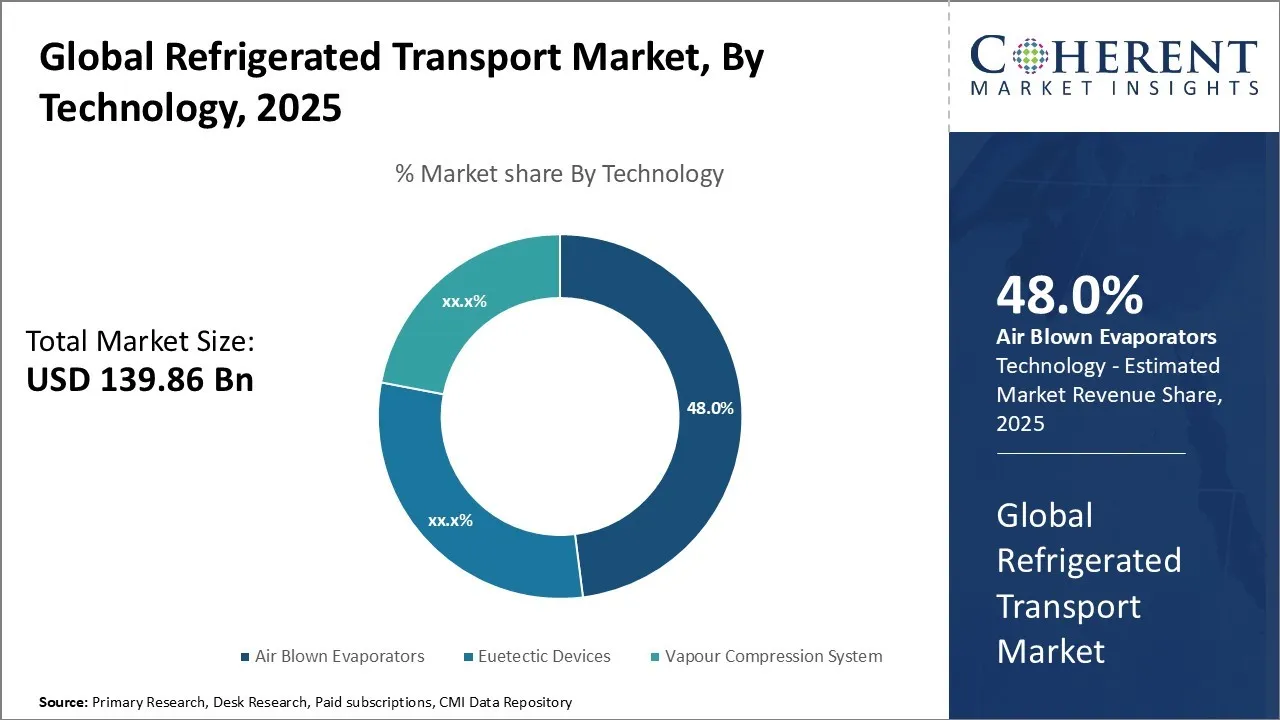
Refrigerated Transport Market Insights, By Technology - Air-Blown Evaporators captures the largest market Share Due to Efficiency and Uniform Cooling
In terms of technology, the air-blown evaporators segment is expected to contribute 49.0% share in the refrigerated transport market in 2026 due to its efficiency, uniform cooling, and compact design, which make them ideal for mobile cold chain environments. Air-blown evaporators circulate cold air evenly across the storage space, maintaining consistent temperatures throughout the vehicle. This is critical for perishable goods like dairy, meat, and pharmaceuticals, where uneven cooling can lead to spoilage. These systems enable rapid temperature drop after door openings during loading/unloading. Faster recovery times ensure minimal temperature fluctuation, essential for maintaining cold chain integrity. Air-blown evaporators are typically compact, allowing more space for cargo and reducing the overall weight of the system, which is valuable for fuel efficiency and load optimization in transport vehicles.
Additionally, Modern air-blown evaporators use smart defrost cycles and low-energy fans, making them energy-efficient, an important consideration as logistics companies aim to reduce operating costs and carbon footprints.
In July 2025, Carrier Transicold unveiled its latest Supra® High Efficiency multi‑temperature units, now fully compatible with air‑blown evaporators. By integrating air‑blown evaporators, these truck‑mounted units offer enhanced temperature control across multiple zones, improving efficiency and performance in refrigerated transport.
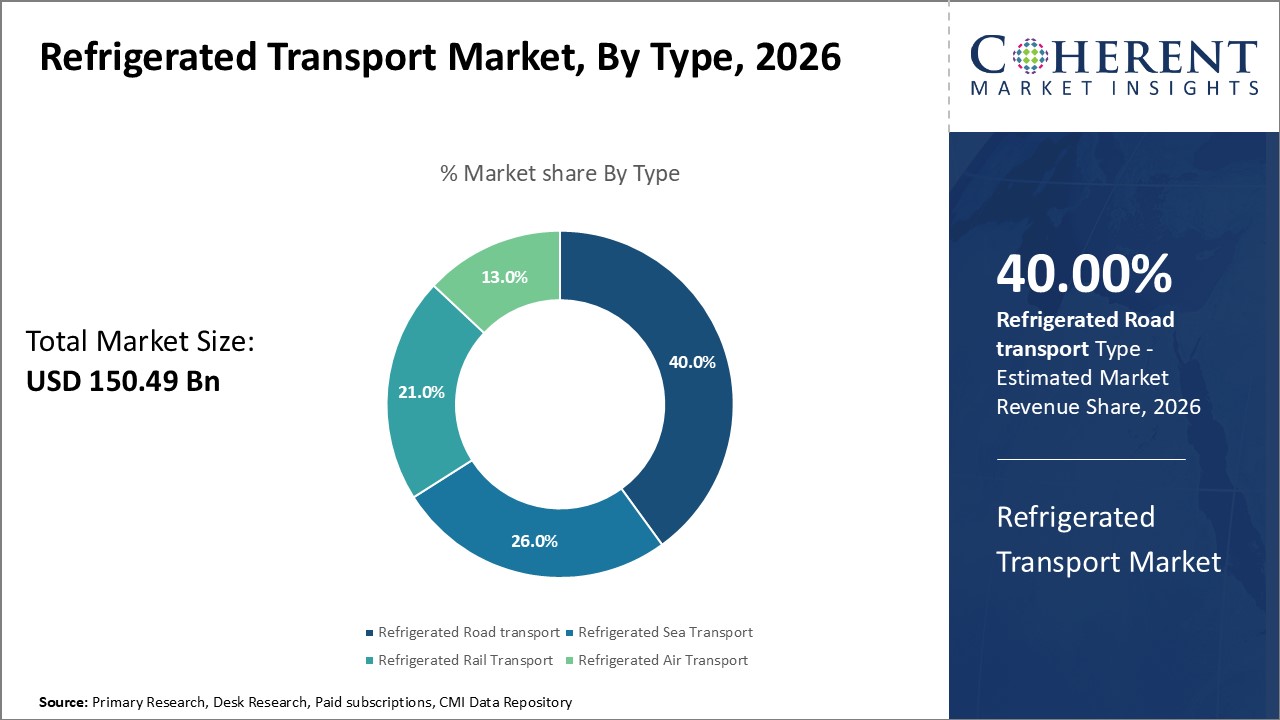
Refrigerated Transport Market Insights, By Type - Refrigerated Road Transport Leads Due To Consumer preference and Food Safety Regulations
In terms of type, the refrigerated road transport segment is expected to contribute the largest share of the market in 2026, primarily driven by consumer preferences, food safety regulations, and supply chain expansion. The global rise in consumption of perishable items such as dairy, fresh produce, meat, seafood, and pharmaceuticals which necessitates temperature-controlled logistics. Consumers now prefer fresh and organic food over processed alternatives, especially in urban and health-conscious markets. Additionally, the boom in online grocery and meal kit deliveries has accelerated the need for last-mile refrigerated transport. Quick commerce models (e.g., 10-minute delivery services) require precise cold chain operations, particularly for dairy, frozen foods, and desserts. Regulatory bodies in the U.S., EU, and Asia-Pacific enforce strict temperature compliance standards to reduce food spoilage and contamination. Compliance with HACCP, FSMA, and other food handling guidelines fuels demand for real-time temperature-monitored transport.
In September 2024, Yellowing’s Delivery Services has partnered with Jubilant FoodWorks to unveil India’s first fully electric reefer (refrigerated) pickup truck, marking a significant milestone in sustainable cold-chain logistics. The vehicle ensures temperature-controlled delivery for perishable goods, aligning with Jubilant’s green logistics goals. Such partnerships are propelling the refrigerated transport market share.
Refrigerated Transport Market Insights, By Temperature - Single Temperature Leads Owing to its Operational Efficiency and Cost-Effectiveness
In terms of temperature, the single temperature segment is projected to dominate the refrigerated transport market with highest share in 2026, due to its operational efficiency, cost-effectiveness, and suitability for bulk transportation of uniform goods. Single temperature is ideal when transporting goods that require the same temperature setting, such as dairy products, frozen meat, or beverages. Compared to multi-temperature systems, single-temp vehicles have lower capital and maintenance costs, making them attractive to logistics providers handling bulk shipments of similar products. Temperature monitoring and control are easier in a single zone, reducing the risk of temperature deviation and product spoilage. It also simplifies logistics planning and vehicle routing. Large grocery chains and cold storage facilities prefer single-temperature vehicles to move full truckloads from centralized distribution centers to stores.
For instance, in the U.S., Carrier Transicold introduced advanced diesel-powered single-temperature Transport Refrigeration Units (TRUs) like the Vector eCool, which combine efficient engine design with telematics and electric standby power systems. These units are optimized for transporting uniformly chilled or frozen goods—ideal for sectors like dairy, beverages, and frozen foods, where maintaining a consistent temperature across the entire trailer is essential.
Refrigerated Transport Market Insights, By Application - Chilled Food Products leads due to surge in fresh and healthy food
In terms of application, the chilled food products segment is expected to contribute the greatest share in the market in 2026, owing to growing demand for fresh and healthy food. As Chilled products like milk, dairy, fresh fruits, vegetables, and beverages are highly perishable and require strict temperature control (typically between 0°C to 5°C) to maintain freshness and prevent spoilage during transit. Consumers globally are increasingly prioritizing fresh, minimally processed food. This shift, especially in urban and health-conscious populations, is driving the need for a reliable cold chain from farm to fork. Governments and regulatory bodies (like the FDA in the U.S. and EFSA in the EU) impose strict guidelines for the safe transport of perishable goods. Refrigerated transport ensures compliance and reduces the risk of foodborne illnesses.
In February 2024, Sumitomo Corporation acquired 100% ownership of Fujiwara Co., Ltd., a key player in refrigerated logistics. This move strengthens Sumitomo’s chilled food logistics capabilities amid rising demand for temperature-sensitive food transport in Japan. Fujiwara, known for its expertise in chilled and frozen food distribution, will support Sumitomo’s strategic push into cold chain logistics.
Regional Insights
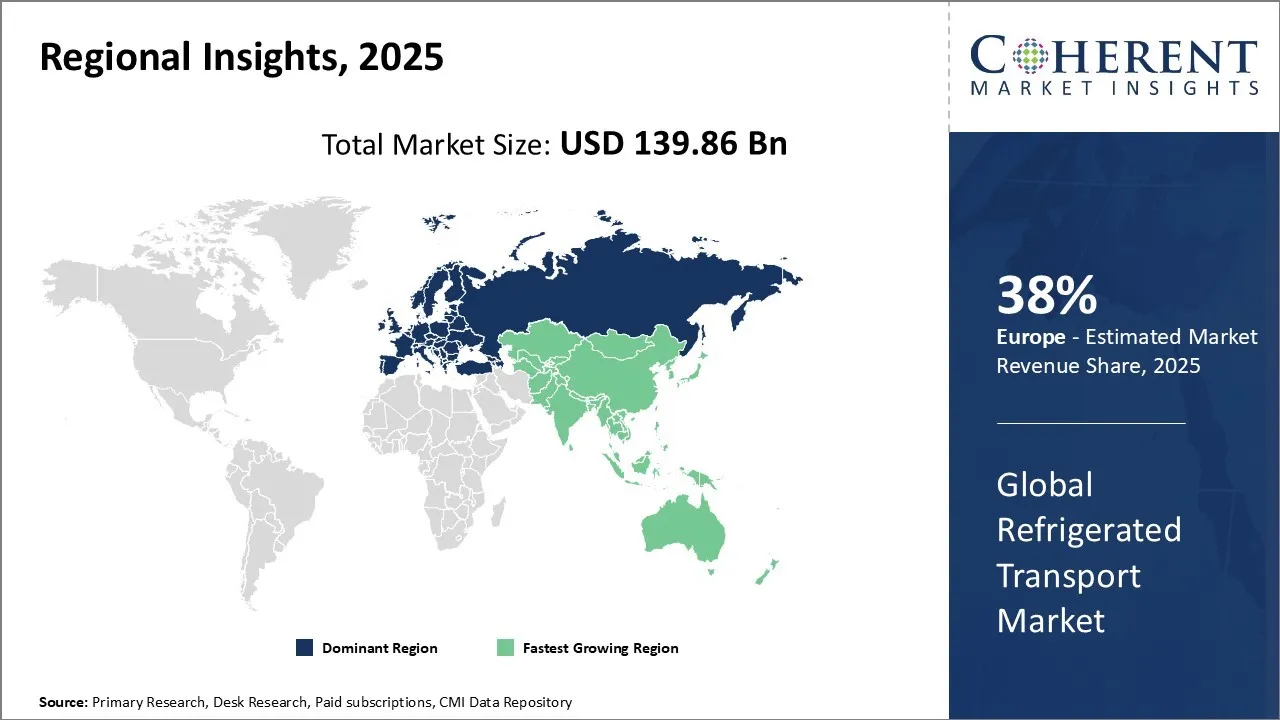
Europe Refrigerated Transport Market Analysis & Trends
Europe, holding an estimated share of 38% in 2026, dominates the refrigerated transport market, supported by a combination of strict regulatory standards, evolving consumer preferences, and sustainability initiatives. The European Food Safety Authority (EFSA) enforces stringent cold chain regulations, requiring consistent temperature control for transporting perishable goods such as dairy, seafood, fruits, and vegetables. Consumers across the region increasingly prefer fresh and chilled products, which has led to a surge in demand for temperature-sensitive logistics. Additionally, the European Union’s framework for the free movement of goods supports cross-border trade of perishables, necessitating reliable refrigerated transport between countries. Efforts to reduce food waste and promote sustainability have also driven investments in modern cold chain infrastructure, including smart temperature monitoring systems and low-emission refrigerated trucks.
For instance, in December 2024, the European Commission announced a new initiative to upgrade cold chain logistics for cross-border food transport, aiming to improve food quality and environmental performance across the EU.
Asia Pacific Refrigerated Transport Market Analysis & Trends
Asia Pacific region is expected to exhibit prominent growth in the market during the forecast period, fueled by growing urbanization, rising consumer expectations for fresh produce, and robust investments in food safety infrastructure. As consumer preferences shift toward fresh and high-quality perishable products like dairy, seafood, fruits, and vegetables, there is a greater need for temperature-controlled logistics to maintain product integrity. The expansion of organized retail, food delivery services, and e-commerce grocery platforms across countries such as China, India, and Southeast Asia has further fueled the need for efficient cold chain infrastructure, thereby propelling the refrigerated transport market share. Additionally, governments in the region are investing in modernizing supply chains to reduce food loss and meet export quality standards.
For instance, India’s Ministry of Food Processing Industries has been supporting cold chain development through subsidies and public-private partnerships to improve agricultural logistics. This growing emphasis on safe food transport, coupled with regional trade in temperature-sensitive goods, continues to drive the demand for refrigerated transport across Asia Pacific.
Refrigerated Transport Market Outlook Country-Wise
Germany Refrigerated Transport Market Trends
Germany's refrigerated transport market is growing due to its strong export of meat, dairy, and pharmaceuticals, all requiring reliable cold chain systems. Strict food safety regulations and sustainability goals are pushing the adoption of eco-friendly technologies. For instance, logistics firms are deploying electric refrigerated trucks and solar-powered cooling systems to meet EU green targets while maintaining product integrity.
The U.S. Refrigerated Transport Market Trends
The United States is a key player in the refrigerated transport market, driven by strong demand for perishable foods and temperature-sensitive pharmaceuticals. Major retailers like Walmart and Kroger are expanding cold fleets and adopting real-time temperature monitoring to ensure food freshness and safe drug delivery. The rise in online grocery shopping and the need for reliable vaccine logistics have further accelerated investments in advanced cold chain infrastructure, solidifying the U.S.'s leadership in the sector.
China Refrigerated Transport Market Trends
China’s demand for refrigerated transport market is growing rapidly due to rising consumption of fresh produce, seafood, and dairy, along with a booming e-commerce sector in fresh food delivery. Platforms like JD Fresh and Freshippo are expanding cold chain logistics to meet this demand. The government is also pushing cold chain modernization and sustainability. In 2024, China saw a 351% year-on-year increase in new energy refrigerated truck sales, highlighting a strong shift toward eco-friendly, efficient cold transport solutions.
Market Report Scope
Refrigerated Transport Market Report Coverage
| Report Coverage | Details | ||
|---|---|---|---|
| Base Year: | 2025 | Market Size in 2026: | USD 150.49 Bn |
| Historical Data for: | 2020 To 2024 | Forecast Period: | 2026 To 2033 |
| Forecast Period 2026 to 2033 CAGR: | 7.6% | 2033 Value Projection: | USD 251.30 Bn |
| Geographies covered: |
| ||
| Segments covered: |
| ||
| Companies covered: | China International Marine Containers (Group) Ltd., Daikin Industries, Ltd., Great Dane Trailers, Inc., HYUNDAI Translead, Ingersoll-Rand PLC (Thermo King), Lamberet SAS, Mitsubishi Heavy Industries, Ltd., Schmitz Cargobull AG, Singamas Container Holdings Limited, United Technologies Corporation (Carrier Corporation), Utility Trailer Manufacturing Company, Wabash National Corporation, and Vehicle Works Bernard Krone Gmbh & Co. KG. | ||
| Growth Drivers: |
| ||
| Restraints & Challenges: |
| ||
Refrigerated Transport Market Drivers
Greater Demand for Frozen & Perishable Goods
The consumption pattern and consumer perception of frozen foods are changing due to a number of factors, including the rise in female employment globally, the sudden impact of pandemics, and an increase in hectic lifestyles combined with the work-from-home culture. Frozen food sales are expected to increase, and opportunities for expansion can be found in developing markets like those in the Asia-Pacific region, Latin America, and Eastern Europe.
When climatic conditions affect crop productivity, frozen foods are preferred because they have a longer shelf life. Food producers work hard to offer consumers frozen food at reasonable prices, in addition to processed and packaged foods. By enhancing affordability and accessibility and preventing food loss, freezing techniques offer the ideal solution for moving food from the farmer's market to the supermarket. The demand for frozen foods is increasing as a result of the expansion of service industries like fast food chains, quick service restaurants, and hypermarkets. These factors collectively support the expansion of the refrigerated transport market size, as efficient cold chain logistics become essential to meet the surging demand for frozen food products.
Significant growth in the food and beverage industry
Due to the acceleration of globalization, which has resulted in an increase in trade and a rise in demand for frozen and packaged food around the world, the market for refrigerated transportation is gaining traction. The refrigerated transport market is anticipated to grow significantly as a result of the global cold chain industry's development, the introduction of cutting-edge freezing technology, and automated freezing systems built into carrier vehicles.
Increasing household demand for frozen food globally, rising demand for meat products (freezing preserves meat products from microbial contamination), and expanding food service industry are additional significant factors that are anticipated to support the growth of the refrigerated transport market. The growth of the refrigerated transport market is also anticipated to be aided by increased governmental concern over the safety of food and regulations on the production, processing, and transportation of frozen food.
Refrigerated Transport Market Opportunities
Utilization of Intermodal Transport to Save Fuel Cost
The efficiency of the supply chain is expected to improve as service providers adopt innovative methods for selecting transport modes. A notable trend is the increasing use of intermodal transportation in the food and beverage industry. This involves a combination of trucks, ships, and aircraft, with rail shipments playing a central role in moving perishable goods. The use of reefer containers in rail-based intermodal systems is gaining traction, particularly due to rising fuel costs, which make rail a more economical option. According to the Association of American Railroads (AAR) in Washington, businesses are investing heavily in rail infrastructure and related technologies to support this shift. This intermodal shift underscores a key trend in the refrigerated transport market forecast, highlighting how cost pressures and sustainability goals are reshaping cold chain logistics.
Refrigerated Transport Market Trends
Increasing demand for Pharmaceutical Drug Transport
Because most pharmaceutical drugs are temperature-sensitive, they require controlled environments during storage and transportation to maintain their efficacy and safety. To support refrigerated transport market growth, temperature-controlled logistics are becoming essential in minimizing shipment losses and handling incidents. Technological advancements in refrigerated transport, coupled with reduced shipping costs, have encouraged several pharmaceutical companies to expand internationally. The increasing global demand for biologics, cellular therapies, vaccines, and blood products has further fueled the need for reliable, temperature-controlled transport solutions.
Analyst Opinion (Expert Opinion)
The refrigerated transport market value stands at a critical inflection point, propelled not just by demand but by the necessity to evolve. In my view, the sector’s long-term resilience will hinge less on volume expansion and more on how quickly it can adopt intelligent technologies and respond to regulatory scrutiny.
A 2023 study from the Global Cold Chain Alliance revealed that nearly 20% of perishable losses occur due to suboptimal temperature control during transit, not storage. This exposes a structural fragility in conventional reefer fleets that can no longer be addressed with patchwork improvements.
Moreover, the increasing shift toward multimodal cold chain networks blending road, rail, and sea introduces complexity that traditional asset-heavy players are struggling to manage. In contrast, technology-forward providers integrating real-time IoT telemetry and predictive analytics are establishing a competitive moat. For instance, Maersk’s use of Remote Container Management (RCM) has led to a 30% reduction in spoilage-related disputes, positioning them ahead in both B2B reliability and ESG reporting.
Another underestimated force shaping this market is regulatory convergence. The tightening of food safety laws in Asia, particularly under India’s Food Safety and Standards Authority (FSSAI) and China’s stringent import protocols is forcing companies to comply with multi-jurisdictional thermal traceability, not just basic monitoring. Compliance is no longer a check-the-box exercise; it is becoming a service differentiator.
Speak to the analyst
Want personalized insights?
Take the findings above to one of our principal consultants, or have the report rebuilt around the segments, geographies and competitors you actually track.
Key Developments
- In July 2025, Utility Trailer Manufacturing Company LLC unveiled new configurations for its 4000D‑X Composite dry freight vans and 3000R refrigerated trailers, designed to enhance versatility and thermal efficiency.
- In December 2024, SeaCube Container Leasing teamed up with Greensee to unveil its Green and Net‑Zero Reefer Leases for refrigerated transport, featuring Greensee’s AI‑driven CO₂ emissions monitoring tools. The Green Leases offer refrigerated containers with next‑generation controllers, enhanced telematics, and energy‑efficient compressors, enabling up to 20% energy and emissions savings.
- In June 2024, Mitsubishi Heavy Industries Thermal Systems, Ltd. (MHI Thermal Systems), part of the MHI Group, introduced its TEK series of compact electric-driven transport refrigeration units for small and mid-size trucks. Sales are being handled by Mitsubishi Heavy Industries Thermal Transport Europe GmbH (MTTE), based in Osnabruck, Germany. The TEK series offers greater cooling and heating capacity while maintaining a compact design, expanding on the previous TE20/30 series range.
- In February 2024, Ocean Network Express (ONE) launched trial shipments of the world’s first dual‑temperature refrigerated container with Controlled Atmosphere (CA) functions, developed in collaboration with Pan Pacific International Holdings (PPIH) and NAX Japan. The container, equipped with a foldable partition, offers two independently controlled temperature zones: one spanning –30 °C to +30 °C and the other from –5 °C to +30 °C.
Market Segmentation
- Global Refrigerated Transport Market, By Transport Type (Revenue, USD Bn, 2021 - 2033)
- Refrigerated Road Transport
- Refrigerated Light Commercial Vehicles (LCV)
- Refrigerated Medium & Heavy Commercial Vehicles (MHCV)
- Refrigerated Heavy Commercial Vehicles (HCV)
- Refrigerated Sea Transport
- Refrigerated Rail Transport
- Refrigerated Air Transport
- Refrigerated Road Transport
- Global Refrigerated Transport Market, By Technology (Revenue, USD Bn, 2021 - 2033)
- Vapor Compression Systems
- Air Blown Evaporators
- Eutectic Devices
- Global Refrigerated Transport Market, By Temperature (Revenue, USD Bn, 2021 - 2033)
- Single Temperature
- Multi-temperature
- Global Refrigerated Transport Market, By Application (Revenue, USD Bn, 2021 - 2033)
- Chilled Food Products
- Milk, Bakery & Confectionery Products
- Dairy Products
- Beverages
- Fresh Fruits & Vegetables
- Frozen Food Products
- Ice Cream
- Frozen Dairy Products
- Processed Meat
- Fish & Sea Food
- Bakery Products
- Chilled Food Products
- Global Refrigerated Transport Market, By Geography (Revenue, USD Bn, 2021 - 2033)
- North America
- U.S.
- Canada
- Latin America
- Brazil
- Argentina
- Mexico
- Rest of Latin America
- Europe
- Germany
- U.K.
- Spain
- France
- Italy
- Russia
- Rest of Europe
- Asia Pacific
- China
- India
- Japan
- Australia
- South Korea
- ASEAN
- Rest of Asia Pacific
- Middle East
- GCC Countries
- Israel
- Rest of Middle East
- Africa
- South Africa
- North Africa
- Central Africa
- North America
- Key Companies Insights (Revenue, USD Bn, 2021 - 2033)
- China International Marine Containers (Group) Ltd.
- Daikin Industries, Ltd.
- Great Dane Trailers, Inc.
- HYUNDAI Translead
- Ingersoll-Rand PLC (Thermo King)
- Lamberet SAS
- Mitsubishi Heavy Industries, Ltd.
- Schmitz Cargobull AG
- Singamas Container Holdings Limited
- United Technologies Corporation (Carrier Corporation)
- Utility Trailer Manufacturing Company
- Wabash National Corporation
- Vehicle Works Bernard Krone Gmbh & Co. KG.
Sources
Primary Research Interviews from the following stakeholders
Stakeholders
- Interviews with cold chain logistics operators, reefer vehicle manufacturers, fleet managers, temperature control equipment suppliers, and supply chain heads across major regions.
Specific Stakeholders
- Logistics and cold chain heads at FMCG and pharma companies (e.g., Nestlé, Britannia, Cipla, Pfizer)
- Fleet managers at refrigerated transport service providers (e.g., Snowman Logistics, Lineage Logistics, DHL Supply Chain)
- Supply chain and procurement heads at food retailers and e-commerce platforms (e.g., BigBasket, Amazon Fresh, Walmart)
- Reefer vehicle OEM product managers (e.g., Tata Motors, Thermo King, Carrier Transicold)
- Warehouse and operations heads at 3PL and 4PL firms
- Maintenance and IoT system managers responsible for real-time temperature monitoring and telematics
Databases
- World Trade Organization (WTO) Trade Statistics
- UN Comtrade Database
- Ministry of Commerce and Industry (India)
- Eurostat – Transport and Mobility Statistics
- China Customs Statistics
- Directorate General of Commercial Intelligence and Statistics (DGCIS), India
- United Nations Economic Commission for Europe (UNECE) – Inland Transport
- U.S. Bureau of Transportation Statistics
- ASEANStats Data Portal
- Japan Ministry of Land, Infrastructure, Transport and Tourism (MLIT)
Magazines
- Cold Chain Management
- Logistics Insider
- Transport Topics
- Frozen & Refrigerated Buyer
- Refrigerated Transporter
- Cooling India
- Modern Materials Handling
- Supply Chain Digital
- Food Logistics Magazine
Journals
- International Journal of Refrigeration
- Journal of Transport Geography
- Applied Thermal Engineering
- Journal of Food Engineering
- Journal of Supply Chain Management
- Transportation Research Part E Logistics and Transportation Review
Newspapers
- The Economic Times – Logistics & Supply Chain
- The Hindu Business Line – Infrastructure & Logistics
- The Wall Street Journal – Supply Chain Section
- Financial Express – Cold Chain & Agri Business
- Business Standard – Transport & Energy
- Nikkei Asia – Logistics & Vehicle Technology
Associations
- International Association of Refrigerated Warehouses (IARW)
- Global Cold Chain Alliance (GCCA)
- Confederation of Indian Industry (CII) – Cold Chain Task Force
- Food Storage and Distribution Federation (FSDF), UK
- Refrigerated Warehouse and Transport Association of Australia (RWTA)
- All India Transporters Welfare Association (AITWA)
- National Centre for Cold-chain Development (NCCD), India
- International Road Transport Union (IRU)
Public Domain Sources
- Ministry of Food Processing Industries (MOFPI), India
- National Centre for Cold-chain Development (NCCD), India
- NITI Aayog – Logistics and Infrastructure Division
- U.S. Department of Agriculture (USDA) – Transportation Services Branch
- European Commission – Mobility and Transport
- India Brand Equity Foundation (IBEF) – Cold Chain Sector Reports
- Reserve Bank of India – Logistics Sector Financial Reviews
- Ministry of Road Transport and Highways (MoRTH), India
- Japan External Trade Organization (JETRO) – Logistics Sector
Proprietary Elements
- CMI Data Analytics Tool, and Proprietary CMI Existing Repository of information for last 8 years
*Definition: The term "refrigerated transport" describes the use of shipping containers and trucks for temperature-controlled freight. These vehicles have an integrated cooling system that keeps the desired temperature constant during transportation
Get access to 250+ pages report
Every segment, forecast, competitor profile and data table behind the analysis above — available for instant download.
- ESOMAR Member
- ISO 9001:2015 Certified
- D-U-N-S Registered
- GDPR & CCPA Compliant
Missing comfort of reading report in your local language? Find your preferred language:
Transform your Strategy with Exclusive Trending Reports
Frequently Asked Questions
The Refrigerated Transport Market is estimated to be valued at USD 150.49 Bn in 2026, and is expected to reach USD 251.30 Bn by 2033.
The refrigerated transport market is expected to surge to a valuation of $ 199.29 Billion by 2033, representing an unprecedented era of growth for this dynamic industry.
The CAGR of the Refrigerated Transport Market is projected to be 7.6% from 2026 to 2033.
Some of the major players operating in the refrigerated transport market include China International Marine Containers (Group) Ltd., Daikin Industries, Ltd., Great Dane Trailers, Inc., HYUNDAI Translead, Ingersoll-Rand PLC (Thermo King), Lamberet SAS, Mitsubishi Heavy Industries, Ltd., Schmitz Cargobull AG, Singamas Container Holdings Limited, United Technologies Corporation (Carrier Corporation), Utility Trailer Manufacturing Company, Wabash National Corporation, and Vehicle Works Bernard Krone Gmbh & Co. KG.
Refrigerated transport ensures perishable goods remain fresh by maintaining specific temperatures, critical for food, pharma, and chemical logistics.
Real-time temperature monitoring provides continuous data to prevent spoilage, ensuring product safety and compliance in cold chain logistics.
Delays expose goods to temperature deviations, risking spoilage, quality degradation, and financial losses, especially in pharmaceuticals and perishables.