

Agricultural Tractor Market Size and Forecast – 2026 to 2033
The agricultural tractor market is estimated to be valued at USD 93.71 Bn in 2026 and is expected to reach USD 140.91 Bn by 2033, growing at a compound annual growth rate (CAGR) of 6.0% from 2026 to 2033.
Key Takeaways
- By Operation, Manual hold the largest market share of 72.9% in 2026 owing to its mechanization and productivity needs.
- By Engine Power, 40HP-120HP expected to hold largest market share of 42.8% in 2026 owing to the mechanization in mid-sized farms.
- By Type, ICE acquired the prominent market share in 2026 owing to the established infrastructure & fuel availability.
- By Drive type, 4-wheel Drive dominates the overall market share in 2026 owing to the superior traction & stability.
- By Region, North America dominates the overall market with an estimated share of 39.4% in 2026 owing to the high-level mechanization of farming.
Market Overview
The agricultural tractor market is expanding as farms modernize and adopt equipment that boosts productivity, efficiency, and labor management. Rising mechanization, innovations in precision farming, and stronger demand for versatile mid-power tractors drive product development and adoption. Manufacturers are enhancing tractors with digital technologies, more powerful engines, and improved ergonomics to address evolving farm needs. Government support programs, the growth of large-scale farming, and increasing emphasis on sustainable practices further accelerate demand across global agricultural regions.
Current Events and Its Impact on the Agricultural Tractor Market
Current Events | Description and Its impact |
Geopolitical Tensions in Eastern Europe |
|
Technological Advancements in Precision Agriculture |
|
Economic Inflation and Rising Input Costs Globally |
|
Role of AI (Artificial Intelligence) in Agriculture Tractor Industry
Artificial intelligence is transforming the tractor market by enhancing efficiency, precision, and productivity in farming operations. AI-enabled tractors can autonomously navigate fields, optimize fuel use, and adjust operations based on real-time soil and crop conditions. Machine-learning algorithms help predict equipment maintenance needs, reducing downtime and operational costs. Advanced sensors and computer vision improve accuracy in tasks such as ploughing, sowing, and spraying, leading to better resource management. AI integration also supports data-driven decision-making, enabling farmers to plan more effectively and increase yields. Overall, AI is reshaping modern agriculture by making tractors smarter, safer, and more efficient.
In July 2025, Punjab Agricultural University unveiled an AI-powered tractor aimed at advancing agricultural operations.
- Current Industry Events of 2026
- Market Size Estimation
- Regional Breakdown
- Competitive Landscape
- Customer Intelligence
- Segmental Analysis
- Pricing Analysis
- Key Market Drivers, Challenges & Future Trends
- Customized Insights Section
Segmental Insights
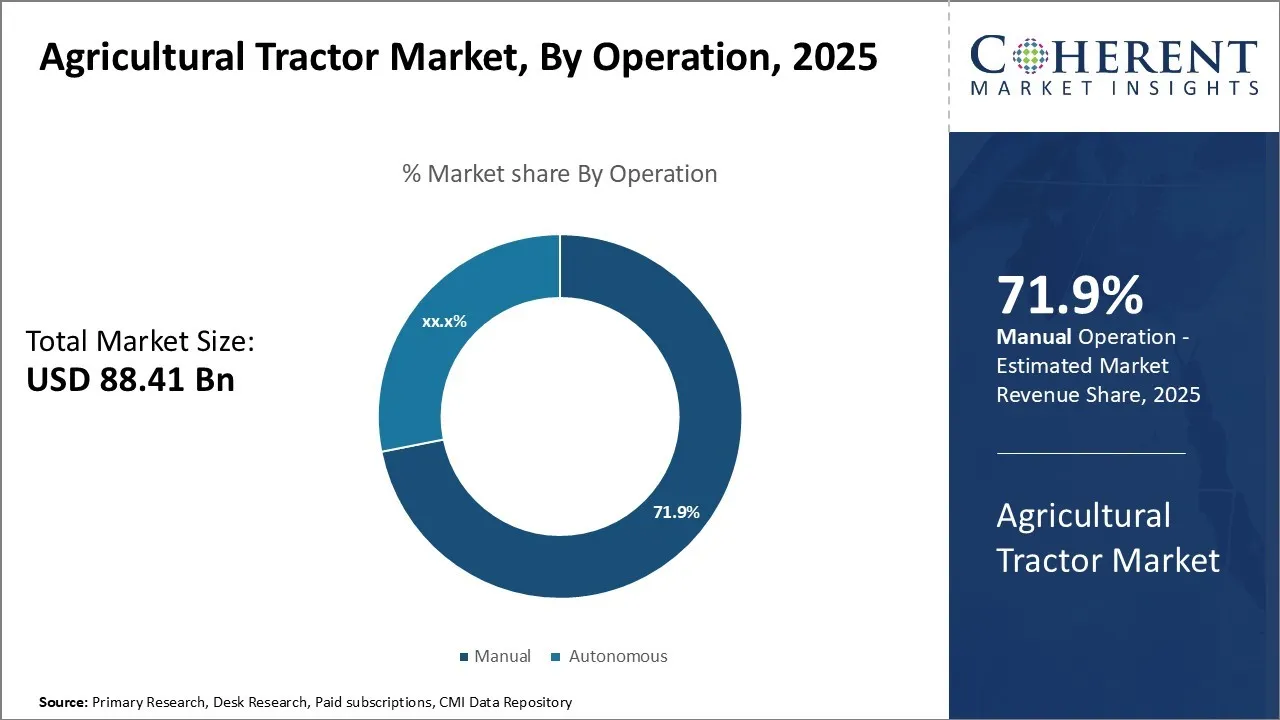
Agricultural Tractor Market Insights, By Operation: Manual contribute the highest share of the market owing to its rising global food demand.
Manual hold the largest market share of 72.9% in 2026. Manual tractors continue to attract buyers because they offer affordability, mechanical simplicity, and reliable performance for small and mid-sized farms. Farmers appreciate that these tractors are easy to maintain, work well with common implements, and handle essential field tasks efficiently. In areas with limited access to advanced service facilities, manual models provide a practical, low-cost solution. Their durability, uncomplicated repairs, and solid resale value further encourage adoption, making them a trusted option for cost-focused users and traditional farming operations.
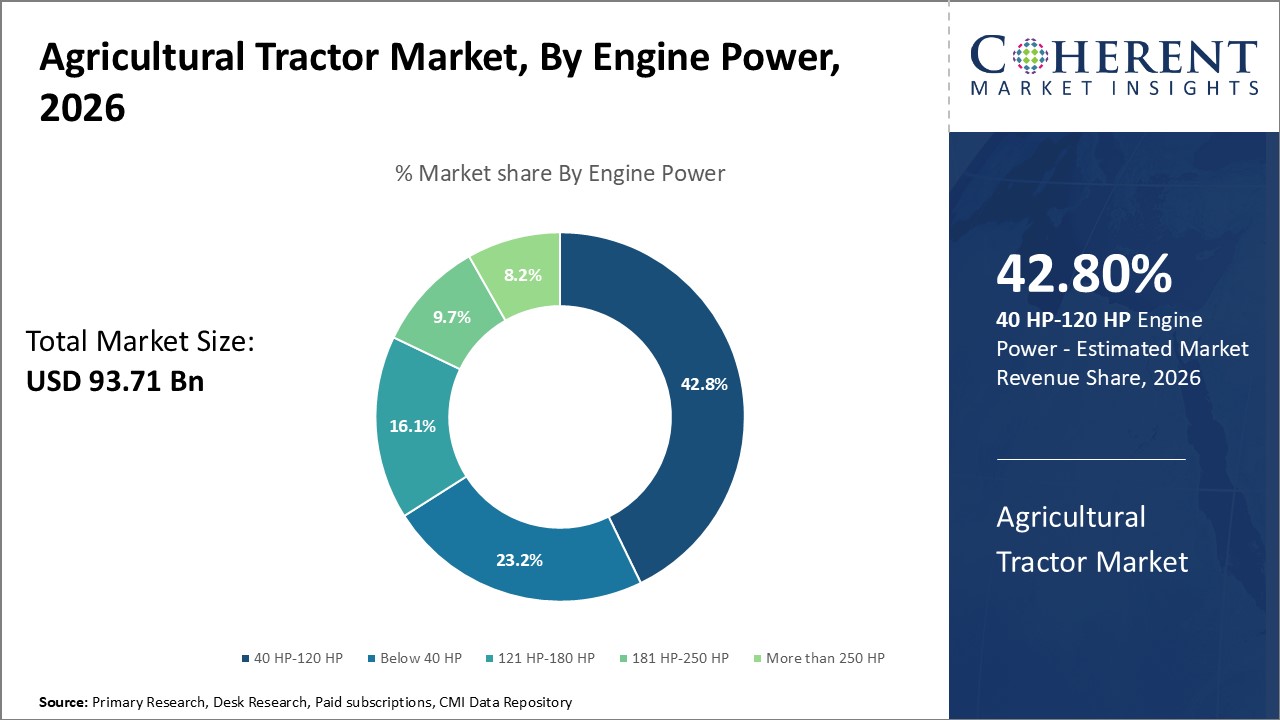
Agricultural Tractor Market Insights, By Engine Power: 40HP-120HP contribute the highest share of the market owing to its optimal power-to-cost efficiency.
40HP-120HP expected to hold largest market share of 42.8% in 2026. Farms are increasingly adopting 40–120 HP tractors as they provide an ideal balance of power, versatility, and cost-effectiveness. Farmers rely on these tractors to perform a wide range of tasks, making them suitable for mixed and medium-scale farming. They value the models’ ability to handle heavier implements while maintaining fuel efficiency and ease of operation. Growing mechanization, rising replacement demands, and the push for higher productivity drive their adoption, and their adaptability to various crops and field conditions ensures widespread use. For instance, Electric tractor maker Solectrac has launched its e70N tractor, delivering 70-horsepower, diesel-equivalent models to three Northern California farms through the BAY AREA FARMER grant program.
Agricultural Tractor Market Insights, By Type: ICE contribute the highest share of the market owing to its established infrastructure & fuel availability.
Farmers continue to rely on internal combustion engine (ICE) tractors because they deliver robust performance, reliability, and easy access to fuel. They use ICE tractors to manage heavy-duty field operations, from plowing to hauling, across various soil types and weather conditions. Well-established maintenance networks and readily available spare parts make these tractors practical for long-term use. Farmers also value their consistent power output and compatibility with multiple implements, making ICE tractors a trusted choice for both traditional and large-scale farming activities. For instance, Escorts India launched the New Escorts Tractor Series (NETS), featuring three compact tractors for orchards and vineyards, including the country’s first electric and hydrostatic tractor concept and a conventional internal combustion model.
Agricultural Tractor Market Insights, By Drive Type: 4-Wheel Drive contribute the highest share of the market owing to its higher power & heavy-duty performance.
Farmers are increasingly choosing 4-wheel drive tractors because they provide superior traction, stability, and performance on challenging terrains. They use these tractors to navigate uneven, muddy, or hilly fields efficiently. Enhanced power distribution enables farmers to operate heavier implements and complete tasks faster. Rising emphasis on productivity, field efficiency, and multi-crop operations fuels their adoption, while the durability and reliability of 4-wheel drive systems make them a practical and trusted option for medium to large-scale farming operations. For instance, in March 2025, ACE Tractors introduced the 4WD variant of the ACE Chetak DI 65 at the 117th All India Farmers Fair in Pantnagar, providing farmers with improved performance and efficiency.
Regional Insights
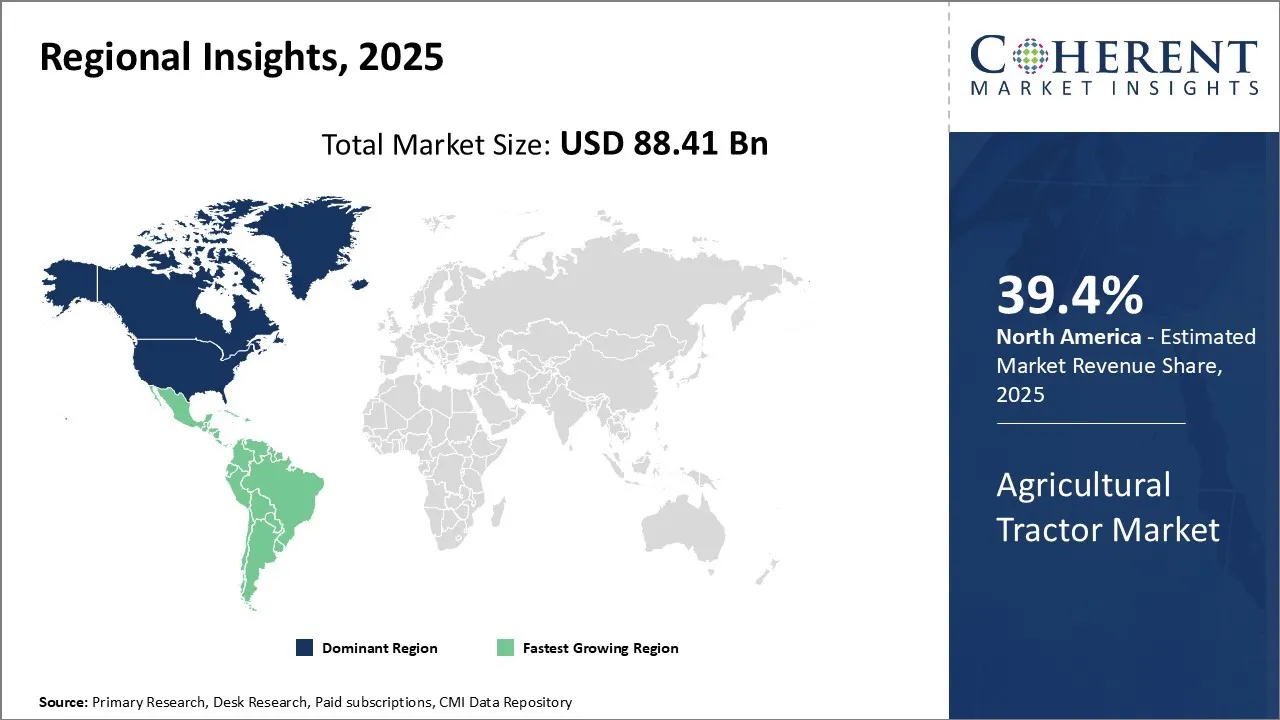
North America Agricultural Tractor Market Trends
North America dominates the overall market with an estimated share of 39.4% in 2026. Farmers in North America are increasingly adopting agricultural tractors due to rising mechanization and the integration of precision farming technologies such as GPS-guided systems and telematics. Government investments and favorable financing help them upgrade machinery more easily. Large-scale farms drive demand for high‑horsepower and autonomous tractors, while sustainability initiatives encourage the use of electric and low-emission models. Strong dealership networks and data-driven farm management further promote the adoption of smart, connected tractors across the region. For instance, in October 2026, JCB unveiled its new 6000 Series Fastrac high-speed tractors to North American customers in Q2 2026, combining productivity, efficiency, versatility, and operator comfort.
Asia Pacific Agricultural Tractor Market Trends
Farmers in the Asia-Pacific region are rapidly mechanizing their smallholder farms as labor shortages and rising rural incomes drive them to adopt more efficient tractors. Governments support this transition by providing subsidies and credit programs that make modern machinery more accessible. Farmers are increasingly using precision farming tools such as GPS, telematics, and pay-per-use models. Meanwhile, manufacturers are developing compact, low-powered, and eco-friendly tractors to suit diverse terrains and meet growing sustainability demands across the region. For instance, in October 2026, Gromax Agri Equipment Ltd., a joint venture of Mahindra & Mahindra and the Gujarat government, launched eight new 2WD and 4WD tractors, including India’s first under-50 HP models with factory-fitted cabins.
Canada Agricultural Tractor Market Trends
Farmers in Canada are rapidly upgrading to more efficient and automated tractors to address labor shortages. They are increasingly adopting GPS-guided and telematics-enabled tractors as precision farming gains traction. Strong demand from provinces, particularly in the prairie regions, drives this shift, while government incentives promote the use of energy-efficient and electric models. Although overall tractor registrations declined, farmers continued to purchase high-horsepower and 4-wheel drive tractors, boosting sales in these segments.
India Agricultural Tractor Market Trends
The agricultural tractor market in India is expanding due to increasing farm mechanization, supported by government subsidies and credit schemes. Manufacturers are introducing compact, low‑HP tractors that suit small and marginal operations. Adoption of precision technologies such as GPS and telematics is rising, alongside the growth of rental and custom-hiring models. Demand is particularly strong in the fertile northern plains, while stricter emissions regulations and clean-energy initiatives are driving the development of eco-friendly tractor variants. For instance, Swaraj Tractors, a part of the Mahindra Group, today introduced CODE, a versatile farm mechanisation solution designed to transform horticulture farming in India.
End-user Feedback and Unmet Needs in the Agricultural Tractor Market
- High Maintenance Costs: Many tractor users complain that upkeep—especially for advanced, high‑HP or automated models—remains expensive. They struggle with the cost of frequent servicing, spare parts, and downtime. This unaddressed need calls for more robust, low-maintenance designs and better after-sales support in rural regions.
- Limited Fuel Efficiency: End‑users frequently point out that tractors, especially older ICE models, consume too much fuel on standard field tasks. They need more efficient engines or hybrid solutions to reduce operating costs and environmental impact. Improved fuel-saving technology and alternative powertrains remain critical gaps.
- Poor Operator Comfort: Operators often report discomfort during long hours in the field: inadequate cabins, excessive vibration, or limited ergonomic controls. This feedback highlights a strong demand for smoother rides, better seating, and refined cab designs—especially for tractors used in multi-day or intensive operations.
Agricultural Tractor Market Trend
Rising Precision Farming Adoption
Tractors are increasingly integrated with GPS‑based guidance, telematics, and data analytics to enable precise planting, spraying, and harvesting. This shift helps farmers optimize inputs like seed, fertilizer, and fuel while reducing errors. OEMs are responding by developing affordable precision packages and retrofittable systems, making smart farming accessible beyond large commercial farms and improving long-term farm efficiency and sustainability.
Growth of Shared‑Use and Custom Hire Models
Farmers are turning to rental, custom‑hiring, and shared-ownership tractor services rather than buying, driven by high capitalization costs and utilization variability. Service providers and cooperatives offer pay-per-use access to modern, powerful machines when needed. This trend lowers entry barriers for smallholders and boosts tractor utilization rates, encouraging manufacturers to design models optimized for frequent rental use and rapid turnaround.
Agricultural Tractor Market Opportunity
Precision & Smart Tractors
The shift toward precision farming and smart agriculture is a strong growth lever. Modern tractors equipped with GPS, telematics, IoT sensors, and remotely‑controlled features help farmers optimize inputs (fuel, fertilizer, seeds) and improve yields. This technology adoption not only increases operational efficiency, but also enables predictive maintenance, reducing downtime. Manufacturers who offer upgradeable, connected tractor platforms can capture value from this transition.
Market Report Scope
Agricultural Tractor Market Report Coverage
| Report Coverage | Details | ||
|---|---|---|---|
| Base Year: | 2025 | Market Size in 2026: | USD 93.71 Bn |
| Historical Data for: | 2020 To 2024 | Forecast Period: | 2026 To 2033 |
| Forecast Period 2026 to 2033 CAGR: | 6.0% | 2033 Value Projection: | USD 140.91 Bn |
| Geographies covered: |
| ||
| Segments covered: |
| ||
| Companies covered: | Agco Tractors (Fendt), Captain Tractors, Eicher Tractors, Escorts Tractors, Force Tractors, Gromax Agri Equipment Limited, John Deere Tractors, JCB, Kubota Tractor, Mahindra Tractors, Monarch Tractor Electric Tractor, New Holland Tractors, SDF, Sonalika Tractors, SOLECTRAC, Standard Tractors, and Swaraj Tractors | ||
| Growth Drivers: |
| ||
| Restraints & Challenges: |
| ||
Agricultural Tractor Market News
- In June 2025, Valencia-based DeepTech startup Voltrac launched its autonomous electric tractor platform for agriculture and frontline logistics, securing €2 million in funding.
- In September 2025, Mahindra & Mahindra launched its new-generation OJA tractor range in Australia, celebrating 20 years in the country, with three models tailored for Australian farmers and property owners.
- In August 2025, Escorts Kubota launched the Kubota MU4201, entering India’s 41-44 HP tractor segment, designed for various agricultural tasks and compatible with implements like rotavators and disc harrows.
Analyst Opinion (Expert Opinion)
The tractor industry is approaching a significant structural transformation rather than a period of simple incremental growth. In India, for example, the level of agricultural mechanization remains approximately 47%, compared with nearly 60% in China and about 75% in Brazil. This differential indicates substantial headroom for further tractor adoption, particularly among the 86% of Indian farmers who operate on landholdings of less than two hectares.
Innovation-driven product development is accelerating this shift. Globally, more than 30% of newly launched tractors are equipped with GPS, telematics, or automated steering systems. These technologies offer measurable economic value by improving input precision and enabling predictive maintenance, thereby reducing the total cost of operation. Simultaneously, sustainability-related advancements are gaining prominence: approximately one quarter of new tractor models introduced worldwide are hybrid or electric. These offerings have moved beyond experimental concepts and now represent a meaningful share of OEM investment portfolios.
The customer landscape, however, remains highly differentiated. In India, tractors within the 30–50 HP segment constitute nearly 83% of demand. Manufacturers that allocate disproportionate resources toward higher horsepower, premium models risk misalignment with core market requirements unless guided by a clearly defined segmentation strategy. Moreover, India’s average landholding size of 1.08 hectares highlights the strategic importance of rental, custom-hire, and shared-ownership solutions. Institutionalized models—such as farm machinery banks and hiring centers—have the potential to expand access for farmers who may not be able to pursue individual ownership.
Policy-related considerations also warrant close attention. The introduction of forthcoming emission standards, including TRM-5 in India, is expected to increase compliance costs. These requirements may stimulate short-term pre-buy activity but could also intensify price sensitivity among rural customers. Nevertheless, overall demand indicators remain robust; for instance, tractor ownership in Uttar Pradesh has risen by more than 62% over the past eight years, according to state government data.
The sector is therefore undergoing a technology-enabled, service-oriented, capital-intensive evolution. Competitive advantage will accrue to manufacturers that effectively integrate advanced product innovation with strong last-mile engagement and sustained support for smallholder farm ecosystems.
Market Segmentation
- Operation Insights (Revenue, USD Bn, 2021 - 2033)
- Manual
- Autonomous
- Engine Power Insights (Revenue, USD Bn, 2021 - 2033)
- Below 40 HP
- 40 HP–120 HP
- 121 HP–180 HP
- 181 HP–250 HP
- More than 250 HP
- Type Insights (Revenue, USD Bn, 2021 - 2033)
- ICE
- Electric/Hybrid
- Drive Type Insights (Revenue, USD Bn, 2021 - 2033)
- 2-Wheel Drive
- 4-Wheel Drive
- Regional Insights (Revenue, USD Bn, 2021 - 2033)
- North America
- U.S.
- Canada
- Latin America
- Brazil
- Argentina
- Mexico
- Rest of Latin America
- Europe
- Germany
- U.K.
- France
- Italy
- Russia
- Rest of Europe
- Asia Pacific
- China
- India
- Japan
- Australia
- South Korea
- ASEAN
- Rest of Asia Pacific
- Middle East & Africa
- GCC Countries
- South Africa
- Rest of Middle East & Africa
- Key Players Insights
- Agco Tractors (Fendt)
- Captain Tractors
- Eicher Tractors
- Escorts Tractors
- Force Tractors
- Gromax Agri Equipment Limited
- John Deere Tractors
- JCB
- Kubota Tractor
- Mahindra Tractors
- Monarch Tractor Electric Tractor
- New Holland Tractors
- SDF
- Sonalika Tractors
- SOLECTRAC
- Standard Tractors
- Swaraj Tractors
Sources
Primary Research interviews
- Tractor manufacturers R&D and sales teams
- Agricultural machinery dealers and distributors
- Large-scale farmers and farm cooperatives
- Agricultural equipment service providers
Databases
- FAOSTAT (Food and Agriculture Organization Statistics)
- World Bank Open Data – Agriculture
- USDA National Agricultural Statistics Service (NASS)
- UN Comtrade Database
Magazines
- Farm Machinery & Equipment Magazine
- Tractor & Farming Today
- Modern Farmer
- Agricultural Engineering Today
Journals
- Journal of Agricultural Engineering Research
- Biosystems Engineering
- International Journal of Agricultural Sustainability
- Precision Agriculture
Newspapers
- The Hindu – Agriculture Section
- The Times of India – Rural & Agriculture News
- The Guardian – Agriculture Section
- Reuters – Agriculture News
Associations
- International Federation of Agricultural Producers (IFAP)
- American Farm Bureau Federation (AFBF)
- European Agricultural Machinery Association (CEMA)
- Indian Society of Agricultural Engineers (ISAE)
Public Domain sources
- Government of India – Ministry of Agriculture & Farmers Welfare reports
- U.S. Department of Agriculture Reports
- FAO Publications and Reports
- United Nations Agricultural Reports
Proprietary Elements
- CMI Data Analytics Tool
- Proprietary CMI Existing Repository of information for last 8 years
Get access to 250+ pages report
Every segment, forecast, competitor profile and data table behind the analysis above — available for instant download.
- ESOMAR Member
- ISO 9001:2015 Certified
- D-U-N-S Registered
- GDPR & CCPA Compliant
Missing comfort of reading report in your local language? Find your preferred language:
Transform your Strategy with Exclusive Trending Reports
Frequently Asked Questions
The Agricultural Tractor Market is estimated to be valued at USD 93.71 Bn in 2026, and is expected to reach USD 140.91 Bn by 2033.
The CAGR of the Agricultural Tractor Market is projected to be 6.0% from 2026 to 2033.
Mechanization of agriculture and precision farming and technology advancements are the major factors driving the growth of the agricultural tractor market.
Rising material costs and meteorological uncertainties affecting crops are the major factors hampering the growth of the agricultural tractor market.
In terms of operation, mannual is estimated to dominate the market revenue share in 2026.
Agco Tractors (Fendt), Captain Tractors, Eicher Tractors, Escorts Tractors, Force Tractors, Gromax Agri Equipment Limited, John Deere Tractors, JCB, Kubota Tractor, Mahindra Tractors, Monarch Tractor Electric Tractor, New Holland Tractors, SDF, Sonalika Tractors, SOLECTRAC, Standard Tractors, and Swaraj Tractors are the major players.
North America is expected to lead the agricultural tractor market in 2026.