

Biometric Vehicle Access Market Size and Forecast — 2026-2033
The Global Biometric Vehicle Access Market size is estimated to be valued at USD 3.21 billion in 2026 and is expected to reach USD 8.39 billion by 2033, exhibiting a compound annual growth rate (CAGR) of 14.7% from 2026 to 2033.
Overview
Biometric vehicle access systems use fingerprint, facial recognition, or iris scanning technologies to provide secure and personalized access to vehicles. These products integrate with the vehicle’s electronic control units (ECUs) and keyless entry systems, enhancing security and convenience while reducing the risk of theft. Biometric solutions can also store driver profiles for seat positioning, mirror adjustments, and infotainment preferences. The market is driven by increasing demand for advanced vehicle security, smart mobility solutions, and integration with connected car technologies.
Key Takeaways
The fingerprint recognition segment remains dominant within the technology segmentation, accounting for nearly 47% market share, driven by high accuracy and ease of deployment in vehicle security systems.
Passenger vehicles constitute the largest market segment by vehicle type, with commercial vehicles and electric vehicles gaining traction due to increasing security concerns and electrification efforts, respectively.
North America stands as the dominating regional market due to advanced automotive ecosystems and stringent vehicle security regulations, holding approximately 34% of the total market share.
Asia Pacific demonstrates the fastest CAGR growth, fueled by rapid urbanization, rising electric vehicle production, and government incentives promoting advanced vehicle security adoption, forecasting over 17% CAGR from 2026 to 2033.
Biometric Vehicle Access Market Segmentation Analysis
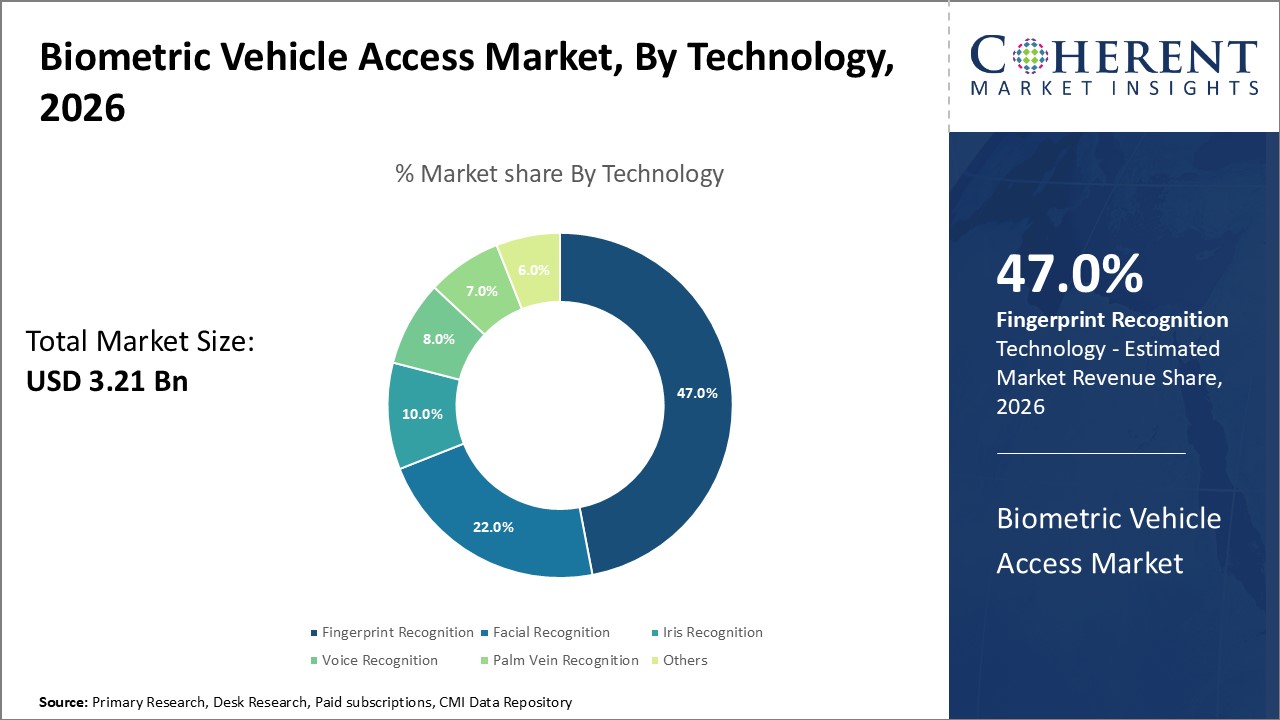
Biometric Vehicle Access Market Insights, By Technology
In terms of technology, Fingerprint Recognition dominates the market share due to its high accuracy, cost efficiency, and proven reliability in various vehicular applications. Many automotive OEMs have standardized fingerprint sensors as the primary method for driver authentication, offering minimal false acceptance rates and easy integration into existing vehicle architecture. The fastest-growing subsegment is Facial Recognition, propelled by increasing consumer preference for contactless access and advancements in camera-based biometric sensors.
Biometric Vehicle Access Market Insights, By Vehicle
Passenger Vehicles dominate this segment by market share because of their volume production and consumer demand for enhanced security and personalized access. Biometrics integrated into passenger cars facilitate sleek design implementations and improve user convenience with minimal latency. Electric Vehicles constitute the fastest-growing subsegment reflecting growing electrification trends, necessitating advanced security features aligned with smart vehicle technology ecosystems.
Biometric Vehicle Access Market Insights, By Component
Hardware dominates the market share due to the essential nature of sensors, scanners, and modules required for biometric authentication in vehicles. Continuous innovation in sensor miniaturization and durability has supported hardware growth, particularly with developments in ruggedized fingerprint scanners and IR cameras for facial recognition suited to automotive environments. Software, including AI algorithms and access control systems, represents the fastest-growing subsegment, fueled by advancements in machine learning improving biometric accuracy and adaptability across diverse environmental conditions.
Biometric Vehicle Access Market Trends
The market is rapidly aligning with digital transformation trends, such as the integration of AI and IoT, enhancing both security and interface usability.
Additionally, cross-industry collaborations between tech firms and automotive companies are driving accelerated innovation cycles, enabling more robust and user-friendly biometric solutions.
The surge in electric vehicle production globally also creates a symbiotic landscape wherein biometric vehicle access becomes a critical differentiator.
Biometric Vehicle Access Market Insights, By Geography
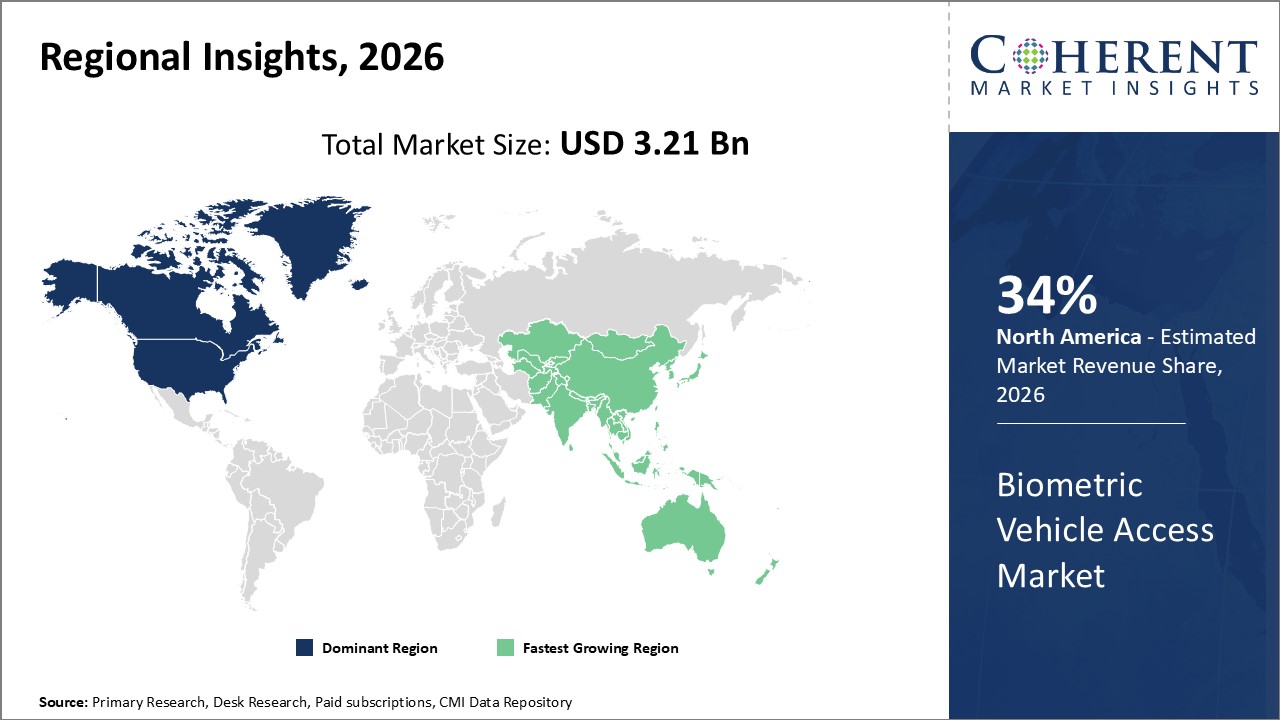
North America Biometric Vehicle Access Market Analysis and Trends
In North America, the dominance in the biometric vehicle access market is rooted in its mature automotive industry and stringent regulatory frameworks focused on vehicle security. The U.S. spearheads this region, supported by significant R&D investments by leading manufacturers focusing on AI-enabled biometric systems. Technological readiness and strong aftermarket demand contribute to North America capturing close to 34% market share, making it the largest regional market.
Asia Pacific Biometric Vehicle Access Market Analysis and Trends
Meanwhile, the Asia Pacific exhibits the fastest growth in the industry, driven by rapid urbanization, significant electric vehicle adoption, and proactive government incentives supporting automotive security innovation. Markets such as China and India are expanding at a CAGR exceeding 17%, fueled by growing disposable incomes and technological penetration. Major players have leveraged partnerships with domestic OEMs to capture this growth, propelling this regional market forward.
Biometric Vehicle Access Market Outlook for Key Countries
USA Biometric Vehicle Access Market Analysis and Trends
The USA's biometric vehicle access market is anticipated to maintain significant momentum, supported by governmental safety regulations such as the National Highway Traffic Safety Administration’s (NHTSA) push for advanced vehicle security technologies. Automotive manufacturers like Tesla and Ford have integrated fingerprint and facial recognition systems into their higher-end models, increasing user adoption by 25% year-over-year. The country’s well-established aftermarket ecosystem also contributes additional revenue streams, with biometric retrofit kits gaining popularity.
China Biometric Vehicle Access Market Analysis and Trends
China's biometric vehicle access market is rapidly evolving, powered by the government’s "Made in China 2026" initiative focusing on smart vehicle technologies. Leading domestic companies, including BYD and NIO, have incorporated multimodal biometric solutions to cater to both security needs and luxury vehicle demand. The presence of a vast electric vehicle market, which accounts for nearly 45% of new vehicle sales, is a major growth catalyst.
Analyst Opinion
The increasing adoption of fingerprint recognition technology as the dominating access control method is a pivotal supply-side indicator driving market growth. Fingerprint-based systems accounted for over 47% of the market share in 2025, primarily due to their accuracy and ease of integration in mid-range and luxury vehicles. For instance, leading automotive manufacturers introduced fingerprint sensors integrated with onboard computer systems, resulting in over 21% increase in user-initiated vehicle startups in 2025 alone.
Demand from the electric vehicle (EV) segment is a strong demand-side indicator shaping the market. With EV sales rising by more than 39% globally in 2025, manufacturers are investing heavily in biometric access as a key feature to complement their smart vehicle portfolios. The rise in EV production hubs such as the U.S. and China is directly related to increased demand for biometric authentication to enhance security and personalization.
Micro-indicators in urban markets reveal a shift toward multi-modal biometric systems combining facial and iris recognition for premium vehicle models. Urban centers in Europe and North America reported a 25% rise in the adoption of combined biometrics for vehicle access between 2023 and 2025, driven by consumer preference for contactless interaction and enhanced theft deterrence. Research also shows a 15% decrease in vehicle break-in incidents attributed to biometric implementations in these regions.
Nano-size indicators in aftermarket products—such as biometric key fobs and smartphone-enabled vehicle access modules—are providing incremental market revenue streams. From 2023 to 2025, aftermarket biometric solutions accounted for approximately 19% of additional market revenue. This segment is capturing niche consumer segments focused on upgrading existing vehicle security systems without full OEM integration.
- Current Industry Events of 2026
- Market Size Estimation
- Regional Breakdown
- Competitive Landscape
- Customer Intelligence
- Segmental Analysis
- Pricing Analysis
- Key Market Drivers, Challenges & Future Trends
- Customized Insights Section
Market Scope
| Report Coverage | Details | ||
|---|---|---|---|
| Base Year: | 2025 | Market Size in 2026: | USD 3.21 billion |
| Historical Data for: | 2020 To 2024 | Forecast Period: | 2026 To 2033 |
| Forecast Period 2026 to 2033 CAGR: | 14.7% | 2033 Value Projection: | USD 8.39 billion |
| Geographies covered: |
| ||
| Segments covered: |
| ||
| Companies covered: | HID Global, Synaptics Incorporated, NEC Corporation, Aware Inc, Suprema Inc, Iris ID Systems Inc, 3M Company, Fujitsu Limited, BIO-key International Inc, Gemalto NV, Infineon Technologies AG, Safran, NEC Corporation, Sony Corporation. | ||
| Growth Drivers: |
| ||
Biometric Vehicle Access Market Growth Factors
The expanding automotive biometrics ecosystem is directly boosted by the rising incidents of vehicle theft globally, which jumped by 12% in 2025 across North America alone, prompting demand for foolproof security mechanisms. Secondly, government regulations mandating advanced vehicle security features in regions like the EU and the U.S. are accelerating mandatory integration of biometric systems, directly stimulating market revenue. Third, the surge in electric vehicles has created a parallel demand for innovative access methods aligned with smart technologies, as evidenced by a 40% growth in biometric system adoption in EVs during 2023. Finally, technological developments in AI-enabled biometric authentication improve accuracy and user experience, reducing false rejection rates by nearly 18% year-on-year, driving widespread market acceptance.
Biometric Vehicle Access Market Development
In September 2026, FORVIA revealed a secure biometric authentication system for vehicles in collaboration with Smart Eye at Auto Shanghai. The system uses iris and face recognition via the existing Driver Monitoring System (DMS) camera for passenger authentication. Among its features: seamless in-car payments without extra input from the user, enhancing both security and user experience.
In May 2026, Smart Eye, Fingerprint Cards, and FORVIA announced enhancements to in-cabin biometric authentication—including combining iris + face recognition—enabling features like personalized access and secure in-car payments using an existing camera system, reducing hardware complexity.
Key Players
Leading companies of the market:
HID Global
Synaptics Incorporated
Aware Inc
Suprema Inc
Iris ID Systems Inc
3M Company
Fujitsu Limited
BIO-key International Inc
Gemalto NV
Infineon Technologies AG
Safran
NEC Corporation
Sony Corporation
Leading companies are increasingly investing in R&D to introduce multimodal biometric vehicle access solutions that blend security with user convenience. For example, HID Global’s collaboration with automotive OEMs led to the successful deployment of contactless facial recognition modules, reducing vehicle access times by 31%. Similarly, Suprema’s recent licensing agreement with electric vehicle manufacturers has amplified its market reach in the Asia Pacific by over 23% in 2025. Competitive strategies such as technology licensing, partnerships for software integration, and expansion into aftermarket biometrics have been instrumental in solidifying market share among key players.
Biometric Vehicle Access Market Future Outlook
In the coming years, the market is expected to grow as vehicle security becomes increasingly sophisticated and integrated with connected and autonomous vehicle technologies. Advanced AI algorithms will enhance authentication accuracy, adaptability, and user convenience. Biometric systems will increasingly provide multi-factor authentication, seamless driver personalization, and integration with smart city infrastructure. Growth in the luxury and premium vehicle segments, combined with rising regulatory focus on vehicle security and theft prevention, will further drive innovation and adoption across global automotive markets.
Biometric Vehicle Access Market Historical Analysis
The biometric vehicle access market has evolved from traditional keyless entry systems to advanced authentication technologies using fingerprints, facial recognition, and iris scanning. Early adoption was primarily limited to luxury vehicles, but increasing concerns over vehicle theft and the demand for personalized driving experiences have expanded the market. Biometric systems now integrate with vehicle ECUs and connected car technologies, enabling secure access, driver profile customization, and integration with infotainment and safety systems. Rising consumer awareness and technological advancements in sensors, AI, and embedded systems have significantly accelerated market adoption.
Sources
Primary Research interviews:
Automotive Security Engineers
Biometric Technology Experts
Vehicle Electronics Developers
Smart Mobility Researchers
Databases:
Statista Automotive Security Database
Biometric Update Industry Reports
International Biometric Society
Magazines:
Automotive World
Biometric Update
Auto Tech Review
Security Magazine
Journals:
IEEE Transactions on Vehicular Technology
Journal of Biometrics
International Journal of Vehicle Design
Sensors and Actuators Journal
Newspapers:
The Economic Times (Auto Tech)
The Wall Street Journal (Technology)
The Guardian (Innovation)
Financial Express (Mobility)
Associations:
International Biometric Society (IBS)
Automotive Electronics Council (AEC)
Biometric Institute
Society of Automotive Engineers (SAE)
Get access to 250+ pages report
Every segment, forecast, competitor profile and data table behind the analysis above — available for instant download.
- ESOMAR Member
- ISO 9001:2015 Certified
- D-U-N-S Registered
- GDPR & CCPA Compliant
Missing comfort of reading report in your local language? Find your preferred language:
Transform your Strategy with Exclusive Trending Reports
Frequently Asked Questions
Dominant market players include HID Global, Suprema Inc., NEC Corporation, and Synaptics Incorporated, noted for their robust portfolio of biometric hardware and software integrated into automotive applications.
The market is projected to expand from USD 3.21 billion in 2026 to USD 8.39 billion by 2033, reflecting a CAGR of 14.7%, driven by increasing security demands and technological advancements.
Passenger vehicle manufacturers represent the largest growth opportunity, supplemented by rising adoption in electric vehicles and commercial fleet operators increasingly prioritizing biometric security.
Market trends indicate a shift toward multimodal biometric systems and integration with digital and smartphone-based vehicle access solutions, alongside growth in aftermarket retrofitting products.
The competitive landscape is characterized by technological innovation and strategic partnerships; challenges include integration complexity and consumer privacy concerns that require ongoing R&D focus.
Key strategies include licensing agreements, OEM partnerships, aftermarket product development, and investing in AI-enabled biometric authentication to enhance product differentiation and market penetration.