

Global Automotive Fastener Market Size and Trends
Global automotive fastener market is estimated to be valued at USD 37.37 Bn in 2026 and is expected to reach USD 52.94 Bn by 2033, exhibiting a compound annual growth rate (CAGR) of 5.1% from 2026 to 2033.
Key Takeaways
- By Product, the Threaded Segment, is expected to capture 68.2% share of Global Automotive Fastener Market by 2026 due to its use and dependability in vehicle assembly.
- By Vehicle, The contraction in the segment of Passenger Cars is projected to give rise to the maximum contribution of 42.77% market share in 2026, because of the continual increase in global production of passenger vehicles.
- By Application, The Automotive Segment is expected to lead in 2026 by capturing 47.62%, because of the strong spending by OEMs and aftermarket suppliers.
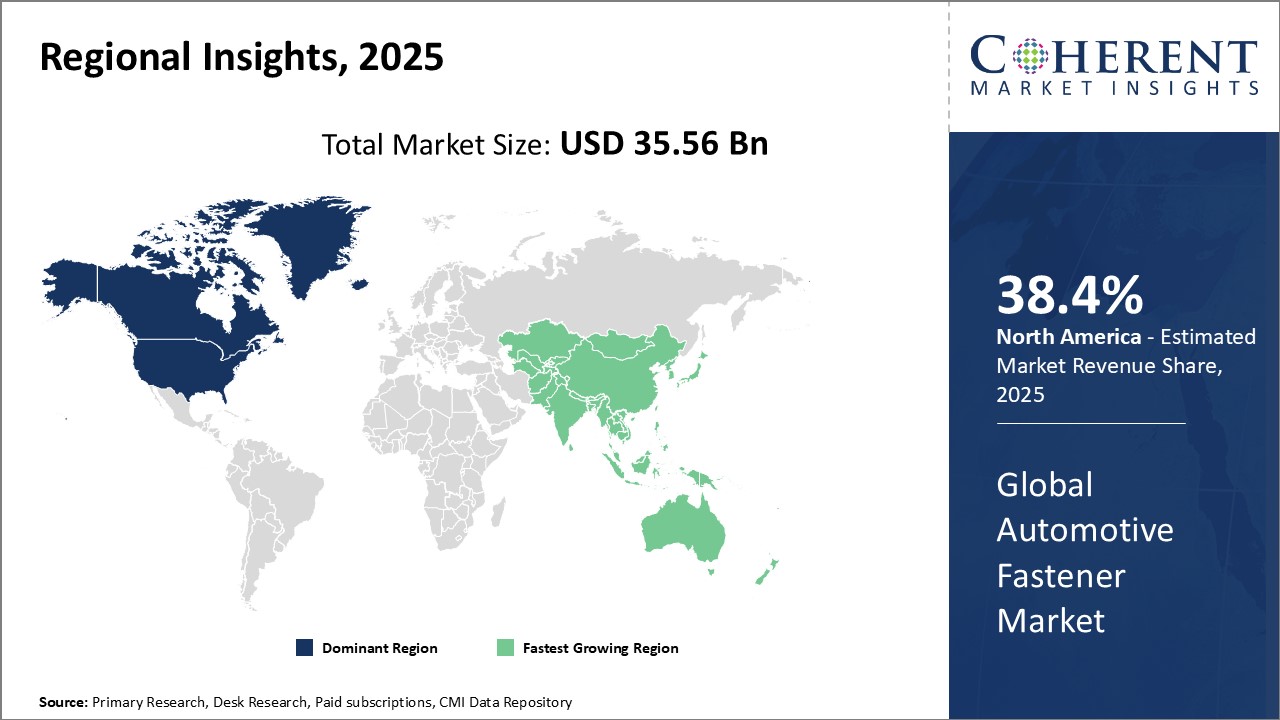
- North America is expected to lead in the market by accounting for 38.4% in 2026, supported by sophisticated automotive manufacturing and powerful supply chains.
- The Asia Pacific region is expected to have the most significant growth, at 7.62% CAGR by 2026 due to the accelerated industrial growth and the increase in the centers for automotive manufacturing.
Market Overview
Global Automotive Fastener Market is expected to witness significant growth over the forecast period due to rising automobile production globally along with implementation of more stringent fuel efficiency and emission norms which is encouraging use of light weighting components and materials in vehicles. Growing demand for electric vehicles worldwide is another factor that boosts need for more fasteners in auto industry as EVs contain a greater number of fasteners compared to conventional vehicles. Furthermore, development of self-driving vehicles equipped with advanced electronics and sensors is expected to drive the market growth in the near future. However, emergence of 3D printing technology for manufacturing of fasteners acts as a potential threat to convention fastener manufacturers.
Current Events and Its Impact on the Global Automotive Fastener Market
Event | Description and Impact |
Global Economic Instability and Inflation |
|
Technological Advancements and Market Adoption of Electric Vehicles (EVs) |
|
Changing Automotive Industry Regulations and Standards |
|
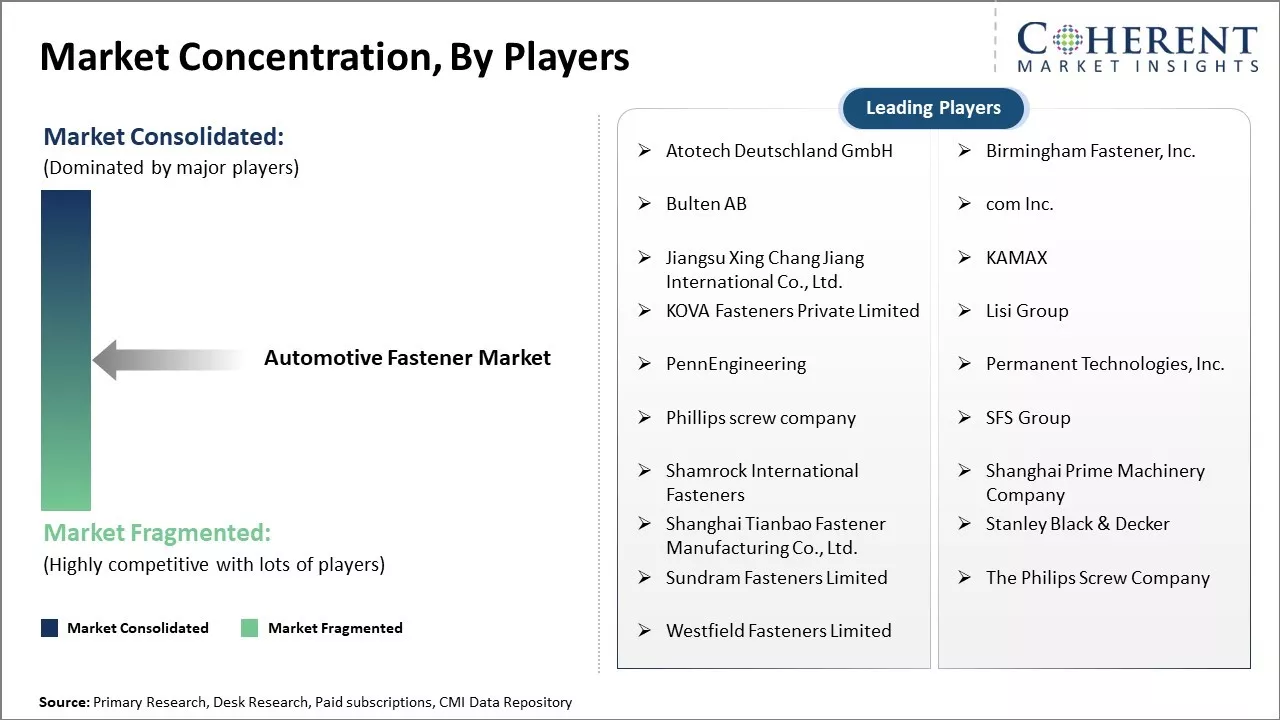
Market Concentration and Competitive Landscape
- Current Industry Events of 2026
- Market Size Estimation
- Regional Breakdown
- Competitive Landscape
- Customer Intelligence
- Segmental Analysis
- Pricing Analysis
- Key Market Drivers, Challenges & Future Trends
- Customized Insights Section
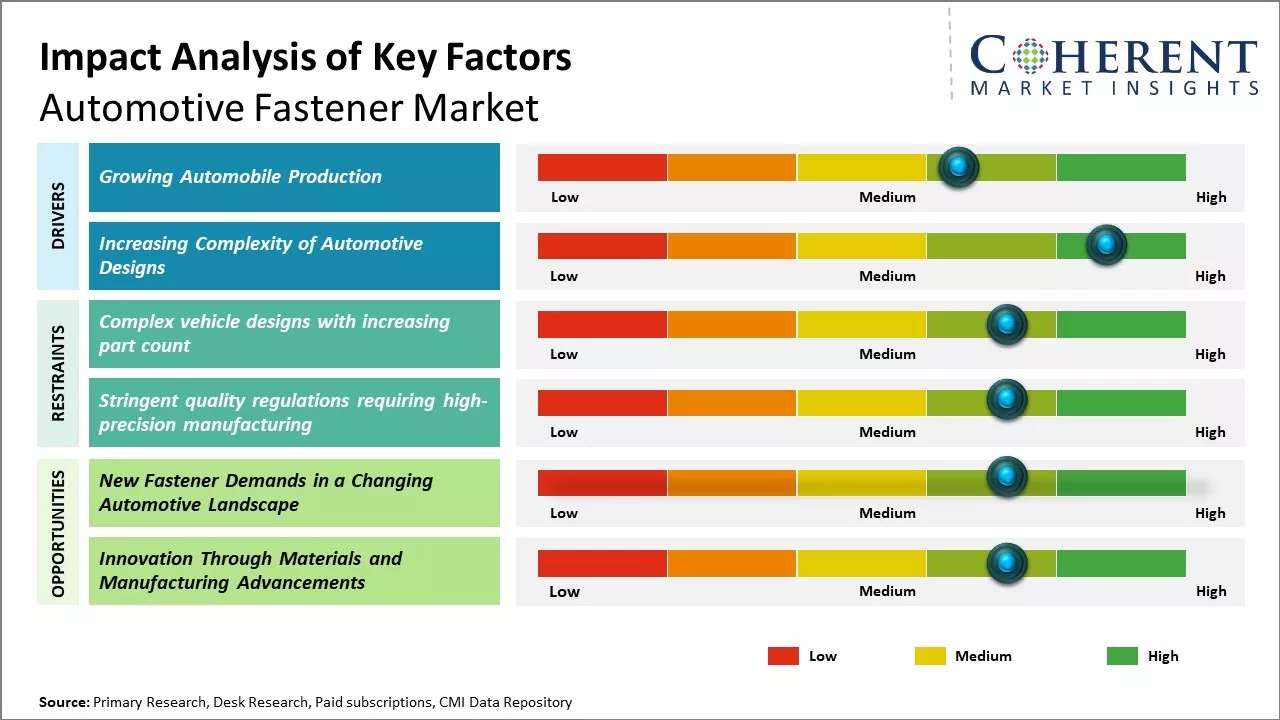
Growing Automobile Production
With rising disposable incomes and improving economic conditions across various markets, automobile sales have experienced significant growth over the past few years. This increase in automobile production acts as a key driver for the automotive fastener market. As more vehicles are manufactured by the automakers and their tier 1 suppliers on a continuous basis, it leads to higher consumption of various fasteners that are an integral component of automobiles. Different types of fasteners such as nuts, bolts, screws, pins, and others are heavily utilized in the manufacturing of engine, transmission, chassis, interior and exterior body parts of automobiles. With assembly operations becoming more complex involving tighter manufacturing tolerances, the usage of fasteners per vehicle has also risen over time.
Therefore, the projected increase in worldwide automobile production volumes directly correlates to the rising need for original equipment based automotive fasteners, there by propelling market growth.
For example, in January 2023, Sundram, an India-based fastener manufacturer, secured a substantial order worth USD 250 million from an electric vehicle (EV) original equipment manufacturer (OEM) under a six-year purchase agreement
Increasing Complexity of Automotive Designs
Rising complexity and technology enhancement of modern vehicle designs are expected to drive the market growth. Automakers are consistently striving to develop lighter, more durable and fuel-efficient vehicles with advanced features without compromising on performance. This has prompted OEMs as well as their supply chains to adopt novel engineering and manufacturing techniques.
The widespread utilization of high strength steels and aluminum alloys in automobile manufacturing requires the application of specialized fasteners that can effectively join dissimilar materials. The integration of cutting-edge technologies including hybrid-electric powertrains, ADAS systems and connectivity solutions has added to the intricacy of automobile assembly processes. To cope up with such intricate designs, OEMs demand fasteners with exacting specifications interims of load bearing capacity, shear strength, temperature resistance and corrosion protection.
Market Opportunities
New Fastener Demands in a Changing Automotive Landscape
As electric vehicles and autonomous driving technologies advance, there's a growing need for new kinds of fasteners. With more people opting for car-sharing and ride-hailing services, there's an increasing demand for strong, mass-produced fasteners that can withstand heavy usage. In regions like Asia and Latin America, where car sales are booming, suppliers are seizing the opportunity to expand into these emerging markets. Moreover, thanks to advancements in materials and manufacturing techniques, there are now innovative solutions available for designing and installing fasteners more efficiently.
Segmental Insights
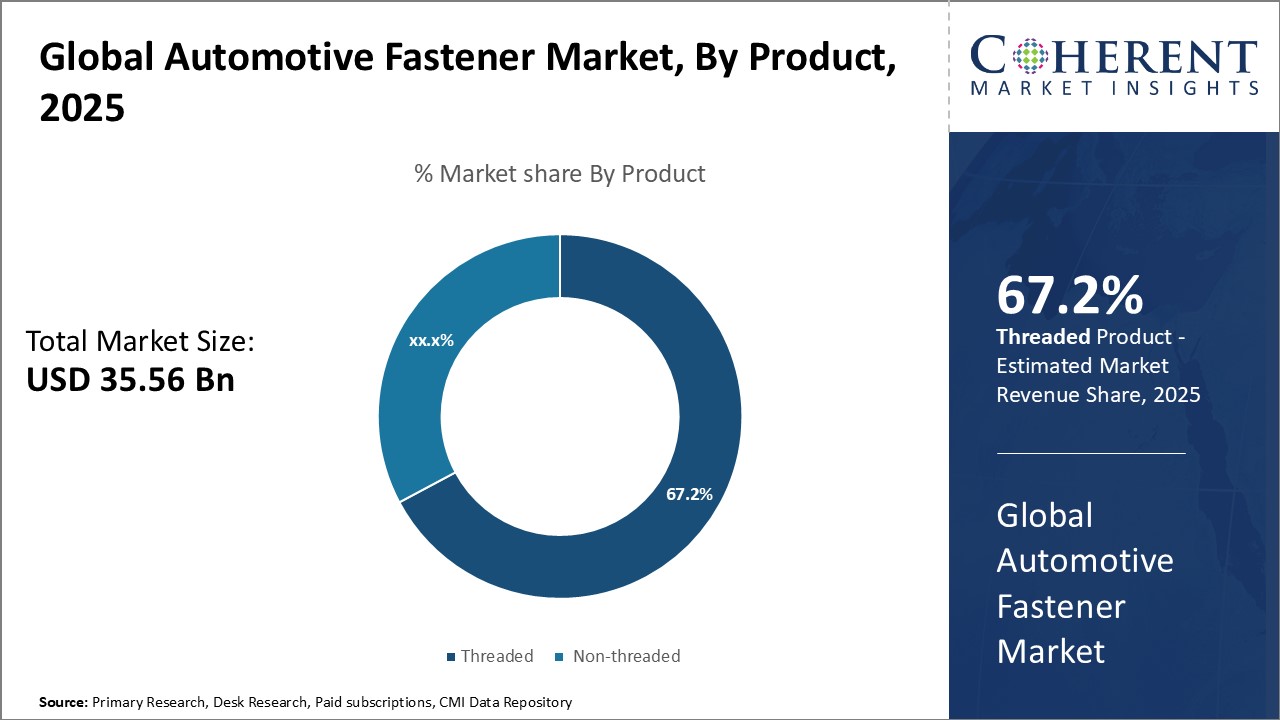
Automotive Fastner Market Insights, By Product - Superior Mechanical Properties Boosts Demand for Threaded Fastener
In terms of product, threaded segment is expected to contribute the highest share of 68.2% in 2026, owing to its superior mechanical strength and load bearing capabilities. Threaded fasteners form a threaded interference fit with the components being joined, distributing loads over a greater surface area for enhanced durability. Their self-tightening action also ensures components remain securely fastened, even under heavy vibrations or impacts encountered in automotive applications.
Threaded fasteners are well-suited for high-tension applications such as joining vehicle frames, engines, and drivetrain components. Advanced threaded designs have corrosion-resistant or hardened coatings to withstand demanding under-hood environments. Some feature integral washers or flanged heads that evenly distribute clamping forces without crushing softer materials. Their torque-limiting qualities are important for repeatable assembly of multi-part components.
Manufacturers continually improve threaded fastener engineering to reduce weight and complexity without compromising strength. Newer threaded designs have tighter tolerances and thread forms for stronger grips in smaller footprints. Some utilize selective coating technologies to control friction for easier assembly and removal over the life of the vehicle. Considerable research also goes into developing ultra-high strength threads capable of bolt-replacement in safety-critical applications.
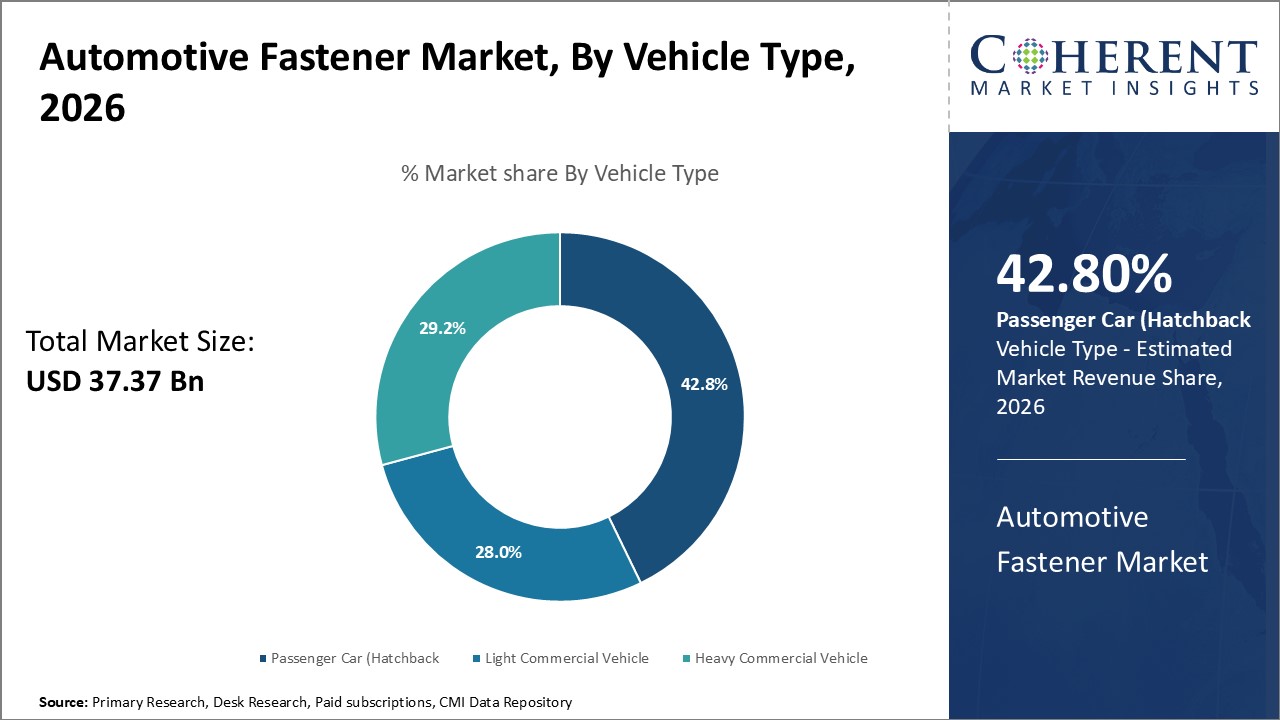
Automotive Fastner Market Insights, By Vehicle type
In terms of vehicle type, passenger car segment is expected to contribute the highest share of 42.77% in 2026, due to large production volumes and unique fastening needs of individual vehicle architectures. Passenger vehicles utilize a wide range of specialized fasteners from bumper attachments to seat mounts to electronic control modules. Even commodity fasteners play a vital joining role.
Exterior panels, closures, and modules on passenger cars demand aggressive thread-forming and resistant coatings to endure repeated environmental exposures and assembly/disassembly cycles. Interior fasteners meanwhile face strict requirements for non-abrasive aesthetics, vibration damping, and ability to join dissimilar lightweight materials. Specialty captive and security fasteners are increasingly used in high theft areas like wheels and catalytic converters.
Configurability and customization are also drivers in passenger car fastener design. Models with modular body styles or that offer numerous trim/option packages present extra integration challenges. This stimulates innovation in adjustment/alignment screws, click-fit attachments, and other fasteners enabling flexible vehicle configurations.
Automotive Fastner Market Insights, By Application
In terms of application, automotive segment is expected to contribute the highest share of 47.62% in 2026 due to integral role fasteners play throughout the manufacturing process. Vehicle assembly would not be possible without diverse fastener types temporarily or permanently joining thousands of parts.
In steps of assembly, fasteners permit adjusting, positioning, and locking for both manual and robotic assembly operations. These position components in a fixed manner for smooth transitions between multiple operations that follow. Custom designed press nuts, clip nuts and other agile self self installing mechanisms are supportive of streamlined workflows with little or no weight and complexity added.
Unibody frames are held together with high strength bolts and exterior body panels which are prone to impacts and corrosion are secured using threaded and non-threaded sheet metal screws. Interior trim and modules are painstakingly and precisely secured using small format fasteners. The automotive industry further drives innovation for other industries such as easier joining of multiple materials using self-piercing methods, newer automotive grade corrosion resistant coatings, and remote servicing and repairing friendly fastener standards.
Regional Insights
North America Automotive Fastener Market Analysis and Trends
North America is projected to dominate the global Automotive Fastener Market, accounting for an estimated 38.4% market share in 2026. This leadership is primarily driven by the strong presence of established automotive OEMs and a well-developed automotive manufacturing industry across the U.S. and Canada. Key fastener manufacturers such as Acument Global Technologies, PennEngineering, and ITW benefit from long-standing relationships with major automakers, enabling them to maintain a robust domestic customer base through comprehensive product portfolios.
The region enjoys a mature supply chain and advanced infrastructure that support the high demand for automotive fasteners. Competitive import tariffs further provide a degree of protection for local suppliers, reinforcing their market position. Nevertheless, industry players face growing pressure to diversify their footprint by expanding exports, aiming to mitigate potential risks associated with fluctuations in regional automobile production volumes
Asia Pacific Automotive Fastener Market Analysis and Trends
Asia Pacific is anticipated to be the fastest-growing region in the global Automotive Fastener Market, with a projected CAGR of 7.62% in 2026. China, the world’s largest automobile manufacturer, has rapidly expanded its production capacities through significant investments, which in turn fuel the demand for high-quality automotive fasteners. Chinese manufacturers are increasingly targeting global export markets, leveraging advanced technology upgrades and new product developments to enhance competitiveness.
The region benefits from a vast manufacturing base and cost advantages, enabling competitive pricing strategies that further boost export potential. Alongside China, emerging economies such as India are witnessing rising automobile sales, contributing to sustained market growth. The Asia Pacific region’s expanding automotive industry and strengthening export orientation are set to continue driving fastener demand in the near future.
Dominating Countries in the Automotive Fastener Market
United States Automotive Fastener Market Analysis and Trends
The U.S. remains the dominant market within North America, supported by a mature automotive manufacturing ecosystem and key domestic fastener producers with deep ties to automakers. Government policies and infrastructure investments create a conducive environment for maintaining steady demand. Continuous product innovation and strong supply chain networks underpin the country’s leading position in the fastener industry.
China Automotive Fastener Market Analysis and Trends
China has rapidly ascended as the largest automotive manufacturer globally, directly fueling its domestic fastener market growth. Chinese manufacturers are improving product quality through technological advancements and expanding production capacity, which supports increasing export volumes. Government initiatives and strategic investments further bolster the region’s competitiveness, solidifying China’s pivotal role in the global automotive fastener supply chain.
Market Report Scope
Global Automotive Fastener Market Report Coverage
| Report Coverage | Details | ||
|---|---|---|---|
| Base Year: | 2025 | Market Size in 2026: | USD 37.37 Bn |
| Historical Data for: | 2020 To 2024 | Forecast Period: | 2026 To 2033 |
| Forecast Period 2026 to 2033 CAGR: | 5.1% | 2033 Value Projection: | USD 52.94 Bn |
| Geographies covered: |
| ||
| Segments covered: |
| ||
| Companies covered: | Atotech Deutschland GmbH, Birmingham Fastener, Inc., Bulten AB, Jiangsu Xing Chang Jiang International Co., Ltd., KAMAX, KOVA Fasteners Private Limited, Lisi Group, PennEngineering, Permanent Technologies, Inc., Phillips screw company, SFS Group, Shamrock International Fasteners, Shanghai Prime Machinery Company, Shanghai Tianbao Fastener Manufacturing Co., Ltd., Stanley Black & Decker, Sundram Fasteners Limited, Westfield Fasteners Limited | ||
| Growth Drivers: |
| ||
| Restraints & Challenges: |
| ||
Global Automotive Fastener Market Key Developments
- In April 2024, Nedschroef launched a hybrid metal-composite fastening solution designed for multi-material vehicle structures, aimed at reducing vibrations and improving assembly performance in electric and lightweight vehicles.
- In January 2024, MEIDOH Co. Ltd. acquired Pilgrim Screw Corp., a U.S.-based fastener manufacturer, to expand its presence in the aerospace and high-performance automotive segments.
- In July 2023, Stanley Engineered Fastening unveiled a new lightweight aluminum fastening system specifically engineered for EV battery enclosures, achieving a 30% weight reduction compared to traditional steel counterparts.
Market Segmentation
- Product Insights (Revenue, USD Bn, 2026 - 2033)
- Threaded
- Non-threaded
- Vehicle Type Insights (Revenue, USD Bn, 2026 - 2033)
- Passenger Car
- Hatchback
- Sedan
- Luxury
- Light Commercial Vehicle
- Heavy Commercial Vehicle
- Application Insights (Revenue, USD Bn, 2026 - 2033)
- Oil and Gas
- Automotive
- Aerospace
- Construction
- Industrial Machinery
- Mining
- Others
- Regional Insights (Revenue, USD Bn, 2026 - 2033)
- North America
- U.S.
- Canada
- Latin America
- Brazil
- Argentina
- Mexico
- Rest of Latin America
- Europe
- Germany
- U.K.
- Spain
- France
- Italy
- Russia
- Rest of Europe
- Asia Pacific
- China
- India
- Japan
- Australia
- South Korea
- ASEAN
- Rest of Asia Pacific
- Middle East & Africa
- GCC Countries
- Israel
- Rest of Middle East & Africa
- Key Players Insights (Revenue, USD Bn, 2021 - 2033)
- Atotech Deutschland GmbH
- Birmingham Fastener, Inc.
- Bulten AB
- Jiangsu Xing Chang Jiang International Co., Ltd.
- KAMAX
- KOVA Fasteners Private Limited
- Lisi Group
- PennEngineering
- Permanent Technologies, Inc.
- Phillips screw company
- SFS Group
- Shamrock International Fasteners
- Shanghai Prime Machinery Company
- Shanghai Tianbao Fastener Manufacturing Co., Ltd.
- Stanley Black & Decker
- Sundram Fasteners Limited
- Westfield Fasteners Limited
Sources
Primary Research interviews
- Automotive Fastener Manufacturers
- Automotive Component Suppliers
- Automobile OEM Professionals
- Industry Experts & Consultants
- Others
Databases
- CMI Automotive Market Database
- Others
Magazines
- Automotive Industries Magazine
- Automotive Engineering Magazine
- Automotive Manufacturing Solutions Magazine
- Others
Journals
- International Journal of Automotive Technology
- Journal of Automobile Engineering
- Journal of Materials Processing Technology
- Others
Newspapers
- The Wall Street Journal
- Automotive News
- Financial Times
- The Economic Times
- Others
Associations
- Automotive Industry Action Group (AIAG)
- International Automotive Components (IAC) Group
- Society of Automotive Engineers (SAE) International
- European Automobile Manufacturers Association (ACEA)
- Others
Public Domain sources
- Organisation Internationale des Constructeurs d’Automobiles (OICA)
- U.S. Department of Transportation (DOT)
- European Commission Automotive Data Portal
- International Trade Centre (ITC)
- Others
Proprietary Elements
- CMI Data Analytics Tool
- Proprietary CMI Existing Repository of information for last 8 years
*Definition: Automotive fastener market includes all types of fasteners that are used in automotive manufacturing and assembly. This includes nuts, bolts, screws, washers, rivets, cable ties, and clamps that hold together vehicle components both externally and internally. Fasteners are essential for securing automotive parts and assemblies during vehicle production as well as for vehicle maintenance and repairs. These provide the strength and durability required to hold vehicle parts in place over the lifetime of the vehicle.
Get access to 250+ pages report
Every segment, forecast, competitor profile and data table behind the analysis above — available for instant download.
- ESOMAR Member
- ISO 9001:2015 Certified
- D-U-N-S Registered
- GDPR & CCPA Compliant
Missing comfort of reading report in your local language? Find your preferred language:
Transform your Strategy with Exclusive Trending Reports
Frequently Asked Questions
The Global Automotive Fastener Market is estimated to be valued at USD 37.37 Bn in 2026, and is expected to reach USD 52.94 Bn by 2033.
The CAGR of the Global Automotive Fastener Market is projected to be 5.1% from 2026 to 2033.
Growing automobile production and increasing complexity of automotive designs are the major factor driving the growth of global automotive fastener market.
Complex vehicle designs with increasing part count and stringent quality regulations requiring high-precision manufacturing are the major factor hampering the growth of global automotive fastener market.
In terms of product, threaded segment is estimated to dominate the market in 2026.
Atotech Deutschland GmbH, Birmingham Fastener, Inc., Bulten AB, Jiangsu Xing Chang Jiang International Co., Ltd., KAMAX, KOVA Fasteners Private Limited, Lisi Group, PennEngineering, Permanent Technologies, Inc., Phillips screw company, SFS Group, Shamrock International Fasteners, Shanghai Prime Machinery Company, Shanghai Tianbao Fastener Manufacturing Co., Ltd., Stanley Black & Decker, Sundram Fasteners Limited, Westfield Fasteners Limited are the major players.
North America is expected to lead the global automotive fastener market.