

Facial Recognition Market Size and Trends Forecast – 2026 - 2033
The facial recognition market is estimated to be valued at USD 8.20 Bn in 2026 and is expected to reach USD 25.03 Bn by 2033, exhibiting a compound annual growth rate (CAGR) of 17.2% from 2026 to 2033.
Key Takeaways of the Facial Recognition Market
- By component, the software segment is expected to contribute the highest market share of 53.9 % in 2026.
- By technology, the 2D facial recognition segment is expected to contribute the highest share of the market with 41.7 % in 2026.
- By application, the security and surveillance segment is projected to contribute the highest share of the market with 39.4 % in 2026.
- North America is the largest market for facial recognition, with a market share of 43.1 % in 2026.
Market Overview
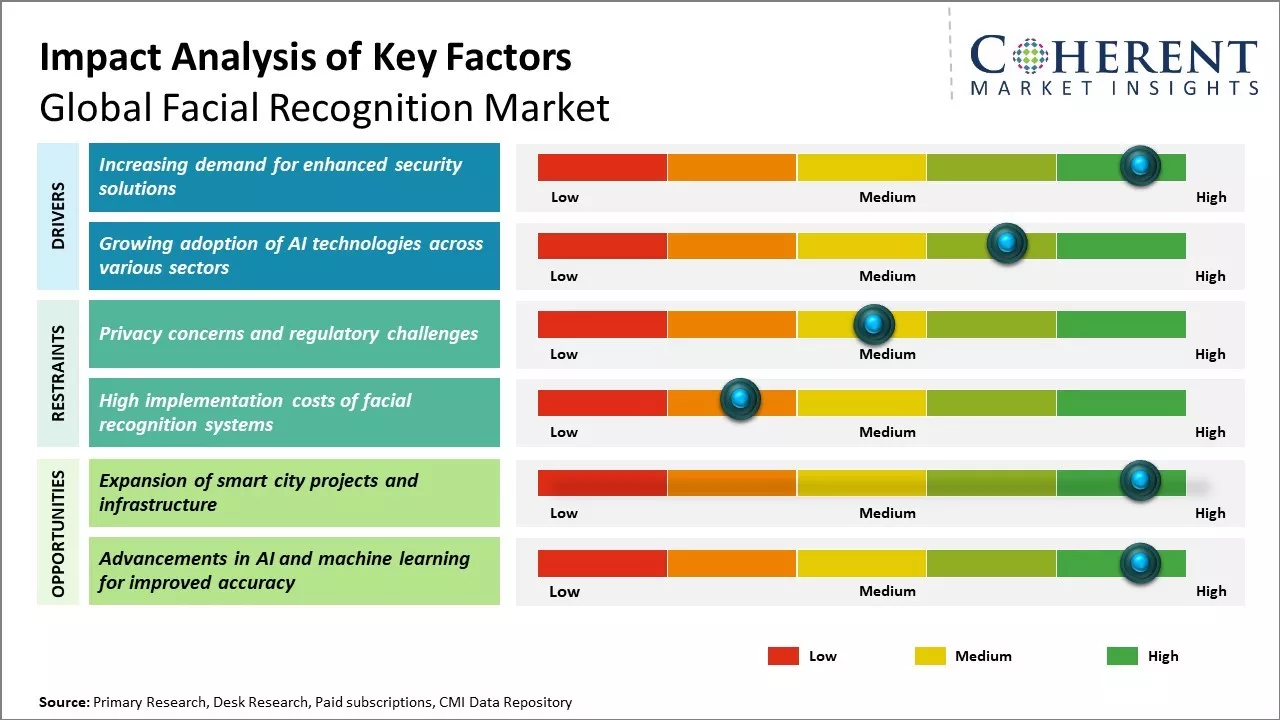
Increasing demand for advanced surveillance systems for public safety and rising applications of facial recognition in mobile devices can drive the market growth. Wide usage of facial recognition in applications such as emotion detection recognition, law enforcement, access control, and others along with the integration of AI and ML capabilities in facial recognition systems can offer lucrative opportunities for the market expansion.
However, privacy concerns around the use of facial data can hamper the market growth. Ongoing innovations to enhance accuracy and address privacy issues can help players address this challenge.
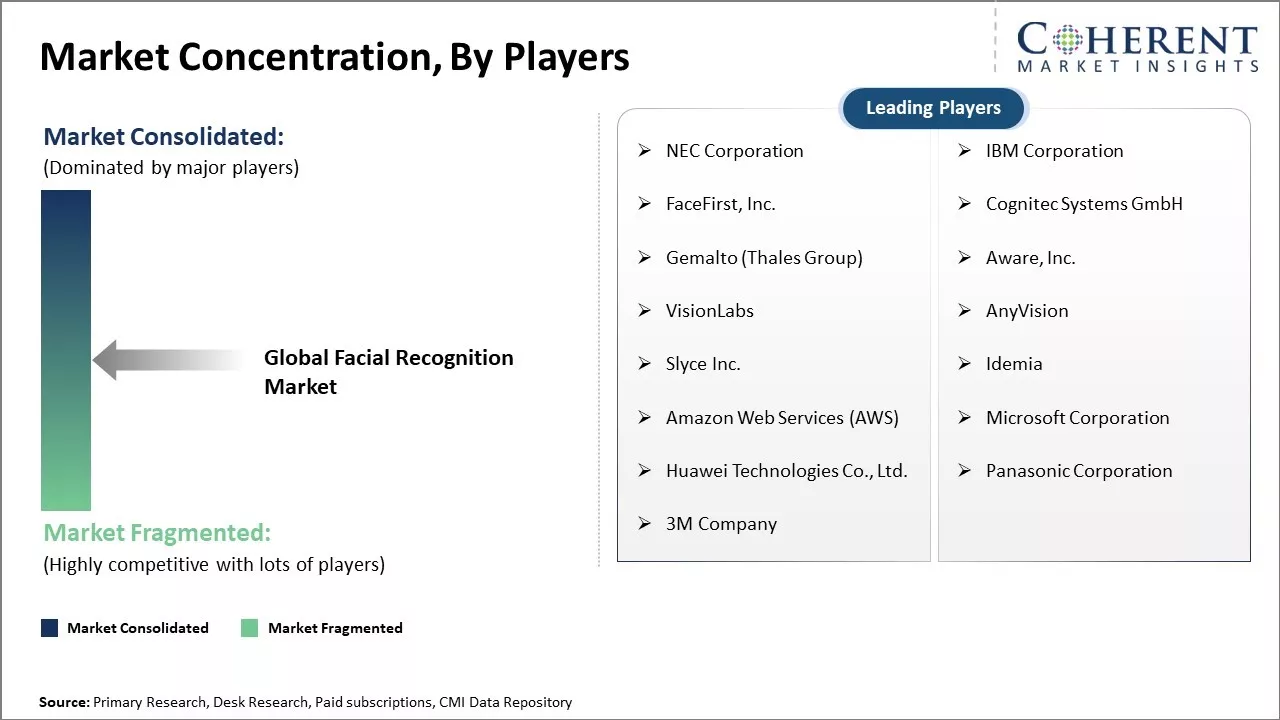
Market Concentration and Competitive Landscape
Current Events and Its Impact
Current Events | Description and its impact |
Regulatory and Privacy Changes |
|
Geopolitical and Security Events |
|
- Current Industry Events of 2026
- Market Size Estimation
- Regional Breakdown
- Competitive Landscape
- Customer Intelligence
- Segmental Analysis
- Pricing Analysis
- Key Market Drivers, Challenges & Future Trends
- Customized Insights Section
Market Trends
Growing Adoption of AI Technologies Across Various Sectors
AI's capabilities to mimic human cognitive functions like learning, reasoning, and problem solving through machine learning algorithms have spawned innovations across many application areas. Facial recognition forms a key part of this revolution as one the most prevalent forms of biometric identification leveraging recent advancements in computer vision and deep learning.
Advancements in artificial intelligence (AI) and machine learning have significantly improved the capabilities of facial recognition software. These enhancements have led to more precise and faster recognition processes, making facial recognition systems indispensable across various sectors. Businesses are increasingly integrating these systems to streamline operations, bolster security measures, and offer personalized services to their clientele.
Segmental Insights
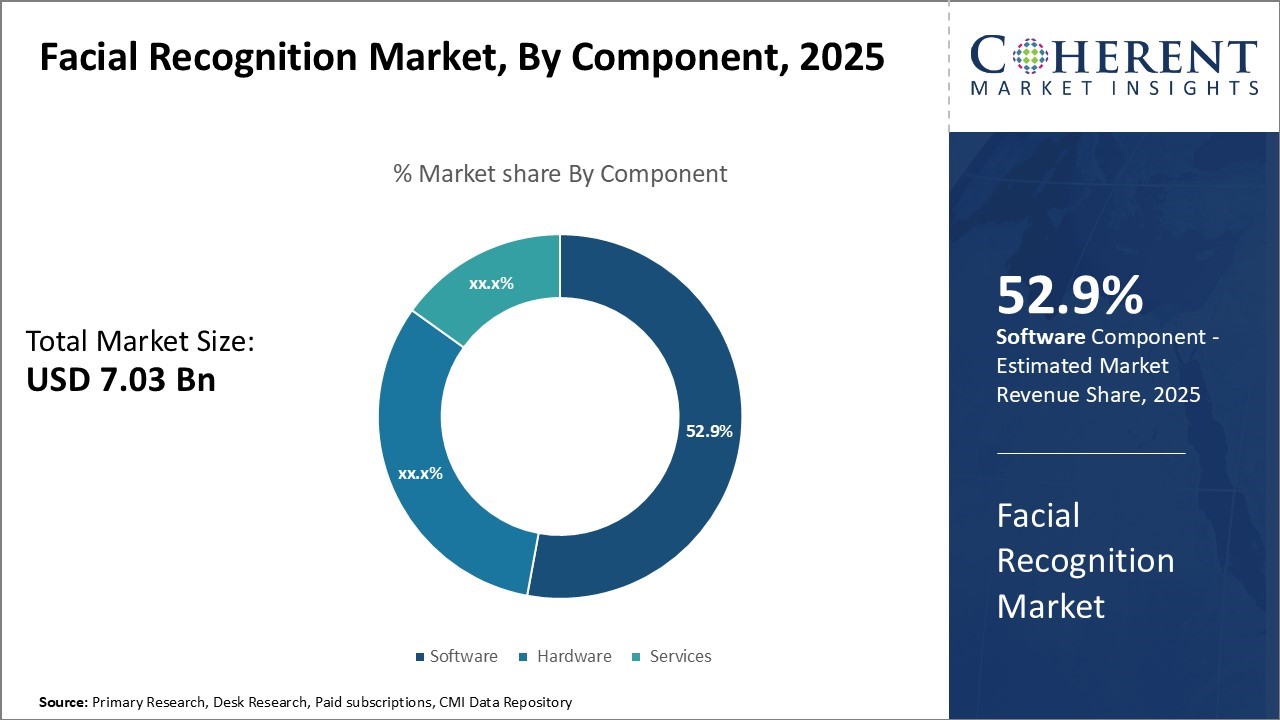
Facial Recognition Market Insights, by Component: Tailored Solutions Drives Software Segment’s Dominance
By component, the software segment is estimated to contribute the highest market share of 53.9% in 2026, owing to its ability to cater to diverse client needs.
Facial recognition software can be customized as per requirements to achieve optimal results across various use cases. Leading vendors such as KeyPlants, Pressmach, Bouygues Construction, etc. offer modular solutions that allow customers to pick and choose specific functionalities based on their unique objectives and constraints. This flexibility ensures software remains highly relevant for a wide range of budgets and technical competencies.
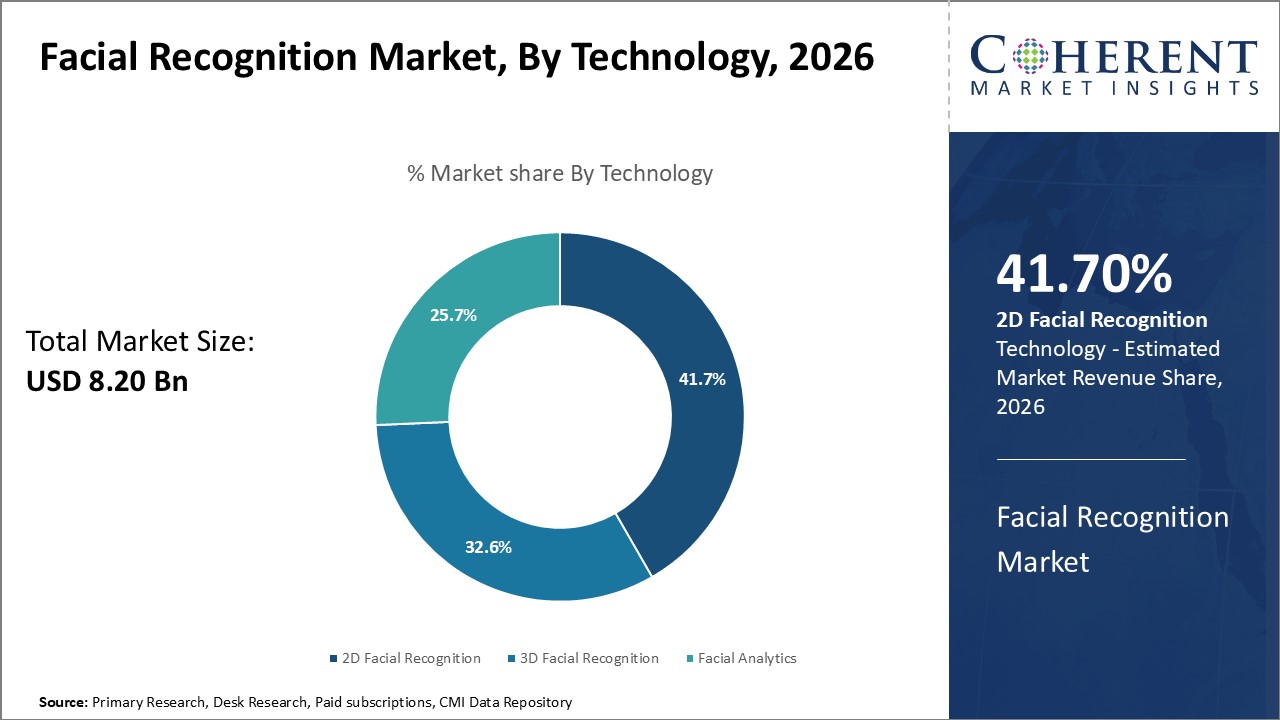
Facial Recognition Market Insights, by Technology: Enhanced Accuracy Boosts 2D Technology Leadership
By technology, 2D facial recognition segment is estimated to contribute the highest market share of 41.7% in 2026, owing to enhanced accuracy delivered through advanced algorithms.
2D technology analyzes facial feature measurements and relationships using digital images or video frames from a single view. Leading 2D vendors like Argentics, Whimsy Games Group LTD, Stepico, Cubix, etc. have invested heavily in compiling extensive training datasets encompassing variations in ethnicities, appearances and environmental conditions. Large-scale training empowers 2D algorithms to identify subtle cue differences and achieve high verification scores on standardized benchmarks.
Facial Recognition Market Insights, by Application: Enhanced Security Stimulates Security and Surveillance Segment Growth
By application, the security and surveillance segment is estimated to contribute the highest market share of 39.4% in 2026, due to the enhanced capabilities offered to boost safety, convenience and law enforcement.
Facial biometrics offer a non-intrusive alternative to traditional identity verification methods for sensitive access zones. When integrated with physical and logical access systems, facial data enhances premises security far more comprehensively than card-based authentication or manual guard checks. The ability to identify suspicious individuals proactively protects personnel and assets.
Emerging Innovations in the Facial Recognition Market
- The Rise of “Contactless Biometric Authentication”
- A noteworthy technological advancement is the rise of “contactless biometric authentication,” which has gained momentum in response to global health concerns. These systems use facial recognition to minimize physical interaction, enhancing hygiene and safety in public spaces. For example, airports and workplaces are adopting touchless access control where users are authenticated simply by looking at a camera.
- Integrating Advanced Facial Recognition Modules
- Recent product launches highlight how companies are incorporating these advancements into real-world applications. One example is mobile device manufacturers integrating advanced facial recognition modules that combine 3D sensing and infrared technology to enable secure user authentication even in complete darkness. These enhancements improve user convenience and device security, encouraging broader consumer acceptance.
Impacts of Artificial Intelligence (AI) on the Facial Recognition Market
Artificial Intelligence (AI) is transforming the facial recognition market, driving innovation and enhancing the capabilities of biometric technologies. By integrating AI, companies are not only improving accuracy but also expanding the scope of facial recognition applications across various sectors.
- Clearview AI applies AI algorithms to scan and match faces against an extensive database of publicly available images. This use case dramatically speeds up the identification process during criminal investigations, offering law enforcement agencies a powerful tool to solve cases more efficiently. The AI system’s ability to handle millions of images with high accuracy reduces manual workload, accelerates suspect identification, and enhances public safety outcomes.
- NEC Corporation, a global leader in biometric solutions. NEC has integrated AI into its facial recognition platforms, leveraging convolutional neural networks (CNNs) to enhance matching accuracy even in challenging conditions such as low light or obstructed faces. This strategic AI adoption allows NEC to deliver reliable identification services used widely in security, law enforcement, and border control. By embedding AI deeply into product design and core operations, NEC has strengthened its market position and driven industry-wide standards for biometric precision.
Regional Insights
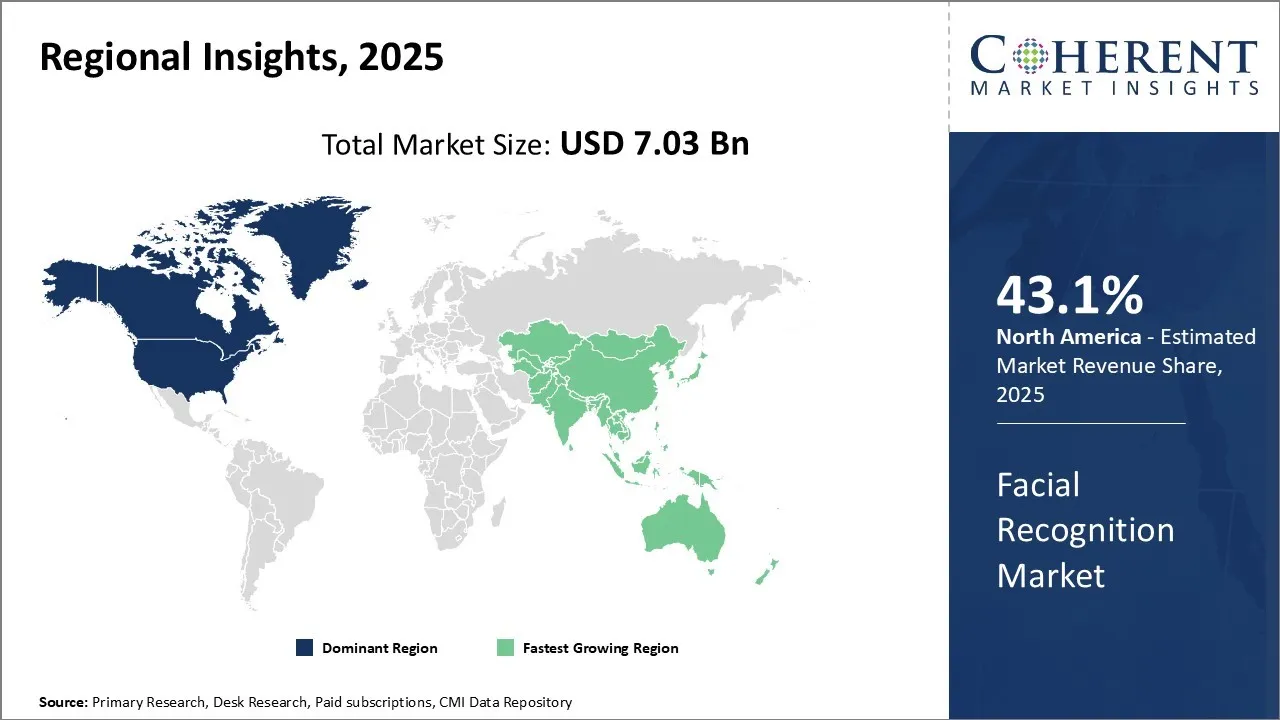
North America Facial Recognition Market Analysis and Trends
North America has firmly established itself as the dominant region in the global facial recognition market with an estimated market share of 43.1% in 2026. With strong technological advancement and significant investments in research and development by leading companies, the U.S. and Canada have emerged as front-runners in developing and applying facial recognition technology.
According to the Regulatory Review, in December 2024, the technology has found widespread adoption. Law enforcement agencies increasingly rely on this technology for criminal investigations, with over 100 U.S. police departments now subscribing to facial recognition services. Private sector use has also expanded rapidly.
Asia Pacific Facial Recognition Market Analysis and Trends
Asia Pacific is expected to be the fastest growing regional market. Facial recognition is gaining ground in the region, due to increasing digitization agenda of governments. Countries like China, Japan and India recognize its benefits for applications like national ID programs, law enforcement, and smart cities. This has prompted aggressive investments to develop domestic facial recognition capabilities.
For instance, Go Digital ASEAN, a regional initiative dedicated to broadening digital skills across Southeast Asia, concluded its second phase in March 2026, equipping 215,896 micro, small and medium enterprises with critical digital skills to grow their businesses.
Global Facial Recognition Market Outlook for Key Countries
U.S. Facial Recognition Market Analysis and Trends
The facial recognition market in the U.S. is primarily driven by the growing adoption of biometric security systems across various sectors such as law enforcement, airports, and financial services. Increased government funding for public safety and homeland security initiatives has accelerated the deployment of facial recognition technologies to enhance surveillance and crime prevention capabilities. Additionally, the presence of major tech companies investing heavily in AI and facial recognition research further propels market growth.
China Facial Recognition Market Analysis and Trends
China’s facial recognition market is fueled by the country’s extensive implementation of smart city projects and government-backed surveillance programs. The government’s strong push toward integrating facial recognition in public security, transportation, and retail sectors has led to widespread use of the technology. Furthermore, the rapid urbanization and the country’s large population contribute to the demand for efficient identity verification systems, making China a dominant market player.
India Facial Recognition Market Analysis and Trends
In India, the facial recognition market is growing due to the increasing need for secure identity verification in banking, government services, and digital payment platforms. The government’s initiatives such as Aadhaar, a biometric identification system, have laid the foundation for facial recognition integration. Moreover, the rising smartphone penetration and digital transformation across sectors like e-commerce and healthcare further drive market adoption.
U.K. Facial Recognition Market Analysis and Trends
The facial recognition market in the U.K. is being propelled by the expanding use of biometric authentication in airports and border control systems. The U.K. government’s focus on enhancing security measures in public places and critical infrastructure has encouraged the deployment of facial recognition technology. Additionally, the rising awareness among businesses and consumers about identity theft and fraud prevention contributes to the market’s steady growth.
Pricing Analysis of the Facial Recognition Market
- Hardware Pricing
- Entry-level facial recognition cameras by brands like Hikvision and Dahua Technology range from USD 200 to USD 700 per unit.
- Advanced multi-sensor cameras with AI features by Axis Communications and Hanwha Techwin cost between USD 1,200 to USD 5,000 depending on resolutions and processing capabilities.
- Software Pricing
- Standalone facial recognition software licenses from providers like NEC Corporation and Cognitec cost between USD 3,000 and USD 20,000 per license, adjusted by user seats, features, and geographic use.
- Cloud-based platforms, e.g., Amazon Rekognition or Microsoft Azure Face API, charge around USD 1.00 to USD 2.00 per 1,000 images processed in the free tier beyond limits, typically reducing in price with volume.
Market Report Scope
Facial Recognition Market Report Coverage
| Report Coverage | Details | ||
|---|---|---|---|
| Base Year: | 2025 | Market Size in 2026: | USD 8.20 Bn |
| Historical Data for: | 2020 To 2024 | Forecast Period: | 2026 To 2033 |
| Forecast Period 2026 to 2033 CAGR: | 17.2% | 2033 Value Projection: | USD 25.03 Bn |
| Geographies covered: |
| ||
| Segments covered: |
| ||
| Companies covered: | NEC Corporation, IBM Corporation, FaceFirst, Inc., Cognitec Systems GmbH, Gemalto (Thales Group), Aware, Inc., VisionLabs, AnyVision, Slyce Inc., Idemia, Amazon Web Services (AWS), Microsoft Corporation, Huawei Technologies Co., Ltd., Panasonic Corporation, and 3M Company | ||
| Growth Drivers: |
| ||
| Restraints & Challenges: |
| ||
Facial Recognition Industry News
- In April 2025, NEC Corporation announced that its face recognition technology was ranked the world's most accurate in the most recent benchmark test conducted by the globally recognized U.S. National Institute of Standards and Technology (NIST)
- In June 2025, at Identiverse 2025, Aware joined thousands of identity and security leaders in Las Vegas to showcase the latest innovations in biometric technology. From fraud prevention and compliance to user experience and enterprise security, Aware demonstrated how biometric authentication is solving today’s most pressing identity challenges—securely and seamlessly.
- In April 2025, Idemia showcased the use of facial recognition technology for law enforcement investigations.
- In February 2025, the Azure AI Face service provided AI algorithms that detect, recognize, and analyze human faces in images. Facial recognition software is important in many scenarios, such as identification, touchless access control, and automatic face blurring for privacy.
Analyst View
- The facial recognition market is experiencing significant momentum, driven primarily by advancements in artificial intelligence and machine learning technologies. Increasing adoption across various sectors, such as security, retail, banking, and healthcare, is propelling this growth. Enhanced demand for biometric authentication to improve security measures and streamline user experiences is a notable driver. Additionally, government initiatives focusing on public safety and surveillance are bolstering market expansion.
- However, privacy concerns and regulatory challenges remain significant restraints. The ethical implications of facial recognition technology, alongside strict data protection laws in regions like Europe, can limit widespread adoption. Public apprehension regarding misuse of personal data may also slow down market penetration in certain areas.
- Geographically, the Asia Pacific region is emerging as the fastest-growing market due to increasing government investments, rising consumer awareness, and rapid urbanization. North America continues to dominate the market, driven by strong technological infrastructure and early adoption by enterprises. Overall, facial recognition technology is poised to increasingly influence diverse industries, provided the challenges around privacy and regulation are adequately addressed.
- Despite these obstacles, there are promising opportunities, especially in emerging economies where digital transformation is accelerating. Integration with Internet of Things (IoT) devices and smart city projects presents substantial growth potential. Moreover, innovations aimed at improving accuracy, reducing false positives, and addressing bias in algorithms are likely to enhance user trust and acceptance.
Speak to the analyst
Want personalized insights?
Take the findings above to one of our principal consultants, or have the report rebuilt around the segments, geographies and competitors you actually track.
Market Segmentation
- By Component Insights (Revenue, USD Billion, 2021 - 2033)
- Software
- Hardware
- Services
- By Technology Insights (Revenue, USD Billion, 2021 - 2033)
- 2D Facial Recognition
- 3D Facial Recognition
- Facial Analytics
- By Application Insights (Revenue, USD Billion, 2021 - 2033)
- Security and Surveillance
- Access Control
- Marketing and Retail
- Healthcare
- Others
- By Regional Insights (Revenue, USD Billion 2021 - 2033)
- North America
- U.S.
- Canada
- Latin America
- Brazil
- Argentina
- Mexico
- Rest of Latin America
- Europe
- Germany
- U.K.
- Spain
- France
- Italy
- Russia
- Rest of Europe
- Asia Pacific
- China
- India
- Japan
- Australia
- South Korea
- ASEAN
- Rest of Asia Pacific
- Middle East
- GCC Countries
- Israel
- Rest of Middle East
- Africa
- South Africa
- North Africa
- Central Africa
- Key Players Insights
- NEC Corporation
- IBM Corporation
- FaceFirst, Inc.
- Cognitec Systems GmbH
- Gemalto (Thales Group)
- Aware, Inc.
- VisionLabs
- AnyVision
- Slyce Inc.
- Idemia
- Amazon Web Services (AWS)
- Microsoft Corporation
- Huawei Technologies Co., Ltd.
- Panasonic Corporation
- 3M Company
Sources
Primary Research Interviews
- Biometric Technology Providers
- Security System Integrators
- AI and Machine Learning Experts
- Healthcare Service Providers
- Others
Magazines
- Biometrics Research Magazine
- Security Technology Magazine
- AI Trends Magazine
- Others
Journals
- Journal of Biometrics
- IEEE Transactions on Pattern Analysis and Machine Intelligence
- Computer Vision and Image Understanding
- Others
Newspapers
- The Wall Street Journal
- Financial Times
- The Economic Times
- TechCrunch
- Others
Associations
- International Biometrics & Identification Association (IBIA)
- Biometrics Institute
- IEEE Biometrics Council
- Society for Imaging Science and Technology (IS&T)
- Others
Public Domain Sources
- U.S. Patent and Trademark Office (USPTO)
- World Intellectual Property Organization (WIPO)
- Government Whitepapers on Surveillance Technologies
- Industry Analyst Reports
- Others
Proprietary Elements
- CMI Data Analytics Tool – Facial Recognition Market
- CMI Existing Repository of Information for the Last 8 Years
*Definition: Global facial recognition market involves the development, production, and sale of facial recognition technologies and services used for identification, verification, attendance, and security screening on a global scale. The market includes identification systems used by law enforcement, border control, airports, commercial buildings, and more to match digital images of human faces against databases for verification, identity authentication, and access control purposes.
Get access to 250+ pages report
Every segment, forecast, competitor profile and data table behind the analysis above — available for instant download.
- ESOMAR Member
- ISO 9001:2015 Certified
- D-U-N-S Registered
- GDPR & CCPA Compliant
Missing comfort of reading report in your local language? Find your preferred language:
Transform your Strategy with Exclusive Trending Reports
Frequently Asked Questions
The facial recognition market is estimated to be valued at USD 8.20 Billion in 2026, and is expected to reach USD 25.03 Billion by 2033.
The CAGR of the facial recognition market is projected to be 17.2% from 2026 to 2033.
Increasing demand for enhanced security solutions and growing adoption of AI technologies across various sectors are the major factors driving the growth of the global facial recognition market.
Privacy concerns and regulatory challenges and high implementation costs of facial recognition systems are the major factors hampering the growth of the global facial recognition market.
In terms of component, the software segment is estimated to dominate the market in 2026.
Best practices for minimizing bias and ensuring fairness in facial recognition deployments include using diverse and representative training data, conducting regular bias audits, and ensuring algorithmic transparency. Additionally, incorporating human oversight, adhering to ethical standards, and continuously monitoring system performance are crucial for fair and responsible use.
Organizations should consider factors such as accuracy and bias mitigation, data security and privacy compliance, scalability and integration capabilities, vendor transparency and ethical practices, and ongoing support and regulatory adherence when selecting a facial recognition system vendor.