

Simulation Software Market Size and Forecast – 2026 to 2033
The Simulation Software Market is estimated to be valued at USD 18.20 Bn in 2026 and is expected to reach USD 41.98 Bn by 2033, growing at a compound annual growth rate (CAGR) of 12.7% from 2026 to 2033.
Key Takeaways
- By Offering, Software holds the largest market share of 73.5% in 2026 owing to its advancements in ai and machine learning.
- By Deployment Mode, On-premises acquired the prominent market share of 69% in 2026 owing to the enhanced data security and compliance.
- By Industry, Manufacturing expected to hold largest market share of 32.8% in 2026 owing to its enhanced operational efficiency.
- By Region, North America dominates the overall market with an estimated share of 35.5% in 2026 owing to the technological leadership and innovation.
Market Overview
Advancements in technology and rising demand in industries such as aerospace, automotive, healthcare, and manufacturing are rapidly driving the simulation software market share. These tools allow companies to conduct virtual testing, optimize designs, and improve processes, which helps reduce costs and speed up time-to-market. The integration of AI, IoT, and Industry 4.0 technologies is boosting their capabilities. Additionally, increased emphasis on training, sustainable manufacturing, and government initiatives actively promotes adoption. Innovation, strategic partnerships, and expanding applications are shaping the market globally.
Current Events and their Impact on the Simulation Software Market
Current Events | Description and its impact |
Economic Factors and Investment Trends |
|
Technological Advances and Industry Innovations |
|
Sector-Specific Developments |
|
End-user Feedback and Unmet Needs in the Simulation Software Market
- User Experience and Interface Complexity: End-users often find simulation software interfaces complex and challenging to navigate, limiting accessibility for non-experts. There is a growing demand for more intuitive, user-friendly designs that reduce the learning curve and improve usability, enabling broader adoption across diverse skill levels and industries.
- Integration with Existing Systems: Many users report difficulties integrating simulation software with legacy systems and other enterprise tools. Seamless interoperability remains a key unmet need, as smoother data exchange and synchronization would enhance workflow efficiency and enable more comprehensive, end-to-end simulation processes.
- Customization and Flexibility: End-users seek more customizable simulation solutions tailored to their unique industry requirements. Current software often lacks the flexibility to adapt to specific workflows or specialized scenarios, creating gaps between available features and actual user needs, limiting the software’s effectiveness in complex or niche applications.
- Current Industry Events of 2026
- Market Size Estimation
- Regional Breakdown
- Competitive Landscape
- Customer Intelligence
- Segmental Analysis
- Pricing Analysis
- Key Market Drivers, Challenges & Future Trends
- Customized Insights Section
Role of AI (Artificial Intelligence) in Simulation Software Market
AI is transforming the simulation software industry by enhancing speed, accuracy, and efficiency in engineering and design processes. Through machine learning and data-driven models, AI enables faster scenario analysis, predictive simulations, and automated optimization, reducing reliance on manual input and trial-and-error. It also improves decision-making by identifying patterns and anomalies in complex systems.
In August 2025, KBC launched Petro-SIM® v7.6, the latest version of its digital twin simulation platform for the oil and gas, refining, petrochemical, polymer, and SAF industries. The update enhances first-principles and hybrid modeling with integrated AI/ML, enabling improved optimization and supporting digitalization, energy transition, and decarbonization efforts.
Segmental Insights
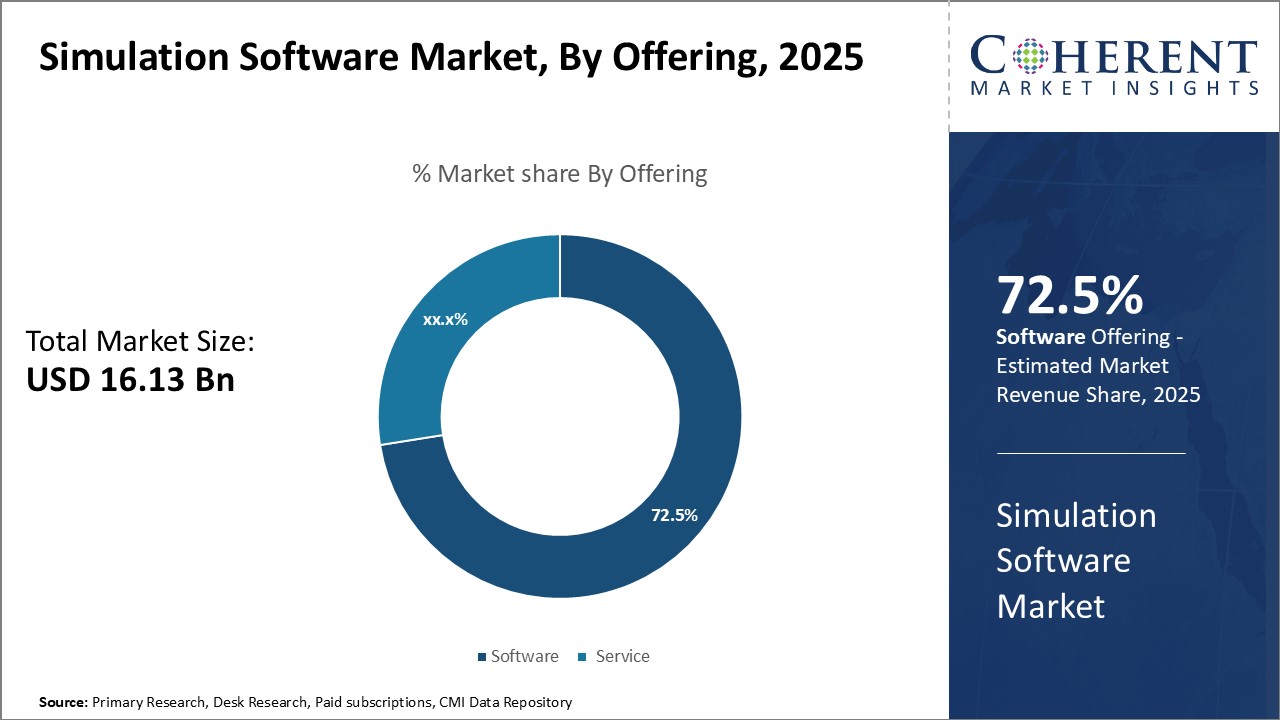
Simulation Software Market Insights, by Offering: Software contributes the highest share of the market owing to its rise of industry 4.0 and smart manufacturing.
Software holds the largest market share of 73.5% in 2026. The need for realistic and efficient virtual environments drives the simulation software market as businesses innovate and minimize risks. Companies are increasingly adopting digital twins, leveraging enhanced computational power, and demanding precise predictive analytics to fuel growth. Industries focus on streamlining product development and training, while advancements in cloud computing expand access to simulation tools. Additionally, the push for automation and sustainability motivates organizations to invest in simulation solutions that enhance decision-making and boost operational efficiency across multiple sectors. For instance, in May 2025, LeddarTech Holdings Inc., an AI-powered software company specializing in advanced driver assistance and autonomous driving systems, launched LeddarSim™, a next-generation simulation platform designed to bridge the gap between virtual testing and real-world deployment.
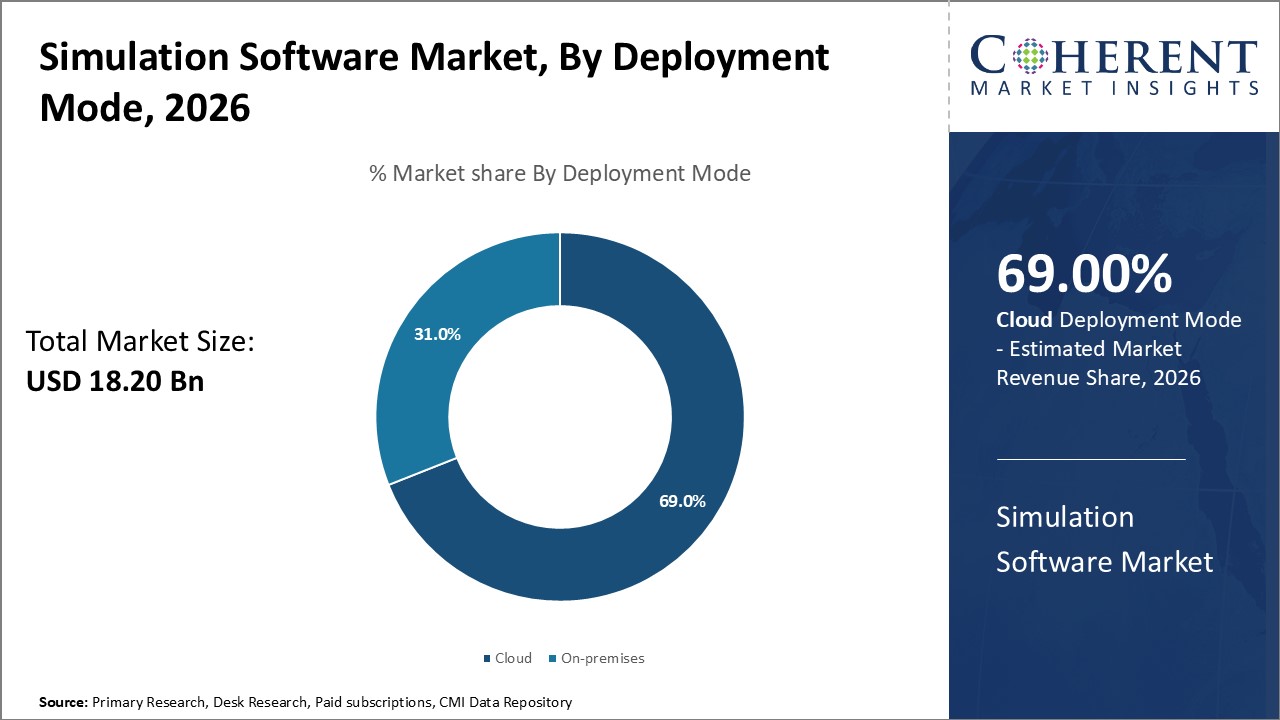
Simulation Software Market Insights, by Deployment Mode: On-premises contribute the highest share of the market owing to its superior performance for complex simulations.
On-premises acquired the prominent market share of 69% in 2026. Organizations drive the growth of the on-premises simulation software market by prioritizing control over their data and infrastructure. Companies in sensitive industries choose on-site solutions to enhance security, ensure compliance, and customize software to meet their specific requirements. On-premises deployment delivers reliable performance for complex simulations that demand high computing power and low latency. Furthermore, many businesses prefer direct integration with existing systems and the ability to operate independently of internet connectivity, making on-premises solutions a dependable option for critical simulation needs. For instance, in May 2025, Mashreq, a leading MENA financial institution, collaborated with Clari5 to launch Clari5 Genie, a Gen AI-powered fraud detection platform. Mashreq will be the first to deploy it fully on-premise, ensuring top data security and compliance
Simulation Software Market Insights, by Industry: Manufacturing contributes the highest share of the market owing to its government initiatives and investments.
Manufacturing expected to hold largest market share of 32.8% in 2026. The manufacturing sector drives growth in the simulation software market by using virtual models to optimize production lines, cut downtime, and boost efficiency. Companies apply simulation to test processes before implementation, reducing costly mistakes and speeding up time-to-market. The growth of smart factories and Industry 4.0 technologies increases demand for digital twins and real-time analytics. Additionally, manufacturers prioritize sustainability and automation, using simulation tools to enhance resource management and automate workflows, thereby improving competitiveness and fostering innovation.
In December 2024, SimScale announced a strategic partnership with PTC’s Onshape®, offering eligible members of the Onshape Start-Up Program three months of free access to SimScale’s Professional License. This collaboration provides start-ups with advanced cloud-based simulation tools to analyze and improve their CAD designs, accelerating product development and market entry.
Regional Insights
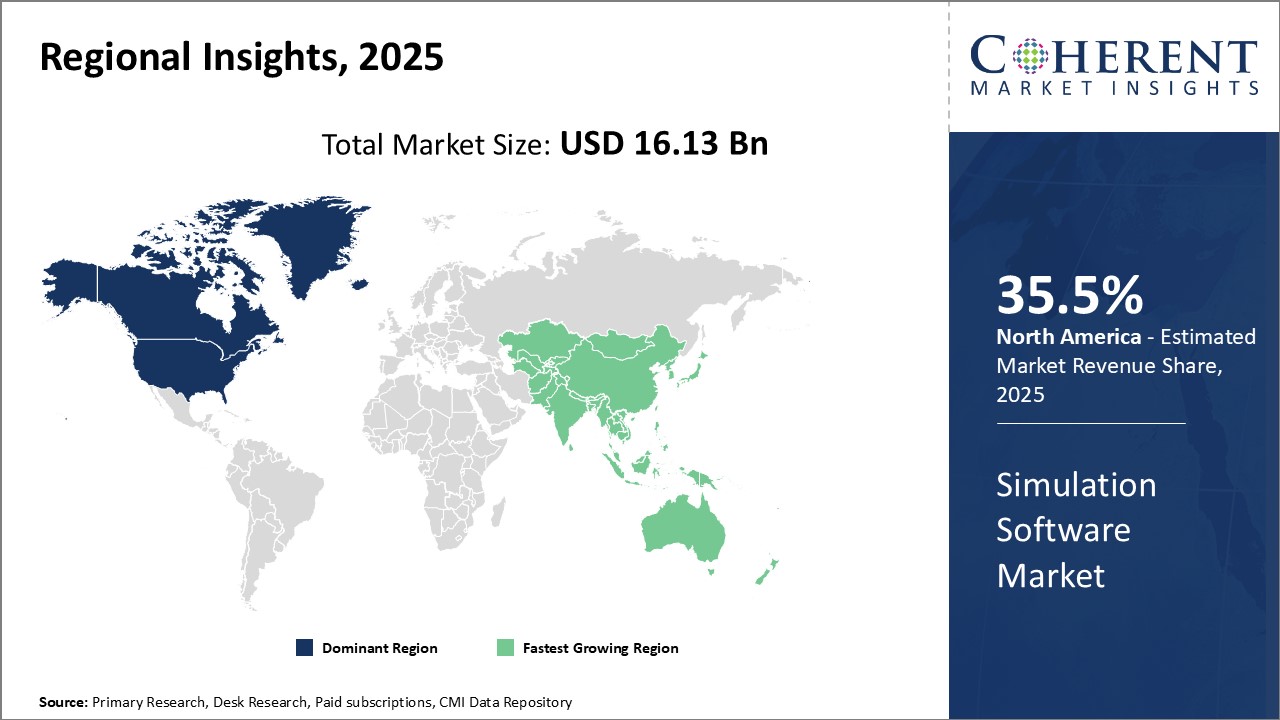
North America Simulation Software Market Trends
North America dominates the overall simulation software market demand with an estimated share of 35.5% in 2026. Technological advancements and diverse industry applications drive strong adoption in North America’s simulation software market. Companies in the region focus on integrating AI, machine learning, and cloud technologies to improve simulation accuracy and scalability. Leading sectors such as aerospace, automotive, and healthcare actively use simulation for design, testing, and training. Governments increase support and invest in research to boost innovation. Additionally, major players engage in strategic collaborations and acquisitions, strengthening the market and expanding simulation solution availability throughout North America.
For instance, in June 2026, FANUC has released ROBOGUIDE Version 10, the latest and most advanced version of its industry-leading offline robot programming and simulation software, rebuilt and redesigned.
Europe Simulation Software Market Trends
Growing demand in automotive, aerospace, and manufacturing industries drives rapid evolution in Europe’s simulation software market revenue. Companies in the region prioritize advancing digital twin technology and integrating simulation with Industry 4.0 initiatives to boost production efficiency. Regulatory bodies enforce strong frameworks that promote sustainable and safe manufacturing practices, increasing the use of simulation tools. Furthermore, investments in research and innovation, combined with collaborations between tech companies and educational institutions, actively fuel market growth, establishing Europe as a leader in developing advanced simulation solutions.
In April 2026, NewtonWorks Corporation launched two simulation tools in Europe for automotive and brake engineering teams. NewtonSuite Aves focuses on brake squeal simulation and analyzes noise and vibration (NV) in components like electric motor stators—critical for electric vehicles. It helps engineers reduce development time and enhance system performance across various applications.
United States Simulation Software Market Trends
Industries like aerospace, healthcare, and automotive drive dynamic growth in the United States simulation software market by increasingly adopting advanced simulation technologies. Companies integrate AI and cloud computing to enhance simulation capabilities and streamline operations. Government initiatives and funding actively support innovation and digital transformation across various sectors. Moreover, technology providers partner with research institutions to accelerate the development of cutting-edge solutions. Together, these trends expand simulation software usage and establish the U.S. as a key leader in the global market.
For instance, in February 2024, U.S. based Ansys launched SimAI, an AI-based simulation software designed to accelerate design iterations and product development. Meanwhile, Concentric has appointed a new SVP for its hydraulics division.
India Simulation Software Market Trends
Industries such as manufacturing, automotive, and healthcare drive momentum in India’s simulation software market by increasingly adopting digital tools to improve efficiency. Companies focus on creating affordable and scalable simulation solutions tailored to local requirements. The government actively promotes digital transformation initiatives to foster innovation and technology adoption. Additionally, increasing investments in IT infrastructure and partnerships between startups and established companies accelerate market growth. Together, these factors expand simulation software usage throughout India, establishing the country as an emerging force in the global simulation technology arena.
For instance, in June 2026, the Pain Clinic in Kolkata launched a web-based MSK ultrasound simulator to teach sonoanatomy for ultrasound-guided pain interventions, offering accessible, self-paced training without the need for cadavers, patients, or machines.
Market Report Scope
Simulation Software Market Report Coverage
| Report Coverage | Details | ||
|---|---|---|---|
| Base Year: | 2025 | Market Size in 2026: | USD 18.20 Bn |
| Historical Data for: | 2020 To 2024 | Forecast Period: | 2026 To 2033 |
| Forecast Period 2026 to 2033 CAGR: | 12.7% | 2033 Value Projection: | USD 41.98 Bn |
| Geographies covered: |
| ||
| Segments covered: |
| ||
| Companies covered: | MathWorks , Autodesk, Ansys, Siemens AG, PTC, Dassault Systemes, Altair Engineering, MSC Software , Honeywell, Keysight Technologies, Aveva, Spirent Communications, Bentley Systems, Synopsys, AVL List GmbH, COMSOL, Certara, CAE (Presagis, aPriori, PTV Group, AnyLogic, SimScale, Scalable Networks, Simul8 Corporation, FlexSim, MOSIMTEC | ||
| Growth Drivers: |
| ||
| Restraints & Challenges: |
| ||
Market Dynamics
Simulation Software Market Trend
Advancement in AI-Powered Simulation
Simulation software increasingly incorporates artificial intelligence and machine learning to enhance predictive accuracy and automate complex analyses. AI-driven models enable faster scenario testing, optimize decision-making, and adapt simulations based on real-time data. This trend accelerates innovation by allowing businesses to explore numerous outcomes quickly, reduce manual input, and improve overall efficiency. Industries like automotive and healthcare benefit from AI-enhanced simulations that provide deeper insights and more reliable forecasting capabilities.
Cloud-Based Simulation Platforms
The shift toward cloud-based simulation platforms offers greater accessibility, scalability, and collaboration opportunities. Cloud deployment eliminates hardware limitations, allowing users to run complex simulations remotely with high computing power. It also facilitates real-time teamwork across different locations and industries. Organizations leverage cloud simulation to reduce costs, improve data security, and accelerate innovation cycles. This trend democratizes simulation technology by enabling small and medium enterprises to access powerful tools without heavy upfront investments.
Simulation Software Market Opportunity
Integration with Virtual and Augmented Reality
The convergence of simulation software with virtual reality (VR) and augmented reality (AR) opens new avenues for immersive training, design visualization, and collaborative problem-solving. These technologies enhance user interaction with simulations, offering realistic environments that improve learning outcomes and decision-making. Providers can capitalize on this opportunity by developing integrated platforms that support VR/AR, attracting industries focused on experiential training and complex system design.
Simulation Software Market News
- In March 2025, Germany-based dSPACE has released its XSG Power Electronics Systems software to simulate highly dynamic switching frequencies of up to 500 kHz for automotive applications.
- In September 2025, UK-based aerospace company Orbex has successfully simulated the launch of its Prime vehicle for the first time, achieving a major technical milestone ahead of its upcoming orbital services. The end-to-end test validated mission-critical systems such as flight software, engine control, and tracking by replicating real launch day conditions.
Analyst Opinion (Expert Opinion)
- The Simulation Software market is rapidly transforming into the backbone of modern innovation, and its trajectory reflects a strategic shift towards more intelligent, integrated, and industry-specific solutions. The undeniable push towards AI-driven simulation platforms is not just an enhancement but a necessity. For instance, Ansys reported that over 70% of their new software deployments integrate machine learning to accelerate predictive modeling—this isn’t a trend but a paradigm shift that is fundamentally reshaping product development cycles.
- Moreover, the aerospace sector exemplifies the critical value of simulation: Boeing’s extensive use of digital twins helped them reduce physical prototyping costs by 30%, directly accelerating the 787 Dreamliner program. This clearly demonstrates how simulation transitions from a supportive tool to a core business driver. The COVID-19 pandemic further validated simulation’s essential role, where pharmaceutical companies utilized these tools to expedite vaccine research, showcasing simulation’s expanding influence beyond traditional engineering into life sciences.
- However, the market still grapples with significant integration challenges. Many legacy simulation platforms lack seamless interoperability with emerging cloud-based architectures, hindering real-time collaboration and data fluidity. Siemens’ acquisition of Altair Engineering signals a consolidation aimed precisely at addressing these integration gaps, yet widespread adoption remains a hurdle.
Speak to the analyst
Want personalized insights?
Take the findings above to one of our principal consultants, or have the report rebuilt around the segments, geographies and competitors you actually track.
Market Segmentation
- Offering Insights (Revenue, USD Bn, 2021 - 2033)
- Software
- Service
- Deployment Mode Insights (Revenue, USD Bn, 2021 - 2033)
- Cloud
- On-premises
- Industry Insights (Revenue, USD Bn, 2021 - 2033)
- Automotive
- Manufacturing
- Electronics & Semiconductor
- Aerospace & Defense
- Healthcare
- Others (Education, Media & Entertainment)
- Regional Insights (Revenue, USD Bn, 2021 - 2033)
- North America
- U.S.
- Canada
- Latin America
- Brazil
- Argentina
- Mexico
- Rest of Latin America
- Europe
- Germany
- U.K.
- Spain
- France
- Italy
- Russia
- Rest of Europe
- Asia Pacific
- China
- India
- Japan
- Australia
- South Korea
- ASEAN
- Rest of Asia Pacific
- Middle East
- GCC Countries
- Israel
- Rest of Middle East& Africa
- Key Players Insights
- MathWorks
- Autodesk
- Ansys
- Siemens AG
- PTC
- Dassault Systemes
- Altair Engineering
- MSC Software
- Honeywell
- Keysight Technologies
- Aveva
- Spirent Communications
- Bentley Systems
- Synopsys
- AVL List GmbH
- COMSOL
- Certara
- CAE
- aPriori
- PTV Group
- AnyLogic
- SimScale
- Scalable Networks
- Simul8 Corporation
- FlexSim
- MOSIMTEC
Sources
Primary Research interviews
- Industry experts and executives from leading simulation software providers
- R&D heads and product managers in aerospace, automotive, and healthcare sectors
- IT decision-makers and digital transformation leads in manufacturing firms
Databases
- IEEE Xplore Digital Library
- Scopus
- SpringerLink
- Google Scholar
Magazines
- Wired
- MIT Technology Review
- Manufacturing Engineering Magazine
- Automation World
Journals
- Journal of Simulation
- Simulation Modelling Practice and Theory
- International Journal of Advanced Manufacturing Technology
- Computer-Aided Design
Newspapers
- The Wall Street Journal – Technology and Industry sections
- Financial Times – Technology and Manufacturing
- The New York Times – Science and Technology
Associations
- The Society for Modeling & Simulation International (SCS)
- Institute of Electrical and Electronics Engineers (IEEE) – Simulation and Modeling Technical Committees
- Association for Computing Machinery (ACM) – Special Interest Group on Simulation
Public Domain sources
- U.S. Patent and Trademark Office (USPTO) – Patent filings related to simulation software
- Government technology whitepapers and R&D reports (e.g., NASA, DARPA)
- Publicly available financial reports and press releases of key simulation software companies
Proprietary Elements
- CMI Data Analytics Tool, and Proprietary CMI Existing Repository of information for last 8 years
Get access to 250+ pages report
Every segment, forecast, competitor profile and data table behind the analysis above — available for instant download.
- ESOMAR Member
- ISO 9001:2015 Certified
- D-U-N-S Registered
- GDPR & CCPA Compliant
Missing comfort of reading report in your local language? Find your preferred language:
Transform your Strategy with Exclusive Trending Reports
Frequently Asked Questions
The Simulation Software Market is estimated to be valued at USD 18.20 Bn in 2026, and is expected to reach USD 41.98 Bn by 2033.
The CAGR of the Simulation Software Market is projected to be 12.7% from 2026 to 2033.
Adoption of Simulation Software for Product Designing and Testing and Rise of Virtual Prototyping to Replace Physical Prototyping are the major factor driving the growth of Simulation Software Market.
Requirement of specialized skilled workforce and Lack of awareness about benefits of simulation softwar are the major factor hampering the growth of Simulation Software Market.
In terms of Offering, Software, estimated to dominate the market revenue share 2026.
MathWorks , Autodesk , Ansys , Siemens AG , PTC , Dassault Systemes , Altair Engineering , MSC Software , Honeywell , Keysight Technologies , Aveva , Spirent Communications , Bentley Systems , Synopsys , AVL List GmbH , COMSOL , Certara , CAE (Presagis , aPriori , PTV Group , AnyLogic , SimScale , Scalable Networks , Simul8 Corporation , FlexSim , MOSIMTEC are the major players.
North America is expected to lead the Simulation Software Market.