

Europe Residential Real Estate Market Size and Trends - 2026 to 2033
The Europe Residential Real Estate Market is expected to be valued at USD 543.8 Mn in 2026 and is expected to reach USD 812.3 Mn by 2033, growing at a compound annual growth rate (CAGR) of 5.9% from 2026 to 2033.
Key Takeaways
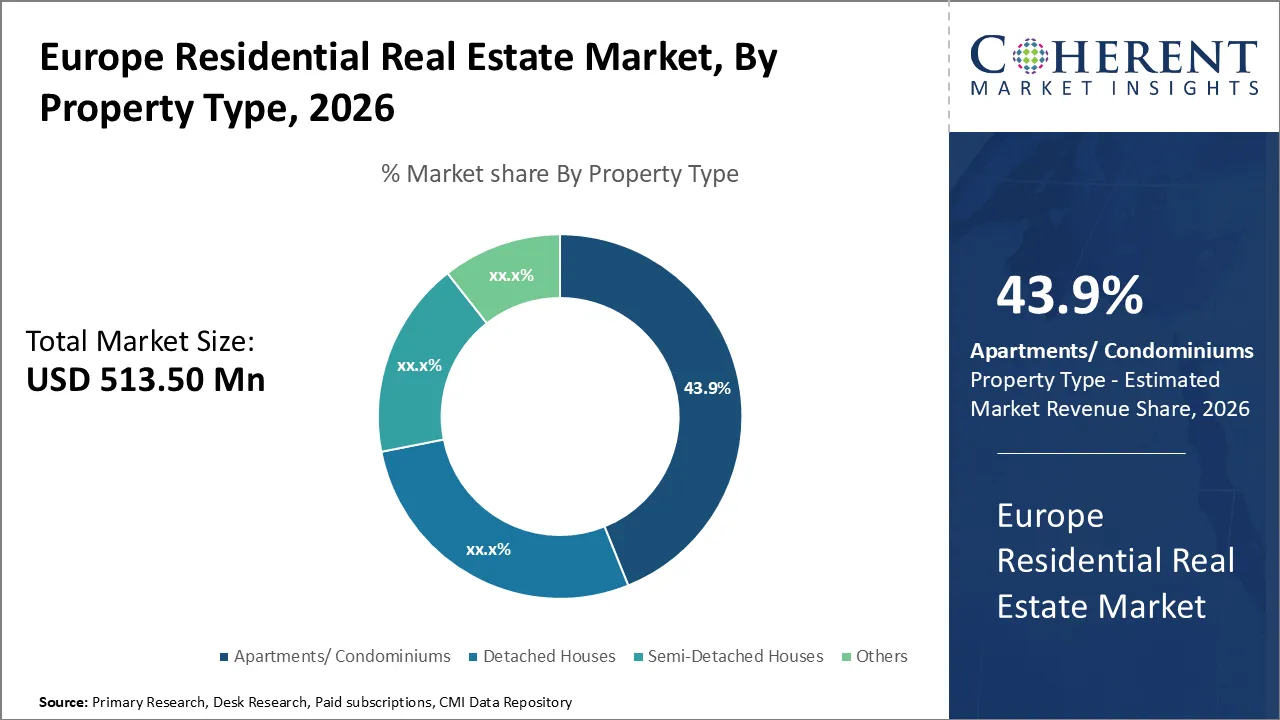
- Based on Property Type, the Apartments/Flats segment is expected to lead the market with a 44.9%share in 2026, owing to their affordability and convenience.
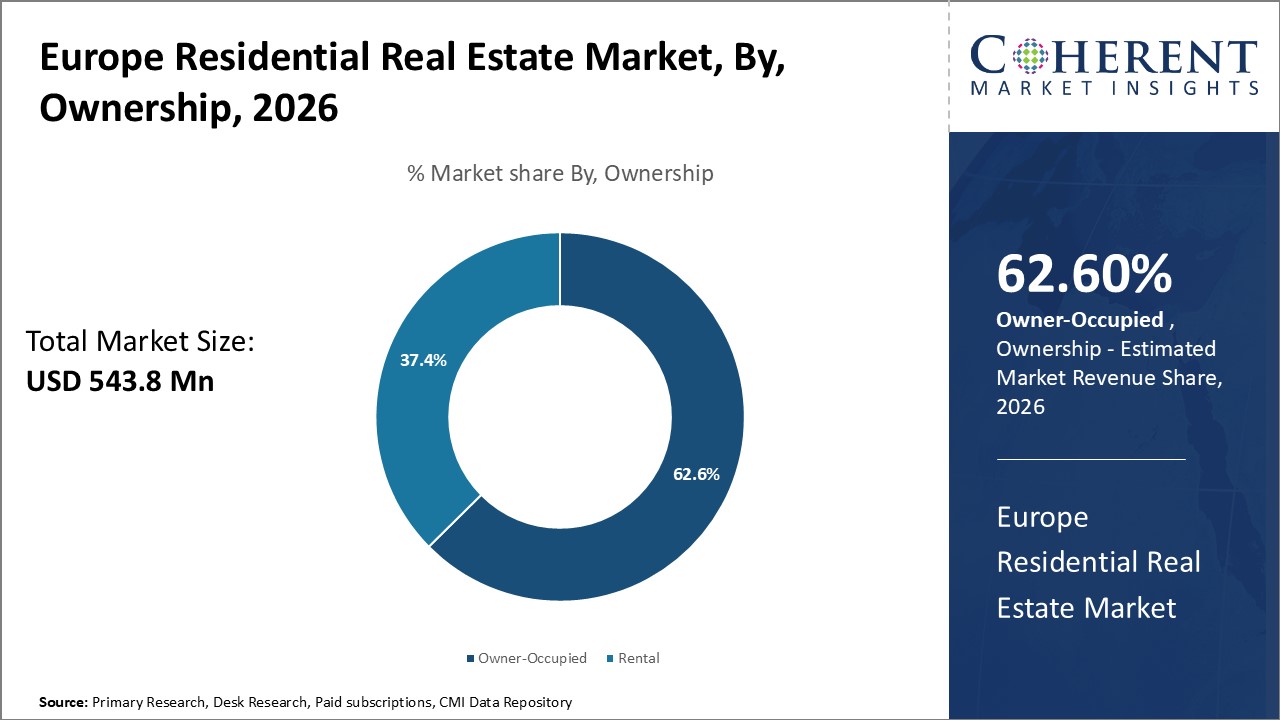
- Based on Ownership, the Owner-Occupied segment is expected to hold 62.6%share of the market in 2026, due to desires for stable long-term housing and investment potential.
- Based on Deployment Type, Newly Built Properties segment is projected to account for a major share in 2026, owing to investor demand and sustainability standards.
Market Overview
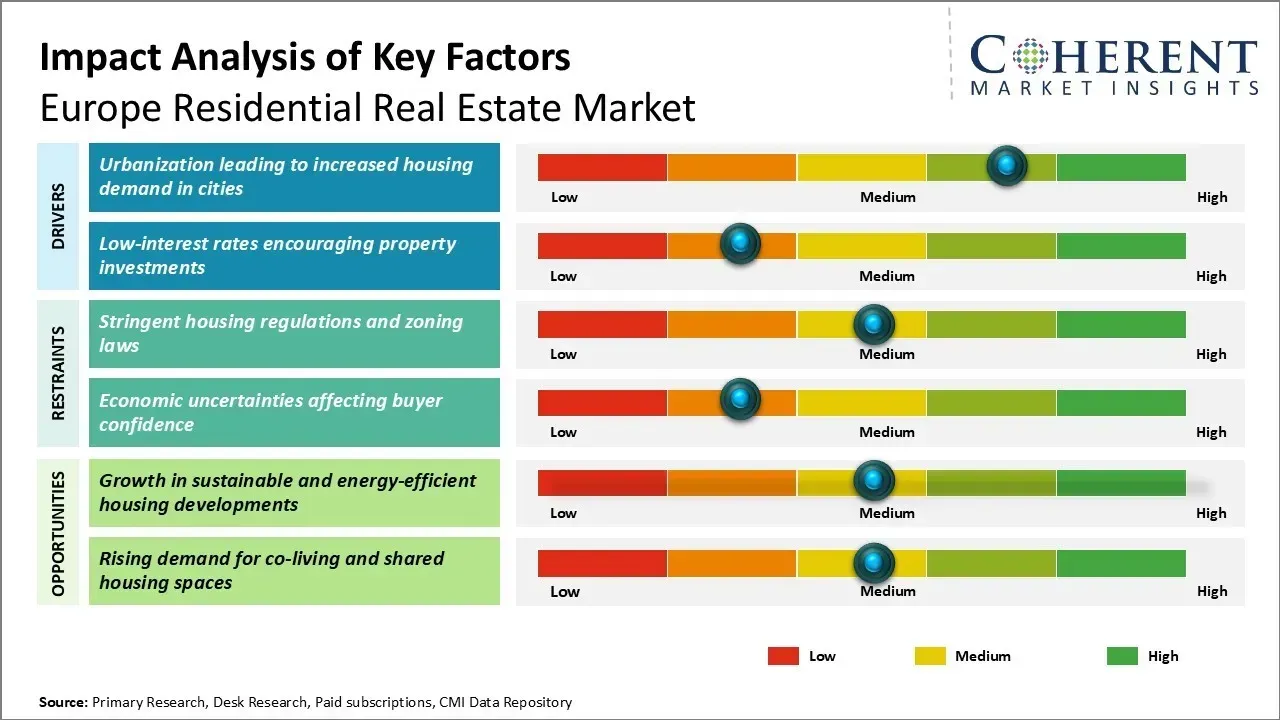
The Europe residential real estate market is driven by several interconnected factors that sustain transaction values and property values. The demographic shift is creating continued demand as aging populations seek downsizing options and younger generations enter home ownership. The favorable financing conditions along with historically low interest rates in many countries is helping to improve mortgage affordability and buyer accessibility.
The urban migration toward employment centers is fueling demand in metropolitan cities. The remote and hybrid work models are expanding buyer interest to suburban and rural properties. The investment demand from domestic and international buyers seeking stable returns is also driving the growth in the market. The supply constraints driven by limited construction activity and rising development costs are amplifying the demand pressures. Such demand in turn is propelling the property valuations in European markets over the forecast period.
Current Events and Its Impacts on the Europe Residential Real Estate Market
Current Event | Description and the Impact |
Regional Urbanization and Demographic Trends |
|
Geopolitical Events & Energy Crisis |
|
Nano-Level Localized Events |
|
Segmental Insights
- Current Industry Events of 2026
- Market Size Estimation
- Regional Breakdown
- Competitive Landscape
- Customer Intelligence
- Segmental Analysis
- Pricing Analysis
- Key Market Drivers, Challenges & Future Trends
- Customized Insights Section
Europe Residential Real Estate Market Insights By, Property Type- Apartments/ condominiums Lead Due to Affordability and Convenience
In terms of property type, the apartments/condominiums segment contributes the highest share of 44.9% in 2026 of the market owing to their affordability and convenience. The rising land prices in major European cities push detached houses and even semi-detached houses beyond reach for many residents. The younger generations entering the property market find apartments particularly accessible. The apartments provide living space at a lower price point per square foot compared to other housing types. The compact design of apartment maximizes limited urban space efficiently. The central city locations provide easy access to public transportation and employment districts. The shopping areas and cultural destinations remain within close proximity without vehicle dependency. The residents avoid traffic congestion and lengthy commutes associated with suburban locations. The higher population densities near apartment buildings facilitate social connections more readily than dispersed housing formats.
For instance, in October 2025, NUMA Group, a primary provider of a completely digitized hospitality platform, has introduced its new multi-brand plan to speed up its growth in Europe. The initiative highlights elegant hotels and serviced apartments in key urban areas along with a smooth online guest process that provides convenience and adaptability.
Europe Residential Real Estate Market Insights By, Ownership- Owner-Occupied Leads Owing to Desire for Permanence and Autonomy
In terms of ownership, the owner-occupied segment contributes the highest share of 62.6% in 2026 of the market. The potential homebuyers are motivated by the desire for permanence and autonomy in their housing arrangements. The acquisition of a property provides lasting security to the buyers via stable occupancy. Although the rental costs may vary annually based on landlord driven market dynamics, mortgage installments typically stay constant throughout the loan duration.
Most European countries provide financial advantages to homeowners like property tax relief on main dwellings. Homeownership is also viewed as a wealth building strategy for future needs. Certain homeowners regard their [roperies as supplementary retirement funds or income sourcing during later years particularly when transitioning to smaller homes or care facilities. Such factors have motivated many individuals to prefer ownership above short-term rental arrangements.
For instance, in June 2025, HILI, a platform for shared home ownership, changed its name to Aparta and introduced a fresh brand identity and updated platform as a part of its plan to grow across Europe. The company helps homeowners access the value in these properties through a flexible shared ownership approach without needing to sell their homes or take in additional plans.
Europe Residential Real Estate Market Insights By, Deployment Mode- Considerable Investor Demand Drives Preference for Newly Built Properties
In terms of deployment mode, the newly built properties segment contribute the highest share in 2026 of the Europe residential real estate market. The growth is fueled by considerable investor demand for contemporary, energy efficient housing that complies with today’s environmental standards. Major cities in Germany, Spain, France and Nordic region are witnessing substantial growth in new construction projects. This is attributable to government funding programs and easier building approval processes. These properties provide better growth potential for modern designs and lower upkeep expenses. While renovated or updated properties still hold value, especially in historic neighborhoods, their market share is relatively smaller due to higher renovation expenses and more complex regulatory requirements.
For instance, in September 2025, the Bellemonde housing development in the northern part of the capital has moved forward with a 3-hectare extension phase. This project brings 80 additional units to the 164 already being built since 2024. The project will feature facilities like multi-use sports areas, green space, and a new outdoor pool.
Europe Residential Real Estate Market Outlook Country-Wise
Portugal Residential Real Estate Market Trends
Portugal is poised to witness strong growth owing to its appealing way of life, pleasant weather, and competitive pricing than other Western European countries. The country’s residency schemes like the well-known Golden Visa program have successfully attracted international buyers and investors from around the globe. Major cities like Lisbon, Porto, along with coastal areas like the Algarve are popular among digital nomads, retirees, and those seeking vacation homes. The nation’s reliable infrastructure, secure environment, and growing tech industry is strengthening its position as a top choice for residential living and property investment.
For instance, in May 2026, Missoni marked its entry into the Portuguese property market with Aroeira Collections by Missoni. It is a residential and tourism venture created with Norfin SGOIC, a top real estate investment company in Portugal.
Hungary Residential Real Estate Market Trends
Hungary is witnessing strong interest in its residential property sector owing to accessible pricing, dynamic city growth and increasing attention from local and international buyers. The capita city Budapest provides a blend of historical character and contemporary amenities bringing in young workers, university students, and location independent workers. Government housing support, good loan options and better rental income are making investors more confident. The country’s location in center of Europe and better transport connections also make it a smart pick for long term property investment.
For instance, in January 2026, Cordia revealed plans to build over 1,000 apartments during 2026 in Budapest, Hungary’s capital. This development responds to strong demand for new housing in a growing market and will increase Budapest's new home supply by 20% compared to year-end figures.
Market Report Scope
Europe Residential Real Estate Market Report Coverage
| Report Coverage | Details | ||
|---|---|---|---|
| Base Year: | 2025 | Market Size in 2026: | USD 543.8 Mn |
| Historical Data for: | 2020 To 2024 | Forecast Period: | 2026 To 2033 |
| Forecast Period 2026 to 2033 CAGR: | 5.9% | 2033 Value Projection: | USD 812.3 Mn |
| Geographies covered: | U.K., Germany, France, Italy, Spain, Poland, Netherlands, Rest of Europe | ||
| Segments covered: |
| ||
| Companies covered: | British Land Company PLC, ELM Group, SEGRO, Engel & Völkers, LEG Immobilien AG, Covivio, Gecina SA, Unibail-Rodamco-Westfield SE, AbitareIn, Neinor Homes, Atal S.A | ||
| Growth Drivers: |
| ||
| Restraints & Challenges: |
| ||
Europe Residential Real Estate Market Drivers
More people moving to cities creates higher housing needs
Over the past decade the fast movement of people into Europe’s cities has been a major force behind the residential real estate market’s growth. As individuals relocate to urban areas for jobs and better lifestyle options the need for city homes has jumped considerably. Major cities like London, Paris, Berlin and Madrid have seen their populations grow steadily putting strain on available housing. In many places, building new home has not been able to match the growing number of families looking for places to live. This gap between rising demand and limited supply is propelling the residential real estate market growth in Europe.
Europe Residential Real Estate Market Opportunities
Increase in green and energy saving homes
A major opportunity for Europe residential real estate market is the rise of eco-friendly and energy-efficient housing projects. As people become mire environmentally aware, homebuyers increasingly want green construction properties that reduce carbon emissions. Developers are noticing this shift and creating projects with energy-saving features like solar panels, better insulation, efficient home systems. Many countries are also providing financial incentives like tax breaks for environment friendly buildings. This has brought more investment into sustainable housing. The developers are gaining competitive edge with these projects which often sell at higher prices. The greater emphasis on sustainability also helps Europeans to achieve their climate goals.
For instance, in May 2025, PATRIZIA, a worldwide real estate investment manager, partnered with Urbania, a major Spanish property development and management firm, to create Sustainable Communities Spain. This partnership aims to invest over USD 152.99 million in affordable and eco-friendly housing in Spain’s largest cities.
Analyst Opinion (Expert Opinion)
The Europe residential real estate market reflects a heterogeneous performance pattern shaped by country-specific economic conditions, housing supply constraints, and affordability dynamics. Recent housing indicators show that residential prices across several European economies have stabilized or resumed moderate growth following prior corrections. Germany, for instance, has recorded multiple consecutive quarters of price increases, supported by limited new housing supply and steady household demand. In contrast, major metropolitan markets such as London exhibit a bifurcated trend, with price softness in central boroughs offset by relative resilience in suburban and commuter zones.
Southern European markets, including Portugal and parts of Spain, continue to demonstrate stronger price momentum, driven by constrained housing stock, urbanization, and sustained buyer interest. Across Central and Eastern Europe, residential markets show varied outcomes, with some countries experiencing gradual recovery while others face affordability pressures tied to income growth and financing conditions.
Rental markets remain structurally tight across much of Europe. Data from urban housing studies indicate rising rental levels and high occupancy rates in major cities, underscoring persistent supply-demand imbalances. This has reinforced residential assets’ attractiveness among long-term investors, particularly in multi-family and urban housing segments.
Overall, the European residential real estate market is characterized by uneven price trajectories, resilient rental demand, and strong dependence on local fundamentals. Supply limitations, demographic trends, and regulatory frameworks continue to play a decisive role in shaping regional market performance.
Speak to the analyst
Want personalized insights?
Take the findings above to one of our principal consultants, or have the report rebuilt around the segments, geographies and competitors you actually track.
Europe Residential Real Estate Industry News
- In November 2025, the Resort and Residential Forum, Marriott International, Inc., announced sustained progress and the broadening of its branded residential developments across the Europe region.
- In September 2025, Bellemonde joined forces with Hype Project, the high-end architecture and interior design firm established by architect Victor Grosu, to introduce a distinctive project to the Romanian market. This will allow buyers to acquire fully finished, ready-to-move-in homes featuring customized interior design for an enhanced living experience.
- In September 2025, PATRIZIA teamed up with Fabrix, a London-based property developer, to form Sustainable Communities London. The project is backed by more than USD 135 million in funding. The venture addresses London’s housing crises by converting underutilized construction sites and structures into eco-friendly, affordable, and innovative residential options.
- In July 2025, Italian luxury brand Roberto Cavalli has revealed its inaugural residential project in partnership with Cyprus’s Leptos Group. This USD 216 million high-end tower in Limassol is in advanced construction stages and is expected to be completed in three years.
Market Segmentation
- Property Type Insights (Revenue, USD Mn, 2026 - 2033)
- Apartments/ Condominiums
- Detached Houses
- Semi-Detached Houses
- Others
- Ownership Insights (Revenue, USD Mn, 2026 - 2033)
- Owner-Occupied
- Rental
- Development Type Insights (Revenue, USD Mn, 2026 - 2033)
- Newly Built Properties
- Renovated / Refurbished Properties
- Regional Insights (Revenue, USD Mn, 2022 - 2033)
- North America
- U.S.
- Canada
- Latin America
- Brazil
- Argentina
- Mexico
- Rest of Latin America
- Europe
- Germany
- U.K.
- Spain
- France
- Italy
- Russia
- Rest of Europe
- Asia Pacific
- China
- India
- Japan
- Australia
- South Korea
- ASEAN
- Rest of Asia Pacific
- Middle East
- GCC Countries
- Israel
- Rest of Middle East
- Africa
- South Africa
- North Africa
- Central Africa
- North America
- Key Players Insights (Revenue, USD Mn, 2021 - 2033)
- British Land Company PLC
- ELM Group
- SEGRO
- Engel & Volkers
- LEG Immobilien AG
- Covivio
- Gecina SA
- Unibail-Rodamco-Westfield SE
- AbitareIn
- Neinor Homes
- Atal S.A
Sources
Primary Research Interviews
- Residential Real Estate Developers & Builders
- Property Investment Firms & Asset Managers
- Real Estate Brokers & Agency Heads
- Housing Finance Institutions & Mortgage Lenders
- Urban Planners & Housing Policy Consultants
- Residential Property Valuation Experts
- Property Management Companies
- Others
Databases
- Bloomberg Terminal
- Thomson Reuters Eikon
- S&P Global Market Intelligence
- Euromonitor International
- Statista
- Oxford Economics
- Others
Magazines
- Property Week
- Estates Gazette
- European Property Magazine
- Housing Europe Review
- Construction Europe Magazine
- Others
Journals
- Journal of European Real Estate Research
- International Journal of Housing Markets and Analysis
- Housing Studies
- Journal of Property Research
- Others
Newspapers
- Financial Times
- The Wall Street Journal
- Reuters
- Bloomberg News
- The Guardian (Property & Housing Section)
- Others
Associations
- Housing Europe – The European Federation of Public, Cooperative & Social Housing
- European Property Federation (EPF)
- Royal Institution of Chartered Surveyors (RICS)
- European Mortgage Federation (EMF)
- Council of European Municipalities and Regions (CEMR)
- Others
Public Domain Sources
- Eurostat – Housing & Construction Statistics
- European Central Bank (ECB) – Residential Property Price Statistics
- European Commission – Housing & Urban Policy Publications
- OECD – Housing Market Indicators
- World Bank Open Data
- Others
Proprietary Elements
- CMI Data Analytics Tool
- Proprietary CMI Existing Repository of Information for the Last 8 Years
Definition: The Europe Residential Real Estate Market connects property buyers, sellers, and investors in the region. It provides housing solutions that allow individuals and businesses to purchase, sell, or rent residential properties in a secure and efficient way. People can use this market to buy homes, invest in rental properties, acquire vacation houses and transfer property ownership through legal channels. The market includes various property types like apartments, single family homes, and luxury estates.
Get access to 250+ pages report
Every segment, forecast, competitor profile and data table behind the analysis above — available for instant download.
- ESOMAR Member
- ISO 9001:2015 Certified
- D-U-N-S Registered
- GDPR & CCPA Compliant
Missing comfort of reading report in your local language? Find your preferred language:
Transform your Strategy with Exclusive Trending Reports
Frequently Asked Questions
The Europe residential real estate market is estimated to be valued at USD 513.50 Mn in 2026 and is expected to reach USD USD 757.0 Mn by 20233.
The CAGR of the Europe residential real estate market is projected to be 5.7% from 2026 to 2033.
Urbanization leading to increased housing demand in cities and low-interest rates encouraging property investments are driving the growth of the Europe residential real estate market.
Stringent housing regulations and zoning laws and economic uncertainties affecting buyer confidence are the major factors hampering the growth of the Europe residential real estate market.
In terms of property type, the apartments/flats segment is estimated to dominate the market revenue share in 2025.
Vonovia SE, LEG Immobilien AG, Deutsche Wohnen SE, Unibail-Rodamco-Westfield, Klépierre, British Land Company PLC, Land Securities Group PLC, Hammerson PLC, Castellum AB, Balder Fastighets AB, Swiss Prime Site AG, Merlin Properties SOCIMI, S.A., Colonial Group, Immofinanz AG, and Atrium European Real Estate.