

Connected Motorcycle Market Size and Trends-(2026-2033)
The global connected motorcycle market is estimated to be valued at USD 1,003.7 Mn in 2026 and is expected to reach USD 18,285 Mn by 2033, growing at a compound annual growth rate (CAGR) of 51.39% from 2026 to 2033.
Key Takeaways
- By Service Type Segment, the Infotainment segment is projected to account for 35% of the market in 2026, since motorcycle owners are looking for advanced digital experiences like navigation, media streaming, and smartphone connectivity.
- By Hardware Type, the Embedded segment is expected to hold 55% share of the market in 2026, as OEMs continue to prefer reliable, integrated solutions.
- By Network Type, the Cellular V2X segment is projected to account for 60% share of the market in 2026, owing to 4G/5G adoption and wide connectivity coverage.
- By Communication Type, the V2V category is projected to lead with 50% in the year 2026, given the prime significance of such communications in the realm of safety and their aforesaid minimal infrastructure dependencies.
- On a basis of End User, the Private segment is poised to register a market share of approximately 68% by 2026, with motorcycle ownership among individuals remaining more prominent compared to commercial ownership.
- Asia Pacific will be leading the connected motorcycle market by a 40% share by 2026. Although, North America will be expected to be the fastest-growing region.
Market Overview
The growing adoption rate of connected motorcycles, which feature telematics, infotainment, and advanced safety, is primarily contributing to the market growth. Functions like live navigation, vehicle status, driver support, and emergency calls are also becoming widely sought after by motorcyclists. Vendors are also trying to introduce new connectivity solutions, which would include hardware integration as well as Cellular V2X communication solutions.
Current Events and Its Impacts on the Connected Motorcycle Market
Current Events | and its impact |
Global Semiconductor Supply Chain Disruptions |
|
Data Privacy and Cybersecurity Regulatory Changes |
|
Technological Advancements in Connected Motorcycle Market
- The connected motorcycle market keeps changing rapidly in 2026, impelled by increased inclusion of intelligence, connectivity, and safety features due to growing expectations of riders and regulatory demands.
- In the connected motorcycle market, connectivity relates to solutions that offer functionalities such as real-time navigation, driver assistance, infotainment, telematics, emergency call systems (eCall, bCall, and iCall), and V2X communications. These technologies improve user safety, allow for efficient management of vehicles, and enable perfect connectivity with other facilities and vehicles.
- The increasing use of smartphones, wearable devices, and 4G/5G networking is also boosting the adoption of connected motorcycle solutions. In addition, the favorable regulatory developments in the area of road safety, smart mobility, as well as growing demands for high-performance motorbikes equipped with recent technological advancements, is also contributing to this market. The major market participants are also putting greater emphasis on hardware solutions, infotainment systems, as well as AI-driven solutions for improved safety.
- For instance, in June 2025, BMW Motorrad Brasil partnered with Ituran to offer advanced telematics and connectivity services for motorcycles in Brazil, enhancing rider safety, security, and real‑time tracking through a strategic collaboration.
- Current Industry Events of 2026
- Market Size Estimation
- Regional Breakdown
- Competitive Landscape
- Customer Intelligence
- Segmental Analysis
- Pricing Analysis
- Key Market Drivers, Challenges & Future Trends
- Customized Insights Section
Segmental Insights
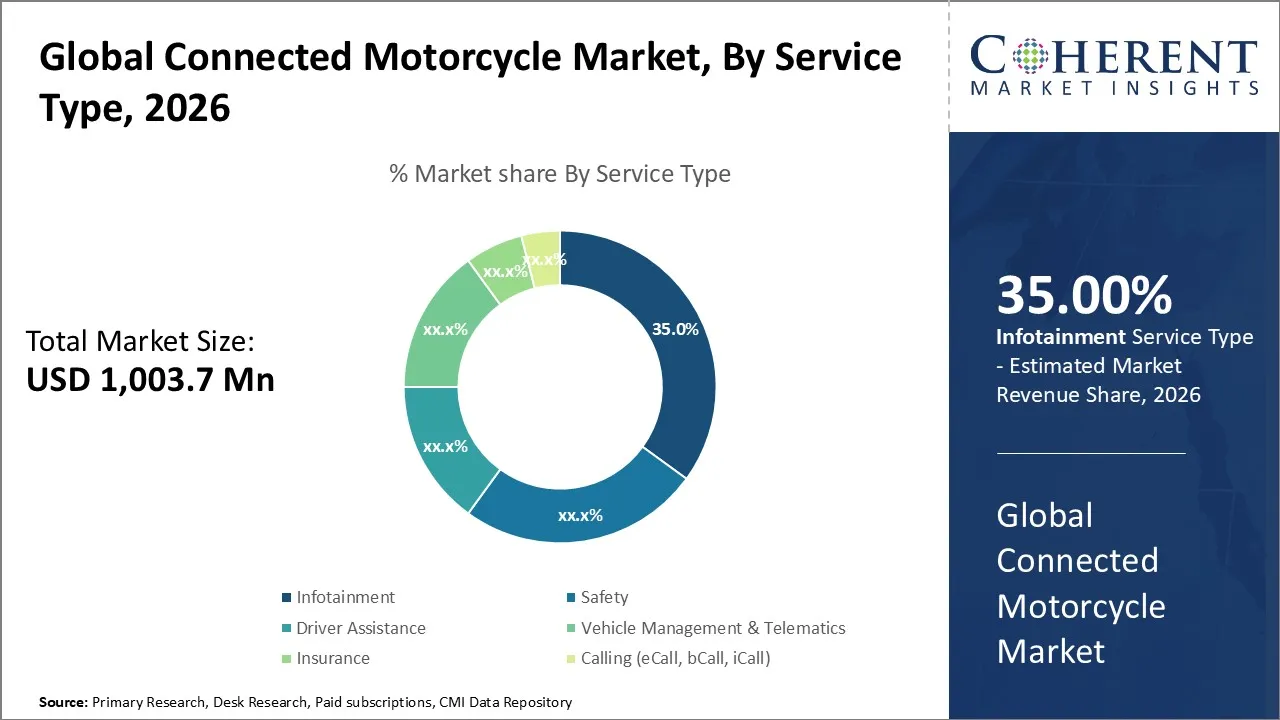
Connected Motorcycle Market Insights, By Service Type Segment – Infotainment leads due to growing demand for enhanced rider experiences
Based on the service type, the Infotainment segment is expected to have a market share of 35% in 2026. Customers of the motorcycle industry have been increasing their focus on functions like the inclusion of the Global Positioning System, media streaming, smartphone connectivity, and application-based connectivity, which improve the experience of riding the motorcycle.
For instance, in March 2025, P3 announced the launch of SPARQ OS for motorcycles, a next‑generation infotainment platform built on Android Automotive OS for two‑wheelers. The system features real-time navigation, integrated telemetry, a customizable app store, and enhanced connectivity, aimed at delivering an enriched infotainment experience for riders.
Connected Motorcycle Market Insights, By Hardware Type – Embedded solutions dominate due to reliability and integration
In terms of hardware type, the embedded segment is predicted to offer the highest market share of 55% by 2026. This is due to an increased focus on embedded systems by OEMs since they can provide efficient solutions. Additionally, embedded hardware guarantees optimal communication between the parts. This is essential when it comes to motorcycle V2V communications.
For instance, in November 2024, At the EICMA 2024 motorcycle show in Milan, Bosch unveiled its Bosch TFT Connect platform and new connected cluster and vehicle architecture solutions designed specifically for two‑wheelers.
Connected Motorcycle Market Insights, By Network Type – Cellular V2X leads thanks to 4G/5G adoption
Based on network type, the cellular V2X segment is estimated to control 60% of the total market share in 2026. This is because most motorcycles use 4G and 5G networks that enable the motorcycle to communicate from a long distance with zero latency. This is because the cellular network has a wider coverage in the urban and rural areas that allow the motorcycle to communicate with the infrastructure.
For instance, in September 2025, Cellular Vehicle‑to‑Everything (C‑V2X) technology reached a significant deployment milestone in the United States, as Atlanta, Georgia, became the nation’s first “Day One Deployment District” for C‑V2X at the ITS World Congress 2025.
Connected Motorcycle Market Insights, By Communication Type – V2V gains traction for critical safety applications
Based on the communication type, it is estimated that vehicle-to-vehicle segment is anticipated to command a market share of 50% in 2026. An important function of V2V communication is to provide improved safety for riders as it allows motorcycles to communicate with each other directly, for example, through information related to speed, direction, and sudden braking.
For instance, in February 2025, Toyota announced the planned integration of advanced V2V communication systems in upcoming models to enhance safety features such as collision avoidance and and traffic management, reflecting how OEMs are adopting V2V communications that enable vehicles, including motorcycles in broader V2X frameworks — to exchange real‑time safety data.
Connected Motorcycle Market Insights, By End User – Private segment dominates due to rising individual motorcycle ownership
By end-user, the private segment is anticipated to hold a market share of 68% in the year 2026. An increase in the usage of motorcycles by individuals, especially in the cities and semi-cities, drives the requirement for a private V2X solution. Private individuals on motorcycles emphasize using high-end features such as safety, connectivity, and convenience, which force car manufacturers to design solutions for the private market as opposed to the commercial market.
For instance, in September 2025, Honda Motorcycle & Scooter India (HMSI) launched its MyHonda‑India mobile application, a comprehensive digital platform designed to enhance the ownership experience for private two‑wheeler riders.
Regional Insights
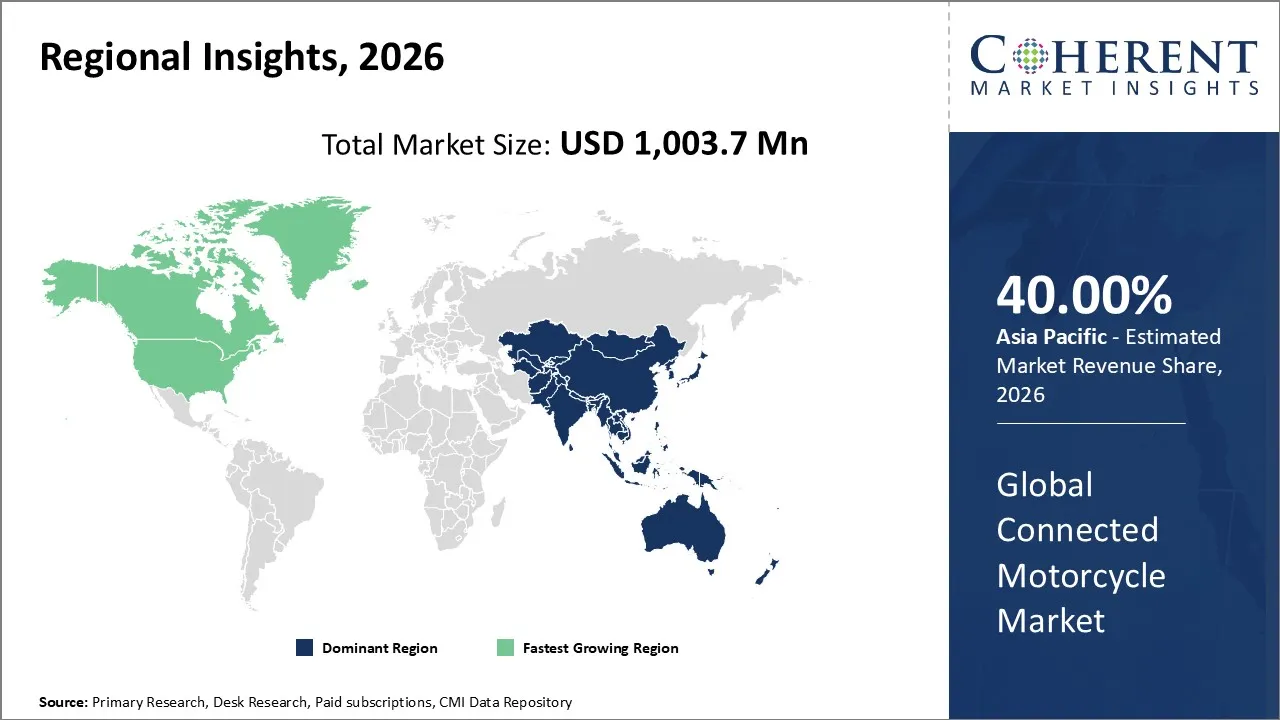
Asia Pacific Connected Motorcycle Market Analysis & Trends
The Asia Pacific market is expected to lead the connected motorcycle market in 2026, contributing about 40% of the total share. The Asia Pacific market can be attributed due to reasons such as the growing adoption of smart mobility services, the strong two-wheeler manufacturing sector in countries in the Asia Pacific region, and government initiatives in adopting smart transport services in the Asia Pacific region.
For instance, in July 2025, Hero MotoCorp launched the Connected Hero platform in India, which offers real-time vehicle diagnostics, navigation, and safety alerts for private motorcycle owners. The system integrates with mobile apps and cloud-based services, enhancing the riding experience and supporting widespread adoption of connected two-wheelers in the region.
North America Connected Motorcycle Market Analysis & Trends
North America will see the highest growth in the connected motorcycle market due to increasing demand for advanced rider safety systems, higher urbanization, and the coverage of cellular V2X and embedded connectivity networks. Smart transport initiatives are driving the growth of connected motorcycles in private ownership in the region.
For instance, in March 2025, Harley-Davidson introduced the LiveWire+ connected motorcycle platform, which includes real-time GPS navigation, remote diagnostics, and cloud-based ride analytics for individual riders in the U.S. The platform reflects the growing trend of private riders adopting fully connected motorcycles to enhance safety, convenience, and overall riding experience.
Connected Motorcycle Market Outlook Country-Wise
U.S. Connected Motorcycle Market Trends
The U.S. connected motorcycle market is anticipated to surge exponentially in 2026, driven by growing demand for sophisticated rider safety technologies, cellular V2X network expansion, and rising appeal for intelligent mobility solutions among individual motorcycle owners. Technological innovations regarding embedded systems, real-time navigation, and mobile apps are driving the market across both urban and suburban regions.
For instance, in March 2025, Harley-Davidson introduced the LiveWire+ connected motorcycle platform, offering features such as real-time GPS navigation, remote diagnostics, ride analytics, and cloud-based safety alerts. This platform enhances convenience and safety for private riders while promoting wider adoption of connected motorcycles in the U.S.
China Connected Motorcycle Market Trends
The connected motorcycle market in China is estimated to develop at a significant rate in 2026 due to factors such as the growing urbanization process, acceptance of intelligent mobility solutions, the government’s initiatives to encourage intelligent transportation systems, and the growing bases of privately owned motorcycles in the country. Automobile manufacturers are launching motorcycles that come equipped with in-born connectivity and cloud-based solutions to cater to the demand among consumers for motorcycle safety, navigation, and online tracking of the vehicles in real time.
For instance, in November 2025, Niu Technologies launched the NQi Pro+ Smart Connected Motorcycle, featuring IoT-based monitoring, app integration for diagnostics, GPS navigation, and ride analytics. The platform supports private owners with enhanced convenience, safety, and connectivity, reflecting China’s growing interest in connected two-wheelers.
Market Report Scope
Connected Motorcycle Market Report Coverage
| Report Coverage | Details | ||
|---|---|---|---|
| Base Year: | 2025 | Market Size in 2026: | USD 1,003.7 Mn |
| Historical Data for: | 2020 To 2024 | Forecast Period: | 2026 To 2033 |
| Forecast Period 2026 to 2033 CAGR: | 51.39% | 2033 Value Projection: | USD 18,285 Mn |
| Geographies covered: |
| ||
| Segments covered: |
| ||
| Companies covered: | Panasonic Corporation, Robert Bosch GmbH, BMW Motorrad, Starcom Systems, Vodafone, Autotalks, Continental AG, KPIT, and TE Connectivity. | ||
| Growth Drivers: |
| ||
| Restraints & Challenges: |
| ||
Market Dynamics
Connected Motorcycle Market Driver
Increasing adoption of connected technologies among motorcycles
Some of the major factors driving growth in the connected motorcycle market include increasing adoption of connected technologies, such as infotainment systems, safety services, V2V/V2X communication, and telematics. OEMs are increasingly integrating advanced connectivity solutions into two-wheelers to improve safety, real-time navigation, entertainment, and diagnostic features, which will be sought after by motorcycle owners. This trend is particularly pronounced among private riders in urban and semi-urban areas, with a high inclination toward smart mobility and digital experiences.
Connected Motorcycle Market Opportunity
Introduction of advanced connected services and personalized rider solutions
The market has a possibility of growing with the innovation of new connected platforms, IoT-based services, and rider applications. The focus can be given on infotainment packages based on customer requirements, AI-based safety notifications, usage-based insurance solutions, and telematics-based maintenance solutions. Solutions can also be developed for the premium segment motorbikes and affordable two-wheelers targeting the emerging markets.
Analyst Opinion (Expert Opinion)
- The connected motorcycle market is evolving at an unprecedented pace, driven by the convergence of advanced telematics, V2X communication, and AI-enabled rider assistance systems. According to recent industry reports, over 60% of new two-wheeler owners in Asia Pacific and North America now expect motorcycles to offer some form of digital connectivity, whether through infotainment, safety, or vehicle management features. This expectation is pushing OEMs to rethink traditional motorcycles as standalone vehicles and instead position them as integrated smart mobility platforms.
- The current market is shifting towards infotainment and safety services. Surveys reveal that consumers using connected motorcycles exhibit an average increase of 30-40% in the use of real-time navigation, traffic alarms, as well as streaming services, generating a clear liking for those motorcycles that serve the consumers with a smooth tech experience.
- Regionally, the Asia-Pacific region leads the innovation in the widespread adoption of smart two-wheelers, with the connectivity offerings of the North American and European markets growing at a fast pace. Initially, the data indicates a 15-20% reduction in downtime for motorcycles equipped with V2V and telematics capabilities for predictive maintenance, which tends to have a profoundly affirmative impact on the buying behavior of the end-users. The private segment tends to have a more affirmative impact on the market than the fleet segment, which makes it more lucrative.
Speak to the analyst
Want personalized insights?
Take the findings above to one of our principal consultants, or have the report rebuilt around the segments, geographies and competitors you actually track.
Connected Motorcycle Industry News
- In August 2025, Panasonic Automotive Systems Co., Ltd. expanded its security innovations for next‑generation vehicle cockpit systems by integrating advanced attack‑detection software into its VERZEUSE® platform, enhancing cybersecurity for vehicle networks and cockpit connectivity solutions.
- In June 2024, MW Motorrad unveiled the Concept ConnectedRide, a forward‑looking connectivity suite designed to enrich motorcycle safety and comfort through smartphone integration, V2X communication, and digital services, marking a clear push toward connected motorcycle ecosystem.
- In June 2025, Autotalks was acquired by Qualcomm Technologies, integrating its V2X communication expertise (supporting DSRC and C‑V2X) into Qualcomm’s Snapdragon Digital Chassis portfolio, a key move to expand V2X solutions for connected vehicles globally, including motorcycles and two‑wheelers.
Market Segmentation
- Service Type Insights (Revenue, USD Mn, 2026 - 2033)
- Driver Assistance
- Infotainment
- Safety
- Vehicle management & telematics
- Insurance
- Calling
- eCall
- bCall
- iCall
- Hardware Type Insights (Revenue, USD Mn, 2026 - 2033)
- Embedded
- Tethered
- Network Type Insights (Revenue, USD Mn, 2026 - 2033)
- Cellular V2X
- Dedicated short range communication
- Communication Type Insights (Revenue, USD Mn, 2026 - 2033)
- V2V
- V2I
- End User Insights (Revenue, USD Mn, 2026 - 2033)
- Private
- Commercial
- Regional Insights (Revenue, USD Mn, 2026 - 2033)
- North America
- U.S.
- Canada
- Latin America
- Brazil
- Argentina
- Mexico
- Rest of Latin America
- Europe
- Germany
- U.K.
- Spain
- France
- Italy
- Russia
- Rest of Europe
- Asia Pacific
- China
- India
- Japan
- Australia
- South Korea
- ASEAN
- Rest of Asia Pacific
- Middle East
- GCC Countries
- Israel
- Rest of Middle East
- Africa
- South Africa
- North Africa
- Central Africa
- North America
- Key Players Insights
- Panasonic Corporation
- Robert Bosch GmbH
- BMW Motorrad
- Starcom Systems
- Vodafone
- Autotalks
- Continental AG
- KPIT
- TE Connectivity
Sources
Primary Research Interviews
- Connected Motorcycle OEMs & Brand Managers (BMW Motorrad, Harley-Davidson, Honda, Yamaha)
- Automotive Electronics & Infotainment Product Designers
- Telematics & V2X Solution Providers
- Two-Wheeler Dealership & Distribution Managers
- Professional Motorcycle Riders & Safety Experts
- IoT & Connectivity Platform Developers
- Others
Databases
- Bloomberg Terminal
- Vehicle & Mobility Industry Databases
- Others
Magazines
- Motorcycle News
- Automotive Electronics News
- Connected Vehicle Magazine
- Two-Wheeler & Mobility Review
- Autonomous Vehicle & IoT Insights
- Others
Journals
- IEEE Transactions on Intelligent Transportation Systems
- Journal of Vehicle Technology & Telematics
- International Journal of Automotive Technology
- Journal of Transportation Safety & Security
- Others
Newspapers
- Financial Times
- The Wall Street Journal
- Reuters
- Bloomberg News
- The Guardian – Automotive Section
- Others
Associations
- Society of Automotive Engineers (SAE International)
- International Motorcycle Manufacturers Association (IMMA)
- European Association of Motorcycle Manufacturers (ACEM)
- International Council on Clean Transportation (ICCT)
- Others
Public Domain Sources
- Official OEM Websites & Press Releases (BMW, Bosch, Harley-Davidson, Yamaha, Panasonic, Continental)
- Government Transport & Safety Reports
- National Highway Traffic Safety Administration (NHTSA) Reports
- World Bank – Transport & Mobility Indicators
- United Nations – Urban Mobility & Connected Vehicles Reports
- Others
Proprietary Elements
- CMI Data Analytics Tool
- Proprietary CMI Existing Repository of Information for the Last 8 Years
Get access to 250+ pages report
Every segment, forecast, competitor profile and data table behind the analysis above — available for instant download.
- ESOMAR Member
- ISO 9001:2015 Certified
- D-U-N-S Registered
- GDPR & CCPA Compliant
Missing comfort of reading report in your local language? Find your preferred language:
Transform your Strategy with Exclusive Trending Reports
Frequently Asked Questions
The Connected Motorcycle Market is estimated to be valued at USD 1,003.7 Mn in 2026, and is expected to reach USD 18,285 Mn by 2033.
The CAGR of the Connected Motorcycle Market is projected to be 51.39% from 2026 to 2033.
The connected motorcycle market is expected to witness strong growth during the forecast period, supported by rising adoption of smart mobility solutions, increasing penetration of embedded connectivity, and growing demand for digitally enhanced riding experiences.
Increasing adoption of connected technologies, rising demand for advanced safety and infotainment features, expansion of cellular V2X infrastructure, and growing preference for smart and personalized riding experiences are the major factors driving market growth.
High implementation costs of advanced connectivity systems, cybersecurity and data privacy concerns, and limited connectivity infrastructure in certain developing regions are key factors restraining market growth.
Panasonic Corporation, Robert Bosch GmbH, BMW Motorrad, Continental AG, Vodafone Group, Autotalks, KPIT Technologies, TE Connectivity, Starcom Systems, Harley-Davidson, Honda Motor Co., Ltd., Yamaha Motor Co., Ltd., and Niu Technologies are among the major players operating in the connected motorcycle market.
Asia Pacific is expected to lead the connected motorcycle market in 2026, driven by high two-wheeler penetration, rapid urbanization, and strong adoption of connected mobility solutions, while North America is anticipated to be the fastest-growing region