

Global Motorcycle and Scooter Market Size and Forecast: 2026-2033
The global motorcycle and scooter market is estimated to be valued at USD 201.63 Bn in 2026 and is expected to reach USD 313.32 Bn by 2033, exhibiting a compound annual growth rate (CAGR) of 6.5% from 2026 to 2033.
Key Takeaways of the Global Motorcycle and Scooter Market
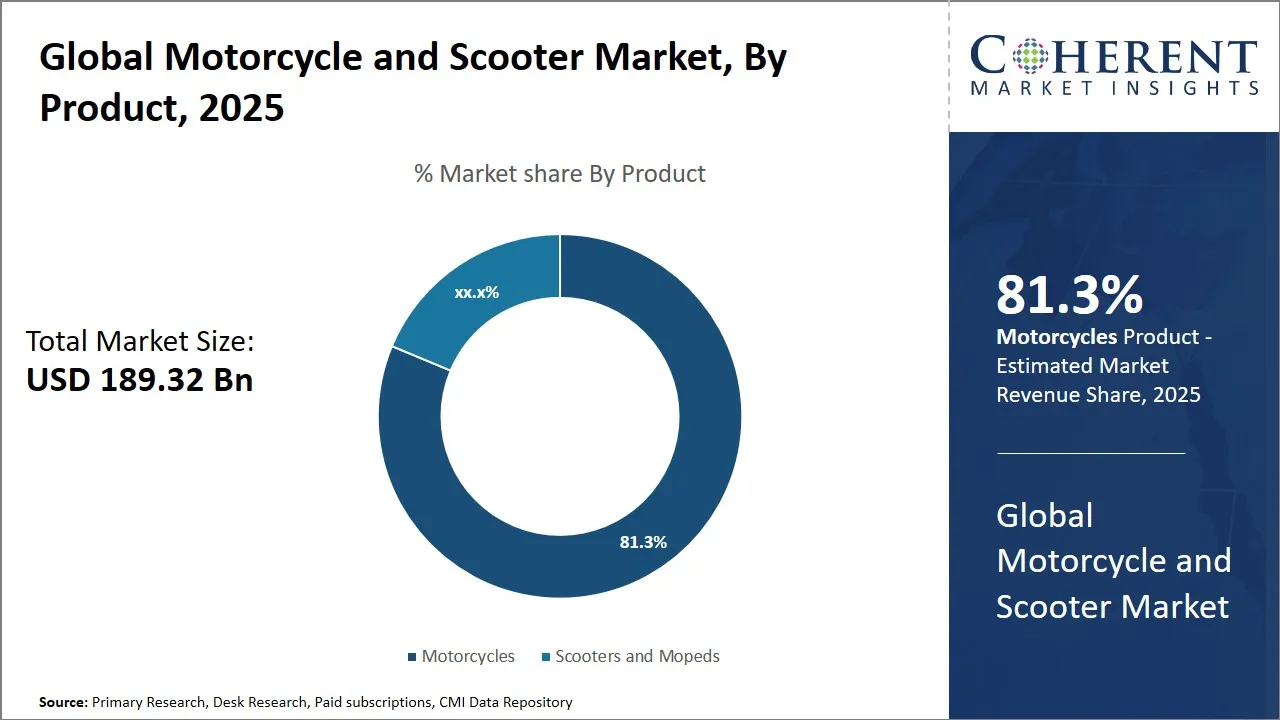
- The motorcycles segment leads the market holding an estimated share of 82.3% in 2026.
- The internal combustion engine segment leads the market holding an estimated share of 85.5% in 2026.
- Asia Pacific is estimated to lead the market with a share of 61.6% in 2026.
- Latin America, holding an estimated share of 8.2% in 2026, is projected to be the fastest growing region.
Market Overview
Market trends indicate a significant shift towards electric motorcycles and scooters, fueled by environmental concerns and supportive government policies promoting clean energy vehicles. Additionally, technological advancements such as connected vehicles and enhanced safety features are gaining traction. The integration of smart mobility solutions and the growing popularity of shared mobility services are also influencing consumer preferences, driving innovation and investment in this dynamic market.
Current Events and their Impact
Current Events | Description and its impact |
Geopolitical and Trade Developments |
|
Economic and Infrastructure Trends |
|
Segmental Insights
- Current Industry Events of 2026
- Market Size Estimation
- Regional Breakdown
- Competitive Landscape
- Customer Intelligence
- Segmental Analysis
- Pricing Analysis
- Key Market Drivers, Challenges & Future Trends
- Customized Insights Section
Global Motorcycle and Scooter Market Insights, By Product – Motorcycles Segment Lead Owing to their Versatility and Performance Appeal
The motorcycles segment dominates the global motorcycle and scooter market, holding an estimated share of 82.3% in 2026. Motorcycles offer higher speed, enhanced maneuverability on congested roads, and greater stability compared to scooters and mopeds. Their ability to navigate through traffic bottlenecks with ease makes them the preferred choice for commuters seeking to save time during peak hours. Furthermore, motorcycles provide better fuel efficiency than many four-wheeled vehicles, aligning well with consumer priorities for economical transportation. In 2023, Royal Enfield launched the Hunter 350 in India, targeting urban commuters who seek a compact, versatile motorcycle that is affordable yet stylish. The model’s strong sales success (over 200,000 units sold within the first year) reflects the rising demand for performance-oriented motorcycles that remain practical for daily city rides.
Another contributing factor is the growing interest in premium and sport motorcycles, which cater to enthusiasts who value style, speed, and advanced technology. Motorcycle manufacturers have increasingly focused on innovation, introducing features such as advanced suspension systems, electronic stability controls, and connectivity options, which enhance safety and rider experience.
Moreover, motorcycles are often easier to finance and maintain relative to larger vehicles, making them accessible to a broader economic spectrum. Urbanization trends in emerging economies are spurring the demand for motorcycles that can weave through dense city traffic or serve as practical transport solutions in areas with limited public transit infrastructure. Government incentives and supportive policies in several countries, aimed at reducing congestion and emissions, have also indirectly promoted motorcycle ownership. Improvements in road infrastructure and availability of comprehensive after-sales services further strengthen consumer confidence in motorcycles.
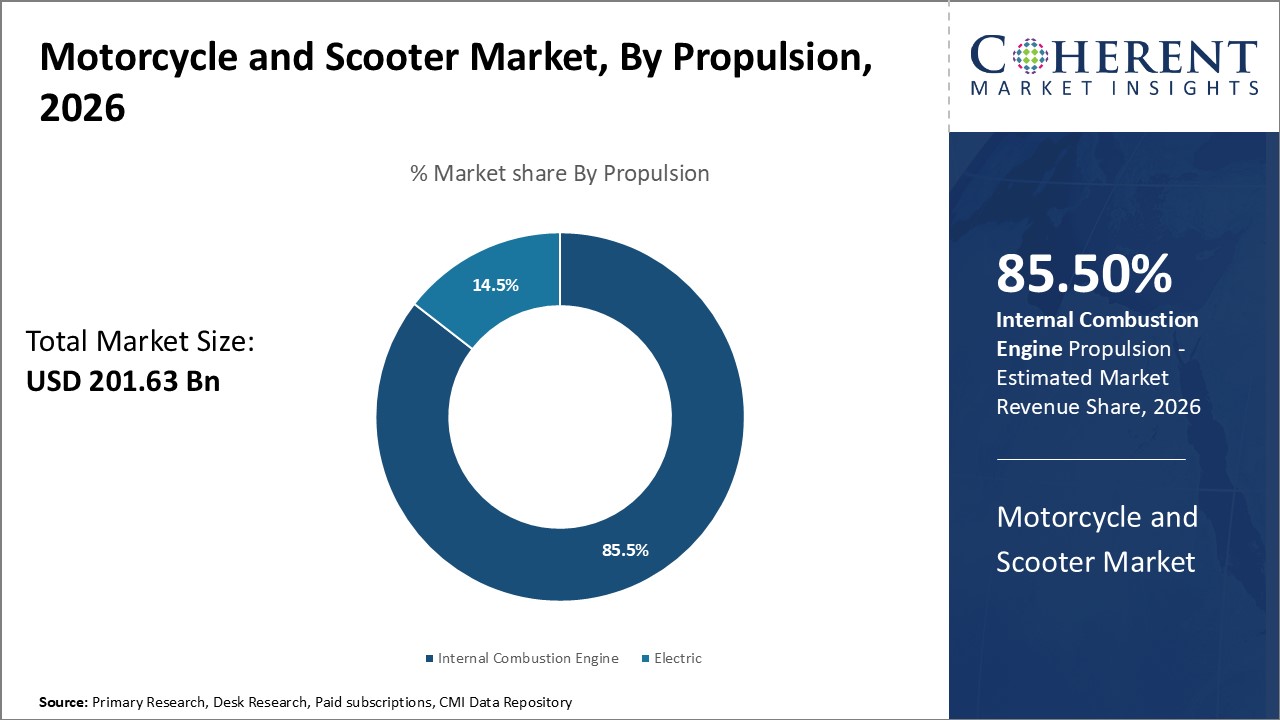
Global Motorcycle and Scooter Market Insights, By Propulsion – Internal Combustion Engine Segment Remains Dominant Driven by Infrastructure and Cost Advantages
The internal combustion engine segment is expected to capture 85.5% share in 2026. Traditional ICE motorcycles and scooters offer a dependable mode of transportation familiar to consumers worldwide, especially in regions where Electric Vehicle (EV) infrastructure is still emerging. Unlike electric models, which require charging stations that are not uniformly accessible globally, ICE motorcycles can be fueled at numerous points, offering greater convenience, especially for long-distance travel and in rural areas. The upfront production costs of ICE motorcycles are generally lower than their electric counterparts, translating into more affordable retail prices. Additionally, ICE engines have witnessed continuous technological advancements that improve fuel efficiency and emissions, making them more compliant with increasingly stringent environmental regulations without compromising performance.
Manufacturers benefit from a decades-long understanding of ICE powertrains, enabling optimization of engine design, durability, and maintenance processes. Fuel supply chains for ICE vehicles are robust and less prone to intermittent disruptions compared to the current limitations seen in electricity generation and EV charging infrastructures. However, while electric propulsion is gaining momentum due to environmental awareness and regulatory support, the transition remains gradual. For now, ICE motorcycles dominate due to their extensive ecosystem advantages, economic feasibility, and technological maturity, making them the backbone of motorcycle transportation globally.
Pricing Analysis of the Motorcycle and Scooter Market
Segment (typical engine/power) | Representative models/examples | Price range (USD) |
Micro/electric kick scooters (personal e-scooters) | NIU KQi/Segway Ninebot/Gotrax/Razor | USD 243 – USD 1,299 |
Entry-level ICE scooters (50–125 cc) | Honda Activa 125 (India), Vespa LX (small trims) | USD 800 – USD 2,200 |
Entry/commuter motorcycles (≤150 cc) | Bajaj Pulsar 125/150, Hero Splendor, Yamaha FZ/MT-15 (125–150cc regionals) | USD 700 – USD 2,200 |
Small-mid motorcycles (151–300 cc) | KTM 200/390 (lower cc family), Honda CB300R, Royal Enfield Hunter 350 | USD 2,000 – USD 6,500 |
Mid-range motorcycles (301–500 cc) | Honda CB500X, Kawasaki Ninja 400/500-range bikes | USD 3,500 – USD 9,000 |
Premium/high-displacement motorcycles (>500 cc) | KTM 890/1290, BMW F/R series, Ducati mid-to-high range | USD 8,000 – USD 30,000 |
Cruisers & Touring (Harley, high-end BMW) | Harley-Davidson Street Glide/Road King | USD 20,000 – USD 48,000+ |
Electric scooters (production, commuter e-2W) | NIU urban scooters, TVS iQube, Ather 450X, Hero Vida (EV scooters) | USD 500 – USD 4,000 |
Electric motorcycles (light commuters to performance e-moto) | Zero SR/F, Energica, LiveWire/Harley (future e-models), small Chinese E-motorcycles | USD 2,000 – USD 30,000+ |
Fleet/utility (incl. 3rd-party last-mile e-Bikes/mopeds) | Cargo e-scooters, utility mopeds (commercial) | USD 900 – USD 6,000 |
Regional Insights
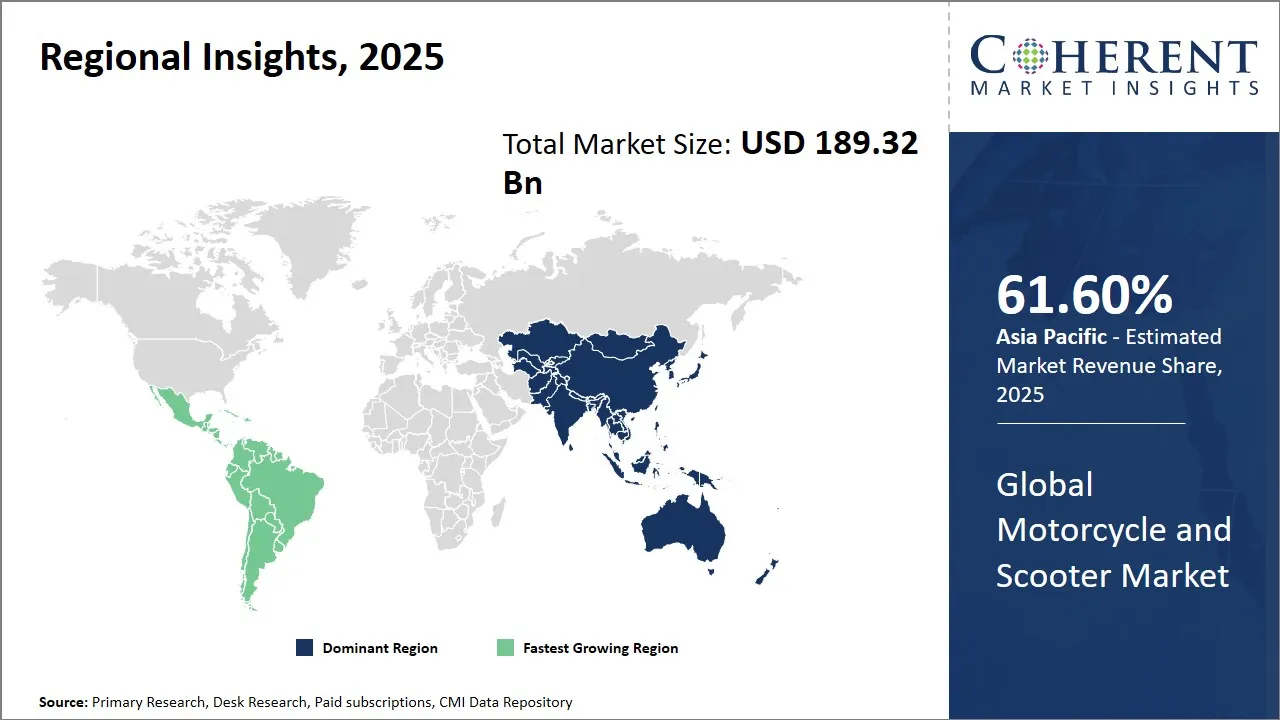
Asia Pacific Motorcycle and Scooter Market Analysis and Trends
The Asia Pacific region is projected to lead the market with a 61.60% share in 2026, driven by a well-established two-wheeler culture, high urban population density, and the need for affordable and efficient transportation. Countries like India, China, Indonesia, and Vietnam have extensive manufacturing ecosystems supported by a large network of suppliers and component manufacturers. Government policies promoting affordable transportation, favorable taxation on two-wheelers, and infrastructure development further bolster the market growth.
Additionally, the presence of major Original Equipment Manufacturers (OEMs) such as Hero MotoCorp, Honda Motorcycle and Scooter India (HMSI), and Yamaha Motor Corporation of Japan, contributes significantly by launching region-specific models catering to varying consumer needs. Trade dynamics within the region are enhanced by free trade agreements among ASEAN countries and proximity to key raw material suppliers, reinforcing Asia Pacific’s leadership in this segment.
Latin America Motorcycle and Scooter Market Analysis and Trends
The Latin America region, holding an estimated share of 8.2% in 2026, exhibits the fastest growth in the global motorcycle and scooter market, fueled by increasing urbanization, rising disposable incomes, and a growing young population seeking cost-effective mobility solutions. The market ecosystems in key countries such as Brazil, Colombia, and Mexico are witnessing increased local manufacturing investments and joint ventures between international and domestic players, enhancing product availability and customization.
Government incentives aimed at reducing urban traffic congestion and lowering emissions have encouraged adoption of motorcycles and scooters, including electric variants. The presence of regional manufacturers like Auteco (Colombia), along with global players such as Honda and Bajaj, is strengthening the market penetration. Trade tariffs and import policies, though evolving, are generally conducive to the market expansion, supported by improving logistics infrastructure.
Global Motorcycle and Scooter Market Outlook for Key Countries
India Motorcycle and Scooter Market Analysis and Trends
India remains highly competitive and dynamically growing, underpinned by its vast rural and urban consumer base. Hero MotoCorp, Bajaj Auto, and TVS Motor Company lead the market with tailored two-wheeler models targeting various segments from entry-level commuters to premium scooters. Government initiatives like the Faster Adoption and Manufacturing of Hybrid & Electric Vehicles (FAME) scheme encourage electrification, influencing product development and the market focus. The country’s strong manufacturing base coupled with rising digital retail platforms facilitates widespread accessibility and consumer engagement.
China Motorcycle and Scooter Market Analysis and Trends
China continues to lead as a critical hub for both production and consumption. Major companies such as Yadea, Niu Technologies, and Loncin are advancing electric scooter technologies, supported by comprehensive government policies enforcing emission regulations and promoting electric mobility. The well-developed supply chains, coupled with significant R&D investments and export capabilities, place China at the forefront of innovation in the electric segment. Urban commuting needs and stringent environmental policies further drive the demand for cleaner two-wheelers.
Brazil Motorcycle and Scooter Market Analysis and Trends
Brazil is marked by its growing affordability and the demand for motorcycles as primary transportation, particularly in suburban and rural areas. Manufacturers like Honda Brazil and Dafra Motors have strong local presences, developing models suited to diverse terrain and consumer income brackets. The government’s focus on automotive industrialization and environmental regulation is prompting gradual adoption of cleaner technologies. Additionally, Brazil's strategic trade policies within Mercosur facilitate smoother regional trade flows, supporting shelf availability and the market variety.
Indonesia Motorcycle and Scooter Market Analysis and Trends
Indonesia’s large population and heavy reliance on two-wheelers for daily transportation position it as a vital market within Asia Pacific. PT Astra Honda Motor dominates with a substantial portfolio of motorcycles and scooters engineered to local market preferences. The government incentivizes two-wheeler ownership via subsidies and infrastructure investments, supporting the market penetration. Furthermore, Indonesia’s integration with ASEAN trade frameworks enhances component sourcing and distribution efficiencies, aiding competitive pricing and broader the market reach.
Mexico Motorcycle and Scooter Market Analysis and Trends
Mexico is emerging as a significant market in Latin America, where increasing urban congestion and fuel cost concerns are boosting interest in motorcycles and scooters. Key players like Italika and Honda Mexico focus on affordable, fuel-efficient models attractive to young consumers and urban commuters. Trade agreements such as USMCA facilitate cross-border manufacturing and parts sourcing, strengthening Mexico's role as both the market and manufacturing base. Government efforts to improve urban mobility infrastructure complement growth prospects for two-wheelers.
Market Players, Key Development, and Competitive Intelligence
Key Developments
- In August 2025, TVS Motor Company, a manufacturer of two- and three-wheelers, announced the launch of its new electric scooter, TVS Orbiter, priced at USD 1,131.9 (INR 99,900).
- In July 2025, Honda Motor Co. confirmed plans to debut a sport-oriented electric motorcycle on September 2, 2025, unveiling camouflaged teaser images that hint at a fully electric take on its established “EV Fun Concept.” This model is expected to usher in a new era of electrified two‑wheelers built for performance and everyday usability.
- In July 2025, Hero MotoCorp announced plans to launch its all-electric Vida sub-brand. This expansion into the U.K., Germany, France, and Spain will be led by the Vida Z electric scooter, which made its debut at the 2024 EICMA motorcycle show.
- In May 2025, India's Bajaj Auto announced plans to take control of KTM AG as part of an USD 906.2 million (800 million euro) debt package aimed at reviving the Austria-based motorcycle maker.
Top Strategies Followed by the Motorcycle and Scooter Market Players
- Established players in the market typically invest heavily in research and development (R&D) to drive innovation and produce high-performance, technologically advanced motorcycles and scooters.
- Honda Motor Co. announced its upcoming electric motorcycle launch in September 2025, part of its multi-billion-dollar investment in electrification to release 10+ EV motorcycle models by 2030. This showcases heavy R&D spend on next-gen EV platforms.
- Mid-level players in the global motorcycle and scooter industry adopt a somewhat different approach, centering their strategies on delivering cost-effective solutions that maintain a careful balance between quality and affordability.
- TVS Motor Company’s TVS Orbiter electric scooter, positioned below its iQube EV, is a low-cost model designed for mass-market, budget-conscious urban riders in India and Southeast Asia.
- Small-scale players in the global motorcycle and scooter market typically carve out their niche by focusing on specialized features or innovative product offerings tailored to specific customer segments.
- Ather Energy (India, startup scale compared to Honda/TVS) focuses on premium connected EV scooters (Ather 450X, Gen 3 with fast charging and smart OS features), carving a tech-driven niche in the urban premium EV scooter segment.
Market Report Scope
Motorcycle and Scooter Market Report Coverage
| Report Coverage | Details | ||
|---|---|---|---|
| Base Year: | 2025 | Market Size in 2026: | USD 201.63 Bn |
| Historical Data for: | 2020 To 2024 | Forecast Period: | 2026 To 2033 |
| Forecast Period 2026 to 2033 CAGR: | 6.5% | 2033 Value Projection: | USD 313.32 Bn |
| Geographies covered: |
| ||
| Segments covered: |
| ||
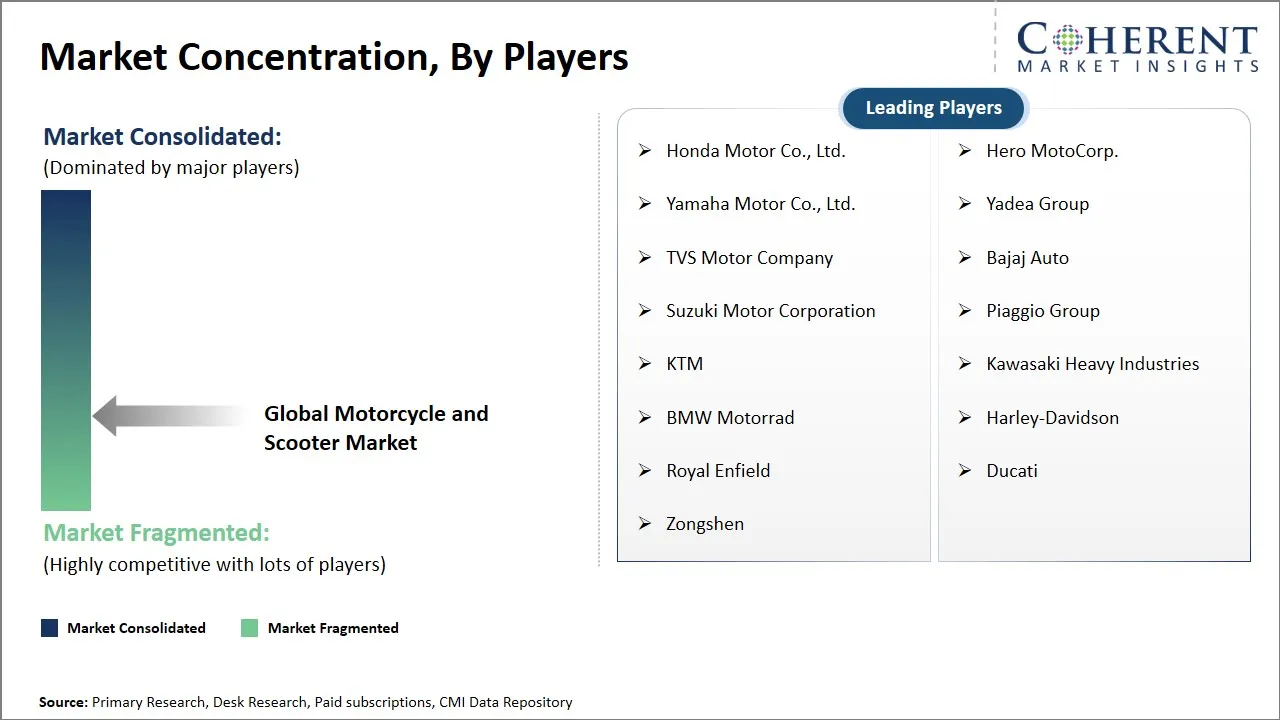
| Companies covered: | Honda Motor Co., Ltd., Hero MotoCorp., Yamaha Motor Co., Ltd., Yadea Group, TVS Motor Company, Bajaj Auto, Suzuki Motor Corporation, Piaggio Group, KTM, Kawasaki Heavy Industries, BMW Motorrad, Harley-Davidson, Royal Enfield, Ducati, and Zongshen | ||
| Growth Drivers: |
| ||
| Restraints & Challenges: |
| ||
Market Dynamics
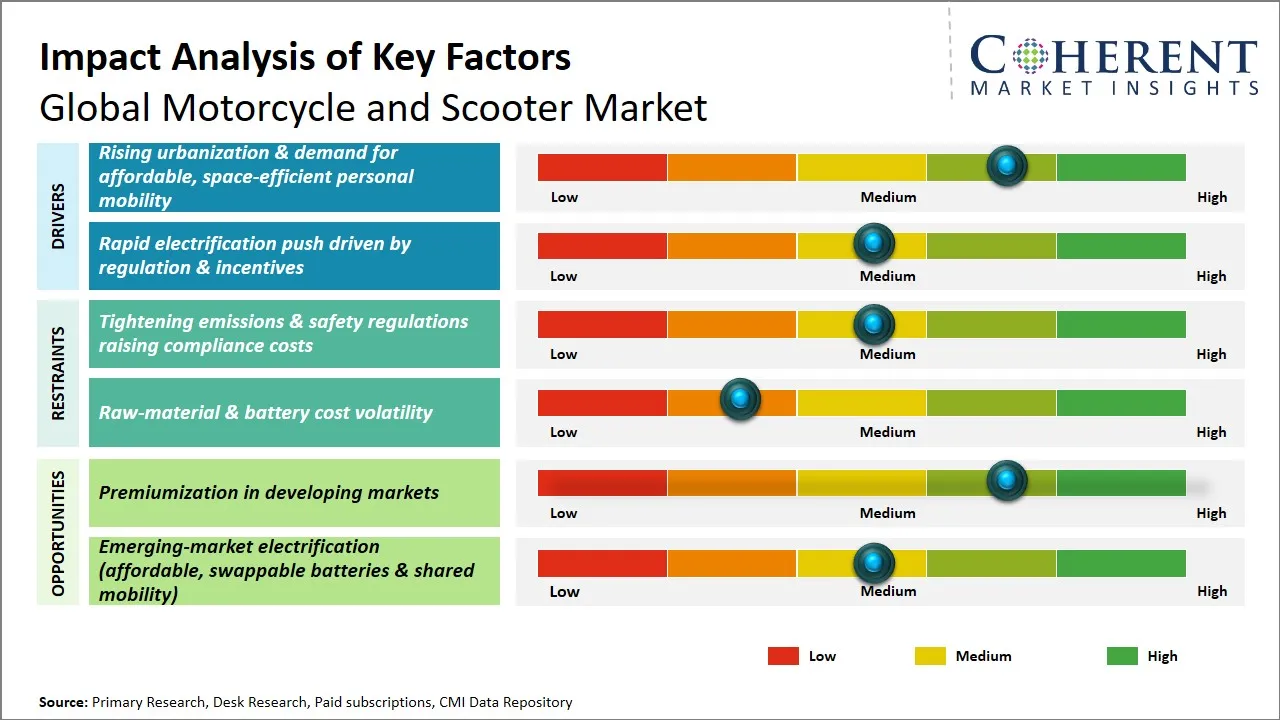
Global Motorcycle and Scooter Market Driver – Rising Urbanization & Demand for Affordable, Space-Efficient Personal Mobility
Rapid urbanization across developing and developed regions has significantly influenced personal transportation preferences, driving a surge in the demand for motorcycles and scooters. As city populations swell, congestion and limited parking spaces have become pressing challenges, pushing consumers to seek affordable, compact, and fuel-efficient alternatives to traditional four-wheel vehicles. Motorcycles and scooters offer a practical solution by enabling easier maneuverability through crowded streets and reducing commute times, which is particularly appealing in densely populated metropolitan areas.
Additionally, the increasing cost of car ownership—including expenses related to fuel, maintenance, and parking—further encourages urban dwellers to opt for two-wheelers as a cost-effective mode of transport. For instance, Honda Activa (India) continues to dominate urban two-wheeler sales, with millions of units sold annually in densely populated Indian cities. Its compact size, fuel efficiency, and affordability make it the go-to scooter for urban commuters, directly reflecting rising urbanization and the need for space-efficient mobility.
Global Motorcycle and Scooter Market Opportunity – Premiumization in Developing Markets
The premiumization trend presents a significant growth opportunity for the global motorcycle and scooter market, particularly in developing economies such as India, Southeast Asia, and Latin America. As rising disposable incomes and urbanization continue to elevate living standards, there is an increasing consumer preference for high-end, technologically advanced two-wheelers that offer superior performance, enhanced safety features, and stylish designs. Unlike traditional low-cost models predominantly seen in these regions, premium motorcycles and scooters cater to aspirational buyers seeking status, comfort, and innovation. This shift is accelerated by younger demographics embracing lifestyle-oriented purchases and improved financing options that make premium vehicles more accessible.
Moreover, manufacturers are capitalizing on this trend by introducing mid to high-range models equipped with cutting-edge technologies such as advanced fuel injection systems, ABS brakes, and digital connectivity features, tailored specifically to local consumer preferences. The rise of premium electric scooters in particular is reshaping market dynamics, addressing environmental concerns while appealing to tech-savvy and eco-conscious urban commuters. For instance, Royal Enfield has seen strong growth in mid-size motorcycle demand in India, Southeast Asia, and Latin America. Launches like the Hunter 350 (2022–23, refreshed in 2025) and expansion of the 650cc Twins tap into aspirational consumers who are moving up from entry-level commuters to lifestyle-oriented premium bikes.
Analyst Opinion (Expert Opinion)
- The demand in APAC remains overwhelmingly commuter-driven, with India, China, Indonesia, and Vietnam accounting for the majority of sales. Affordable motorcycles and scooters dominate due to dense urbanization, price sensitivity, and daily transport reliance. However, the region is also witnessing a strong electrification push, particularly in China and India.
- Countries like Brazil, Colombia, and Mexico are experiencing rapid growth in two-wheeler demand, both as affordable mobility solutions and increasingly for delivery/logistics fleets. Urban congestion and rising fuel costs make scooters and small motorcycles especially attractive. Recent OEM expansions and EV pilots (e.g., Yadea–Copec partnerships in Chile/Colombia) signal growing appetite for innovative mobility.
- Unlike APAC and LATAM, the demand here skews towards premium and recreational motorcycles (Harley-Davidson, BMW, Ducati). Electrification is emerging (e.g., Vespa Elettrica, Harley LiveWire), but volumes remain lower. Buyers focus more on performance, lifestyle, and leisure, with growth concentrated in the premium and electric urban commuter niches.
Speak to the analyst
Want personalized insights?
Take the findings above to one of our principal consultants, or have the report rebuilt around the segments, geographies and competitors you actually track.
Market Segmentation
- Product Insights (Revenue, USD Bn, 2021 - 2033)
- Motorcycles
- Scooters and Mopeds
- Propulsion Insights (Revenue, USD Bn, 2021 - 2033)
- Internal Combustion Engine
- Electric
- Regional Insights (Revenue, USD Bn, 2021 - 2033)
- North America
- U.S.
- Canada
- Latin America
- Brazil
- Argentina
- Mexico
- Rest of Latin America
- Europe
- Germany
- U.K.
- Spain
- France
- Italy
- Russia
- Rest of Europe
- Asia Pacific
- China
- India
- Japan
- Australia
- South Korea
- ASEAN
- Rest of Asia Pacific
- Middle East
- GCC Countries
- Israel
- Rest of Middle East
- Africa
- South Africa
- North Africa
- Central Africa
- North America
- Key Players Insights
- Honda Motor Co., Ltd.
- Hero MotoCorp.
- Yamaha Motor Co., Ltd.
- Yadea Group
- TVS Motor Company
- Bajaj Auto
- Suzuki Motor Corporation
- Piaggio Group
- KTM
- Kawasaki Heavy Industries
- BMW Motorrad
- Harley-Davidson
- Royal Enfield
- Ducati
- Zongshen
Sources
Primary Research Interviews
Stakeholders
- Motorcycle OEM Executives
- Scooter Manufacturers and EV Startups
- Two-Wheeler Component Suppliers (engines, batteries, braking systems, electronics)
- Dealership Networks & Distributors (regional market experts across APAC, LATAM, EU)
- Fleet Operators & Ride-Sharing Platforms (Grab, Bounce, Rapido)
- Urban Mobility Planners & Transport Consultants
Databases
- Eurostat
- U.S. Department of Transportation (DOT)
- OECD Mobility Database
- Society of Indian Automobile Manufacturers (SIAM)
- ANFAVEA (Brazilian Motor Vehicle Manufacturers Association)
Magazines
- Motorcycle News (MCN)
- TwoWheel Trends
- Scooter World Magazine
- Urban Mobility Today
Journals
- Journal of Transportation Research
- International Journal of Vehicle Design
- Journal of Cleaner Production (Mobility Focus)
- Sustainable Mobility Journal
Newspapers
- The Guardian (U.K.)
- Nikkei Asia (Japan)
- The Economic Times (India)
- Valor Econômico (Brazil)
Associations
- International Motorcycle Manufacturers Association (IMMA)
- European Association of Motorcycle Manufacturers (ACEM)
- Motorcycle Industry Council (MIC – U.S.)
- Latin American Motorcycle Association (LAMA)
- Society of Indian Automobile Manufacturers (SIAM)
Public Domain Sources
- World Bank Mobility Reports
- United Nations Economic Commission for Europe (UNECE) – Transport Statistics
- ResearchGate (mobility & sustainability studies)
- International Energy Agency (IEA) – Electric Mobility Data
Proprietary Elements
- CMI Data Analytics Tool
- Proprietary CMI Existing Repository of information for last 8 years
Get access to 250+ pages report
Every segment, forecast, competitor profile and data table behind the analysis above — available for instant download.
- ESOMAR Member
- ISO 9001:2015 Certified
- D-U-N-S Registered
- GDPR & CCPA Compliant
Missing comfort of reading report in your local language? Find your preferred language:
Transform your Strategy with Exclusive Trending Reports
Frequently Asked Questions
The global motorcycle and scooter market is estimated to be valued at USD 201.63 Bn in 2026 and is expected to reach USD 313.32 Bn by 2033.
The CAGR of the global motorcycle and scooter market is projected to be 6.5% from 2026 to 2033.
Rising urbanization & demand for affordable, space-efficient personal mobility and rapid electrification push driven by regulation & incentives are the major factors driving the growth of the global motorcycle and scooter market.
Tightening emissions & safety regulations raising compliance costs and raw-material & battery cost volatility are the major factors hampering the growth of the global motorcycle and scooter market.
In terms of product, the motorcycles segment is estimated to dominate the market revenue share in 2026.
Honda Motor Co., Ltd., Hero MotoCorp., Yamaha Motor Co., Ltd., Yadea Group, TVS Motor Company, Bajaj Auto, Suzuki Motor Corporation, Piaggio Group, KTM, Kawasaki Heavy Industries, BMW Motorrad, Harley-Davidson, Royal Enfield, Ducati, and Zongshen are the major players.
Asia Pacific is expected to lead the global motorcycle and scooter market in 2026.